

A randomized crossover clinical study showing that methylphenidate-SODAS improves attention-deficit/hyperactivity disorder symptoms in adolescents with substance use disorder
Open accessThe DOI matches its Crossref record; 37 of the 37 references it cites were found in a registry or an index.
Abstract
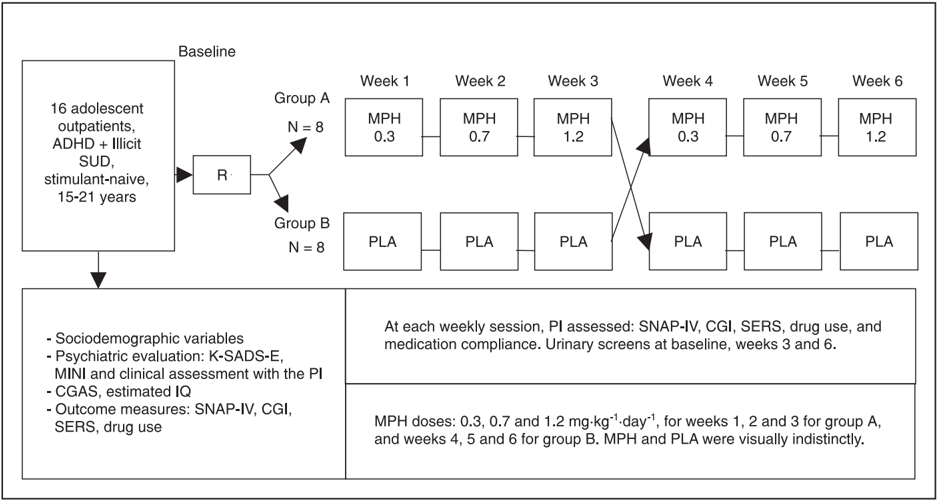
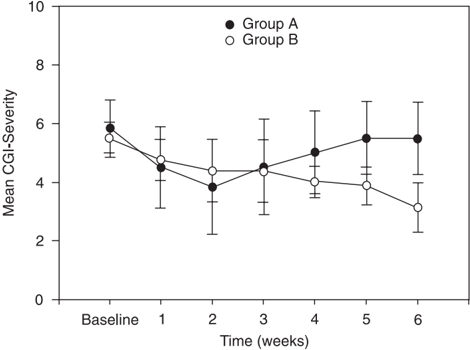
Our objective was to evaluate the effectiveness of a long-acting formulation of methylphenidate (MPH-SODAS) on attention-deficit/hyperactivity disorder (ADHD) symptoms in an outpatient sample of adolescents with ADHD and substance use disorders (SUD). Secondary goals were to evaluate the tolerability and impact on drug use of MPH-SODAS. This was a 6-week, single-blind, placebo-controlled crossover study assessing efficacy of escalated doses of MPH-SODAS on ADHD symptoms in 16 adolescents with ADHD/SUD. Participants were randomly allocated to either group A (weeks 1-3 on MPH-SODAS, weeks 4-6 on placebo) or group B (reverse order). The primary outcome measures were the Swanson, Nolan and Pelham Scale, version IV (SNAP-IV) and the Clinical Global Impression Scale (CGI). We also evaluated the adverse effects of MPH-SODAS using the Barkley Side Effect Rating Scale and subject reports of drug use during the study. The sample consisted of marijuana (N = 16; 100%) and cocaine users (N = 7; 43.8%). Subjects had a significantly greater reduction in SNAP-IV and CGI scores (P < 0.001 for all analyses) during MPH-SODAS treatment compared to placebo. No significant effects for period or sequence were found in analyses with the SNAP-IV and CGI scales. There was no significant effect on drug use. MPH-SODAS was well tolerated but was associated with more severe appetite reduction than placebo (P < 0.001). MPH-SODAS was more effective than placebo in reducing ADHD symptoms in a non-abstinent outpatient sample of adolescents with comorbid SUD. Randomized clinical trials, with larger samples and SUD intervention, are recommended.
Overview
The claims and statistics of this paper haven’t been checked yet.
Free: it reads the open-access text and checks the first 5 claims that cite a source we can check. Create a free account to check every claim.
Integrity signals
Registry
Cites
Statistics
Figures
Verification
Claims the paper makes
The claims and statistics of this paper haven’t been checked yet.
Free: it reads the open-access text and checks the first 5 claims that cite a source we can check. Create a free account to check every claim.
Claims other papers make about this one
Each is checked against this paper’s own text: does it say what the citing paper says it does?
The cited source says what the claim attributes to it.
In the citing paper
“They found MPH-SODAS to be more effective than placebo at improving ADHD symptoms and global functioning, but not at reducing substance use [36].”
From Treatment of Adolescents with Concurrent Substance Use Disorder and Attention-Deficit/Hyperactivity Disorder: A Systematic Review (2021) · cites this paper as [36]
The cited source says what the claim attributes to it.
In the citing paper
“Concerning pharmacotherapy, the results of the reviewed randomized trials in adolescents with concurrent ADHD and SUD were equivocal, with contradictory findings between the primary and secondary outcome measures pertaining to ADHD [37,38] and SUD [37], overall negative findings for both ADHD and SUD [39], and a small sample size [36].”
From Treatment of Adolescents with Concurrent Substance Use Disorder and Attention-Deficit/Hyperactivity Disorder: A Systematic Review (2021) · cites this paper as [36]
Self-check
Percentages, sums and reported differences re-computed from the paper’s own numbers.
The self-check needs the paper’s full text.
Citations
Cites
The worldwide prevalence of ADHD: a systematic review and metaregression analysis
Polanczyk, G., de Lima, M. S., Horta, B. L., Biederman, J., & Rohde, L. A. (2007) · American Journal of Psychiatry · doi:10.1176/ajp.2007.164.6.942 · Cited by 5,346
Self-citationManual for the Wechsler Adult Intelligence Scale.
Wechsler, D. (1955) · Psychological Corp. eBooks · Cited by 4,941
Attention Deficit Hyperactivity Disorder: A Handbook for Diagnosis and Treatment
Barkley, R. A., & Poillion, M. J. (1994) · Behavioral Disorders · doi:10.1177/019874299401900205 · Cited by 4,639
A Children's Global Assessment Scale (CGAS)
Shaffer, D. (1983) · Archives of General Psychiatry · doi:10.1001/archpsyc.1983.01790100074010 · Cited by 3,716 · cited 2×
“Other measures were: a) the Clinical Global Assessment Scale (CGAS) (29); b) the Brazilian Association of Market Research Form (30) for evaluation of socioeconomic status (SES); c) Block Design and Vocabulary subtests of the Wechsler Intelligence Scale, third edition (WISC-III) (31), and the Wechsler Adult Intelligenc…”
MethodInfluentialDrug abuse: hedonic homeostatic dysregulation
Koob, G. F., & Moal, M. L. (1997) · Science · doi:10.1126/science.278.5335.52 · Cited by 2,535 · cited 1×
“well established that SUD progression affects the reward system (38).”
BackgroundChambers, R. A., Taylor, J. R., & Potenza, M. N. (2003) · American Journal of Psychiatry · doi:10.1176/appi.ajp.160.6.1041 · Cited by 1,719 · cited 1×
“These findings may not necessarily be translated to adolescents, since there are reports of different MPH (22) and drug responses (23,24) between adults and adolescents.”
BackgroundGueorguieva, R., & Krystal, J. H. (2004) · Archives of General Psychiatry · doi:10.1001/archpsyc.61.3.310 · Cited by 1,529
Attention Deficit Hyperactivity Disorder. A Handbook for Diagnosis and Treatment
SILVER, L. B. (1991) · Journal of the American Academy of Child & Adolescent Psychiatry · doi:10.1097/00004583-199107000-00040 · Cited by 1,384
Amorim, P. (2000) · Revista Brasileira de Psiquiatria · doi:10.1590/s1516-44462000000300003 · Cited by 1,070 · cited 1×
“The diagnoses of SUD relied on the drug section of the Mini International Neuropsychiatry Interview (MINI), Brazilian version (28), which generates diagnoses of abuse or dependence according to Diagnostic and Statistical Manual of Mental Disorders (DSM-IV) criteria.”
MethodToga, A. W., Thompson, P. M., & Sowell, E. R. (2006) · Trends in Neurosciences · doi:10.1016/j.tins.2006.01.007 · Cited by 872 · cited 1×
“Last, the adolescent brain is still in development (40), which might favor recruitment of some brain pathways involved in the effects of MPH.”
BackgroundVolkow, N. D., Fowler, J. S., & Wang, G.-J. (2004) · Neuropharmacology · doi:10.1016/j.neuropharm.2004.07.019 · Cited by 616 · cited 1×
“Given that most abused drugs act on the dopaminergic system (13), as does MPH (14), pharmacological studies of subjects with ADHD/SUD are crucial.”
BackgroundThe epidemiology of attention‐deficit/hyperactivity disorder (ADHD): A public health view
Rowland, A. S., Lesesne, C. A., & Abramowitz, A. J. (2002) · Mental Retardation and Developmental Disabilities Research Reviews · doi:10.1002/mrdd.10036 · Cited by 495
PLISZKA, S. R., CRISMON, M. L., HUGHES, C. W., CORNERS, C. K., EMSLIE, G. J., JENSEN, P. S., McCRACKEN, J. T., SWANSON, J. M., & LOPEZ, M. (2006) · Journal of the American Academy of Child & Adolescent Psychiatry · doi:10.1097/01.chi.0000215326.51175.eb · Cited by 442
Volkow, N. D., Wang, G.-J., Fowler, J. S., & Ding, Y.-S. (2005) · Biological Psychiatry · doi:10.1016/j.biopsych.2004.11.006 · Cited by 368 · cited 7×
“02] and baseline score effects [F(1,14) = 115.”
BackgroundInfluentialROHDE, L. A., BIEDERMAN, J., BUSNELLO, E. A., ZIMMERMANN, H., SCHMITZ, M., MARTINS, S., & TRAMONTINA, S. (1999) · Journal of the American Academy of Child & Adolescent Psychiatry · doi:10.1097/00004583-199906000-00019 · Cited by 329 · cited 1×
“These figures are even higher in non-referred samples from developing countries (5,6).”
BackgroundSelf-citationVolkow, N. D., Wang, G.-J., Fowler, J. S., Telang, F., Maynard, L., Logan, J., Gatley, S. J., Pappas, N., Wong, C., Vaska, P., et al. (2004) · American Journal of Psychiatry · doi:10.1176/appi.ajp.161.7.1173 · Cited by 281 · cited 1×
“Since MPH acts on reward system (39), the length of time of drug use might affect brain response to MPH.”
BackgroundSchubiner, H., Downey, K. K., Arfken, C. L., Johanson, C.-E., Schuster, C. R., Lockhart, N., Edwards, A., Donlin, J., & Pihlgren, E. (2002) · Experimental and Clinical Psychopharmacology · doi:10.1037/1064-1297.10.3.286 · Cited by 249 · cited 1×
“Interestingly, first line medications for ADHD were recently evaluated in adults with the comorbidity, with a positive result regarding ADHD symptoms (18), and most of the few available randomized clinical trials did not find a superior effect of MPH over placebo (19,20), or over placebo and bupropion (21) on ADHD sym…”
BackgroundLevin, F. R., Evans, S. M., Brooks, D. J., & Garawi, F. (2007) · Drug and Alcohol Dependence · doi:10.1016/j.drugalcdep.2006.07.004 · Cited by 220 · cited 3×
“Our results showing a treatment effect for MPH on ADHD symptoms in adolescents with illicit SUD are in contrast with some randomized clinical trials with stimulants in adults (19-21).”
BackgroundResultBukstein, O. G. (2005) · Journal of the American Academy of Child & Adolescent Psychiatry · doi:10.1097/01.chi.0000159135.33706.37 · Cited by 176 · cited 8×
“02] and baseline score effects [F(1,14) = 115.”
BackgroundInfluentialSelf-citationLevin, F. R., Evans, S. M., Brooks, D. J., Kalbag, A. S., Garawi, F., & Nunes, E. V. (2006) · Drug and Alcohol Dependence · doi:10.1016/j.drugalcdep.2005.06.012 · Cited by 173 · cited 3×
“Our results showing a treatment effect for MPH on ADHD symptoms in adolescents with illicit SUD are in contrast with some randomized clinical trials with stimulants in adults (19-21).”
BackgroundResultHorner, B., & Scheibe, K. E. (1997) · Journal of the American Academy of Child & Adolescent Psychiatry · doi:10.1097/00004583-199701000-00014 · Cited by 162 · cited 1×
“ADHD is highly prevalent among adolescents with substance use disorders (SUD) (8,9).”
BackgroundDevelopmental Sequence From Disruptive Behavior Diagnosis to Adolescent Alcohol Dependence
Kuperman, S., Schlosser, S. S., Kramer, J. R., Bucholz, K., Hesselbrock, V., Reich, T., & Reich, W. (2001) · American Journal of Psychiatry · doi:10.1176/appi.ajp.158.12.2022 · Cited by 159 · cited 1×
“ADHD is highly prevalent among adolescents with substance use disorders (SUD) (8,9).”
BackgroundRohde, L. A., Szobot, C., Polanczyk, G., Schmitz, M., Martins, S., & Tramontina, S. (2005) · Biological Psychiatry · doi:10.1016/j.biopsych.2005.01.042 · Cited by 154
Self-citationAn Open Trial of Bupropion for ADHD in Adolescents With Substance Use Disorders and Conduct Disorder
Riggs, P., LEON, S. L., Mikulich, S. K., & POTTLE, L. C. (1998) · Journal of the American Academy of Child & Adolescent Psychiatry · doi:10.1097/00004583-199812000-00010 · Cited by 144 · cited 1×
“Few open trials with bupropion (15,16) and one randomized clinical trial with pemoline (17) have addressed adolescents with ADHD/SUD.”
BackgroundADHD in Brazil: The DSM-IV Criteria in a Culturally Different Population
Rohde, L. A. (2002) · Journal of the American Academy of Child & Adolescent Psychiatry · doi:10.1097/00004583-200209000-00014 · Cited by 115 · cited 1×
“These figures are even higher in non-referred samples from developing countries (5,6).”
BackgroundSelf-citationBupropion SR vs. Methylphenidate vs. Placebo for Attention Deficit Hyperactivity Disorder in Adults
Kuperman, S., Perry, P., Gaffney, G., Lund, B., Bever-Stille, K., Arndt, S., Holman, T., Moser, D., & Paulsen, J. (2001) · Annals of Clinical Psychiatry · doi:10.3109/10401230109148958 · Cited by 113 · cited 1×
“These findings may not necessarily be translated to adolescents, since there are reports of different MPH (22) and drug responses (23,24) between adults and adolescents.”
BackgroundHousehold survey on drug abuse in Brazil: Study involving the 107 major cities of the country—2001
Galduróz, J. C. F., Noto, A. R., Nappo, S. A., & Carlini, E. A. (2004) · Addictive Behaviors · doi:10.1016/j.addbeh.2004.08.004 · Cited by 92
Carpentier, P. J., De Jong, C. A. J., Dijkstra, B. A. G., Verbrugge, C. A. G., & Krabbe, P. F. M. (2005) · Addiction · doi:10.1111/j.1360-0443.2005.01272.x · Cited by 91 · cited 3×
“Our results showing a treatment effect for MPH on ADHD symptoms in adolescents with illicit SUD are in contrast with some randomized clinical trials with stimulants in adults (19-21).”
BackgroundResultRiggs, P. D., Hall, S. K., Mikulich-Gilbertson, S. K., Lohman, M., & Kayser, A. (2004) · Journal of the American Academy of Child & Adolescent Psychiatry · doi:10.1097/00004583-200404000-00008 · Cited by 89 · cited 3×
“Few open trials with bupropion (15,16) and one randomized clinical trial with pemoline (17) have addressed adolescents with ADHD/SUD.”
BackgroundResultSzobot, C. M., Rohde, L. A., Bukstein, O., Molina, B. S. G., Martins, C., Ruaro, P., & Pechansky, F. (2007) · Addiction · doi:10.1111/j.1360-0443.2007.01850.x · Cited by 89 · cited 7×
“Subjects were recruited from a previous community case-control study assessing adolescents with ADHD/SUD (25).”
MethodInfluentialSelf-citationSolhkhah, R., Wilens, T. E., Daly, J., Prince, J. B., Patten, S. L. V., & Biederman, J. (2005) · Journal of Child and Adolescent Psychopharmacology · doi:10.1089/cap.2005.15.777 · Cited by 78 · cited 2×
“Few open trials with bupropion (15,16) and one randomized clinical trial with pemoline (17) have addressed adolescents with ADHD/SUD.”
BackgroundWhite, A. M., Jordan, J. D., Schroeder, K. M., Acheson, S. K., Georgi, B. D., Sauls, G., Ellington, R. R., & Swartzwelder, H. S. (2004) · Substance Abuse · doi:10.1300/j465v25n01_08 · Cited by 74 · cited 2×
“Even though some studies have shown that ADHD severity might worsen SUD prognosis (10,11), it is possible to speculate that ADHD improvement within a short period of time (3 weeks) is not enough to decrease drug use in adolescents with chronic use.”
BackgroundResultCHILDHOOD ATTENTION DEFICIT/HYPERACTIVITY DISORDER AND ALCOHOL DEPENDENCE: A 1-YEAR FOLLOW-UP
Ercan, E. S. (2003) · Alcohol and Alcoholism · doi:10.1093/alcalc/agg084 · Cited by 72 · cited 2×
“Even though some studies have shown that ADHD severity might worsen SUD prognosis (10,11), it is possible to speculate that ADHD improvement within a short period of time (3 weeks) is not enough to decrease drug use in adolescents with chronic use.”
BackgroundResultNeurochemical effects of cocaine in adolescence compared to adulthood
Stansfield, K. H., & Kirstein, C. L. (2005) · Developmental Brain Research · doi:10.1016/j.devbrainres.2005.07.005 · Cited by 52 · cited 2×
“Also, animal studies documented different brain and behavioral responses to cocaine among adolescent vs adult rats (24).”
BackgroundReview and Comparison of the Long Acting Methylphenidate Preparations
Liu, F., Muniz, R., Minami, H., & Silva, R. R. (2005) · Psychiatric Quarterly · doi:10.1007/s11126-005-2979-0 · Cited by 16 · cited 1×
“since its clinical response is limited to no more than 8-9 h (26), preventing carryover effects.”
BackgroundEngels, E. (2000) · doi:10.1002/1097-0258(20000715)19:13 · Cited by 2
Research works printed but not linked: 2
- 33. National Institute of Mental Health. CGI (Clinical Global Impression) scale. Psychopharmacol Bull 1985; 21: 839- 843.
- 36. Littell RC, Pendergast J, Natarajan R. Modelling covariance structure in the analysis of repeated measures data. Stat Med 2000; 19: 1793-1819. · doi:10.1002/1097-0258(20000715)19:13<1793::aid-sim482>3.0.co;2-q
Cited by
Methylphenidate for children and adolescents with attention deficit hyperactivity disorder (ADHD)
Storebø, O. J., Ramstad, E., Krogh, H. B., Nilausen, T. D., Skoog, M., Holmskov, M., Rosendal, S., Groth, C., Magnusson, F. L., Moreira-Maia, C. R., et al. (2015) · Cochrane Database of Systematic Reviews · doi:10.1002/14651858.cd009885.pub2 · Cited by 347
Storebø, O. J., Krogh, H. B., Ramstad, E., Moreira-Maia, C. R., Holmskov, M., Skoog, M., Nilausen, T. D., Magnusson, F. L., Zwi, M., Gillies, D., et al. (2015) · BMJ · doi:10.1136/bmj.h5203 · Cited by 209
Thurstone, C., Riggs, P. D., Salomonsen-Sautel, S., & Mikulich-Gilbertson, S. K. (2010) · Journal of the American Academy of Child & Adolescent Psychiatry · doi:10.1016/j.jaac.2010.02.013 · Cited by 96
Harvey, R. C., Sen, S., Deaciuc, A., Dwoskin, L. P., & Kantak, K. M. (2011) · Neuropsychopharmacology · doi:10.1038/npp.2010.223 · Cited by 86
“Compared to placebo treatment, studies show decreases (Biederman et al , 1999; Levin et al , 2007), increases (Barkley et al , 2003; Lambert and Hartsough, 1998), or no changes (Schubiner et al , 2002; Szobot et al , 2008) in cocaine use with methylphenidate treatment among individuals with ADHD.”
Methylphenidate for children and adolescents with attention deficit hyperactivity disorder (ADHD)
Storebø, O. J., Storm, M. R. O., Ribeiro, J. P., Skoog, M., Groth, C., Edemann-Callesen, H., Schaug, J. P., Rasmussen, P. D., Huus, C.-M. L., Zwi, M., et al. (2023) · Cochrane Database of Systematic Reviews · doi:10.1002/14651858.cd009885.pub3 · Cited by 166
Metadata
- Authors
- Szobot, C. M., Rohde, L. A., Katz, B., Ruaro, P., Schaefer, T., Walcher, M., Bukstein, O., & Pechansky, F.
- Affiliations
- Universidade Federal do Rio Grande do Sul (BR)
- Universidade Luterana do Brasil (BR)
- University of Pittsburgh (US)
- Centro de Pesquisas em Álcool e Drogas
- Venue
- Brazilian Journal of Medical and Biological Research
- Publisher
- FapUNIFESP (SciELO)
- Published
- 2008-02-20
- Volume
- 41
- Issue
- 3
- Pages
- 250-257
- ISSN
- 0100-879X (ISSN-L)
- 1414-431X
- OpenAlex
- W2097467510
- Semantic Scholar
- 1ff68120f8d0f8ee8a5baa701f6e41d39de183bc
- Cited by
- 51
- References
- 37
- Citations by year
- 2026: 1 · 2025: 4 · 2023: 3 · 2022: 3 · 2021: 4 · 2020: 3 · 2019: 1 · 2018: 3 · 2017: 1 · 2016: 1 · 2015: 4 · 2014: 3 · 2013: 3 · 2012: 3
- FWCI
- 3.27
- Type
- journal article
- Language
- en
- Open access
- gold
- doi.org
- Licence
- cc-by
- Locations
- Brazilian Journal of Medical and Biological Research (publishedVersion, cc-by)
- PubMed (publishedVersion)
- LA Referencia (Red Federada de Repositorios Institucionales de Publicaciones Científicas) (publishedVersion, other-oa)
- Americanae (AECID Library) (submittedVersion, cc-by)
- Americanae (AECID Library) (submittedVersion, other-oa)
- DOAJ (DOAJ: Directory of Open Access Journals) (submittedVersion, cc-by-sa)
- Lume (Universidade Federal do Rio Grande do Sul) (submittedVersion, other-oa)
- LA Referencia (Red Federada de Repositorios Institucionales de Publicaciones Científicas) (submittedVersion, cc-by-nc-sa)
- Funders
- Bristol-Myers Squibb
- Eli Lilly and Company
- Conselho Nacional de Desenvolvimento Científico e Tecnológico (307780/2004-0)
- Hospital de Clínicas de Porto Alegre
- Shire
- National Institute on Drug Abuse
- National Institute of Allergy and Infectious Diseases
- Cilag
- Topics
- Health Sciences › Medicine › Psychiatry and Mental health › Attention Deficit Hyperactivity Disorder
- Health Sciences › Medicine › Epidemiology › Substance Abuse Treatment and Outcomes
- Health Sciences › Medicine › Psychiatry and Mental health › Schizophrenia research and treatment
- Keywords
- methylphenidate, long-acting stimulants, attention deficit hyperactivity disorder, substance use disorders, adolescents, comorbidities, cannabis use, cocaine use, ADHD symptom reduction, appetite suppression, tolerability
- MeSH terms
- Adolescent, Adult, Central Nervous System Stimulants, Attention Deficit Disorder with Hyperactivity, Humans, Male, Methylphenidate, Single-Blind Method, Treatment Outcome, Cross-Over Studies, Substance-Related Disorders
About these checks
Registry, retraction, Cites and statistics results are computed, not judged, with one exception: a printed reference that no index lists is read once by a model before it counts as a citation error. Claims are extracted by a model and kept only when their quote appears verbatim in the text; each cited source is then checked, with a model’s help, for whether it says what the claim relies on. Those verdicts can be wrong — read the claim’s quote and the cited source before relying on one.
Statistics and arithmetic are recomputed, not judged.
Confidence bands are shown only for fields calibrated on our annotated test set. None is calibrated yet, so no band is shown.
What counts as a claim ›How we measure confidence ›How we check this ›
Are you an author, or do you see a problem with this page? Request a review
Data sources
Bibliographic data: Semantic Scholar, OpenAlex, Crossref.
Contains information from the Semantic Scholar Academic Graph Datasets, made available under the ODC Attribution License (ODC-BY 1.0).
Semantic Scholar’s data is described in: Kinney, R., et al. (2023). The Semantic Scholar Open Data Platform. arXiv:2301.10140.
