

Antagonism of Trichoderma species on Cladosporium herbarum and their enzimatic characterization
Open accessThe DOI matches its Crossref record; 33 of the 33 references it cites were found in a registry or an index.
Abstract
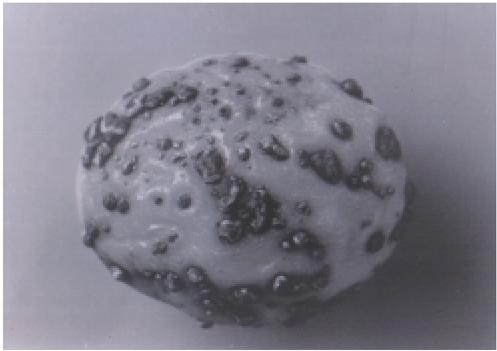
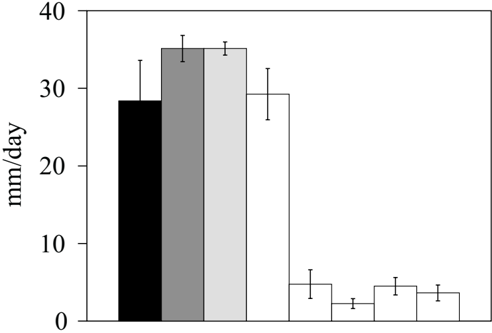
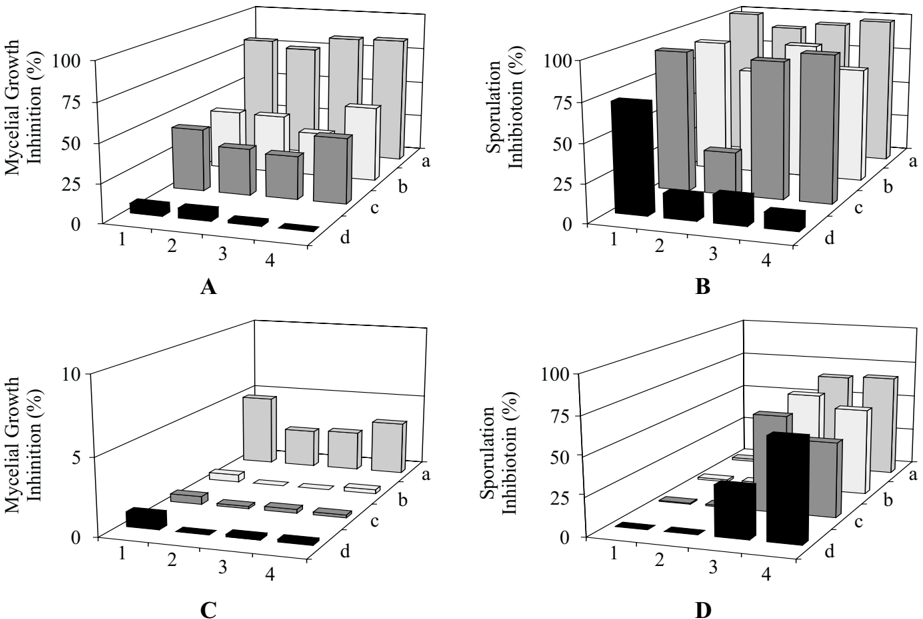
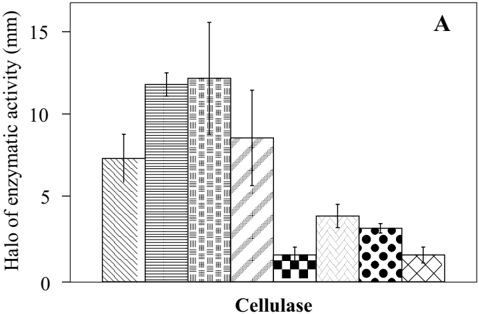
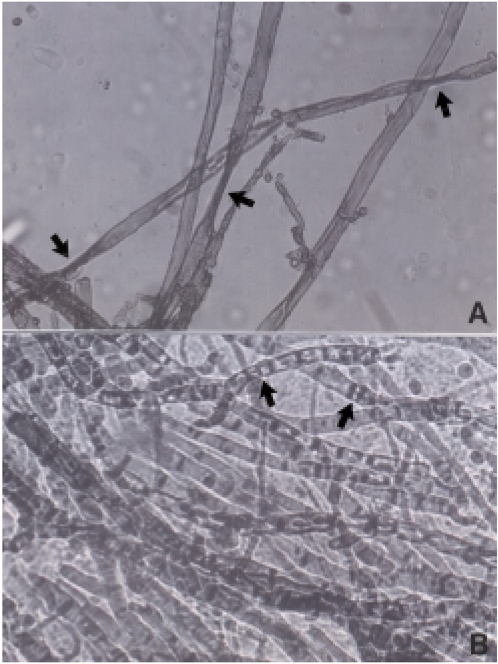
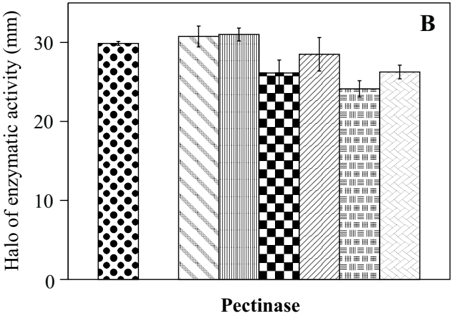
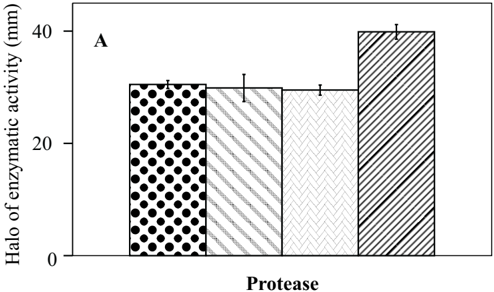
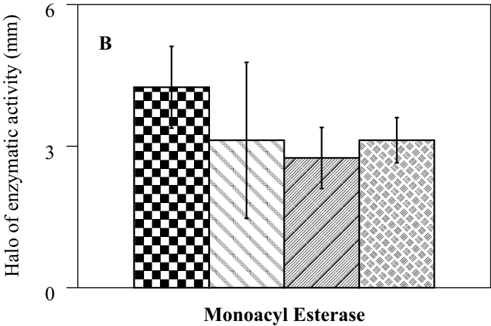
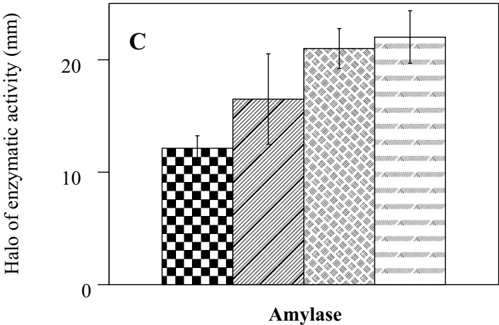
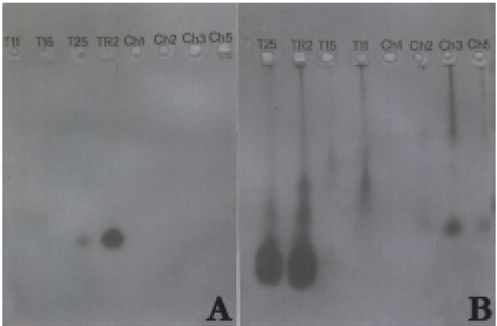
The verrucose caused by Cladosporium herbarum reduces production and quality of Passion fruit (Passiflora edulis Sims.), a largely consumed tropical fruit. This work aimed to investigate the antagonism of Trichoderma species (T. polysporum, T. koningii, T. viride and T. harzianum) against Cladosporium herbarum, and to study the production of extracellular hydrolytic enzymes by the pathogen and the antagonists. The results showed considerable antagonistic potential for the biocontrol of C. herbarum isolates by all Trichoderma species, except T. koningii. The most distinguished effect was observed for T. polysporum. In relation to the pattern of esterase obtained by electrophoresis in poliacrylamyde gel, the major activity presented by the isolates was observed after five days of incubation. The C. herbarum isolates produced extracellular enzymes, lipase, pectinase, cellulase, and protease, all possibly related to the infection process. Amylase excretion, not known to be associated with phytopathogens, was detected in Trichoderma species, but not in C. herbarum. In addition to amylase, all Trichoderma species tested produced also extracellular cellulase and pectinase, except T. koningii in relation to the latter enzyme. The demonstration of various esterase isoenzymes in zymograms of the Trichoderma species and C. herbarum isolates was markedly improved by washing the mycelia with detergents or EDTA. This fact suggested that a major fraction of extracelular enzymes may remain attached to outside fungal cell wall after being excreted.
Overview
The claims and statistics of this paper haven’t been checked yet.
Free: it reads the open-access text and checks the first 5 claims that cite a source we can check. Create a free account to check every claim.
Integrity signals
Registry
Cites
Statistics
Figures
Verification
Claims the paper makes
The claims and statistics of this paper haven’t been checked yet.
Free: it reads the open-access text and checks the first 5 claims that cite a source we can check. Create a free account to check every claim.
Self-check
Percentages, sums and reported differences re-computed from the paper’s own numbers.
The self-check needs the paper’s full text.
Citations
Cites
Ellis, M. B. (1971) · doi:10.1079/9780851986180.0000 · Cited by 2,021
More Dematiaceous Hyphomycetes
(1976) · CABI eBooks · doi:10.1079/9780851983653.0000 · Cited by 1,787
Antagonistic properties of species-groups of Trichoderma
Dennis, C., & Webster, J. (1971) · Transactions of the British Mycological Society · doi:10.1016/s0007-1536(71)80077-3 · Cited by 1,008 · cited 3×
“herbarum was tested by the method described by Lundberg and Unestan (33), and Dennis and Webster (12).”
MethodInfluentialCOCHRANE, V. W. (1959) · SOIL SCIENCE · doi:10.1097/00010694-195904000-00014 · Cited by 829
The Use of Solid Media for Detection of Enzyme Production by Fungi
Hankin, L., & Anagnostakis, S. L. (1975) · Mycologia · doi:10.1080/00275514.1975.12019782 · Cited by 792 · cited 4×
“The method of Hankin and Anagnostakis (26) was used to detect the secretion of extracellular cell wall degrading enzymes, both by the isolates of C. herbarum and Trichoderma species.”
BackgroundMethodInfluentialSpecific and sensitive plate assay for bacterial lipases
Kouker, G., & Jaeger, K. E. (1987) · Applied and Environmental Microbiology · doi:10.1128/aem.53.1.211-213.1987 · Cited by 748 · cited 1×
“herbarum, using a different kind of lipase assay (results not shown) than the method employed for monoacyl esterase, because it has been argued that soluble substrates are possibly not a good assay for lipase activity (29,41).”
MethodAntagonistic properties of species-groups of Trichoderma
Dennis, C., & Webster, J. (1971) · Transactions of the British Mycological Society · doi:10.1016/s0007-1536(71)80050-5 · Cited by 624
Trichoderma: a review of biology and systematics of the genus
Samuels, G. J. (1996) · Mycological Research · doi:10.1016/s0953-7562(96)80043-8 · Cited by 398 · cited 2×
“harzianum, named Trichodex, is used to control soilborne and phyloplane pathogens and other formulations, such as Binab-T, GlioGard and RootShield, are used to control several soilborne pathogens which cause damping-off and root rot (24,43).”
BackgroundThe Use of Solid Media for Detection of Enzyme Production by Fungi
Hankin, L., & Anagnostakis, S. L. (1975) · Mycologia · doi:10.2307/3758395 · Cited by 358
Fungitoxic Spectrum of Benzimidazole Compounds
Edgington, L. V. (1971) · Phytopathology · doi:10.1094/phyto-61-42 · Cited by 342 · cited 1×
“The inhibition percent was obtained using the formula: I% = [ (C2 – C1) / C2) ] x 100 (19), where C1 means growth of C.”
MethodElad, Y., Chet, I., & Katan, J. (2025) · Phytopathology® · doi:10.1094/phyto-70-119 · Cited by 341 · cited 1×
“These species are well studied and have shown efficience on biocontrol of different phytopathogens (8,20,31,36,37), including some from phyloplane, such as Botrytis (Pers.”
BackgroundIntroduction to research on plant diseases
Riker, A. J., & Riker, R. S. (1936) · Cited by 278
Antifungal alkyl pyrones of Trichoderma harzianum
Claydon, N., Allan, M., Hanson, J. R., & Avent, A. G. (1987) · Transactions of the British Mycological Society · doi:10.1016/s0007-1536(87)80034-7 · Cited by 277 · cited 1×
“Volatile antifungals, among which 6-pentyl-2-pyrone is the best known substance (6) were much less effective against this particular phytopathogen, although other species seem to be rather susceptible (27,44).”
BackgroundIntroduction to research on plant diseases
Riker, A. J., & Riker, R. S. (1936) · Cited by 260
Biological Control of Plant Diseases: Progress and Challenges for the Future
Tjamos, E. C., Papavizas, G. C., & Cook, R. (1992) · Springer eBooks · doi:10.1007/978-1-4757-9468-7 · Cited by 255
Annis, S. L., & Goodwin, P. H. (1997) · European Journal of Plant Pathology · doi:10.1023/a:1008656013255 · Cited by 206
Insertion of cutinase gene into a wound pathogen enables it to infect intact host
Dickman, M. B., Podila, G. K., & Kolattukudy, P. E. (1989) · Nature · doi:10.1038/342446a0 · Cited by 149
Lifshitz, R. (1986) · Phytopathology · doi:10.1094/phyto-76-720 · Cited by 129 · cited 1×
“These species are well studied and have shown efficience on biocontrol of different phytopathogens (8,20,31,36,37), including some from phyloplane, such as Botrytis (Pers.”
BackgroundContribution to the knowledge of the genus Cladosporium Link ex Fr.
VRIES, G. A. D. (1952) · Medical Entomology and Zoology · Cited by 127
Induction of Suppressiveness toRhizoctonia solaniin Soil
Chet, I. (1980) · Phytopathology · doi:10.1094/phyto-70-994 · Cited by 118
Semiquantitative Plate Assay for Determination of Cellulase Production by Trichoderma viride
Montenecourt, B. S., & Eveleigh, D. E. (1977) · Applied and Environmental Microbiology · doi:10.1128/aem.33.1.178-183.1977 · Cited by 118
Formation of extracellular lipases by filamentous fungi, yeasts, and bacteria
Rapp, P., & Backhaus, S. (1992) · Enzyme and Microbial Technology · doi:10.1016/0141-0229(92)90059-w · Cited by 103 · cited 1×
“herbarum, using a different kind of lipase assay (results not shown) than the method employed for monoacyl esterase, because it has been argued that soluble substrates are possibly not a good assay for lipase activity (29,41).”
MethodSarath, G., Zeece, M., & Penheiter, A. R. (2001) · Oxford University Press eBooks · doi:10.1093/oso/9780199636631.003.0003 · Cited by 69
Purification and properties of an endopolygalacturonase produced byRhizopus stolonifer
Manachini, P. L., Fortina, M. G., & Parini, C. (1987) · Biotechnology Letters · doi:10.1007/bf01024570 · Cited by 58
Biological Activities of Volatile Fungal Metabolites
Hutchinson, S. A. (1973) · Annual Review of Phytopathology · doi:10.1146/annurev.py.11.090173.001255 · Cited by 58
Harzianolide, a butenolide metabolite from cultures ofTrichoderma harzianum
Claydon, N., Hanson, J. R., Truneh, A., & Avent, A. G. (1991) · Phytochemistry · doi:10.1016/0031-9422(91)80115-h · Cited by 49 · cited 1×
“The species of Trichoderma are known to produce a number of antibiotics, such as trichodermin, trichodermol, harzianum A and harzianolide (7,17).”
BackgroundRole of cutinase in the invasion of plants
Köller, W., Yao, C., Trial, F., & Parker, D. M. (1995) · Canadian Journal of Botany · doi:10.1139/b95-366 · Cited by 36 · cited 1×
“On the other hand, there is evidence that at least part of the activity measured in all acyl esterase assays is in fact cutinase, an enzyme responsible for pathogenicity of Colletotrichum gloeosporioides on Carica papaya and other plants (18,28).”
BackgroundAntagonism against fomes annosus. Comparison between different test methods in vitro and in vivo
Lundborg, A., & Unestam, T. (1980) · Mycopathologia · doi:10.1007/bf00443076 · Cited by 34
Modes of Action of Mycoparasites in Relation to Biocontrol of Soilborne Plant Pathogens
Deacon, J. W., & Berry, L. A. (1992) · Springer eBooks · doi:10.1007/978-1-4757-9468-7_21 · Cited by 32 · cited 1×
“Its rapid growth gives Trichoderma an important advantage in the competition for space and nutrients with plant pathogenic fungi, even before it deploys its arsenal of mycotoxins (10,11).”
BackgroundIn vitro identification ofTrichoderma harzianum as a potential antagonist of plant pathogens
Lynch, J. M. (1987) · Current Microbiology · doi:10.1007/bf01568169 · Cited by 28
Metabolites of some biological control agents
Dickinson, J. M., Hanson, J. R., & Truneh, A. (1995) · Pesticide Science · doi:10.1002/ps.2780440411 · Cited by 19 · cited 1×
“The species of Trichoderma are known to produce a number of antibiotics, such as trichodermin, trichodermol, harzianum A and harzianolide (7,17).”
BackgroundFungal flora of white draff of maize.
Despoulain, B., Murandi, F. S., Steiman, R., et al. (1990) · Cryptogamie Mycologie · Cited by 1
La flore fongique des drèches blanches de maïs
Despoulain, B., Seigle-Murandi, F. M., Steiman, R., & Degiorgis, L. (1990) · Cryptogamie Mycologie · doi:10.5962/p.354581 · Cited by 1
Research works printed but not linked: 4
- [6]6. Claydon, N.; Allan, M.; Hanson, J.R.; Avent, A.G. Antifungal alkylpyrones of Trichoderma harzianum. Trans. Br. Mycol. Soc., 88:503-513, 1987.
- [10]10. Cook, R.J.; Baker, K.F. The nature apractice of biological control of plant pathogens. APS Press, St. Paul, 1989. 539p.
- [14]14. Dennis, C.; Webster, J. Antagonistic properties of species-groups of Trichoderma. III. Hyfal interaction. Trans. Br. Mycol. Soc., 57:363- 369, 1971c.
- [40]40. O'Donnell, J.; Dickinson, C.H. Pathonicity of Alternaria and Cladosporium isolates on Phaseolus. Trans. Br. Mycol. Soc., 74:335- 342, 1980.
Cited by
Zivkovic, S., Stojanovic, S., Ivanovic, Z., Gavrilovic, V., Popovic, T., & Balaz, J. (2010) · Archives of Biological Sciences · doi:10.2298/abs1003611z · Cited by 180
Trichoderma harzianum: a biocontrol agent against Bipolaris oryzae
Abdel-Fattah, G. M., Shabana, Y. M., Ismail, A. E., & Rashad, Y. M. (2007) · Mycopathologia · doi:10.1007/s11046-007-9032-9 · Cited by 111
Biological control of rice brown spot with native isolates of three Trichoderma species
Khalili, E., Sadravi, M., Naeimi, S., & Khosravi, V. (2012) · Brazilian Journal of Microbiology · doi:10.1590/s1517-83822012000100035 · Cited by 116
El‐Hasan, A., Walker, F., & Buchenauer, H. (2007) · Journal of Phytopathology · doi:10.1111/j.1439-0434.2007.01330.x · Cited by 72
Şesan, T. E., Oancea, A., Ștefan, L. M., Manoiu, V. S., Ghiurea, M., Răut, I., Constantinescu-Aruxandei, D., Toma, A., Savin, S., Bira, A. F., et al. (2020) · Microorganisms · doi:10.3390/microorganisms8010123 · Cited by 74
“To date, strains from Trichoderma genera were applied to Passiflora plants as bio/myco‐fungicides for the treatment of fungal diseases [57,58] or as biofertilizer to promote root growth and root function related to mineral nutrient uptake [59].”
Method
Metadata
- Authors
- Barbosa, M. A. G., Rehn, K. G., Menezes, M., & Mariano, R. D. L. R.
- Affiliations
- Universidade Federal Rural de Pernambuco (BR)
- Venue
- Brazilian Journal of Microbiology
- Publisher
- FapUNIFESP (SciELO)
- Published
- 2001-06
- Volume
- 32
- Issue
- 2
- ISSN
- 1517-8382 (ISSN-L)
- OpenAlex
- W2115456201
- Semantic Scholar
- 4c2a21deb8526e77430ca4424b8f3d4fbb7f1e21
- Cited by
- 80
- References
- 30
- Citations by year
- 2026: 3 · 2025: 3 · 2024: 4 · 2023: 9 · 2022: 3 · 2020: 6 · 2019: 4 · 2018: 2 · 2017: 4 · 2016: 6 · 2015: 1 · 2014: 6 · 2013: 1 · 2012: 4
- FWCI
- 0.45
- Type
- journal article
- Language
- en
- Open access
- hybrid
- doi.org
- Licence
- cc-by-nc
- Locations
- Brazilian Journal of Microbiology (publishedVersion, cc-by-nc)
- LA Referencia (Red Federada de Repositorios Institucionales de Publicaciones Científicas) (publishedVersion, other-oa)
- Americanae (AECID Library) (submittedVersion, cc-by-nc)
- DOAJ (DOAJ: Directory of Open Access Journals) (submittedVersion)
- Topics
- Life Sciences › Agricultural and Biological Sciences › Plant Science › Plant Pathogens and Fungal Diseases
- Life Sciences › Agricultural and Biological Sciences › Plant Science › Plant-Microbe Interactions and Immunity
- Life Sciences › Agricultural and Biological Sciences › Plant Science › Fungal Plant Pathogen Control
- Keywords
- Trichoderma, Cladosporium herbarum, biological control, fungal antagonism, Passiflora edulis, extracellular enzymes, esterase isozymes, lipase, pectinase, cellulase, proteolytic enzymes, amylase, Trichoderma polysporum, Trichoderma harzianum, Trichoderma viride, Trichoderma koningii, fungal cell wall
About these checks
Registry, retraction, Cites and statistics results are computed, not judged, with one exception: a printed reference that no index lists is read once by a model before it counts as a citation error. Claims are extracted by a model and kept only when their quote appears verbatim in the text; each cited source is then checked, with a model’s help, for whether it says what the claim relies on. Those verdicts can be wrong — read the claim’s quote and the cited source before relying on one.
Statistics and arithmetic are recomputed, not judged.
Confidence bands are shown only for fields calibrated on our annotated test set. None is calibrated yet, so no band is shown.
What counts as a claim ›How we measure confidence ›How we check this ›
Are you an author, or do you see a problem with this page? Request a review
Data sources
Bibliographic data: Semantic Scholar, OpenAlex, Crossref.
Contains information from the Semantic Scholar Academic Graph Datasets, made available under the ODC Attribution License (ODC-BY 1.0).
Semantic Scholar’s data is described in: Kinney, R., et al. (2023). The Semantic Scholar Open Data Platform. arXiv:2301.10140.
