

The DOI matches its Crossref record; 28 of the 30 references it cites were found in a registry or an index.
Dental caries experience, oral health status and treatment needs of dental patients with autism
Open accessAbstract
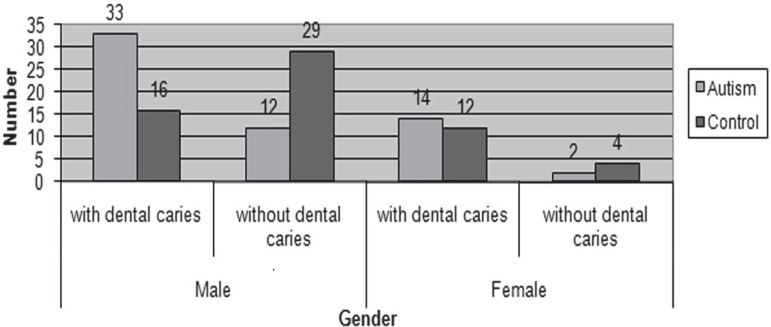
OBJECTIVES: Autism is a lifelong neurodevelopmental disorder. The aims of this study were to investigate whether children with autism have higher caries prevalence, higher periodontal problems, or more treatment needs than children of a control group of non-autistic patients, and to provide baseline data to enable comparison and future planning of dental services to autistic children. MATERIAL AND METHODS: 61 patients with autism aged 6-16 years (45 males and 16 females) attending Dubai and Sharjah Autism Centers were selected for the study. The control group consisted of 61 non-autistic patients chosen from relatives or friends of autistic patients in an attempt to have matched age, sex and socioeconomic status. Each patient received a complete oral and periodontal examination, assessment of caries prevalence, and caries severity. Other conditions assessed were dental plaque, gingivitis, restorations and treatment needs. Chi-square and Fisher's exact test of significance were used to compare groups. RESULTS: The autism group had a male-to-female ratio of 2.8:1. Compared to controls, children with autism had significantly higher decayed, missing or filled teeth than unaffected patients and significantly needed more restorative dental treatment. The restorative index (RI) and Met Need Index (MNI) for the autistic children were 0.02 and 0.3, respectively. The majority of the autistic children either having poor 59.0% (36/61) or fair 37.8% (23/61) oral hygiene compared with healthy control subjects. Likewise, 97.0% (59/61) of the autistic children had gingivitis. CONCLUSIONS: Children with autism exhibited a higher caries prevalence, poor oral hygiene and extensive unmet needs for dental treatment than non-autistic healthy control group. Thus oral health program that emphasizes prevention should be considered of particular importance for children and young people with autism.
Overview
The claims and statistics of this paper haven’t been checked yet.
Run the check — free, no account needed. It reads the open-access text and checks the sources it cites.
Integrity signals
Registry
Cites
Statistics
Figures
Verification
Claims the paper makes
The claims and statistics of this paper haven’t been checked yet.
Run the check — free, no account needed. It reads the open-access text and checks the sources it cites.
Claims other papers make about this one
Each is checked against this paper’s own text: does it say what the citing paper says it does?
The source backs part of the claim, not all of it — or backs it for a different population, condition or comparison.
In the citing paper
“The age selection starting at six was due to the development of the motor ability of children at this age, where they can have a good grip on the dental brush during brushing”
From Culturally Adapted Dental Visual Aids Effect on Behavior Management during Dental Visits in Children with Autism Spectrum Disorder. (2024) · cites this paper as [31]
Experimental — accuracy not yet measuredThe check wasn’t confident either way, so it gives no verdict — never disputed.
In the citing paper
“and ending at 12 to minimize the possibility of puberty hormones negatively interfering with their behavioral patterns. 30,31”
From Culturally Adapted Dental Visual Aids Effect on Behavior Management during Dental Visits in Children with Autism Spectrum Disorder. (2024) · cites this paper as [31]
Experimental — accuracy not yet measured
Self-check
Percentages, sums and reported differences re-computed from the paper’s own numbers.
The self-check needs the paper’s full text.
Citations
Cites
Diagnostic and Statistical Manual of Mental Disorders.
Widiger, T. A. (2000) · Oxford University Press eBooks · doi:10.1037/10518-009 · Cited by 19,766
Periodontal Disease in Pregnancy I. Prevalence and Severity
Löe, H. A., & Silness, J. (1963) · Acta Odontologica Scandinavica · doi:10.3109/00016356309011240 · Cited by 7,234
The Simplified Oral Hygiene Index
Greene, J. G., & Vermillion, J. R. (1964) · The Journal of the American Dental Association · doi:10.14219/jada.archive.1964.0034 · Cited by 2,676
Epidemiology of Pervasive Developmental Disorders
Fombonne, E. (2009) · Pediatric Research · doi:10.1203/pdr.0b013e31819e7203 · Cited by 1,971
Amaral, D. G., Schumann, C. M., & Nordahl, C. W. (2008) · Trends in Neurosciences · doi:10.1016/j.tins.2007.12.005 · Cited by 1,492
The Epidemiology of Autism Spectrum Disorders
Newschaffer, C. J., Croen, L. A., Daniels, J., Giarelli, E., Grether, J. K., Levy, S. E., Mandell, D. S., Miller, L. A., Pinto-Martin, J., Reaven, J., et al. (2007) · Annual Review of Public Health · doi:10.1146/annurev.publhealth.28.021406.144007 · Cited by 1,228
The Screening and Diagnosis of Autistic Spectrum Disorders
Filipek, P. A., Accardo, P., Baranek, G. T., Cook, E. H., Dawson, G., Gordon, B., Gravel, J. S., Johnson, C. P., Kallen, R. J., Levy, S. E., et al. (1999) · Journal of Autism and Developmental Disorders · doi:10.1023/a:1021943802493 · Cited by 1,016
Incidence of autism spectrum disorders: Changes over time and their meaning*
Rutter, M. L. (2005) · Acta Paediatrica · doi:10.1111/j.1651-2227.2005.tb01779.x · Cited by 541
What are infant siblings teaching us about autism in infancy?
Rogers, S. J. (2009) · Autism Research · doi:10.1002/aur.81 · Cited by 351
Autism: Many Genes, Common Pathways?
Geschwind, D. H. (2008) · Cell · doi:10.1016/j.cell.2008.10.016 · Cited by 328
Research works printed but not linked: 3
- Amaral DG, 2000, Pervasive developmental disorders, 69
- Murshid EZ, 2005, Oral health status, dental needs habits and behavioral attitude towards dental treatment of a group of autistic children in Riyadh, Saudi Arabia, Saudi Dent J, 17, 132
- Peres MA, 2001, Calibration of examiners for dental caries epidemiology studies, Cad Saúde Públ, 17, 153
Cited by
Sorted by citations
Zazpe (2014) · doi:10.1177/0883073813498821 · Cited by 239
Zhang, M., Ma, W., Zhang, J., He, Y., & Wang, J. (2018) · Scientific Reports · doi:10.1038/s41598-018-32219-2 · Cited by 188
Qiao, Y., Wu, M., Feng, Y., Zhou, Z., Chen, L., & Chen, F. (2018) · Scientific Reports · doi:10.1038/s41598-018-19982-y · Cited by 174
Delli, K., Reichart, P. A., Bornstein, M. M., & Livas, C. (2013) · Medicina oral, patología oral y cirugía bucal · doi:10.4317/medoral.19084 · Cited by 166
Lam, P. P. Y., Du, R. Y., Peng, S., McGrath, C. P. J., & Yiu, C. K. Y. (2020) · Autism · doi:10.1177/1362361319877337 · Cited by 115
Metadata
- Authors
- Jaber, M. A.
- Affiliations
- Ajman University (AE)
- Corresponding author
- Jaber, Mohamed Abdullah
- Venue
- Journal of Applied Oral Science
- Publisher
- FapUNIFESP (SciELO)
- Published
- 2011-06
- Volume
- 19
- Issue
- 3
- Pages
- 212-217
- ISSN
- 1678-7757 (ISSN-L)
- PMC
- PMC4234331
- OpenAlex
- W2103263912
- Cited by
- 289
- References
- 30
- Citations by year
- 2026: 16 · 2025: 25 · 2024: 30 · 2023: 25 · 2022: 32 · 2021: 25 · 2020: 27 · 2019: 19 · 2018: 21 · 2017: 16 · 2016: 16 · 2015: 8 · 2014: 16 · 2013: 8 · 2012: 5
- FWCI
- 11.50
- Type
- journal article
- Language
- en
- Open access
- diamond
- doi.org
- Licence
- cc-by
- Locations
- Journal of Applied Oral Science (publishedVersion, cc-by)
- PubMed Central (publishedVersion, cc-by-nc)
- PubMed (publishedVersion)
- LA Referencia (Red Federada de Repositorios Institucionales de Publicaciones Científicas) (publishedVersion)
- LA Referencia (Red Federada de Repositorios Institucionales de Publicaciones Científicas) (publishedVersion, other-oa)
- Americanae (AECID Library) (submittedVersion, other-oa)
- DOAJ (DOAJ: Directory of Open Access Journals) (submittedVersion, cc-by-sa)
- Topics
- Health Sciences › Dentistry › General Dentistry › Dental Health and Care Utilization
- Health Sciences › Dentistry › Periodontics › Oral microbiology and periodontitis research
- Health Sciences › Dentistry › General Dentistry › Dental Research and COVID-19
- Keywords
- autism spectrum disorder, dental caries, caries prevalence, oral health status, periodontal disease, gingivitis, dental plaque, restorative dental treatment, treatment needs, oral hygiene, children and adolescents, neurodevelopmental disorders
- MeSH terms
- Adolescent, Autistic Disorder, Child, Dental Care for Disabled, Dental Care for Persons with Disabilities, Dental Caries, DMF Index, Female, Humans, Male, Oral Health, Oral Hygiene, Socioeconomic Factors, United Arab Emirates, Prevalence, Case-Control Studies, Sex Distribution, Dental Care for Children
About these checks
Registry, retraction, Cites and statistics results are computed, not judged, with one exception: a printed reference that no index lists is read once by a model before it counts as a citation error. Claims are extracted by a model and kept only when their quote appears verbatim in the text; each cited source is then checked, with a model’s help, for whether it says what the claim relies on. Those verdicts can be wrong — read the claim’s quote and the cited source before relying on one.
Statistics and arithmetic are recomputed, not judged.
Confidence bands are shown only for fields calibrated on our annotated test set. None is calibrated yet, so no band is shown.
What counts as a claim ›How we measure confidence ›How we check this ›
Are you an author, or do you see a problem with this page? Request a review
