

The effects of heated vegetable oils on blood pressure in rats
Open accessThe DOI matches its Crossref record; 34 of the 39 references it cites were found in a registry or an index.
Abstract
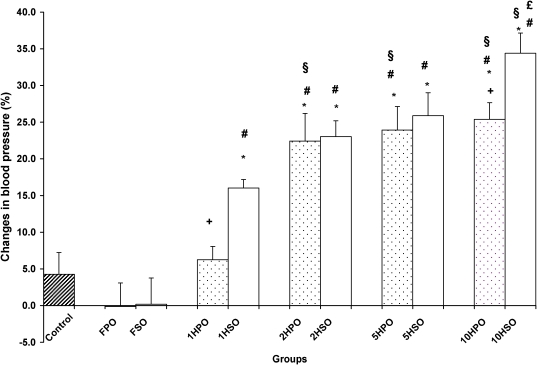
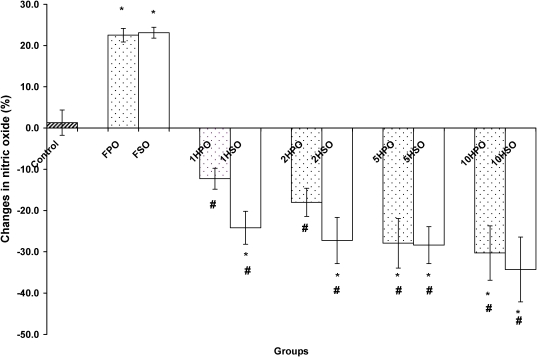
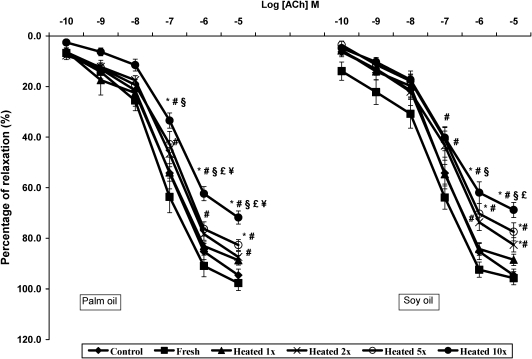
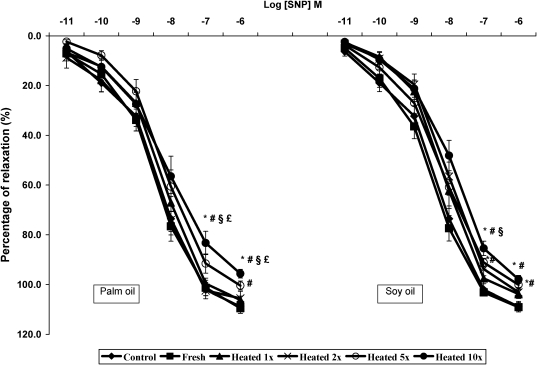
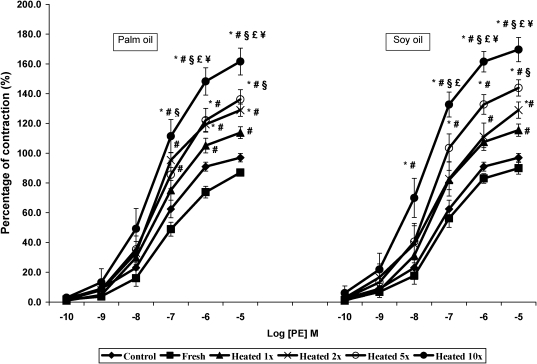
OBJECTIVES: The goal of this study was to determine the possible mechanism that is involved in the blood pressure-raising effect of heated vegetable oils. METHODS: Adult male Sprague-Dawley rats were divided into 11 groups; the control group was fed with rat chow, and the other groups were fed with chow that was mixed with 15% weight/weight palm or soy oils, which were either in a fresh form or heated once, twice, five, or ten times. Blood pressures were measured at the baseline and throughout the 24-week study. Plasma nitric oxide levels were assessed prior to treatment and at the end of the study. Following 24 weeks, the rats were sacrificed to investigate their vascular reactivity using the thoracic aorta. RESULTS: Palm and soy oils had no detrimental effects on blood pressure, and they significantly elevated the nitric oxide contents and reduced the contractile responses to phenylephrine. However, trials using palm and soy oils that were repeatedly heated showed an increase in blood pressure, enhanced phenylephrine-induced contractions, reduced acetylcholine- and sodium nitroprusside-induced relaxations relative to the control and rats that were fed fresh vegetable oils. CONCLUSIONS: The blood pressure-raising effect of the heated vegetable cooking oils is associated with increased vascular reactivity and a reduction in nitric oxide levels. The chronic consumption of heated vegetable oils leads to disturbances in endogenous vascular regulatory substances, such as nitric oxide. The thermal oxidation of the cooking oils promotes the generation of free radicals and may play an important contributory role in the pathogenesis of hypertension in rats.
Overview
The claims and statistics of this paper haven’t been checked yet.
Free: it reads the open-access text and checks the first 5 claims that cite a source we can check. Create a free account to check every claim.
Integrity signals
Registry
Cites
Statistics
Figures
Verification
Claims the paper makes
The claims and statistics of this paper haven’t been checked yet.
Free: it reads the open-access text and checks the first 5 claims that cite a source we can check. Create a free account to check every claim.
Claims other papers make about this one
Each is checked against this paper’s own text: does it say what the citing paper says it does?
The cited source doesn’t support the claim as written.
In the citing paper
“ovariectomized adult female Sprague-Dawley rats with suppressed resistance to atherosclerosis were developed by putting the animal on a 15% w/w of heated vegetable oil diet.”
From Cardiovascular disease models: A game changing paradigm in drug discovery and screening (2019) · cites this paper as [121]
Checked by a reasoning model — may be wrong.
Experimental — accuracy not yet measuredThe source backs part of the claim, not all of it — or backs it for a different population, condition or comparison.
In the citing paper
“The same diet over a longer period (16–24 weeks) promoted atherosclerosis in male subjects [120,121].”
From Cardiovascular disease models: A game changing paradigm in drug discovery and screening (2019) · cites this paper as [121]
Experimental — accuracy not yet measured
Self-check
Percentages, sums and reported differences re-computed from the paper’s own numbers.
The self-check needs the paper’s full text.
Citations
Cites
Nitric oxide: physiology, pathophysiology, and pharmacology.
Moncada, S., Palmer, R. M., & Higgs, E. A. (1991) · Pharmacological Reviews · doi:10.1016/s0031-6997(25)06663-3 · Cited by 15,525
The L-Arginine-Nitric Oxide Pathway
Epstein, F. H., Moncada, S., & Higgs, A. (1993) · New England Journal of Medicine · doi:10.1056/nejm199312303292706 · Cited by 6,678
Mensink, R. P., & Katan, M. B. (1990) · New England Journal of Medicine · doi:10.1056/nejm199008163230703 · Cited by 1,424 · cited 2×
“particular.(10) The fats that are found in processed foods are”
Psaltopoulou, T., Naska, A., Orfanos, P., Trichopoulos, D., Mountokalakis, T., & Trichopoulou, A. (2004) · The American Journal of Clinical Nutrition · doi:10.1093/ajcn/80.4.1012 · Cited by 516 · cited 1×
“The consumption of a diet that is rich in monounsaturated fatty acids (MUFAs) and polyunsaturated fatty acids (PUFAs), such as olive oil and fish oil, has been found to decrease blood pressure (BP).(1,2) Conversely, diets that are rich in saturated fatty acids (SFAs) have been found to increase BP.”
Hermann, M., Flammer, A., & Lüscher, T. F. (2006) · The Journal of Clinical Hypertension · doi:10.1111/j.1524-6175.2006.06032.x · Cited by 354 · cited 1×
“NO plays a vital contributory role in BP regulation.(17) The impairment of NO bioavailability may be an important aspect to the pathogenesis of diet-induced hypertension that follows the prolonged intake of heated vegetable oils.”
Endothelial Function in Hypertension: The Role of Superoxide Anion
McIntyre, M., Bohr, D. F., & Dominiczak, A. F. (1999) · Hypertension · doi:10.1161/01.hyp.34.4.539 · Cited by 354
Effect of Soybean Protein on Blood Pressure: A Randomized, Controlled Trial
He, J., Gu, D., Wu, X., Chen, J., Duan, X., Chen, J., & Whelton, P. K. (2005) · Annals of Internal Medicine · doi:10.7326/0003-4819-143-1-200507050-00004 · Cited by 212 · cited 7×
“The consumption of a diet that is rich in monounsaturated fatty acids (MUFAs) and polyunsaturated fatty acids (PUFAs), such as olive oil and fish oil, has been found to decrease blood pressure (BP).1,2 Conversely, diets that are rich in saturated fatty acids (SFAs) have been found to increase BP.3,4 The pathogenesis o…”
InfluentialMahn, K., Borrás, C., Knock, G. A., Taylor, P., Khan, I. Y., Sugden, D., Poston, L., Ward, J. P., Sharpe, R. M., Viña, J., et al. (2005) · The FASEB Journal · doi:10.1096/fj.05-4008fje · Cited by 196 · cited 1×
“Dietary soy has been shown to enhance nitric oxide synthase expression, which further promotes NO production.(24) The identification of increased plasma NO metabolite levels after 24 weeks in both of the”
Carr, A., & Frei, B. (2000) · Free Radical Biology and Medicine · doi:10.1016/s0891-5849(00)00225-2 · Cited by 190 · cited 2×
“It has been suggested that natural antioxidants found in fresh oils may provide protective effects by decreasing oxidative stress or stimulating NO formation, which subsequently preserves the bioavailability of NO.21 Soy intake was also inversely associated with BP.22,23 Dietary soy has been shown to enhance nitric ox…”
Hypertension is related to the degradation of dietary frying oils
Soriguer, F., Rojo-Martínez, G., Dobarganes, M. C., García Almeida, J. M., Esteva, I., Beltrán, M., Ruiz De Adana, M. S., Tinahones, F., Gómez-Zumaquero, J. M., García-Fuentes, E., et al. (2003) · The American Journal of Clinical Nutrition · doi:10.1093/ajcn/78.6.1092 · Cited by 185 · cited 7×
“The consumption of a diet that is rich in monounsaturated fatty acids (MUFAs) and polyunsaturated fatty acids (PUFAs), such as olive oil and fish oil, has been found to decrease blood pressure (BP).1,2 Conversely, diets that are rich in saturated fatty acids (SFAs) have been found to increase BP.3,4 The pathogenesis o…”
InfluentialIntroduction: nutritional aspects of palm oil
Cottrell, R. C. (1991) · The American Journal of Clinical Nutrition · doi:10.1093/ajcn/53.4.989sb · Cited by 161
Gao, Y., & Lee, R. M. K. W. (2001) · British Journal of Pharmacology · doi:10.1038/sj.bjp.0704420 · Cited by 128 · cited 7×
“The consumption of a diet that is rich in monounsaturated fatty acids (MUFAs) and polyunsaturated fatty acids (PUFAs), such as olive oil and fish oil, has been found to decrease blood pressure (BP).1,2 Conversely, diets that are rich in saturated fatty acids (SFAs) have been found to increase BP.3,4 The pathogenesis o…”
InfluentialAndrikopoulos, N. K., Kalogeropoulos, N., Falirea, A., & Barbagianni, M. N. (2002) · International Journal of Food Science & Technology · doi:10.1046/j.1365-2621.2002.00555.x · Cited by 124 · cited 2×
“As a result, cooking oil decomposes and forms volatile compounds and various monomers, and polymers.(9) Several factors can affect the quality of cooking oil during heating, including ventilation, temperature, heating duration, the type of oil, the saturation ratio of the oil, and the presence of a catalyst/antioxidan…”
Andrikopoulos, N. K., Dedoussis, G. V., Falirea, A., Kalogeropoulos, N., & Hatzinikola, H. S. (2002) · International Journal of Food Sciences and Nutrition · doi:10.1080/09637480220138098 · Cited by 122
Yoshida, Y., Saito, Y., Jones, L. S., & Shigeri, Y. (2007) · Journal of Bioscience and Bioengineering · doi:10.1263/jbb.104.439 · Cited by 122
Longitudinal study of soy food intake and blood pressure among middle-aged and elderly Chinese women
Yang, G., Shu, X., Jin, F., Zhang, X., Li, H., Li, Q., Gao, Y., & Zheng, W. (2005) · American Journal of Clinical Nutrition · doi:10.1093/ajcn/81.5.1012 · Cited by 113 · cited 7×
“The consumption of a diet that is rich in monounsaturated fatty acids (MUFAs) and polyunsaturated fatty acids (PUFAs), such as olive oil and fish oil, has been found to decrease blood pressure (BP).1,2 Conversely, diets that are rich in saturated fatty acids (SFAs) have been found to increase BP.3,4 The pathogenesis o…”
InfluentialOwu, D. U., Osim, E. E., & Ebong, P. E. (1998) · Acta Tropica · doi:10.1016/s0001-706x(97)00115-0 · Cited by 109 · cited 2×
“Preparation of heated-oil diets Commercially purchased palm and soy oils were either used fresh or were heated according to the modified method of Owu et al.12 In the heating process, the oils were used to fry sweet potatoes in a stainless-steel wok for ten minutes.”
Garrido-Polonio, C., García-Linares, M. C., García-Arias, M. T., López-Varela, S., García-Fernández, M. C., Terpstra, A. H. M., & Sánchez-Muniz, F. J. (2004) · British Journal of Nutrition · doi:10.1079/bjn20041174 · Cited by 106 · cited 1×
“The repeated heating of cooking oil will result in oil that is more prone to lipid peroxidation.(11) However, the potential adverse effects that are associated with this”
Palm Tocotrienol Exerted Better Antioxidant Activities in Bone than α‐Tocopherol
Maniam, S., Mohamed, N., Shuid, A. N., & Soelaiman, I. N. (2008) · Basic & Clinical Pharmacology & Toxicology · doi:10.1111/j.1742-7843.2008.00241.x · Cited by 99
Adam, S. K., Soelaiman, I. N., Umar, N. A., Mokhtar, N., Mohamed, N., & Jaarin, K. (2020) · McGill Journal of Medicine · doi:10.26443/mjm.v11i2.566 · Cited by 83 · cited 1×
“Our earlier laboratory findings reported that heated vegetable cooking oils caused increased lipid peroxidation as indicated by elevated serum acid thiobarbituric acid (TBARS) levels.(35,36) We suggest that repeated heating may increase the number of free radicals.”
Self-citationLeong, X. F., Aishah, A., Nor Aini, U., Das, S., & Jaarin, K. (2008) · Archives of Medical Research · doi:10.1016/j.arcmed.2008.04.009 · Cited by 67 · cited 7×
“The consumption of a diet that is rich in monounsaturated fatty acids (MUFAs) and polyunsaturated fatty acids (PUFAs), such as olive oil and fish oil, has been found to decrease blood pressure (BP).1,2 Conversely, diets that are rich in saturated fatty acids (SFAs) have been found to increase BP.3,4 The pathogenesis o…”
InfluentialSelf-citationEffects of dietary fat saturation on eicosanoid production, platelet aggregation and blood pressure
LAHOZ, C., ALONSO, R., ORDOVÁS, J. M., LÓPEZ‐FARRÉ, A., DE OYA, M., & MATA, P. (1997) · European Journal of Clinical Investigation · doi:10.1046/j.1365-2362.1997.1860735.x · Cited by 63 · cited 7×
“The consumption of a diet that is rich in monounsaturated fatty acids (MUFAs) and polyunsaturated fatty acids (PUFAs), such as olive oil and fish oil, has been found to decrease blood pressure (BP).1,2 Conversely, diets that are rich in saturated fatty acids (SFAs) have been found to increase BP.3,4 The pathogenesis o…”
InfluentialAdam, S. K., Das, S., Soelaiman, I. N., Umar, N. A., & Jaarin, K. (2008) · The Tohoku Journal of Experimental Medicine · doi:10.1620/tjem.215.219 · Cited by 56 · cited 1×
“Our earlier laboratory findings reported that heated vegetable cooking oils caused increased lipid peroxidation as indicated by elevated serum acid thiobarbituric acid (TBARS) levels.(35,36) We suggest that repeated heating may increase the number of free radicals.”
Self-citationEffect of palm oil on oxidative stress-induced hypertension in sprague-dawley rats
Ganafa, A. A., Socci, R. R., Eatman, D., Silvestrov, N. A., Abukhalaf, I. K., & Bayorh, M. A. (2002) · American Journal of Hypertension · doi:10.1016/s0895-7061(02)02963-1 · Cited by 55 · cited 2×
“In this study, the effect of fresh oils on BP was not in agreement with previous studies.(5,6,16) The results could be due to differences in duration of the study, the types of oils and the animals used.”
Hayashi, Y., Sawa, Y., Nishimura, M., Fukuyama, N., Ichikawa, H., Ohtake, S., Nakazawa, H. K., & Matsuda, H. (2004) · European Journal of Cardio-Thoracic Surgery · doi:10.1016/j.ejcts.2004.03.033 · Cited by 53 · cited 1×
“We postulate that thermally oxidized oils generate free radicals, such as the superoxide anion, which react with NO to form peroxynitrite.(18) The reduction in the plasma nitrite levels could be explained by the enhanced NO sequestration by free radicals and its inactivation due to the imbalance between the antioxidan…”
Influence of Dietary Fats Upon Systolic Blood Pressure in the Rat
Langley-Evans, S. C., Clamp, A. G., Grimble, R. F., & Jackson, A. A. (1996) · International Journal of Food Sciences and Nutrition · doi:10.3109/09637489609006955 · Cited by 47 · cited 7×
“The consumption of a diet that is rich in monounsaturated fatty acids (MUFAs) and polyunsaturated fatty acids (PUFAs), such as olive oil and fish oil, has been found to decrease blood pressure (BP).1,2 Conversely, diets that are rich in saturated fatty acids (SFAs) have been found to increase BP.3,4 The pathogenesis o…”
InfluentialAdam, S. K., Das, S., & Jaarin, K. (2009) · International Journal of Experimental Pathology · doi:10.1111/j.1365-2613.2009.00658.x · Cited by 45 · cited 1×
“In addition, the consumption of heated oils has been reported to cause abnormal ultrastructural changes in the aorta.(30,31)”
Self-citationArterial pressure and lipid profile in rats following chronic ingestion of palm oil diets.
Osim, E., Owu, D. U., & Km, E. (1996) · PubMed · Cited by 38
Effect of palm oil on blood pressure, endothelial function and oxidative stress.
Bayorh, M. A., Abukhalaf, I. K., & Ganafa, A. A. (2005) · PubMed · Cited by 34
(1992) · PubMed · Cited by 34
Adam, S. K., Das, S., Othman, F. B., & Jaarin, K. (2009) · Clinics · doi:10.1590/s1807-59322009001100012 · Cited by 31 · cited 1×
“In addition, the consumption of heated oils has been reported to cause abnormal ultrastructural changes in the aorta.(30,31)”
Self-citationMachha, A., & Mustafa, M. R. (2006) · Vascular Pharmacology · doi:10.1016/j.vph.2006.05.001 · Cited by 30 · cited 1×
“, rings showing greater than 50% relaxation in response to ACh) were used.(13) Different aortic rings with an intact endothelium were used in each experiment.”
Self-citationMedeiros, F., Mothé, C. G., Águila, M. B., & Mandarim‐de‐Lacerda, C. A. (2005) · Prostaglandins & Other Lipid Mediators · doi:10.1016/j.prostaglandins.2005.09.001 · Cited by 25 · cited 1×
“In this study, the effect of fresh oils on BP was not in agreement with previous studies.(5,6,16) The results could be due to differences in duration of the study, the types of oils and the animals used.”
Methodologic aspects of acetylcholine-evoked relaxation of rabbit aorta
Hansen, K., & Nedergaard, O. A. (1999) · Journal of Pharmacological and Toxicological Methods · doi:10.1016/s1056-8719(99)00035-0 · Cited by 24 · cited 1×
“NO is synthesized predominantly in the vascular endothelium and diffuses into the adjacent smooth muscle cells to activate guanylate cyclase (GC); this increases the formation of cyclic guanosine monophosphate (cGMP) and causes vascular smooth muscle relaxation.(27) In the aorta, endothelium-dependent relaxation induc…”
Owu, D. U., Orie, N. N., & Osim, E. (2000) · PubMed · Cited by 15
Research works printed but not linked: 2
- Gupta MK Frying oil Shahidi F, editor. Edible Oil and Food Products: Products and Applications New Jersey John Wiley & Sons Inc 2005 1 31
- Adam SK Sulaiman NA Mat Top AG Jaarin K Heating reduces vitamin E content in palm and soy oils Malays J Biochem Molec Biol 2007 15 76 9
Cited by
Cardiovascular disease models: A game changing paradigm in drug discovery and screening
Savoji, H., Mohammadi, M. H., Rafatian, N., Toroghi, M. K., Wang, E. Y., Zhao, Y., Korolj, A., Ahadian, S., & Radisic, M. (2019) · Biomaterials · doi:10.1016/j.biomaterials.2018.09.036 · Cited by 223
Animal models in cardiovascular research: hypertension and atherosclerosis
Leong, X.-F., Ng, C.-Y., & Jaarin, K. (2015) · BioMed Research International · doi:10.1155/2015/528757 · Cited by 203
“Furthermore, systematic reviewsmay improve the quality and translational value of animal research to human trial [18].”
BackgroundSelf-citationMechanisms of the antihypertensive effects of Nigella sativa oil in L-NAME-induced hypertensive rats
Jaarin, K., Foong, W. D., Yeoh, M. H., Kamarul, Z. Y. N., Qodriyah, H. M. S., Azman, A., Zuhair, J. S. F., Juliana, A. H., & Kamisah, Y. (2015) · Clinics · doi:10.6061/clinics/2015(11)07 · Cited by 102
Self-citationLipidomic Analysis of Oxidized Fatty Acids in Plant and Algae Oils
Richardson, C. E., Hennebelle, M., Otoki, Y., Zamora, D., Yang, J., Hammock, B. D., & Taha, A. Y. (2017) · Journal of Agricultural and Food Chemistry · doi:10.1021/acs.jafc.6b05559 · Cited by 71
Potential Health Implications of the Consumption of Thermally-Oxidized Cooking Oils – a Review
Falade, A. O., Oboh, G., & Okoh, A. I. (2016) · Polish Journal of Food and Nutrition Sciences · doi:10.1515/pjfns-2016-0028 · Cited by 77
Metadata
- Authors
- Jaarin, K., Mustafa, M. R., & Leong, X.-F.
- Affiliations
- National University of Malaysia (MY)
- University of Malaya (MY)
- Corresponding author
- Jaarin, Kamsiah
- Venue
- Clinics
- Publisher
- Elsevier BV
- Published
- 2011-12
- Volume
- 66
- Issue
- 12
- Pages
- 2125-2132
- ISSN
- 1807-5932 (ISSN-L)
- PMC
- PMC3226610
- OpenAlex
- W2139619319
- Cited by
- 49
- References
- 39
- Citations by year
- 2025: 1 · 2024: 7 · 2023: 5 · 2022: 2 · 2021: 3 · 2020: 5 · 2019: 5 · 2018: 5 · 2017: 3 · 2016: 3 · 2015: 4 · 2014: 2 · 2013: 2 · 2012: 2
- FWCI
- 1.31
- Type
- journal article
- Language
- en
- Open access
- gold
- doi.org
- Licence
- cc-by-nc
- www.elsevier.com/tdm/userlicense/1.0/ (tdm)
- www.elsevier.com/legal/tdmrep-license (tdm)
- creativecommons.org/licenses/by-nc/3.0/ (vor, 19 d)
- Locations
- Clinics (publishedVersion, cc-by-nc)
- Europe PMC (PubMed Central) (publishedVersion, cc-by-nc)
- PubMed Central (publishedVersion, cc-by-nc)
- PubMed (publishedVersion)
- LA Referencia (Red Federada de Repositorios Institucionales de Publicaciones Científicas) (publishedVersion, other-oa)
- The University of Malaya Research Repository (University of Malaya) (acceptedVersion)
- Americanae (AECID Library) (submittedVersion, cc-by-nc)
- DOAJ (DOAJ: Directory of Open Access Journals) (submittedVersion, cc-by-sa)
- LA Referencia (Red Federada de Repositorios Institucionales de Publicaciones Científicas) (submittedVersion, other-oa)
- Funders
- Universiti Malaya
- Universiti Kebangsaan Malaysia
- Topics
- Health Sciences › Medicine › Physiology (medical) › Nitric Oxide and Endothelin Effects
- Physical Sciences › Chemistry › Organic Chemistry › Edible Oils Quality and Analysis
- Life Sciences › Biochemistry, Genetics and Molecular Biology › Biochemistry › Eicosanoids and Hypertension Pharmacology
- Keywords
- blood pressure, hypertension, palm oil, soybean oil, nitric oxide, vascular reactivity, phenylephrine-induced contraction, thermal oxidation, free radicals, cooking oil consumption, thoracic aorta
- MeSH terms
- Palm Oil, Acetylcholine, Animals, Aorta, Thoracic, Blood Pressure, Endothelium, Vascular, Hot Temperature, Male, Nitric Oxide, Nitroprusside, Plant Oils, Soybean Oil, Vasoconstriction, Vasodilation, Rats, Sprague-Dawley, Rats
About these checks
Registry, retraction, Cites and statistics results are computed, not judged, with one exception: a printed reference that no index lists is read once by a model before it counts as a citation error. Claims are extracted by a model and kept only when their quote appears verbatim in the text; each cited source is then checked, with a model’s help, for whether it says what the claim relies on. Those verdicts can be wrong — read the claim’s quote and the cited source before relying on one.
Statistics and arithmetic are recomputed, not judged.
Confidence bands are shown only for fields calibrated on our annotated test set. None is calibrated yet, so no band is shown.
What counts as a claim ›How we measure confidence ›How we check this ›
Are you an author, or do you see a problem with this page? Request a review
Data sources
Bibliographic data: Semantic Scholar, OpenAlex, Crossref.
Contains information from the Semantic Scholar Academic Graph Datasets, made available under the ODC Attribution License (ODC-BY 1.0).
Semantic Scholar’s data is described in: Kinney, R., et al. (2023). The Semantic Scholar Open Data Platform. arXiv:2301.10140.
