

Conducting gender-based analysis of existing databases when self-reported gender data are unavailable: the GENDER Index in a working population
Open accessThe DOI matches its Crossref record; 40 of the 40 references it cites were found in a registry or an index.
Abstract
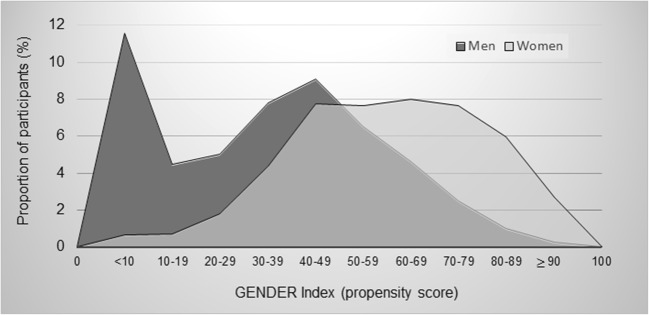
Objectives: Growing attention has been given to considering sex and gender in health research. However, this remains a challenge in the context of retrospective studies where self-reported gender measures are often unavailable. This study aimed to create and validate a composite gender index using data from the Canadian Community Health Survey (CCHS). Methods: According to scientific literature and expert opinion, the GENDER Index was built using several variables available in the CCHS and deemed to be gender-related (e.g., occupation, receiving child support, number of working hours). Among workers aged 18–50 years who had no missing data for our variables of interest (n = 29,470 participants), propensity scores were derived from a logistic regression model that included gender-related variables as covariates and where biological sex served as the dependent variable. Construct validity of propensity scores (GENDER Index scores) were then examined. Results: When looking at the distribution of the GENDER Index scores in males and females, they appeared related but partly independent. Differences in the proportion of females appeared between groups categorized according to the GENDER Index scores tertiles (p < 0.0001). Construct validity was also examined through associations between the GENDER Index scores and gender-related variables identified a priori such as choosing/avoiding certain foods because of weight concerns (p < 0.0001), caring for children as the most important thing contributing to stress (p = 0.0309), and ability to handle unexpected/difficult problems (p = 0.0375). Conclusion: The GENDER Index could be useful to enhance the capacity of researchers using CCHS data to conduct gender-based analysis among populations of workers.
Overview
The claims and statistics of this paper haven’t been checked yet.
Free: it reads the open-access text and checks the first 5 claims that cite a source we can check. Create a free account to check every claim.
Integrity signals
Registry
Cites
Statistics
Figures
Verification
Claims the paper makes
The claims and statistics of this paper haven’t been checked yet.
Free: it reads the open-access text and checks the first 5 claims that cite a source we can check. Create a free account to check every claim.
Claims other papers make about this one
Each is checked against this paper’s own text: does it say what the citing paper says it does?
The cited source says what the claim attributes to it.
In the citing paper
“While not the conventional epidemiological framing, this approach finds precedent in sex- and gender-score methodology in peer-reviewed health survey research (38, 40).”
From Health misinformation, digital health literacy, and attitudes toward science among university students: an exploratory cross-sectional survey (2026) · cites this paper as [38]
The cited source says what the claim attributes to it.
In the citing paper
“This approach is supported by peer-reviewed health research in which logistic regression with biological sex as the dependent variable is employed to identify variables that differ systematically between male and female participants (38–40).”
From Health misinformation, digital health literacy, and attitudes toward science among university students: an exploratory cross-sectional survey (2026) · cites this paper as [38]
The cited source says what the claim attributes to it.
In the citing paper
“Concerning the logistic regression model, the use of biological sex as the dependent variable, while documented in sex- and gender-score methodology in peer-reviewed health research (38, 40), represents a non-conventional analytical choice;the exploratory findings should therefore be interpreted with caution and replicated using more standard modeling approaches in future studies.”
From Health misinformation, digital health literacy, and attitudes toward science among university students: an exploratory cross-sectional survey (2026) · cites this paper as [38]
Self-check
Percentages, sums and reported differences re-computed from the paper’s own numbers.
The self-check needs the paper’s full text.
Citations
Cites
A Caution Regarding Rules of Thumb for Variance Inflation Factors
O’brien, R. M. (2007) · Quality & Quantity · doi:10.1007/s11135-006-9018-6 · Cited by 11,217
The measurement of psychological androgyny
Bem, S. L. (1974) · Journal of Consulting and Clinical Psychology · doi:10.1037/h0036215 · Cited by 8,522 · cited 1×
“As for gender, some validated self-report indexes are available for the measurement of selected gender constructs in prospective studies (e.g., gender roles, identity, relations) (Nanda 2011; McHugh and Hanson Frieze 1997; Shulman et al. 2017; Kachel et al. 2016; Bem 1974).”
MethodThe standards for educational and psychological testing.
Eignor, D. R. (2013) · APA handbook of testing and assessment in psychology, Vol. 1: Test theory and testing and assessment in industrial and organizational psychology. · doi:10.1037/14047-013 · Cited by 6,988
Mokkink, L. B., Terwee, C. B., Patrick, D. L., Alonso, J., Stratford, P. W., Knol, D. L., Bouter, L. M., & de Vet, H. C. W. (2010) · Journal of Clinical Epidemiology · doi:10.1016/j.jclinepi.2010.02.006 · Cited by 4,465
Standards for Educational and Psychological Testing
(2007) · Encyclopedia of Measurement and Statistics · doi:10.4135/9781412952644.n432 · Cited by 3,126
Multicollinearity in Regression Analyses Conducted in Epidemiologic Studies
P. Vatcheva, K., & Lee, M. (2016) · Epidemiology: Open Access · doi:10.4172/2161-1165.1000227 · Cited by 1,291
A review of uses of health care utilization databases for epidemiologic research on therapeutics
Schneeweiss, S., & Avorn, J. (2005) · Journal of Clinical Epidemiology · doi:10.1016/j.jclinepi.2004.10.012 · Cited by 1,277
Tamblyn, R., Lavoie, G., Petrella, L., & Monette, J. (1995) · Journal of Clinical Epidemiology · doi:10.1016/0895-4356(94)00234-h · Cited by 577
Indications for propensity scores and review of their use in pharmacoepidemiology
Glynn, R. J., Schneeweiss, S., & Stürmer, T. (2006) · Basic & Clinical Pharmacology & Toxicology · doi:10.1111/j.1742-7843.2006.pto_293.x · Cited by 541
Johnson, J. L., Greaves, L., & Repta, R. (2009) · International Journal for Equity in Health · doi:10.1186/1475-9276-8-14 · Cited by 531
Recommendations for reporting the results of studies of instrument and scale development and testing
Streiner, D. L., & Kottner, J. (2014) · Journal of Advanced Nursing · doi:10.1111/jan.12402 · Cited by 463
Handling missing data in self-report measures
Fox-Wasylyshyn, S. M., & El-Masri, M. M. (2005) · Research in Nursing & Health · doi:10.1002/nur.20100 · Cited by 395
Composite Variables: When and How
Song, M.-K., Lin, F.-C., Ward, S. E., & Fine, J. P. (2013) · Nursing Research · doi:10.1097/nnr.0b013e3182741948 · Cited by 388 · cited 1×
“…with the use of a set of gender-related variables, they provide greater statistical power by reducing the number of covariates included in multiple regression models, offer the possibility to test interaction terms, and reduce multiple comparisons (Glynn et al. 2006; Song et al. 2013).”
BackgroundTraditional Masculinity and Femininity: Validation of a New Scale Assessing Gender Roles
Kachel, S., Steffens, M. C., & Niedlich, C. (2016) · Frontiers in Psychology · doi:10.3389/fpsyg.2016.00956 · Cited by 302
Sex Versus Gender-Related Characteristics
Pelletier, R., Khan, N. A., Cox, J., Daskalopoulou, S. S., Eisenberg, M. J., Bacon, S. L., Lavoie, K. L., Daskupta, K., Rabi, D., Humphries, K. H., et al. (2016) · Journal of the American College of Cardiology · doi:10.1016/j.jacc.2015.10.067 · Cited by 291
The Measurement of Gender-Role Attitudes: A Review and Commentary
McHugh, M. C., & Frieze, I. H. (1997) · Psychology of Women Quarterly · doi:10.1111/j.1471-6402.1997.tb00097.x · Cited by 287
Masculine Gender-Role Stress: Predictor of Anger, Anxiety, and Health-Risk Behaviors
Eisler, R. M., Skidmore, J. R., & Ward, C. H. (1988) · Journal of Personality Assessment · doi:10.1207/s15327752jpa5201_12 · Cited by 271
Pelletier, R., Ditto, B., & Pilote, L. (2015) · Psychosomatic Medicine · doi:10.1097/psy.0000000000000186 · Cited by 223
Gender diagnosticity: A new Bayesian approach to gender-related individual differences.
Lippa, R. A., & Connelly, S. L. (1990) · Journal of Personality and Social Psychology · doi:10.1037/0022-3514.59.5.1051 · Cited by 184
Administrative Database Studies: Goldmine or Goose Chase?
Brodt, E., Skelly, A., Dettori, J., & Hashimoto, R. (2014) · Evidence-Based Spine-Care Journal · doi:10.1055/s-0034-1390027 · Cited by 135 · cited 1×
“…of such data sources is, nonetheless, indispensable to enriching our understanding of health trajectories, healthcare utilization, and real-world risks and benefits of drugs among large populations (Schneeweiss and Avorn 2005; Tamblyn et al. 1995; Bernatsky et al. 2013; Hashimoto et al. 2014).”
BackgroundMuula, A. S., Polycarpe, M. M., Job, J., Siziya, S., & Rudatsikira, E. (2009) · International Journal for Equity in Health · doi:10.1186/1475-9276-8-1 · Cited by 123
Conceptual complexity of gender and its relevance to pain
Boerner, K. E., Chambers, C. T., Gahagan, J., Keogh, E., Fillingim, R. B., & Mogil, J. S. (2018) · Pain · doi:10.1097/j.pain.0000000000001275 · Cited by 121
Measuring gender when you don’t have a gender measure: constructing a gender index using survey data
Smith, P. M., & Koehoorn, M. (2016) · International Journal for Equity in Health · doi:10.1186/s12939-016-0370-4 · Cited by 94 · cited 5×
“…and number of working hours per week) were consistent with variables retained by other authors when creating composite gender indexes (responsibility for caring for children, occupation, number of hours of work (Smith and Koehoorn 2016), and hours per week doing housework (Pelletier et al. 2015)).”
BackgroundMethodInfluentialCoping and adjustment in men with prostate cancer: a systematic review of qualitative studies
Spendelow, J. S., Joubert, H. E., Lee, H., & Fairhurst, B. R. (2017) · Journal of Cancer Survivorship · doi:10.1007/s11764-017-0654-8 · Cited by 94 · cited 1×
“…not have enough to eat 0.031 0.047 0.5110 Ownership of the household Tenant Reference Owner − 0.000 0.005 0.9887 Sense of belonging to the local community Very weak Reference Somewhat weak 0.020 0.009 0.0226 Somewhat strong 0.029 0.008 0.0003 (Spendelow et al. 2018), and expectations (Bekker 2003).”
BackgroundInfluentialA review of contemporary assessment tools for use with transgender and gender nonconforming adults.
Shulman, G. P., Holt, N. R., Hope, D. A., Mocarski, R. A., Eyer, J. C., & Woodruff, N. (2017) · Psychology of Sexual Orientation and Gender Diversity · doi:10.1037/sgd0000233 · Cited by 68
How to study the impact of sex and gender in medical research: a review of resources
McGregor, A. J., Hasnain, M., Sandberg, K., Morrison, M. F., Berlin, M., & Trott, J. (2016) · Biology of Sex Differences · doi:10.1186/s13293-016-0099-1 · Cited by 64
Sanmartin, C., Decady, Y. J., Trudeau, R., Dasylva, A., Tjepkema, M., Finès, P., Burnett, R. T., Ross, N. A., & Manuel, D. G. (2016) · PubMed · Cited by 64
Day, S., Masón, R., Tannenbaum, C., & Rochon, P. A. (2017) · PLoS ONE · doi:10.1371/journal.pone.0182812 · Cited by 61
Bekker, M. H. J. (2003) · Psychology, Health & Medicine · doi:10.1080/1354850031000087618 · Cited by 51 · cited 6×
“According to the literature, occupational characteristics are important gender-related variables to be considered in the creation of a gender index (Bekker 2003) and CCHS work-related variables are measured among participants aged 18–50 years.”
BackgroundMethodInfluentialJones, K. D., Mendenhall, S., & Myers, C. A. (2016) · Journal of American College Health · doi:10.1080/07448481.2015.1117462 · Cited by 43 · cited 1×
“…Canada 2012) b Unless stated otherwise c None of the participants reported being Aboriginal (North American Indian, Métis or Inuit) and Kufahl 2014) and stress can be related to gender roles or gender identities (Jones et al. 2016; Eisler et al. 1988), such variables were also relevant to our work.”
BackgroundMarital status, gender, and sexual orientation: Implications for employment hiring decisions.
Nadler, J. T., & Kufahl, K. M. (2014) · Psychology of Sexual Orientation and Gender Diversity · doi:10.1037/sgd0000050 · Cited by 41
Sajatovic, M., Micula‐Gondek, W., Tatsuoka, C. M., & Bialko, C. S. (2011) · Gender Medicine · doi:10.1016/j.genm.2011.06.002 · Cited by 35
BERNATSKY, S., LIX, L., O’DONNELL, S., LACAILLE, D., & CANRAD Network (2013) · The Journal of Rheumatology · doi:10.3899/jrheum.120835 · Cited by 34
How Reliable are Selected Scales from Population-based Health Surveys? An Analysis Among Seniors
Raina, P. S., Bonnett, B. N., Waltner‐Toews, D., Woodward, C. A., & Abernathy, T. (1999) · Canadian Journal of Public Health · doi:10.1007/bf03404102 · Cited by 33
Multi-level determinants to HPV vaccination among Hispanic farmworker families in Florida
Vamos, C. A., Vázquez‐Otero, C., Kline, N., Lockhart, E. A., Wells, K. J., Proctor, S. K., Meade, C. D., & Daley, E. M. (2018) · Ethnicity and Health · doi:10.1080/13557858.2018.1514454 · Cited by 30 · cited 2×
“…chronic diseases, such as experience and expression of physical symptoms (e.g., pain (Boerner et al. 2018)), health behaviours (e.g., vaccination (Vamos et al. 2018), treatment adherence (Sajatovic et al. 2011), alcohol or drug use (Lye and Waldron 1998)), coping strategies Table 3…”
BackgroundIncorporating Sex and Gender in Cardiovascular Research: The Time Has Come
Pilote, L., & Humphries, K. H. (2014) · Canadian Journal of Cardiology · doi:10.1016/j.cjca.2013.09.021 · Cited by 29
Yergens, D., Dutton, D. J., & Patten, S. B. (2014) · BMC Medical Research Methodology · doi:10.1186/1471-2288-14-15 · Cited by 27 · cited 2×
“…source of detailed self-reported information about the health status, health risk factors, and use of healthcare services among Canadians (Statistics Canada 2012), and its secondary analysis is of great value for research purposes (Sanmartin et al. 2016; Raina et al. 1999; Yergens et al. 2014).”
BackgroundRelationships of substance use to attitudes toward gender roles, family and cohabitation
Lye, D. N., & Waldron, I. (1998) · Journal of Substance Abuse · doi:10.1016/s0899-3289(99)80133-3 · Cited by 26
Vissandjée, B., Mourid, A., Greenaway, C., Short, W. E., & Proctor, J. A. (2016) · International Journal of Women s Health · doi:10.2147/ijwh.s119757 · Cited by 14
Self-citationHarrell, F., Jr. (1996) · doi:10.1002/(sici)1097-0258(19960229)15:4<361::aid-sim168>3.0.co;2-4
Research works printed but not linked: 2
- Institut de la statistique du Québec Trajectoires de soins des patients ayant des conditions propices aux soins ambulatoires de l’Unité de soutien à la recherche axée sur le patient (SRAP), Rapport d’appariement – Phase 1 2018 Québec Gouvernement du Québec
- Statistics Canada Canadian Community Health Survey (CCHS) – annual component: user guide 2010 and 2009–2010 Microdata files 2010 Ottawa Statistics Canada
Cited by
European Journal of Clinical Investigation
(2010) · European Journal of Clinical Investigation · doi:10.1111/(issn)1365-2362 · Cited by 632
Gender medicine: effects of sex and gender on cardiovascular disease manifestation and outcomes
Regitz-Zagrosek, V., & Gebhard, C. (2023) · Nature Reviews Cardiology · doi:10.1038/s41569-022-00797-4 · Cited by 386
The Importance of Gender to Understand Sex Differences in Cardiovascular Disease
Connelly, P. J., Azizi, Z., Alipour, P., Delles, C., Pilote, L., & Raparelli, V. (2021) · Canadian Journal of Cardiology · doi:10.1016/j.cjca.2021.02.005 · Cited by 189
Methods for prospectively incorporating gender into health sciences research
Tadiri, C. P., Raparelli, V., Abrahamowicz, M., Kautzy-Willer, A., Kublickiene, K., Herrero, M.-T., Norris, C. M., & Pilote, L. (2021) · Journal of Clinical Epidemiology · doi:10.1016/j.jclinepi.2020.08.018 · Cited by 71
The Operationalisation of Sex and Gender in Quantitative Health–Related Research: A Scoping Review
Horstmann, S., Schmechel, C., Palm, K., Oertelt‐Prigione, S., & Bolte, G. (2022) · International Journal of Environmental Research and Public Health · doi:10.3390/ijerph19127493 · Cited by 69
Metadata
- Authors
- on behalf of the TORSADE Cohort Working Group, Lacasse, A., Pagé, M. G., Choinière, M., Dorais, M., Vissandjée, B., Nguefack, H. L. N., Katz, J., Samb, O. M., & Vanasse, A.
- Affiliations
- Université du Québec en Abitibi-Témiscamingue (CA)
- Centre Hospitalier de l’Université de Montréal (CA)
- Université de Montréal (CA)
- Université de Sherbrooke (CA)
- Corresponding author
- Lacasse, Anaïs
- ORCID
- Venue
- Canadian Journal of Public Health
- Published
- 2020-01-13
- Volume
- 111
- Issue
- 2
- Pages
- 155-168
- ISSN
- 0008-4263 (ISSN-L)
- 1920-7476
- PMC
- PMC7109207
- OpenAlex
- W2999256346
- Cited by
- 39
- References
- 40
- Citations by year
- 2026: 4 · 2025: 5 · 2024: 5 · 2023: 7 · 2022: 7 · 2021: 7 · 2020: 4
- FWCI
- 4.68
- Type
- journal article
- Language
- en
- Open access
- hybrid
- doi.org
- Licence
- cc-by
- creativecommons.org/licenses/by/4.0 (tdm)
- creativecommons.org/licenses/by/4.0 (vor)
- Locations
- Canadian Journal of Public Health (publishedVersion, cc-by)
- PubMed Central (publishedVersion, cc-by)
- PubMed (publishedVersion)
- Depositum (Université du Québec en Abitibi-Témiscamingue) (acceptedVersion)
- Funders
- Canadian Institutes of Health Research (#PCG155479)
- The Quebec SUPPORT Unit (NA)
- Topics
- Health Sciences › Medicine › Public Health, Environmental and Occupational Health › Sex and Gender in Healthcare
- Physical Sciences › Mathematics › Statistics and Probability › Statistical Methods in Epidemiology
- Social Sciences › Sociology and Political Science › Gender, Health, and Social Inequality
- Keywords
- gender analysis, gender index, Canadian Community Health Survey, workers, construct validity, propensity score, biological sex, child support, working hours
- MeSH terms
- Adolescent, Adult, Female, Health Surveys, Humans, Male, Middle Aged, Research, Sex Factors, Bias, Databases, Factual, Young Adult, Propensity Score, Self Report
About these checks
Registry, retraction, Cites and statistics results are computed, not judged, with one exception: a printed reference that no index lists is read once by a model before it counts as a citation error. Claims are extracted by a model and kept only when their quote appears verbatim in the text; each cited source is then checked, with a model’s help, for whether it says what the claim relies on. Those verdicts can be wrong — read the claim’s quote and the cited source before relying on one.
Statistics and arithmetic are recomputed, not judged.
Confidence bands are shown only for fields calibrated on our annotated test set. None is calibrated yet, so no band is shown.
What counts as a claim ›How we measure confidence ›How we check this ›
Are you an author, or do you see a problem with this page? Request a review
Data sources
Bibliographic data: Semantic Scholar, OpenAlex, Crossref.
Contains information from the Semantic Scholar Academic Graph Datasets, made available under the ODC Attribution License (ODC-BY 1.0).
Semantic Scholar’s data is described in: Kinney, R., et al. (2023). The Semantic Scholar Open Data Platform. arXiv:2301.10140.
