

The DOI matches its Crossref record; 29 of the 31 references it cites were found in a registry or an index.
Validación mexicana de la Escala de Funcionamiento Psicológico Positivo. Perspectivas en torno al estudio del bienestar y su medida
Open accessAbstract
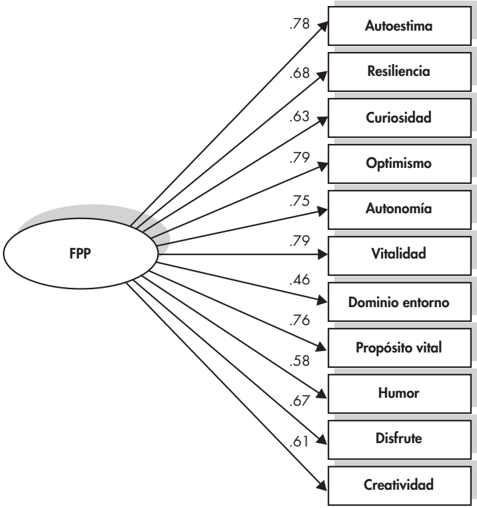
Resumen Antecedentes. La escala de Funcionamiento Psicológico Positivo (FPP) es una escala recientemente desarrollada en España. Está formada por 11 recursos psicológicos: autonomía, resiliencia, autoestima, propósito en la vida, disfrute, optimismo, curiosidad, creatividad, humor, dominio del entorno y vitalidad. Éstos se agrupan en un factor de segundo orden que da nombre a la escala. Se trata de un instrumento que presenta una adecuada validez y fiabilidad. Además, los análisis factoriales confirmatorios arrojaron un buen nivel de ajuste. Objetivo. El propósito del presente estudio es validar la escala de FPP en México. Método. A tal fin, contamos con una muestra de 184 estudiantes de Psicología de la Universidad Nacional Autónoma de México (UNAM) a la que hemos aplicado la escala de FPP junto con otras medidas relacionadas para calcular la fiabilidad y validez de la escala en México. Resultados. Los resultados obtenidos en la escala de FPP muestran una fiabilidad y validez adecuadas. Además, el cuestionario presenta una estructura factorial jerárquica formada por 11 factores de primer orden y un factor general de segundo orden. Los mismos resultados se encontraron en la validación española. Discusión y conclusión. Al menos que sepamos, no hay otra escala que mida funcionamiento positivo en México, pues los intentos de adaptar otras escalas semejantes no han sido satisfactorios. Los resultados encontrados nos permiten recomendar la aplicación de esta escala en México.
Overview
The claims and statistics of this paper haven’t been checked yet.
Run the check — free, no account needed. It reads the open-access text and checks the sources it cites.
Integrity signals
Registry
Cites
Statistics
Figures
Verification
Claims the paper makes
The claims and statistics of this paper haven’t been checked yet.
Run the check — free, no account needed. It reads the open-access text and checks the sources it cites.
Claims other papers make about this one
Each is checked against this paper’s own text: does it say what the citing paper says it does?
The cited source says what the claim attributes to it.
In the citing paper
“Furthermore, the Positive Psychological Functioning scale [102] was planned to be included in this paper. However, it could not be included because while the postmeasurements could be retrieved, there were electronic issues during the premeasurements.”
Self-check
Percentages, sums and reported differences re-computed from the paper’s own numbers.
The self-check needs the paper’s full text.
Citations
Cites
Development and validation of brief measures of positive and negative affect: The PANAS scales.
Watson, D., Clark, L. A., & Tellegen, A. (1988) · Journal of Personality and Social Psychology · doi:10.1037/0022-3514.54.6.1063 · Cited by 32,433
The satisfaction with life scale
Diener, E., Emmons, R. A., Larsen, R. J., & Griffin, S. (1985) · Journal of Personality Assessment · doi:10.1207/s15327752jpa4901_13 · Cited by 31,768
Comparative fit indexes in structural models.
Bentler, P. M. (1990) · Psychological Bulletin · doi:10.1037/0033-2909.107.2.238 · Cited by 25,266
(1970) · Cited by 24,983
Significance tests and goodness of fit in the analysis of covariance structures.
Bentler, P. M., & Bonett, D. G. (1980) · Psychological Bulletin · doi:10.1037/0033-2909.88.3.588 · Cited by 20,015
Happiness is everything, or is it? Explorations on the meaning of psychological well-being.
Ryff, C. D. (1989) · Journal of Personality and Social Psychology · doi:10.1037/0022-3514.57.6.1069 · Cited by 14,847
On Happiness and Human Potentials: A Review of Research on Hedonic and Eudaimonic Well-Being
Ryan, R. M., & Deci, E. L. (2001) · Annual Review of Psychology · doi:10.1146/annurev.psych.52.1.141 · Cited by 11,567 · cited 1×
“Neurol Neurocir Psiquiat 2008;41(3-4):90-97.”
Multivariate Data Analysis, 6th ed
Tatham, R. L., Anderson, R. E., Babin, B. J., Black, W. C., & Hair, J. F. (2006) · Cited by 9,807
Structural model evaluation and modification: An interval estimation approach
Steiger, J. H. (1990) · Multivariate Behavioral Research · doi:10.1207/s15327906mbr2502_4 · Cited by 7,408
Structural Equation Modeling With AMOS: Basic Concepts, Applications, and Programming, Third Edition
Byrne, B. M. (2016) · doi:10.4324/9781315757421 · Cited by 4,653
Research works printed but not linked: 6
- Stones MJ, Worobetz S, Brink P. Overestimated Relationship with we- llbeing. Canadian Psychology 2011;52:93-100.
- Medina-Calvillo MA, Gutiérrez-Hernández CY, Padrós-Blázquez F. Propiedades psicométricas de la escala de bienestar psicológico de Ryff en población mexicana. Revista Educación Desarrollo 2013;27:25-30.
- Beck AT, Steer RA, Brown GK. BDI-II. Beck depression inventory. Second edition. Manual. San Antonio, TX: The Psychological Corpo- ration; 1996.
- Díaz D, Rodríguez-Carvajal R, Blanco A, Moreno-Jiménez B et al. Adaptación española de las escalas de bienestar psicológico de Ryff. Psicothema 2006;18:572-577.
- Loera N, Balcázar P, Trejo L, Gurrola G et al. Adaptación de la escala de Bienestar Psicológico de Ryff en adolescentes preuniversitarios. Neurol Neurocir Psiquiat 2008;41(3-4):90-97.
- Steiger JH. Structural model evaluation modification: An interval esti- mation approach. Multivariate Behavioral Research 1990;25:173-180.
Cited by
Sorted by citations
Felicidad y Bienestar Psicológico: Estudio Comparativo Entre Argentina y España
Muratori, M., Zubieta, E. M., Landa, S. U., González, J. L., & Bobowik, M. (2015) · Psykhe (Santiago) · doi:10.7764/psykhe.24.2.900 · Cited by 42
Merino, M. D., Privado, J., & Arnaiz, R. (2019) · Journal of Work and Organizational Psychology · doi:10.5093/jwop2019a1 · Cited by 35
Self-citationVillalobos, J. Á. C., & Marrero, R. J. (2017) · Suma Psicológica · doi:10.1016/j.sumpsi.2017.01.002 · Cited by 43
“En población mexicana, el alfa es de .84 para emociones positivas y de .88 para emociones negativas (Merino et al., 2015).”
BackgroundRodríguez, A. D., la Rosa-Gómez, A. D., Jiménez, M. J. H., Arenas-Landgrave, P., Martínez-Luna, S. C., Silva, J. A., Hernández, J. E. G., Arzola-Sánchez, C. A., & Guzmán, V. A. (2020) · JMIR Research Protocols · doi:10.2196/23117 · Cited by 19
Propiedades Psicométricas del Cuestionario QEWB de Bienestar Eudaimónico en Adolescentes
Salavera, C., & Supervía, P. U. (2019) · Psicologí a Educativa · doi:10.5093/psed2019a3 · Cited by 15
“En relación al bienestar subjetivo, Merino, Privado y Gracia (2015) establecieron una escala de funcionamiento positivo (FPP) formada por 11 recursos psicológicos (autonomía, resiliencia, autoestima, propósito en la vida, disfrute, optimismo, curiosidad, creatividad, humor, dominio del entorno y…”
Background
Metadata
- Authors
- Merino, M. D., Facultad de Psicología, D. D. P., Privado, J., Gracia, Z., & Facultad de Psicología, D. D. M. D. L. C. D. C.
- Affiliations
- Universidad Complutense de Madrid (ES)
- ORCID
- Privado, Jesús
- Venue
- Salud mental
- Published
- 2015-04-14
- Volume
- 38
- Issue
- 2
- Pages
- 109-115
- ISSN
- 0185-3325 (ISSN-L)
- OpenAlex
- W2169673009
- Cited by
- 22
- References
- 31
- Citations by year
- 2024: 2 · 2023: 2 · 2022: 2 · 2021: 2 · 2020: 4 · 2019: 2 · 2018: 1 · 2017: 3 · 2016: 1 · 2015: 2
- FWCI
- 3.82
- Type
- journal article
- Language
- es
- Open access
- diamond
- doi.org
- Licence
- cc-by-nc
- Locations
- Salud Mental (publishedVersion, cc-by-nc)
- Redalyc (Universidad Autónoma del Estado de México) (submittedVersion)
- Zaguan (University of Zaragoza Repository) (submittedVersion, cc-by)
- Topics
- Social Sciences › Psychology › Social Psychology › Psychological Well-being and Life Satisfaction
- Social Sciences › Decision Sciences › Management Science and Operations Research › Psychometric Methodologies and Testing
- Social Sciences › Psychology › Applied Psychology › Optimism, Hope, and Well-being
- Keywords
- positive psychological functioning, psychological well-being, cross-cultural adaptation, psychometric validation, factor structure, second-order factors, autonomy, resilience, self-esteem, optimism, curiosity, creativity, humor, vitality, Mexican university students
About these checks
Registry, retraction, Cites and statistics results are computed, not judged, with one exception: a printed reference that no index lists is read once by a model before it counts as a citation error. Claims are extracted by a model and kept only when their quote appears verbatim in the text; each cited source is then checked, with a model’s help, for whether it says what the claim relies on. Those verdicts can be wrong — read the claim’s quote and the cited source before relying on one.
Statistics and arithmetic are recomputed, not judged.
Confidence bands are shown only for fields calibrated on our annotated test set. None is calibrated yet, so no band is shown.
What counts as a claim ›How we measure confidence ›How we check this ›
Are you an author, or do you see a problem with this page? Request a review
