

Assessment of the psychometric properties of the Italian version of the perceptions of empowerment in midwifery practice scale-revised (PEMS-R-IT) in midwives
Open accessThe DOI matches its Crossref record; 25 of the 27 references it cites were found in a registry or an index; none of the 34 sources its claims cite is checked for support yet.
Abstract
INTRODUCTION: A higher degree of midwives' empowerment is associated with greater job satisfaction and better midwifery care outcomes for women and their families. Empowered midwives are able to better empower women who in turn have a positive influence on the midwives' empowerment. The aim of this study was the translation, cultural adaptation, and validation of the perceptions of empowerment in midwifery scale-revised (PEMS-R) in a group of Italian midwives. METHODS: The World Health Organization (WHO) method was adopted to achieve the PEMS-R Italian version. This process involved five steps: 1) forward translation, 2) expert panel translation, 3) back-translation, 4) pre-testing and cognitive interviewing, and 5) final version. The test's internal consistency and validity were assessed by following international guidelines. Internal consistency was examined through Cronbach's alpha (α) coefficient. RESULTS: The PEMS-R-IT was administered to 147 Italian midwives from northern Italy. Factor analysis of the 19 items, extracted 4 factors that explained 74.96% of the variance. The Student's t-test for independent samples was used to identify a possible correlation between a higher/lower perception of empowerment and: 1) the education level, and 2) the years of experience of recruited midwives. No statistically significant differences were obtained in either case. The PEMS-R-IT was found to have a good internal consistency for each of its 4 subscales. CONCLUSIONS: The PEMS-R-IT is a valid and reliable tool, useful to assess midwives' empowerment. It can be used in both clinical practice and research in order to investigate the level of empowerment of midwives within the Italian national context.
Overview
CoChat Summary
TL;DR
This study translated, culturally adapted, and validated the Italian version of the Perceptions of Empowerment in Midwifery Scale-Revised (PEMS-R-IT) in 147 Italian midwives. It found a four-factor structure explaining 74.96% of variance and good internal consistency for all subscales, with no statistically significant differences in empowerment by education level or years of experience.
Key findings
- Exploratory factor analysis of the 19 PEMS-R-IT items extracted 4 factors explaining 74.96% of the variance, matching the original PEMS-R subscales: autonomy/empowerment, manager support, professional recognition, and skills and resources.
- Cronbach’s alpha was 0.807 for autonomy/empowerment, 0.948 for manager support, 0.866 for professional recognition, and 0.767 for skills and resources.
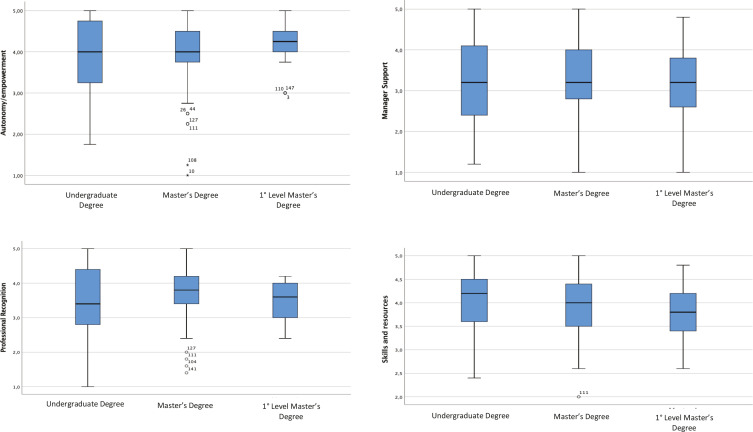
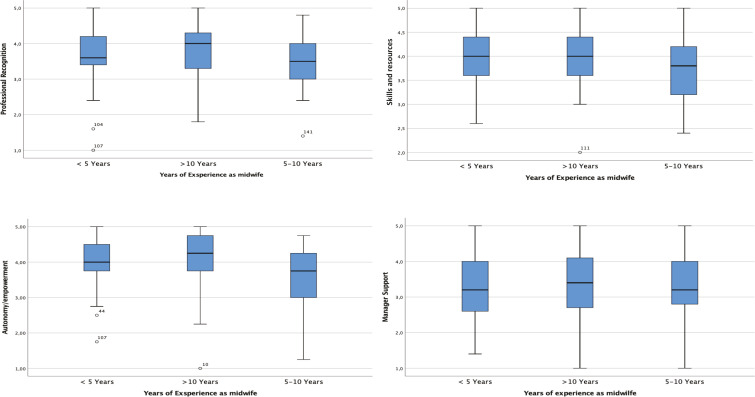
- Student’s t-test for independent samples found no statistically significant differences in empowerment subscale scores by education level (undergraduate degree, Master’s degree, first level Master’s degree) or years of experience (<5, 5–10, >10 years).
- The sample comprised 147 midwives recruited mainly from Northern Italy: 103 (70.1%) had an undergraduate degree, 23 (15.6%) a Master’s degree, and 21 (14.3%) a first level Master’s degree; 137 (93.2%) worked in hospitals and 10 (6.8%) in community settings.
Methods
- The PEMS-R was translated and culturally adapted into Italian using the World Health Organization (WHO) Translation Protocol, involving five steps: forward translation, expert panel translation, back-translation, pre-testing and cognitive interviewing, and final version.
- The PEMS-R-IT was administered to 147 qualified Italian midwives recruited via three Italian Colleges of Midwives; demographic questions covered education level, years of experience, and workplace.
- Statistical analysis used SPSS 18.0 and followed COSMIN guidelines: exploratory factor analysis for construct validity, Student’s t-test for independent samples to compare empowerment by education and experience, and Cronbach’s alpha for internal consistency (values >0.70 considered acceptable).
Limitations
- The paper states there was no correlation with a gold standard because no other tools measuring empowerment in midwives were identified.
- The paper states the lack of statistically significant differences by years of experience and education level could be due to the small sample size and non-comparable groups; a self-report questionnaire also exposed data to potential social desirability effects.
- Evident from the text: the sample was predominantly from Northern Italy and hospital-based (137/147, 93.2%), limiting generalizability; no test-retest analysis was performed, and the authors recommend it for future validations.
Model-written summary. Check it against the paper before relying on it.
Integrity signals
Registry
Cites
Statistics
Figures
Verification
Claims the paper makes
0 Valid · 0 Not valid · 22 Not checked · 15 Own results and interpretations
A result the paper reports from its own data — it cites no other source for it, so there is none to check. The quote shows it is in the paper.
In the paper
“Moreover, in the corrected item-total correlation, item 17 (‘I have control over my practice’) appears to be the least correlated within the entire scale, with α=0.457.”
§ Assessment of the psychometric properties of the Italian version of the perceptions of empowerment in midwifery practice scale-revised (PEMS-R-IT) in midwives > DISCUSSION
hedgedstates an association- Asserted: passes — The authors put it forward as true.
- Checkable: passes — It can be checked against evidence.
- Load-bearing: unclear — It is unclear whether the paper’s conclusions depend on it.
- Based: passes — The paper gives a reason why it holds.
A result the paper reports from its own data — it cites no other source for it, so there is none to check. The quote shows it is in the paper.
In the paper
“Exploratory factor analysis was used to estimate the construct validity of the 19-items PEMS-R-IT, extracting 4 factors that explained 74.9% of the variance.”
§ Assessment of the psychometric properties of the Italian version of the perceptions of empowerment in midwifery practice scale-revised (PEMS-R-IT) in midwives > RESULTS
plainn = 147- Asserted: passes — The authors put it forward as true.
- Checkable: passes — It can be checked against evidence.
- Load-bearing: passes — The paper’s conclusions depend on it.
- Based: passes — The paper gives a reason why it holds.
A result the paper reports from its own data — it cites no other source for it, so there is none to check. The quote shows it is in the paper.
In the paper
“In the first case, as shown in Table 3, no statistically significant values were shown between the mean scores obtained in the 3 categories of education level taken into consideration (undergraduate degree, Master’s degree, first level Master’s degree).”
§ Assessment of the psychometric properties of the Italian version of the perceptions of empowerment in midwifery practice scale-revised (PEMS-R-IT) in midwives > DISCUSSION
plain- Asserted: passes — The authors put it forward as true.
- Checkable: passes — It can be checked against evidence.
- Load-bearing: unclear — It is unclear whether the paper’s conclusions depend on it.
- Based: passes — The paper gives a reason why it holds.
A result the paper reports from its own data — it cites no other source for it, so there is none to check. The quote shows it is in the paper.
In the paper
“As shown in Table 3, there are no statistically significant differences in the 4 subscales for the 3 considered categories (<5, 5–10, and >10 years)”
§ Assessment of the psychometric properties of the Italian version of the perceptions of empowerment in midwifery practice scale-revised (PEMS-R-IT) in midwives > DISCUSSION
plain- Asserted: passes — The authors put it forward as true.
- Checkable: passes — It can be checked against evidence.
- Load-bearing: unclear — It is unclear whether the paper’s conclusions depend on it.
- Based: passes — The paper gives a reason why it holds.
What the paper did — it cites no source for this, so there is none to check. The quote shows it is in the paper.
In the paper
“However, our results cannot confirm this, as a stratified analysis by workplace could not be performed due to non-comparable sample sizes between the two groups, with 137 (93.2%) hospital midwives and only 10 (6.8%) community midwives.”
§ Assessment of the psychometric properties of the Italian version of the perceptions of empowerment in midwifery practice scale-revised (PEMS-R-IT) in midwives > DISCUSSION
plain- Asserted: passes — The authors put it forward as true.
- Checkable: passes — It can be checked against evidence.
- Load-bearing: passes — The paper’s conclusions depend on it.
- Based: passes — The paper gives a reason why it holds.
8 more claims
Create a free account to see all 37 claims and to verify the 34 references still open.
- It may state two separate claims as one. 9
- Probably not a substantial claim. 19
Self-check
Percentages, sums and reported differences re-computed from the paper’s own numbers.
Each contradiction between two passages listed here was confirmed by an independent check.
Rated minor: it would not touch a result — a value no result rests on, a p-value that stays on the same side of the significance level, or a conflict that is clerical, resolved elsewhere in the paper, or outside its own findings.
In the paper
§ Assessment of the psychometric properties of the Italian version of the perceptions of empowerment in midwifery practice scale-revised (PEMS-R-IT) in midwives > DISCUSSION
“item 17 (‘I have control over my practice’) appears to be the least correlated within the entire scale, with α=0.457.”
§ Assessment of the psychometric properties of the Italian version of the perceptions of empowerment in midwifery practice scale-revised (PEMS-R-IT) in midwives > RESULTS
“| | I do not know what my scope of practice is | 0.457 | 0.759 |”
Rated minor: it would not touch a result — a value no result rests on, a p-value that stays on the same side of the significance level, or a conflict that is clerical, resolved elsewhere in the paper, or outside its own findings.
In the paper
§ Assessment of the psychometric properties of the Italian version of the perceptions of empowerment in midwifery practice scale-revised (PEMS-R-IT) in midwives > RESULTS
“| I do not have a supportive manager | -0.876 | | | |”
§ Assessment of the psychometric properties of the Italian version of the perceptions of empowerment in midwifery practice scale-revised (PEMS-R-IT) in midwives > RESULTS
“| Manager support | I do not have a supportive manager | 0.850 | 0.937 |”
Citations
Cites
Wild, D., Grove, A., Martin, M., Eremenco, S., McElroy, S., Verjee-Lorenz, A., & Erikson, P. (2005) · Value in Health · doi:10.1111/j.1524-4733.2005.04054.x · Cited by 5,521
Mokkink, L. B., Terwee, C. B., Patrick, D. L., Alonso, J., Stratford, P. W., Knol, D. L., Bouter, L. M., & de Vet, H. C. W. (2010) · Quality of Life Research · doi:10.1007/s11136-010-9606-8 · Cited by 4,260
A model of equivalence in the cultural adaptation of HRQoL instruments: the universalist approach.
Herdman, M., Fox-Rushby, J. A., & Badia, X. C. (1998) · Quality of Life Research · doi:10.1023/a:1024985930536 · Cited by 1,201
Kirwan, M., Matthews, A., & Scott, P. A. (2013) · International Journal of Nursing Studies · doi:10.1016/j.ijnurstu.2012.08.020 · Cited by 295
Empowerment: Rejuvenating a potent idea
Forrester, R. (2000) · Academy of Management Perspectives · doi:10.5465/ame.2000.4468067 · Cited by 237
Cultural characteristics of “high” and “low” performing hospitals
Mannion, R., Davies, H. T. O., & Marshall, M. N. (2005) · Journal of Health Organization and Management · doi:10.1108/14777260510629689 · Cited by 196
The effect of structural empowerment of nurses on quality outcomes in hospitals: a scoping review
Goedhart, N. S., van Oostveen, C., & Vermeulen, H. (2017) · Journal of Nursing Management · doi:10.1111/jonm.12455 · Cited by 187
The culture of midwifery in the National Health Service in England
Kirkham, M. (1999) · Journal of Advanced Nursing · doi:10.1046/j.1365-2648.1999.01139.x · Cited by 184
Pezaro, S., Clyne, W., Turner, A., Fulton, E. A., & Gerada, C. (2015) · Women and Birth · doi:10.1016/j.wombi.2015.10.006 · Cited by 142
Sullivan, K., Lock, L., & Homer, C. (2011) · Midwifery · doi:10.1016/j.midw.2011.01.007 · Cited by 126
Cited by
Midwives' stress and burnout during the Omicron wave in Italy: An observational survey
Fumagalli, S., Panzeri, M., Borrelli, S., Ornaghi, S., Antolini, L., Sacco, G. G. A., Formenti, M., Sala, S., & Nespoli, A. (2024) · Journal of Advanced Nursing · doi:10.1111/jan.16065 · Cited by 7
Self-citationAmadio, E., Mencio, M., Carlizza, A., Panuccio, F., Sellitto, G., Ruotolo, I., Simeon, R., Berardi, A., & Galeoto, G. (2024) · Journal of Clinical Medicine · doi:10.3390/jcm13206166 · Cited by 7
Self-citationFumagalli, S., Torrenzano, G., Adami, A., Panzeri, M., Lucia, A. D., Antolini, L., Caliari, E., Bassetti, S., Danza, M., Lopresti, E., et al. (2025) · Nurse Education in Practice · doi:10.1016/j.nepr.2025.104342 · Cited by 7
Self-citationIglesias-Casás, S., Vila‐Candel, R., Tudela, D. M., Martín-Arribas, A., & León-Larios, F. (2024) · Healthcare · doi:10.3390/healthcare12191994 · Cited by 7
la Torre, H. G., Hernández-Rodríguez, M.-I., Moreno-Canino, A.-M., Portela-Lomba, A.-M., Berenguer‐Pérez, M., & Soriano, J. V. (2023) · Healthcare · doi:10.3390/healthcare11101464 · Cited by 5
Metadata
- Authors
- Fumagalli, S., Borrelli, S., Galeoto, G., Panuccio, F., Pignataro, C., Gottardi, M., & Nespoli, A.
- Affiliations
- University of Milano-Bicocca (IT)
- University of Nottingham (GB)
- Istituto Neurologico Mediterraneo (IT)
- Sapienza University of Rome (IT)
- Azienda sanitaria universitaria Friuli Centrale (IT)
- Corresponding author
- Fumagalli, Simona
- Venue
- European Journal of Midwifery
- Publisher
- European Publishing
- Published
- 2022-05-23
- Volume
- 6
- Issue
- May
- Pages
- 1-8
- ISSN
- 2585-2906 (ISSN-L)
- PMC
- PMC9126032
- OpenAlex
- W4281398500
- Cited by
- 13
- References
- 27
- Citations by year
- 2026: 3 · 2025: 4 · 2024: 5 · 2023: 1
- FWCI
- 1.80
- Type
- journal article
- Language
- en
- Open access
- gold
- doi.org
- Licence
- cc-by
- creativecommons.org/licenses/by/4.0/ (vor)
- creativecommons.org/licenses/by/4.0/ (am)
- creativecommons.org/licenses/by/4.0/ (tdm)
- Locations
- European Journal of Midwifery (publishedVersion, cc-by)
- Repository@Nottingham (University of Nottingham) (publishedVersion, cc-by)
- PubMed Central (publishedVersion, cc-by)
- PubMed (publishedVersion)
- IRIS Research product catalog (Sapienza University of Rome) (submittedVersion, cc-by)
- BOA (University of Milano-Bicocca) (submittedVersion, cc-by)
- DOAJ (DOAJ: Directory of Open Access Journals) (submittedVersion)
- Topics
- Health Sciences › Nursing › Leadership and Management › Healthcare Education and Workforce Issues
- Health Sciences › Nursing › Research and Theory › Health Education and Validation
- Health Sciences › Nursing › Research and Theory › Nursing education and management
- Keywords
- psychometric validation, internal consistency, midwifery workforce, job satisfaction
About these checks
Registry, retraction, Cites and statistics results are computed, not judged, with one exception: a printed reference that no index lists is read once by a model before it counts as a citation error. Claims are extracted by a model and kept only when their quote appears verbatim in the text; each cited source is then checked, with a model’s help, for whether it says what the claim relies on. Those verdicts can be wrong — read the claim’s quote and the cited source before relying on one.
A language model drew the claims from the paper on 2026-11-24, under version 3 of the claim definition (model deepseek-v4.1-flash, prompt extract-v3).
A second model labelled each claim on 2026-11-24 (model jev-1.13-20260917, definition revision gold-guideline-v0.2).
Statistics and arithmetic are recomputed, not judged.
Confidence bands are shown only for fields calibrated on our annotated test set. None is calibrated yet, so no band is shown.
What counts as a claim ›How we measure confidence ›How we check this ›
Are you an author, or do you see a problem with this page? Request a review
How to cite
Cite CoChat for the checks on this page, and the paper for its own findings.
- This page
- CoChat. (2026). Citation check: Assessment of the psychometric properties of the Italian version of the perceptions of empowerment in midwifery practice scale-revised (PEMS-R-IT) in midwives. https://app.cochat.ai/papers/10.18332/ejm/146587
- The paper
- Fumagalli, S., Borrelli, S., Galeoto, G., Panuccio, F., Pignataro, C., Gottardi, M., & Nespoli, A. (2022). Assessment of the psychometric properties of the Italian version of the perceptions of empowerment in midwifery practice scale-revised (PEMS-R-IT) in midwives. European Journal of Midwifery. https://doi.org/10.18332/ejm/146587
Data sources
Bibliographic data: Semantic Scholar, OpenAlex, Crossref.
Contains information from the Semantic Scholar Academic Graph Datasets, made available under the ODC Attribution License (ODC-BY 1.0).
Semantic Scholar’s data is described in: Kinney, R., et al. (2023). The Semantic Scholar Open Data Platform. arXiv:2301.10140.
