

The DOI matches its Crossref record; 61 of the 66 references it cites were found in a registry or an index, and 1 are not checked yet.
A Systematic Assessment of Syntactic Generalization in Neural Language Models
Open accessAbstract
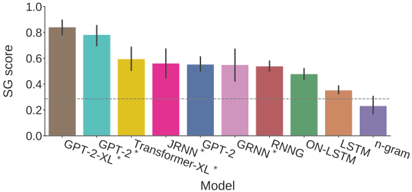
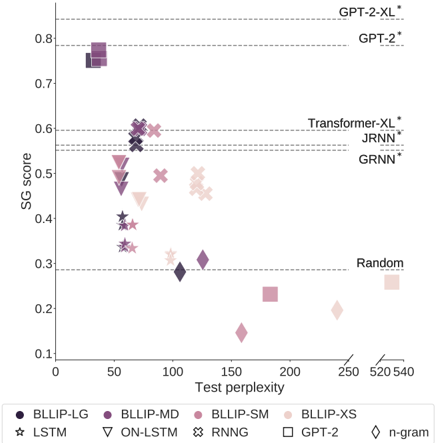
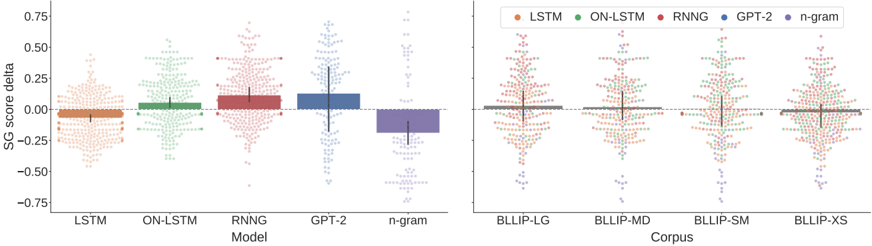
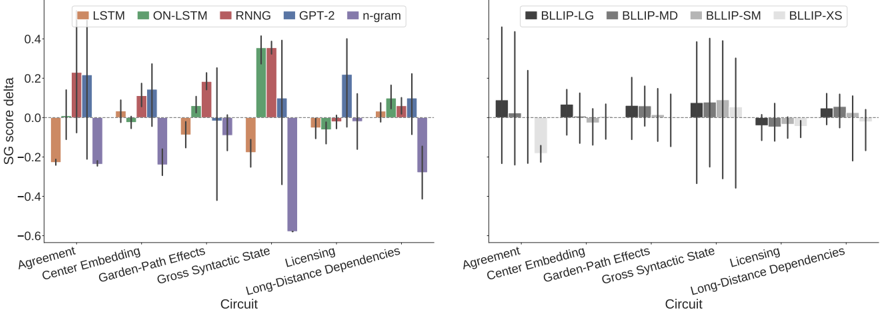
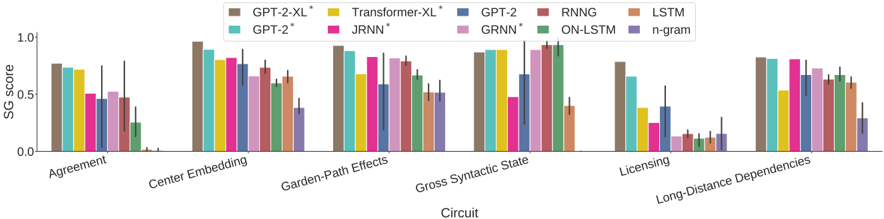
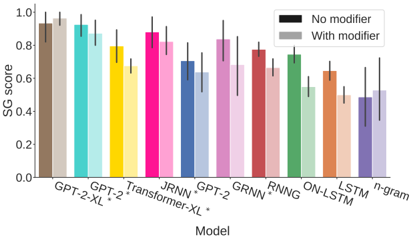
While state-of-the-art neural network models continue to achieve lower perplexity scores on language modeling benchmarks, it remains unknown whether optimizing for broad-coverage predictive performance leads to human-like syntactic knowledge.Furthermore, existing work has not provided a clear picture about the model properties required to produce proper syntactic generalizations.We present a systematic evaluation of the syntactic knowledge of neural language models, testing 20 combinations of model types and data sizes on a set of 34 English-language syntactic test suites.We find substantial differences in syntactic generalization performance by model architecture, with sequential models underperforming other architectures.Factorially manipulating model architecture and training dataset size (1M-40M words), we find that variability in syntactic generalization performance is substantially greater by architecture than by dataset size for the corpora tested in our experiments.Our results also reveal a dissociation between perplexity and syntactic generalization performance.
Overview
The claims and statistics of this paper haven’t been checked yet.
Run the check — free, no account needed. It reads the open-access text and checks the sources it cites.
Integrity signals
Registry
Cites
Statistics
Figures

Verification
Claims the paper makes
The claims and statistics of this paper haven’t been checked yet.
Run the check — free, no account needed. It reads the open-access text and checks the sources it cites.
Claims other papers make about this one
Each is checked against this paper’s own text: does it say what the citing paper says it does?
The cited source doesn’t support the claim as written.
In the citing paper
“It is evaluated as the model with outperforming bilingual evaluation understudy (BLEU) score among four state-of-art text generation methods (RNN, GAN, GPT, and CTRL) [66] and the best syntactic generalization score among trained (LSTM, ON-LSTM, Transformer, n-gram) and ofthe-shelf (GPT, JRNN, Transformer-XL) models [46].”
From Synthetic Lies: Understanding AI-Generated Misinformation and Evaluating Algorithmic and Human Solutions (2023) · cites this paper as [46]
Checked by a reasoning model — may be wrong.
Experimental — accuracy not yet measured
Self-check
Percentages, sums and reported differences re-computed from the paper’s own numbers.
The self-check needs the paper’s full text.
Citations
Cites
Vaswani, A., Shazeer, N., Parmar, N., Uszkoreit, J., Jones, L., Gomez, A. N., Kaiser, L., & Polosukhin, I. (2017) · arXiv · doi:10.48550/arxiv.1706.03762 · Cited by 120,404
Hochreiter, S., & Schmidhuber, J. (1997) · Neural Computation · doi:10.1162/neco.1997.9.8.1735 · Cited by 102,318
BERT: Pre-training of Deep Bidirectional Transformers for Language Understanding
Devlin, J., Chang, M.-W., Lee, K., & Toutanova, K. (2018) · arXiv · doi:10.48550/arxiv.1810.04805 · Cited by 73,173
BERT: Pre-training of Deep Bidirectional Transformers for Language Understanding
Devlin, J., Chang, M.-W., Lee, K., & Toutanova, K. (2019) · Proceedings of the 2019 Conference of the North American Chapter of the Association for Computational Linguistics: Human Language Technologies, Volume 1 (Long and Short Papers) · doi:10.18653/v1/n19-1423 · Cited by 54,325
(2017) · Cited by 11,625
Building a Large Annotated Corpus of English: The Penn Treebank
Marcus, M. (1993) · doi:10.21236/ada273556 · Cited by 7,405
XLNet: Generalized Autoregressive Pretraining for Language Understanding
Yang, Z., Dai, Z., Yang, Y., Carbonell, J., Salakhutdinov, R., & Le, Q. V. (2019) · arXiv · doi:10.48550/arxiv.1906.08237 · Cited by 6,687
GLUE: A Multi-Task Benchmark and Analysis Platform for Natural Language Understanding
Wang, A., Singh, A., Michael, J., Hill, F., Levy, O., & Bowman, S. (2018) · Proceedings of the 2018 EMNLP Workshop BlackboxNLP: Analyzing and Interpreting Neural Networks for NLP · doi:10.18653/v1/w18-5446 · Cited by 4,222
Constraints on variables in syntax
Ross, J. R. (1967) · DSpace@MIT (Massachusetts Institute of Technology) · Cited by 4,102
Loper, E., & Bird, S. (2002) · doi:10.3115/1118108.1118117 · Cited by 3,323
Research works printed but not linked: 6
- Andrew Carnie. 2012. Syntax: A generative introduc- tion, volume 18. John Wiley & Sons.
- Anastasia Giannakidou. 2011. Negative and positive polarity items: Variation, licensing, and composi- tionality. In Semantics: An international hand- book of natural language meaning, volume 3, pages 1660-1712. Berlin: Mouton de Gruyter.
- Mario Giulianelli, Jack Harding, Florian Mohnert, Dieuwke Hupkes, and Willem Zuidema. 2018. Un- der the hood: Using diagnostic classifiers to in- vestigate and improve how language models track agreement information. In Proceedings of the 2018 EMNLP Workshop BlackboxNLP: Analyzing and In- terpreting Neural Networks for NLP, pages 240- 248.
- Tanya Reinhart. 1981. Definite NP anaphora and c- command domains. Linguistic Inquiry, 12(4):605- 635.
- Ethan Wilcox, Jon Gauthier, Jennifer Hu, Peng Qian, and Roger P. Levy. 2020. Evaluating neural net- works as models of human online language process- ing. In Proceedings of the 42nd Meeting of the Cog- nitive Science Society (CogSci 2020). To appear.
- Ethan Wilcox, Peng Qian, Richard Futrell, Miguel Ballestros, and Roger P. Levy. 2019b. Structural su- pervision improves learning of non-local grammati- cal dependencies. In Proceedings of the 2019 Con- ference of the North American Chapter of the Asso- ciation for Computational Linguistics: Human Lan- guage Technologies, pages 3302-3312, Minneapo- lis, Minnesota.
Cited by
Sorted by citations
The neural architecture of language: Integrative modeling converges on predictive processing
Schrimpf, M., Blank, I. A., Tuckute, G., Kauf, C., Hosseini, E. A., Kanwisher, N., Tenenbaum, J. B., & Fedorenko, E. (2021) · Proceedings of the National Academy of Sciences · doi:10.1073/pnas.2105646118 · Cited by 517
Zhou, J., Zhang, Y., Luo, Q., Parker, A. G., & De Choudhury, M. (2023) · Proceedings of the 2023 CHI Conference on Human Factors in Computing Systems · doi:10.1145/3544548.3581318 · Cited by 288
Winoground: Probing Vision and Language Models for Visio-Linguistic Compositionality
Thrush, T., Jiang, R., Bartolo, M., Singh, A., Williams, A., Kiela, D., & Ross, C. (2022) · IEEE Computer Society Conference on Computer Vision and Pattern Recognition/Proceedings - IEEE Computer Society Conference on Computer Vision and Pattern Recognition/Proceedings · doi:10.1109/cvpr52688.2022.00517 · Cited by 296
What Artificial Neural Networks Can Tell Us about Human Language Acquisition
Warstadt, A., & Bowman, S. R. (2022) · Algebraic Structures in Natural Language · doi:10.1201/9781003205388-2 · Cited by 111
Language Model Behavior: A Comprehensive Survey
Chang, T. A., & Bergen, B. K. (2024) · Computational Linguistics · doi:10.1162/coli_a_00492 · Cited by 105
When Do You Need Billions of Words of Pretraining Data?
Zhang, Y., Warstadt, A., Li, X., & Bowman, S. R. (2021) · Proceedings of the 59th Annual Meeting of the Association for Computational Linguistics and the 11th International Joint Conference on Natural Language Processing (Volume 1: Long Papers) · doi:10.18653/v1/2021.acl-long.90 · Cited by 85
A fine-grained comparison of pragmatic language understanding in humans and language models
Hu, J., Floyd, S., Jouravlev, O., Fedorenko, E., & Gibson, E. (2023) · Proceedings of the 61st Annual Meeting of the Association for Computational Linguistics (Volume 1: Long Papers) · doi:10.18653/v1/2023.acl-long.230 · Cited by 78
Self-citationBabyBERTa: Learning More Grammar With Small-Scale Child-Directed Language
Huebner, P. A., Sulem, E., Fisher, C. L., & Roth, D. (2021) · Conference on Computational Natural Language Learning · doi:10.18653/v1/2021.conll-1.49 · Cited by 78
Szewczyk, J., & Federmeier, K. D. (2021) · Journal of Memory and Language · doi:10.1016/j.jml.2021.104311 · Cited by 83
McCoy, R. T., Smolensky, P., Linzen, T., Gao, J., & Celikyilmaz, A. (2023) · Transactions of the Association for Computational Linguistics · doi:10.1162/tacl_a_00567 · Cited by 70
McCoy, R. T., Smolensky, P., Linzen, T., Gao, J., & Celikyilmaz, A. (2021) · arXiv · doi:10.48550/arxiv.2111.09509 · Cited by 70
Single‐Stage Prediction Models Do Not Explain the Magnitude of Syntactic Disambiguation Difficulty
van Schijndel, M., & Linzen, T. (2021) · Cognitive Science · doi:10.1111/cogs.12988 · Cited by 83
Semantic Structure in Deep Learning
Pavlick, E. (2021) · Annual Review of Linguistics · doi:10.1146/annurev-linguistics-031120-122924 · Cited by 82
Driving and suppressing the human language network using large language models
Tuckute, G., Sathe, A., Srikant, S., Taliaferro, M., Wang, M., Schrimpf, M., Kay, K., & Fedorenko, E. G. (2024) · Nature Human Behaviour · doi:10.1038/s41562-023-01783-7 · Cited by 106
Using Computational Models to Test Syntactic Learnability
Wilcox, E., Futrell, R., & Lévy, R. (2022) · Linguistic Inquiry · doi:10.1162/ling_a_00491 · Cited by 78
Self-citationLanguage in Brains, Minds, and Machines
Tuckute, G., Kanwisher, N., & Fedorenko, E. G. (2024) · Annual Review of Neuroscience · doi:10.1146/annurev-neuro-120623-101142 · Cited by 78
Hosseini, E. A., Schrimpf, M., Zhang, Y., Bowman, S., Zaslavsky, N., & Fedorenko, E. (2024) · Neurobiology of Language · doi:10.1162/nol_a_00137 · Cited by 63
SyntaxGym: An Online Platform for Targeted Evaluation of Language Models
Gauthier, J., Hu, J., Wilcox, E., Qian, P., & Levy, R. (2020) · Proceedings of the 58th Annual Meeting of the Association for Computational Linguistics: System Demonstrations · doi:10.18653/v1/2020.acl-demos.10 · Cited by 61
Self-citationLinguistically inspired roadmap for building biologically reliable protein language models
Vu, M. H., Akbar, R., Robert, P. A., Świątczak, B., Sandve, G. K., Greiff, V., & Haug, D. T. T. (2023) · Nature Machine Intelligence · doi:10.1038/s42256-023-00637-1 · Cited by 59
Inductive reasoning in humans and large language models
Han, S. J., Ransom, K., Perfors, A., & Kemp, C. (2023) · Cognitive Systems Research · doi:10.1016/j.cogsys.2023.101155 · Cited by 82
Huang, K., Arehalli, S., Kugemoto, M., Muxica, C., Prasad, G., Dillon, B., & Linzen, T. (2023) · PsyArXiv (OSF Preprints) · doi:10.1016/j.jml.2024.104510 · Cited by 80
Hao, Y., Mendelsohn, S., Sterneck, R., Martinez, R., & Frank, R. (2020) · Workshop on Cognitive Modeling and Computational Linguistics (CMCL) · doi:10.18653/v1/2020.cmcl-1.10 · Cited by 52
Language models align with human judgments on key grammatical constructions
Hu, J., Mahowald, K., Lupyan, G., Ivanova, A. A., & Levy, R. (2024) · Proceedings of the National Academy of Sciences of the United States of America · doi:10.1073/pnas.2400917121 · Cited by 91
Self-citationPrompting is not a substitute for probability measurements in large language models
Hu, J., & Levy, R. (2023) · Proceedings of the 2023 Conference on Empirical Methods in Natural Language Processing · doi:10.18653/v1/2023.emnlp-main.306 · Cited by 60
Self-citationFrequency Effects on Syntactic Rule Learning in Transformers
Wei, J., Garrette, D., Linzen, T., & Pavlick, E. (2021) · Conference on Empirical Methods in Natural Language Processing (EMNLP) · doi:10.18653/v1/2021.emnlp-main.72 · Cited by 55
A taxonomy and review of generalization research in NLPPreprint
Hupkes, D., Giulianelli, M., Dankers, V., Artetxe, M., Elazar, Y., Pimentel, T., Christodoulopoulos, C., Lasri, K., Saphra, N., Sinclair, A., et al. (2022) · arXiv (Cornell University) · doi:10.3929/ethz-b-000638992 · Cited by 41
A-maze of Natural Stories: Comprehension and surprisal in the Maze task
Boyce, V., & Lévy, R. (2023) · Glossa Psycholinguistics · doi:10.5070/g6011190 · Cited by 36
Lampinen, A. (2024) · Computational Linguistics · doi:10.1162/coli_a_00525 · Cited by 32
Shen, Y., Tay, Y., Zheng, C., Bahri, D., Metzler, D., & Courville, A. (2021) · Proceedings of the 59th Annual Meeting of the Association for Computational Linguistics and the 11th International Joint Conference on Natural Language Processing (Volume 1: Long Papers) · doi:10.18653/v1/2021.acl-long.559 · Cited by 29
How much pretraining data do language models need to learn syntax?
Pérez-Mayos, L., Ballesteros, M., & Wanner, L. (2021) · Conference on Empirical Methods in Natural Language Processing (EMNLP) · doi:10.18653/v1/2021.emnlp-main.118 · Cited by 26
Perplexity-Based Molecule Ranking and Bias Estimation of Chemical Language Models
Moret, M., Grisoni, F., Katzberger, P., & Schneider, G. (2022) · Journal of Chemical Information and Modeling · doi:10.1021/acs.jcim.2c00079 · Cited by 27
Yedetore, A., Linzen, T., Frank, R., & McCoy, R. T. (2023) · Proceedings of the conference - Association for Computational Linguistics. Meeting · doi:10.18653/v1/2023.acl-long.521 · Cited by 29
CLiMP: A Benchmark for Chinese Language Model Evaluation
Xiang, B., Yang, C., Li, Y., Warstadt, A., & Kann, K. (2021) · Conference of the European Chapter of the Association for Computational Linguistics · doi:10.18653/v1/2021.eacl-main.242 · Cited by 33
Structural Guidance for Transformer Language Models
Qian, P., Naseem, T., Lévy, R., & Astudillo, R. F. (2021) · doi:10.18653/v1/2021.acl-long.289 · Cited by 26
Self-citationCloze Distillation: Improving Neural Language Models with Human Next-Word Prediction
Eisape, T., Zaslavsky, N., & Lévy, R. (2020) · Conference on Computational Natural Language Learning · doi:10.18653/v1/2020.conll-1.49 · Cited by 26
What Makes My Model Perplexed? A Linguistic Investigation on Neural Language Models Perplexity
Miaschi, A., Brunato⋄, D., Dell’Orletta⋄, F., & Venturi⋄, G. (2021) · Workshop on Knowledge Extraction and Integration for Deep Learning Architectures: Deep Learning Inside Out (DeeLIO) · doi:10.18653/v1/2021.deelio-1.5 · Cited by 23
How is BERT surprised? Layerwise detection of linguistic anomalies
Li, B., Zhu, Z., Thomas, G., Xu, Y., & Rudzicz, F. (2021) · doi:10.18653/v1/2021.acl-long.325 · Cited by 26
Modeling rapid language learning by distilling Bayesian priors into artificial neural networks
McCoy, R. T., & Griffiths, T. L. (2025) · Nature Communications · doi:10.1038/s41467-025-59957-y · Cited by 50
Effective Batching for Recurrent Neural Network Grammars
Noji, H., & Oseki, Y. (2021) · Findings of the Association for Computational Linguistics: ACL (Findings of ACL) · doi:10.18653/v1/2021.findings-acl.380 · Cited by 19
Language Models Use Monotonicity to Assess NPI Licensing
Jumelet, J., Denić, M., Szymanik, J., Hupkes, D., & Steinert‐Threlkeld, S. (2021) · Findings of the Association for Computational Linguistics: ACL (Findings of ACL) · doi:10.18653/v1/2021.findings-acl.439 · Cited by 21
Neural reality of argument structure constructions
Li, B., Zhu, Z., Thomas, G., Rudzicz, F., & Xu, Y. (2022) · Proceedings of the conference - Association for Computational Linguistics. Meeting · doi:10.18653/v1/2022.acl-long.512 · Cited by 24
Schuster, S., & Linzen, T. (2022) · Conference of the North American Chapter of the Association for Computational Linguistics: Human Language Technologies (NAACL-HLT) · doi:10.18653/v1/2022.naacl-main.71 · Cited by 18
Human-like property induction is a challenge for large language modelsPreprint
Han, S. J., Ransom, K., Perfors, A., & Kemp, C. (2022) · doi:10.31234/osf.io/6mkjy · Cited by 16
Decoding Prompt Syntax: Analysing its Impact on Knowledge Retrieval in Large Language Models
Linzbach, S., Tressel, T., Kallmeyer, L., Dietze, S., & Jabeen, H. (2023) · International World Wide Web Conference (WWW) · doi:10.1145/3543873.3587655 · Cited by 17
Schrödinger's tree—On syntax and neural language models
Kulmizev, A., & Nivre, J. (2022) · Frontiers in Artificial Intelligence · doi:10.3389/frai.2022.796788 · Cited by 20
Huang, K., Arehalli, S., Kugemoto, M., Muxica, C., Prasad, G., Dillon, B., & Linzen, T. (2023) · doi:10.31234/osf.io/z38u6 · Cited by 14
Expectations over Unspoken Alternatives Predict Pragmatic Inferences
Hu, J. J., Lévy, R., Degen, J., & Schuster, S. (2023) · Transactions of the Association for Computational Linguistics · doi:10.1162/tacl_a_00579 · Cited by 20
Self-citationDove, G. O. (2024) · Philosophical Transactions of the Royal Society B Biological Sciences · doi:10.1098/rstb.2023.0149 · Cited by 15
Recurrent babbling: evaluating the acquisition of grammar from limited input data
Pannitto, L., & Herbelot, A. (2020) · Conference on Computational Natural Language Learning · doi:10.18653/v1/2020.conll-1.13 · Cited by 12
Mueller, A., & Linzen, T. (2023) · Proceedings of the conference - Association for Computational Linguistics. Meeting · doi:10.18653/v1/2023.acl-long.629 · Cited by 20
Predicting Human Psychometric Properties Using Computational Language Models
Laverghetta, A., Nighojkar, A., Mirzakhalov, J., & Licato, J. (2022) · Springer proceedings in mathematics & statistics · doi:10.1007/978-3-031-04572-1_12 · Cited by 11
The Roles of Neural Networks in Language Acquisition
Portelance, E., & Jasbi, M. (2024) · Language and Linguistics Compass · doi:10.1111/lnc3.70001 · Cited by 13
Szewczyk, J., & Federmeier, K. D. (2021) · doi:10.31234/osf.io/rbych · Cited by 8
Evaluating Neural Language Models as Cognitive Models of Language Acquisition
Martínez, H. J. V., Heuser, A., Yang, C. D., & Kodner, J. (2023) · GenBench Workshop on Generalisation (Benchmarking) in NLP (GenBench) · doi:10.18653/v1/2023.genbench-1.4 · Cited by 10
Sequential Machine Learning for Activity Sequence Prediction from Daily Work Report Data
Alikhani, H., Le, C., Jeong, H. D., & Damnjanovic, I. D. (2023) · Journal of Construction Engineering and Management · doi:10.1061/jcemd4.coeng-13165 · Cited by 6
Probing for Incremental Parse States in Autoregressive Language Models
Eisape, T., Gangireddy, V., Lévy, R., & Kim, Y. (2022) · Findings of the Association for Computational Linguistics: EMNLP (Findings of EMNLP) · doi:10.18653/v1/2022.findings-emnlp.203 · Cited by 11
Characterizing English Preposing in PP constructions
Potts, C. (2024) · Journal of Linguistics · doi:10.1017/s0022226724000227 · Cited by 9
Language model acceptability judgements are not always robust to context
Sinha, K., Gauthier, J., Mueller, A., Misra, K., Fuentes, K., Lévy, R., & Williams, A. (2023) · Proceedings of the conference - Association for Computational Linguistics. Meeting · doi:10.18653/v1/2023.acl-long.333 · Cited by 12
Self-citationBERT-Proof Syntactic Structures: Investigating Errors in Discontinuous Constituency Parsing
Coavoux, M. (2021) · Findings of the Association for Computational Linguistics: ACL (Findings of ACL) · doi:10.18653/v1/2021.findings-acl.288 · Cited by 7
Informativity enhances memory robustness against interference in sentence comprehension
Xu, W., & Futrell, R. (2025) · Journal of Memory and Language · doi:10.1016/j.jml.2024.104603 · Cited by 5
Representing affect information in word embeddings
Zhang, Y., Chen, W., Zhang, R., & Zhang, X. (2023) · Experiments in Linguistic Meaning · doi:10.3765/elm.2.5391 · Cited by 5
Shin, G., & Mun, S. (2023) · Developmental Science · doi:10.1111/desc.13405 · Cited by 7
(2022) · doi:10.18653/v1/2022.conll-1.8 · Cited by 5
Can Language Models Be Tricked by Language Illusions? Easier with Syntax, Harder with Semantics
Zhang, Y., Gibson, E. A. F., & Davis, F. (2023) · Conference on Computational Natural Language Learning · doi:10.18653/v1/2023.conll-1.1 · Cited by 8
Shin, G., Jung, B. K., & Mun, S. (2024) · Natural Language Processing Journal · doi:10.1016/j.nlp.2024.100060 · Cited by 6
Filtered Corpus Training (FiCT) Shows that Language Models Can Generalize from Indirect Evidence
Patil, A., Jumelet, J., Chiu, Y. Y., Lapastora, A., Shen, P. S., Wang, L., Willrich, C., & Steinert‐Threlkeld, S. (2024) · Transactions of the Association for Computational Linguistics · doi:10.1162/tacl_a_00720 · Cited by 16
Investigating Critical Period Effects in Language Acquisition through Neural Language Models
Constantinescu, I., Pimentel, T., Cotterell, R., & Warstadt, A. (2025) · Transactions of the Association for Computational Linguistics · doi:10.1162/tacl_a_00725 · Cited by 7
Unsupervised Dependency Graph Network
Shen, Y., Tan, S., Sordoni, A., Li, P., Zhou, J., & Courville, A. C. (2022) · Proceedings of the conference - Association for Computational Linguistics. Meeting · doi:10.18653/v1/2022.acl-long.327 · Cited by 8
Explicitly Modeling Syntax in Language Models with Incremental Parsing and a Dynamic Oracle
Shen, Y., Tan, S., Sordoni, A., Reddy, S., & Courville, A. C. (2021) · Conference of the North American Chapter of the Association for Computational Linguistics: Human Language Technologies (NAACL-HLT) · doi:10.18653/v1/2021.naacl-main.132 · Cited by 8
Shades of zero: Distinguishing impossibility from inconceivability
Hu, J., Sosa, F., & Ullman, T. D. (2025) · Journal of Memory and Language · doi:10.1016/j.jml.2025.104640 · Cited by 8
Self-citationFlexible Generation from Fragmentary Linguistic Input
Qian, P., & Lévy, R. (2022) · Proceedings of the conference - Association for Computational Linguistics. Meeting · doi:10.18653/v1/2022.acl-long.563 · Cited by 3
Self-citationNeural Networks as Cognitive Models of the Processing of Syntactic Constraints
Arehalli, S., & Linzen, T. (2024) · Open Mind · doi:10.1162/opmi_a_00137 · Cited by 6
Assessing the Syntactic Capabilities of Transformer-based Multilingual Language Models
Pérez-Mayos, L., García, A. T., Mille, S., & Wanner, L. (2021) · Findings of the Association for Computational Linguistics: ACL (Findings of ACL) · doi:10.18653/v1/2021.findings-acl.333 · Cited by 5
Can Recurrent Neural Networks Validate Usage-Based Theories of Grammar Acquisition?
Pannitto, L., & Herbelot, A. (2022) · Frontiers in Psychology · doi:10.3389/fpsyg.2022.741321 · Cited by 4
Garden Path Traversal in GPT-2
Jurayj, W., Rudman, W., & Eickhoff, C. (2022) · BlackboxNLP Workshop on Analyzing and Interpreting Neural Networks for NLP (BlackboxNLP) · doi:10.18653/v1/2022.blackboxnlp-1.25 · Cited by 5
Active use of latent tree-structured sentence representation in humans and large language models
Liu, W., Xiang, M., & Ding, N. (2025) · Nature Human Behaviour · doi:10.1038/s41562-025-02297-0 · Cited by 8
What Can String Probability Tell Us About Grammaticality?
Hu, J., Wilcox, E., Song, S., Mahowald, K., & Lévy, R. (2026) · Transactions of the Association for Computational Linguistics · doi:10.1162/tacl.a.611 · Cited by 7
Self-citationTakeda, N., Legaspi, R., Nishimura, Y., Ikeda, K., Minamikawa, A., Plötz, T., & Chernova, S. (2023) · International Conference on Intelligent Environments (IE) · doi:10.1109/ie57519.2023.10179111 · Cited by 6
Sieker, J., & Zarrieß, S. (2023) · Proceedings of the 6th BlackboxNLP Workshop: Analyzing and Interpreting Neural Networks for NLP · doi:10.18653/v1/2023.blackboxnlp-1.14 · Cited by 2
Signal Smoothing and Syntactic Choices: A Critical Reflection on the UID Hypothesis
Juzek, T. S. (2024) · Open Mind · doi:10.1162/opmi_a_00125 · Cited by 3
de-Dios-Flores, I., Amboage, J. P. G., & García, M. (2023) · Proceedings of the conference - Association for Computational Linguistics. Meeting · doi:10.18653/v1/2023.acl-long.12 · Cited by 4
Hints on the data for language modeling of synthetic languages with transformers
Zevallos, R., & Bel, N. (2023) · Proceedings of the conference - Association for Computational Linguistics. Meeting · doi:10.18653/v1/2023.acl-long.699 · Cited by 4
Large Language Models Are Partially Primed in Pronoun Interpretation
Lam, S.-Y., Zeng, Q., Zhang, K., You, C., & Voigt, R. (2023) · Findings of the Association for Computational Linguistics: ACL (Findings of ACL) · doi:10.18653/v1/2023.findings-acl.605 · Cited by 5
Meaning creation in novel noun-noun compounds: humans and language models
Chen, P., Poeppel, D., & Zuanazzi, A. (2023) · Language Cognition and Neuroscience · doi:10.1080/23273798.2023.2254865 · Cited by 3
Transformers in the loop: Polarity in neural models of language
Bylinina, L., & Tikhonov, A. (2022) · Proceedings of the conference - Association for Computational Linguistics. Meeting · doi:10.18653/v1/2022.acl-long.455 · Cited by 4
Portelance, E., Frank, M. C., & Jurafsky, D. (2024) · Cognitive Science · doi:10.1111/cogs.13448 · Cited by 7
Controlled Evaluation of Grammatical Knowledge in Mandarin Chinese Language Models
Wang, Y., Hu, J., Lévy, R., & Qian, P. (2021) · Conference on Empirical Methods in Natural Language Processing (EMNLP) · doi:10.18653/v1/2021.emnlp-main.454 · Cited by 3
Self-citationXu, W., & Futrell, R. (2025) · Journal of Memory and Language · doi:10.1016/j.jml.2025.104706 · Cited by 2
Kerimoğlu, C. (2026) · Dil Araştırmaları · doi:10.54316/dilarastirmalari.1879242 · Cited by 2
Introduction to the special section on the interaction between formal and computational linguistics
Bernard, T., & Winterstein, G. (2022) · Journal of Language Modelling · doi:10.15398/jlm.v10i1.325 · Cited by 4
Probabilistic Transformer: A Probabilistic Dependency Model for Contextual Word Representation
Wu, H., & Tu, K. (2023) · Findings of the Association for Computational Linguistics: ACL (Findings of ACL) · doi:10.18653/v1/2023.findings-acl.482 · Cited by 4
Surface and Contextual Linguistic Cues in Dialog Act Classification: A Cognitive Science View
Linders, G. M., & Louwerse, M. M. (2023) · Cognitive Science · doi:10.1111/cogs.13367 · Cited by 2
Modelling child comprehension: A case of suffixal passive construction in Korean
Shin, G., & Mun, S. (2024) · Computer Speech & Language · doi:10.1016/j.csl.2024.101701 · Cited by 2
Zhou, Y., Tarr, M. J., & Yurovsky, D. (2025) · PLoS ONE · doi:10.1371/journal.pone.0321973 · Cited by 4
Kobzeva, A., Arehalli, S., Linzen, T., & Kush, D. (2025) · Journal of Memory and Language · doi:10.1016/j.jml.2025.104663 · Cited by 3
MultiBLiMP 1.0: A Massively Multilingual Benchmark of Linguistic Minimal Pairs
Jumelet, J., Weissweiler, L., Nivre, J., & Bisazza, A. (2026) · Transactions of the Association for Computational Linguistics · doi:10.1162/tacl.a.600 · Cited by 66
A Targeted Assessment of the Syntactic Abilities of Transformer Models for Galician-Portuguese
García, M., & Crespo-Otero, A. (2022) · Lecture notes in computer science · doi:10.1007/978-3-030-98305-5_5 · Cited by 3
Scaling Laws for BERT in Low-Resource Settings
Urbizu, G., Vicente, I. S., Saralegi, X., Agerri, R., & Soroa, A. (2023) · Findings of the Association for Computational Linguistics: ACL (Findings of ACL) · doi:10.18653/v1/2023.findings-acl.492 · Cited by 4
Probing for targeted syntactic knowledge through grammatical error detection
Davis, C., Bryant, C., Caines, A., Rei, M., & Buttery, P. J. (2022) · Conference on Computational Natural Language Learning · doi:10.18653/v1/2022.conll-1.25 · Cited by 2
Metadata
- Authors
- Hu, J., Gauthier, J., Qian, P., Wilcox, E., & Levy, R.
- Affiliations
- Massachusetts Institute of Technology (US)
- Harvard University (US)
- Venue
- Proceedings of the 58th Annual Meeting of the Association for Computational Linguistics
- Published
- 2020
- Pages
- 1725-1744
- ISSN
- 0736-587X (ISSN-L)
- OpenAlex
- W3034510440
- Cited by
- 134
- References
- 66
- Citations by year
- 2026: 11 · 2025: 10 · 2024: 17 · 2023: 40 · 2022: 26 · 2021: 25 · 2020: 5
- FWCI
- 9.17
- Type
- conference paper
- Language
- en
- Open access
- hybrid
- doi.org
- Licence
- cc-by
- Locations
- Proceedings of the conference - Association for Computational Linguistics. Meeting (publishedVersion, cc-by)
- Funders
- National Science Foundation
- Open Philanthropy Project
- National Institutes of Health
- Topics
- Physical Sciences › Computer Science › Artificial Intelligence › Natural Language Processing Techniques
- Physical Sciences › Computer Science › Artificial Intelligence › Topic Modeling
- Social Sciences › Arts and Humanities › Language and Linguistics › Syntax, Semantics, Linguistic Variation
- Keywords
- syntactic generalization, neural language models, syntactic knowledge, model architecture, training data size, perplexity, English syntax, sequential model, language model evaluation
About these checks
Registry, retraction, Cites and statistics results are computed, not judged, with one exception: a printed reference that no index lists is read once by a model before it counts as a citation error. Claims are extracted by a model and kept only when their quote appears verbatim in the text; each cited source is then checked, with a model’s help, for whether it says what the claim relies on. Those verdicts can be wrong — read the claim’s quote and the cited source before relying on one.
Statistics and arithmetic are recomputed, not judged.
Confidence bands are shown only for fields calibrated on our annotated test set. None is calibrated yet, so no band is shown.
What counts as a claim ›How we measure confidence ›How we check this ›
Are you an author, or do you see a problem with this page? Request a review
