

The DOI matches its Crossref record; 61 of the 66 references it cites were found in a registry or an index, and 1 are not checked yet.
A Systematic Assessment of Syntactic Generalization in Neural Language Models
Open accessAbstract
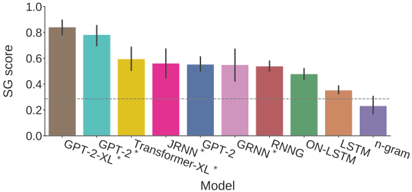
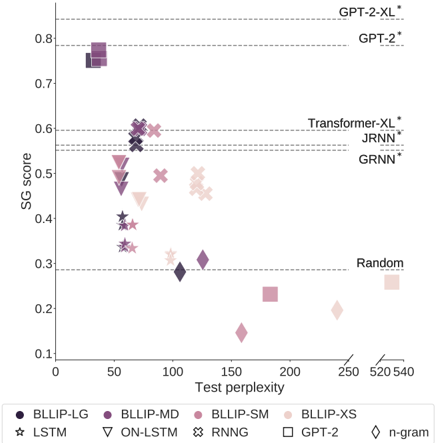
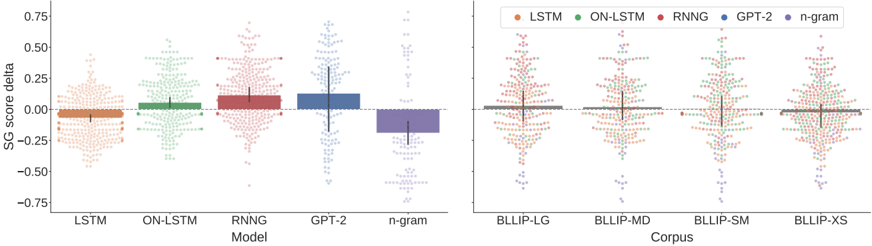
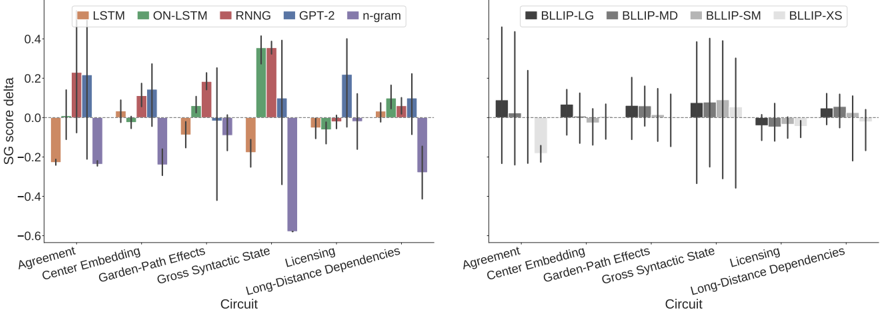
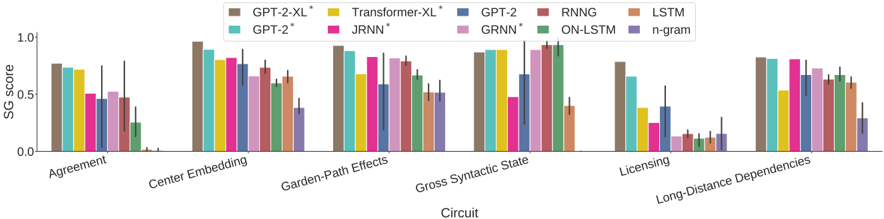
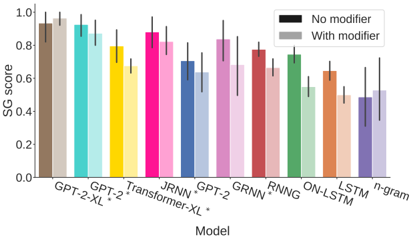
While state-of-the-art neural network models continue to achieve lower perplexity scores on language modeling benchmarks, it remains unknown whether optimizing for broad-coverage predictive performance leads to human-like syntactic knowledge.Furthermore, existing work has not provided a clear picture about the model properties required to produce proper syntactic generalizations.We present a systematic evaluation of the syntactic knowledge of neural language models, testing 20 combinations of model types and data sizes on a set of 34 English-language syntactic test suites.We find substantial differences in syntactic generalization performance by model architecture, with sequential models underperforming other architectures.Factorially manipulating model architecture and training dataset size (1M-40M words), we find that variability in syntactic generalization performance is substantially greater by architecture than by dataset size for the corpora tested in our experiments.Our results also reveal a dissociation between perplexity and syntactic generalization performance.
Overview
The claims and statistics of this paper haven’t been checked yet.
Run the check — free, no account needed. It reads the open-access text and checks the sources it cites.
Integrity signals
Registry
Cites
Statistics
Figures

Verification
Claims the paper makes
The claims and statistics of this paper haven’t been checked yet.
Run the check — free, no account needed. It reads the open-access text and checks the sources it cites.
Claims other papers make about this one
Each is checked against this paper’s own text: does it say what the citing paper says it does?
The cited source doesn’t support the claim as written.
In the citing paper
“It is evaluated as the model with outperforming bilingual evaluation understudy (BLEU) score among four state-of-art text generation methods (RNN, GAN, GPT, and CTRL) [66] and the best syntactic generalization score among trained (LSTM, ON-LSTM, Transformer, n-gram) and ofthe-shelf (GPT, JRNN, Transformer-XL) models [46].”
From Synthetic Lies: Understanding AI-Generated Misinformation and Evaluating Algorithmic and Human Solutions (2023) · cites this paper as [46]
Checked by a reasoning model — may be wrong.
Experimental — accuracy not yet measured
Self-check
Percentages, sums and reported differences re-computed from the paper’s own numbers.
The self-check needs the paper’s full text.
Citations
Cites
Vaswani, A., Shazeer, N., Parmar, N., Uszkoreit, J., Jones, L., Gomez, A. N., Kaiser, L., & Polosukhin, I. (2017) · arXiv · doi:10.48550/arxiv.1706.03762 · Cited by 120,404
Hochreiter, S., & Schmidhuber, J. (1997) · Neural Computation · doi:10.1162/neco.1997.9.8.1735 · Cited by 102,318
BERT: Pre-training of Deep Bidirectional Transformers for Language Understanding
Devlin, J., Chang, M.-W., Lee, K., & Toutanova, K. (2018) · arXiv · doi:10.48550/arxiv.1810.04805 · Cited by 73,173
BERT: Pre-training of Deep Bidirectional Transformers for Language Understanding
Devlin, J., Chang, M.-W., Lee, K., & Toutanova, K. (2019) · Proceedings of the 2019 Conference of the North American Chapter of the Association for Computational Linguistics: Human Language Technologies, Volume 1 (Long and Short Papers) · doi:10.18653/v1/n19-1423 · Cited by 54,325
(2017) · Cited by 11,625
Building a Large Annotated Corpus of English: The Penn Treebank
Marcus, M. (1993) · doi:10.21236/ada273556 · Cited by 7,405
XLNet: Generalized Autoregressive Pretraining for Language Understanding
Yang, Z., Dai, Z., Yang, Y., Carbonell, J., Salakhutdinov, R., & Le, Q. V. (2019) · arXiv · doi:10.48550/arxiv.1906.08237 · Cited by 6,687
GLUE: A Multi-Task Benchmark and Analysis Platform for Natural Language Understanding
Wang, A., Singh, A., Michael, J., Hill, F., Levy, O., & Bowman, S. (2018) · Proceedings of the 2018 EMNLP Workshop BlackboxNLP: Analyzing and Interpreting Neural Networks for NLP · doi:10.18653/v1/w18-5446 · Cited by 4,222
Constraints on variables in syntax
Ross, J. R. (1967) · DSpace@MIT (Massachusetts Institute of Technology) · Cited by 4,102
Loper, E., & Bird, S. (2002) · doi:10.3115/1118108.1118117 · Cited by 3,323
Transformer-XL: Attentive language models beyond a fixed-length context
Dai, Z., Yang, Z., Yang, Y., Carbonell, J., Le, Q., & Salakhutdinov, R. (2019) · Proceedings of the 57th Annual Meeting of the Association for Computational Linguistics · doi:10.18653/v1/p19-1285 · Cited by 3,169
NLTK: The Natural Language ToolkitPreprint
Loper, E., & Bird, S. (2002) · arXiv (Cornell University) · doi:10.48550/arxiv.cs/0205028 · Cited by 1,893
Frazier, L., & Rayner, K. (1982) · Cognitive Psychology · doi:10.1016/0010-0285(82)90008-1 · Cited by 1,793
(2018) · International Conference on Learning Representations · Cited by 1,621
The cognitive basis for linguistic structures1
Bever, T. G. (2013) · Oxford University Press eBooks · doi:10.1093/acprof:oso/9780199677139.003.0001 · Cited by 1,301
Exploring the Limits of Language ModelingPreprint
Józefowicz, R., Vinyals, O., Schuster, M., Shazeer, N., & Wu, Y. (2016) · arXiv (Cornell University) · doi:10.48550/arxiv.1602.02410 · Cited by 1,238
Neural Network Acceptability Judgments
Warstadt, A., Singh, A., & Bowman, S. R. (2019) · Transactions of the Association for Computational Linguistics · doi:10.1162/tacl_a_00290 · Cited by 1,215
Semantic Influences On Parsing: Use of Thematic Role Information in Syntactic Ambiguity Resolution
Trueswell, J. C., Tanenhaus, M. K., & Garnsey, S. M. (1994) · Journal of Memory and Language · doi:10.1006/jmla.1994.1014 · Cited by 1,175
The independence of syntactic processing
Ferreira, F., & Clifton, C. (1986) · Journal of Memory and Language · doi:10.1016/0749-596x(86)90006-9 · Cited by 1,151
A probabilistic earley parser as a psycholinguistic model
Hale, J. (2001) · Second meeting of the North American Chapter of the Association for Computational Linguistics on Language technologies 2001 - NAACL '01 · doi:10.3115/1073336.1073357 · Cited by 1,150
Polarity sensitivity as inherent scope relations
Ladusaw, W. A. (1980) · Cited by 1,091
SuperGLUE: A Stickier Benchmark for General-Purpose Language Understanding Systems
Wang, A., Pruksachatkun, Y., Nangia, N., Singh, A., Michael, J., Hill, F., Levy, O., & Bowman, S. R. (2019) · arXiv · doi:10.48550/arxiv.1905.00537 · Cited by 1,051
Neural Machine Translation of Rare Words with Subword Units
Sennrich, R., Haddow, B., & Birch, A. (2016) · Proceedings of the 54th Annual Meeting of the Association for Computational Linguistics (Volume 1: Long Papers) · doi:10.18653/v1/p16-1162 · Cited by 974
Right for the Wrong Reasons: Diagnosing Syntactic Heuristics in Natural Language Inference
McCoy, R. T., Pavlick, E., & Linzen, T. (2019) · Proceedings of the 57th Annual Meeting of the Association for Computational Linguistics · doi:10.18653/v1/p19-1334 · Cited by 944
(1963) · Cited by 855
Assessing the Ability of LSTMs to Learn Syntax-Sensitive Dependencies
Linzen, T., Emmanuel Dupoux, A., & Goldberg, Y. (2016) · Transactions of the Association for Computational Linguistics · doi:10.1162/tacl_a_00115 · Cited by 820
Syntax: A Generative Introduction
Carnie, A. (2002) · Cited by 735
The effect of word predictability on reading time is logarithmic
Smith, N. J., & Levy, R. (2013) · Cognition · doi:10.1016/j.cognition.2013.02.013 · Cited by 725
The Pseudo-Cleft Construction in English
Higgins, F. R. (2015) · Routledge eBooks · doi:10.4324/9781315693545 · Cited by 683
Improved Inference for Unlexicalized Parsing
Petrov, S., & Klein, D. (2007) · Cited by 606
Parsing WH-constructions: Evidence for on-line gap location
Stowe, L. A. (1986) · Language and Cognitive Processes · doi:10.1080/01690968608407062 · Cited by 601
(2019) · doi:10.18653/v1/n19-1419 · Cited by 601
Colorless Green Recurrent Networks Dream Hierarchically
Gulordava, K., Bojanowski, P., Grave, É., Linzen, T., & Baroni, M. (2018) · Conference of the North American Chapter of the Association for Computational Linguistics: Human Language Technologies (NAACL-HLT) · doi:10.18653/v1/n18-1108 · Cited by 538
Constituency Parsing with a Self-Attentive Encoder
Kitaev, N., & Klein, D. (2018) · Proceedings of the conference - Association for Computational Linguistics. Meeting · doi:10.18653/v1/p18-1249 · Cited by 531
Recurrent Neural Network Grammars
Dyer, C., Kuncoro, A., Ballesteros, M., & Smith, N. A. (2016) · Proceedings of the 2016 Conference of the North American Chapter of the Association for Computational Linguistics: Human Language Technologies · doi:10.18653/v1/n16-1024 · Cited by 517
Assessing BERT's Syntactic Abilities
Goldberg, Y. (2019) · arXiv · doi:10.48550/arxiv.1901.05287 · Cited by 385
Targeted Syntactic Evaluation of Language Models
Marvin, R., & Linzen, T. (2018) · Proceedings of the 2018 Conference on Empirical Methods in Natural Language Processing · doi:10.18653/v1/d18-1151 · Cited by 334
How can grammars help parsers?
Crain, S., & Fodor, J. D. (1985) · Cambridge University Press eBooks · doi:10.1017/cbo9780511597855.004 · Cited by 310
What do Neural Machine Translation Models Learn about Morphology?
Belinkov, Y., Durrani, N., Dalvi, F., Sajjad, H., & Glass, J. (2017) · Proceedings of the 55th Annual Meeting of the Association for Computational Linguistics (Volume 1: Long Papers) · doi:10.18653/v1/p17-1080 · Cited by 307
Plausibility and recovery from garden paths: An eye-tracking study.
Pickering, M. J., & Traxler, M. J. (1998) · Journal of Experimental Psychology Learning Memory and Cognition · doi:10.1037/0278-7393.24.4.940 · Cited by 271
Processing Polarity: How the Ungrammatical Intrudes on the Grammatical
Vasishth, S., Brüssow, S., Lewis, R. L., & Drenhaus, H. (2008) · Cognitive Science · doi:10.1080/03640210802066865 · Cited by 268
Grammaticality, Acceptability, and Probability: A Probabilistic View of Linguistic Knowledge
Lau, J. H., Clark, A., & Lappin, S. (2016) · Cognitive Science · doi:10.1111/cogs.12414 · Cited by 262
Ordered Neurons: Integrating Tree Structures into Recurrent Neural NetworksPreprint
Shen, Y., Tan, S., Sordoni, A., & Courville, A. C. (2018) · arXiv (Cornell University) · doi:10.48550/arxiv.1810.09536 · Cited by 261
Structural Change and Reanalysis Difficulty in Language Comprehension
Sturt, P., Pickering, M. J., & Crocker, M. W. (1999) · Journal of Memory and Language · doi:10.1006/jmla.1998.2606 · Cited by 220
Insensitivity of the Human Sentence-Processing System to Hierarchical Structure
Frank, S. L., & Bod, R. (2011) · Psychological Science · doi:10.1177/0956797611409589 · Cited by 219
Predictive power of word surprisal for reading times is a linear function of language model quality
Goodkind, A., & Bicknell, K. (2018) · Workshop on Cognitive Modeling and Computational Linguistics (CMCL) · doi:10.18653/v1/w18-0102 · Cited by 190
Lexical Guidance in Human Parsing: Locus and Processing Characteristics
Coltheart, M. (2016) · Routledge eBooks · doi:10.4324/9781315630427-42 · Cited by 183
What do RNN Language Models Learn about Filler–Gap Dependencies?
Wilcox, E., Lévy, R., Morita, T., & Futrell, R. (2018) · BlackboxNLP Workshop on Analyzing and Interpreting Neural Networks for NLP (BlackboxNLP) · doi:10.18653/v1/w18-5423 · Cited by 173
Self-citationNeural language models as psycholinguistic subjects: Representations of syntactic state
Futrell, R., Wilcox, E., Morita, T., Qian, P., Ballesteros, M., & Lévy, R. (2019) · Conference of the North American Chapter of the Association for Computational Linguistics: Human Language Technologies (NAACL-HLT) · doi:10.18653/v1/n19-1004 · Cited by 162
Self-citationThe parser doesn't ignore intransitivity, after all.
Staub, A. (2007) · Journal of Experimental Psychology Learning Memory and Cognition · doi:10.1037/0278-7393.33.3.550 · Cited by 159
Sequential vs. Hierarchical Syntactic Models of Human Incremental Sentence Processing
Fossum, V., & Lévy, R. (2012) · Cited by 73
Quantity doesn’t buy quality syntax with neural language models
van Schijndel, M., Mueller, A., & Linzen, T. (2019) · Proceedings of the 2019 Conference on Empirical Methods in Natural Language Processing and the 9th International Joint Conference on Natural Language Processing (EMNLP-IJCNLP) · doi:10.18653/v1/d19-1592 · Cited by 65
Structural Supervision Improves Learning of Non-Local Grammatical Dependencies
Wilcox, E., Qian, P., Futrell, R., Ballesteros, M., & Lévy, R. (2019) · Conference of the North American Chapter of the Association for Computational Linguistics: Human Language Technologies (NAACL-HLT) · doi:10.18653/v1/n19-1334 · Cited by 62
Self-citationEffective Inference for Generative Neural Parsing
Stern, M., Fried, D., & Klein, D. (2017) · Conference on Empirical Methods in Natural Language Processing (EMNLP) · doi:10.18653/v1/d17-1178 · Cited by 60
RNN Simulations of Grammaticality Judgments on Long-distance Dependencies
Chowdhury, S. A., & Zamparelli, R. (2018) · Iris (University of Trento) · Cited by 56
RNNs as psycholinguistic subjects: Syntactic state and grammatical dependencyPreprint
Futrell, R., Wilcox, E., Morita, T., & Lévy, R. (2018) · arXiv (Cornell University) · doi:10.48550/arxiv.1809.01329 · Cited by 50
Self-citationModeling garden path effects without explicit hierarchical syntax.
van Schijndel, M., & Linzen, T. (2018) · eScholarship (California Digital Library) · Cited by 45
BLiMP: the benchmark of linguistic minimal pairs for English
Warstadt, A., Parrish, A., Liu, H., Mohananey, A., Peng, W., Wang, S.-F., & Bowman, S. R. (2020) · Transactions of the Association for Computational Linguistics · doi:10.1162/tacl_a_00321 · Cited by 28
Hierarchical Representation in Neural Language Models: Suppression and Recovery of Expectations
Wilcox, E., Lévy, R., & Futrell, R. (2019) · BlackboxNLP Workshop on Analyzing and Interpreting Neural Networks for NLP (BlackboxNLP) · doi:10.18653/v1/w19-4819 · Cited by 26
Self-citationWhat Don't RNN Language Models Learn About Filler-Gap Dependencies?
Chaves, R. P. (2020) · ScholarWorks@UMassAmherst (University of Massachusetts Amherst) · doi:10.7275/f7yj-1n62 · Cited by 18
A Closer Look at the Performance of Neural Language Models on Reflexive Anaphor Licensing
Hu, J., Chen, S. Y., & Lévy, R. (2020) · ScholarWorks@UMassAmherst (University of Massachusetts Amherst) · doi:10.7275/67qw-mf84 · Cited by 9
Self-citationCoLA: The Corpus of Linguistic Acceptability (with added annotations)
Warstadt, A., Singh, A., & Bowman, S. R. (2019) · Faculty Digital Archive (New York University Florence) · Cited by 8
Research works printed but not linked: 6
- Andrew Carnie. 2012. Syntax: A generative introduc- tion, volume 18. John Wiley & Sons.
- Anastasia Giannakidou. 2011. Negative and positive polarity items: Variation, licensing, and composi- tionality. In Semantics: An international hand- book of natural language meaning, volume 3, pages 1660-1712. Berlin: Mouton de Gruyter.
- Mario Giulianelli, Jack Harding, Florian Mohnert, Dieuwke Hupkes, and Willem Zuidema. 2018. Un- der the hood: Using diagnostic classifiers to in- vestigate and improve how language models track agreement information. In Proceedings of the 2018 EMNLP Workshop BlackboxNLP: Analyzing and In- terpreting Neural Networks for NLP, pages 240- 248.
- Tanya Reinhart. 1981. Definite NP anaphora and c- command domains. Linguistic Inquiry, 12(4):605- 635.
- Ethan Wilcox, Jon Gauthier, Jennifer Hu, Peng Qian, and Roger P. Levy. 2020. Evaluating neural net- works as models of human online language process- ing. In Proceedings of the 42nd Meeting of the Cog- nitive Science Society (CogSci 2020). To appear.
- Ethan Wilcox, Peng Qian, Richard Futrell, Miguel Ballestros, and Roger P. Levy. 2019b. Structural su- pervision improves learning of non-local grammati- cal dependencies. In Proceedings of the 2019 Con- ference of the North American Chapter of the Asso- ciation for Computational Linguistics: Human Lan- guage Technologies, pages 3302-3312, Minneapo- lis, Minnesota.
Cited by
Sorted by citations
The neural architecture of language: Integrative modeling converges on predictive processing
Schrimpf, M., Blank, I. A., Tuckute, G., Kauf, C., Hosseini, E. A., Kanwisher, N., Tenenbaum, J. B., & Fedorenko, E. (2021) · Proceedings of the National Academy of Sciences · doi:10.1073/pnas.2105646118 · Cited by 517
Zhou, J., Zhang, Y., Luo, Q., Parker, A. G., & De Choudhury, M. (2023) · Proceedings of the 2023 CHI Conference on Human Factors in Computing Systems · doi:10.1145/3544548.3581318 · Cited by 288
Winoground: Probing Vision and Language Models for Visio-Linguistic Compositionality
Thrush, T., Jiang, R., Bartolo, M., Singh, A., Williams, A., Kiela, D., & Ross, C. (2022) · IEEE Computer Society Conference on Computer Vision and Pattern Recognition/Proceedings - IEEE Computer Society Conference on Computer Vision and Pattern Recognition/Proceedings · doi:10.1109/cvpr52688.2022.00517 · Cited by 296
What Artificial Neural Networks Can Tell Us about Human Language Acquisition
Warstadt, A., & Bowman, S. R. (2022) · Algebraic Structures in Natural Language · doi:10.1201/9781003205388-2 · Cited by 111
Metadata
- Authors
- Hu, J., Gauthier, J., Qian, P., Wilcox, E., & Levy, R.
- Affiliations
- Massachusetts Institute of Technology (US)
- Harvard University (US)
- Venue
- Proceedings of the 58th Annual Meeting of the Association for Computational Linguistics
- Published
- 2020
- Pages
- 1725-1744
- ISSN
- 0736-587X (ISSN-L)
- OpenAlex
- W3034510440
- Cited by
- 134
- References
- 66
- Citations by year
- 2026: 11 · 2025: 10 · 2024: 17 · 2023: 40 · 2022: 26 · 2021: 25 · 2020: 5
- FWCI
- 9.17
- Type
- conference paper
- Language
- en
- Open access
- hybrid
- doi.org
- Licence
- cc-by
- Locations
- Proceedings of the conference - Association for Computational Linguistics. Meeting (publishedVersion, cc-by)
- Funders
- National Science Foundation
- Open Philanthropy Project
- National Institutes of Health
- Topics
- Physical Sciences › Computer Science › Artificial Intelligence › Natural Language Processing Techniques
- Physical Sciences › Computer Science › Artificial Intelligence › Topic Modeling
- Social Sciences › Arts and Humanities › Language and Linguistics › Syntax, Semantics, Linguistic Variation
- Keywords
- syntactic generalization, neural language models, syntactic knowledge, model architecture, training data size, perplexity, English syntax, sequential model, language model evaluation
About these checks
Registry, retraction, Cites and statistics results are computed, not judged, with one exception: a printed reference that no index lists is read once by a model before it counts as a citation error. Claims are extracted by a model and kept only when their quote appears verbatim in the text; each cited source is then checked, with a model’s help, for whether it says what the claim relies on. Those verdicts can be wrong — read the claim’s quote and the cited source before relying on one.
Statistics and arithmetic are recomputed, not judged.
Confidence bands are shown only for fields calibrated on our annotated test set. None is calibrated yet, so no band is shown.
What counts as a claim ›How we measure confidence ›How we check this ›
Are you an author, or do you see a problem with this page? Request a review
