

The DOI matches its Crossref record; 21 of the 25 references it cites were found in a registry or an index.
ProofWriter: Generating Implications, Proofs, and Abductive Statements over Natural Language
Open accessAbstract
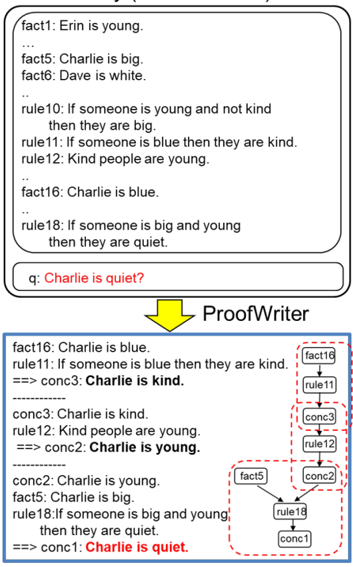
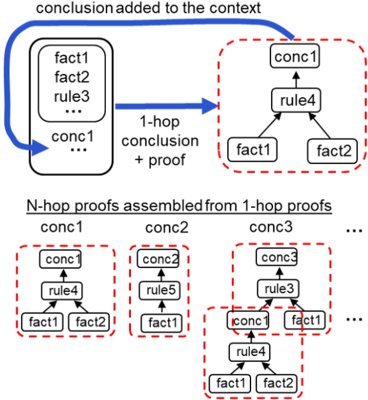
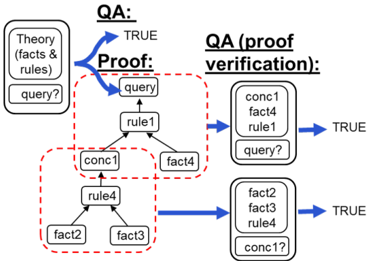
Transformers have been shown to emulate logical deduction over natural language theories (logical rules expressed in natural language), reliably assigning true/false labels to candidate implications.However, their ability to generate implications of a theory has not yet been demonstrated, and methods for reconstructing proofs of answers are imperfect.In this work we show that a generative model, called ProofWriter, can reliably generate both implications of a theory and the natural language proofs that support them.In particular, iterating a 1-step implication generator results in proofs that are highly reliable, and represent actual model decisions (rather than post-hoc rationalizations).On the RuleTaker dataset, the accuracy of ProofWriter's proofs exceed previous methods by +9% absolute, and in a way that generalizes to proof depths unseen in training and on out-of-domain problems.We also show that generative techniques can perform a type of abduction with high precision: Given a theory and an unprovable conclusion, identify a missing fact that allows the conclusion to be proved, along with a proof.These results significantly improve the viability of neural methods for systematically reasoning over natural language.1
Overview
The claims and statistics of this paper haven’t been checked yet.
Run the check — free, no account needed. It reads the open-access text and checks the sources it cites.
Integrity signals
Registry
Cites
Statistics
Figures
Verification
Claims the paper makes
The claims and statistics of this paper haven’t been checked yet.
Run the check — free, no account needed. It reads the open-access text and checks the sources it cites.
Claims other papers make about this one
Each is checked against this paper’s own text: does it say what the citing paper says it does?
The cited source doesn’t support the claim as written.
In the citing paper
“ProofWriter (Tafjord et al., 2021) is a synthetic dataset created to assess deductive reasoning abilities of LLMs.”
From OpenHands: An Open Platform for AI Software Developers as Generalist Agents (2024) · cites this paper as Tafjord et al., 2021
Checked by a reasoning model — may be wrong.
Experimental — accuracy not yet measuredThe cited source doesn’t support the claim as written.
In the citing paper
“ProofWriter, meanwhile, is a synthetically generated dataset for logical reasoning over natural language.”
From LINC: A Neurosymbolic Approach for Logical Reasoning by Combining Language Models with First-Order Logic Provers (2023) · cites this paper as Tafjord et al., 2021
Checked by a reasoning model — may be wrong.
Experimental — accuracy not yet measuredThe cited source says what the claim attributes to it.
In the citing paper
“Early work on deductive reasoning benchmarks such as RuleTaker (Clark et al., 2020) and ProofWriter (Tafjord et al., 2021) established the basic setup of query answering over sets of rules and facts, with ProofWriter reaching a maximum proof depth of five steps.ProntoQA (Saparov and He, 2023) introduces proof-structure controls and formal error attribution, also evaluated up to five hops.”
From Probing for Long-Horizon Deductive Reasoning Capabilities in Language Models with Prolog (2026) · cites this paper as Tafjord et al., 2021
The cited source says what the claim attributes to it.
In the citing paper
“These benchmarks revealed that models at the time struggle as proof depth increases, but the depths studied remain shallow.”
From Probing for Long-Horizon Deductive Reasoning Capabilities in Language Models with Prolog (2026) · cites this paper as Tafjord et al., 2021
The cited source says what the claim attributes to it.
In the citing paper
“This process is algorithmic; a model that has learned a robust implementation of this algorithm should, in principle, generalize beyond the shallow depths seen in previous benchmarks (Clark et al., 2020;Tafjord et al., 2021;Saparov and He, 2023).”
From Probing for Long-Horizon Deductive Reasoning Capabilities in Language Models with Prolog (2026) · cites this paper as Tafjord et al., 2021
Self-check
Percentages, sums and reported differences re-computed from the paper’s own numbers.
The self-check needs the paper’s full text.
Citations
Cites
Hobbs, J. R., Stickel, M. E., Appelt, D. E., & Martin, P. (1988) · Artificial Intelligence · doi:10.1016/0004-3702(93)90015-4 · Cited by 1,222
Applications of circumscription to formalizing common-sense knowledge
McCarthy, J. (1986) · Artificial Intelligence · doi:10.1016/0004-3702(86)90032-9 · Cited by 1,114
McCarthy, J. (1960) · Cited by 799
Language Models as Knowledge Bases?Preprint
Petroni, F., Rocktäschel, T., Lewis, P., Bakhtin, A., Wu, Y., Miller, A., & Riedel, S. (2019) · arXiv (Cornell University) · doi:10.48550/arxiv.1909.01066 · Cited by 714
What you always wanted to know about Datalog (and never dared to ask)
Ceri, S., Gottlob, G., & Tanca, L. (1989) · IEEE Transactions on Knowledge and Data Engineering · doi:10.1109/69.43410 · Cited by 704
ERASER: A Benchmark to Evaluate Rationalized NLP Models
DeYoung, J., Jain, S., Rajani, N. F., Lehman, E., Xiong, C., Socher, R., & Wallace, B. C. (2020) · Proceedings of the 58th Annual Meeting of the Association for Computational Linguistics · doi:10.18653/v1/2020.acl-main.408 · Cited by 561
e-SNLI: Natural language inference with natural language explanations
Camburu, O.-M., Rocktäschel, T., Lukasiewicz, T., & Blunsom, P. (2018) · arXiv · doi:10.48550/arxiv.1812.01193 · Cited by 367 · cited 2×
“Similarly, work on explanations has sought to gen-Proof erate human-style justifications, which again are typically supporting evidence rather than a fully-formed line of reasoning, and without explicit reasoning rules (Camburu et al., 2018; Jhamtani and Clark, 2020; Inoue et al., 2020).”
BackgroundWT5?! Training Text-to-Text Models to Explain their PredictionsPreprint
Narang, S., Raffel, C., Lee, K., Roberts, A., Fiedel, N., & Malkan, K. (2020) · arXiv (Cornell University) · doi:10.48550/arxiv.2004.14546 · Cited by 221
Transformers as Soft Reasoners over Language
Clark, P., Tafjord, O., & Richardson, K. (2020) · Proceedings of the Twenty-Ninth International Joint Conference on Artificial Intelligence · doi:10.24963/ijcai.2020/537 · Cited by 176
Self-citationA Survey on Semantic ParsingPreprint
Kamath, A., & Das, R. (2018) · arXiv (Cornell University) · doi:10.48550/arxiv.1812.00978 · Cited by 117
Research works printed but not linked: 4
- Chandra Bhagavatula, Ronan Le Bras, Chaitanya Malaviya, Keisuke Sakaguchi, Ari Holtzman, Han- nah Rashkin, Doug Downey, S. Yih, and Yejin Choi. 2020. Abductive commonsense reasoning. In ICLR'20.
- Tim Rocktäschel and S. Riedel. 2017. End-to-end dif- ferentiable proving. In NeurIPS.
- Daniel Selsam, Matthew Lamm, Benedikt Bünz, Percy Liang, Leonardo de Moura, and David L. Dill. 2019. Learning a SAT solver from single-bit supervision. In ICLR.
- Alon Talmor, Oyvind Tafjord, P. Clark, Y. Goldberg, and Jonathan Berant. 2020. LeapOfThought: Teach- ing pre-trained models to systematically reason over implicit knowledge. In NeurIPS.
Cited by
Sorted by citations
Logic-LM: Empowering Large Language Models with Symbolic Solvers for Faithful Logical Reasoning
Pan, L., Albalak, A., Wang, X., & Wang, W. Y. (2023) · arXiv · doi:10.48550/arxiv.2305.12295 · Cited by 144
“We randomly selected 300 examples from each subset of ProofWriter, ensuring a balanced label distribution.”
MethodInfluentialReasoning with Language Model Prompting: A Survey
Qiao, S., Ou, Y., Zhang, N., Chen, X., Yao, Y., Deng, S., Tan, C., Huang, F., & Chen, H. (2023) · Proceedings of the conference - Association for Computational Linguistics. Meeting · doi:10.18653/v1/2023.acl-long.294 · Cited by 346
Large Language Models Can Be Easily Distracted by Irrelevant Context
Shi, F., Chen, X., Misra, K., Scales, N., Dohan, D., Chi, E., Schärli, N., & Zhou, D. (2023) · arXiv · doi:10.48550/arxiv.2302.00093 · Cited by 134
“There exist some logical reasoning benchmarks that contain irrelevant content in task descriptions (Weston et al., 2015; Sinha et al., 2019; Clark et al., 2021; Han et al., 2022; Tafjord et al., 2020, inter alia ).”
BackgroundTowards Faithful Model Explanation in NLP: A Survey
Lyu, Q., Apidianaki, M., & Callison-Burch, C. (2024) · Computational Linguistics · doi:10.1162/coli_a_00511 · Cited by 196
Faith and Fate: Limits of Transformers on Compositionality
Dziri, N., Lu, X., Sclar, M., Li, X. (., Jiang, L., Lin, B. Y., Welleck, S., West, P., Bhagavatula, C., Bras, R. L., et al. (2023) · Advances in Neural Information Processing Systems 36 · doi:10.52202/075280-3081 · Cited by 335
“Lastly, leveraging LLMs to generate each reasoning step iteratively via a selection and inference mechanism [16, 15, 54].”
BackgroundMethodFaith and Fate: Limits of Transformers on Compositionality
Dziri, N., Lu, X., Sclar, M., Li, X. L., Jiang, L., Lin, B. Y., West, P., Bhagavatula, C., Bras, R. L., Hwang, J. D., et al. (2023) · arXiv · Cited by 124
The formal rationality of artificial intelligence-based algorithms and the problem of bias
Nishant, R., Schneckenberg, D., & Ravishankar, M. N. (2023) · Journal of Information Technology · doi:10.1177/02683962231176842 · Cited by 109
Explaining Answers with Entailment Trees
Dalvi, B. B., Jansen, P. A., Tafjord, O., Xie, Z., Smith, H., Pipatanangkura, L., & Clark, P. E. (2021) · Conference on Empirical Methods in Natural Language Processing (EMNLP) · doi:10.18653/v1/2021.emnlp-main.585 · Cited by 148
Self-citationPan, L., Saxon, M., Xu, W., Nathani, D., Wang, X., & Wang, W. Y. (2024) · Transactions of the Association for Computational Linguistics · doi:10.1162/tacl_a_00660 · Cited by 86
Are Large Language Models Really Good Logical Reasoners? A Comprehensive Evaluation and Beyond
Xu, F., Lin, Q., Han, J., Zhao, T., Liu, J., & Cambria, E. (2025) · IEEE Transactions on Knowledge and Data Engineering · doi:10.1109/tkde.2025.3536008 · Cited by 164
Cognitive Architectures for Language Agents
Sumers, T. R., Yao, S., Narasimhan, K., & Griffiths, T. L. (2023) · arXiv · doi:10.48550/arxiv.2309.02427 · Cited by 72
A Survey on LLM-Based Code Generation for Low-Resource and Domain-Specific Programming Languages
Joel, S., Wu, J. J., & Fard, F. H. (2025) · ACM Transactions on Software Engineering and Methodology · doi:10.1145/3770084 · Cited by 140
AI Reasoning in Deep Learning Era: From Symbolic AI to Neural–Symbolic AI
Liang, B., Wang, Y., & Tong, C. (2025) · Mathematics · doi:10.3390/math13111707 · Cited by 100
Olausson, T., Gu, A., Lipkin, B., Zhang, C., Solar-Lezama, A., Tenenbaum, J., & Levy, R. (2023) · Proceedings of the 2023 Conference on Empirical Methods in Natural Language Processing · doi:10.18653/v1/2023.emnlp-main.313 · Cited by 57
“Datasets: Our experiments use tasks from two existing datasets: FOLIO (Han et al., 2022) and ProofWriter (Tafjord et al., 2021), both of which have been shown to be challenging for off-the-shelf LLMs (Han et al., 2022; Creswell et al., 2023).”
MethodUniGeo: Unifying Geometry Logical Reasoning via Reformulating Mathematical Expression
Chen, J., Li, T., Qin, J., Lu, P., Lin, L., Chen, C., & Liang, X. (2022) · Conference on Empirical Methods in Natural Language Processing (EMNLP) · doi:10.18653/v1/2022.emnlp-main.218 · Cited by 143
A Survey on Symbolic Knowledge Distillation of Large Language Models
Acharya, K., Velasquez, A., & Song, H. (2024) · IEEE Transactions on Artificial Intelligence · doi:10.1109/tai.2024.3428519 · Cited by 56
LAMBADA: Backward Chaining for Automated Reasoning in Natural Language
Kazemi, M., Kim, N., Bhatia, D. S., Xu, X., & Ramachandran, D. (2023) · Proceedings of the conference - Association for Computational Linguistics. Meeting · doi:10.18653/v1/2023.acl-long.361 · Cited by 79
The Abduction of Sherlock Holmes: A Dataset for Visual Abductive Reasoning
Hessel, J., Hwang, J. D., Park, J. S., Zellers, R., Bhagavatula, C., Rohrbach, A., Saenko, K., & Choi, Y. (2022) · Lecture notes in computer science · doi:10.1007/978-3-031-20059-5_32 · Cited by 37
Generating Natural Language Proofs with Verifier-Guided Search
Yang, K., Deng, J., & Chen, D. (2022) · Conference on Empirical Methods in Natural Language Processing (EMNLP) · doi:10.18653/v1/2022.emnlp-main.7 · Cited by 55
Entailer: Answering Questions with Faithful and Truthful Chains of Reasoning
Tafjord, O., Mishra, B. D., & Clark, P. A. (2022) · Conference on Empirical Methods in Natural Language Processing (EMNLP) · doi:10.18653/v1/2022.emnlp-main.134 · Cited by 35
Self-citationSay What You Mean! Large Language Models Speak Too Positively about Negative Commonsense Knowledge
Chen, J., Shi, W., Fu, Z., Cheng, S., Li, L., & Xiao, Y. (2023) · Proceedings of the conference - Association for Computational Linguistics. Meeting · doi:10.18653/v1/2023.acl-long.550 · Cited by 35
Minding Language Models’ (Lack of) Theory of Mind: A Plug-and-Play Multi-Character Belief Tracker
Sclar, M., Kumar, S., West, P., Suhr, A., Choi, Y., & Tsvetkov, Y. (2023) · Proceedings of the 61st Annual Meeting of the Association for Computational Linguistics (Volume 1: Long Papers) · doi:10.18653/v1/2023.acl-long.780 · Cited by 27
Entailment Tree Explanations via Iterative Retrieval-Generation Reasoner
Ribeiro, D. N., Wang, S., Ma, X., Dong, R., Wei, X., Zhu, H., Chen, X., Xu, P., Huang, Z., Arnold, A., et al. (2022) · Findings of the Association for Computational Linguistics: NAACL · doi:10.18653/v1/2022.findings-naacl.35 · Cited by 23
Demystifying Chains, Trees, and Graphs of Thoughts
Besta, M., Memedi, F., Zhang, Z., Gerstenberger, R., Piao, G., Blach, N., Nyczyk, P., Copik, M., Kwaśniewski, G., Müller, J., et al. (2025) · IEEE Transactions on Pattern Analysis and Machine Intelligence · doi:10.1109/tpami.2025.3598182 · Cited by 80
Flexible Generation of Natural Language Deductions
Bostrom, K., Zhao, X., Chaudhuri, S., & Durrett, G. (2021) · Conference on Empirical Methods in Natural Language Processing (EMNLP) · doi:10.18653/v1/2021.emnlp-main.506 · Cited by 25
METGEN: A Module-Based Entailment Tree Generation Framework for Answer Explanation
Hong, R., Zhang, H., Yu, X., & Zhang, C. (2022) · Findings of the Association for Computational Linguistics: NAACL · doi:10.18653/v1/2022.findings-naacl.145 · Cited by 21
BABILong: Testing the Limits of LLMs with Long Context Reasoning-in-a-Haystack
Kuratov, Y., Bulatov, A., Anokhin, P., Rodkin, I., Sorokin, D., Sorokin, A., & Burtsev, M. (2024) · arXiv · doi:10.48550/arxiv.2406.10149 · Cited by 19
“Additionally, we release the predictions of all models used in our study to ensure that all re-ported results can be reproduced and verified: https://github.com/booydar/babilong/tree/ predictions_06_2024 .”
MethodFaiRR: Faithful and Robust Deductive Reasoning over Natural Language
Sanyal, S., Singh, H., & Ren, X. (2022) · Proceedings of the conference - Association for Computational Linguistics. Meeting · doi:10.18653/v1/2022.acl-long.77 · Cited by 26
A Survey of Reasoning with Foundation ModelsPreprint
Sun, J., Zheng, C., Xie, E., Liu, Z., Chu, R., Liu, J., Xu, J., Ding, M., Li, H., Geng, M., et al. (2023) · OSF Preprints (OSF Preprints) · doi:10.31219/osf.io/ac4sp · Cited by 143
RuleBERT: Teaching Soft Rules to Pre-Trained Language Models
Saeed, M., Ahmadi, N., Nakov, P., & Papotti, P. (2021) · Conference on Empirical Methods in Natural Language Processing (EMNLP) · doi:10.18653/v1/2021.emnlp-main.110 · Cited by 16
Generative Multi-hop Retrieval
Lee, H., Yang, S., Oh, H., & Seo, M. (2022) · Conference on Empirical Methods in Natural Language Processing (EMNLP) · doi:10.18653/v1/2022.emnlp-main.92 · Cited by 26
Natural Language Deduction through Search over Statement Compositions
Bostrom, K., Sprague, Z., Chaudhuri, S., & Durrett, G. (2022) · Findings of the Association for Computational Linguistics: EMNLP (Findings of EMNLP) · doi:10.18653/v1/2022.findings-emnlp.358 · Cited by 35
OpenHands: An Open Platform for AI Software Developers as Generalist Agents
Wang, X., Li, B., Song, Y., Xu, F. F., Tang, X., Zhuge, M., Pan, J., Song, Y., Li, B., Singh, J., et al. (2024) · arXiv · doi:10.48550/arxiv.2407.16741 · Cited by 24
NaturalProofs: Mathematical Theorem Proving in Natural LanguagePreprint
Welleck, S., Liu, J., Bras, R. J. L., Hajishirzi, H., Choi, Y., & Cho, K. (2021) · arXiv (Cornell University) · doi:10.48550/arxiv.2104.01112 · Cited by 60
AbductionRules: Training Transformers to Explain Unexpected Inputs
Young, N., Bao, Q., Bensemann, J., & Witbrock, M. (2022) · Findings of the Association for Computational Linguistics: ACL (Findings of ACL) · doi:10.18653/v1/2022.findings-acl.19 · Cited by 19
Pushing the Limits of Rule Reasoning in Transformers through Natural Language Satisfiability
Richardson, K., & Sabharwal, A. (2022) · Proceedings of the AAAI Conference on Artificial Intelligence · doi:10.1609/aaai.v36i10.21371 · Cited by 18
Transfer Learning with Synthetic Corpora for Spatial Role Labeling and Reasoning
Mirzaee, R., & Kordjamshidi, P. (2022) · Conference on Empirical Methods in Natural Language Processing (EMNLP) · doi:10.18653/v1/2022.emnlp-main.413 · Cited by 26
Neural Unification for Logic Reasoning over Natural Language
Picco, G., Hoang, T. L., Sbodio, M. L., & López, V. (2021) · Findings of the Association for Computational Linguistics: EMNLP (Findings of EMNLP) · doi:10.18653/v1/2021.findings-emnlp.331 · Cited by 11
RLET: A Reinforcement Learning Based Approach for Explainable QA with Entailment Trees
Liu, T., Guo, Q., Hu, X., Zhang, Y., Qiu, X., & Zhang, Z. (2022) · Conference on Empirical Methods in Natural Language Processing (EMNLP) · doi:10.18653/v1/2022.emnlp-main.483 · Cited by 14
IAG: Induction-Augmented Generation Framework for Answering Reasoning Questions
Zhang, Z., Zhang, X., Ren, Y., Shi, S., Han, M., Wu, Y., Lai, R., & Cao, Z. (2023) · Conference on Empirical Methods in Natural Language Processing (EMNLP) · doi:10.18653/v1/2023.emnlp-main.1 · Cited by 17
MindMap: Constructing Evidence Chains for Multi-Step Reasoning in Large Language Models
Wu, Y., Han, X., Song, W., Cheng, M., & Li, F. (2024) · Proceedings of the AAAI Conference on Artificial Intelligence · doi:10.1609/aaai.v38i17.29896 · Cited by 8
LoRP: LLM-based Logical Reasoning via Prolog
Di, Z., Zhang, C., Lv, H., Cui, L., & Liu, L. (2025) · Knowledge-Based Systems · doi:10.1016/j.knosys.2025.114140 · Cited by 14
MURMUR: Modular Multi-Step Reasoning for Semi-Structured Data-to-Text Generation
Saha, S., Yu, X., Bansal, M., Pasunuru, R., & Çelikyılmaz, A. (2023) · Findings of the Association for Computational Linguistics: ACL (Findings of ACL) · doi:10.18653/v1/2023.findings-acl.704 · Cited by 12
Explicit Planning Helps Language Models in Logical Reasoning
Zhao, H., Wang, K., Yu, M., & Mei, H. (2023) · Conference on Empirical Methods in Natural Language Processing (EMNLP) · doi:10.18653/v1/2023.emnlp-main.688 · Cited by 15
Learning Symbolic Rules for Reasoning in Quasi-Natural LanguagePreprint
Yang, K., & Deng, J. (2021) · arXiv (Cornell University) · doi:10.48550/arxiv.2111.12038 · Cited by 8
Lee, J., & Lee, G. G. (2025) · Knowledge-Based Systems · doi:10.1016/j.knosys.2025.113091 · Cited by 8
Yao, B., Jindal, I., Popa, L. C., Katsis, Y., Ghosh, S., He, L., Lu, Y., Srivastava, S., Li, Y., Hendler, J., et al. (2023) · Findings of the Association for Computational Linguistics: EMNLP (Findings of EMNLP) · doi:10.18653/v1/2023.findings-emnlp.778 · Cited by 10
Aghahadi, Z., & Talebpour, A. (2022) · Journal of Applied Non-Classical Logics · doi:10.1080/11663081.2022.2041352 · Cited by 9
Interpretable Proof Generation via Iterative Backward Reasoning
Qu, H., Cao, Y. H., Gao, J., Ding, L., & Xu, R. (2022) · Conference of the North American Chapter of the Association for Computational Linguistics: Human Language Technologies (NAACL-HLT) · doi:10.18653/v1/2022.naacl-main.216 · Cited by 7
Abductive Commonsense Reasoning Exploiting Mutually Exclusive Explanations
Zhao, W., Chiu, J., Cardie, C., & Rush, A. M. (2023) · Proceedings of the conference - Association for Computational Linguistics. Meeting · doi:10.18653/v1/2023.acl-long.831 · Cited by 18
RobustLR: A Diagnostic Benchmark for Evaluating Logical Robustness of Deductive Reasoners
Sanyal, S., Liao, Z., & Ren, X. (2022) · Conference on Empirical Methods in Natural Language Processing (EMNLP) · doi:10.18653/v1/2022.emnlp-main.653 · Cited by 18
Breakpoint Transformers for Modeling and Tracking Intermediate Beliefs
Richardson, K., Tamari, R., Sultan, O., Shahaf, D., Tsarfaty, R., & Sabharwal, A. (2022) · Conference on Empirical Methods in Natural Language Processing (EMNLP) · doi:10.18653/v1/2022.emnlp-main.658 · Cited by 7
Saha, S., Yadav, P., & Bansal, M. (2022) · Proceedings of the conference - Association for Computational Linguistics. Meeting · doi:10.18653/v1/2022.acl-long.85 · Cited by 8
AlKhamissi, B., Verma, S. S., Yu, P., Jin, Z., Çelikyılmaz, A., & Diab, M. (2023) · doi:10.18653/v1/2023.nlrse-1.10 · Cited by 8
Betz, G., & Richardson, K. (2022) · Joint Conference on Lexical and Computational Semantics · doi:10.18653/v1/2022.starsem-1.2 · Cited by 7
Can Pretrained Language Models (Yet) Reason Deductively?
Yuan, Z., Hu, S., Vulić, I., Korhonen, A., & Meng, Z. (2023) · Conference of the European Chapter of the Association for Computational Linguistics · doi:10.18653/v1/2023.eacl-main.106 · Cited by 8
PAT-Agent: Autoformalization for Model Checking
Zuo, X., Zhang, Y., Wang, H., Cai, Y., Hóu, Z., Sun, J., & Dong, J. S. (2025) · IEEE/ACM International Conference on Automated Software Engineering (ASE) · doi:10.1109/ase63991.2025.00176 · Cited by 5
Graph of Logic: Enhancing LLM Reasoning with Graphs and Symbolic Logic
Alotaibi, F., Kulkarni, A., & Zhou, D. (2024) · IEEE International Conference on Big Data (BigData) · doi:10.1109/bigdata62323.2024.10825450 · Cited by 5
ALERT: Adapt Language Models to Reasoning Tasks
Yu, P., Wang, T., Golovneva, O., AlKhamissi, B., Verma, S. S., Jin, Z., Ghosh, G., Diab, M., & Çelikyılmaz, A. (2023) · Proceedings of the conference - Association for Computational Linguistics. Meeting · doi:10.18653/v1/2023.acl-long.60 · Cited by 25
MetaLogic: Logical Reasoning Explanations with Fine-Grained Structure
Huang, Y., Zhang, H., Hong, R., Liang, X., Zhang, C., & Yu, D. (2022) · Conference on Empirical Methods in Natural Language Processing (EMNLP) · doi:10.18653/v1/2022.emnlp-main.310 · Cited by 5
APOLLO: A Simple Approach for Adaptive Pretraining of Language Models for Logical Reasoning
Sanyal, S., Yi‐chong, X., Wang, S., Yang, Z., Pryzant, R., Yu, W., Zhu, C., & Ren, X. (2023) · Proceedings of the conference - Association for Computational Linguistics. Meeting · doi:10.18653/v1/2023.acl-long.347 · Cited by 7
Li, Y., Fu, X., Verma, G., Buitelaar, P., & Liu, M. (2025) · arXiv · doi:10.48550/arxiv.2510.24476 · Cited by 4
Haji, S., Suekane, K., Sano, H., & Takagi, T. (2023) · IEEE International Conference on Semantic Computing (ICSC) · doi:10.1109/icsc56153.2023.00036 · Cited by 4
World Models for Math Story Problems
Opedal, A., Stoehr, N., Saparov, A., & Sachan, M. (2023) · Findings of the Association for Computational Linguistics: ACL (Findings of ACL) · doi:10.18653/v1/2023.findings-acl.579 · Cited by 12
Reliable Reasoning Beyond Natural Language
Borazjanizadeh, N., & Piantadosi, S. T. (2024) · arXiv · doi:10.48550/arxiv.2407.11373 · Cited by 3
“This method has shown significant performance gains on the FOLIO [16] and ProofWriter [34]”
REASON: Accelerating Probabilistic Logical Reasoning for Scalable Neuro-Symbolic Intelligence
Wan, Z.-S., Liu, C.-K., Qian, J., Yang, H.-C., Raychowdhury, A., & Krishna, T. (2026) · International Symposium on High-Performance Computer Architecture · doi:10.1109/hpca68181.2026.11408458 · Cited by 2
Betz, G., & Richardson, K. (2023) · PLoS ONE · doi:10.1371/journal.pone.0281372 · Cited by 6
Experiments with LLMs for Converting Language to Logic
Tammet, T., Järv, P., Verrev, M., & Draheim, D. (2024) · Lecture notes in computer science · doi:10.1007/978-3-031-71170-1_24 · Cited by 3
Towards General Natural Language Understanding with Probabilistic Worldbuilding
Saparov, A., & Mitchell, T. M. (2022) · Transactions of the Association for Computational Linguistics · doi:10.1162/tacl_a_00463 · Cited by 6
Porada, I., Sordoni, A., & Cheung, J. C. K. (2022) · Conference of the North American Chapter of the Association for Computational Linguistics: Human Language Technologies (NAACL-HLT) · doi:10.18653/v1/2022.naacl-main.337 · Cited by 6
Diff-Explainer: Differentiable Convex Optimization for Explainable Multi-hop Inference
Thayaparan, M., Valentino, M., Ferreira, D. M., Rozanova, J., & Freitas, A. (2022) · Transactions of the Association for Computational Linguistics · doi:10.1162/tacl_a_00508 · Cited by 3
DCoL-A: Agentic dual chain of thinking helps LLMs pretend logic solvers
Chen, M., Wu, L.-I., Liu, R., Chang, X., Xue, J., & Li, G. (2026) · Journal of Systems Architecture · doi:10.1016/j.sysarc.2026.103780 · Cited by 2
Betz, G., & Richardson, K. (2022) · Frontiers in Artificial Intelligence · doi:10.3389/frai.2022.900943 · Cited by 2
Towards a Mechanistic Interpretation of Multi-Step Reasoning Capabilities of Language Models
Hou, Y., Li, J., Fei, Y., Stolfo, A., Zhou, W., Zeng, G., Bosselut, A., & Sachan, M. (2023) · Conference on Empirical Methods in Natural Language Processing (EMNLP) · doi:10.18653/v1/2023.emnlp-main.299 · Cited by 42
Identifying the limits of transformers when performing model-checking with natural language
Madusanka, T., Batista-Navarro, R., & Pratt-Hartmann, I. E. (2023) · Conference of the European Chapter of the Association for Computational Linguistics · doi:10.18653/v1/2023.eacl-main.257 · Cited by 5
Madusanka, T., Zahid, I., Li, H., Pratt-Hartmann, I. E., & Batista-Navarro, R. (2023) · Conference on Empirical Methods in Natural Language Processing (EMNLP) · doi:10.18653/v1/2023.emnlp-main.536 · Cited by 3
A Generative Symbolic Model for More General Natural Language Understanding and ReasoningPreprint
Saparov, A., & Mitchell, T. M. (2021) · arXiv (Cornell University) · Cited by 2
Large-Scale Commonsense Knowledge for Default Logic Reasoning
Järv, P., Tammet, T., Verrev, M., & Draheim, D. (2023) · SN Computer Science · doi:10.1007/s42979-023-01963-2 · Cited by 1
Can Language Models Pretend Solvers? Logic Code Simulation with LLMs
Chen, M., Li, G., Wu, L.-I., Liu, R., Su, Y., Chang, X., & Xue, J. (2024) · Lecture notes in computer science · doi:10.1007/978-981-96-0602-3_6 · Cited by 6
Toward Enhancing Reasoning Capabilities of LLMs: An Approach via Synthetic Logic Corpus
Morishita, T., Morio, G., Yamaguchi, A., & Sogawa, Y. (2025) · Journal of Natural Language Processing · doi:10.5715/jnlp.32.520 · Cited by 1
Think straight or think again? Continual joint learning of deduction, abduction and induction
Xiong, K., Ding, X., Cao, Y., Zhao, Y., Liu, T., & Qin, B. (2025) · Neural Networks · doi:10.1016/j.neunet.2025.107768 · Cited by 1
Question Answering with LLMs and Learning from Answer Sets
Borroto, M., GALLAGHER, K., Ielo, A., KAREEM, I., Ricca, F., & Russo, A. (2025) · Theory and Practice of Logic Programming · doi:10.1017/s1471068425100343 · Cited by 5
EMRDCM : An experience-enhanced multi-role debate method based on compromise mechanisms
Zhang, Y., Feng, J., Yiming, X., Wang, Z., Yang, T., & Wang, X. (2026) · Journal of Intelligent Information Systems · doi:10.1007/s10844-026-01022-1 · Cited by 1
DL-ReasonSuite: A Benchmark for Evaluating Description Logic Reasoning in Large Language Models
Olucoglu, M., & Bursa, O. (2026) · Applied Sciences · doi:10.3390/app16041821 · Cited by 1
LogiCue: Targeted Prompting for Improved Modal and Conditional Reasoning in Large Language Models
Shahrokhshahi, F., Mohammadi, F., & Sönmez, F. (2026) · Procedia Computer Science · doi:10.1016/j.procs.2026.01.057 · Cited by 1
Large Language Model for OWL Proofs
Yang, H., Chen, J., & Sattler, U. (2026) · International World Wide Web Conference (WWW) · doi:10.1145/3774904.3792395 · Cited by 4
Neuro-symbolic NLP: taxonomy, assessment, and directions
Chatzikyriakidis, S., & Lappin, S. (2026) · Frontiers in Artificial Intelligence · doi:10.3389/frai.2026.1797587 · Cited by 2
Investigating Transformer-Guided Chaining for Interpretable Natural Logic Reasoning
Kanagasabai, R., Rajamanickam, S., & Shi, W. (2023) · Findings of the Association for Computational Linguistics: ACL (Findings of ACL) · doi:10.18653/v1/2023.findings-acl.588 · Cited by 1
MTR: A Dataset Fusing Inductive, Deductive, and Defeasible Reasoning
Li, Y., Tian, J., Fan, C., Chen, W., He, H., & Jin, Y. (2023) · Findings of the Association for Computational Linguistics: ACL (Findings of ACL) · doi:10.18653/v1/2023.findings-acl.640 · Cited by 1
Transformers in the Service of Description Logic-Based Contexts
Poulis, A., Tsalapati, E., & Koubarakis, M. (2024) · Lecture notes in computer science · doi:10.1007/978-3-031-77792-9_20 · Cited by 1
Advances in reasoning by prompting large language models: A survey
Hong, R., Pang, X., & Zhang, C. (2026) · Cybernetics and Intelligence · doi:10.26599/cai.2024.9390004 · Cited by 3
Language-Based Syllogistic Reasoning Using Deep Neural Networks
Aghahadi, Z., & Talebpour, A. (2022) · Cognitive Semantics · doi:10.1163/23526416-bja10026 · Cited by 2
Empirical Investigation of Neural Symbolic Reasoning Strategies
Aoki, Y., Kudo, K., Kuribayashi, T., Brassard, A., Yoshikawa, M., Sakaguchi, K., & Inui, K. (2023) · Findings of the Association for Computational Linguistics: EACL · doi:10.18653/v1/2023.findings-eacl.86 · Cited by 1
Evaluating and Improving the Reasoning Abilities of Language Models
Helwe, C. (2024) · theses.fr (ABES) · doi:10.70675/7fc70e59zdd27z4b0fza38dz03a2c67cda50 · Cited by 1
Probing for Long-Horizon Deductive Reasoning Capabilities in Language Models with Prolog
Al-Negheimish, H., Ilieva, J., & Kim, Y. (2026) · arXiv · doi:10.48550/arxiv.2610.11592
“This process is algorithmic; a model that has learned a robust implementation of this algorithm should, in principle, generalize beyond the shallow depths seen in previous benchmarks (Clark et al., 2020; Tafjord et al., 2021; Saparov and He, 2023).”
Neural Unification for Logic Reasoning over Natural LanguagePreprint
Picco, G., Lam, H. T., Sbodio, M. L., & Garcia, V. L. (2021) · arXiv (Cornell University) · doi:10.48550/arxiv.2109.08460 · Cited by 1
ProofInfer: Generating Proof via Iterative Hierarchical Inference
Fei, Z., Zhang, Q., Zhou, X., Gui, T., & Huang, X. (2022) · Conference on Empirical Methods in Natural Language Processing (EMNLP) · doi:10.18653/v1/2022.emnlp-main.747
Natural Language Annotations for Reasoning about Program Semantics
Zocca, M. (2023) · Findings of the Association for Computational Linguistics: EMNLP (Findings of EMNLP) · doi:10.18653/v1/2023.findings-emnlp.601
Zhang, Z., Storks, S., Hu, F., Sohn, S., Lee, M., Lee, H., & Chai, J. Y. (2023) · Conference on Empirical Methods in Natural Language Processing (EMNLP) · doi:10.18653/v1/2023.emnlp-main.456 · Cited by 3
Metadata
- Authors
- Tafjord, O., Dalvi, B., & Clark, P.
- Affiliations
- Allen Institute for Artificial Intelligence (US)
- ORCID
- Clark, Peter
- Venue
- Findings of the Association for Computational Linguistics: ACL-IJCNLP 2021
- Published
- 2021
- Pages
- 3621-3634
- OpenAlex
- W3115201256
- Cited by
- 122
- References
- 25
- Citations by year
- 2026: 22 · 2025: 18 · 2024: 14 · 2023: 32 · 2022: 27 · 2021: 9
- FWCI
- 9.47
- Type
- conference paper
- Language
- en
- Open access
- hybrid
- doi.org
- Licence
- cc-by
- Locations
- Findings of the Association for Computational Linguistics: ACL (Findings of ACL) (publishedVersion, cc-by)
- arXiv (Cornell University) (submittedVersion)
- arXiv (Cornell University)
- Topics
- Physical Sciences › Computer Science › Artificial Intelligence › Topic Modeling
- Physical Sciences › Computer Science › Artificial Intelligence › Logic, Reasoning, and Knowledge
- Physical Sciences › Computer Science › Artificial Intelligence › Natural Language Processing Techniques
- Keywords
- proof generation, abductive reasoning, large language models, generative models
About these checks
Registry, retraction, Cites and statistics results are computed, not judged, with one exception: a printed reference that no index lists is read once by a model before it counts as a citation error. Claims are extracted by a model and kept only when their quote appears verbatim in the text; each cited source is then checked, with a model’s help, for whether it says what the claim relies on. Those verdicts can be wrong — read the claim’s quote and the cited source before relying on one.
Statistics and arithmetic are recomputed, not judged.
Confidence bands are shown only for fields calibrated on our annotated test set. None is calibrated yet, so no band is shown.
What counts as a claim ›How we measure confidence ›How we check this ›
Are you an author, or do you see a problem with this page? Request a review
