

ASQA: Factoid Questions Meet Long-Form Answers
The DOI matches its Crossref record; 34 of the 34 references it cites were found in a registry or an index.
Abstract
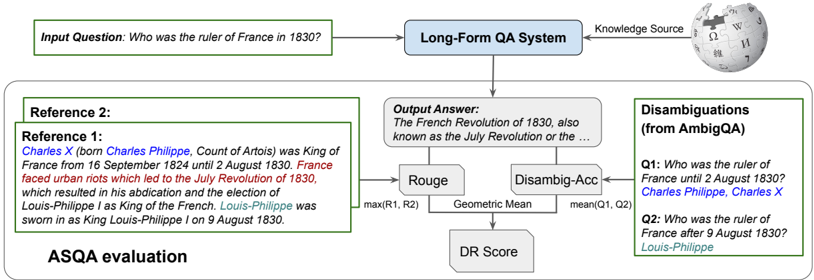
An abundance of datasets and availability of reliable evaluation metrics have resulted in strong progress in factoid question answering (QA).This progress, however, does not easily transfer to the task of long-form QA, where the goal is to answer questions that require in-depth explanations.The hurdles include (i) a lack of high-quality data, and (ii) the absence of a well-defined notion of the answer's quality.In this work, we address these problems by (i) releasing a novel dataset and a task that we call ASQA (Answer Summaries for Questions which are Ambiguous); and (ii) proposing a reliable metric for measuring performance on ASQA.Our task focuses on factoid questions that are ambiguous, that is, have different correct answers depending on interpretation.Answers to ambiguous questions should synthesize factual information from multiple sources into a long-form summary that resolves the ambiguity.In contrast to existing long-form QA tasks (such as ELI5), ASQA admits a clear notion of correctness: a user faced with a good summary should be able to answer different interpretations of the original ambiguous question.We use this notion of correctness to define an automated metric of performance for ASQA.Our analysis demonstrates an agreement between this metric and human judgments, and reveals a considerable gap between human performance and strong baselines.
Overview
The claims and statistics of this paper haven’t been checked yet.
Free: it reads the open-access text and checks the first 5 claims that cite a source we can check. Create a free account to check every claim.
Integrity signals
Registry
Cites
Statistics
Figures
Verification
Claims the paper makes
The claims and statistics of this paper haven’t been checked yet.
Free: it reads the open-access text and checks the first 5 claims that cite a source we can check. Create a free account to check every claim.
Claims other papers make about this one
Each is checked against this paper’s own text: does it say what the citing paper says it does?
The cited source says what the claim attributes to it.
In the citing paper
“We compile three datasets that cover different types of questions and corpora-ASQA (Stelmakh et al., 2022), QAMPARI (Rubin et al., 2022), and ELI5 (Fan et al., 2019)-as shown in Table 1.”
From Enabling Large Language Models to Generate Text with Citations (2023) · cites this paper as Stelmakh et al., 2022
In the citing paper
“For ASQA, Stelmakh et al. (2022) also propose a QA-based evaluation which we found to be not as stable, and thus we do not report it in our paper.”
From Enabling Large Language Models to Generate Text with Citations (2023) · cites this paper as Stelmakh et al. (2022)
In the citing paper
“ASQA (Stelmakh et al., 2022) is a long-form factoid QA dataset characterized by inherently ambiguous questions that require multiple short answers to encapsulate different viewpoints.”
From Learning Fine-Grained Grounded Citations for Attributed Large Language Models (2024) · cites this paper as Stelmakh et al., 2022
In the citing paper
“Recent years have seen the emergence of long-form QA evaluations, such as ELI5 (Fan et al., 2019) and ASQA (Stelmakh et al., 2022a), which allow for more elaborate answers.”
From DebateQA: Evaluating Question Answering on Debatable Knowledge (2026) · cites this paper as Stelmakh et al., 2022a
Self-check
Percentages, sums and reported differences re-computed from the paper’s own numbers.
The self-check needs the paper’s full text.
Citations
Cites
Exploring the Limits of Transfer Learning with a Unified Text-to-Text Transformer
Raffel, C., Shazeer, N., Roberts, A., Lee, K., Narang, S., Matena, M., Zhou, Y., Li, W., & Liu, P. J. (2019) · arXiv · doi:10.48550/arxiv.1910.10683 · Cited by 31,859
Language Models are Few-Shot Learners
Brown, T. B., Mann, B., Ryder, N., Subbiah, M., Kaplan, J., Dhariwal, P., Neelakantan, A., Shyam, P., Sastry, G., Askell, A., et al. (2020) · arXiv · doi:10.48550/arxiv.2005.14165 · Cited by 23,372
Transformers: State-of-the-Art Natural Language Processing
Wolf, T., Debut, L., Sanh, V., Chaumond, J., Delangue, C., Moi, A., Cistac, P., Rault, T., Louf, R., Funtowicz, M., et al. (2020) · Proceedings of the 2020 Conference on Empirical Methods in Natural Language Processing: System Demonstrations · doi:10.18653/v1/2020.emnlp-demos.6 · Cited by 8,741
SQuAD: 100,000+ Questions for Machine Comprehension of Text
Rajpurkar, P., Zhang, J., Lopyrev, K., & Liang, P. (2016) · Proceedings of the 2016 Conference on Empirical Methods in Natural Language Processing · doi:10.18653/v1/d16-1264 · Cited by 6,208
Dense Passage Retrieval for Open-Domain Question Answering
Karpukhin, V., Oğuz, B., Min, S., Lewis, P., Wu, L., Edunov, S., Chen, D., & Yih, W.-T. (2020) · arXiv · doi:10.48550/arxiv.2004.04906 · Cited by 5,311
Dense passage retrieval for open-domain question answering
Karpukhin, V., Oguz, B., Min, S., Lewis, P., Wu, L., Edunov, S., Chen, D., & Yih, W.-T. (2020) · Proceedings of the 2020 Conference on Empirical Methods in Natural Language Processing (EMNLP) · doi:10.18653/v1/2020.emnlp-main.550 · Cited by 3,575
Retrieval-Augmented Generation for Knowledge-Intensive NLP Tasks
Lewis, P., Perez, E., Piktus, A., Petroni, F., Karpukhin, V., Goyal, N., Küttler, H., Lewis, M., Yih, W.-T., Rocktäschel, T., et al. (2020) · arXiv · doi:10.48550/arxiv.2005.11401 · Cited by 3,101
MS MARCO: A Human Generated MAchine Reading COmprehension Dataset
Bajaj, P., Campos, D., Craswell, N., Deng, L., Gao, J., Liu, X., Majumder, R., McNamara, A., Mitra, B., Nguyen, T., et al. (2016) · arXiv · doi:10.48550/arxiv.1611.09268 · Cited by 2,473
Know What You Don't Know: Unanswerable Questions for SQuAD
Rajpurkar, P., Jia, R., & Liang, P. (2018) · arXiv · doi:10.48550/arxiv.1806.03822 · Cited by 2,242
Know What You Don’t Know: Unanswerable Questions for SQuAD
Rajpurkar, P., Jia, R., & Liang, P. (2018) · Proceedings of the 56th Annual Meeting of the Association for Computational Linguistics (Volume 2: Short Papers) · doi:10.18653/v1/p18-2124 · Cited by 2,240
Research works printed but not linked: 11
- Abdalghani Abujabal, Rishiraj Saha Roy, Mohamed Yahya, and Gerhard Weikum. 2019. ComQA: A community-sourced dataset for complex factoid ques- tion answering with paraphrase clusters. In Proceed- ings of the 2019 Conference of the North American Chapter of the Association for Computational Lin- guistics: Human Language Technologies, Volume 1 (Long and Short Papers), pages 307-317, Min- neapolis, Minnesota. Association for Computational Linguistics. · DOI
- Hoa Trang Dang. 2005. Overview of duc 2005. In Pro- ceedings of the document understanding conference, volume 2005, pages 1-12.
- Chin-Yew Lin. 2004. ROUGE: A package for auto- matic evaluation of summaries. In Text Summariza- tion Branches Out, pages 74-81, Barcelona, Spain. Association for Computational Linguistics.
- Yinhan Liu, Myle Ott, Naman Goyal, Jingfei Du, Man- dar Joshi, Danqi Chen, Omer Levy, Mike Lewis, Luke Zettlemoyer, and Veselin Stoyanov. 2019. Roberta: A robustly optimized BERT pretraining approach. CoRR, abs/1907.11692. · arXiv
- Sewon Min, Kenton Lee, Ming-Wei Chang, Kristina Toutanova, and Hannaneh Hajishirzi. 2021. Joint passage ranking for diverse multi-answer retrieval. In Proceedings of the 2021 Conference on Empiri- cal Methods in Natural Language Processing, pages 6997-7008, Online and Punta Cana, Dominican Re- public. Association for Computational Linguistics. · DOI
- Sewon Min, Julian Michael, Hannaneh Hajishirzi, and Luke Zettlemoyer. 2020. AmbigQA: Answering am- biguous open-domain questions. In Proceedings of the 2020 Conference on Empirical Methods in Nat- ural Language Processing (EMNLP), pages 5783- 5797, Online. Association for Computational Lin- guistics. · DOI · Paper page
- Preksha Nema, Mitesh M. Khapra, Anirban Laha, and Balaraman Ravindran. 2017. Diversity driven atten- tion model for query-based abstractive summariza- tion. In Proceedings of the 55th Annual Meeting of the Association for Computational Linguistics (Vol- ume 1: Long Papers), pages 1063-1072, Vancouver, Canada. Association for Computational Linguistics. · DOI · Paper page
- Claude Sammut and Geoffrey I. Webb, editors. 2010. TF-IDF, pages 986-987. Springer US, Boston, MA. · DOI
- Nisan Stiennon, Long Ouyang, Jeffrey Wu, Daniel Ziegler, Ryan Lowe, Chelsea Voss, Alec Radford, Dario Amodei, and Paul F Christiano. 2020. Learn- ing to summarize with human feedback. Advances in Neural Information Processing Systems, 33:3008- 3021.
- Haitian Sun, William W Cohen, and Ruslan Salakhutdi- nov. 2021. Conditionalqa: A complex reading com- prehension dataset with conditional answers. arXiv preprint arXiv:2110.06884. · arXiv
- Ellen M. Voorhees and Dawn M. Tice. 2000. Building a question answering test collection. In Proceedings of the 23rd Annual International ACM SIGIR Confer- ence on Research and Development in Information Retrieval, SIGIR '00, page 200-207, New York, NY, USA. Association for Computing Machinery. · DOI · Paper page
Cited by
Huang, L., Yu, W., Ma, W., Zhong, W., Feng, Z., Wang, H., Chen, Q., Peng, W., Feng, X., Qin, B., et al. (2025) · ACM Transactions on Information Systems · doi:10.1145/3703155 · Cited by 4,688
Active Retrieval Augmented Generation
Jiang, Z., Xu, F., Gao, L., Sun, Z., Liu, Q., Dwivedi-Yu, J., Yang, Y., Callan, J., & Neubig, G. (2023) · Proceedings of the 2023 Conference on Empirical Methods in Natural Language Processing · doi:10.18653/v1/2023.emnlp-main.495 · Cited by 497
Enabling Large Language Models to Generate Text with Citations
Gao, T., Yen, H., Yu, J., & Chen, D. (2023) · arXiv · doi:10.48550/arxiv.2305.14627 · Cited by 223
Enabling Large Language Models to Generate Text with Citations
Gao, T., Yen, H., Yu, J., & Chen, D. (2023) · Proceedings of the 2023 Conference on Empirical Methods in Natural Language Processing · doi:10.18653/v1/2023.emnlp-main.398 · Cited by 216
Zhao, S., Yang, Y., Wang, Z., He, Z., Qiu, L. K., & Qiu, L. (2024) · arXiv · doi:10.48550/arxiv.2409.14924 · Cited by 180
Hallucination Mitigation for Retrieval-Augmented Large Language Models: A Review
Zhang, W., & Zhang, J. (2025) · Mathematics · doi:10.3390/math13050856 · Cited by 145
Agentic Retrieval-Augmented Generation: A Survey on Agentic RAG
Singh, A., Ehtesham, A., Kumar, S., Khoei, T. T., & Vasilakos, A. V. (2025) · arXiv · doi:10.48550/arxiv.2501.09136 · Cited by 36
A Critical Evaluation of Evaluations for Long-form Question Answering
Xu, F., Song, Y., Iyyer, M., & Choi, E. (2023) · Proceedings of the 61st Annual Meeting of the Association for Computational Linguistics (Volume 1: Long Papers) · doi:10.18653/v1/2023.acl-long.181 · Cited by 33
Conditional Generation with a Question-Answering Blueprint
Narayan, S., Maynez, J., Amplayo, R. K., Ganchev, K., Louis, A., Huot, F., Sandholm, A., Das, D., & Lapata, M. (2022) · arXiv · doi:10.48550/arxiv.2207.00397 · Cited by 24
Selectively Answering Ambiguous Questions
Cole, J. R., Zhang, M. J. Q., Gillick, D., Eisenschlos, J. M., Dhingra, B., & Eisenstein, J. (2023) · arXiv · doi:10.48550/arxiv.2305.14613 · Cited by 19
Self-citationSelectively Answering Ambiguous Questions
Cole, J., Zhang, M., Gillick, D., Eisenschlos, J., Dhingra, B., & Eisenstein, J. (2023) · Proceedings of the 2023 Conference on Empirical Methods in Natural Language Processing · doi:10.18653/v1/2023.emnlp-main.35 · Cited by 19
Self-citationAttribute First, then Generate: Locally-attributable Grounded Text Generation
Slobodkin, A., Hirsch, E., Cattan, A., Schuster, T., & Dagan, I. (2024) · arXiv · doi:10.48550/arxiv.2403.17104 · Cited by 17
DebateQA: Evaluating Question Answering on Debatable Knowledge
Xu, R., Qi, X., Qi, Z., Xu, W., & Guo, Z. (2026) · Findings of the Association for Computational Linguistics: EACL 2026 · doi:10.18653/v1/2026.findings-eacl.44 · Cited by 15
Learning Fine-Grained Grounded Citations for Attributed Large Language Models
Huang, L., Feng, X., Ma, W., Gu, Y., Zhong, W., Feng, X., Yu, W., Peng, W., Tang, D., Tu, D., et al. (2024) · Findings of the Association for Computational Linguistics ACL 2024 · doi:10.18653/v1/2024.findings-acl.838 · Cited by 12
Chiang, C.-H., & Lee, H.-Y. (2024) · Findings of the Association for Computational Linguistics ACL 2024 · doi:10.18653/v1/2024.findings-acl.160 · Cited by 5
Understanding Retrieval Augmentation for Long-Form Question Answering
Chen, H.-T., Xu, F., Arora, S., & Choi, E. (2023) · arXiv · doi:10.48550/arxiv.2310.12150 · Cited by 3
Generation-Time vs. Post-hoc Citation: A Holistic Evaluation of LLM Attribution
Saxena, Y., Bommireddy, R., Padia, A., & Gaur, M. (2025) · arXiv · doi:10.48550/arxiv.2509.21557
CiteEval: Principle-Driven Citation Evaluation for Source Attribution
Xu, Y., Qi, P., Chen, J., Liu, K., Han, R., Liu, L., Min, B., Castelli, V., Gupta, A., & Wang, Z. (2025) · arXiv · doi:10.48550/arxiv.2506.01829
GenerationPrograms: Fine-grained Attribution with Executable Programs
Wan, D., Hirsch, E., Stengel-Eskin, E., Dagan, I., & Bansal, M. (2025) · arXiv · doi:10.48550/arxiv.2506.14580
Metadata
- Authors
- Stelmakh, I., Luan, Y., Dhingra, B., & Chang, M.-W.
- Venue
- Proceedings of the 2022 Conference on Empirical Methods in Natural Language Processing
- Published
- 2022
- Pages
- 8273-8288
- Cited by
- 63
- References
- 34
About these checks
Registry, retraction, Cites and statistics results are computed, not judged, with one exception: a printed reference that no index lists is read once by a model before it counts as a citation error. Claims are extracted by a model and kept only when their quote appears verbatim in the text; each cited source is then checked, with a model’s help, for whether it says what the claim relies on. Those verdicts can be wrong — read the claim’s quote and the cited source before relying on one.
Statistics and arithmetic are recomputed, not judged.
Confidence bands are shown only for fields calibrated on our annotated test set. None is calibrated yet, so no band is shown.
What counts as a claim ›How we measure confidence ›How we check this ›
Are you an author, or do you see a problem with this page? Request a review
Data sources
Bibliographic data: Semantic Scholar, OpenAlex, Crossref.
Contains information from the Semantic Scholar Academic Graph Datasets, made available under the ODC Attribution License (ODC-BY 1.0).
Semantic Scholar’s data is described in: Kinney, R., et al. (2023). The Semantic Scholar Open Data Platform. arXiv:2301.10140.
