

Temporal Evidence Chain for Temporal Knowledge Graph Question Answering with Large Language Models
Open accessThe DOI matches its Crossref record; 34 of the 35 references it cites were found in a registry or an index; 7 of the 16 sources its claims cite were checked for support.
Abstract
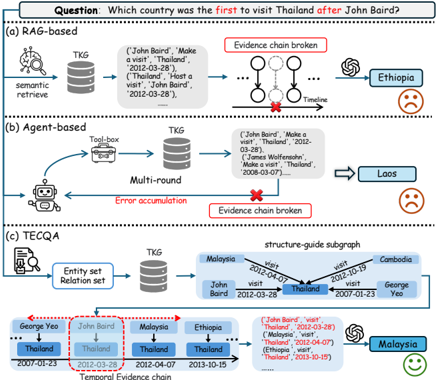
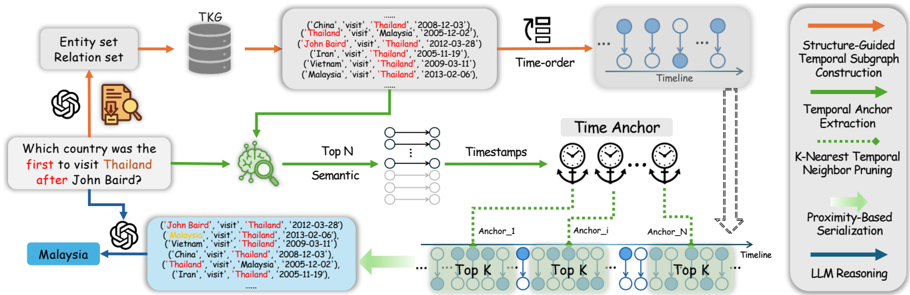
Temporal Knowledge Graph Question Answering (TKGQA) aims to answer temporal questions using knowledge from Temporal Knowledge Graphs (TKGs).Existing LLM-based TKGQA methods typically utilize RAG-based or agent-based paradigms, yet both struggle to construct reliable temporal evidence chains.RAG-based approaches primarily rely on semantic retrieval to fetch question-relevant contexts but overlook the structural dependencies within TKGs, leading to broken evidence chains, whereas iterative agents are prone to error propagation during multi-step reasoning.To address these limitations, we propose TECQA, a framework designed to construct temporal evidence chains for LLM reasoning.Firstly, TECQA employs structure-guided subgraph retrieval to capture structural dependencies and intermediate reasoning paths.Subsequently, it utilizes a k-nearest temporal neighbor pruning strategy to filter irrelevant noise while strictly preserving the continuous local history surrounding critical events.Finally, the retained temporal neighbors are serialized by temporal proximity to explicitly reconstruct a coherent temporal evidence chain.Extensive experiments on MultiTQ and CronQuestions demonstrate that TECQA achieves stateof-the-art performance, outperforming strong baselines by 45.3% particularly on complex queries.
Overview
CoChat Summary
TL;DR
TECQA constructs timeline-consistent temporal evidence chains for LLM-based temporal knowledge graph question answering via structure-guided retrieval, temporal anchor pruning, and proximity-based serialization. It achieves state-of-the-art Hits@1 on MultiTQ (0.811) and CronQuestions (0.980), with large gains on complex queries.
Key findings
- TECQA achieves Overall Hits@1 of 0.811 on MultiTQ and 0.980 on CronQuestions; on MultiTQ’s complex Multiple category it reaches Hits@1 0.616, with the abstract reporting it outperforms strong baselines by 45.3% particularly on complex queries.
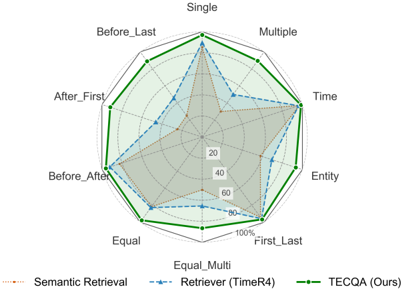
- Structure-guided retrieval achieves 99.33% answer recall; k-nearest temporal neighbor pruning maintains 94.12% answer recall while condensing context to an average of only 20 quadruples. Figure 2 reports semantic retrieval saturates at 68% and TimeR4 at 78%, while TECQA reaches 94%.
- Ablations on MultiTQ show removing structure-guided retrieval drops Overall to 0.657 and Multiple to 0.172; removing k-nearest temporal neighbor pruning drops Overall to 0.726 and Multiple to 0.291; removing proximity-based serialization drops Overall to 0.742 and Multiple to 0.425.
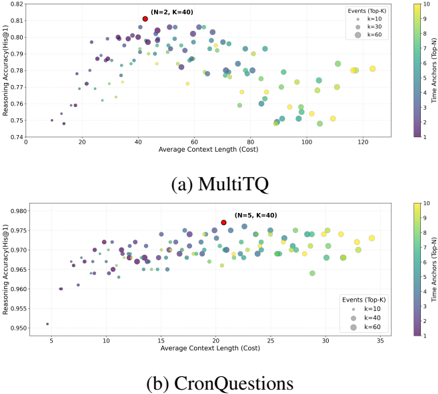
- Optimal hyperparameters are K = 40 for both datasets, with N = 2 implicit anchors for MultiTQ and N = 5 for CronQuestions; with Qwen3-8B generalist, TECQA leads TimeR4 by 27.8%, and reasoning models generally outperform non-reasoning counterparts.
Methods
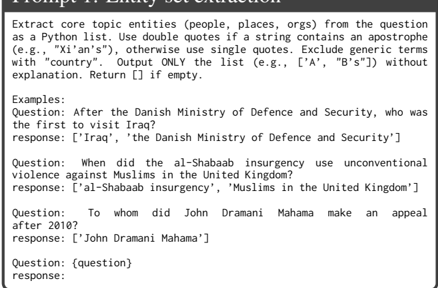
- TECQA has three stages: (1) structure-guided subgraph construction, where an LLM extracts entities/relations and a main entity, schema grounding maps them to the TKG, and retrieval forms a high-recall candidate set from main-entity facts and auxiliary-entity interactions; (2) temporal evidence chain construction, which extracts explicit regex-based anchors and implicit top-N semantic anchors, applies bidirectional k-nearest temporal neighbor pruning around anchors, and serializes retained facts by proximity to anchors; (3) LLM reasoning over the serialized evidence chain.
- Evaluated on MultiTQ (500K question-answer pairs, multiple temporal granularities) and CronQuestions (410K questions, time intervals), using Hits@1. Implementation uses Gemini-2.5-flash for structural parsing, bge-base-en-v1.5 for grounding, and Qwen3-8B for reasoning with temperature fixed at 0; K = 40, N = 2 for MultiTQ, N = 5 for CronQuestions.
- Baselines span PLMs (BERT, ALBERT), traditional TKGQA methods (CronKGQA, TempoQR, MultiQA, LGQA, QC-MHM), and LLM-based frameworks (ARI, TempAgent, TimeR4, RTQA, PoK). Ablations remove structure-guided retrieval (w/o SG), k-nearest temporal neighbor pruning (w/o KNTN), and proximity-based serialization (w/o PS).
Limitations
- The paper states: TECQA depends on upstream structural parsing accuracy, so ambiguous queries or out-of-domain entities where schema grounding fails may degrade performance; k-nearest temporal neighbor pruning assumes temporal locality and may underperform on long-horizon reasoning where the answer is temporally distant from the anchor; and evaluation is confined to structured TKGQA, with extension to unstructured text or real-time streaming data left as future work.
- Evident from the error analysis: on the MultiTQ test set of 54,584 queries, 159 queries (0.29%) yield an empty subgraph, and 86 of these failures are directly caused by incorrect main-entity extraction; first/last queries can also fail when conservative anchor exploration and neighbor retention truncate the temporal span and exclude the true earliest or latest event.
Model-written summary. Check it against the paper before relying on it.
Integrity signals
Registry
Cites
Statistics
Figures
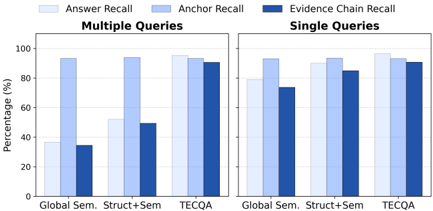
Verification
Claims the paper makes
5 Valid · 2 Not valid · 4 Not checked · 70 Own results and interpretations
Every source the paper cites for this claim was checked and supports it.
In the paper
“TimeR 4 exhibits a significant performance drop when switching from its fine-tuned version to the generalist Qwen3-8B (Yang et al., 2025), suggesting its reliance on parametric knowledge to mitigate retrieval noise.”
§ Temporal Evidence Chain for Temporal Knowledge Graph Question Answering with Large Language Models > Interplay between Retrieval and Reasoning.
What the sources say
- Supportedcites Yang et al., 2025 matched to “Qwen3 Technical Report” (2025) source
The citation sits immediately after 'the generalist Qwen3-8B', so it is offered to identify that model, not to carry the TimeR4 comparison (which is the citing paper's own experiment, along with the 'parametric knowledge / retrieval noise' inference). Our copy of the Qwen3 Technical Report is exactly that source: Section 2 Architecture lists Qwen3-8B among the six dense models, Table 1 gives its configuration (36 layers, 32/8 heads, 128K context), and the Abstract/Introduction present the series as general-purpose LLMs evaluated 'across diverse benchmarks' rather than task-specific fine-tunes — consistent with 'generalist'. No passage of our copy addresses TimeR4 or time-series reasoning, but nothing in it contradicts the identification. (LLM, conf=0.85)
plainstates a cause- Asserted: passes — The authors put it forward as true.
- Checkable: passes — It can be checked against evidence.
- Load-bearing: passes — The paper’s conclusions depend on it.
- Based: passes — The paper gives a reason why it holds.
- Supported
The cited sources support only part of this claim — read each source’s verdict below.
In the paper
“RAG-based approaches primarily rely on semantic retrieval to fetch question-relevant contexts but overlook the structural dependencies within TKGs, leading to broken evidence chains”
- Also stated in: § Laos · plain
“As shown in Figure 1 (a), RAG-based methods retrieve and semantically match individual quadruples, thereby overlooking the explicit structural dependencies among them.”
- Also stated in: § Laos · plain
“Such a retrieval process often produces fragmented chains with missing crucial intermediate facts.”
§ Temporal Evidence Chain for Temporal Knowledge Graph Question Answering with Large Language Models > Abstract
What the sources say
- Partly supportedcites Qian et al., 2024 matched to “TimeR4 : Time-aware Retrieval-Augmented Large Language Models for Temporal Knowledge Graph Question Answering” (2024) sourceExperimental — accuracy not yet measured
Our copy does support the first half: Section 2.1 (KG-enhanced LLMs) says retrieval-based methods "only consider semantic similarity and neglect temporal constraints," and the Introduction's challenge (2) says prior retrieval tools "focus solely on semantic matching." But the overlooked dimension in TimeR4 is the question's TIME CONSTRAINTS, not "structural dependencies within TKGs" (the paper's structural/path-based critique is a separate category, faulted for not accounting for the temporal dimension). Nor does the paper describe the consequence as "broken or fragmented evidence chains": it says the retrieved knowledge is "ineffective for reasoning" (Introduction) and yields "low answer coverage in the retrieved results" (Section 5.4.3), with hallucination attributed to implicit temporal questions rather than to retrieval. The evidence-chain framing and the structural-dependency qualifier are therefore not attributable to this source. (LLM, conf=0.78)
- Partly supportedcites Gong et al., 2025 matched to “RTQA : Recursive Thinking for Complex Temporal Knowledge Graph Question Answering with Large Language Models” (2025) sourceExperimental — accuracy not yet measured
Our copy does support the retrieval half of the claim: the Relevant Facts Retriever section (Section 4) states that TKG quadruples are turned into natural-language statements, embedded with a dense encoder, and 'the top-K most relevant facts are retrieved based on similarity', and Section 5.1 adopts exactly such a similarity-based RAG baseline (which scores only 0.009 Hits@1 on complex TimelineKGQA questions, Performance Comparison on TimelineKGQA). However, no passage characterises RAG-based methods as 'overlooking the structural dependencies within TKGs' or as producing 'broken evidence chains'; the Introduction (1 Introduction, challenge 1) attributes the failures instead to hallucination and inability to handle implicit/compound temporal constraints ('before Kuwait', 'before/last'), and challenge 2 to error propagation in decomposition frameworks, while Section 2.1 criticises embedding-based methods for ranking by vector semantic similarity and handling only simple questions. So the structural-dependency/broken-evidence-chain framing is not what this source says. (LLM, conf=0.72)
plainstates a cause- Asserted: passes — The authors put it forward as true.
- Checkable: passes — It can be checked against evidence.
- Load-bearing: passes — The paper’s conclusions depend on it.
- Based: passes — The paper gives a reason why it holds.
- Also stated in: § Laos · plain
The cited sources support only part of this claim — read each source’s verdict below.
In the paper
“Existing LLM-based TKGQA methods typically utilize RAG-based or agent-based paradigms, yet both struggle to construct reliable temporal evidence chains.”
§ Temporal Evidence Chain for Temporal Knowledge Graph Question Answering with Large Language Models > Abstract
What the sources say
- Supportedcites Qian et al., 2024 matched to “TimeR4 : Time-aware Retrieval-Augmented Large Language Models for Temporal Knowledge Graph Question Answering” (2024) source
Section 2.1 (KG-enhanced LLMs) states that LLM-KGQA integration splits into retrieval-based and agent-based reasoning (path-based being inapplicable to TKGQA), and attributes to each exactly the limitation the claim paraphrases: retrieval-based methods 'only consider semantic similarity and neglect temporal constraints', while agent-based methods 'prove inefficient for complex reasoning tasks due to their reliance on multiple LLM-calls' and their greedy decision-making is 'susceptible to error propagation'. The Introduction (challenges 1 and 2) reinforces this for the temporal setting: LLMs hallucinate on implicit temporal questions 'leading to incorrect reasoning', and off-the-shelf retrieval (BM25, Li et al., 2023) retrieves facts that 'neglect the time constraints of the question, rendering it ineffective for reasoning'. Together these support that both paradigms fail to assemble temporally valid evidence for the reasoning chain; 'temporal evidence chains' is the citing authors' phrasing for the paper's retrieved-facts-plus-reasoning-chain limitation. (LLM, conf=0.82)
- Supportedcites Chen et al., 2024 matched to “Temporal Knowledge Question Answering via Abstract Reasoning Induction” (2024) source
The introduction's 'LACK OF COMPLEX TEMPORAL REASONING' subsection states that RAG-based methods suffer retrieval-accuracy and input-length limits yielding 'irrelevant noises and incomplete reasoning clues', and concludes that 'above approaches fail to provide necessary guidance for ongoing temporal reasoning processes and are susceptible to incorporating extraneous noise'; the same section notes LLMs 'might accumulate errors' in interconnected multi-step temporal reasoning. The results discussion (Table 1 / MULTITQ analysis) extends this to the agent/interaction-based variants: KG-RAG 'still falls short of leading TKGQA models' because retrieved knowledge is redundant or irrelevant, and both ReAct KB and CoT KB show a persistent gap versus ARI because, despite interacting with the environment/KG, they lack guidance suited to the current question. Together these cover both paradigms named in the claim; the only difference is terminological — our copy labels the second group as exemplar-guided/agent-interaction rather than 'agent-based'. (LLM, conf=0.80)
- Not matchedcites Hu et al., 2025
This doesn’t read as a citation we can look up.
plain- Asserted: passes — The authors put it forward as true.
- Checkable: passes — It can be checked against evidence.
- Load-bearing: passes — The paper’s conclusions depend on it.
- Based: passes — The paper gives a reason why it holds.
- Supported
Every source the paper cites for this claim was checked and supports it.
In the paper
“Although ensuring high execution rates, such methods typically lack the reasoning depth required for complex temporal queries (Gong et al., 2025).”
§ Temporal Evidence Chain for Temporal Knowledge Graph Question Answering with Large Language Models > 2.1 Traditional TKGQA Methods
What the sources say
- Supportedcites Gong et al., 2025 matched to “RTQA : Recursive Thinking for Complex Temporal Knowledge Graph Question Answering with Large Language Models” (2025) source
The Related Work subsection 'Embedding-based Methods' (Sec. 2.1 TKGQA) states of TKG embedding-based methods that they 'ensure high execution rates but can only handle simple questions and perform poorly on complex temporal questions', which is exactly the limitation the citing sentence attributes to Gong et al. (2025). 'Lack the reasoning depth required for complex temporal queries' is a fair paraphrase of that inability to handle complex temporal questions; the source's own framing of embedding methods as vector-similarity rankers over quadruples (no explicit multi-step reasoning) supports the paraphrase. (LLM, conf=0.90)
plain- Asserted: passes — The authors put it forward as true.
- Checkable: passes — It can be checked against evidence.
- Load-bearing: passes — The paper’s conclusions depend on it.
- Based: passes — The paper gives a reason why it holds.
- Supported
The cited sources support only part of this claim — read each source’s verdict below.
In the paper
“Despite inherent flexibility, iterative exploration remains vulnerable to error propagation.”
§ Temporal Evidence Chain for Temporal Knowledge Graph Question Answering with Large Language Models > 2.2 LLM-based TKGQA Methods
What the sources say
- Partly supportedcites Chen et al., 2024 matched to “Temporal Knowledge Question Answering via Abstract Reasoning Induction” (2024) sourceExperimental — accuracy not yet measured
Our copy supports the error-propagation half: the Introduction ('Lack of Complex Temporal Reasoning') says that 'facing the interconnected multi-step temporal reasoning, LLMs might accumulate errors during the process of probabilistic generation', and the A.6 Error Analysis describes bad guidance 'proving inadequate in guiding subsequent reasoning processes, leading to a cascade of errors' and warns of LLMs 'falling into a repetitive cycle of errors' — i.e. the recursive multi-step action exploration of §3.3/A.4 is vulnerable to propagated error. Two parts of the claim are not in the paper: the 'inherent flexibility' concession is never attached to iterative exploration (flexibility appears only in A.3, about finely-grained atomic templates being 'flexibly combined'), and the paper hedges the error point ('might accumulate errors'), whereas the citing sentence asserts vulnerability as fact. No contrary statement was found, so this is partial support rather than dispute. (LLM, conf=0.70)
- Not matchedcites Hu et al., 2025
This doesn’t read as a citation we can look up.
plain- Asserted: passes — The authors put it forward as true.
- Checkable: passes — It can be checked against evidence.
- Load-bearing: passes — The paper’s conclusions depend on it.
- Based: passes — The paper gives a reason why it holds.
- Partly supported
33 more claims
Create a free account to see all 81 claims and to verify the 6 references still open.
- It may state two separate claims as one. 29
- The quote only partly states this claim. 2
- Probably not a substantial claim. 18
Self-check
Percentages, sums and reported differences re-computed from the paper’s own numbers.
Each contradiction between two passages listed here was confirmed by an independent check.
Rated minor: it would not touch a result — a value no result rests on, a p-value that stays on the same side of the significance level, or a conflict that is clerical, resolved elsewhere in the paper, or outside its own findings.
In the paper
§ Temporal Evidence Chain for Temporal Knowledge Graph Question Answering with Large Language Models > Interplay between Retrieval and Reasoning.
“TECQA achieves a dramatic 27.8% lead over TimeR 4 with Qwen3-8B”
§ Temporal Evidence Chain for Temporal Knowledge Graph Question Answering with Large Language Models > Prompt 4: Question answering
“| Qwen3-8B Generalist | TimeR 4 TECQA | 0.533 0.778 |”
Citations
Cites
BERT: Pre-training of Deep Bidirectional Transformers for Language Understanding
Devlin, J., Chang, M.-W., Lee, K., & Toutanova, K. (2019) · Proceedings of the 2019 Conference of the North American Chapter of the Association for Computational Linguistics: Human Language Technologies, Volume 1 (Long and Short Papers) · doi:10.18653/v1/n19-1423 · Cited by 54,325
DeepSeek-R1: Incentivizing Reasoning Capability in LLMs via Reinforcement Learning
DeepSeek-AI, Guo, D., Yang, D., Zhang, H., Song, J., Wang, P., Zhu, Q., Xu, R., Zhang, R., Ma, S., et al. (2025) · arXiv · doi:10.48550/arxiv.2501.12948 · Cited by 18,918
Self-citationYang, A., Li, A., Yang, B., Zhang, B., Hui, B., Zheng, B., Yu, B., Gao, C., Huang, C., Lv, C., et al. (2025) · arXiv · doi:10.48550/arxiv.2505.09388 · Cited by 17,283
Self-citationALBERT: A Lite BERT for Self-supervised Learning of Language Representations
Lan, Z., Chen, M., Goodman, S., Gimpel, K., Sharma, P., & Soricut, R. (2019) · arXiv · doi:10.48550/arxiv.1909.11942 · Cited by 4,308
Llama 2: Open Foundation and Fine-Tuned Chat Models
Touvron, H., Martin, L., Stone, K., Albert, P., Almahairi, A., Babaei, Y., Bashlykov, N., Batra, S., Bhargava, P., Bhosale, S., et al. (2023) · arXiv · doi:10.48550/arxiv.2307.09288 · Cited by 2,604
ReAct: Synergizing Reasoning and Acting in Language Models
Yao, S., Zhao, J., Yu, D., Du, N., Shafran, I., Narasimhan, K., & Cao, Y. (2022) · arXiv · doi:10.48550/arxiv.2210.03629 · Cited by 608
C-Pack: Packed Resources For General Chinese Embeddings
Xiao, S., Liu, Z., Zhang, P., Muennighoff, N., Lian, D., & Nie, J.-Y. (2024) · Proceedings of the 47th International ACM SIGIR Conference on Research and Development in Information Retrieval · doi:10.1145/3626772.3657878 · Cited by 523
C-Pack: Packed Resources For General Chinese Embeddings
Xiao, S., Liu, Z., Zhang, P., Muennighoff, N., Lian, D., & Nie, J.-Y. (2023) · arXiv · doi:10.48550/arxiv.2309.07597 · Cited by 514
Grattafiori, A., Dubey, A., Jauhri, A., Pandey, A., Kadian, A., Al-Dahle, A., Letman, A., Mathur, A., Schelten, A., Vaughan, A., et al. (2024) · arXiv · doi:10.48550/arxiv.2407.21783 · Cited by 505
Learning Sequence Encoders for Temporal Knowledge Graph Completion
García-Durán, A., Dumančić, S., & Niepert, M. (2018) · Proceedings of the 2018 Conference on Empirical Methods in Natural Language Processing · doi:10.18653/v1/d18-1516 · Cited by 449
DeepSeek-AI, Liu, A., Feng, B., Xue, B., Wang, B., Wu, B., Lu, C., Zhao, C., Deng, C., Zhang, C., et al. (2024) · arXiv · doi:10.48550/arxiv.2412.19437 · Cited by 294
Self-citationQuestion Answering Over Temporal Knowledge Graphs
Saxena, A., Chakrabarti, S., & Talukdar, P. (2021) · Proceedings of the 59th Annual Meeting of the Association for Computational Linguistics and the 11th International Joint Conference on Natural Language Processing (Volume 1: Long Papers) · doi:10.18653/v1/2021.acl-long.520 · Cited by 91
Temporal knowledge graph question answering via subgraph reasoning
Chen, Z., Zhao, X. H., Liao, J., Li, X., & Kanoulas, E. (2022) · Knowledge-Based Systems · doi:10.1016/j.knosys.2022.109134 · Cited by 88
Comanici, G., Bieber, E., Schaekermann, M., Pasupat, I., Sachdeva, N., Dhillon, I., Blistein, M., Ram, O., Zhang, D., Rosen, E., et al. (2025) · arXiv · doi:10.48550/arxiv.2507.06261 · Cited by 69
Local and Global: Temporal Question Answering via Information Fusion
Liu, Y., Liang, D., Li, M., Giunchiglia, F., Li, X., Wang, S., Wu, W. B., Huang, L., Feng, X., & Guan, R. (2023) · International Joint Conference on Artificial Intelligence · doi:10.24963/ijcai.2023/571 · Cited by 64
TEQUILA: Temporal Question Answering over Knowledge Bases
Jia, Z., Abujabal, A., Saha Roy, R., Strötgen, J., & Weikum, G. (2018) · Proceedings of the 27th ACM International Conference on Information and Knowledge Management · doi:10.1145/3269206.3269247 · Cited by 61
Multi-granularity Temporal Question Answering over Knowledge Graphs
Chen, Z., Liao, J., & Zhao, X. (2023) · Proceedings of the 61st Annual Meeting of the Association for Computational Linguistics (Volume 1: Long Papers) · doi:10.18653/v1/2023.acl-long.637 · Cited by 54
Question Calibration and Multi-Hop Modeling for Temporal Question Answering
Xue, C., Liang, D., Wang, P., & Zhang, J. (2024) · Proceedings of the AAAI Conference on Artificial Intelligence · doi:10.1609/aaai.v38i17.29903 · Cited by 50
TwiRGCN: Temporally Weighted Graph Convolution for Question Answering over Temporal Knowledge Graphs
Sharma, A., Saxena, A., Gupta, C., Kazemi, M., Talukdar, P. P., & Chakrabarti, S. (2023) · Conference of the European Chapter of the Association for Computational Linguistics · doi:10.18653/v1/2023.eacl-main.150 · Cited by 43
Qian, X., Zhang, Y., Zhao, Y., Zhou, B., Sui, X., Zhang, L., & Song, K. (2024) · Proceedings of the 2024 Conference on Empirical Methods in Natural Language Processing · doi:10.18653/v1/2024.emnlp-main.394 · Cited by 35
Two-stage Generative Question Answering on Temporal Knowledge Graph Using Large Language Models
Gao, Y., Qiao, L., Kan, Z., Wen, Z., He, Y., & Li, D. (2024) · Findings of the Association for Computational Linguistics ACL 2024 · doi:10.18653/v1/2024.findings-acl.401 · Cited by 32
Temporal Knowledge Graph Question Answering: A SurveyPreprint
Su, M., Li, Z., Chen, Z., Bai, L., Jin, X., & Guo, J. (2024) · arXiv (Cornell University) · doi:10.48550/arxiv.2406.14191 · Cited by 30
Time-aware ReAct Agent for Temporal Knowledge Graph Question Answering
Hu, Q., Tu, X., Guo, C., & Zhang, S. (2025) · Findings of the Association for Computational Linguistics: NAACL · doi:10.18653/v1/2025.findings-naacl.334 · Cited by 29
TempoQR: Temporal Question Reasoning over Knowledge Graphs
Mavromatis, C., Subramanyam, P. L., Ioannidis, V. N., Adeshina, A., Howard, P. R., Grinberg, T., Hakim, N., & Karypis, G. (2022) · Proceedings of the AAAI Conference on Artificial Intelligence · doi:10.1609/aaai.v36i5.20526 · Cited by 16
Temporal Knowledge Question Answering via Abstract Reasoning Induction
Chen, Z., Li, D., Zhao, X., Hu, B., & Zhang, M. (2024) · Proceedings of the 62nd Annual Meeting of the Association for Computational Linguistics (Volume 1: Long Papers) · doi:10.18653/v1/2024.acl-long.267 · Cited by 16
Zhang, Y., Qian, X., Zhao, Y., Zhou, B., Sui, X., & Yuan, X. (2026) · IEEE Transactions on Knowledge and Data Engineering · doi:10.1109/tkde.2026.3718295 · Cited by 9
Semantic Framework based Query Generation for Temporal Question Answering over Knowledge Graphs
Ding, W., Chen, H., Li, H., & Qu, Y. (2022) · Proceedings of the 2022 Conference on Empirical Methods in Natural Language Processing · doi:10.18653/v1/2022.emnlp-main.122 · Cited by 8
Gong, Z., Li, J., Liu, Z., Liang, L., Chen, H., & Zhang, W. (2025) · Proceedings of the 2025 Conference on Empirical Methods in Natural Language Processing · doi:10.18653/v1/2025.emnlp-main.499 · Cited by 8
SYGMA: System for Generalizable Modular Question Answering OverKnowledge Bases
Neelam, S., Sharma, U., Karanam, H., Ikbal, S., Kapanipathi, P., Abdelaziz, I., Mihindukulasooriya, N., Lee, Y.-S., Srivastava, S., Pendus, C., et al. (2021) · arXiv · doi:10.48550/arxiv.2109.13430
Two-stage Generative Question Answering on Temporal Knowledge Graph Using Large Language Models
Gao, Y., Qiao, L., Kan, Z., Wen, Z., He, Y., & Li, D. (2024) · arXiv · doi:10.48550/arxiv.2402.16568
Question Answering Over Temporal Knowledge Graphs
Saxena, A., Chakrabarti, S., & Talukdar, P. (2021) · arXiv · doi:10.48550/arxiv.2106.01515
TwiRGCN: Temporally Weighted Graph Convolution for Question Answering over Temporal Knowledge Graphs
Sharma, A., Saxena, A., Gupta, C., Kazemi, S. M., Talukdar, P., & Chakrabarti, S. (2022) · arXiv · doi:10.48550/arxiv.2210.06281
Semantic Framework based Query Generation for Temporal Question Answering over Knowledge Graphs
Ding, W., Chen, H., Li, H., & Qu, Y. (2022) · arXiv · doi:10.48550/arxiv.2210.04490
TempoQR: Temporal Question Reasoning over Knowledge Graphs
Mavromatis, C., Subramanyam, P. L., Ioannidis, V. N., Adeshina, S., Howard, P. R., Grinberg, T., Hakim, N., & Karypis, G. (2021) · arXiv · doi:10.48550/arxiv.2112.05785
Qian, X., Zhang, Y., Zhao, Y., Zhou, B., Sui, X., & Yuan, X. (2025) · arXiv · doi:10.48550/arxiv.2511.04072
Cited by
Yuen, I. (2026) · Automated Knowledge Base Construction · doi:10.18653/2026.akbc-1.10
CoSTA: Co-Evolving Self-Play Timeline Agents for Complex Temporal Knowledge Graph Question AnsweringPreprint
Liu, H., Yan, Z., Guo, S., Gu, J., Basulto, V. G., Wang, J., & Li, R. (2026) · arXiv (Cornell University) · doi:10.48550/arxiv.2610.38450
CREDO: Evidence-Conditioned Credit Assignment for Temporal Reasoning AgentsPreprint
Leng, Y., Wen, S., Chen, X., Zeng, X., Tian, Y., & Huang, S.-J. (2026) · arXiv (Cornell University) · doi:10.48550/arxiv.2611.01643
Metadata
- Authors
- Liu, S., Zhou, X., Wang, B., & Zhang, G.
- Affiliations
- Chinese Academy of Sciences (CN)
- University of International Business and Economics (CN)
- Venue
- Proceedings of the 64th Annual Meeting of the Association for Computational Linguistics (Volume 1: Long Papers)
- Published
- 2026
- Pages
- 29515-29529
- ISSN
- 0736-587X (ISSN-L)
- OpenAlex
- W7166805089
- Cited by
- 3
- References
- 26
- Citations by year
- 2026: 3
- FWCI
- 2.66
- Type
- conference paper
- Language
- en
- Open access
- hybrid
- doi.org
- Licence
- cc-by
- Locations
- Proceedings of the conference - Association for Computational Linguistics. Meeting (publishedVersion, cc-by)
- Funders
- National Natural Science Foundation of China (62176252)
- Topics
- Physical Sciences › Computer Science › Artificial Intelligence › Advanced Graph Neural Networks
- Physical Sciences › Computer Science › Artificial Intelligence › Topic Modeling
- Physical Sciences › Computer Science › Artificial Intelligence › Semantic Web and Ontologies
- Keywords
- temporal knowledge graphs, large language models, temporal proximity, LLM reasoning
About these checks
Registry, retraction, Cites and statistics results are computed, not judged, with one exception: a printed reference that no index lists is read once by a model before it counts as a citation error. Claims are extracted by a model and kept only when their quote appears verbatim in the text; each cited source is then checked, with a model’s help, for whether it says what the claim relies on. Those verdicts can be wrong — read the claim’s quote and the cited source before relying on one.
The claim verdicts this report counts are experimental: their accuracy is not yet measured.
A language model drew the claims from the paper on 2026-11-18, under version 3 of the claim definition (model deepseek-v4.1-flash, prompt extract-v3).
A second model labelled each claim on 2026-11-18 (model jev-1.13-20260917, definition revision gold-guideline-v0.2).
Cited sources are checked with a language model’s help (qwen3.8-omni-flash).
Statistics and arithmetic are recomputed, not judged.
Confidence bands are shown only for fields calibrated on our annotated test set. None is calibrated yet, so no band is shown.
What counts as a claim ›How we measure confidence ›How we check this ›
Are you an author, or do you see a problem with this page? Request a review
Data sources
Bibliographic data: Semantic Scholar, OpenAlex, Crossref.
Contains information from the Semantic Scholar Academic Graph Datasets, made available under the ODC Attribution License (ODC-BY 1.0).
Semantic Scholar’s data is described in: Kinney, R., et al. (2023). The Semantic Scholar Open Data Platform. arXiv:2301.10140.
