

The DOI matches its Crossref record; 15 of the 15 references it cites were found in a registry or an index.
Aligning Knowledge and Text Embeddings by Entity Descriptions
Open accessAbstract
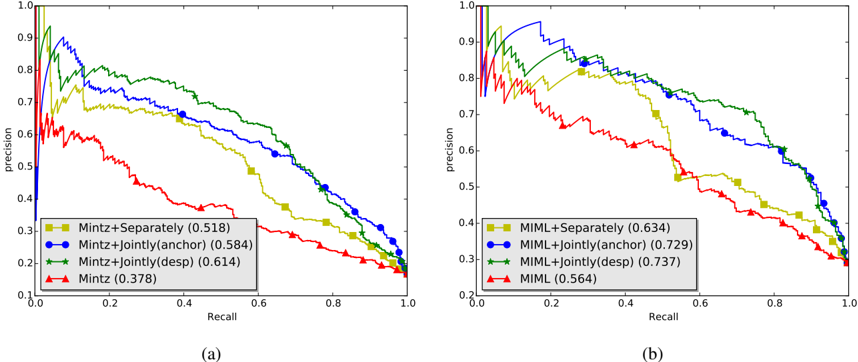
We study the problem of jointly embedding a knowledge base and a text corpus.The key issue is the alignment model making sure the vectors of entities, relations and words are in the same space.Wang et al. (2014a) rely on Wikipedia anchors, making the applicable scope quite limited.In this paper we propose a new alignment model based on text descriptions of entities, without dependency on anchors.We require the embedding vector of an entity not only to fit the structured constraints in KBs but also to be equal to the embedding vector computed from the text description.Extensive experiments show that, the proposed approach consistently performs comparably or even better than the method of Wang et al. (2014a), which is encouraging as we do not use any anchor information.
Overview
The claims and statistics of this paper haven’t been checked yet.
Free: it reads the open-access text and checks the first 5 claims that cite a source we can check. Create a free account to check every claim.
Integrity signals
Registry
Cites
Statistics
Figures
Verification
Claims the paper makes
The claims and statistics of this paper haven’t been checked yet.
Free: it reads the open-access text and checks the first 5 claims that cite a source we can check. Create a free account to check every claim.
Claims other papers make about this one
Each is checked against this paper’s own text: does it say what the citing paper says it does?
The check wasn’t confident either way, so it gives no verdict — never disputed.
In the citing paper
“The distributed word vectors, along with a simple supervised model, can learn to predict numeric and binary attributes of entities with a reasonable degree of accuracy.”
From Pre-trained models for natural language processing: A survey (2020) · cites this paper as [119]
Experimental — accuracy not yet measuredIn the citing paper
“Similarly, Gupta et al. [119] showed that word2vec embeddings implicitly encode referential attributes of entities.”
From Pre-trained models for natural language processing: A survey (2020) · cites this paper as [119]
Self-check
Percentages, sums and reported differences re-computed from the paper’s own numbers.
The self-check needs the paper’s full text.
Citations
Cites
Efficient Estimation of Word Representations in Vector Space
Mikolov, T., Chen, K., Corrado, G., & Dean, J. (2013) · arXiv · doi:10.48550/arxiv.1301.3781 · Cited by 26,568
Distributed Representations of Words and Phrases and their Compositionality
Mikolov, T., Sutskever, I., Chen, K., Corrado, G., & Dean, J. (2013) · arXiv · doi:10.48550/arxiv.1310.4546 · Cited by 24,533
(2013) · Cited by 5,726
Knowledge Graph Embedding by Translating on Hyperplanes
Wang, Z., Zhang, J., Feng, J., & Chen, Z. (2014) · Proceedings of the AAAI Conference on Artificial Intelligence · doi:10.1609/aaai.v28i1.8870 · Cited by 3,915
Self-citationLearning Entity and Relation Embeddings for Knowledge Graph Completion
Lin, Y., Liu, Z., Sun, M., Liu, Y., & Zhu, X. (2015) · Proceedings of the AAAI Conference on Artificial Intelligence · doi:10.1609/aaai.v29i1.9491 · Cited by 3,749
Distant supervision for relation extraction without labeled data
Mintz, M., Bills, S., Snow, R., & Jurafsky, D. (2009) · Proceedings of the Joint Conference of the 47th Annual Meeting of the ACL and the 4th International Joint Conference on Natural Language Processing of the AFNLP: Volume 2 - ACL-IJCNLP '09 · doi:10.3115/1690219.1690287 · Cited by 2,752
Reasoning With Neural Tensor Networks for Knowledge Base Completion
Socher, R., Chen, D., Manning, C. D., & Ng, A. Y. (2013) · Cited by 1,667
Modeling Relations and Their Mentions without Labeled Text
Riedel, S., Yao, L., & McCallum, A. (2010) · Lecture Notes in Computer Science · doi:10.1007/978-3-642-15939-8_10 · Cited by 1,270
Learning Structured Embeddings of Knowledge Bases
Bordes, A., Weston, J., Collobert, R., & Bengio, Y. (2011) · Proceedings of the AAAI Conference on Artificial Intelligence · doi:10.1609/aaai.v25i1.7917 · Cited by 829
Bordes, A., Glorot, X., Weston, J., & Bengio, Y. (2014) · Machine Learning · doi:10.1007/s10994-013-5363-6 · Cited by 675
Research works printed but not linked: 1
- Tomas Mikolov, Ilya Sutskever, Kai Chen, Greg S Cor- rado, and Jeff Dean. 2013b. Distributed representa- tions of words and phrases and their compositional- ity. In Advances in Neural Information Processing Systems, pages 3111-3119.
Cited by
Knowledge Graph Embedding: A Survey of Approaches and Applications
Wang, Q., Mao, Z., Wang, B., & Guo, L. (2017) · IEEE Transactions on Knowledge and Data Engineering · doi:10.1109/tkde.2017.2754499 · Cited by 2,654
Pre-trained models for natural language processing: A survey
Qiu, X., Sun, T., Xu, Y., Shao, Y., Dai, N., & Huang, X. (2020) · Science China Technological Sciences · doi:10.1007/s11431-020-1647-3 · Cited by 1,591
“Early studies [197, 217, 201, 205] focused on learning knowledge graph embeddings and word embedding jointly.”
BackgroundRippleNet: Propagating User Preferences on the Knowledge Graph for Recommender Systems
Wang, H., Zhang, F., Wang, J., Zhao, M., Li, W., Xie, X., & Guo, M. (2018) · Proceedings of the 27th ACM International Conference on Information and Knowledge Management · doi:10.1145/3269206.3271739 · Cited by 1,160
Representation Learning of Knowledge Graphs with Entity Descriptions
Xie, R., Liu, Z., Jia, J., Luan, H., & Sun, M. (2016) · Proceedings of the AAAI Conference on Artificial Intelligence · doi:10.1609/aaai.v30i1.10329 · Cited by 725
Multilingual Knowledge Graph Embeddings for Cross-lingual Knowledge Alignment
Chen, M., Tian, Y., Yang, M., & Zaniolo, C. (2017) · Proceedings of the Twenty-Sixth International Joint Conference on Artificial Intelligence · doi:10.24963/ijcai.2017/209 · Cited by 531
Metadata
- Authors
- Zhong, H., Zhang, J., Wang, Z., Wan, H., & Chen, Z.
- Affiliations
- Sun Yat-sen University (CN)
- Microsoft (United States) (US)
- Venue
- Proceedings of the 2015 Conference on Empirical Methods in Natural Language Processing
- Published
- 2015
- Pages
- 267-272
- OpenAlex
- W2250807343
- Cited by
- 163
- References
- 15
- Citations by year
- 2026: 1 · 2025: 1 · 2024: 5 · 2023: 10 · 2022: 11 · 2021: 25 · 2020: 33 · 2019: 27 · 2018: 27 · 2017: 11 · 2016: 12
- FWCI
- 9.39
- Type
- conference paper
- Language
- en
- Open access
- hybrid
- doi.org
- Licence
- cc-by
- Locations
- Conference on Empirical Methods in Natural Language Processing (EMNLP) (publishedVersion, cc-by)
- Topics
- Physical Sciences › Computer Science › Artificial Intelligence › Topic Modeling
- Physical Sciences › Computer Science › Artificial Intelligence › Advanced Graph Neural Networks
- Physical Sciences › Computer Science › Computer Vision and Pattern Recognition › Multimodal Machine Learning Applications
- Keywords
- knowledge base embedding, text embeddings, entity alignment, entity descriptions, entity embeddings, relation embeddings, word embeddings
About these checks
Registry, retraction, Cites and statistics results are computed, not judged, with one exception: a printed reference that no index lists is read once by a model before it counts as a citation error. Claims are extracted by a model and kept only when their quote appears verbatim in the text; each cited source is then checked, with a model’s help, for whether it says what the claim relies on. Those verdicts can be wrong — read the claim’s quote and the cited source before relying on one.
Statistics and arithmetic are recomputed, not judged.
Confidence bands are shown only for fields calibrated on our annotated test set. None is calibrated yet, so no band is shown.
What counts as a claim ›How we measure confidence ›How we check this ›
Are you an author, or do you see a problem with this page? Request a review
How to cite
Cite CoChat for the checks on this page, and the paper for its own findings.
- This page
- CoChat. (2026). Citation check: Aligning Knowledge and Text Embeddings by Entity Descriptions. https://app.cochat.ai/papers/10.18653/v1/d15-1031
- The paper
- Zhong, H., Zhang, J., Wang, Z., Wan, H., & Chen, Z. (2015). Aligning Knowledge and Text Embeddings by Entity Descriptions. Proceedings of the 2015 Conference on Empirical Methods in Natural Language Processing. https://doi.org/10.18653/v1/d15-1031
Data sources
Bibliographic data: Semantic Scholar, OpenAlex, Crossref.
Contains information from the Semantic Scholar Academic Graph Datasets, made available under the ODC Attribution License (ODC-BY 1.0).
Semantic Scholar’s data is described in: Kinney, R., et al. (2023). The Semantic Scholar Open Data Platform. arXiv:2301.10140.
