

Natural Language Does Not Emerge ‘Naturally’ in Multi-Agent Dialog
Open accessThe DOI matches its Crossref record; 24 of the 24 references it cites were found in a registry or an index.
Abstract
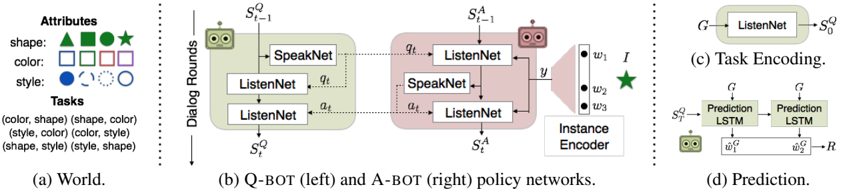
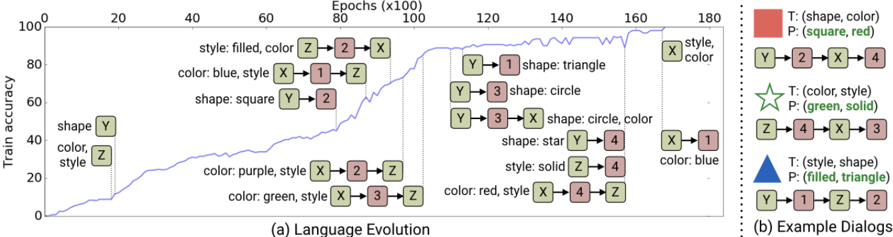
A number of recent works have proposed techniques for end-to-end learning of communication protocols among cooperative multi-agent populations, and have simultaneously found the emergence of grounded human-interpretable language in the protocols developed by the agents, learned without any human supervision!In this paper, using a Task & Talk reference game between two agents as a testbed, we present a sequence of 'negative' results culminating in a 'positive' one -showing that while most agent-invented languages are effective (i.e.achieve near-perfect task rewards), they are decidedly not interpretable or compositional.In essence, we find that natural language does not emerge 'naturally', despite the semblance of ease of natural-language-emergence that one may gather from recent literature.We discuss how it is possible to coax the invented languages to become more and more human-like and compositional by increasing restrictions on how two agents may communicate.
Overview
The claims and statistics of this paper haven’t been checked yet.
Free: it reads the open-access text and checks the first 5 claims that cite a source we can check. Create a free account to check every claim.
Integrity signals
Registry
Cites
Statistics
Figures
Verification
Claims the paper makes
The claims and statistics of this paper haven’t been checked yet.
Free: it reads the open-access text and checks the first 5 claims that cite a source we can check. Create a free account to check every claim.
Claims other papers make about this one
Each is checked against this paper’s own text: does it say what the citing paper says it does?
The source backs part of the claim, not all of it — or backs it for a different population, condition or comparison.
In the citing paper
“Despite the flexibility of such methods, traditional EC agents often exhibit undesirable properties, such as being overly-complex (Chaabouni et al., 2019), slow to converge (Eccles et al., 2019;Lin et al., 2021), or unable to generalize to novel inputs (Kottur et al., 2017).”
From Towards Human-Like Emergent Communication via Utility, Informativeness, and Complexity (2025) · cites this paper as Kottur et al., 2017
Experimental — accuracy not yet measuredThe cited source says what the claim attributes to it.
In the citing paper
“Based in part by a desired to mirror the complexity-limited discrete nature of words, some recent EC works seek to induce complexity-limited discrete communication among agents (Kottur et al., 2017).”
From Towards Human-Like Emergent Communication via Utility, Informativeness, and Complexity (2025) · cites this paper as Kottur et al., 2017
The cited source says what the claim attributes to it.
In the citing paper
“In traditional EC work, agents are trained in cooperative multi-agent environments to maximize a utility function (sometimes called the reward) (Havrylov & Titov, 2017;Kottur et al., 2017;Lazaridou et al., 2018;Lowe et al., 2017;Wang et al., 2020).”
From Towards Human-Like Emergent Communication via Utility, Informativeness, and Complexity (2025) · cites this paper as Kottur et al., 2017
Self-check
Percentages, sums and reported differences re-computed from the paper’s own numbers.
The self-check needs the paper’s full text.
Citations
Cites
Adam: A Method for Stochastic Optimization
Kingma, D. P., & Ba, J. (2014) · arXiv · doi:10.48550/arxiv.1412.6980 · Cited by 98,946 · cited 1×
“We use 1000 episodes of two-round dialogs to compute policy gradients, and perform updates according to Adam optimizer (Kingma and Ba, 2015), with a learning rate of 0 .”
MethodStrategic information transmission
Crawford, V. P., & Sobel, J. (1982) · Econometrica · doi:10.2307/1913390 · Cited by 4,293 · cited 2×
“This ‘set partitioning’ strategy is consistent with known results from game theory on Nash equilibria in ‘cheap talk’ games (Crawford and Sobel, 1982).”
BackgroundResultConvention: A Philosophical Study.
Llewelyn, J. E., & Lewis, D. K. (1970) · The Philosophical Quarterly · doi:10.2307/2218418 · Cited by 3,121
Building End-To-End Dialogue Systems Using Generative Hierarchical Neural Network Models
Serban, I., Sordoni, A., Bengio, Y., Courville, A., & Pineau, J. (2016) · Proceedings of the AAAI Conference on Artificial Intelligence · doi:10.1609/aaai.v30i1.9883 · Cited by 1,615 · cited 1×
“While historically such agents have been based on slot filling (Lemon et al., 2006), the dominant paradigm today is neural dialog models (Bor-des and Weston, 2016; Weston, 2016; Serban et al., 2016a,b) trained on large quantities of data.”
BackgroundLearning to Communicate with Deep Multi-Agent Reinforcement Learning
Foerster, J. N., Assael, Y. M., de Freitas, N., & Whiteson, S. (2016) · arXiv · doi:10.48550/arxiv.1605.06676 · Cited by 1,217 · cited 1×
“, 2014) and is witnessing a recent resurgence (Wang et al., 2016; Foerster et al., 2016; Sukhbaatar et al., 2016; Jorge et al., 2016; Lazaridou et al., 2017; Havrylov and Titov, 2017; Mordatch and Abbeel, 2017; Das et al., 2017b) – is situated language learning.”
BackgroundSimple statistical gradient-following algorithms for connectionist reinforcement learning
Williams, R. J. (1992) · Machine Learning · doi:10.1023/a:1022672621406 · Cited by 817 · cited 6×
“To train these agents, we update policy parameters θQ and θA using the popular REINFORCE (Williams, 1992) policy gradient algorithm.”
MethodInfluentialThe Ubuntu Dialogue Corpus: A Large Dataset for Research in Unstructured Multi-Turn Dialogue Systems
Lowe, R., Pow, N., Serban, I., & Pineau, J. (2015) · Proceedings of the 16th Annual Meeting of the Special Interest Group on Discourse and Dialogue · doi:10.18653/v1/w15-4640 · Cited by 748
Procedures as a representation for data in a computer program for understanding natural language
Winograd, T. A. (1971) · DSpace@MIT (Massachusetts Institute of Technology) · Cited by 520
Das, A., Kottur, S., Gupta, K., Singh, A., Jain, D., Moura, J. M. F., Parikh, D., & Batra, D. (2017) · IEEE Computer Society Conference on Computer Vision and Pattern Recognition/Proceedings - IEEE Computer Society Conference on Computer Vision and Pattern Recognition/Proceedings · Cited by 499
Self-citationEmergence of grounded compositional language in multi-agent populations
Mordatch, I., & Abbeel, P. (2018) · Proceedings of the AAAI Conference on Artificial Intelligence · doi:10.1609/aaai.v32i1.11492 · Cited by 440
Research works printed but not linked: 3
- Vincent Crawford and Joel Sobel. 1982. Strategic in- formation transmission. Econometrica 50(6):1431-51.
- Emilio Jorge, Mikael Kågebäck, and Emil Gustavsson. 2016. Learning to play guess who? and inventing a grounded language as a consequence. In NIPS work- shop on deep reinforcement learning.
- Iulian Vlad Serban, Alessandro Sordoni, Ryan Lowe, Laurent Charlin, Joelle Pineau, Aaron Courville, and Yoshua Bengio. 2016b. A Hierarchical Latent Variable Encoder-Decoder Model for Generating Dialogues. arXiv preprint arXiv:1605.06069 . · arXiv
Cited by
Items 101–165 of 165
Context-dependent communication under environmental constraints
Główka, K., Zubek, J., & Rączaszek‐Leonardi, J. (2024) · Cognitive Systems Research · doi:10.1016/j.cogsys.2024.101293 · Cited by 8
Learning Multi-Object Positional Relationships via Emergent Communication
Feng, Y., An, B., & Lu, Z. (2024) · Proceedings of the AAAI Conference on Artificial Intelligence · doi:10.1609/aaai.v38i16.29685 · Cited by 7
Cooperative Multi-Agent Reinforcement Learning with Conversation Knowledge for Dialogue Management
Lei, S., Wang, X., & Yuan, C. (2020) · Applied Sciences · doi:10.3390/app10082740 · Cited by 3
“References [28,29] proposed a cooperative ‘image guessing’ game between two agents – Q-BOT and A-BOT– who communicate in natural language dialog so that Q-BOT can select an unseen image from a lineup of images.”
BackgroundA Definition and a Test for Human-Level Artificial Intelligence
Park, D., Mondol, M. A. R., Pothula, A., & Islam, M. (2023) · IEEE Symposium Series on Computational Intelligence (SSCI) · doi:10.1109/ssci52147.2023.10372029 · Cited by 4
“While we might find clues about the learning mechanism, it may be challenging to apply to human-robot interaction because language is a set of arbitrary symbols shared between members [50].”
BackgroundEmergence of Numeric Concepts in Multi-Agent Autonomous CommunicationPreprint
Guo, S. (2019) · arXiv (Cornell University) · doi:10.48550/arxiv.1911.01098 · Cited by 6
Denamganaï, K., & Walker, J. A. (2020) · arXiv (Cornell University) · doi:10.48550/arxiv.2012.09486 · Cited by 14
“In this form, the agent has to generate an output, which can for instance, be the task of reconstructing the target stimulus itself or some of its (symbolic) attributes [45, 17].”
BackgroundResultInfluentialIterated learning for emergent systematicity in VQAPreprint
Vani, A., Schwarzer, M., Lu, Y., Dhekane, E. G., & Courville, A. C. (2021) · arXiv (Cornell University) · doi:10.48550/arxiv.2105.01119 · Cited by 10
“Most approaches to learning a discrete communication protocol between agents use reinforcement learning (Foerster et al., 2016; Lazaridou et al., 2017; Kottur et al., 2017; Jorge et al., 2016; Havrylov & Titov, 2017).”
Towards Human-Like Emergent Communication via Utility, Informativeness, and Complexity
Tucker, M., Shah, J., Levy, R., & Zaslavsky, N. (2025) · Open Mind · doi:10.1162/opmi_a_00188 · Cited by 2
“Despite the flexibility of such methods, traditional EC agents often exhibit undesirable properties, such as being overly-complex (Chaabouni et al., 2019), slow to converge (Eccles et al., 2019; Lin et al., 2021), or unable to generalize to novel inputs (Kottur et al., 2017).”
A framework for the emergence and analysis of language in social learning agents
Wieczorek, T. J., Tchumatchenko, T., Wert-Carvajal, C., & Eggl, M. F. (2024) · Nature Communications · doi:10.1038/s41467-024-51887-5 · Cited by 4
Multitasking Inhibits Semantic Drift
Jacob, A. P., Lewis, M., & Andreas, J. (2021) · Conference of the North American Chapter of the Association for Computational Linguistics: Human Language Technologies (NAACL-HLT) · doi:10.18653/v1/2021.naacl-main.421 · Cited by 9
Connecting Language and Vision to Actions
Anderson, P., Das, A., & Wu, Q. (2018) · doi:10.18653/v1/p18-5004 · Cited by 2
“Within visual dialog, we will look at recent work that uses cooperative multi-agent tasks as a proxy for training effective visual conversational models via RL (Kottur et al., 2017; Das et al., 2017b).”
MethodKouwenhoven, T., Verhoef, T., de Kleijn, R., & Raaijmakers, S. A. (2022) · Frontiers in Artificial Intelligence · doi:10.3389/frai.2022.886349 · Cited by 14
“The emergent protocols also often do not bear core properties of natural language (Kottur et al., 2017; Chaabouni et al., 2019).”
BackgroundBiology and Compositionality: Empirical Considerations for Emergent-Communication ProtocolsPreprint
LaCroix, T. (2019) · arXiv (Cornell University) · doi:10.48550/arxiv.1911.11668 · Cited by 4
“…this is sometimes called a referential game; see Lazaridou et al. (2016); Das et al. (2017); Evtimova et al. (2017); Havrylov and Titov (2017); Kottur et al. (2017); Choi et al. (2018); Lazaridou et al. (2018). emergent communication) research, then it is necessary to build a more…”
BackgroundEmergent Communication with World ModelsPreprint
Cowen-Rivers, A. I., & Naradowsky, J. (2020) · arXiv (Cornell University) · doi:10.48550/arxiv.2002.09604 · Cited by 7
“With the advent of deep reinforcement learning, there has been a resurgence of interest in situated emergent communication (EC) research [1, 2, 3, 4, 5].”
BackgroundStructural and Functional Decomposition for Personality Image Captioning in a Communication GamePreprint
Nguyen, T., Phung, D., Hoai, M., & Nguyen, T. H. (2020) · arXiv (Cornell University) · doi:10.48550/arxiv.2011.08543 · Cited by 2
Infinite use of finite means: Zero-Shot Generalization using Compositional Emergent Protocols.Preprint
Hazra, R., Dixit, S., & Sen, S. (2020) · arXiv (Cornell University) · Cited by 2
DORA: Toward Policy Optimization for Task-oriented Dialogue System with Efficient ContextPreprint
Jeon, H., & Lee, G. G. (2021) · arXiv (Cornell University) · doi:10.48550/arxiv.2107.03286 · Cited by 2
“The naı̈ve approach is to treat an NLG module as a low-level policy and to use words as actions (Lewis et al., 2017; Das et al., 2017; Kottur et al., 2017).”
MethodStructural Inductive Biases in Emergent CommunicationPreprint
Słowik, A., Gupta, A., Hamilton, W. L., Jamnik, M., Holden, S. B., & Pal, C. (2020) · arXiv (Cornell University) · doi:10.48550/arxiv.2002.01335 · Cited by 20
“Existing multi-agent communication systems fail to compositionally generalize even on constrained symbolic data [Kottur et al., 2017].”
BackgroundInformation fusion for decision making
Saha, H. (2021) · doi:10.31274/td-20240329-429 · Cited by 2
Beikmohammadi, A. (2024) · Preprints.org · doi:10.20944/preprints202404.0813.v1 · Cited by 2
Yadla, P. (2025) · IEEE International Conference on Computer Vision Workshops · doi:10.1109/iccvw69036.2025.00676 · Cited by 1
“Compositional communication emerges naturally when agents face pressure to generalize to new combinations of concepts [20].”
Disentangling Categorization in Multi-agent Emergent Communication
García, W., Clouse, H. S., & Butler, K. R. B. (2022) · Conference of the North American Chapter of the Association for Computational Linguistics: Human Language Technologies (NAACL-HLT) · doi:10.18653/v1/2022.naacl-main.335 · Cited by 5
“…dimension is the input’s activation of a prototypical part previously seen by the agent, or (b) concept whitening (CW) (Chen et al., 2020), where each dimension corresponds to a previously-observed data category. guages, such as compositionality and basic inter-pretability (Kottur et al., 2017).”
BackgroundImai, S., Iwasawa, Y., Suzuki, M., & Matsuo, Y. (2024) · Transactions of the Japanese Society for Artificial Intelligence · doi:10.1527/tjsai.39-2_d-n71 · Cited by 1
The World in My Mind: Visual Dialog with Adversarial Multi-modal Feature Encoding
Yao, Y., Xu, J., & Xu, B. (2019) · Conference of the North American Chapter of the Association for Computational Linguistics: Human Language Technologies (NAACL-HLT) · doi:10.18653/v1/n19-1266 · Cited by 1
“In some extreme settings, such a task definition can even lead to emergence of a new language between robots (Kottur et al., 2017).”
BackgroundOn Task-Level Dialogue Composition of Generative Transformer Model
Parthasarathi, P., Narang, S., & Neelakantan, A. (2020) · Workshop on Insights from Negative Results in NLP (Insights) · doi:10.18653/v1/2020.insights-1.6 · Cited by 4
Taming Continuous Posteriors for Latent Variational Dialogue Policies
Vlastelica, M., Erñst, P., & Szarvas, G. (2023) · Proceedings of the AAAI Conference on Artificial Intelligence · doi:10.1609/aaai.v37i11.26602 · Cited by 1
Multi-Agent Language Learning: Symbolic Mapping
Feng, Y., & Lu, Z. (2023) · Findings of the Association for Computational Linguistics: ACL (Findings of ACL) · doi:10.18653/v1/2023.findings-acl.491 · Cited by 1
“…work has focused on the emergence of language in cooperative tasks where neural network agents learn a communication protocol from scratch to solve problems together (Lazaridou et al., 2017; Das et al., 2017; Havrylov and Titov, 2017; Kottur et al., 2017; Li and Bowling, 2019; Ren et al., 2020).”
BackgroundMethodResultInfluentialChapGTP, ILLC’s Attempt at Raising a BabyLM: Improving Data Efficiency by Automatic Task Formation
Jumelet, J., Hanna, M., Kloots, M. D. H., Langedijk, A., Pouw, C., & van der Wal, O. (2023) · BabyLM Challenge · doi:10.18653/v1/2023.conll-babylm.6 · Cited by 4
Cooperative image captioningPreprint
Vered, G., Gal, O., Atzmon, Y., & Chechik, G. (2019) · arXiv (Cornell University) · doi:10.48550/arxiv.1907.11565 · Cited by 1
“For instance, networks may assign a new meaning (blue) to a common word (red), or code highly-specific information within a single symbol (“field” becomes synonym for a “giraffes near a tree”) (Kottur et al., 2017).”
BackgroundLanguage Acquisition Environment for Human-Level Artificial Intelligence.Preprint
Park, D. (2020) · arXiv (Cornell University) · Cited by 1
The emergence of visual semantics through communication gamesPreprint
Mihai, D., & Hare, J. S. (2021) · arXiv (Cornell University) · doi:10.48550/arxiv.2101.10253 · Cited by 6
Compositionality Through Language Transmission, using Artificial Neural NetworksPreprint
Perkins, H. (2021) · arXiv (Cornell University) · doi:10.48550/arxiv.2101.11739 · Cited by 2
“(Kottur et al., 2017) shows that agents do not learn compositionality unless they have to.”
BackgroundInfluentialZero-Shot Generalization using Intrinsically Motivated Compositional Emergent ProtocolsPreprint
Hazra, R., Dixit, S., & Sen, S. (2021) · arXiv (Cornell University) · doi:10.48550/arxiv.2105.05069 · Cited by 3
“…Law of Abbreviation (Chaabouni et al., 2019); (ii) communication protocols either do not follow compositionality patterns of natural language (Kottur et al., 2017) or are not always interpretable (Lowe et al., 2019); (iii) emerged protocols are sensitive to experimental conditions (Lazaridou…”
Understanding "Compositionality" in Research on Language EmergencePreprint
Rorot, W., & Rączaszek‐Leonardi, J. (2023) · OSF Preprints (OSF Preprints) · doi:10.31219/osf.io/phy45 · Cited by 1
Maintaining The Humanity of Our ModelsPreprint
Bhatt, U. (2017) · arXiv (Cornell University) · doi:10.48550/arxiv.1711.05791
Mind Your Language: Learning Visually Grounded Dialog in a Multi-Agent Setting.Preprint
Agarwal, A., Gurumurthy, S., Sharma, V., & Sycara, K. P. (2018) · arXiv (Cornell University)
Incentivizing the Emergence of Grounded Discrete Communication Between General Agents.Preprint
Unger, T. A., & Bruni, E. (2020) · arXiv (Cornell University)
Contribution of reflection in language emergence with an under-restricted situation
Todo, K., & Yamamura, M. (2020) · International Research Conference on Smart Computing and Systems Engineering (SCSE) · doi:10.1109/scse49731.2020.9313061 · Cited by 1
“However, current language emergence studies have not achieved the autonomous grounding of mental images as those of humans and animals [16],[17].”
BackgroundGeneralizing Emergent CommunicationPreprint
Unger, T. A., & Bruni, E. (2020) · arXiv (Cornell University) · doi:10.48550/arxiv.2001.01772 · Cited by 4
“Kottur et al. (2017) and Lowe et al. (2019) previously stressed that, despite the relative simplicity of emergent communication in contemporary works, the associated semantics are difficult to interpret.”
BackgroundSelf-play for Data Efficient Language AcquisitionPreprint
Lovering, C., & Pavlick, E. (2020) · arXiv (Cornell University) · doi:10.48550/arxiv.2010.04872
“…to learn more general representations of language, including compression (Kirby et al., 2015), effi-ciency (Gibson et al., 2019), memory constraints (Kottur et al., 2017), pragmatic constraints (Tom-lin and Pavlick, 2018), and positive biases to respond to other agents (Jaques et al., 2018; Eccles…”
BackgroundMethodInfluentialA Framework for Measuring Compositional Inductive Bias.Preprint
Perkins, H. (2021) · arXiv (Cornell University)
gComm: An environment for investigating generalization in Grounded Language AcquisitionPreprint
Hazra, R., & Dixit, S. (2021) · arXiv (Cornell University) · doi:10.48550/arxiv.2105.03943 · Cited by 1
TexRel: a Green Family of Datasets for Emergent Communications on RelationsPreprint
Perkins, H. (2021) · arXiv (Cornell University) · doi:10.48550/arxiv.2105.12804 · Cited by 5
“Ren et al. (2020), Li and Bowling (2019) and Andreas (2019) use a referential task with symbolic inputs, similar to Kottur et al. (2017).”
BackgroundMethodInfluentialReinforced Natural Language Interfaces via Entropy DecompositionPreprint
Wu, X., & Kang, Y. (2021) · arXiv (Cornell University) · doi:10.48550/arxiv.2109.11408
“Emergent communication protocols are not in natural language and even violate some of its core features, such as Zipf’s Law of Abbreviation [8] and compositionality patterns [37].”
BackgroundThe Emergence of the Shape Bias Results from Communicative EfficiencyPreprint
Portelance, E., Frank, M. C., Jurafsky, D., Sordoni, A., & Laroche, R. (2021) · arXiv (Cornell University) · doi:10.48550/arxiv.2109.06232 · Cited by 9
“Neural emergent communication agents have been used to study the emergence of structural linguistic properties (Andreas and Klein, 2016; Lazaridou et al., 2017; Havrylov and Titov, 2017; Kottur et al., 2017).”
BackgroundMethodPerkins, H. (2021) · arXiv (Cornell University) · doi:10.48550/arxiv.2103.04180 · Cited by 8
“Given that compositional language does not appear to emerge naturally, (Kottur et al., 2017), works such as (Ren et al., 2020), (Perkins, 2021) and (Dagan et al., 2020) have examined the effect of cultural and genetic evolution on the emergence of compositional languages.”
BackgroundMethodThe Emergence of Argument Structure in Artificial Languages
Bosc, T., & Vincent, P. (2022) · Transactions of the Association for Computational Linguistics · doi:10.1162/tacl_a_00524 · Cited by 3
“In the deep learning era, language emergence researchers have focused on the referential function of language, namely, how agents communicate about single objects, using artificial noun phrases equivalent to ‘‘blue triangle’’ or ‘‘red circle’’ (Lazaridou et al., 2017; Kottur et al., 2017).”
BackgroundExpression unleashed in artificial intelligence
Tolstaya, E. I., Gupta, A., & Hughes, E. (2023) · Behavioral and Brain Sciences · doi:10.1017/s0140525x22000814
Syntax and Geometry of Information
Bailly, R., Leblond, L., & Gábor, K. (2023) · Proceedings of the conference - Association for Computational Linguistics. Meeting · doi:10.18653/v1/2023.acl-long.590
“Among others, Fodor and Lepore (2002) and Kottur et al. (2017) claim that syntactic compositionality (Chomsky, 1957, 1965) is a prerequisite to learn to generalize to complex unseen input.”
BackgroundOn the Correspondence between Compositionality and Imitation in Emergent Neural Communication
Cheng, E., Rita, M., & Poibeau, T. (2023) · Findings of the Association for Computational Linguistics: ACL (Findings of ACL) · doi:10.18653/v1/2023.findings-acl.787 · Cited by 6
Overview of the NLPCC 2023 Shared Task 9: User Feedback Prediction and Response Generation
Teng, H., Sun, H., Liu, W., Dong, S., Yan, R., Luan, J., & Wang, B. (2023) · Lecture notes in computer science · doi:10.1007/978-3-031-44699-3_35
Skowrońska, K. (2024) · PsyArXiv (OSF Preprints) · doi:10.31234/osf.io/dse6n
Modular Method for Embodied Instruction Following with Environmental Context Adaptation
Xu, Z., Ouyang, L., Liu, Y., & Zhang, L. (2024) · International Joint Conference on Neural Networks (IJCNN) · doi:10.1109/ijcnn60899.2024.10651083 · Cited by 1
Lin, B. (2024) · Signals and communication technology · doi:10.1007/978-3-031-53720-2_18
Pathways of Machine Learning-Based Agents on Diverse Communication Structures
Purushothaman, S., Granitzer, M., Lemmerich, F., & Mitrović, J. (2025) · Lecture notes in computer science · doi:10.1007/978-3-031-87327-0_5
Language evolution with deep learning
Rita, M., Michel, P., Chaabouni, R., Pietquin, O., Dupoux, E., & Strub, F. (2025) · Oxford University Press eBooks · doi:10.1093/oxfordhb/9780192886491.013.18 · Cited by 14
Improving Zero-Shot ObjectNav with Generative Communication
Dorbala, V. S., Sharma, V. D., Tokekar, P., & Manocha, D. (2025) · Proceedings - IEEE International Conference on Robotics and Automation/Proceedings · doi:10.1109/icra55743.2025.11127870 · Cited by 1
“Earlier approaches studying referential games used symbolic communication [47]–[49], but with the advancements in deep learning, attention shifted to communicating with embeddings, often learned over time with reinforcement learning [50].”
Emerging linguistic universals in communicating neural network agents
Chaabouni, R. (2021) · theses.fr (ABES) · doi:10.70675/bc536b46z9d4ez461bz8607zde5f498ca922
Chaffin, A. (2023) · theses.fr (ABES) · doi:10.70675/5e4cd6f0z8697z4a0cz921dzd8592affa0a9
Improving Cooperation in Multi-agent Deep Reinforcement Learning for Mobile Robotics
Toquebiau, M. (2024) · theses.fr (ABES) · doi:10.70675/3385d0bbzc66cz4fceza9e0z8696ff61ff4e
Art as Structural Surplus: Toward a Relational Ontology Beyond Human AuthorshipPreprint
Esteban, J. A. (2026) · SSRN Electronic Journal · doi:10.2139/ssrn.6764018 · Cited by 1
Consensus from Ambiguity: Language Emergence in Guessing Games
Joseph, A. G., & Kumar, V. (2026) · Autonomous Agents and Multi-Agent Systems · doi:10.1007/s10458-026-09762-8
“A few others target the pertinent linguistic universals of natural languages, such as the symbolic grounding [ 21 , 26, 27], compositionality [ 21 , 26, 28 –31 ], generalization [ 32–34 ], brevity regularity [19, 35], the cultural and architectural transmission [29, 36], language structures through…”
Hierarchical Multi-Agent Systems with Dynamic Task Decomposition: A Novel Adaptive Framework
Ilesanmi, O., Anifowose, A., Fatuase, D., Ugwa, S., Akinbo, A., Oraegbunam, L., Amafili, A., & Obi, C. M. (2026) · International Conference on Machine Learning Technologies (ICMLT) · doi:10.1109/icmlt69916.2026.11688320
Ramurs, A. H., Vijayakumar, C., Senapati, A., Nambur, A. S., & Srinivas, C. (2026) · International Conference on Machine Learning Technologies (ICMLT) · doi:10.1109/icmlt69916.2026.11688719
“Kottur et al. examined whether emergent communication resembles natural language and found that agents often converge to efficient but non-interpretable signaling systems [22], suggesting the need for additional constraints to promote interpretability.”
Metadata
- Authors
- Kottur, S., Moura, J., Lee, S., & Batra, D.
- Affiliations
- Carnegie Mellon University (US)
- Georgia Institute of Technology (US)
- Venue
- Proceedings of the 2017 Conference on Empirical Methods in Natural Language Processing
- Published
- 2017
- Pages
- 2962-2967
- OpenAlex
- W2730230212
- Cited by
- 164
- References
- 20
- Citations by year
- 2026: 4 · 2025: 6 · 2024: 14 · 2023: 13 · 2022: 12 · 2021: 32 · 2020: 43 · 2019: 25 · 2018: 8 · 2017: 7
- FWCI
- 356.92
- Type
- conference paper
- Language
- en
- Open access
- hybrid
- doi.org
- Licence
- cc-by
- Locations
- Conference on Empirical Methods in Natural Language Processing (EMNLP) (publishedVersion, cc-by)
- arXiv (Cornell University) (submittedVersion)
- arXiv (Cornell University)
- Topics
- Social Sciences › Cultural Studies › Language and cultural evolution
- Physical Sciences › Computer Science › Artificial Intelligence › Multi-Agent Systems and Negotiation
- Physical Sciences › Computer Science › Artificial Intelligence › Speech and dialogue systems
- Keywords
- multi-agent communication, interpretability, compositional language
About these checks
Registry, retraction, Cites and statistics results are computed, not judged, with one exception: a printed reference that no index lists is read once by a model before it counts as a citation error. Claims are extracted by a model and kept only when their quote appears verbatim in the text; each cited source is then checked, with a model’s help, for whether it says what the claim relies on. Those verdicts can be wrong — read the claim’s quote and the cited source before relying on one.
Statistics and arithmetic are recomputed, not judged.
Confidence bands are shown only for fields calibrated on our annotated test set. None is calibrated yet, so no band is shown.
What counts as a claim ›How we measure confidence ›How we check this ›
Are you an author, or do you see a problem with this page? Request a review
Data sources
Bibliographic data: Semantic Scholar, OpenAlex, Crossref.
Contains information from the Semantic Scholar Academic Graph Datasets, made available under the ODC Attribution License (ODC-BY 1.0).
Semantic Scholar’s data is described in: Kinney, R., et al. (2023). The Semantic Scholar Open Data Platform. arXiv:2301.10140.
