

Natural Language Does Not Emerge ‘Naturally’ in Multi-Agent Dialog
Open accessThe DOI matches its Crossref record; 24 of the 24 references it cites were found in a registry or an index.
Abstract
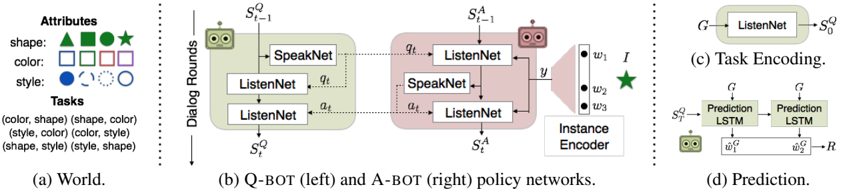
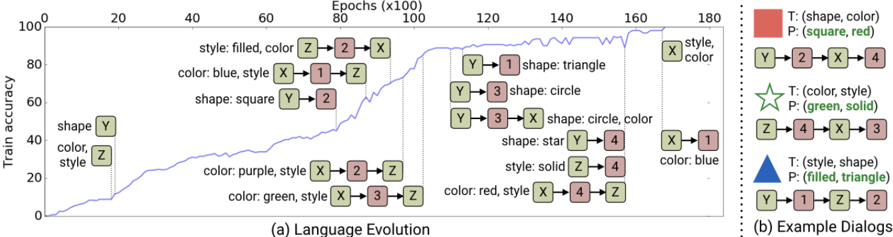
A number of recent works have proposed techniques for end-to-end learning of communication protocols among cooperative multi-agent populations, and have simultaneously found the emergence of grounded human-interpretable language in the protocols developed by the agents, learned without any human supervision!In this paper, using a Task & Talk reference game between two agents as a testbed, we present a sequence of 'negative' results culminating in a 'positive' one -showing that while most agent-invented languages are effective (i.e.achieve near-perfect task rewards), they are decidedly not interpretable or compositional.In essence, we find that natural language does not emerge 'naturally', despite the semblance of ease of natural-language-emergence that one may gather from recent literature.We discuss how it is possible to coax the invented languages to become more and more human-like and compositional by increasing restrictions on how two agents may communicate.
Overview
The claims and statistics of this paper haven’t been checked yet.
Free: it reads the open-access text and checks the first 5 claims that cite a source we can check. Create a free account to check every claim.
Integrity signals
Registry
Cites
Statistics
Figures
Verification
Claims the paper makes
The claims and statistics of this paper haven’t been checked yet.
Free: it reads the open-access text and checks the first 5 claims that cite a source we can check. Create a free account to check every claim.
Claims other papers make about this one
Each is checked against this paper’s own text: does it say what the citing paper says it does?
The source backs part of the claim, not all of it — or backs it for a different population, condition or comparison.
In the citing paper
“Despite the flexibility of such methods, traditional EC agents often exhibit undesirable properties, such as being overly-complex (Chaabouni et al., 2019), slow to converge (Eccles et al., 2019;Lin et al., 2021), or unable to generalize to novel inputs (Kottur et al., 2017).”
From Towards Human-Like Emergent Communication via Utility, Informativeness, and Complexity (2025) · cites this paper as Kottur et al., 2017
Experimental — accuracy not yet measuredThe cited source says what the claim attributes to it.
In the citing paper
“Based in part by a desired to mirror the complexity-limited discrete nature of words, some recent EC works seek to induce complexity-limited discrete communication among agents (Kottur et al., 2017).”
From Towards Human-Like Emergent Communication via Utility, Informativeness, and Complexity (2025) · cites this paper as Kottur et al., 2017
The cited source says what the claim attributes to it.
In the citing paper
“In traditional EC work, agents are trained in cooperative multi-agent environments to maximize a utility function (sometimes called the reward) (Havrylov & Titov, 2017;Kottur et al., 2017;Lazaridou et al., 2018;Lowe et al., 2017;Wang et al., 2020).”
From Towards Human-Like Emergent Communication via Utility, Informativeness, and Complexity (2025) · cites this paper as Kottur et al., 2017
Self-check
Percentages, sums and reported differences re-computed from the paper’s own numbers.
The self-check needs the paper’s full text.
Citations
Cites
Adam: A Method for Stochastic Optimization
Kingma, D. P., & Ba, J. (2014) · arXiv · doi:10.48550/arxiv.1412.6980 · Cited by 98,946 · cited 1×
“We use 1000 episodes of two-round dialogs to compute policy gradients, and perform updates according to Adam optimizer (Kingma and Ba, 2015), with a learning rate of 0 .”
MethodStrategic information transmission
Crawford, V. P., & Sobel, J. (1982) · Econometrica · doi:10.2307/1913390 · Cited by 4,293 · cited 2×
“This ‘set partitioning’ strategy is consistent with known results from game theory on Nash equilibria in ‘cheap talk’ games (Crawford and Sobel, 1982).”
BackgroundResultConvention: A Philosophical Study.
Llewelyn, J. E., & Lewis, D. K. (1970) · The Philosophical Quarterly · doi:10.2307/2218418 · Cited by 3,121
Building End-To-End Dialogue Systems Using Generative Hierarchical Neural Network Models
Serban, I., Sordoni, A., Bengio, Y., Courville, A., & Pineau, J. (2016) · Proceedings of the AAAI Conference on Artificial Intelligence · doi:10.1609/aaai.v30i1.9883 · Cited by 1,615 · cited 1×
“While historically such agents have been based on slot filling (Lemon et al., 2006), the dominant paradigm today is neural dialog models (Bor-des and Weston, 2016; Weston, 2016; Serban et al., 2016a,b) trained on large quantities of data.”
BackgroundLearning to Communicate with Deep Multi-Agent Reinforcement Learning
Foerster, J. N., Assael, Y. M., de Freitas, N., & Whiteson, S. (2016) · arXiv · doi:10.48550/arxiv.1605.06676 · Cited by 1,217 · cited 1×
“, 2014) and is witnessing a recent resurgence (Wang et al., 2016; Foerster et al., 2016; Sukhbaatar et al., 2016; Jorge et al., 2016; Lazaridou et al., 2017; Havrylov and Titov, 2017; Mordatch and Abbeel, 2017; Das et al., 2017b) – is situated language learning.”
BackgroundSimple statistical gradient-following algorithms for connectionist reinforcement learning
Williams, R. J. (1992) · Machine Learning · doi:10.1023/a:1022672621406 · Cited by 817 · cited 6×
“To train these agents, we update policy parameters θQ and θA using the popular REINFORCE (Williams, 1992) policy gradient algorithm.”
MethodInfluentialThe Ubuntu Dialogue Corpus: A Large Dataset for Research in Unstructured Multi-Turn Dialogue Systems
Lowe, R., Pow, N., Serban, I., & Pineau, J. (2015) · Proceedings of the 16th Annual Meeting of the Special Interest Group on Discourse and Dialogue · doi:10.18653/v1/w15-4640 · Cited by 748
Procedures as a representation for data in a computer program for understanding natural language
Winograd, T. A. (1971) · DSpace@MIT (Massachusetts Institute of Technology) · Cited by 520
Das, A., Kottur, S., Gupta, K., Singh, A., Jain, D., Moura, J. M. F., Parikh, D., & Batra, D. (2017) · IEEE Computer Society Conference on Computer Vision and Pattern Recognition/Proceedings - IEEE Computer Society Conference on Computer Vision and Pattern Recognition/Proceedings · Cited by 499
Self-citationEmergence of grounded compositional language in multi-agent populations
Mordatch, I., & Abbeel, P. (2018) · Proceedings of the AAAI Conference on Artificial Intelligence · doi:10.1609/aaai.v32i1.11492 · Cited by 440
Research works printed but not linked: 3
- Vincent Crawford and Joel Sobel. 1982. Strategic in- formation transmission. Econometrica 50(6):1431-51.
- Emilio Jorge, Mikael Kågebäck, and Emil Gustavsson. 2016. Learning to play guess who? and inventing a grounded language as a consequence. In NIPS work- shop on deep reinforcement learning.
- Iulian Vlad Serban, Alessandro Sordoni, Ryan Lowe, Laurent Charlin, Joelle Pineau, Aaron Courville, and Yoshua Bengio. 2016b. A Hierarchical Latent Variable Encoder-Decoder Model for Generating Dialogues. arXiv preprint arXiv:1605.06069 . · arXiv
Cited by
Deep Reinforcement Learning: An Overview
Li, Y. (2017) · arXiv · doi:10.48550/arxiv.1701.07274 · Cited by 762
“-to-end optimization with deep RL for goal-driven and visually grounded dialogue systems for GuessWhat?! game.Das et al.(2017) proposed to learn cooperative Visual Dialog agents with deep RL. See alsoKottur et al. (2017). SeePasunuru and Bansal(2017) for video captioning. 5.5 NEURAL ARCHITECTURE DESIGN Neural networks…”
BackgroundInfluentialLearning Cooperative Visual Dialog Agents with Deep Reinforcement Learning
Das, A., Kottur, S., Moura, J. M. F., Lee, S., & Batra, D. (2017) · 2017 IEEE International Conference on Computer Vision (ICCV) · doi:10.1109/iccv.2017.321 · Cited by 356
Self-citationLi, C. (2019) · Reinforcement Learning for Cyber-Physical Systems · doi:10.1201/9781351006620-6 · Cited by 188
Deep multiagent reinforcement learning: challenges and directions
Wong, A., Bäck, T., Kononova, A. V., & Plaat, A. (2023) · Artificial Intelligence Review · doi:10.1007/s10462-022-10299-x · Cited by 197
“Language also emerges in more complicated versions of the game that require dialogue (Jorge et al. 2017; Das et al. 2017; Kottur et al. 2017) or negotiation (Cao et al.”
BackgroundLearning when to Communicate at Scale in Multiagent Cooperative and Competitive TasksPreprint
Singh, A., Jain, T., & Sukhbaatar, S. (2018) · arXiv (Cornell University) · doi:10.48550/arxiv.1812.09755 · Cited by 304
“Lee et al. (2017) demonstrated that agents speaking different languages can learn to translate in referential games.”
BackgroundWhat Artificial Neural Networks Can Tell Us about Human Language Acquisition
Warstadt, A., & Bowman, S. R. (2022) · Algebraic Structures in Natural Language · doi:10.1201/9781003205388-2 · Cited by 111
Open Problems in Cooperative AI
Dafoe, A., Hughes, E., Bachrach, Y., Collins, T., McKee, K. R., Leibo, J. Z., Larson, K., & Graepel, T. (2020) · arXiv · doi:10.48550/arxiv.2012.08630 · Cited by 93
Align2Ground: Weakly Supervised Phrase Grounding Guided by Image-Caption Alignment
Datta, S., Sikka, K., Roy, A., Ahuja, K., Parikh, D., & Divakaran, A. (2019) · IEEE/CVF International Conference on Computer Vision (ICCV) · doi:10.1109/iccv.2019.00269 · Cited by 118
“Such “cheating” tendencies, wherein models learn to do well at the downstream task without necessarily getting better at the intermediate task, has also been seen in prior works such as [11, 23, 31].”
ResultEmergent Multi-Agent Communication in the Deep Learning EraPreprint
Lazaridou, A., & Baroni, M. (2020) · arXiv (Cornell University) · doi:10.48550/arxiv.2006.02419 · Cited by 330
“Other priors that have been proposed and empirically validated include input representations ([47]), agent and channel capacity ([55, 72, 56]), and specific training strategies, such as letting the agents simulate other agents’ understanding of one’s language ([67]).”
BackgroundEmergence of Linguistic Communication from Referential Games with Symbolic and Pixel Input
Lazaridou, A., Hermann, K. M., Tuyls, K., & Clark, S. (2018) · arXiv · doi:10.48550/arxiv.1804.03984 · Cited by 86
“Thus, research on this topic usually relies on defining necessary requirements that any language claiming to be compositional should adhere to, such as the ability to generalize to novel situations (Batali, 1998; Franke, 2015; Kottur et al., 2017).”
BackgroundAnti-efficient encoding in emergent communication
Chaabouni, R., Kharitonov, E., Dupoux, E., & Baroni, M. (2019) · arXiv · doi:10.48550/arxiv.1905.12561 · Cited by 85
“As part of this trend, several recent studies analyze the properties of the emergent codes [e.g., Kottur et al., 2017, Bouchacourt and Baroni, 2018, Evtimova et al., 2018, Lowe et al., 2019, Graesser et al., 2019].”
BackgroundCompositionality and Generalization In Emergent Languages
Chaabouni, R., Kharitonov, E., Bouchacourt, D., Dupoux, E., & Baroni, M. (2020) · Proceedings of the conference - Association for Computational Linguistics. Meeting · doi:10.18653/v1/2020.acl-main.407 · Cited by 205
Aligning Faithful Interpretations with their Social Attribution
Jacovi, A., & Goldberg, Y. (2021) · Transactions of the Association for Computational Linguistics · doi:10.1162/tacl_a_00367 · Cited by 73
“Kottur et al. (2017); Subramanian et al. (2020) describe failure cases of Trojans where communicating modules encode information unintuitively, despite an interpretable interface between them.”
BackgroundR-MADDPG for Partially Observable Environments and Limited CommunicationPreprint
Wang, R., Everett, M., & How, J. P. (2020) · arXiv (Cornell University) · doi:10.48550/arxiv.2002.06684 · Cited by 109
“Not only are these assumptions unrealistic for real world conditions, enforcing a specific communication architecture can limit the diversity of emergent communication protocols (Kottur et al., 2017).”
BackgroundCountering Language Drift via Visual Grounding
Lee, J., Cho, K., & Kiela, D. (2019) · Proceedings of the 2019 Conference on Empirical Methods in Natural Language Processing and the 9th International Joint Conference on Natural Language Processing (EMNLP-IJCNLP) · doi:10.18653/v1/d19-1447 · Cited by 57
“Our work is inspired by recent work in protocols or languages that emerge from multi-agent interaction (Lazaridou et al., 2017; Lee et al., 2018; Andreas et al., 2017; Evtimova et al., 2018; Kottur et al., 2017; Havrylov and Titov, 2017; Mordatch and Abbeel, 2017).”
MethodLazaridou, A., Potapenko, A., & Tieleman, O. (2020) · Proceedings of the 58th Annual Meeting of the Association for Computational Linguistics · doi:10.18653/v1/2020.acl-main.685 · Cited by 56
Measuring Compositionality in Representation Learning
Andreas, J. (2019) · arXiv (Cornell University) · doi:10.48550/arxiv.1902.07181 · Cited by 22
“As in the previous section, existing work argues for a relationship between compo-sitionality and generalization, claiming that agents need compositional communication protocols to generalize to unseen referents (Kottur et al., 2017; Choi et al., 2018).”
BackgroundCoDraw: Collaborative Drawing as a Testbed for Grounded Goal-driven Communication
Kim, J.-H., Kitaev, N., Chen, X., Rohrbach, M., Zhang, B.-T., Tian, Y., Batra, D., & Parikh, D. (2019) · Proceedings of the 57th Annual Meeting of the Association for Computational Linguistics · doi:10.18653/v1/p19-1651 · Cited by 53
“In addition, the learned communication protocols are usually not natural (Kottur et al., 2017) or interpretable, whereas the CoDraw task is designed to develop agents that use human language.”
BackgroundSelf-citationMulti-Agent Task-Oriented Dialog Policy Learning with Role-Aware Reward Decomposition
Takanobu, R., Liang, R., & Huang, M. (2020) · Proceedings of the conference - Association for Computational Linguistics. Meeting · doi:10.18653/v1/2020.acl-main.59 · Cited by 70
Interactive Grounded Language Acquisition and Generalization in a 2D WorldPreprint
Yu, H., Zhang, H., & Xu, W. (2018) · arXiv (Cornell University) · doi:10.48550/arxiv.1802.01433 · Cited by 69
“This suggests that neural networks tend to exploit data in an unexpected way to achieve tasks if no constraints are imposed (Kottur et al., 2017).”
BackgroundCompositional Obverter Communication Learning From Raw Visual Input
Choi, E., Lazaridou, A., & de Freitas, N. (2018) · arXiv (Cornell University) · doi:10.48550/arxiv.1804.02341 · Cited by 49
“More recently, Mordatch & Abbeel (2017) and Kottur et al. (2017) trained the agents to communicate in grounded, compositional language.”
BackgroundMethodResultInfluentialOn the Pitfalls of Measuring Emergent Communication
Lowe, R., Foerster, J., Boureau, Y.-L., Pineau, J., & Dauphin, Y. (2019) · Adaptive Agents and Multi-Agents Systems · doi:10.65109/knvj7743 · Cited by 178
Emergent Translation in Multi-Agent Communication
Lee, J., Cho, K., Weston, J., & Kiela, D. (2017) · arXiv (Cornell University) · doi:10.48550/arxiv.1710.06922 · Cited by 44
“rge et al., 2016), adaptive communication bandwidth (Havrylov & Titov, 2017) and multi-turn communication with a variable-length conversation (Evtimova et al., 2017), and simple compositionality (Kottur et al., 2017; Mordatch & Abbeel, 2017). Meanwhile, Andreas et al. (2017) proposed a model to interpret conti…”
BackgroundMeta-Learning to Compositionally Generalize
Conklin, H., Wang, B., Smith, K., & Titov, I. (2021) · Proceedings of the 59th Annual Meeting of the Association for Computational Linguistics and the 11th International Joint Conference on Natural Language Processing (Volume 1: Long Papers) · doi:10.18653/v1/2021.acl-long.258 · Cited by 46
“A related area of research looks at the emergence of compositional languages, often showing that languages which seem to lack natural-language like compositional structure may still be able to generalize to novel concepts (Kottur et al., 2017; Chaabouni et al., 2020).”
BackgroundBiases for Emergent Communication in Multi-agent Reinforcement Learning
Eccles, T., Bachrach, Y., Lever, G., Lazaridou, A., & Graepel, T. (2019) · arXiv · doi:10.48550/arxiv.1912.05676 · Cited by 42
“Earlier work on emergent communication focused on cooperative “embodied” agents, showing how communication helps accomplish a common goal [8, 29, 6], or investigating communication in mixed cooperativecompetitive environments [25, 3, 15], studying properties of the emergent protocols [20, 17, 24].”
BackgroundDeep Learning Based Chatbot ModelsPreprint
Csáky, R. (2019) · arXiv (Cornell University) · doi:10.48550/arxiv.1908.08835 · Cited by 83
“In [Havrylov and Titov, 2017] and [Kottur et al., 2017] a different line of research is explored using similar methods.”
EGG: a toolkit for research on Emergence of lanGuage in Games
Kharitonov, E., Chaabouni, R., Bouchacourt, D., & Baroni, M. (2019) · Proceedings of the 2019 Conference on Empirical Methods in Natural Language Processing and the 9th International Joint Conference on Natural Language Processing (EMNLP-IJCNLP): System Demonstrations · doi:10.18653/v1/d19-3010 · Cited by 40
“Studying the languages that emerge when neural agents interact with each other recently became a vibrant area of research (Havrylov and Titov, 2017; Lazaridou et al., 2016, 2018; Kottur et al., 2017; Bouchacourt and Baroni, 2018; Lowe et al., 2019).”
BackgroundCountering Language Drift with Seeded Iterated LearningPreprint
Lu, Y., Singhal, S., Strub, F., Pietquin, O., & Courville, A. C. (2020) · arXiv (Cornell University) · doi:10.48550/arxiv.2003.12694 · Cited by 51
“Figures 2 and 3 show two instances of the S/R games studied here: the Translation game (Lee et al., 2019) and the Lewis game (Kottur et al., 2017).”
BackgroundOn the interaction between supervision and self-play in emergent communicationPreprint
Lowe, R., Gupta, A., Foerster, J., Kiela, D., & Pineau, J. (2020) · arXiv (Cornell University) · doi:10.48550/arxiv.2002.01093 · Cited by 72
Compositional Languages Emerge in a Neural Iterated Learning ModelPreprint
Ren, Y., Guo, S., Labeau, M., Cohen, S. B., & Kirby, S. (2020) · arXiv (Cornell University) · doi:10.48550/arxiv.2002.01365 · Cited by 92
“To represent objects, similarly to the settings chosen in (Kottur et al., 2017), we encode each attribute as a one-hot vector and concatenate the N a one-hot vectors to represent one object.”
BackgroundMethodInfluentialImproving Generative Visual Dialog by Answering Diverse Questions
Murahari, V., Chattopadhyay, P., Batra, D., Parikh, D., & Das, A. (2019) · Conference on Empirical Methods in Natural Language Processing (EMNLP) · doi:10.18653/v1/d19-1152 · Cited by 69
“…judgements from humans show that agents trained with our approach develop a more effective communication protocol for the downstream image-guessing task, while still not deviating off English, which is a common pitfall when training dialog agents with RL (Kottur et al., 2017; Lewis et al., 2017).”
Self-citationEmergence of Compositional Language with Deep Generational TransmissionPreprint
Cogswell, M., Lu, J., Lee, S., Parikh, D., & Batra, D. (2019) · arXiv (Cornell University) · doi:10.48550/arxiv.1904.09067 · Cited by 61
“We start by introducing goal-driven neural dialog models similar to Kottur et al. (2017), then describe how we incorporate cultural transmission.”
BackgroundMethodResultInfluentialSelf-citationDeep Reinforcement Learning For Modeling Chit-Chat Dialog With Discrete Attributes
Sankar, C., & Ravi, S. (2019) · Annual Meeting of the Special Interest Group on Discourse and Dialogue · doi:10.18653/v1/w19-5901 · Cited by 39
“Another potential drawback with directly acting over the vocabulary space is that the RL optimization procedure tends to strip away the linguistic / natural language aspects learned during the supervised pre-training step, as observed in (Kottur et al., 2017; Lewis et al., 2017).”
BackgroundReinforcement learning and bandits for speech and language processing: Tutorial, review and outlook
Lin, B. (2024) · Expert Systems with Applications · doi:10.1016/j.eswa.2023.122254 · Cited by 28
Interpretation of Emergent Communication in Heterogeneous Collaborative Embodied Agents
Patel, S., Wani, S., Jain, U., Schwing, A. G., Lazebnik, S., Savva, M., & Chang, A. X. (2021) · IEEE/CVF International Conference on Computer Vision (ICCV) · doi:10.1109/iccv48922.2021.01565 · Cited by 41
“[40], in that we study and analyze emergent communication patterns and what information they communicate.”
BackgroundEmergence of Communication in an Interactive World with Consistent SpeakersPreprint
Bogin, B., Geva, M., & Berant, J. (2018) · arXiv (Cornell University) · doi:10.48550/arxiv.1809.00549 · Cited by 44
“Recently there has been growing interest in developing models for grounded multi-agent com- munication, where communication arises between neural agents solely based on the necessity to cooperate in order to complete an end task (Lewis et al., 2017; Kottur et al., 2017; Lazaridou et al., 2018a).”
BackgroundMethodCo-evolution of language and agents in referential games
Dagan, G., Hupkes, D., & Bruni, E. (2021) · Conference of the European Chapter of the Association for Computational Linguistics · doi:10.18653/v1/2021.eacl-main.260 · Cited by 44
Capacity, Bandwidth, and Compositionality in Emergent Language Learning
Resnick, C., Gupta, A., Foerster, J., Dai, A. M., & Cho, K. (2020) · Adaptive Agents and Multi-Agents Systems · doi:10.65109/pmny4515 · Cited by 63
Developmentally motivated emergence of compositional communication via template transferPreprint
Korbak, T., Zubek, J., Kuciński, Ł., Miłoś, P., & Rączaszek‐Leonardi, J. (2019) · arXiv (Cornell University) · doi:10.48550/arxiv.1910.06079 · Cited by 28
“Recent work on emergent communication in artificial intelligence shows that compositionality requires strong inductive biases to be imposed on communicating agents (Kottur et al., 2017).”
BackgroundKuciński, Ł., Korbak, T., Kołodziej, P., & Miłoś, P. (2021) · arXiv · doi:10.48550/arxiv.2111.06464 · Cited by 23
“A recent line of work has studied conditions under which compositionality emerges (Batali (1998); Kottur et al. (2017); Choi et al. (2018); Korbak et al. (2019); Li and Bowling (2019); Słowik et al. (2020b,a); Guo et al. (2020)).”
BackgroundResultInfluentialWord-order Biases in Deep-agent Emergent Communication
Chaabouni, R., Kharitonov, E., Lazaric, A., Dupoux, E., & Baroni, M. (2019) · Proceedings of the conference - Association for Computational Linguistics. Meeting · doi:10.18653/v1/p19-1509 · Cited by 42
“…temporal iconicity, defined as the tendency of clauses denoting events to reflect the chronological order of the denoted events (as in Caesar’s veni, vidi, vici; Greenberg, 1963; Haiman, 1980; Newmeyer, 1992; Radden and Dirven, 2007; Diessel, 2008; Marcus and Calude, 2010; de Ruiter et al., 2018).”
BackgroundChen, B., Song, S., Lipson, H., & Vondrick, C. (2020) · Conference on Artificial Life (ALIFE) · doi:10.1162/isal_a_00269 · Cited by 25
“LazImpa”: Lazy and impatient neural agents learn to communicate efficiently
Rita, M., Chaabouni, R., & Dupoux, E. (2020) · Proceedings of the 24th Conference on Computational Natural Language Learning · doi:10.18653/v1/2020.conll-1.26 · Cited by 17
Miss Tools and Mr Fruit: Emergent Communication in Agents Learning about Object Affordances
Bouchacourt, D., & Baroni, M. (2019) · Proceedings of the conference - Association for Computational Linguistics. Meeting · doi:10.18653/v1/p19-1380 · Cited by 32
“Is memory ablation necessary for communication to matter? An important observation from previous research is that depriving at least one agent of memory might be necessary to develop successful multi-turn communication (Kottur et al., 2017; Cao et al., 2018; Evtimova et al., 2018).”
BackgroundMethodInfluentialEmergent Language Generalization and Acquisition Speed are not tied to Compositionality
Kharitonov, E., & Baroni, M. (2020) · BlackboxNLP Workshop on Analyzing and Interpreting Neural Networks for NLP (BlackboxNLP) · doi:10.18653/v1/2020.blackboxnlp-1.2 · Cited by 36
Toward More Human-Like AI Communication: A Review of Emergent Communication Research
Brandizzi, N. (2023) · IEEE Access · doi:10.1109/access.2023.3339656 · Cited by 44
“Similarly, Kottur et al. [2017] carried out a TnT reference game involving two agents and investigated the necessary constraints for a generalized language to emerge.”
BackgroundInfluentialMetropolis-Hastings algorithm in joint-attention naming game: experimental semiotics study
Okumura, R., Taniguchi, T., Hagiwara, Y., & Taniguchi, A. (2023) · Frontiers in Artificial Intelligence · doi:10.3389/frai.2023.1235231 · Cited by 20
“Referential and naming games, often referred to as variants of the Lewis-style signaling game, have also been used to achieve compositionality in languages (Kottur et al., 2017; Choi et al., 2018; Ren et al., 2020; Mu and Goodman, 2021).”
MethodThe Emergence of the Shape Bias Results from Communicative Efficiency
Portelance, E., Frank, M. C., Jurafsky, D., Sordoni, A., & Laroche, R. (2021) · Conference on Computational Natural Language Learning · doi:10.18653/v1/2021.conll-1.48 · Cited by 26
Ease-of-Teaching and Language Structure from Emergent Communication
Li, F., & Bowling, M. (2019) · neural information processing systems · doi:10.48550/arxiv.1906.02403 · Cited by 39
“For simplicity, each object is represented by a 12-dimension vector concatenating a one-hot vector of color with a one-hot vector of shape, which is similar to Kottur et al. (2017).”
BackgroundMethodEvaluating Machines by their Real-World Language UsePreprint
Zellers, R., Holtzman, A., Clark, E., Qin, L., Farhadi, A., & Choi, Y. (2020) · arXiv (Cornell University) · Cited by 15
Deep neural networks and humans both benefit from compositional language structure
Galke, L. P. A., Ram, Y., & Raviv, L. (2024) · Nature Communications · doi:10.1038/s41467-024-55158-1 · Cited by 39
“However, as argued in the introduction, certain linguistic phenomena of natural language appear to be hard to replicate in multi-agent reinforcement learning 54,55,58,90 , which had raised the question whether compositionality is helpful for neural networks at all.”
TuringAdvice: A Generative and Dynamic Evaluation of Language Use
Zellers, R., Holtzman, A., Clark, E., Qin, L., Farhadi, A., & Choi, Y. (2021) · Proceedings of the 2021 Conference of the North American Chapter of the Association for Computational Linguistics: Human Language Technologies · doi:10.18653/v1/2021.naacl-main.386 · Cited by 13
“However, ensuring that machines communicate in standard English is di ffi cult, as there is usually a more e ffi cient machine-language coding scheme for the task (Kottur et al., 2017).”
BackgroundAnswerer in Questioner's Mind for Goal-Oriented Visual Dialogue.Preprint
Lee, S.-W., Heo, Y., & Zhang, B. (2018) · arXiv (Cornell University) · Cited by 17
Self-citationExperience-based Causality Learning for Intelligent Agents
Liu, Y., Wang, S., Zhang, J., & Zong, C. (2019) · ACM Transactions on Asian and Low-Resource Language Information Processing · doi:10.1145/3314943 · Cited by 18
“For example, they may use symbols to replace the perception input such image and signals [32, 35].”
BackgroundResultInfluentialEntropy Minimization In Emergent LanguagesPreprint
Kharitonov, E., Chaabouni, R., Bouchacourt, D., & Baroni, M. (2019) · arXiv (Cornell University) · doi:10.48550/arxiv.1905.13687 · Cited by 39
“This vision revived research interest in artificial neural agents communicating with each other through discrete messages to jointly solve a task [Lazaridou et al., 2016, Kottur et al., 2017, Havrylov and Titov, 2017, Choi et al., 2018, Lazaridou et al., 2018].”
Emergent Discrete Communication in Semantic Spaces
Tucker, M., Li, H., Agrawal, S., Hughes, D., Sycara, K., Lewis, M., & Shah, J. (2021) · arXiv · doi:10.48550/arxiv.2108.01828 · Cited by 13
“, compositionality or, in continuous communication settings, zero-shot understanding) [15, 19, 5, 4].”
BackgroundLearning to cooperate: Emergent communication in multi-agent navigationPreprint
Kajić, I., Aygün, E., & Precup, D. (2020) · arXiv (Cornell University) · doi:10.48550/arxiv.2004.01097 · Cited by 30
Emergent language: a survey and taxonomy
Peters, J., de Puiseau, C. W., Tercan, H., Gopikrishnan, A., de Carvalho, G. A. L., Bitter, C., & Meisen, T. (2025) · Autonomous Agents and Multi-Agent Systems · doi:10.1007/s10458-025-09691-y · Cited by 38
Seeded self-play for language learning
Gupta, A., Lowe, R., Foerster, J., Kiela, D., & Pineau, J. (2019) · doi:10.18653/v1/d19-6409 · Cited by 11
“A speaker-listener game We construct a referential game similar to the Task & Talk game from (Kottur et al., 2017), except with a single turn.”
MethodCommunity Regularization of Visually-Grounded Dialog
Agarwal, A., Gurumurthy, S., Sharma, V., Lewis, M., & Sycara, K. P. (2019) · Adaptive Agents and Multi-Agents Systems · doi:10.65109/pehe9530 · Cited by 21
“In fact Kottur et al. (2017) recently showed that language emerging from two agents interacting with each other might not even be interpretable or compositional.”
BackgroundEmergent Communication Pretraining for Few-Shot Machine Translation
Li, Y., Ponti, E. M., Vulić, I., & Korhonen, A. (2020) · International Conference on Computational Linguistics · doi:10.18653/v1/2020.coling-main.416 · Cited by 19
“…to shed light on cooperative behaviours, the compositional properties of emergent communication protocols (Lazaridou et al., 2017; Havrylov and Titov, 2017; Cao et al., 2018; Li and Bowling, 2019; Kaji´c et al., 2020), and natural language evolution (Kottur et al., 2017; Graesser et al., 2019).”
BackgroundInterpretable and Pedagogical ExamplesPreprint
Milli, S., Abbeel, P., & Mordatch, I. (2017) · arXiv (Cornell University) · doi:10.48550/arxiv.1711.00694 · Cited by 15
“A number of techniques have been suggested to encourage interpretability, such as limiting symbol vocabulary size (Mordatch & Abbeel, 2017), limiting memorization capabilities of the speaker (Kottur et al., 2017), or introducing auxiliary tasks such as image labelling based on supervision data (Lazaridou et al.”
BackgroundInfluentialCoDraw: Collaborative Drawing as a Testbed for Grounded Goal-driven CommunicationPreprint
Kim, J.-H., Kitaev, N., Chen, X., Rohrbach, M., Zhang, B., Tian, Y., Batra, D., & Parikh, D. (2017) · arXiv (Cornell University) · doi:10.48550/arxiv.1712.05558 · Cited by 10
Self-citationEmergent Communication of Generalizations
Mu, J., & Goodman, N. D. (2021) · neural information processing systems · doi:10.48550/arxiv.2106.02668 · Cited by 14
“The ability to communicate accurately, even on unseen concepts, is not necessarily indicative of more systematic communication; generalization without compositional language is a common finding in the literature [1, 6, 16, 22].”
BackgroundDORA: Towards policy optimization for task-oriented dialogue system with efficient context
Jeon, H., & Lee, G. G. (2021) · Computer Speech & Language · doi:10.1016/j.csl.2021.101310 · Cited by 16
Learning to Mediate Disparities Towards Pragmatic Communication
Bao, Y., Ghosh, S., & Chai, J. Y. (2022) · Proceedings of the conference - Association for Computational Linguistics. Meeting · doi:10.18653/v1/2022.acl-long.202 · Cited by 18
Pre-Learning Environment Representations for Data-Efficient Neural Instruction Following
Gaddy, D., & Klein, D. (2019) · Proceedings of the conference - Association for Computational Linguistics. Meeting · doi:10.18653/v1/p19-1188 · Cited by 8
“Our approach also relates to recent work on learning artificial languages by simulating agents interacting in an environment (Mordatch and Abbeel, 2018; Das et al., 2017; Kottur et al., 2017, i.a.).”
MethodLearning Effective Value Function Factorization via Attentional Communication
Wu, B., Xiao-ya, Y., Sun, C., Wang, R., Hu, X., & Hu, Y. (2020) · Conference proceedings/Conference proceedings - IEEE International Conference on Systems, Man, and Cybernetics · doi:10.1109/smc42975.2020.9283355 · Cited by 10
Internal and external pressures on language emergence: least effort, object constancy and frequency
Luna, D. R., Ponti, E. M., Hupkes, D., & Bruni, E. (2020) · Findings of the Association for Computational Linguistics: EMNLP (Findings of EMNLP) · doi:10.18653/v1/2020.findings-emnlp.397 · Cited by 34
Interactive Reinforcement Learning for Object Grounding via Self-TalkingPreprint
Zhu, Y., Zhang, S., & Metaxas, D. (2017) · arXiv (Cornell University) · doi:10.48550/arxiv.1712.00576 · Cited by 8
“To narrow the semantic gap between artificial language and natural language, [7, 9] explored different techniques to retain interpretability, including constrain vocabulary size [7] and iteratively updating different agents [9].”
MethodExploring Structural Inductive Biases in Emergent Communication.Preprint
Słowik, A., Gupta, A., Hamilton, W. L., Jamnik, M., Holden, S. B., & Pal, C. (2020) · arXiv (Cornell University) · Cited by 8
Interactive Learning from Activity DescriptionPreprint
Nguyen, K., Misra, D., Schapire, R., Dudík, M., & Shafto, P. (2021) · International Conference on Machine Learning · doi:10.48550/arxiv.2102.07024 · Cited by 37
“Finally, our work also fundamentally differs from work on (RL-based) cooperative emergent language (Lazaridou et al., 2017; Havrylov & Titov, 2017; Das et al., 2017; Evtimova et al., 2018; Kottur et al., 2017) in that we assume the teacher speaks a fixed, well-formed language, whereas in that work the teacher begins w…”
MethodDessì, R., Kharitonov, E., & Baroni, M. (2021) · neural information processing systems · doi:10.48550/arxiv.2106.04258 · Cited by 26
“In part for this reason, recent work tends to focus on controlled symbolic inputs, where it is easier to detect degenerate communication strategies [e.g., 10, 15, 16].”
BackgroundMeasuring non-trivial compositionality in emergent communicationPreprint
Korbak, T., Zubek, J., & Rączaszek‐Leonardi, J. (2020) · arXiv (Cornell University) · doi:10.48550/arxiv.2010.15058 · Cited by 17
“Concrete problems that can be posed as emergent communication include image captioning (Kottur et al., 2017)) and unsupervised machine translation (Lee et al.”
BackgroundDynamic population-based meta-learning for multi-agent communication with natural language
Gupta, A., Lanctot, M., & Lazaridou, A. (2021) · neural information processing systems · doi:10.48550/arxiv.2110.14241 · Cited by 21
“While such communication approaches result in agents achieving higher rewards at test time when paired with their training partners [21, 14, 23], there is growing evidence that these agents do not acquire communication skills with general properties [31, 1, 3, 18] but rather learn to form…”
BackgroundEmergent Language-Based Coordination In Deep Multi-Agent Systems
Baroni, M., Dessì, R., & Lazaridou, A. (2022) · doi:10.18653/v1/2022.emnlp-tutorials.3 · Cited by 10
“Given this recent turn, we started seeing papers on this topic appearing at the major NLP conferences and occasionally being recognized with best-paper awards (Kottur et al., 2017).”
BackgroundInteraction history as a source of compositionality in emergent communication
Korbak, T., Zubek, J., Kuciński, Ł., Miłoś, P., & Rączaszek‐Leonardi, J. (2021) · Interaction Studies Social Behaviour and Communication in Biological and Artificial Systems · doi:10.1075/is.21020.kor · Cited by 10
Visually Grounded Language Learning: A Review of Language Games, Datasets, Tasks, and Models
Suglia, A., Konstas, I., & Lemon, O. (2024) · Journal of Artificial Intelligence Research · doi:10.1613/jair.1.15185 · Cited by 21
On Emergent Communication in Competitive Multi-Agent Teams
Liang, P. P., Chen, J. W., Salakhutdinov, R., Morency, L., & Kottur, S. (2020) · Adaptive Agents and Multi-Agents Systems · doi:10.65109/ghof1719 · Cited by 17
Self-citationExploring Zero-Shot Emergent Communication in Embodied Multi-Agent PopulationsPreprint
Bullard, K., Meier, F., Kiela, D., Pineau, J., & Foerster, J. (2020) · arXiv (Cornell University) · doi:10.48550/arxiv.2010.15896 · Cited by 23
Mitigating Contradictions in Dialogue Based on Contrastive Learning
Li, W., Kong, J., Liao, B., & Cai, Y. (2022) · Findings of the Association for Computational Linguistics: ACL (Findings of ACL) · doi:10.18653/v1/2022.findings-acl.219 · Cited by 11
“However, the RL-based methods are easy to degrade in deep neural network (Parisotto et al., 2020), leading to the decoder generates responses that deviate from human language (Lewis et al., 2017; Kottur et al., 2017).”
BackgroundMethodThe Grammar of Emergent Languages
van der Wal, O., de Boer, S., Bruni, E., & Hupkes, D. (2020) · Conference on Empirical Methods in Natural Language Processing (EMNLP) · doi:10.18653/v1/2020.emnlp-main.270 · Cited by 17
Structural and Functional Decomposition for Personality Image Captioning in a Communication Game
Nguyen, M. T., Phung, D., Hoai, M., & Nguyen, T. H. (2020) · Findings of the Association for Computational Linguistics: EMNLP (Findings of EMNLP) · doi:10.18653/v1/2020.findings-emnlp.411 · Cited by 5
The Effect of Efficient Messaging and Input Variability on Neural-Agent Iterated Language Learning
Lian, Y., Bisazza, A., & Verhoef, T. (2021) · Conference on Empirical Methods in Natural Language Processing (EMNLP) · doi:10.18653/v1/2021.emnlp-main.794 · Cited by 17
“Most of the existing studies simulate the emergence of language by letting neural network agents play referential games and study the signals that are used by these agents (Kottur et al., 2017; Havrylov and Titov, 2017; Lazaridou et al., 2018; Chaabouni et al., 2019a; Dagan et al., 2020).”
Quasi-Equivalence Discovery for Zero-Shot Emergent CommunicationPreprint
Bullard, K., Kiela, D., Meier, F., Pineau, J., & Foerster, J. (2021) · arXiv (Cornell University) · doi:10.48550/arxiv.2103.08067 · Cited by 24
On the Relationship between Zipf’s Law of Abbreviation and Interfering Noise in Emergent Languages
Ueda, R., & Washio, K. (2021) · doi:10.18653/v1/2021.acl-srw.6 · Cited by 21
“…have investigated the characteristics of emergent languages, mainly concerned with to what extent they are similar to human languages or what kind of factor forms language-like protocols (e.g., Kottur et al., 2017; Harding Graesser et al., 2019; Chaabouni et al., 2020; Kharitonov et al., 2020).”
BackgroundRLupus: Cooperation through emergent communication in The Werewolf social deduction game
Brandizzi, N., Grossi, D., & Iocchi, L. (2022) · Intelligenza Artificiale · doi:10.3233/ia-210081 · Cited by 9
“Standard games for this line of research are the Task & Talk [25], which is centered around dialogue, on the other hand, the Pointing Game [35] grounds the communication into natural image processing.”
Do Learned Speech Symbols Follow Zipf’s Law?
Takamichi, S., Maeda, H., Park, J., Saito, D., & Saruwatari, H. (2024) · IEEE International Conference on Acoustics Speech and Signal Processing · doi:10.1109/icassp48485.2024.10448331 · Cited by 6
“Viewing communication through this perspective allows for the potential measurement of the naturalness exhibited in communication, including emergent communication [6] and machine-generated communication [7].”
BackgroundCompositionality and Capacity in Emergent Languages
Gupta, A., Resnick, C., Foerster, J., Dai, A. M., & Cho, K. (2020) · Workshop on Representation Learning for NLP (RepL4NLP) · doi:10.18653/v1/2020.repl4nlp-1.5 · Cited by 14
“Our paper is most similar to Kottur et al. (2017), which showed that compositional language arose only when certain constraints on the agents are sat-isfied.”
BackgroundDefending Compositionality in Emergent Languages
Auersperger, M., & Pecina, P. (2022) · Conference of the North American Chapter of the Association for Computational Linguistics: Student Research Workshop (NAACL SRW) · doi:10.18653/v1/2022.naacl-srw.35 · Cited by 18
Zubek, J., Korbak, T., & Rączaszek‐Leonardi, J. (2024) · Artificial Intelligence Review · doi:10.1007/s10462-024-11048-y · Cited by 11
“The work of Kottur et al. (2017) on emergent dialogue is to some extent motivated by the work on visually-grounded conversational systems (Mostafazadeh et al. 2017).”
SEDRo: A Simulated Environment for Developmental Robotics
Pothula, A., Mondol, M. A. R., Narasimhan, S., Islam, S. M., & Park, D. (2020) · IEEE International Conference on Development and Learning (ICDL) · doi:10.1109/icdl-epirob48136.2020.9278036 · Cited by 4
Multi-Agent Reinforcement Learning
Plaat, A. (2022) · Springer eBooks · doi:10.1007/978-981-19-0638-1_7 · Cited by 5
Rat big, cat eaten! Ideas for a useful deep-agent protolanguagePreprint
Baroni, M. (2020) · arXiv (Cornell University) · doi:10.48550/arxiv.2003.11922 · Cited by 8
“…a code to cooperatively solve their tasks (e.g., Foerster et al. [2016], Lazaridou et al. [2017], Cao et al. [2018], Havrylov and Titov [2017], Kottur et al. [2017], Evtimova et al. [2018], Mordatch and Abbeel [2018], Chaabouni et al. [2019], Li and Bowling [2019], Lowe et al. [2019], among…”
Background"LazImpa": Lazy and Impatient neural agents learn to communicate efficientlyPreprint
Rita, M., Chaabouni, R., & Emmanuel Dupoux, A. (2020) · arXiv (Cornell University) · doi:10.48550/arxiv.2010.01878 · Cited by 4
“However, it has been shown that, even if these emergent languages lead to successful communication, they often do not bear core properties of natural language (Kottur et al., 2017; Bouchacourt and Baroni, 2018; Lazaridou et al., 2018; Chaabouni et al., 2020).”
BackgroundA Response Retrieval Approach for Dialogue Using a Multi-Attentive TransformerPreprint
Senese, M. A., Benincasa, A., Barbara Caputo, B., & Rizzo, G. F. (2020) · arXiv (Cornell University) · doi:10.48550/arxiv.2012.08148 · Cited by 4
“In recent years the AI community started to work on dialogue scenarios that require a common visual grounding between the parts (Das et al., 2017; Kottur et al., 2017).”
Inductive Bias and Language Expressivity in Emergent CommunicationPreprint
Guo, S., Ren, Y., Słowik, A., & Mathewson, K. W. (2020) · arXiv (Cornell University) · doi:10.48550/arxiv.2012.02875 · Cited by 9
“More specifically, to better align emergent languages with natural languages, many works focus on developing compositional languages in multi-agent games [14, 22, 7, 24, 28, 19], based on a common assumption that compositional languages could be better generalised to the unseen samples.”
BackgroundEmergence of Hierarchical Reference Systems in Multi-agent Communication
Ohmer, X., Duda, M., & Bruni, E. (2022) · arXiv · doi:10.48550/arxiv.2203.13176 · Cited by 4
“Without additional pressures, the emerging languages are not compositional (Kottur et al., 2017; van der Wal et al., 2020; Dagan et al., 2021).”
BackgroundEmergent Communication for Numerical Concepts Generalization
Zhou, E., Hao, Y., Zhang, R., Guo, Y., Du, Z., Zhang, X., Song, X., Wang, C., Zhou, X., Guo, J., et al. (2024) · Proceedings of the AAAI Conference on Artificial Intelligence · doi:10.1609/aaai.v38i16.29712 · Cited by 7
“However, previous research has focused chiefly on recognizing qualitative patterns of object attributes(e.g., shape and color) (Kottur et al. 2017; Kuci´nski et al. 2021) and paid little attention to the agents’ numerical concepts.”
Background
Metadata
- Authors
- Kottur, S., Moura, J., Lee, S., & Batra, D.
- Affiliations
- Carnegie Mellon University (US)
- Georgia Institute of Technology (US)
- Venue
- Proceedings of the 2017 Conference on Empirical Methods in Natural Language Processing
- Published
- 2017
- Pages
- 2962-2967
- OpenAlex
- W2730230212
- Cited by
- 164
- References
- 20
- Citations by year
- 2026: 4 · 2025: 6 · 2024: 14 · 2023: 13 · 2022: 12 · 2021: 32 · 2020: 43 · 2019: 25 · 2018: 8 · 2017: 7
- FWCI
- 356.92
- Type
- conference paper
- Language
- en
- Open access
- hybrid
- doi.org
- Licence
- cc-by
- Locations
- Conference on Empirical Methods in Natural Language Processing (EMNLP) (publishedVersion, cc-by)
- arXiv (Cornell University) (submittedVersion)
- arXiv (Cornell University)
- Topics
- Social Sciences › Cultural Studies › Language and cultural evolution
- Physical Sciences › Computer Science › Artificial Intelligence › Multi-Agent Systems and Negotiation
- Physical Sciences › Computer Science › Artificial Intelligence › Speech and dialogue systems
- Keywords
- multi-agent communication, interpretability, compositional language
About these checks
Registry, retraction, Cites and statistics results are computed, not judged, with one exception: a printed reference that no index lists is read once by a model before it counts as a citation error. Claims are extracted by a model and kept only when their quote appears verbatim in the text; each cited source is then checked, with a model’s help, for whether it says what the claim relies on. Those verdicts can be wrong — read the claim’s quote and the cited source before relying on one.
Statistics and arithmetic are recomputed, not judged.
Confidence bands are shown only for fields calibrated on our annotated test set. None is calibrated yet, so no band is shown.
What counts as a claim ›How we measure confidence ›How we check this ›
Are you an author, or do you see a problem with this page? Request a review
Data sources
Bibliographic data: Semantic Scholar, OpenAlex, Crossref.
Contains information from the Semantic Scholar Academic Graph Datasets, made available under the ODC Attribution License (ODC-BY 1.0).
Semantic Scholar’s data is described in: Kinney, R., et al. (2023). The Semantic Scholar Open Data Platform. arXiv:2301.10140.
