

Do NLP Models Know Numbers? Probing Numeracy in Embeddings
Open accessThe DOI matches its Crossref record; 30 of the 30 references it cites were found in a registry or an index.
Abstract
Eric Wallace, Yizhong Wang, Sujian Li, Sameer Singh, Matt Gardner. Proceedings of the 2019 Conference on Empirical Methods in Natural Language Processing and the 9th International Joint Conference on Natural Language Processing (EMNLP-IJCNLP). 2019.
Overview
The claims and statistics of this paper haven’t been checked yet.
Free: it reads the open-access text and checks the first 5 claims that cite a source we can check. Create a free account to check every claim.
Integrity signals
Registry
Cites
Statistics
Figures
Verification
Claims the paper makes
The claims and statistics of this paper haven’t been checked yet.
Free: it reads the open-access text and checks the first 5 claims that cite a source we can check. Create a free account to check every claim.
Self-check
Percentages, sums and reported differences re-computed from the paper’s own numbers.
The self-check needs the paper’s full text.
Citations
Cites
BERT: Pre-training of Deep Bidirectional Transformers for Language Understanding
Devlin, J., Chang, M.-W., Lee, K., & Toutanova, K. (2018) · arXiv · doi:10.48550/arxiv.1810.04805 · Cited by 73,173 · cited 3×
“, 2018), BERT (Devlin et al., 2019), and GloVe (Pennington et al.”
BackgroundBERT: Pre-training of Deep Bidirectional Transformers for Language Understanding
Devlin, J., Chang, M.-W., Lee, K., & Toutanova, K. (2019) · Proceedings of the 2019 Conference of the North American Chapter of the Association for Computational Linguistics: Human Language Technologies, Volume 1 (Long and Short Papers) · doi:10.18653/v1/n19-1423 · Cited by 54,325 · cited 3×
“, 2018), BERT (Devlin et al., 2019), and GloVe (Pennington et al.”
BackgroundGlove: Global Vectors for Word Representation
Pennington, J., Socher, R., & Manning, C. (2014) · Proceedings of the 2014 Conference on Empirical Methods in Natural Language Processing (EMNLP) · doi:10.3115/v1/d14-1162 · Cited by 34,071 · cited 4×
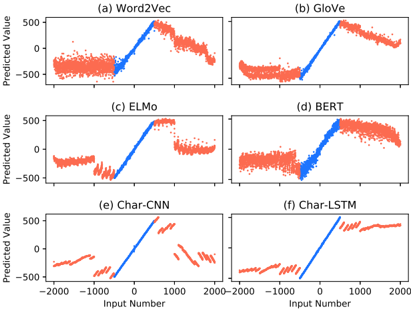
“We find that all widely-used pre-trained embed-dings, e.g., ELMo (Peters et al., 2018), BERT (De-vlin et al., 2019), and GloVe (Pennington et al., 2014), capture numeracy: number magnitude is present in the embeddings, even for numbers in the thousands.”
BackgroundMethodInfluentialDeep Contextualized Word Representations
Peters, M., Neumann, M., Iyyer, M., Gardner, M., Clark, C., Lee, K., & Zettlemoyer, L. (2018) · Proceedings of the 2018 Conference of the North American Chapter of the Association for Computational Linguistics: Human Language Technologies, Volume 1 (Long Papers) · doi:10.18653/v1/n18-1202 · Cited by 11,983 · cited 3×
“We find that all widely-used pre-trained embed-dings, e.g., ELMo (Peters et al., 2018), BERT (De-vlin et al., 2019), and GloVe (Pennington et al., 2014), capture numeracy: number magnitude is present in the embeddings, even for numbers in the thousands.”
MethodSelf-citationSQuAD: 100,000+ Questions for Machine Comprehension of Text
Rajpurkar, P., Zhang, J., Lopyrev, K., & Liang, P. (2016) · Proceedings of the 2016 Conference on Empirical Methods in Natural Language Processing · doi:10.18653/v1/d16-1264 · Cited by 6,208 · cited 2×
“The dataset’s input-output format is a superset of SQuAD (Rajpurkar et al., 2016): the an... JaMarcus Russell completed a 91-yard touchdown pass to rookie wide receiver Chaz Schilens .”
MethodUnderstanding Black-box Predictions via Influence Functions
Koh, P. W., & Liang, P. (2017) · arXiv · doi:10.48550/arxiv.1703.04730 · Cited by 1,514 · cited 2×
“, influence functions (Koh and Liang, 2017; Brunet et al., 2019)).”
BackgroundBidirectional Attention Flow for Machine Comprehension
Seo, M. J., Kembhavi, A., Farhadi, A., & Hajishirzi, H. (2016) · arXiv (Cornell University) · doi:10.48550/arxiv.1611.01603 · Cited by 1,445 · cited 2×
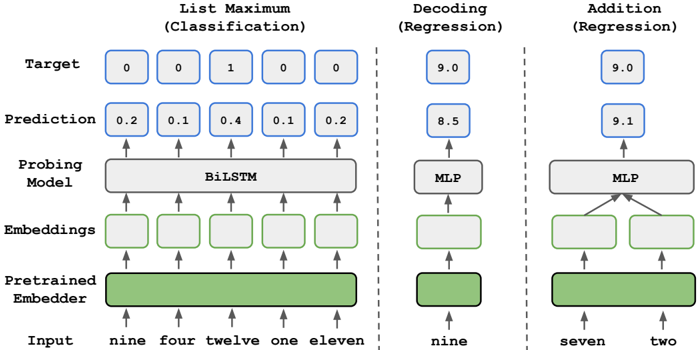
“As in typical span selection models (Seo et al., 2017), an LSTM reads the list of token embeddings, and a weight matrix and softmax function assign a probability to each index using the model’s hidden state.”
BackgroundMethodQANet: Combining Local Convolution with Global Self-Attention for Reading Comprehension
Yu, A. W., Dohan, D., Luong, M.-T., Zhao, R., Chen, K., Norouzi, M., & Le, Q. V. (2018) · arXiv · doi:10.48550/arxiv.1804.09541 · Cited by 1,118
Graves, A., Wayne, G., & Danihelka, I. (2014) · arXiv · doi:10.48550/arxiv.1410.5401 · Cited by 1,058 · cited 2×
“Synthetic Numerical Tasks Similar to our synthetic numerical reasoning tasks, other work considers sorting (Graves et al., 2014), counting (Weiss et al., 2018), or decoding tasks (Trask et al., 2018).”
MethodAssessing the Ability of LSTMs to Learn Syntax-Sensitive Dependencies
Linzen, T., Dupoux, E., & Goldberg, Y. (2016) · Transactions of the Association for Computational Linguistics · doi:10.1162/tacl_a_00115 · Cited by 737 · cited 1×
“Khandel-wal et al. (2018) show how language models leverage context, while Linzen et al. (2016) demonstrate that language models understand subject-verb agreement.”
Background
Research works printed but not linked: 4
- [1]1. Yossi Adi, Einat Kermany, Yonatan Belinkov, Ofer Lavi, and Yoav Goldberg. 2017. Finegrained anal- ysis of sentence embeddings using auxiliary predic- tion tasks. In ICLR.
- [13]13. Nelson F Liu, Matt Gardner, Yonatan Belinkov, Matthew Peters, and Noah A Smith. 2019. Linguis- tic knowledge and transferability of contextual rep- resentations. In NAACL.
- [14]14. Tomas Mikolov, Edouard Grave, Piotr Bojanowski, Christian Puhrsch, and Armand Joulin. 2018. Ad- vances in pre-training distributed word representa- tions. In LREC.
- [24]24. Andrew Trask, Felix Hill, Scott Reed, Jack W. Rae, Chris Dyer, and Phil Blunsom. 2018. Neural arith- metic logic units. In NeurIPS.
Cited by
Liu, P., Yuan, W., Fu, J., Jiang, Z., Hayashi, H., & Neubig, G. (2023) · ACM Computing Surveys · doi:10.1145/3560815 · Cited by 4,361
“Within the context of pre-trained LMs, researchers have found that pre-trained embeddings and LMs can perform simple operations such as addition and subtraction when the number of digits is small, but fail when the numbers are larger [9, 88, 139].”
BackgroundA primer in BERTology: What we know about how BERT works
Rogers, A., Kovaleva, O., & Rumshisky, A. (2020) · Transactions of the Association for Computational Linguistics · doi:10.1162/tacl_a_00349 · Cited by 1,552
“This is in line with the recent findings on adversarial attacks, with models disturbed by nonsensical inputs (Wallace et al., 2019a), and suggests that BERT’s encoding of syntactic structure does not indicate that it actually relies on that knowledge .”
BackgroundResultPre-trained models: Past, present and future
Han, X., Zhang, Z., Ding, N., Gu, Y., Liu, X., Huo, Y., Qiu, J., Yao, Y., Zhang, A., Zhang, L., et al. (2021) · AI Open · doi:10.1016/j.aiopen.2021.08.002 · Cited by 994
TaPas: Weakly Supervised Table Parsing via Pre-training
Herzig, J., Nowak, P. K., Müller, T., Piccinno, F., & Eisenschlos, J. (2020) · Proceedings of the 58th Annual Meeting of the Association for Computational Linguistics · doi:10.18653/v1/2020.acl-main.398 · Cited by 535
“This can assist the model when processing questions that involve superlatives, as word pieces may not represent numbers informatively (Wallace et al., 2019).”
BackgroundLiu, P., Yuan, W., Fu, J., Jiang, Z., Hayashi, H., & Neubig, G. (2021) · arXiv · doi:10.48550/arxiv.2107.13586 · Cited by 4,352
“Within the context of pre-trained LMs, researchers have found that pre-trained embeddings and LMs can perform simple operations such as addition and subtraction when the number of digits is small, but fail when the numbers are larger [9, 88, 139].”
Background
Metadata
- Authors
- Wallace, E., Wang, Y., Li, S., Singh, S., & Gardner, M.
- Affiliations
- Allen Institute for Artificial Intelligence (US)
- Peking University (CN)
- University of California, Irvine (US)
- Venue
- Proceedings of the 2019 Conference on Empirical Methods in Natural Language Processing and the 9th International Joint Conference on Natural Language Processing (EMNLP-IJCNLP)
- Published
- 2019
- Pages
- 5306-5314
- OpenAlex
- W2974596953
- Cited by
- 227
- References
- 28
- Citations by year
- 2026: 9 · 2025: 16 · 2024: 17 · 2023: 38 · 2022: 41 · 2021: 61 · 2020: 43 · 2019: 2
- FWCI
- 14.06
- Type
- conference paper
- Language
- en
- Open access
- hybrid
- doi.org
- Licence
- cc-by
- Locations
- Conference on Empirical Methods in Natural Language Processing (EMNLP) (publishedVersion, cc-by)
- arXiv (Cornell University) (submittedVersion)
- arXiv (Cornell University)
- Greater South Information System
- Topics
- Physical Sciences › Computer Science › Artificial Intelligence › Topic Modeling
- Physical Sciences › Computer Science › Artificial Intelligence › Natural Language Processing Techniques
- Physical Sciences › Computer Science › Computer Vision and Pattern Recognition › Multimodal Machine Learning Applications
- Keywords
- numeracy, numerical reasoning, word embeddings, language models
About these checks
Registry, retraction, Cites and statistics results are computed, not judged, with one exception: a printed reference that no index lists is read once by a model before it counts as a citation error. Claims are extracted by a model and kept only when their quote appears verbatim in the text; each cited source is then checked, with a model’s help, for whether it says what the claim relies on. Those verdicts can be wrong — read the claim’s quote and the cited source before relying on one.
Statistics and arithmetic are recomputed, not judged.
Confidence bands are shown only for fields calibrated on our annotated test set. None is calibrated yet, so no band is shown.
What counts as a claim ›How we measure confidence ›How we check this ›
Are you an author, or do you see a problem with this page? Request a review
Data sources
Bibliographic data: Semantic Scholar, OpenAlex, Crossref.
Contains information from the Semantic Scholar Academic Graph Datasets, made available under the ODC Attribution License (ODC-BY 1.0).
Semantic Scholar’s data is described in: Kinney, R., et al. (2023). The Semantic Scholar Open Data Platform. arXiv:2301.10140.
