

The DOI matches its Crossref record; 35 of the 36 references it cites were found in a registry or an index.
Multi-Task, Multi-Channel, Multi-Input Learning for Mental Illness Detection using Social Media Text
Open accessAbstract
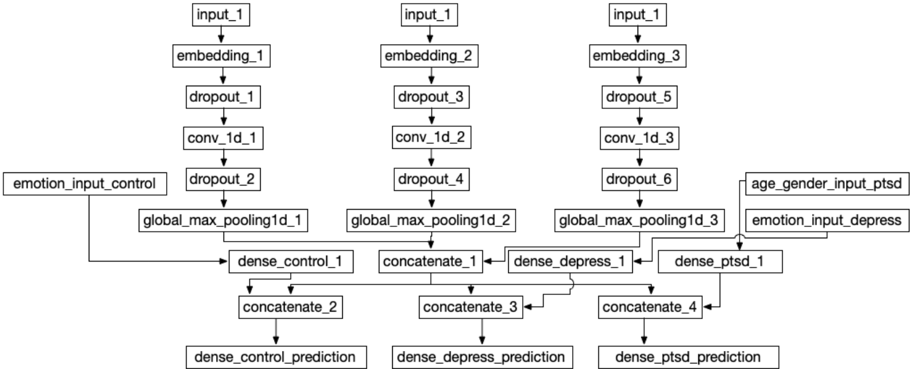
We investigate the impact of using emotional patterns identified by the clinical practitioners and computational linguists to enhance the prediction capabilities of a mental illness detection (in our case depression and posttraumatic stress disorder) model built using a deep neural network architecture.Over the years, deep learning methods have been successfully used in natural language processing tasks, including a few in the domain of mental illness and suicide ideation detection.We illustrate the effectiveness of using multitask learning with a multi-channel convolutional neural network as the shared representation and use additional inputs identified by researchers as indicatives in detecting mental disorders to enhance the model predictability.Given the limited amount of unstructured data available for training, we managed to obtain a task-specific AUC higher than 0.90.In comparison to methods such as multi-class classification, we identified multi-task learning with multi-channel convolution neural network and multiple-inputs to be effective in detecting mental disorders.
Overview
The claims and statistics of this paper haven’t been checked yet.
Free: it reads the open-access text and checks the first 5 claims that cite a source we can check. Create a free account to check every claim.
Integrity signals
Registry
Cites
Statistics
Figures
Verification
Claims the paper makes
The claims and statistics of this paper haven’t been checked yet.
Free: it reads the open-access text and checks the first 5 claims that cite a source we can check. Create a free account to check every claim.
Claims other papers make about this one
Each is checked against this paper’s own text: does it say what the citing paper says it does?
The source backs part of the claim, not all of it — or backs it for a different population, condition or comparison.
In the citing paper
“The first 2 studies leverage social media data and rely on selfreported PTSD diagnoses, which may contribute to their higher AUC values.”
From Linguistic markers for identifying post-traumatic stress disorder and associated symptoms: a systematic literature review (2025) · cites this paper as [84]
Experimental — accuracy not yet measuredThe cited source says what the claim attributes to it.
In the citing paper
“Some 42,61,84,88 were unclear about their analysis because they used uninterpretable features or did not use methods like SHAP to suggest interpretations, and they limited their results to classification performance.”
From Linguistic markers for identifying post-traumatic stress disorder and associated symptoms: a systematic literature review (2025) · cites this paper as [84]
The cited source says what the claim attributes to it.
In the citing paper
“From the forest plot highlights studies with notably higher AUC scores, particularly Reece et al, 52 Kirinde Gamaarachchige and Inkpen, 84 and Schultebraucks et al. 43”
From Linguistic markers for identifying post-traumatic stress disorder and associated symptoms: a systematic literature review (2025) · cites this paper as [84]
The cited source says what the claim attributes to it.
In the citing paper
“Studies 42,61,84,88 reporting only classification performances or using deep learning methods without methods to interpret had very low clinical impact.”
From Linguistic markers for identifying post-traumatic stress disorder and associated symptoms: a systematic literature review (2025) · cites this paper as [84]
Self-check
Percentages, sums and reported differences re-computed from the paper’s own numbers.
The self-check needs the paper’s full text.
Citations
Cites
Adam: A Method for Stochastic Optimization
Kingma, D. P., & Ba, J. (2014) · arXiv · doi:10.48550/arxiv.1412.6980 · Cited by 98,946 · cited 1×
“The Adam optimizer (Kingma and Ba, 2014) was used when training both the models with the default learning rate of 0.001.”
MethodInfluential(2014) · Cited by 33,419
Enriching Word Vectors with Subword Information
Bojanowski, P., Grave, E., Joulin, A., & Mikolov, T. (2017) · Transactions of the Association for Computational Linguistics · doi:10.1162/tacl_a_00051 · Cited by 9,645 · cited 1×
“We decided to use fastText because given the unstructured nature of the twitter messages we could obtain a more meaningful representation by expressing a word as a vector constructed out of the sum of several vectors for different parts of the word (Bojanowski et al., 2017).”
MethodCaruana, R. (1997) · Machine Learning · doi:10.1023/a:1007379606734 · Cited by 6,636 · cited 1×
“Learning a shared representation so that individual tasks can benefit from one another (Caruana, 1997) can be considered as one of the most appropriate architectures when trying to detect multiple mental illnesses.”
BackgroundBag of Tricks for Efficient Text Classification
Joulin, A., Grave, E., Bojanowski, P., & Mikolov, T. (2017) · Proceedings of the 15th Conference of the European Chapter of the Association for Computational Linguistics: Volume 2, Short Papers · doi:10.18653/v1/e17-2068 · Cited by 4,545
Bag of Tricks for Efficient Text Classification
Joulin, A., Grave, E., Bojanowski, P., & Mikolov, T. (2016) · arXiv · doi:10.48550/arxiv.1607.01759 · Cited by 4,542 · cited 2×
“Even though our best results were obtained by instantiating the embedding layer weights with random numbers (refer Table 4), we conducted several preliminary experiments using word embeddings trained on the fastText (Joulin et al., 2017)”
MethodQuantifying Mental Health Signals in Twitter
Coppersmith, G., Dredze, M., & Harman, C. (2014) · Proceedings of the Workshop on Computational Linguistics and Clinical Psychology: From Linguistic Signal to Clinical Reality · doi:10.3115/v1/w14-3207 · Cited by 722 · cited 2×
“Social media text was used to classify users with insomnia and distress (Jamison-Powell et al., 2012; Lehrman et al., 2012), postpartum depression (De Choudhury et al., 2013a,b, 2014), depression (Resnik et al., 2015a, 2013, 2015b; Schwartz et al., 2014; Tsugawa et al., 2015), Post-Traumatic Stress Disorder (Coppersmi…”
BackgroundPredicting postpartum changes in emotion and behavior via social media
De Choudhury, M., Counts, S., & Horvitz, E. (2013) · Proceedings of the SIGCHI Conference on Human Factors in Computing Systems · doi:10.1145/2470654.2466447 · Cited by 462 · cited 1×
“…media text was used to classify users with insomnia and distress (Jamison-Powell et al., 2012; Lehrman et al., 2012), postpartum depression (De Choudhury et al., 2013a,b, 2014), depression (Resnik et al., 2015a, 2013, 2015b; Schwartz et al., 2014; Tsugawa et al., 2015), Post-Traumatic Stress…”
MethodCharacterizing and predicting postpartum depression from shared facebook data
De Choudhury, M., Counts, S., Horvitz, E. J., & Hoff, A. (2014) · Proceedings of the 17th ACM conference on Computer supported cooperative work & social computing · doi:10.1145/2531602.2531675 · Cited by 379
Recognizing Depression from Twitter Activity
Tsugawa, S., Kikuchi, Y., Kishino, F., Nakajima, K., Itoh, Y., & Ohsaki, H. (2015) · Proceedings of the 33rd Annual ACM Conference on Human Factors in Computing Systems · doi:10.1145/2702123.2702280 · Cited by 334 · cited 1×
“…et al., 2012), postpartum depression (De Choudhury et al., 2013a,b, 2014), depression (Resnik et al., 2015a, 2013, 2015b; Schwartz et al., 2014; Tsugawa et al., 2015), Post-Traumatic Stress Disorder (Coppersmith et al., 2014a,b), schizophrenia (Loveys et al., 2017) and many other mental…”
Background
Research works printed but not linked: 1
- [28]28. Umashanthi Pavalanathan and Munmun De Choud- hury. 2015. Identity Management and Mental Health Discourse in Social Media Identity in Online Communities. In WWW'15 Companion: 24th Inter- national World Wide Web Conference, pages 18-22.
Cited by
Mental Health Analysis in Social Media Posts: A Survey
Garg, M. (2023) · Archives of Computational Methods in Engineering · doi:10.1007/s11831-022-09863-z · Cited by 197
Malhotra, A., & Jindal, R. (2022) · Applied Soft Computing · doi:10.1016/j.asoc.2022.109713 · Cited by 125
Schizophrenia Detection Using Machine Learning Approach from Social Media Content
Bae, Y. J., Shim, M., & Lee, W. H. (2021) · Sensors · doi:10.3390/s21175924 · Cited by 96
Cost-Sensitive Boosting Pruning Trees for Depression Detection on Twitter
Tong, L., Liu, Z., Jiang, Z., Zhou, F., Chen, L., Lyu, J., Zhang, X., Zhang, Q., Sadka, A. H., Wang, Y., et al. (2022) · IEEE Transactions on Affective Computing · doi:10.1109/taffc.2022.3145634 · Cited by 78
Tahir, W. B., Khalid, S., Almutairi, S. S., Abohashrh, M., Memon, S. A., & Khan, J. (2025) · IEEE Access · doi:10.1109/access.2025.3530862 · Cited by 71
“The aim is to strip down the text to its most relevant components, making it easier for models to focus on meaningful content [14], [66], [69], [78], [87]. is useful for rare or compound words.”
Influential
Metadata
- Authors
- Kirinde Gamaarachchige, P., & Inkpen, D.
- Affiliations
- University of Ottawa (CA)
- Corresponding author
- Inkpen, Diana
- ORCID
- Inkpen, Diana
- Venue
- Proceedings of the Tenth International Workshop on Health Text Mining and Information Analysis (LOUHI 2019)
- Published
- 2019
- Pages
- 54-64
- OpenAlex
- W2983910710
- Semantic Scholar
- f63e347e336b744852bbb7d74663300c2d94bcd7
- Cited by
- 28
- References
- 36
- Citations by year
- 2026: 2 · 2025: 2 · 2024: 8 · 2023: 5 · 2022: 5 · 2021: 4 · 2020: 2
- FWCI
- 4.55
- Type
- conference paper
- Language
- en
- Open access
- hybrid
- doi.org
- Licence
- cc-by
- Locations
- International Workshop on Health Text Mining and Information Analysis (LOUHI) (publishedVersion, cc-by)
- Topics
- Social Sciences › Psychology › Social Psychology › Mental Health via Writing
- Physical Sciences › Computer Science › Artificial Intelligence › Sentiment Analysis and Opinion Mining
- Physical Sciences › Computer Science › Artificial Intelligence › Emotion and Mood Recognition
- Keywords
- mental disorder detection, depression detection, post-traumatic stress disorder, social media text, multi-task learning, multi-channel convolutional neural network, emotional patterns, suicidal ideation, shared representations
About these checks
Registry, retraction, Cites and statistics results are computed, not judged, with one exception: a printed reference that no index lists is read once by a model before it counts as a citation error. Claims are extracted by a model and kept only when their quote appears verbatim in the text; each cited source is then checked, with a model’s help, for whether it says what the claim relies on. Those verdicts can be wrong — read the claim’s quote and the cited source before relying on one.
Statistics and arithmetic are recomputed, not judged.
Confidence bands are shown only for fields calibrated on our annotated test set. None is calibrated yet, so no band is shown.
What counts as a claim ›How we measure confidence ›How we check this ›
Are you an author, or do you see a problem with this page? Request a review
How to cite
Cite CoChat for the checks on this page, and the paper for its own findings.
- This page
- CoChat. (2026). Citation check: Multi-Task, Multi-Channel, Multi-Input Learning for Mental Illness Detection using Social Media Text. https://app.cochat.ai/papers/10.18653/v1/d19-6208
- The paper
- Kirinde Gamaarachchige, P., & Inkpen, D. (2019). Multi-Task, Multi-Channel, Multi-Input Learning for Mental Illness Detection using Social Media Text. Proceedings of the Tenth International Workshop on Health Text Mining and Information Analysis (LOUHI 2019). https://doi.org/10.18653/v1/d19-6208
Data sources
Bibliographic data: Semantic Scholar, OpenAlex, Crossref.
Contains information from the Semantic Scholar Academic Graph Datasets, made available under the ODC Attribution License (ODC-BY 1.0).
Semantic Scholar’s data is described in: Kinney, R., et al. (2023). The Semantic Scholar Open Data Platform. arXiv:2301.10140.
