

The DOI matches its Crossref record; 26 of the 27 references it cites were found in a registry or an index.
Effective Crowd Annotation for Relation Extraction
Open accessAbstract
Angli Liu, Stephen Soderland, Jonathan Bragg, Christopher H. Lin, Xiao Ling, Daniel S. Weld. Proceedings of the 2016 Conference of the North American Chapter of the Association for Computational Linguistics: Human Language Technologies. 2016.
Overview
The claims and statistics of this paper haven’t been checked yet.
Free: it reads the open-access text and checks the first 5 claims that cite a source we can check. Create a free account to check every claim.
Integrity signals
Registry
Cites
Statistics
Figures
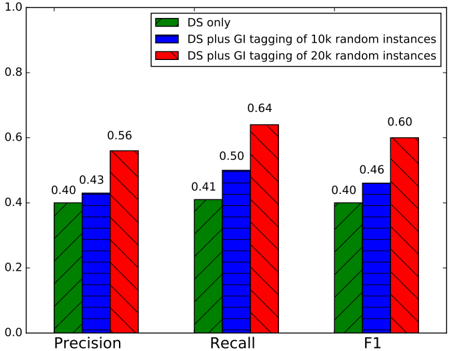
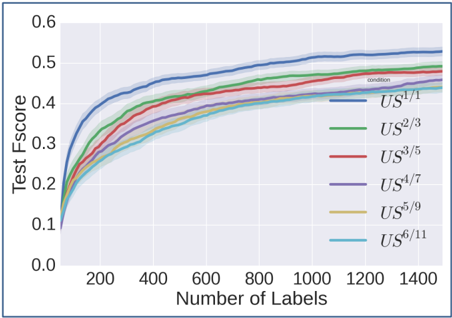
Verification
Claims the paper makes
The claims and statistics of this paper haven’t been checked yet.
Free: it reads the open-access text and checks the first 5 claims that cite a source we can check. Create a free account to check every claim.
Claims other papers make about this one
Each is checked against this paper’s own text: does it say what the citing paper says it does?
The source backs part of the claim, not all of it — or backs it for a different population, condition or comparison.
In the citing paper
“a screening phase required the participant to correctly label four of six reviews [51]. Only participants who passed the gating test were allowed to proceed to the main task.”
From Does the Whole Exceed its Parts? The Effect of AI Explanations on Complementary Team Performance (2021) · cites this paper as [51]
Experimental — accuracy not yet measured
Self-check
Percentages, sums and reported differences re-computed from the paper’s own numbers.
The self-check needs the paper’s full text.
Citations
Cites
Conditional Random Fields: Probabilistic Models for Segmenting and Labeling Sequence Data
Lafferty, J., McCallum, A., & Pereira, F. C. N. (2001) · ScholarlyCommons (University of Pennsylvania) · Cited by 12,935
Incorporating non-local information into information extraction systems by Gibbs sampling
Finkel, J. R., Grenager, T., & Manning, C. (2005) · Proceedings of the 43rd Annual Meeting on Association for Computational Linguistics - ACL '05 · doi:10.3115/1219840.1219885 · Cited by 3,008 · cited 1×
“First we collected sentences of training data from the TAC-KBP newswire corpus that contain a person and a location according to the Stanford NER tagger (Finkel et al., 2005).”
MethodDistant supervision for relation extraction without labeled data
Mintz, M., Bills, S., Snow, R., & Jurafsky, D. (2009) · Proceedings of the Joint Conference of the 47th Annual Meeting of the ACL and the 4th International Joint Conference on Natural Language Processing of the AFNLP: Volume 2 - ACL-IJCNLP '09 · doi:10.3115/1690219.1690287 · Cited by 2,752 · cited 5×
“We represent them us-ing the features described by Mintz et al. (2009).”
BackgroundMethodInfluentialCheap and fast---but is it good?: evaluating non-expert annotations for natural language tasks
Snow, R., O'Connor, B., Jurafsky, D., & Ng, A. Y. (2008) · Proceedings of the Conference on Empirical Methods in Natural Language Processing - EMNLP '08 · doi:10.3115/1613715.1613751 · Cited by 1,887 · cited 2×
“Snow et al. (2008) showed that multiple workers can simulate an expert worker in a variety of natural language tasks.”
BackgroundMaximum Likelihood Estimation of Observer Error-Rates Using the EM Algorithm
Dawid, A. P., & Skene, A. M. (1979) · Applied Statistics · doi:10.2307/2346806 · Cited by 1,692 · cited 2×
“Techniques such as expectation maximization (Dawid and Skene, 1979) can be used to produce new gold questions based on worker answers.”
BackgroundModeling Relations and Their Mentions without Labeled Text
Riedel, S., Yao, L., & McCallum, A. (2010) · Lecture Notes in Computer Science · doi:10.1007/978-3-642-15939-8_10 · Cited by 1,270 · cited 1×
“To address this shortcoming, there have been attempts to model the relation dependencies as multi-instance multi-class (Bunescu and Mooney, 2007; Riedel et al., 2010) leading to state-of-the art extraction learners MultiR (Hoffmann et al., 2011) and MIML-RE (Sur-deanu et al., 2012).”
Get another label? improving data quality and data mining using multiple, noisy labelers
Sheng, V. S., Provost, F., & Ipeirotis, P. G. (2008) · Proceedings of the 14th ACM SIGKDD international conference on Knowledge discovery and data mining · doi:10.1145/1401890.1401965 · Cited by 1,165
Whose Vote Should Count More: Optimal Integration of Labels from Labelers of Unknown Expertise
Whitehill, J., Wu, T., Bergsma, J., Movellan, J. R., & Ruvolo, P. (2009) · Cited by 1,004
Knowledge-Based Weak Supervision for Information Extraction of Overlapping Relations
Hoffmann, R., Zhang, C., Ling, X., Zettlemoyer, L., & Weld, D. S. (2011) · Cited by 874
Self-citationMulti-instance Multi-label Learning for Relation Extraction
Surdeanu, M., Tibshirani, J., Nallapati, R. M., & Manning, C. D. (2012) · Cited by 643
Research works printed but not linked: 2
- M. Califf and R. Mooney. 1997. Relational learning of pattern-match rules for information extraction. In Workshop in Natural Language Learning, Conf. Assoc. Computational Linguistics .
- Christopher H. Lin, Mausam, and Daniel S. Weld. 2016. Reactive learning: Active learning with relabeling. In AAAI .
Cited by
Does the Whole Exceed its Parts? The Effect of AI Explanations on Complementary Team Performance
Bansal, G., Wu, T., Zhou, J., Fok, R., Nushi, B., Kamar, E., Ribeiro, M. T., & Weld, D. (2021) · Proceedings of the 2021 CHI Conference on Human Factors in Computing Systems · doi:10.1145/3411764.3445717 · Cited by 757
“; and they were shown dataset-specific examples. 2) To familiarize them with the task and verify their understanding, a screening phase required the participant to correctly label four of six reviews [44]. Only participants who passed the gating test were allowed to proceed to the main task. 3) The main task randomly…”
Self-citationDoes the Whole Exceed its Parts? The Effect of AI Explanations on Complementary Team Performance
Bansal, G., Wu, T., Zhou, J., Fok, R., Nushi, B., Kamar, E., Ribeiro, M. T., & Weld, D. S. (2020) · arXiv · doi:10.48550/arxiv.2006.14779 · Cited by 754
“; and they were shown dataset-specific examples. 2) To familiarize them with the task and verify their understanding, a screening phase required the participant to correctly label four of six reviews [44]. Only participants who passed the gating test were allowed to proceed to the main task. 3) The main task randomly…”
Self-citationZero-Shot Relation Extraction via Reading Comprehension
Levy, O., Seo, M., Choi, E., & Zettlemoyer, L. (2017) · arXiv · doi:10.48550/arxiv.1706.04115 · Cited by 482
“When the type of facts (relations) are predefined, one can use crowdsourcing (Liu et al., 2016) or distant supervision (Hoffmann et al., 2011) to collect examples and train an extraction model for each relation type.”
MethodZero-Shot Relation Extraction via Reading Comprehension
Levy, O., Seo, M., Choi, E., & Zettlemoyer, L. (2017) · Proceedings of the 21st Conference on Computational Natural Language Learning (CoNLL 2017) · doi:10.18653/v1/k17-1034 · Cited by 482
“When the type of facts (relations) are predefined, one can use crowdsourcing (Liu et al., 2016) or distant supervision (Hoffmann et al., 2011) to collect examples and train an extraction model for each relation type.”
MethodAdversarial Attacks on Deep Learning Models in Natural Language Processing: A Survey
Zhang, W. E., Sheng, Q. Z., Alhazmi, A., & Li, C. (2019) · arXiv (Cornell University) · doi:10.48550/arxiv.1901.06796 · Cited by 248
“They used two relation dataset NYT dataset [109] and UW dataset [110].”
Method
Metadata
- Authors
- Liu, A., Soderland, S., Bragg, J., Lin, C. H., Ling, X., & Weld, D. S.
- Affiliations
- University of Washington (US)
- Venue
- Proceedings of the 2016 Conference of the North American Chapter of the Association for Computational Linguistics: Human Language Technologies
- Published
- 2016
- Pages
- 897-906
- OpenAlex
- W2469104253
- Cited by
- 68
- References
- 27
- Citations by year
- 2025: 2 · 2024: 3 · 2023: 5 · 2022: 3 · 2021: 12 · 2020: 13 · 2019: 10 · 2018: 12 · 2017: 7 · 2016: 1
- FWCI
- 5.39
- Type
- conference paper
- Language
- en
- Open access
- hybrid
- doi.org
- Licence
- cc-by
- Locations
- Conference of the North American Chapter of the Association for Computational Linguistics: Human Language Technologies (NAACL-HLT) (publishedVersion, cc-by)
- Topics
- Physical Sciences › Computer Science › Artificial Intelligence › Natural Language Processing Techniques
- Physical Sciences › Computer Science › Artificial Intelligence › Topic Modeling
- Physical Sciences › Computer Science › Computer Science Applications › Mobile Crowdsensing and Crowdsourcing
- Keywords
- crowd annotation, relation extraction, crowdsourcing, manual annotation
About these checks
Registry, retraction, Cites and statistics results are computed, not judged, with one exception: a printed reference that no index lists is read once by a model before it counts as a citation error. Claims are extracted by a model and kept only when their quote appears verbatim in the text; each cited source is then checked, with a model’s help, for whether it says what the claim relies on. Those verdicts can be wrong — read the claim’s quote and the cited source before relying on one.
Statistics and arithmetic are recomputed, not judged.
Confidence bands are shown only for fields calibrated on our annotated test set. None is calibrated yet, so no band is shown.
What counts as a claim ›How we measure confidence ›How we check this ›
Are you an author, or do you see a problem with this page? Request a review
How to cite
Cite CoChat for the checks on this page, and the paper for its own findings.
- This page
- CoChat. (2026). Citation check: Effective Crowd Annotation for Relation Extraction. https://app.cochat.ai/papers/10.18653/v1/n16-1104
- The paper
- Liu, A., Soderland, S., Bragg, J., Lin, C. H., Ling, X., & Weld, D. S. (2016). Effective Crowd Annotation for Relation Extraction. Proceedings of the 2016 Conference of the North American Chapter of the Association for Computational Linguistics: Human Language Technologies. https://doi.org/10.18653/v1/n16-1104
Data sources
Bibliographic data: Semantic Scholar, OpenAlex, Crossref.
Contains information from the Semantic Scholar Academic Graph Datasets, made available under the ODC Attribution License (ODC-BY 1.0).
Semantic Scholar’s data is described in: Kinney, R., et al. (2023). The Semantic Scholar Open Data Platform. arXiv:2301.10140.
