

Structural Scaffolds for Citation Intent Classification in Scientific Publications
Open accessThe DOI matches its Crossref record; 38 of the 38 references it cites were found in a registry or an index; 19 of the 28 sources its claims cite were checked for support.
Abstract
Arman Cohan, Waleed Ammar, Madeleine van Zuylen, Field Cady. Proceedings of the 2019 Conference of the North American Chapter of the Association for Computational Linguistics: Human Language Technologies, Volume 1 (Long and Short Papers). 2019.
Overview
CoChat Summary
TL;DR
The paper proposes a multitask neural model with two “structural scaffolds”—predicting section title and citation worthiness—to improve citation intent classification. It reports a new state of the art on ACL-ARC (67.9 macro F1, +13.3 absolute over prior SOTA) and introduces SciCite, a larger multi-domain citation intent dataset.
Key findings
- On ACL-ARC, the best model (`BiLSTM-Attn w/ ELMo + both scaffolds`) reaches 67.9 macro F1, a 13.3 absolute improvement over the previous state of the art (Jurgens et al., 2018) at 54.6.
- Each scaffold helps: section title scaffold reaches 56.9 F1 and citation worthiness scaffold 56.3 F1, versus 51.8 for the BiLSTM-Attn baseline; using both scaffolds reaches 63.1 F1 without ELMo.
- SciCite contains 11,020 instances from 6,627 papers across computer science and medicine, with categories Background (0.58), Method (0.29), and Result comparison; ACL-ARC has 1,941 instances from 186 papers. Best SciCite result is 84.0 macro F1 with ELMo plus both scaffolds.
- Adding Jurgens et al. (2018) hand-engineered features to the best model did not improve performance and caused at least a 1.7% decline.
Methods
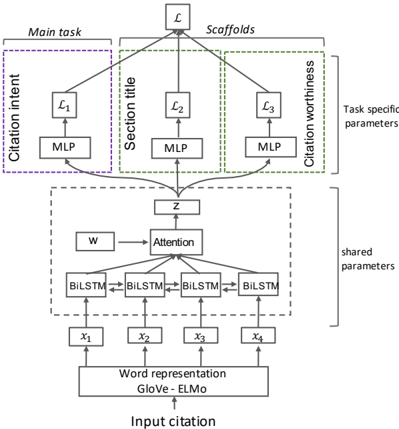
- The model is a multitask neural framework: a shared BiLSTM with attention encodes the citation context, using 100-dimensional GloVe and 1,024-dimensional ELMo representations; task-specific MLPs produce outputs for the main citation intent task and two auxiliary scaffold tasks.
- The two scaffolds are citation worthiness (whether a sentence needs a citation) and section title prediction (normalized to introduction, related work, method, experiments, conclusion); training uses a weighted joint loss, AdaDelta, gradient clipping at 5.0, and early stopping.
- Data include ACL-ARC (1,941 instances, 186 papers, six intent categories) and SciCite (11,020 instances, 6,627 papers, three categories), with SciCite crowdsourced via Figure Eight and a separate expert-annotated test set of 1,861 instances; scaffold data sizes are about 47K/50K for ACL-ARC and 91K/73K for SciCite.
Limitations
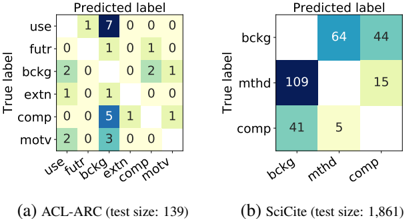
- The paper states that errors occur on rare categories, e.g., FUTUREWORK has the fewest data points and is hardest to classify, and some errors may require additional context; an attempt to encode extended surrounding context with a BiLSTM concatenated to the citation vector caused a large decline in overall performance.
- The paper states future work includes replacing ELMo with other contextualized representations such as BERT.
- Evident from the text: evaluation is limited to ACL-ARC (NLP) and SciCite (computer science and medicine); SciCite annotations are crowdsourced with quality controls, and only a 100-sample subset was re-annotated by an expert, with 86% agreement.
Model-written summary. Check it against the paper before relying on it.
Integrity signals
Registry
Cites
Statistics
Figures
Verification
Claims the paper makes
16 Valid · 7 Not valid · 3 Not checked · 64 Own results and interpretations
At least one cited source doesn’t support this claim or points to a different paper, and none confirmed it — see the verdicts below.
In the paper
“previous state-of-the-art results of Jurgens et al. (2018) 54.6”
What the sources say
- Disputedcites Jurgens et al., 2018 matched to “Measuring the Evolution of a Scientific Field through Citation Frames” (2018) sourceExperimental — accuracy not yet measured
Table 7 reports a macro F1 of 0.530 for the authors’ classifier, not 0.546. The Experimental Setup describes evaluation on a combined citation-function dataset, so the paper also does not establish 54.6 as an ACL-ARC result. (LLM, conf=0.88)
Checked by a reasoning model — may be wrong.
plain- Asserted: passes — The authors put it forward as true.
- Checkable: passes — It can be checked against evidence.
- Load-bearing: passes — The paper’s conclusions depend on it.
- Based: passes — The paper gives a reason why it holds.
- Disputed
The cited sources support only part of this claim — read each source’s verdict below.
In the paper
“Our model achieves a new state-ofthe-art on an existing ACL anthology dataset (ACL-ARC) with a 13.3% absolute increase in F1 score, without relying on external linguistic resources or hand-engineered features as done in existing methods.”
- Also stated in: § 1 Introduction · plain
“we achieve a new state-of-the-art of 67.9% F1 on the ACLARC citations benchmark, an absolute 13.3% increase over the previous state-of-the-art (Jurgens et al., 2018)”
- Also stated in: § 4.3 Results · plain
“The best result is achieved when we also add ELMovectors (Peters et al., 2018) to the input representations in 'BiLSTM-Attn w/ ELMo + both scaffolds', achieving an F1 of 67.9, a major improvement from the previous state-of-the-art results of Jurgens et al. (2018) 54.6 ( ∆=13 . 3 ).”
What the sources say
- Partly supportedcites Jurgens et al., 2018 matched to “Measuring the Evolution of a Scientific Field through Citation Frames” (2018) sourceExperimental — accuracy not yet measured
Section 3.3 (page unavailable) says the paper’s methods outperformed the closest state of the art, supporting the general performance claim. It does not report a 13.3-percentage-point absolute F1 increase in the passages found; Section 3.2 describes evaluation on a combined citation-function dataset rather than establishing that figure for ACL-ARC. (LLM, conf=0.85)
plainstates a cause- Asserted: passes — The authors put it forward as true.
- Checkable: passes — It can be checked against evidence.
- Load-bearing: passes — The paper’s conclusions depend on it.
- Based: passes — The paper gives a reason why it holds.
- Also stated in: § 1 Introduction · plain
Every source the paper cites for this claim was checked and supports it.
In the paper
“Our implementation of this model achieves a macro-averaged F1 score of 0.526 using 10-fold cross-validation”
What the sources say
- Supportedcites Jurgens et al., 2018 matched to “Measuring the Evolution of a Scientific Field through Citation Frames” (2018) source
The citation identifies the model being implemented: Section 3.2 describes Jurgens et al.’s classifier and its evaluation using macro-averaged F1. The 0.526 score and 10-fold cross-validation are stated as results of the citing authors’ own implementation, not attributed to Jurgens et al. (LLM, conf=0.91)
plain- Asserted: passes — The authors put it forward as true.
- Checkable: passes — It can be checked against evidence.
- Load-bearing: passes — The paper’s conclusions depend on it.
- Based: passes — The paper gives a reason why it holds.
- Supported
Every source the paper cites for this claim was checked and supports it.
In the paper
“followed by Jurgens et al. (2018)”
What the sources say
- Supportedcites Jurgens et al., 2018 matched to “Measuring the Evolution of a Scientific Field through Citation Frames” (2018) source
The citation identifies the Jurgens et al. system used as a comparison baseline. Section 3.2 describes their citation-function classifier; the 'second best' ranking on SciCite is the citing paper's own comparison, not a result attributed to Jurgens et al. (LLM, conf=0.84)
plain- Asserted: passes — The authors put it forward as true.
- Checkable: passes — It can be checked against evidence.
- Load-bearing: unclear — It is unclear whether the paper’s conclusions depend on it.
- Based: passes — The paper gives a reason why it holds.
- Rests on an assumption not shown here.
- Supported
Every source the paper cites for this claim was checked and supports it.
In the paper
“We note that these results were obtained without using hand-curated features or additional linguistic resources as used in Jurgens et al. (2018).”
What the sources say
- Supportedcites Jurgens et al., 2018 matched to “Measuring the Evolution of a Scientific Field through Citation Frames” (2018) source
Section 3.1 (page not supplied) says Jurgens et al. added 132 patterns and 13 lexical categories based on manual analysis, supporting the reference to hand-curated features. Section 3.2 (page not supplied) says they used CoreNLP for syntactic processing and pretrained GloVe vectors, supporting the reference to additional linguistic resources. The citing authors’ statement about how they obtained their own results is not attributed to Jurgens et al. (LLM, conf=0.93)
plain- Asserted: passes — The authors put it forward as true.
- Checkable: passes — It can be checked against evidence.
- Load-bearing: passes — The paper’s conclusions depend on it.
- Based: passes — The paper gives a reason why it holds.
- Supported
39 more claims
Create a free account to see all 90 claims and every source verdict.
- Probably not a substantial claim. 38
- It may state two separate claims as one. 14
- The quote only partly states this claim. 2
Claims other papers make about this one
Each is checked against this paper’s own text: does it say what the citing paper says it does?
The source backs part of the claim, not all of it — or backs it for a different population, condition or comparison.
In the citing paper
“section titles have frequently been used as auxiliary or additional features within multitask learning frameworks for CIC (Cohan et al., 2019; Qi et al., 2023; Zhang et al., 2022)”
From CiteFusion: an ensemble framework for citation intent classification harnessing dual-model binary couples and SHAP analyses (2025) · cites this paper as Cohan et al., 2019
Experimental — accuracy not yet measuredThe source backs part of the claim, not all of it — or backs it for a different population, condition or comparison.
In the citing paper
“In addition, SCIBERT outperforms the SOTA on SciCite (Co-han et al., 2019).”
From SciBERT: A Pretrained Language Model for Scientific Text (2019) · cites this paper as Cohan et al., 2019
Experimental — accuracy not yet measuredThe cited source says what the claim attributes to it.
In the citing paper
“Incorporating auxiliary scaffold tasks via multitask learning has been studied before for improving span-labeling and text classification (Swayamdipta et al., 2018b; Cohan et al., 2019).”
From TLDR: Extreme Summarization of Scientific Documents (2020) · cites this paper as Cohan et al., 2019
The check wasn’t confident either way, so it gives no verdict — never disputed.
In the citing paper
“SciBERT (Beltagy et al., 2019), pretrained on scientific corpora and equipped with a specialized scientific vocabulary – SciVOCAB –, consistently outperforms general-pur- pose models in processing academic texts (Cohan et al., 2019).”
From CiteFusion: an ensemble framework for citation intent classification harnessing dual-model binary couples and SHAP analyses (2025) · cites this paper as Cohan et al., 2019
Experimental — accuracy not yet measuredIn the citing paper
“In addition, SCIBERT achieves new SOTA results on ACL-ARC (Cohan et al., 2019), and the NER part of SciERC (Luan et al., 2018).”
From SciBERT: A Pretrained Language Model for Scientific Text (2019) · cites this paper as Cohan et al., 2019
1 more claim about this paper
Create a free account to see every claim other papers make about this one.
Self-check
Percentages, sums and reported differences re-computed from the paper’s own numbers.
Each contradiction between two passages listed here was confirmed by an independent check.
Rated minor: it would not touch a result — a value no result rests on, a p-value that stays on the same side of the significance level, or a conflict that is clerical, resolved elsewhere in the paper, or outside its own findings.
In the paper
§ 4.3 Results
“| Previous SOTA (Jurgens et al., 2018) | 79.6 |”
§ 4.4 Analysis
“| Previous SOTA (Jurgens et al., 2018) | 77.9 | 92.9 | 84.7 | 91.5 | 63.1 | 74.7 | 79.1 | 77.3 | 78.2 | 82.8 | 77.8 | 79.2 |”
Rated minor: it would not touch a result — a value no result rests on, a p-value that stays on the same side of the significance level, or a conflict that is clerical, resolved elsewhere in the paper, or outside its own findings.
In the paper
“Citation contexts were annotated by 850 crowdsource workers who made a total of 29,926 annotations and individually made between 4 and 240 annotations. Each sentence was annotated, on average, 3.74 times. This resulted in a total 9,159 crowdsourced instances”
Reported 3.74 · recomputed 3.267387
Citations
Cites
Hochreiter, S., & Schmidhuber, J. (1997) · Neural Computation · doi:10.1162/neco.1997.9.8.1735 · Cited by 102,318 · cited 2×
“…(GloVe, Pennington et al., 2014) and contextualized embeddings (ELMo, Peters et al., 2018), i.e.: We then use a bidirectional long short-term memory (Hochreiter and Schmidhuber, 1997) (BiL-STM) network with hidden size of d 2 to obtain a contextual representation of each token vector with respect…”
MethodBERT: Pre-training of Deep Bidirectional Transformers for Language Understanding
Devlin, J., Chang, M.-W., Lee, K., & Toutanova, K. (2018) · arXiv · doi:10.48550/arxiv.1810.04805 · Cited by 73,173
BERT: Pre-training of Deep Bidirectional Transformers for Language Understanding
Devlin, J., Chang, M.-W., Lee, K., & Toutanova, K. (2019) · Proceedings of the 2019 Conference of the North American Chapter of the Association for Computational Linguistics: Human Language Technologies, Volume 1 (Long and Short Papers) · doi:10.18653/v1/n19-1423 · Cited by 54,325 · cited 1×
“For example, at the time of finalizing the camera ready version of this paper, Beltagy et al. (2019) showed that a BERT contextualized representation model (Devlin et al., 2018) trained on scientific text can achieve promising results on the SciCite dataset.”
BackgroundGlove: Global Vectors for Word Representation
Pennington, J., Socher, R., & Manning, C. (2014) · Proceedings of the 2014 Conference on Empirical Methods in Natural Language Processing (EMNLP) · doi:10.3115/v1/d14-1162 · Cited by 34,071
(2014) · Cited by 33,419
(2010) · International Conference on Machine Learning · Cited by 13,995
Deep Contextualized Word Representations
Peters, M., Neumann, M., Iyyer, M., Gardner, M., Clark, C., Lee, K., & Zettlemoyer, L. (2018) · Proceedings of the 2018 Conference of the North American Chapter of the Association for Computational Linguistics: Human Language Technologies, Volume 1 (Long Papers) · doi:10.18653/v1/n18-1202 · Cited by 11,983 · cited 4×
“We experiment with two variants of this model: with and without using the contex-tualized word vector representations (ELMo) of Peters et al. (2018).”
BackgroundMethodInfluentialCaruana, R. (1997) · Machine Learning · doi:10.1023/a:1007379606734 · Cited by 6,636 · cited 2×
“Multitask learning as defined by Caruana (1997) is an approach to inductive transfer learning that improves generalization by using the domain information contained in the training signals of related tasks as an inductive bias.”
MethodADADELTA: An Adaptive Learning Rate Method
Zeiler, M. D. (2012) · arXiv · doi:10.48550/arxiv.1212.5701 · Cited by 5,322 · cited 1×
“We compute the gradient of the loss for each mini-batch and tune model parameters using the AdaDelta optimizer (Zeiler, 2012) with gradient clipping threshold of 5.0.”
MethodInfluentialAllenNLP: A Deep Semantic Natural Language Processing Platform
Gardner, M., Grus, J., Neumann, M., Tafjord, O., Dasigi, P., Liu, N. F., Peters, M., Schmitz, M., & Zettlemoyer, L. (2018) · Proceedings of Workshop for NLP Open Source Software (NLP-OSS) · doi:10.18653/v1/w18-2501 · Cited by 1,252 · cited 1×
“We implement our proposed scaffold framework using the AllenNLP library (Gardner et al., 2018).”
Method
Cited by
SciBERT: A Pretrained Language Model for Scientific Text
Beltagy, I., Lo, K., & Cohan, A. (2019) · Proceedings of the 2019 Conference on Empirical Methods in Natural Language Processing and the 9th International Joint Conference on Natural Language Processing (EMNLP-IJCNLP) · doi:10.18653/v1/d19-1371 · Cited by 3,218
“In addition, SCIBERT achieves new SOTA results on ACLARC (Cohan et al., 2019), and the NER part of SciERC (Luan et al., 2018).”
BackgroundMethodResultInfluentialSelf-citationS2ORC: The Semantic Scholar Open Research Corpus
Lo, K., Wang, L. L., Neumann, M., Kinney, R., & Weld, D. (2020) · Proceedings of the 58th Annual Meeting of the Association for Computational Linguistics · doi:10.18653/v1/2020.acl-main.447 · Cited by 457
“Other tasks that leverage citation contexts include classifying citation intent (Teufel et al., 2006; Jurgens et al., 2018; Cohan et al., 2019), identifying citation sentiment (Athar and Teufel, 2012), identifying meaningful citations (Valen-zuela et al., 2015), extracting key phrases (Caragea et…”
BackgroundTLDR: Extreme Summarization of Scientific Documents
Cachola, I., Lo, K., Cohan, A., & Weld, D. (2020) · Findings of the Association for Computational Linguistics: EMNLP 2020 · doi:10.18653/v1/2020.findings-emnlp.428 · Cited by 319
“Incorporating auxiliary scaffold tasks via multitask learning has been studied before for improving span-labeling and text classification (Swayamdipta et al., 2018b; Cohan et al., 2019).”
MethodSelf-citationSciREX: A Challenge Dataset for Document-Level Information Extraction
Jain, S., van Zuylen, M., Hajishirzi, H., & Beltagy, I. (2020) · Proceedings of the 58th Annual Meeting of the Association for Computational Linguistics · doi:10.18653/v1/2020.acl-main.670 · Cited by 159
“extractions include citation analysis (Jurgens et al., 2018; Cohan et al., 2019), identifying entities and relations (Augenstein et al.”
MethodA Survey of Joint Intent Detection and Slot Filling Models in Natural Language Understanding
Weld, H., Huang, X., Long, S., Poon, J., & Han, S. C. (2023) · ACM Computing Surveys · doi:10.1145/3547138 · Cited by 167
Nicholson, J. M., Mordaunt, M., Lopez, P., Uppala, A., Rosati, D., Rodrigues, N. P., Grabitz, P., & Rife, S. C. (2021) · bioRxiv (published in Quantitative Science Studies) · doi:10.1101/2021.03.15.435418 · Cited by 202
“…with RNN (Recursive Neural Network) architectures such as BidGRU (Bidirectional Gated Recurrent Unit, an architecture similar to the approach of Cohan et al. (2019) for citation intent classification), we obtained significant improvements with the more recently introduced ELMo (Embeddings from…”
MethodCrossFit: A Few-shot Learning Challenge for Cross-task Generalization in NLP
Ye, Q., Lin, B. Y., & Ren, X. (2021) · Proceedings of the 2021 Conference on Empirical Methods in Natural Language Processing · doi:10.18653/v1/2021.emnlp-main.572 · Cited by 103
“…comprehension Lin et al. 2019 rotten_tomatoes cls/sentiment analysis Pang and Lee 2005 samsum cg/summarization Gliwa et al. 2019 scicite cls/other Cohan et al. 2019 sciq qa/multiple-choice qa Welbl et al. 2017 scitail cls/nli Khot et al. 2018 search_qa qa/closed-book qa Dunn et al. 2017 sick…”
BackgroundMulti-Task Stance Detection with Sentiment and Stance Lexicons
Li, Y., & Caragea, C. (2019) · Conference on Empirical Methods in Natural Language Processing (EMNLP) · doi:10.18653/v1/d19-1657 · Cited by 127
“Motivated by recent advances in multi-task learning (Liu et al., 2016, 2017; Balikas et al., 2017; Yu et al., 2018; Cohan et al., 2019) and the effectiveness of sentiment information in stance detection (Sobhani et al., 2016; Sun et al., 2018, 2019), we propose an attention-based multi-task…”
MethodWhat to Pre-Train on? Efficient Intermediate Task Selection
Poth, C., Pfeiffer, J., Rücklé, A., & Gurevych, I. (2021) · Conference on Empirical Methods in Natural Language Processing (EMNLP) · doi:10.18653/v1/2021.emnlp-main.827 · Cited by 142
“96.4 95.60 SciCite (Cohan et al., 2019) 8.2K citation intents scientific papers acc.”
BackgroundInfluentialThe Semantic Scholar Academic Graph (S2AG)
Wade, A. D. (2022) · Companion Proceedings of the Web Conference 2022 · doi:10.1145/3487553.3527147 · Cited by 63
Citation Intent Classification Using Word Embedding
Roman, M., Shahid, A., Khan, S., Koubaa, A., & Yu, L. (2021) · IEEE Access · doi:10.1109/access.2021.3050547 · Cited by 57
“We also compared our method by annotating and then comparing the Sci-Cite [7], a pre-annotated dataset.”
BackgroundMethodInfluentialNeighborhood Contrastive Learning for Scientific Document Representations with Citation Embeddings
Ostendorff, M., Rethmeier, N., Augenstein, I., Gipp, B., & Rehm, G. (2022) · Proceedings of the 2022 Conference on Empirical Methods in Natural Language Processing · doi:10.18653/v1/2022.emnlp-main.802 · Cited by 56
Domain-Independent Extraction of Scientific Concepts from Research Articles
Brack, A., D’Souza, J., Hoppe, A., Auer, S., & Ewerth, R. (2020) · Lecture notes in computer science · doi:10.1007/978-3-030-45439-5_17 · Cited by 78
“SciCite[9] and ACL ARC [21] are datasets for citation intent classification from Computer Science, Medicine, and Computational Linguistics.”
MethodChang, J. C., Zhang, A. X., Bragg, J., Head, A., Lo, K., Downey, D., & Weld, D. S. (2023) · International Conference on Human Factors in Computing Systems · doi:10.1145/3544548.3580847 · Cited by 68
“While priorwork either analyzes inline citations in a non-personalized way [16, 60] or only support personalized paper discovery independent of reading [12, 26, 47], CiteSee explores the idea of a personalized reading experience focused on helping users make sense of inline citations and prioritize which citations to…”
BackgroundA meta-analysis of semantic classification of citations
Kunnath, S. N., Herrmannova, D., Pride, D., & Knoth, P. (2021) · Quantitative Science Studies · doi:10.1162/qss_a_00159 · Cited by 43
“Similarly, the error analysis on the developed citation function classification model shows the increase in false positive rates for the dominating categories (Cohan et al., 2019).”
InfluentialSciBERT: A Pretrained Language Model for Scientific Text
Beltagy, I., Lo, K., & Cohan, A. (2019) · arXiv · doi:10.48550/arxiv.1903.10676 · Cited by 41
“In addition, SCIBERT outperforms the SOTA on ScienceCite (Cohan et al., 2019).”
Self-citationUnderstanding the meanings of citations using sentiment, role, and citation function classifications
Budi, I. D., & Yaniasih, Y. (2022) · Scientometrics · doi:10.1007/s11192-022-04567-4 · Cited by 63
“Cohan et al. (2019) picked three schema classes (“background/information,” “technique comparisons,” and “outcome comparisons”) because they were necessary for exploring subjects, connected to the scientific article structure, and easy to execute using machine learning.”
BackgroundMethodWang, S., Mao, J., Lü, K., Cao, Y., & Li, G. (2021) · Journal of Informetrics · doi:10.1016/j.joi.2021.101214 · Cited by 35
Lauscher, A., Ko, B., Kuehl, B., Johnson, S., Cohan, A., Jurgens, D., & Lo, K. (2022) · Conference of the North American Chapter of the Association for Computational Linguistics: Human Language Technologies (NAACL-HLT) · doi:10.18653/v1/2022.naacl-main.137 · Cited by 73
“In some of the preceding works, ambiguous citances were reportedly removed (e.g., Cohan et al., 2019), leading to an artificial simplification of the task.”
BackgroundSelf-citationCiteRead: Integrating Localized Citation Contexts into Scientific Paper Reading
Rachatasumrit, N., Bragg, J., Zhang, A. X., & Weld, D. S. (2022) · ACM International Conference on Intelligent User Interfaces (IUI) · doi:10.1145/3490099.3511162 · Cited by 48
“• (F11) Intent classification: An ordinal feature based on the citance’s intent classification [5], with values set according to observed usefulness of the intent.”
BackgroundExtracting Sentence Embeddings from Pretrained Transformer Models
Stankevičius, L., & Lukoševičius, M. (2024) · Applied Sciences · doi:10.3390/app14198887 · Cited by 56
An Authoritative Approach to Citation Classification
Pride, D., & Knoth, P. (2020) · ACM/IEEE Joint Conference on Digital Libraries · doi:10.1145/3383583.3398617 · Cited by 31
“[2] took the classification schema first defined by Jurgens et al.”
MethodWang, M., Zhang, J., Jiao, S., Zhang, X., Zhu, N., & Chen, G. (2020) · Scientometrics · doi:10.1007/s11192-020-03677-1 · Cited by 40
“The citation motivation (Agarwal et al. 2010; Jha et al. 2017; Bakhti et al. 2018; Cohan et al. 2019), citation emotion (Athar 2011; Poria et al. 2016; Pham and Le 2018; Ikram and Afzal 2019; Wang et al. 2019b) and the textual similarity between citation pairs (Mei and Zhai 2008; Mohammad et al.…”
BackgroundMethodTowards employing native information in citation function classification
Zhang, Y., Zhao, R., Wang, Y., Chen, H., Mahmood, A., Zaib, M., Zhang, W. E., & Sheng, Q. Z. (2022) · Scientometrics · doi:10.1007/s11192-021-04242-0 · Cited by 28
“In the dataset construction process, we selected raw instances from the SciCite (Cohan et al., 2019) dataset and the ACL-ARC citation dataset (Jurgens et al., 2018).”
BackgroundMethodResultInfluentialTweetBERT: A Pretrained Language Representation Model for Twitter Text AnalysisPreprint
Qudar, M. M. A., & Mago, V. (2020) · arXiv (Cornell University) · doi:10.48550/arxiv.2010.11091 · Cited by 66
“SciCite has been very recently released [50].”
SPEC5G: A Dataset for 5G Cellular Network Protocol Analysis
Karim, I., Mubasshir, K. S., Rahman, M. M., & Bertino, E. (2023) · doi:10.18653/v1/2023.findings-ijcnlp.3 · Cited by 54
Learn Continually, Generalize Rapidly: Lifelong Knowledge Accumulation for Few-shot Learning
Jin, X., Lin, B. Y., Rostami, M. G., & Ren, X. (2021) · Findings of the Association for Computational Linguistics: EMNLP (Findings of EMNLP) · doi:10.18653/v1/2021.findings-emnlp.62 · Cited by 58
FinRED: A Dataset for Relation Extraction in Financial Domain
Sharma, S., Nayak, T., Bose, A., Meena, A. K., Dasgupta, K., Ganguly, N., & Goyal, P. (2022) · International World Wide Web Conference (WWW) · doi:10.1145/3487553.3524637 · Cited by 70
“For the CNN we use 25 filters of size [1, 2, 3, 4].”
BackgroundMethodPhương, N. L., Le, H. T. T., Linh, N. Q., Phuong, T. T. T., Pham, H.-H. T., Giang, N. T., & Thuy, V. T. (2023) · Eurasia Journal of Mathematics Science and Technology Education · doi:10.29333/ejmste/13216 · Cited by 56
Identifying Referential Intention with Heterogeneous Contexts
Yu, W., Yu, M., Zhao, T., & Jiang, M. (2020) · International World Wide Web Conference (WWW) · doi:10.1145/3366423.3380175 · Cited by 26
“proposed a concise annotation schema including three categories that is useful for navigating research topics and machine reading of scientific papers [6].”
BackgroundMethodInfluentialExplaining Relationships Between Scientific Documents
Luu, K., Wu, X., Koncel-Kedziorski, R., Lo, K., Cachola, I., & Smith, N. A. (2020) · Annual Meeting of the Association for Computational Linguistics · doi:10.18653/v1/2021.acl-long.166 · Cited by 63
“Cohan et al. (2019) condense this ontology to just three: “background,” “method,” and “result comparison.””
BackgroundCitePrompt: Using Prompts to Identify Citation Intent in Scientific Papers
Lahiri, A., Sanyal, D. K., & Mukherjee, I. (2023) · 2023 ACM/IEEE Joint Conference on Digital Libraries (JCDL) · doi:10.1109/jcdl57899.2023.00017 · Cited by 24
“[5] include two auxiliary scaffold tasks, which are the prediction of the title of the section where the citation occurs and the prediction of whether a sentence needs a citation or not.”
BackgroundMethodInfluentialSequential sentence classification in research papers using cross-domain multi-task learning
Brack, A., Entrup, E., Stamatakis, M., Buschermöhle, P., Hoppe, A., & Ewerth, R. (2024) · International Journal on Digital Libraries · doi:10.1007/s00799-023-00392-z · Cited by 35
Structure-inducing pre-training
McDermott, M. B. A., Yap, B., Szolovits, P., & Žitnik, M. (2023) · Nature Machine Intelligence · doi:10.1038/s42256-023-00647-z · Cited by 33
“[13] Arman Cohan, Waleed Ammar, Madeleine van Zuylen, and Field Cady.”
BackgroundCiteWorth: Cite-Worthiness Detection for Improved Scientific Document Understanding
Wright, D., & Augenstein, I. (2021) · Findings of the Association for Computational Linguistics: ACL (Findings of ACL) · doi:10.18653/v1/2021.findings-acl.157 · Cited by 41
“In particular, it has been shown to help improve performance on the closely related task of citation intent clas-sification (Jürgens et al., 2018) when used as an auxiliary task in a multi-task setup (Cohan et al., 2019).”
BackgroundMethodInfluentialBrack, A., Hoppe, A., Stocker, M., Auer, S., & Ewerth, R. (2021) · International Journal on Digital Libraries · doi:10.1007/s00799-021-00306-x · Cited by 38
“Am-mar et al. [1] link entity mentions in abstracts with DBpe-dia [65] and Unified Medical Language System (UMLS) [11], and Cohan et al. [23] extend the citation graph with citation intents (e.g. citation as background or used method).”
MethodControl Prefixes for Parameter-Efficient Text Generation
Clive, J., Cao, K., & Rei, M. (2022) · Workshop on Generation, Evaluation and Metrics (GEM) · doi:10.18653/v1/2022.gem-1.31 · Cited by 89
“This strategy was inspired by previous work which incorporates auxiliary scaffold tasks in multitask learning to improve span-labeling and text classification (Swayamdipta et al., 2018; Cohan et al., 2019; Cachola et al., 2020).”
MethodJust Rank: Rethinking Evaluation with Word and Sentence Similarities
Wang, B., Kuo, C. ‐. J., & Li, H. (2022) · Proceedings of the conference - Association for Computational Linguistics. Meeting · doi:10.18653/v1/2022.acl-long.419 · Cited by 43
Prompting Strategies for Citation Classification
Kunnath, S. N., Pride, D., & Knoth, P. (2023) · ACM International Conference on Information and Knowledge Management (CIKM) · doi:10.1145/3583780.3615018 · Cited by 42
“Although these semi-supervised models have significantly improved performance compared to the earlier fully-supervised feature-based [13, 38] and neural architecture-based models [6], the existing methods for citation classification still rely on supervised methods, utilising large annotated datasets for fine-tuning.”
MethodRevise and Resubmit: An Intertextual Model of Text-based Collaboration in Peer Review
Kuznetsov, I., Buchmann, J., Eichler, M., & Gurevych, I. (2022) · Computational Linguistics · doi:10.1162/coli_a_00455 · Cited by 17
“…is a direct generalization of a wide spectrum of existing NLP tasks covering specific use cases and narrow domains: Citation intent prediction (Cohan et al. 2019a; Teufel, Siddharthan, and Tidhar 2006), citation contextualization (Chandrasekaran et al. 2020), argument pair extraction (Cheng…”
BackgroundMethodInfluentialMalkawi, R., Daradkeh, M. K., Elhassan, A., & Petrov, P. (2022) · Information · doi:10.3390/info13110546 · Cited by 18
Control Prefixes for Text Generation.Preprint
Clive, J., Cao, K., & Rei, M. (2021) · arXiv (Cornell University) · Cited by 25
BigBIO: A Framework for Data-Centric Biomedical Natural Language Processing
Fries, J. A., Weber, L., Seelam, N., Altay, G., Datta, D., Garda, S., Kang, M., Su, R., Kusa, W., Cahyawijaya, S., et al. (2022) · arXiv · doi:10.48550/arxiv.2206.15076 · Cited by 17
GraphCite: Citation Intent Classification in Scientific Publications via Graph Embeddings
Berrebbi, D., Huynh, N., & Balalau, O. (2022) · International World Wide Web Conference (WWW) · doi:10.1145/3487553.3524657 · Cited by 18
“[4] created a dataset of 11K manually annotated citation intents for papers in computer science and medicine, covering 6.”
BackgroundMethodInfluentialMulti-task learning model for citation intent classification in scientific publications
Qi, R., Jia, W., Shao, Z., Li, Z.-G., Chen, H., Sun, Y., & Li, S. (2023) · Scientometrics · doi:10.1007/s11192-023-04858-4 · Cited by 22
“…21.18% higher on ACL-ARC and 5.94% higher on Scicite than Jurgens et al. (2018), macro F1 12.68% higher on ACL-ARC and 6.44% higher on Scicite than Structural-Scaffold (Cohan et al., 2019), macro F1 15.04% higher on ACL-ARC and 0.12% higher on Scicite than Beltagy and Cohan’s SciBERT Frozen (2019).”
BackgroundMethodResultInfluentialCSS-LM: A Contrastive Framework for Semi-Supervised Fine-Tuning of Pre-Trained Language Models
Su, Y., Han, X., Lin, Y., Zhang, Z., Liu, Z., Li, P., Zhou, J., & Sun, M. (2021) · IEEE/ACM Transactions on Audio Speech and Language Processing · doi:10.1109/taslp.2021.3105013 · Cited by 19
“For intent classification, we select SciCite [48] and ACL-ARC [48] for our experiments.”
MethodTDM-CFC: Towards Document-Level Multi-label Citation Function Classification
Zhang, Y., Wang, Y., Sheng, Q. Z., Mahmood, A., Zhang, W. E., & Zhao, R. (2021) · Lecture notes in computer science · doi:10.1007/978-3-030-91560-5_26 · Cited by 28
The Diminishing Returns of Masked Language Models to Science
Hong, Z., Ajith, A., Pauloski, J., Duede, E., Chard, K., & Foster, I. (2023) · Findings of the Association for Computational Linguistics: ACL 2023 · doi:10.18653/v1/2023.findings-acl.82 · Cited by 24
Rogers, B., Noman, N., Chalup, S. K., & Moscato, P. (2023) · Evolutionary Intelligence · doi:10.1007/s12065-023-00874-8 · Cited by 20
Kampatzis, A., Sidiropoulos, A., Diamantaras, K., & Ougiaroglou, S. (2024) · Electronics · doi:10.3390/electronics13091753 · Cited by 21
Cross-domain multi-task learning for sequential sentence classification in research papers
Brack, A., Hoppe, A., Buschermöhle, P., & Ewerth, R. (2022) · ACM/IEEE Joint Conference on Digital Libraries · doi:10.1145/3529372.3530922 · Cited by 29
“for citation intent classification [14, 39], or algorithmic metadata extraction [61] but without exploiting context from surrounding sentences.”
BackgroundRequirements Analysis for an Open Research Knowledge Graph
Brack, A., Hoppe, A., Stocker, M., Auer, S., & Ewerth, R. (2020) · Lecture notes in computer science · doi:10.1007/978-3-030-54956-5_1 · Cited by 17
“[17] extend the citation graph with semantic citation intents (e.”
BackgroundBACO: A Background Knowledge- and Content-Based Framework for Citing Sentence Generation
Ge, Y., Dinh, L., Liu, X., Su, J., Lu, Z., Wang, A., & Diesner, J. (2021) · doi:10.18653/v1/2021.acl-long.116 · Cited by 53
“Following a prior general pipeline of citation function classification (Cohan et al., 2019; Zhao et al., 2019), we first concatenated the last hidden state sT of the decoder, which we considered as a representation of the generated citing sentence, with the document representation dctx of the citing sentence’s context.”
BackgroundMethodInfluentialMao, Y., Zhong, M., & Han, J. (2022) · Conference on Empirical Methods in Natural Language Processing (EMNLP) · doi:10.18653/v1/2022.emnlp-main.750 · Cited by 36
“However, they typically do not distinguish the citation texts that can serve as summaries of the cited paper from those used for other purposes, e.g. , background or result comparison (Cohan et al., 2019).”
BackgroundCitation recommendation based on argumentative zoning of user queries
Ma, S., Zhang, C., Zhang, H., & Gao, Z. (2024) · Journal of Informetrics · doi:10.1016/j.joi.2024.101607 · Cited by 16
Data Curation Alone Can Stabilize In-context Learning
Chang, T.-Y., & Jia, R. (2023) · Proceedings of the conference - Association for Computational Linguistics. Meeting · doi:10.18653/v1/2023.acl-long.452 · Cited by 91
“TOPPROMPTS-5 and TOPPROMPTS-10 are the strongest baselines, performing especially well on SST-2, Subj, and Scicite, showing that the training examples that compose the highestaccuracy prompts are more stable than others.”
BackgroundMethodInfluentialTowards establishing a research lineage via identification of significant citations
Ghosal, T., Tiwary, P., Patton, R. M., & Stahl, C. G. (2021) · Quantitative Science Studies · doi:10.1162/qss_a_00170 · Cited by 14
“More recently, several open-source datasets for citation classification came up in the works of Cohan, Ammar, van Zuylen, and Cady (2019); Pride and Knoth (2020).”
Learning to Initialize: Can Meta Learning Improve Cross-task Generalization in Prompt Tuning?
Qin, C., Joty, S., Li, Q., & Zhao, R. (2023) · Proceedings of the conference - Association for Computational Linguistics. Meeting · doi:10.18653/v1/2023.acl-long.659 · Cited by 22
Do CoNLL-2003 Named Entity Taggers Still Work Well in 2023?
Liu, S., & Ritter, A. (2023) · Proceedings of the conference - Association for Computational Linguistics. Meeting · doi:10.18653/v1/2023.acl-long.459 · Cited by 24
Zheng, A., Zhao, H., Luo, Z., Feng, C., Liu, X., & Ye, Y. (2021) · Information Processing & Management · doi:10.1016/j.ipm.2021.102638 · Cited by 16
Contextualised segment-wise citation function classification
Jiang, X., & Chen, J. (2023) · Scientometrics · doi:10.1007/s11192-023-04778-3 · Cited by 23
“These results implies that the NI-Cite dataset (Zhang et al., 2022), similarly the scic-ite dataset (Cohan et al., 2019) it extends on, is “problematic” in the sense that the citations could be recognised using the citance alone.”
BackgroundMethodResultInfluentialThe ACL OCL Corpus: Advancing Open Science in Computational Linguistics
Rohatgi, S., Qin, Y., Aw, B., Unnithan, N., & Kan, M. (2023) · Conference on Empirical Methods in Natural Language Processing (EMNLP) · doi:10.18653/v1/2023.emnlp-main.640 · Cited by 44
Sentiment and intent classification of in-text citations using BERT
Visser, R., & Dunaiski, M. (2022) · EPiC series in computing · doi:10.29007/wk21 · Cited by 14
Ghosal, T., Varanasi, K. K., & Kordoni, V. (2023) · Scientometrics · doi:10.1007/s11192-023-04811-5 · Cited by 12
“We retain the two structural scaffolds as proposed by Cohan et al. (2019).”
InfluentialMultidomain Pretrained Language Models for Green NLP
Maronikolakis, A., & Schütze, H. (2021) · Cited by 23
A joint framework for identifying the type and arguments of scientific contribution
Chao, W., Chen, M., Zhou, X., & Luo, Z. (2023) · Scientometrics · doi:10.1007/s11192-023-04694-6 · Cited by 13
“In the past few years, different classifying schemes have been defined for Citation Function Classification (Cohan et al., 2019; Tuarob et al., 2019; Roman et al., 2021), Future Work Sentences Classification (Hu & Wan, 2015; Zhu et al., 2019; Hao et al., 2020), Argumentative Zoning (Al Khatib et al., 2021), On-line Re…”
BackgroundMethodInfluentialRoman, M., Shahid, A., Uddin, M. I., Hua, Q., & Maqsood, S. (2021) · Complexity · doi:10.1155/2021/5554874 · Cited by 10
“[16] criticized predefined hand-engineered features such as linguistic patterns extracted from paper content and borrowed the idea of scaffolding from Swayamdipta et al.”
MethodMRT: Tracing the Evolution of Scientific Publications
Yin, D., Tam, W., Ding, M., & Tang, J. (2021) · IEEE Transactions on Knowledge and Data Engineering · doi:10.1109/tkde.2021.3088139 · Cited by 14
Van, T. P., Tran, T., Phuong, T. T. T., Ngoc, A. H., Thi, T. N., & La, T. P. (2022) · Journal on Efficiency and Responsibility in Education and Science · doi:10.7160/eriesj.2022.150406 · Cited by 11
“Cohan et al. (2019) categorize citation intents into three types: background information, methods used, and comparing results.”
MethodA Holistic Framework for Forecasting Transformative AI
Gruetzemacher, R. (2019) · Big Data and Cognitive Computing · doi:10.3390/bdcc3030035 · Cited by 14
Leveraging full-text article exploration for citation analysis
Quatra, M. L., Cagliero, L., & Baralis, E. (2021) · Scientometrics · doi:10.1007/s11192-021-04117-4 · Cited by 13
“The relevance of a citation to a specific context has been investigated in Hernandez-Alvarez et al. (2017), whereas in Cohan et al. (2019) and Jurgens et al. (2018) the authors focused on inferring the citation intent.”
BackgroundHybrid Data Augmentation for Citation Function Classification
Zhang, Y., Wang, Y., Sheng, Q. Z., Mahmood, A., Zhang, W. E., & Zhao, R. (2023) · International Joint Conference on Neural Networks (IJCNN) · doi:10.1109/ijcnn54540.2023.10191695 · Cited by 16
“We followed the same evaluation metrics as previous works [3, 4, 8] for the low resource setting.”
BackgroundMethodInfluentialCross-lingual citations in English papers: a large-scale analysis of prevalence, usage, and impact
Saier, T., Färber, M., & Tsereteli, T. (2021) · International Journal on Digital Libraries · doi:10.1007/s00799-021-00312-z · Cited by 15
Meta-Harness: End-to-End Optimization of Model Harnesses
Lee, Y., Nair, R., Zhang, Q., Lee, K., Khattab, O., & Finn, C. (2026) · arXiv · doi:10.48550/arxiv.2603.28052 · Cited by 3
“• SciCite is a 3-way citation-intent classification benchmark introduced by Cohan et al. [14].”
Gupta, K., Ahmad, A., Ghosal, T., & Ekbal, A. (2024) · International Journal on Digital Libraries · doi:10.1007/s00799-023-00393-y · Cited by 11
“The citance classi-fication task is trained using the SciCite dataset [18].”
Scientific document processing: challenges for modern learning methods
Kashyap, A. R., Yang, Y., & Kan, M. (2023) · International Journal on Digital Libraries · doi:10.1007/s00799-023-00352-7 · Cited by 15
“For example, Cohan et al. [32] predict the title of the section as an auxiliary task for citation intent classi-fication.”
BackgroundMethodInfluentialLafia, S., Thomer, A. K., Moss, E., Bleckley, D. A., & Hemphill, L. (2023) · Data Science Journal · doi:10.5334/dsj-2023-010 · Cited by 16
VarMAE: Pre-training of Variational Masked Autoencoder for Domain-adaptive Language Understanding
Hu, D., Hou, X., Du, X., Zhou, M., Jiang, L., Mo, Y., & Shi, X. (2022) · Findings of the Association for Computational Linguistics: EMNLP (Findings of EMNLP) · doi:10.18653/v1/2022.findings-emnlp.468 · Cited by 21
Eliciting and Understanding Cross-task Skills with Task-level Mixture-of-Experts
Ye, Q., Zha, J., & Ren, X. (2022) · Findings of the Association for Computational Linguistics: EMNLP (Findings of EMNLP) · doi:10.18653/v1/2022.findings-emnlp.189 · Cited by 26
Exploring multiple diversification strategies for academic citation contexts recommendation
Chen, H., Yang, Y., Lu, W. P., & Chen, J. (2020) · The Electronic Library · doi:10.1108/el-02-2020-0046 · Cited by 7
Paolini, L., Vahdati, S., Di Iorio, A., Wardenga, R., Heibi, I., & Peroni, S. (2025) · Scientometrics · doi:10.1007/s11192-025-05418-8 · Cited by 8
“Indeed, some citations may indicate the reuse of a methodology while some others may merely serve as an acknowledgment of a prior work (Cohan et al., 2019).”
InfluentialMf-cite: citation intent classification in scientific papers based on multi-feature fusion
Xu, X., Xie, Y., Zhao, X., & Liu, Y. (2025) · Scientometrics · doi:10.1007/s11192-025-05365-4 · Cited by 7
“• Structural-Scaffold (Cohan et al., 2019) is a multi-task learning framework containing BiLSTM with attention, using GloVe word embedding vectors concatenated with ELMo (Peters et al., 2018) as the input.”
Koloveas, P., Chatzopoulos, S., Vergoulis, T., & Tryfonopoulos, C. (2025) · Lecture notes in computer science · doi:10.1007/978-3-032-05409-8_13 · Cited by 25
“They also in-Method (Cohan et al., 2019) 84.00 67.90 SciBERT (Beltagy et al., 2019) 85.22 – ImpactCite (Mercier et al., 2021) 88.93 – CitePrompt (Lahiri et al., 2023) 86.33 68.39 EnsIntWS (Paolini et al., 2024) 89.46 – EnsIntWoS (Paolini et al., 2024) 88.48 – MTL Finetuning (Search) (Shui et al.,…”
InfluentialContext-Enhanced Language Models for Generating Multi-paper Citations
Anand, A., Prasad, K., Goel, U., Gupta, M., Lal, N., Verma, A., & Shah, R. R. (2023) · Lecture notes in computer science · doi:10.1007/978-3-031-49601-1_6 · Cited by 14
“They concentrated on coming up with a single sentence for a single reference [8].”
BackgroundWhat can rhetoric bring us? Incorporating rhetorical structure into neural related work generation
Wang, P., Li, S., Tang, J., & Wang, T. (2024) · Expert Systems with Applications · doi:10.1016/j.eswa.2024.123781 · Cited by 6
Chatrinan, K., Noraset, T., & Tuarob, S. (2025) · Scientometrics · doi:10.1007/s11192-025-05233-1 · Cited by 7
“The labeled data-sets include the ACL-ARC dataset (Jurgens et al., 2018), the SciCite dataset (Cohan et al., 2019), and an algorithm citation function dataset (Tuarob et al., 2020), which serve as representative examples of various downstream applications in citation function analysis.”
Valuing Training Data via Causal Inference for In-Context Learning
Zhou, X., Ye, W., Lee, Z., Zou, L., & Zhang, S. (2025) · IEEE Transactions on Knowledge and Data Engineering · doi:10.1109/tkde.2025.3546761 · Cited by 15
“…[10], [57], [58], our experiments are conducted on five classification tasks, including a sentiment analysis dataset, SST-2 [73], two natural language inference datasets, BoolQ [74] and Scicite [75], a subjectivity classi-fication dataset, Subj [76], and a news classification dataset, AGNews [77].”
A Joint Domain-Specific Pre-Training Method Based on Data Enhancement
Gan, Y., Lu, G., Su, Z., Lei, W., Zhou, J., Jiang, J., & Chen, D. (2023) · Applied Sciences · doi:10.3390/app13074115 · Cited by 7
Embedding Recycling for Language Models
Saad-Falcon, J., Singh, A., Soldaini, L., D’Arcy, M., Cohan, A., & Downey, D. (2023) · Findings of the Association for Computational Linguistics: EACL · doi:10.18653/v1/2023.findings-eacl.145 · Cited by 13
Self-citationRoman, M., Shahid, A., Khan, S., Yu, L., Asif, M., & Ghadi, Y. Y. (2022) · IEEE Access · doi:10.1109/access.2022.3159980 · Cited by 7
“In terms of Precision, Recall, and F1 metrics, [13] outperformed the previous results.”
BackgroundMethodResultInfluentialSciLit: A Platform for Joint Scientific Literature Discovery, Summarization and Citation Generation
Gu, N., & Hahnloser, R. H. R. (2023) · Proceedings of the conference - Association for Computational Linguistics. Meeting · doi:10.18653/v1/2023.acl-demo.22 · Cited by 20
Ensembling approaches to citation function classification and important citation screening
Jiang, X. (2025) · Scientometrics · doi:10.1007/s11192-025-05265-7 · Cited by 9
“Deep learning methods further pushed the states of the art (SOTA) significantly (Cohan et al., 2019; Beltagy et al., 2019; Zhang et al., 2022; Jiang & Chen, 2023; Qi et al., 2023).”
InfluentialVeeramani, H., Thapa, S., & Naseem, U. (2023) · Workshop on Information Extraction from Scientific Publications (WIESP) · doi:10.18653/v1/2023.wiesp-1.16 · Cited by 7
“Citations serve as the foundation of knowledge, allowing researchers to establish context, validate findings, and trace the intellectual lineage of ideas (Cohan et al., 2019a).”
BackgroundMethodObadage, R. R., Rajtmajer, S. M., & Wu, J. F. (2024) · ACM Conference on Reproducibility and Replicability (ACM REP) · doi:10.1145/3641525.3663628 · Cited by 9
“In terms of citation context classification, Cohan et al. [16] propose “structural scaffolds", a multitask model incorporating structural information of scientific papersfor classification of citation intent.”
Intent-Controllable Citation Text Generation
Jung, S.-Y., Lin, T., Liao, C., Yuan, S., & Sun, C. (2022) · Mathematics · doi:10.3390/math10101763 · Cited by 18
ContributionSum: Generating Disentangled Contributions for Scientific Papers
Liu, M.-H., Yen, A.-Z., Huang, H., & Chen, H. (2023) · ACM International Conference on Information and Knowledge Management (CIKM) · doi:10.1145/3583780.3615115 · Cited by 11
“Various components in the academic literature, such as citations [6, 15], abstracts [7, 8], peer reviews [14, 21], and scientific claims [22, 23] have been studied.”
BackgroundOn the Use of Language Models for Function Identification of Citations in Scholarly Papers
Ikoma, T., & Matsubara, S. (2023) · Workshop on Information Extraction from Scientific Publications (WIESP) · doi:10.18653/v1/2023.wiesp-1.15 · Cited by 7
“Recently, several new datasets for the citation classification task, e.g., ACL-ARC (Jurgens et al., 2018) and SciCite (Cohan et al., 2019), have been created and made available to the public.”
Backgroundhaq, M. I. U., Mahmood, K., Li, Q., Das, A. K., Shetty, S. S., & Hussain, M. (2024) · IEEE Access · doi:10.1109/access.2024.3516946 · Cited by 7
“For conducting the data supplementation SCICite data set was utilized as proposed in [42].”
Li, B., Xu, W., Xu, Z., Li, J., & Peng, P. (2021) · Applied Intelligence · doi:10.1007/s10489-021-02269-7 · Cited by 5
“SciBERT [3] pre-trained BERT on a large multi-domain corpus of scientific publications that achieves good results in scientific-related text tasks in ACL-ARC [4] and SciCite [9].”
MethodGupta, K. C., Ahmad, A., Ghosal, T., & Ekbal, A. (2021) · Lecture notes in computer science · doi:10.1007/978-3-030-91669-5_34 · Cited by 8
Metadata
- Authors
- Cohan, A., Ammar, W., van Zuylen, M., & Cady, F.
- Affiliations
- Allen Institute for Artificial Intelligence (US)
- Venue
- Proceedings of the 2019 Conference of the North American Chapter of the Association for Computational Linguistics: Human Language Technologies, Volume 1 (Long and Short Papers)
- Published
- 2019
- Pages
- 3586-3596
- OpenAlex
- W2933655602
- Semantic Scholar
- 95ebe37c856e914b760bc5db63561f461ec444cc
- Cited by
- 214
- References
- 29
- Citations by year
- 2026: 19 · 2025: 26 · 2024: 26 · 2023: 47 · 2022: 38 · 2021: 35 · 2020: 16 · 2019: 7
- FWCI
- 76.88
- Type
- conference paper
- Language
- en
- Open access
- hybrid
- doi.org
- Licence
- cc-by
- Locations
- Conference of the North American Chapter of the Association for Computational Linguistics: Human Language Technologies (NAACL-HLT) (publishedVersion, cc-by)
- arXiv (Cornell University) (submittedVersion)
- arXiv (Cornell University)
- Topics
- Social Sciences › Library and Information Sciences › scientometrics and bibliometrics research
- Social Sciences › Library and Information Sciences › Academic Writing and Publishing
- Physical Sciences › Computer Science › Artificial Intelligence › Topic Modeling
- Keywords
- citation intent classification, scientific publications, structural scaffolds, citation analysis, bibliographic metadata
About these checks
Registry, retraction, Cites and statistics results are computed, not judged, with one exception: a printed reference that no index lists is read once by a model before it counts as a citation error. Claims are extracted by a model and kept only when their quote appears verbatim in the text; each cited source is then checked, with a model’s help, for whether it says what the claim relies on. Those verdicts can be wrong — read the claim’s quote and the cited source before relying on one.
The claim verdicts this report counts are experimental: their accuracy is not yet measured.
A language model drew the claims from the paper on 2026-10-02, under version 3 of the claim definition (model deepseek-v4.1-flash, prompt extract-v3).
A second model labelled each claim on 2026-10-02 (model jev-1.13-20260917, definition revision gold-guideline-v0.2).
Cited sources are checked with a language model’s help (gpt-6-sol).
Statistics and arithmetic are recomputed, not judged.
Confidence bands are shown only for fields calibrated on our annotated test set. None is calibrated yet, so no band is shown.
What counts as a claim ›How we measure confidence ›How we check this ›
Are you an author, or do you see a problem with this page? Request a review
Data sources
Bibliographic data: Semantic Scholar, OpenAlex, Crossref.
Contains information from the Semantic Scholar Academic Graph Datasets, made available under the ODC Attribution License (ODC-BY 1.0).
Semantic Scholar’s data is described in: Kinney, R., et al. (2023). The Semantic Scholar Open Data Platform. arXiv:2301.10140.
