

Structural Scaffolds for Citation Intent Classification in Scientific Publications
Open accessThe DOI matches its Crossref record; 38 of the 38 references it cites were found in a registry or an index; 19 of the 28 sources its claims cite were checked for support.
Abstract
Arman Cohan, Waleed Ammar, Madeleine van Zuylen, Field Cady. Proceedings of the 2019 Conference of the North American Chapter of the Association for Computational Linguistics: Human Language Technologies, Volume 1 (Long and Short Papers). 2019.
Overview
CoChat Summary
TL;DR
The paper proposes a multitask neural model with two “structural scaffolds”—predicting section title and citation worthiness—to improve citation intent classification. It reports a new state of the art on ACL-ARC (67.9 macro F1, +13.3 absolute over prior SOTA) and introduces SciCite, a larger multi-domain citation intent dataset.
Key findings
- On ACL-ARC, the best model (`BiLSTM-Attn w/ ELMo + both scaffolds`) reaches 67.9 macro F1, a 13.3 absolute improvement over the previous state of the art (Jurgens et al., 2018) at 54.6.
- Each scaffold helps: section title scaffold reaches 56.9 F1 and citation worthiness scaffold 56.3 F1, versus 51.8 for the BiLSTM-Attn baseline; using both scaffolds reaches 63.1 F1 without ELMo.
- SciCite contains 11,020 instances from 6,627 papers across computer science and medicine, with categories Background (0.58), Method (0.29), and Result comparison; ACL-ARC has 1,941 instances from 186 papers. Best SciCite result is 84.0 macro F1 with ELMo plus both scaffolds.
- Adding Jurgens et al. (2018) hand-engineered features to the best model did not improve performance and caused at least a 1.7% decline.
Methods
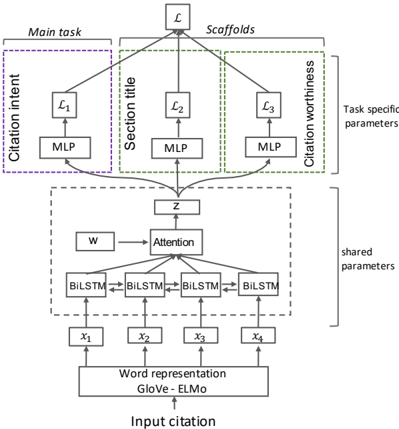
- The model is a multitask neural framework: a shared BiLSTM with attention encodes the citation context, using 100-dimensional GloVe and 1,024-dimensional ELMo representations; task-specific MLPs produce outputs for the main citation intent task and two auxiliary scaffold tasks.
- The two scaffolds are citation worthiness (whether a sentence needs a citation) and section title prediction (normalized to introduction, related work, method, experiments, conclusion); training uses a weighted joint loss, AdaDelta, gradient clipping at 5.0, and early stopping.
- Data include ACL-ARC (1,941 instances, 186 papers, six intent categories) and SciCite (11,020 instances, 6,627 papers, three categories), with SciCite crowdsourced via Figure Eight and a separate expert-annotated test set of 1,861 instances; scaffold data sizes are about 47K/50K for ACL-ARC and 91K/73K for SciCite.
Limitations
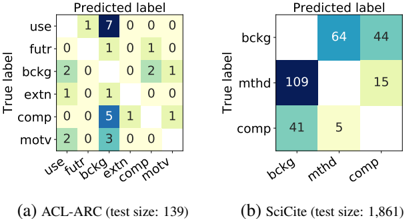
- The paper states that errors occur on rare categories, e.g., FUTUREWORK has the fewest data points and is hardest to classify, and some errors may require additional context; an attempt to encode extended surrounding context with a BiLSTM concatenated to the citation vector caused a large decline in overall performance.
- The paper states future work includes replacing ELMo with other contextualized representations such as BERT.
- Evident from the text: evaluation is limited to ACL-ARC (NLP) and SciCite (computer science and medicine); SciCite annotations are crowdsourced with quality controls, and only a 100-sample subset was re-annotated by an expert, with 86% agreement.
Model-written summary. Check it against the paper before relying on it.
Integrity signals
Registry
Cites
Statistics
Figures
Verification
Claims the paper makes
16 Valid · 7 Not valid · 3 Not checked · 64 Own results and interpretations
At least one cited source doesn’t support this claim or points to a different paper, and none confirmed it — see the verdicts below.
In the paper
“previous state-of-the-art results of Jurgens et al. (2018) 54.6”
What the sources say
- Disputedcites Jurgens et al., 2018 matched to “Measuring the Evolution of a Scientific Field through Citation Frames” (2018) sourceExperimental — accuracy not yet measured
Table 7 reports a macro F1 of 0.530 for the authors’ classifier, not 0.546. The Experimental Setup describes evaluation on a combined citation-function dataset, so the paper also does not establish 54.6 as an ACL-ARC result. (LLM, conf=0.88)
Checked by a reasoning model — may be wrong.
plain- Asserted: passes — The authors put it forward as true.
- Checkable: passes — It can be checked against evidence.
- Load-bearing: passes — The paper’s conclusions depend on it.
- Based: passes — The paper gives a reason why it holds.
- Disputed
The cited sources support only part of this claim — read each source’s verdict below.
In the paper
“Our model achieves a new state-ofthe-art on an existing ACL anthology dataset (ACL-ARC) with a 13.3% absolute increase in F1 score, without relying on external linguistic resources or hand-engineered features as done in existing methods.”
- Also stated in: § 1 Introduction · plain
“we achieve a new state-of-the-art of 67.9% F1 on the ACLARC citations benchmark, an absolute 13.3% increase over the previous state-of-the-art (Jurgens et al., 2018)”
- Also stated in: § 4.3 Results · plain
“The best result is achieved when we also add ELMovectors (Peters et al., 2018) to the input representations in 'BiLSTM-Attn w/ ELMo + both scaffolds', achieving an F1 of 67.9, a major improvement from the previous state-of-the-art results of Jurgens et al. (2018) 54.6 ( ∆=13 . 3 ).”
What the sources say
- Partly supportedcites Jurgens et al., 2018 matched to “Measuring the Evolution of a Scientific Field through Citation Frames” (2018) sourceExperimental — accuracy not yet measured
Section 3.3 (page unavailable) says the paper’s methods outperformed the closest state of the art, supporting the general performance claim. It does not report a 13.3-percentage-point absolute F1 increase in the passages found; Section 3.2 describes evaluation on a combined citation-function dataset rather than establishing that figure for ACL-ARC. (LLM, conf=0.85)
plainstates a cause- Asserted: passes — The authors put it forward as true.
- Checkable: passes — It can be checked against evidence.
- Load-bearing: passes — The paper’s conclusions depend on it.
- Based: passes — The paper gives a reason why it holds.
- Also stated in: § 1 Introduction · plain
Every source the paper cites for this claim was checked and supports it.
In the paper
“Our implementation of this model achieves a macro-averaged F1 score of 0.526 using 10-fold cross-validation”
What the sources say
- Supportedcites Jurgens et al., 2018 matched to “Measuring the Evolution of a Scientific Field through Citation Frames” (2018) source
The citation identifies the model being implemented: Section 3.2 describes Jurgens et al.’s classifier and its evaluation using macro-averaged F1. The 0.526 score and 10-fold cross-validation are stated as results of the citing authors’ own implementation, not attributed to Jurgens et al. (LLM, conf=0.91)
plain- Asserted: passes — The authors put it forward as true.
- Checkable: passes — It can be checked against evidence.
- Load-bearing: passes — The paper’s conclusions depend on it.
- Based: passes — The paper gives a reason why it holds.
- Supported
Every source the paper cites for this claim was checked and supports it.
In the paper
“followed by Jurgens et al. (2018)”
What the sources say
- Supportedcites Jurgens et al., 2018 matched to “Measuring the Evolution of a Scientific Field through Citation Frames” (2018) source
The citation identifies the Jurgens et al. system used as a comparison baseline. Section 3.2 describes their citation-function classifier; the 'second best' ranking on SciCite is the citing paper's own comparison, not a result attributed to Jurgens et al. (LLM, conf=0.84)
plain- Asserted: passes — The authors put it forward as true.
- Checkable: passes — It can be checked against evidence.
- Load-bearing: unclear — It is unclear whether the paper’s conclusions depend on it.
- Based: passes — The paper gives a reason why it holds.
- Rests on an assumption not shown here.
- Supported
Every source the paper cites for this claim was checked and supports it.
In the paper
“We note that these results were obtained without using hand-curated features or additional linguistic resources as used in Jurgens et al. (2018).”
What the sources say
- Supportedcites Jurgens et al., 2018 matched to “Measuring the Evolution of a Scientific Field through Citation Frames” (2018) source
Section 3.1 (page not supplied) says Jurgens et al. added 132 patterns and 13 lexical categories based on manual analysis, supporting the reference to hand-curated features. Section 3.2 (page not supplied) says they used CoreNLP for syntactic processing and pretrained GloVe vectors, supporting the reference to additional linguistic resources. The citing authors’ statement about how they obtained their own results is not attributed to Jurgens et al. (LLM, conf=0.93)
plain- Asserted: passes — The authors put it forward as true.
- Checkable: passes — It can be checked against evidence.
- Load-bearing: passes — The paper’s conclusions depend on it.
- Based: passes — The paper gives a reason why it holds.
- Supported
39 more claims
Create a free account to see all 90 claims and every source verdict.
- Probably not a substantial claim. 38
- It may state two separate claims as one. 14
- The quote only partly states this claim. 2
Claims other papers make about this one
Each is checked against this paper’s own text: does it say what the citing paper says it does?
The source backs part of the claim, not all of it — or backs it for a different population, condition or comparison.
In the citing paper
“section titles have frequently been used as auxiliary or additional features within multitask learning frameworks for CIC (Cohan et al., 2019; Qi et al., 2023; Zhang et al., 2022)”
From CiteFusion: an ensemble framework for citation intent classification harnessing dual-model binary couples and SHAP analyses (2025) · cites this paper as Cohan et al., 2019
Experimental — accuracy not yet measuredThe source backs part of the claim, not all of it — or backs it for a different population, condition or comparison.
In the citing paper
“In addition, SCIBERT outperforms the SOTA on SciCite (Co-han et al., 2019).”
From SciBERT: A Pretrained Language Model for Scientific Text (2019) · cites this paper as Cohan et al., 2019
Experimental — accuracy not yet measuredThe cited source says what the claim attributes to it.
In the citing paper
“Incorporating auxiliary scaffold tasks via multitask learning has been studied before for improving span-labeling and text classification (Swayamdipta et al., 2018b; Cohan et al., 2019).”
From TLDR: Extreme Summarization of Scientific Documents (2020) · cites this paper as Cohan et al., 2019
The check wasn’t confident either way, so it gives no verdict — never disputed.
In the citing paper
“SciBERT (Beltagy et al., 2019), pretrained on scientific corpora and equipped with a specialized scientific vocabulary – SciVOCAB –, consistently outperforms general-pur- pose models in processing academic texts (Cohan et al., 2019).”
From CiteFusion: an ensemble framework for citation intent classification harnessing dual-model binary couples and SHAP analyses (2025) · cites this paper as Cohan et al., 2019
Experimental — accuracy not yet measuredIn the citing paper
“In addition, SCIBERT achieves new SOTA results on ACL-ARC (Cohan et al., 2019), and the NER part of SciERC (Luan et al., 2018).”
From SciBERT: A Pretrained Language Model for Scientific Text (2019) · cites this paper as Cohan et al., 2019
1 more claim about this paper
Create a free account to see every claim other papers make about this one.
Self-check
Percentages, sums and reported differences re-computed from the paper’s own numbers.
Each contradiction between two passages listed here was confirmed by an independent check.
Rated minor: it would not touch a result — a value no result rests on, a p-value that stays on the same side of the significance level, or a conflict that is clerical, resolved elsewhere in the paper, or outside its own findings.
In the paper
§ 4.3 Results
“| Previous SOTA (Jurgens et al., 2018) | 79.6 |”
§ 4.4 Analysis
“| Previous SOTA (Jurgens et al., 2018) | 77.9 | 92.9 | 84.7 | 91.5 | 63.1 | 74.7 | 79.1 | 77.3 | 78.2 | 82.8 | 77.8 | 79.2 |”
Rated minor: it would not touch a result — a value no result rests on, a p-value that stays on the same side of the significance level, or a conflict that is clerical, resolved elsewhere in the paper, or outside its own findings.
In the paper
“Citation contexts were annotated by 850 crowdsource workers who made a total of 29,926 annotations and individually made between 4 and 240 annotations. Each sentence was annotated, on average, 3.74 times. This resulted in a total 9,159 crowdsourced instances”
Reported 3.74 · recomputed 3.267387
Citations
Cites
Hochreiter, S., & Schmidhuber, J. (1997) · Neural Computation · doi:10.1162/neco.1997.9.8.1735 · Cited by 102,318 · cited 2×
“…(GloVe, Pennington et al., 2014) and contextualized embeddings (ELMo, Peters et al., 2018), i.e.: We then use a bidirectional long short-term memory (Hochreiter and Schmidhuber, 1997) (BiL-STM) network with hidden size of d 2 to obtain a contextual representation of each token vector with respect…”
MethodBERT: Pre-training of Deep Bidirectional Transformers for Language Understanding
Devlin, J., Chang, M.-W., Lee, K., & Toutanova, K. (2018) · arXiv · doi:10.48550/arxiv.1810.04805 · Cited by 73,173
BERT: Pre-training of Deep Bidirectional Transformers for Language Understanding
Devlin, J., Chang, M.-W., Lee, K., & Toutanova, K. (2019) · Proceedings of the 2019 Conference of the North American Chapter of the Association for Computational Linguistics: Human Language Technologies, Volume 1 (Long and Short Papers) · doi:10.18653/v1/n19-1423 · Cited by 54,325 · cited 1×
“For example, at the time of finalizing the camera ready version of this paper, Beltagy et al. (2019) showed that a BERT contextualized representation model (Devlin et al., 2018) trained on scientific text can achieve promising results on the SciCite dataset.”
BackgroundGlove: Global Vectors for Word Representation
Pennington, J., Socher, R., & Manning, C. (2014) · Proceedings of the 2014 Conference on Empirical Methods in Natural Language Processing (EMNLP) · doi:10.3115/v1/d14-1162 · Cited by 34,071
(2014) · Cited by 33,419
(2010) · International Conference on Machine Learning · Cited by 13,995
Deep Contextualized Word Representations
Peters, M., Neumann, M., Iyyer, M., Gardner, M., Clark, C., Lee, K., & Zettlemoyer, L. (2018) · Proceedings of the 2018 Conference of the North American Chapter of the Association for Computational Linguistics: Human Language Technologies, Volume 1 (Long Papers) · doi:10.18653/v1/n18-1202 · Cited by 11,983 · cited 4×
“We experiment with two variants of this model: with and without using the contex-tualized word vector representations (ELMo) of Peters et al. (2018).”
BackgroundMethodInfluentialCaruana, R. (1997) · Machine Learning · doi:10.1023/a:1007379606734 · Cited by 6,636 · cited 2×
“Multitask learning as defined by Caruana (1997) is an approach to inductive transfer learning that improves generalization by using the domain information contained in the training signals of related tasks as an inductive bias.”
MethodADADELTA: An Adaptive Learning Rate Method
Zeiler, M. D. (2012) · arXiv · doi:10.48550/arxiv.1212.5701 · Cited by 5,322 · cited 1×
“We compute the gradient of the loss for each mini-batch and tune model parameters using the AdaDelta optimizer (Zeiler, 2012) with gradient clipping threshold of 5.0.”
MethodInfluentialAllenNLP: A Deep Semantic Natural Language Processing Platform
Gardner, M., Grus, J., Neumann, M., Tafjord, O., Dasigi, P., Liu, N. F., Peters, M., Schmitz, M., & Zettlemoyer, L. (2018) · Proceedings of Workshop for NLP Open Source Software (NLP-OSS) · doi:10.18653/v1/w18-2501 · Cited by 1,252 · cited 1×
“We implement our proposed scaffold framework using the AllenNLP library (Gardner et al., 2018).”
Method
Cited by
Items 101–200 of 205
CORWA: A Citation-Oriented Related Work Annotation Dataset
Li, X., Mandal, B., & Ouyang, J. (2022) · Conference of the North American Chapter of the Association for Computational Linguistics: Human Language Technologies (NAACL-HLT) · doi:10.18653/v1/2022.naacl-main.397 · Cited by 30
Neural machine translation for in‐text citation classification
Safder, I., Ali, M., Aljohani, N. R., Nawaz, R., & Hassan, S. (2023) · Journal of the Association for Information Science and Technology · doi:10.1002/asi.24817 · Cited by 10
“Finney (1979) proposed a classification scheme based on citation location in the document and cue verbs around it.”
BackgroundInfluentialS2ORC: The Semantic Scholar Open Research CorpusPreprint
Lo, K., Wang, L. L., Neumann, M., Kinney, R., & Weld, D. S. (2019) · arXiv (Cornell University) · doi:10.48550/arxiv.1911.02782 · Cited by 155
“…2015; Yu et al., 2012), in-line citation recommendation (Jeong et al., 2019; Huang et al., 2015; He et al., 2010), categorizing citation intent (Cohan et al., 2019; Teufel et al., 2006), paper summarization (Cohan and Goharian, 2015; Mitrovic and M¨uller, 2015; Qazvinian and Radev, 2008;…”
BackgroundSciND: a new triplet-based dataset for scientific novelty detection via knowledge graphs
Gupta, K., Ahmad, A., Ghosal, T., & Ekbal, A. (2024) · International Journal on Digital Libraries · doi:10.1007/s00799-023-00386-x · Cited by 8
Heterogeneous hypergraph learning for literature retrieval based on citation intents
Shi, K., Liu, K., & He, X. (2024) · Scientometrics · doi:10.1007/s11192-024-05066-4 · Cited by 6
“A context-based dataset SciCite (Cohan et al., 2019) is used to fine-tune SciBERT for constructing citation intent graph.”
LLMs in Citation Intent Classification: Progress, Precision, and Reproducibility Challenges
Fogelson, A., Trišović, A., & Thompson, N. (2025) · ACM Conference on Reproducibility and Replicability (ACM REP) · doi:10.1145/3736731.3746137 · Cited by 9
“The emergence of deep neural networks, along with larger annotated datasets [4, 6, 11], enabled more robust learning but still suffered from limitations, including spurious keyphrase correlations and contextual noise.”
Long, K., Li, S., Wang, P., Tang, J., & Wang, T. (2022) · International Joint Conference on Neural Networks (IJCNN) · doi:10.1109/ijcnn55064.2022.9892003 · Cited by 7
“representations of words in text, embeddings of Glove and ELMo are concatenated as the output [20], i.”
BackgroundMethodUsman, M., & Balke, W. (2023) · Lecture notes in computer science · doi:10.1007/978-3-031-43849-3_11 · Cited by 5
“More than 150 types of citation intention classes exist in the literature [8], and several studies have investigated citation intentions, e.g., [6,7].”
BackgroundIqbal, A., Shahid, A., Roman, M., Afzal, M. T., & Yahya, M. (2023) · IEEE Access · doi:10.1109/access.2023.3320038 · Cited by 12
“The Second dataset used in this study is SciCite, which was created by Cohen et al. [46].”
MethodInfluentialCiteBench: A Benchmark for Scientific Citation Text Generation
Funkquist, M., Kuznetsov, I., Hou, Y., & Gurevych, I. (2023) · Conference on Empirical Methods in Natural Language Processing (EMNLP) · doi:10.18653/v1/2023.emnlp-main.455 · Cited by 34
Scientific Software Citation Intent Classification Using Large Language Models
Istrate, A.-M., Fisher, J., Yang, X., Moraw, K., Li, K., Li, D., & Klein, M. (2024) · Lecture notes in computer science · doi:10.1007/978-3-031-65794-8_6 · Cited by 10
A Survey of Citation Recommendation Tasks and Methods
Medić, Z., & Šnajder, J. (2021) · Journal of Computing and Information Technology · doi:10.20532/cit.2020.1005160 · Cited by 12
Tell Me How to Survey: Literature Review Made Simple with Automatic Reading Path Generation
Ding, J., Xiang, T., Ou, Z., Zuo, W., Zhao, R., Lin, C., Zheng, Y., & Liu, B. (2022) · IEEE International Conference on Data Engineering (ICDE) · doi:10.1109/icde53745.2022.00322 · Cited by 10
Contextualised Modelling for Effective Citation Function Classification
Jiang, X., Cai, C., Fan, W., Liu, T., & Chen, J. (2022) · International Conference on Natural Language Processing and Information Retrieval (NLPIR) · doi:10.1145/3582768.3582769 · Cited by 6
“This performance can be deemed strong compared to the two SOTAs, 67.9% in [12] and 70.98% in [11] on the 6-class original Jur-gens2018 dataset.”
MethodResultInfluentialS2abEL: A Dataset for Entity Linking from Scientific Tables
Lou, Y., Kuehl, B., Bransom, E., Feldman, S., Naik, A., & Downey, D. (2023) · Conference on Empirical Methods in Natural Language Processing (EMNLP) · doi:10.18653/v1/2023.emnlp-main.186 · Cited by 16
Structured Semantic Modeling of Scientific Citation Intents
Ferrod, R., Di, L., & Schifanella, C. (2021) · Lecture notes in computer science · doi:10.1007/978-3-030-77385-4_27 · Cited by 4
“This process was based on different techniques: for classes such as use and extend we made use of the classifier provided in [6], while for others (analyze and propose) we employed a keyword-based random search.”
BackgroundMethodInfluentialA Multi-task based Bilateral-Branch Network for Imbalanced Citation Intent Classification
Hu, T., Li, J., Fukumoto, F., & Zhou, R. (2022) · International Conference on Ubiquitous Information Management and Communication (IMCOM) · doi:10.1109/imcom53663.2022.9721746 · Cited by 4
Why Did You Not Compare with That? Identifying Papers for Use as Baselines
Bedi, M., Pandey, T., Bhatia, S., & Chakraborty, T. (2022) · Lecture notes in computer science · doi:10.1007/978-3-030-99736-6_4 · Cited by 9
“[7], which is a baseline for the current work, already claimed to achieve better performance than this classifier.”
BackgroundMethodInfluentialDid AI get more negative recently?
Beese, D., Altunbaş, B., Güzeler, G., & Eger, S. (2023) · Royal Society Open Science · doi:10.1098/rsos.221159 · Cited by 11
“A number of more recent papers also leverage or study individual citation context, including Cohan et al. (2019); Jebari et al. (2021); Wright and Au-genstein (2021); Lauscher et al. (2022).”
BackgroundLet’s learn step by step: Enhancing in-context learning ability with curriculum learning
Liu, Y., Liu, J., Shi, X., Cheng, Q., Huang, Y., & Lu, W. (2024) · arXiv · doi:10.48550/arxiv.2402.10738 · Cited by 4
“We also notice that LocalE and MDL are competitive on SciCite.”
MethodLi, T., Wang, J., Zhang, Y., Li, S., & Chen, L. (2025) · ACM SIGKDD Conference on Knowledge Discovery and Data Mining (KDD) · doi:10.1145/3711896.3736829 · Cited by 8
“For decoder-based LLMs, we experiment with the instruction-tuned Llama3-8B since it is one of the leading open-source LLMs among models of similar size.”
InfluentialInline Citation Classification Using Peripheral Context and Time-Evolving Augmentation
Gupta, P., Atri, Y. K., Nagvenkar, A. S., Dasgupta, S., & Chakraborty, T. (2023) · Lecture notes in computer science · doi:10.1007/978-3-031-33383-5_1 · Cited by 7
Multi-Agent Transformer Networks With Graph Attention
Jin, W., & Lee, H. (2024) · IEEE Access · doi:10.1109/access.2024.3447056 · Cited by 3
“Examples include attention mechanisms that account for dependency relationships or syntactic information in natural language processing and those tailored for molecular structures [32], [33], [34].”
BackgroundReader-aware Writing Assistance through Reader Profiles
Li, G., Vachtsevanou, D., Lemée, J., Mayer, S., & Strecker, J. (2024) · ACM Conference on Hypertext and Social Media (HT) · doi:10.1145/3648188.3675152 · Cited by 7
“Citations thereby could serve to map the landscape of various research domains, providing insights into how different areas of study are interlinked, and containing information about the frontiers of individual domains [9].”
BackgroundSciWING– A Software Toolkit for Scientific Document Processing
Kashyap, A. R., & Kan, M. (2020) · Workshop on Scholarly Document Processing (SDP) · doi:10.18653/v1/2020.sdp-1.13 · Cited by 6
“(Cohan et al., 2019) use Bi-LSTM with attention At the time of writing, SciWING does not include attention models, and as such results are not strictly comparable.”
BackgroundSystematic Design and Evaluation of a Citation Function Classification Scheme in Indonesian Journals
Yaniasih, Y., & Budi, I. D. (2021) · Publications · doi:10.3390/publications9030027 · Cited by 6
“16 comparison [6,14,23] 134,127 sentences from 20,000 article about natural language processing; [29] 395 articles (science field and indexing information are not available) 17 comparison or contrast [9]”
BackgroundMethodResultInfluentialAsubiaro, T., & Ajiferuke, I. (2022) · Scientometrics · doi:10.1007/s11192-022-04522-3 · Cited by 4
“…methodology, conclusion) (An et al., 2017; Ding et al., 2013; Maričić et al., 1998; Pride & Knoth, 2017; Voos & Dagaev, 1976), citation function (Cohan et al., 2019; HernáNdez-Alvarez & Gomez, 2016; Li et al., 2013; McKeown et al., 2016; et al., 2017; Stremersch et al., 2015; Teufel et al.,…”
Identifying Influential Citations in Scientific Papers
James, M., Palakkat, V., & Jones, G. J. F. (2023) · Irish Conference on Artificial Intelligence and Cognitive Science (AICS) · doi:10.1109/aics60730.2023.10470500 · Cited by 5
“However, Cohan et al. [2] point out that citation intent categories can conflict with each other since citations can belong to multiple categories.”
BackgroundLinguistic perspectives in deciphering citation function classification
Bertin, M., & Atanassova, I. (2024) · Scientometrics · doi:10.1007/s11192-024-05082-4 · Cited by 3
“…Li et al. 2013; Abu-Jbara et al. 2013; Hernandez-Alvarez et al. 2017; Jurgens et al. 2018; Su et al. 2019; Lauscher et al. 2021) biomedicine (Agarwal et al. 2010; Cohan et al. 2019; Kunnath et al. 2020, 2021), computer science (Cohan et al. 2019; Kunnath et al. 2020, 2021) and machine learning.”
Low-resource multi-granularity academic function recognition based on multiple prompt knowledge
Liu, J., Xiong, Z., Jiang, Y., Ma, Y., Lu, W., Huang, Y., & Cheng, Q. (2024) · The Electronic Library · doi:10.1108/el-01-2024-0022 · Cited by 4
“We carry out our experiment on a citation function recognition dataset, the SciCite [7], which is more than five times larger and covers multiple scientific domains compared with the ACL-ARC [29] dataset.”
BackgroundMethodInfluentialGiosa, D., & Di, L. (2020) · Lecture notes in computer science · doi:10.1007/978-3-030-61244-3_10 · Cited by 3
“, [17, 12, 5]), (ii) data analysis and extraction of relevant information (e.”
BackgroundBag of Tricks for Citation Intent Classification via SciBERT
Motrichenko, D., Nedumov, Y., & Skorniakov, K. (2021) · Ivannikov ISPRAS Open Conference (ISPRAS) · doi:10.1109/ispras53967.2021.00022 · Cited by 3
Multitask Learning for Citation Purpose ClassificationPreprint
Oesterling, A., Ghosal, A., Yu, H., Xin, R., Baig, Y., Semenova, L., & Rudin, C. D. (2021) · arXiv (Cornell University) · doi:10.48550/arxiv.2106.13275 · Cited by 11
“Our third-place model consists of solely the LSTM-with-attention developed by (Cohan et al., 2019) using the competition dataset padded by the supplemental ACL-ARC dataset (Bird et al., 2008).”
BackgroundMethodInfluentialSciRIFF: A Resource to Enhance Language Model Instruction-Following over Scientific Literature
Wadden, D., Shi, K., Morrison, J., Li, A., Naik, A., Singh, S., Barzilay, N., Lo, K., Hope, T., Soldaini, L., et al. (2025) · Proceedings of the 2025 Conference on Empirical Methods in Natural Language Processing · doi:10.18653/v1/2025.emnlp-main.310 · Cited by 3
Self-citationMeasuring how computer science research translates into innovation and development
Cinus, F., Septiandri, A. A., Constantinides, M., & Quercia, D. (2025) · EPJ Data Science · doi:10.1140/epjds/s13688-025-00568-4 · Cited by 3
Wang, Q., Li, H., Ma, M., & Li, Z. (2025) · Scientometrics · doi:10.1007/s11192-025-05382-3 · Cited by 4
Deepening citation understanding in scientific literature via LLM-powered context extraction
Nguyen, T. H., Pruski, C., & Silveira, M. D. (2026) · Scientometrics · doi:10.1007/s11192-026-05637-7 · Cited by 5
“Although fixed-size windows around citation markers are straightforward to implement, they often suffer from two opposing limitations: they may omit relevant contextual information or include unrelated content from adjacent citations (Cohan et al., 2019).”
Leveraging MRC Framework for Research Contribution Patterns Identification in Citation Sentences
Zhao, Y., Zhang, Z., & Xiao, Y. (2023) · Lecture notes in computer science · doi:10.1007/978-981-99-8088-8_16 · Cited by 2
Intermediate-Task Transfer Learning for Peer Review Score Prediction
Muangkammuen, P., Fukumoto, F., Li, J., & Suzuki, Y. (2023) · doi:10.18653/v1/2023.ijcnlp-srw.6 · Cited by 7
“Unsupervised pre-training S CI B ERT (Beltagy et al., 2019) was utilized on various downstream scientific NLP tasks, including biomedical domain (Li et al., 2016; Nye et al., 2018), computer science domain (Luan et al., 2018; Jurgens et al., 2018), and multiple domains (Cohan et al., 2019).”
MethodTransfer learning meets sales engagement email classification: Evaluation, analysis, and strategies
Liu, Y., Dmitriev, P., Huang, Y., Brooks, A., Li, D., Liang, M., Boshernitzan, Z., Cao, J., & Nguy, B. (2020) · Concurrency and Computation Practice and Experience · doi:10.1002/cpe.5759 · Cited by 1
Applying artificial intelligence in the science & technology cycle
Weber, R. O. (2019) · Information Services & Use · doi:10.3233/isu-190062 · Cited by 8
Evaluating Scholarly Impact: Towards Content-Aware Bibliometrics
Manchanda, S., & Karypis, G. (2021) · Conference on Empirical Methods in Natural Language Processing (EMNLP) · doi:10.18653/v1/2021.emnlp-main.488 · Cited by 3
“SciCite: SciCite (Cohan et al., 2019) is a dataset of citation intents based on a sample of papers from the Semantic Scholar corpus 13 , consisting of papers in general computer science and medicine domains.”
BackgroundMethodInfluentialCitation Worthiness Identification for Fine-Grained Citation Recommendation Systems
Roostaee, M. (2022) · Iranian Journal of Science and Technology Transactions of Electrical Engineering · doi:10.1007/s40998-021-00472-3 · Cited by 4
“…extraction (Jebari et al. 2018; Qayyum and Afzal 2019; Roman et al. 2021), reference span identifi-cation (Moraes et al. 2018), Citation intent recognition (Cohan et al. 2019), Citation polarity detection (Ghosh et al. 2016), and Citation importance identification (Chakraborty and Narayanam 2016).”
BackgroundSDCF: semi-automatically structured dataset of citation functions
Basuki, S., & Tsuchiya, M. (2022) · Scientometrics · doi:10.1007/s11192-022-04471-x · Cited by 6
“This research applied BERT, depending on the three labels proposed by Sci-Cite (Cohan et al., 2019).”
MethodCrossFit: A Few-shot Learning Challenge for Cross-task Generalization in NLPPreprint
Ye, Q., Lin, B. Y., & Ren, X. (2021) · arXiv (Cornell University) · doi:10.48550/arxiv.2104.08835 · Cited by 2
“…comprehension Lin et al. 2019 rotten_tomatoes cls/sentiment analysis Pang and Lee 2005 samsum cg/summarization Gliwa et al. 2019 scicite cls/other Cohan et al. 2019 sciq qa/multiple-choice qa Welbl et al. 2017 scitail cls/nli Khot et al. 2018 search_qa qa/closed-book qa Dunn et al. 2017 sick…”
BackgroundTowards Generating Citation Sentences for Multiple References with Intent ControlPreprint
Wu, J.-Y., Shieh, A. T.-W., Hsu, S.-J., & Chen, Y.-N. (2021) · arXiv (Cornell University) · doi:10.48550/arxiv.2112.01332 · Cited by 12
“Previous work demonstrated that citations can be classified into several intentions, such as background information, method or result comparison Cohan et al. (2019).”
InfluentialAbstention vs. Hallucination: Benchmarking LLM Source Attribution for Scientific Citations
Tilwani, D., Saxena, Y., Mohammadi, S., Padia, A., Raff, E., Sheth, A., Parthasarathy, S., & Gaur, M. (2024) · arXiv · doi:10.48550/arxiv.2405.02228 · Cited by 2
“Similarly, citation-intent datasets and large scholarly corpora [20, 21] support citation analysis, scholarly document understanding, and modeling of citation relationships.”
Long, D. (2025) · Journal of Electronic Resources in Medical Libraries · doi:10.1080/15424065.2025.2496616 · Cited by 6
“Cohan et al. (2019) categorize citation intentions into three distinct types: foundational information, methods used, and comparison of results.”
Three-way decisions with text data and its application in market regulation
Li, T., Qiao, J., & Chao, G. (2025) · Information Processing & Management · doi:10.1016/j.ipm.2025.104307 · Cited by 1
A Large-Scale Dataset and Citation Intent Classification in Turkish with LLMs
Karaca, K. S., & Eravcı, B. (2025) · International Conference on Computer Science and Engineering (UBMK) · doi:10.1109/ubmk67458.2025.11207038 · Cited by 4
“It divides citations into three primary classes: BACKGROUND (providing theoretical or contextual information), METHOD (referencing the methods or techniques used), and RESULT COMPARISON (comparing experimental results) [3] which was also adopted by the GRaSPoS project.”
InfluentialSurvey on information requirements on the Google Books Ngram Corpus
Richter, F., Matteucci, F., Reimann, P., & Böhm, K. (2025) · International Journal of Digital Humanities · doi:10.1007/s42803-025-00113-9 · Cited by 1
“A broader survey may be possible in the future, e.g., by using citation intent classification (Cohan et al., 2019) instead of a pure keyword selection.”
Leveraging LLM-based agents for social science research: insights from citation network simulations
Ji, J., Lei, R., Pan, X., Wei, Z., Sun, H., Lin, Y., Chen, X., Yang, Y., Li, Y., Ding, B., et al. (2026) · Humanities and Social Sciences Communications · doi:10.1057/s41599-025-06193-w · Cited by 10
“We de fi ne the independent variable as the SciCite taxonomy categories (Cohan et al. 2019): providing background information (B-I), describing methods (F-M), comparing results (R-C) , and the dependent variable as the selected motivation and its importance.”
CC30k: A Citation Contexts Dataset for Reproducibility-Oriented Sentiment Analysis
Obadage, R. R., Rajtmajer, S. M., & Wu, J. (2025) · ACM/IEEE Joint Conference on Digital Libraries · doi:10.1109/jcdl67857.2025.00013 · Cited by 2
“Citation context datasets such as the ACL-ARC subset [18], SciCite [19], and the Critical Citation Contexts Corpus [20] typically focus on broader citation functions (e.g., background, uses, compares or contrasts, motivation, continuation, future), citation intents (e.g., background, method,…”
Where You Cite Matters: Section-Aware Embeddings for Citation Intent Classification
Nam, S., Phan, T. A., Kim, G., Jung, J. J., & Bui, K.-H. N. (2025) · RIVF International Conference on Computing and Communication Technologies (RIVF) · doi:10.1109/rivf68649.2025.11365141 · Cited by 1
“Citation intent classification seeks to identify the functional role of citations such as providing background, introducing methods, motivating new research, or drawing comparisons [1].”
Exploring the structure of BERT through Kernel Learning
Lauriola, I., Lavelli, A., Moschitti, A., & Aiolli, F. (2021) · International Joint Conference on Neural Networks (IJCNN) · doi:10.1109/ijcnn52387.2021.9534117 · Cited by 1
“These corpora cover different domains, and they are Decop [35], Clickbait [36], Acl-imdb [37], Subjectivity [38], Website [39], and Scicite [40].”
BackgroundIdentifying and Representing Knowledge Delta in Scientific Literature
El-Ebshihy, A. (2023) · Lecture notes in computer science · doi:10.1007/978-3-031-28241-6_49 · Cited by 1
Representation Projection Invariance Mitigates Representation Collapse
Razdaibiedina, A., Khetan, A., Karnin, Z. S., Khashabi, D., & Madan, V. (2023) · Findings of the Association for Computational Linguistics: EMNLP (Findings of EMNLP) · doi:10.18653/v1/2023.findings-emnlp.975 · Cited by 14
“…(Kringelum et al., 2016), sentiment classification on YELP (Zhang et al., 2015a) and IMDB (Maas et al., 2011), citation intent classification on SCICITE (Cohan et al., 2019), language inference on SCITAIL (Khot et al., 2018) and article topic classification on AG-NEWS (Zhang et al., 2015b).”
MethodKhouya, N., Retbi, A., & Bennani, S. (2024) · International Symposium on Signal, Image, Video and Communications (ISIVC) · doi:10.1109/isivc61350.2024.10577900 · Cited by 1
“For instance, Teufel et al., as well as Jurgens et al. [4], have examined the classification of citations in academic texts, focusing on intentions such as providing context or comparing works.”
BackgroundHuettemann, S. (2025) · Lecture notes in information systems and organisation · doi:10.1007/978-3-031-80122-8_10 · Cited by 2
Citation Context Extraction Using a Transformer-Based Model with a Question-Answering Task
Khanyi, M., van Lill, M., & Dunaiski, M. (2025) · Communications in computer and information science · doi:10.1007/978-3-031-96262-2_19 · Cited by 1
Towards Finding a Research Lineage Leveraging on Identification of Significant Citations
Ghosal, T., & Singh, M. (2021) · Proceedings of the Association for Information Science and Technology · doi:10.1002/pra2.478 · Cited by 1
Utilizing Out-Domain Datasets to Enhance Multi-task Citation Analysis
Mercier, D., Rizvi, S. T. R., Rajashekar, V., Ahmed, S., & Dengel, A. R. (2022) · Lecture notes in computer science · doi:10.1007/978-3-031-10161-8_6 · Cited by 2
“The SciCite dataset proposed in [7] is a famous benchmark for citation intent classification.”
MethodInfluentialA Question-Answering System on COVID-19 Scientific Literature
Raza, S., Schwartz, B., & Ondrusek, N. K. (2022) · IEEE Annual International Computer Software and Applications Conference (COMPSAC) · doi:10.1109/compsac54236.2022.00210 · Cited by 2
Fine-tuning Pre-trained Contextual Embeddings for Citation Content Analysis in Scholarly PublicationPreprint
Chen, H., & Nguyen, H. (2020) · arXiv (Cornell University) · doi:10.48550/arxiv.2009.05836 · Cited by 1
“Pre-trained language models such as ELMo [2] and BERT [24] have been used effectively for contextualized embedding.”
MethodInfluentialLearning from Multiple Noisy Partial LabelersPreprint
Yu, P., Ding, T., & Bach, S. H. (2021) · arXiv (Cornell University) · doi:10.48550/arxiv.2106.04530 · Cited by 6
“SciCite (Cohan et al., 2019) is a citation purpose classification dataset containing 8243 train, 916 development and 1861 test instances of 3 categories sourced from scientific literatures and it is publicly available under Apache License 2.0.”
BackgroundInfluentialLearn Continually, Generalize Rapidly: Lifelong Knowledge Accumulation for Few-shot LearningPreprint
Jin, X., Lin, B. Y., Rostami, M. G., et al. (2021) · arXiv (Cornell University) · doi:10.48550/arxiv.2104.08808 · Cited by 1
Modeling text embedded information cascades
Xu, S. (2019) · Digital Repository Service (Northeastern University) · doi:10.17760/d20328884 · Cited by 1
“the semantics of sentences prior to or after current sentence reveals additional information such as cite worthiness (Cohan et al., 2019).”
BackgroundAspect-based Document Similarity for Literature Recommender Systems
Ostendorff, M. (2023) · eDiss (Georg-August-Universität Göttingen) · doi:10.53846/goediss-9937 · Cited by 1
Custom Named Construct Recognition in the Business and Management Literature
Bhattacharya, A. (2023) · Carleton University's Institutional Repository (MacOdrum Library, Carleton University) · doi:10.22215/etd/2023-15467 · Cited by 1
SciWING -- A Software Toolkit for Scientific Document ProcessingPreprint
Kashyap, A. R., & Kan, M. (2020) · arXiv (Cornell University) · doi:10.48550/arxiv.2004.03807
“(Cohan et al., 2019) use Bi-LSTM with attention At the time of writing, SciWING does not include attention models, and as such results are not strictly comparable.”
BackgroundContextual Document Similarity for Content-based Literature Recommender SystemsPreprint
Ostendorff, M. (2020) · arXiv (Cornell University) · doi:10.48550/arxiv.2008.00202 · Cited by 15
“Moreover, the availability of citation context datasets [2, 12, 33] might also allow developing a learning approach for documents that do not share any citations.”
BackgroundA descriptive analysis of cite units from the perspectives of content and linguistic expressions
Watanabe, K., Kageura, K., & Sekine, S. (2021) · Library and Information Science Research E-Journal · doi:10.32655/libres.2021.2.2
CiteVis : Visual Analysis of Overlapping Citation Intents as Dynamic Sets (Paper)
Agarwal, S., Ghosh, U., Beck, F., & Sreevalsan‐Nair, J. (2022) · doi:10.20378/irb-54949
Kuznetsov, I., & Gurevych, I. (2023) · Proceedings of the conference - Association for Computational Linguistics. Meeting · doi:10.18653/v1/2023.acl-long.633
Automating Citation Intent Classification on SciCite Dataset
Lenin, A., Chauhan, P., Mehta, T., Baliyan, N., & Sharma, D. K. (2023) · International Conference on Computer, Electronics & Electrical Engineering & their Applications (IC2E3) · doi:10.1109/ic2e357697.2023.10262812 · Cited by 1
Fan, L., Lafia, S., Wofford, M. F., Thomer, A., Yakel, E., & Hemphill, L. (2023) · ACM/IEEE Joint Conference on Digital Libraries · doi:10.1109/jcdl57899.2023.00039 · Cited by 2
“The structural properties, such as sections of papers where citations occur, support classification tasks and can be used to predict the function of a citation (e.g., providing background information or describing a method) [10].”
BackgroundLearning to Predict Task Transferability via Soft Prompt
Feng, L. (2023) · Conference on Empirical Methods in Natural Language Processing (EMNLP) · doi:10.18653/v1/2023.emnlp-main.546 · Cited by 3
Improving Peer-Review Score Prediction via Pretrained Model with Intermediate-Task Training
Muangkammuen, P., Fukumoto, F., Li, J., & Suzuki, Y. (2024) · International Conference on Ubiquitous Information Management and Communication (IMCOM) · doi:10.1109/imcom60618.2024.10418356
“Through the utilization of unsupervised pretraining on an extensive scientific corpus, it enhances performance on subsequent scientific NLP tasks downstream [16]–[20].”
BackgroundMulti-sentence and multi-intent classification using RoBERTa and graph convolutional neural networkPreprint
Ravi, K., Singh, A. V., & Gautam, C. (2024) · Research Square · doi:10.21203/rs.3.rs-3960194/v1
The Impact of CHIIR Publications: A Study of Eight Years of CHIIR
Gäde, M., Bogers, T., Hall, M. M., Koolen, M., Petras, V., & Larsen, B. (2024) · Conference on Human Information Interaction and Retrieval · doi:10.1145/3627508.3638338 · Cited by 2
Enhancing Academic Title Generation Using SciBERT and Linguistic Rules
Callegari, E., Vajdečka, P., Xhura, D., & Ingason, A. K. (2023) · Workshop on Information Extraction from Scientific Publications (WIESP) · doi:10.18653/v1/2023.wiesp-1.10 · Cited by 1
“We decided to use SciB-ERT as it outperforms BERT in a variety of tasks in the scientific domain (Beltagy et al., 2019) and achieves SOTA performance in multi-class text classification on the SciCite dataset (Cohan et al., 2019).”
MethodCitation Worthiness Assessment using Deep Learning Techniques
Manjusha, R., Logkesh, M., Ashwath, V. A., et al. (2024) · IEEE International Conference on Electronics, Computing and Communication Technologies (CONECCT) · doi:10.1109/conecct62155.2024.10677154
“By harnessing the power of linguistic features and machine learning algorithms, researchers have endeavored to develop sophisticated approaches aimed at streamlining this intricate process [1] [2].”
Background-, D. B., -, K. S., -, A. B., & -, S. M. A. H. (2024) · International Journal For Multidisciplinary Research · doi:10.36948/ijfmr.2024.v06i06.32271
Information Literacy of University Teachers: Bibliometric Analysis with Scopus 1998 - 2023
Long, D. (2025) · Educational Academic Research · doi:10.33418/education.1549575
A Research on Citation Sentiment Classification Based on Large Language Model
孔, 明. (2025) · Computer Science and Application · doi:10.12677/csa.2025.151021
MixPro: Simple yet Effective Data Augmentation for Prompt-based Learning
Li, B., Dou, L., Hou, Y., Feng, Y., Mu, H., Wang, E., Zhu, Q., Sun, Q., & Che, W. (2025) · International Journal of Machine Learning and Cybernetics · doi:10.1007/s13042-025-02548-6 · Cited by 6
“However, they can sometimes struggle in specialized domains with scarce data, including fields like science [34], psychology [35], and medicine [36, 37].”
Chatrinan, K., Noraset, T., & Tuarob, S. (2025) · IEEE Access · doi:10.1109/access.2025.3586729 · Cited by 1
“For example, the ACL-ARC dataset [5] examines citation objectives across various sections of academic papers, while SciCite [7] broadens its scope to investigate citation purposes across diverse domains.”
Semantically Orthogonal Framework for Citation Classification: Disentangling Intent and Content
Duan, C., & Tan, Z. (2026) · Lecture Notes in Computer Science · doi:10.1007/978-3-032-05409-8_12 · Cited by 3
“Despite the progress enabled by widely used frameworks such as CiTO [52], ACL-ARC [28], SciCite [14], and ACT/ACT2 [40, 45], several structural limitations persist.”
Zhao, Y., Xiao, Y., Wang, Y., & Zhang, Z. (2026) · International Journal on Digital Libraries · doi:10.1007/s00799-025-00438-4
Fine-Tuning SciBERT for Citation Intent Classification: An Empirical Study
Firdaus, J., & Ruskanda, F. Z. (2025) · IEEE International Conference on Data and Software Engineering (ICoDSE) · doi:10.1109/icodse68111.2025.11351694
“Various datasets have been developed for this task, including SciCite [3] and MultiCite [9].”
Box-enhanced context fusion for citation intent classification
Yang, J., & Du, Z. (2026) · Neural Networks · doi:10.1016/j.neunet.2026.108962
Local citation relationship classification for recommendation: a SciBERT-based DualFocusNet approach
Lu, Y., Yuan, M., & Chen, M. (2026) · Scientometrics · doi:10.1007/s11192-026-05627-9
“Subsequently Cohan et al. (2019) exploited sentence structural properties for effective categorization.”
Liu, Y., Yang, J., Liu, G., & Huang, L. (2026) · Scientometrics · doi:10.1007/s11192-026-05658-2
“…further synthe-sizes research on semantic citation classification and highlights the importance of natural language processing pipelines and contextual features for fine-grained citation identification and its potential applications in research evaluation (Cohan et al., 2019; Kunnath et al., 2021).”
KAMU YÖNETİMİ EĞİTİMİNDE YAPAY ZEKANIN ÖNEMİ
Yıldırım, Ç. P. (2026) · Çukurova Üniversitesi Sosyal Bilimler Enstitüsü Dergisi · doi:10.35379/cusosbil.1696786
Causal Backdoor Adjustment for Citation Intent Classification
Song, Y., Wan, L., Zhang, Z., Wang, D., & Zhuang, F. (2026) · Lecture notes in computer science · doi:10.1007/978-981-92-2868-3_9
A Joint Multi-Task Learning Framework for Citation Intent and Citation Evaluation Classification
Zhao, Y., & Zhang, G. (2026) · Journal of Data and Information Science · doi:10.1515/jdis-2025-0479
CiteFuncRanker: an LLM-based pairwise ranking framework for multi-functional citation analysis
Wang, Y., Ruan, X., Lyu, D., & Cheng, Y. (2026) · Scientometrics · doi:10.1007/s11192-026-05764-1
“This study uses two widely adopted benchmark datasets for citation function analysis, ACL-ARC and SciCite (Cohan et al., 2019), focusing on their official test sets for evaluation.”
InfluentialA Framework for Verifying Citation Support Across Languages Using Multilingual Sentence Embeddings
Kubis, M., Dubec, J., Baťalík, P., et al. (2026) · doi:10.1109/iit.src67760.2026.11629011
“SciCite [14], for example, classifies citations by rhetorical role e.g., background, method, result, which is valuable for scientometric analysis but does not assess whether a cited claim is supported by the referenced source.”
In-context curriculum learning for enhanced semantic understanding in scientific text mining
Liu, Y., Liu, J., Shi, X., Huang, Y., Lu, W. P., & Cheng, Q. (2026) · Scientometrics · doi:10.1007/s11192-026-05767-y
Latent Chain-of-Thought Reasoning with Adaptive Scratchpad for Citation Intent Classification
Song, Y., Li, Y., Zhang, Z., Wang, D., & Zhuang, F. (2026) · Lecture notes in computer science · doi:10.1007/978-3-032-38410-2_32
Metadata
- Authors
- Cohan, A., Ammar, W., van Zuylen, M., & Cady, F.
- Affiliations
- Allen Institute for Artificial Intelligence (US)
- Venue
- Proceedings of the 2019 Conference of the North American Chapter of the Association for Computational Linguistics: Human Language Technologies, Volume 1 (Long and Short Papers)
- Published
- 2019
- Pages
- 3586-3596
- OpenAlex
- W2933655602
- Semantic Scholar
- 95ebe37c856e914b760bc5db63561f461ec444cc
- Cited by
- 214
- References
- 29
- Citations by year
- 2026: 19 · 2025: 26 · 2024: 26 · 2023: 47 · 2022: 38 · 2021: 35 · 2020: 16 · 2019: 7
- FWCI
- 76.88
- Type
- conference paper
- Language
- en
- Open access
- hybrid
- doi.org
- Licence
- cc-by
- Locations
- Conference of the North American Chapter of the Association for Computational Linguistics: Human Language Technologies (NAACL-HLT) (publishedVersion, cc-by)
- arXiv (Cornell University) (submittedVersion)
- arXiv (Cornell University)
- Topics
- Social Sciences › Library and Information Sciences › scientometrics and bibliometrics research
- Social Sciences › Library and Information Sciences › Academic Writing and Publishing
- Physical Sciences › Computer Science › Artificial Intelligence › Topic Modeling
- Keywords
- citation intent classification, scientific publications, structural scaffolds, citation analysis, bibliographic metadata
About these checks
Registry, retraction, Cites and statistics results are computed, not judged, with one exception: a printed reference that no index lists is read once by a model before it counts as a citation error. Claims are extracted by a model and kept only when their quote appears verbatim in the text; each cited source is then checked, with a model’s help, for whether it says what the claim relies on. Those verdicts can be wrong — read the claim’s quote and the cited source before relying on one.
The claim verdicts this report counts are experimental: their accuracy is not yet measured.
A language model drew the claims from the paper on 2026-10-02, under version 3 of the claim definition (model deepseek-v4.1-flash, prompt extract-v3).
A second model labelled each claim on 2026-10-02 (model jev-1.13-20260917, definition revision gold-guideline-v0.2).
Cited sources are checked with a language model’s help (gpt-6-sol).
Statistics and arithmetic are recomputed, not judged.
Confidence bands are shown only for fields calibrated on our annotated test set. None is calibrated yet, so no band is shown.
What counts as a claim ›How we measure confidence ›How we check this ›
Are you an author, or do you see a problem with this page? Request a review
Data sources
Bibliographic data: Semantic Scholar, OpenAlex, Crossref.
Contains information from the Semantic Scholar Academic Graph Datasets, made available under the ODC Attribution License (ODC-BY 1.0).
Semantic Scholar’s data is described in: Kinney, R., et al. (2023). The Semantic Scholar Open Data Platform. arXiv:2301.10140.
