

Naturalizing a Programming Language via Interactive Learning
Open accessThe DOI matches its Crossref record; 18 of the 18 references it cites were found in a registry or an index.
Abstract
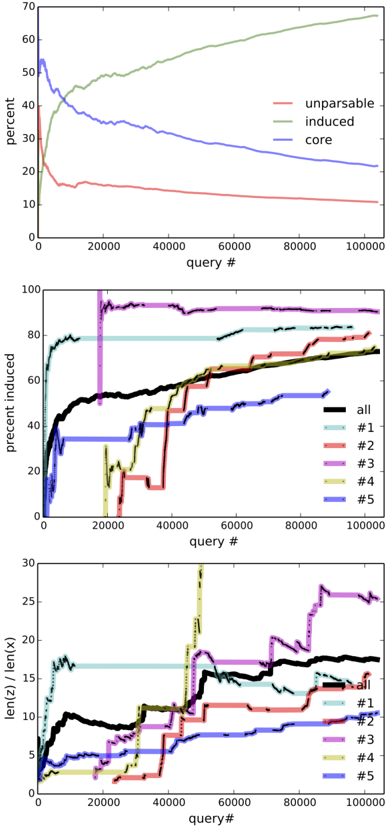
Our goal is to create a convenient natural language interface for performing wellspecified but complex actions such as analyzing data, manipulating text, and querying databases.However, existing natural language interfaces for such tasks are quite primitive compared to the power one wields with a programming language.To bridge this gap, we start with a core programming language and allow users to "naturalize" the core language incrementally by defining alternative, more natural syntax and increasingly complex concepts in terms of compositions of simpler ones.In a voxel world, we show that a community of users can simultaneously teach a common system a diverse language and use it to build hundreds of complex voxel structures.Over the course of three days, these users went from using only the core language to using the naturalized language in 85.9% of the last 10K utterances.
Overview
The claims and statistics of this paper haven’t been checked yet.
Free: it reads the open-access text and checks the first 5 claims that cite a source we can check. Create a free account to check every claim.
Integrity signals
Registry
Cites
Statistics
Figures

Verification
Claims the paper makes
The claims and statistics of this paper haven’t been checked yet.
Free: it reads the open-access text and checks the first 5 claims that cite a source we can check. Create a free account to check every claim.
Claims other papers make about this one
Each is checked against this paper’s own text: does it say what the citing paper says it does?
The source backs part of the claim, not all of it — or backs it for a different population, condition or comparison.
In the citing paper
“How users adapt to systems over time is of interest for not only HCI researchers but also NLP researchers [59,60].”
From CoAuthor: Designing a Human-AI Collaborative Writing Dataset for Exploring Language Model Capabilities (2022) · cites this paper as [59]
Experimental — accuracy not yet measured
Self-check
Percentages, sums and reported differences re-computed from the paper’s own numbers.
The self-check needs the paper’s full text.
Citations
Cites
Semantic Parsing on Freebase from Question-Answer Pairs
Berant, J., Chou, A., Frostig, R., & Liang, P. (2013) · Proceedings of the 2013 Conference on Empirical Methods in Natural Language Processing · doi:10.18653/v1/d13-1160 · Cited by 1,517
Self-citationZettlemoyer, L., & Collins, M. (2012) · arXiv (Cornell University) · doi:10.48550/arxiv.1207.1420 · Cited by 728 · cited 3×
“guage, which has been the subject of work in semantic parsing (Zettlemoyer and Collins, 2005; Artzi and Zettlemoyer, 2011, 2013; Pasupat and Liang, 2015).”
BackgroundUnderstanding Natural Language Commands for Robotic Navigation and Mobile Manipulation
Tellex, S., Kollar, T., Dickerson, S., Walter, M., Banerjee, A., Teller, S., & Roy, N. (2011) · Proceedings of the AAAI Conference on Artificial Intelligence · doi:10.1609/aaai.v25i1.7979 · Cited by 650
Learning to parse database queries using inductive logic programming
Zelle, J. M., & Mooney, R. J. (1996) · Cited by 642
Learning Dependency-Based Compositional Semantics
Liang, P., Jordan, M. I., & Klein, D. (2013) · Computational Linguistics · doi:10.1162/coli_a_00127 · Cited by 546 · cited 1×
“In this work, we use semantic parsing techniques that can handle ambiguity (Zettlemoyer and Collins, 2005, 2007; Kwiatkowski et al., 2010; Liang et al., 2011; Pasupat and Liang, 2015).”
MethodSelf-citationCompositional Semantic Parsing on Semi-Structured Tables
Pasupat, P., & Liang, P. (2015) · Proceedings of the 53rd Annual Meeting of the Association for Computational Linguistics and the 7th International Joint Conference on Natural Language Processing (Volume 1: Long Papers) · doi:10.3115/v1/p15-1142 · Cited by 514
Self-citationWeakly Supervised Learning of Semantic Parsers for Mapping Instructions to Actions
Artzi, Y., & Zettlemoyer, L. (2013) · Transactions of the Association for Computational Linguistics · doi:10.1162/tacl_a_00209 · Cited by 406
Online Learning of Relaxed CCG Grammars for Parsing to Logical Form
Zettlemoyer, L., & Collins, M. (2007) · Cited by 387
Learning Language Games through Interaction
Wang, S. I., Liang, P., & Manning, C. D. (2016) · Proceedings of the 54th Annual Meeting of the Association for Computational Linguistics (Volume 1: Long Papers) · doi:10.18653/v1/p16-1224 · Cited by 132 · cited 4×
“Compared to interactive language learning with weak denotational supervision (Wang et al., 2016), definitions are critical for learning complex ac-”
BackgroundMethodInfluentialSelf-citationBootstrapping Semantic Parsers from Conversations
Artzi, Y., & Zettlemoyer, L. (2011) · Cited by 120
Research works printed but not linked: 3
- J. Duchi, E. Hazan, and Y. Singer. 2010. Adaptive sub- gradient methods for online learning and stochastic optimization. In Conference on Learning Theory (COLT).
- N. Kushman and R. Barzilay. 2013. Using semantic unification to generate regular expressions from nat- ural language. In Human Language Technology and North American Association for Computational Lin- guistics (HLT/NAACL). pages 826-836.
- T. Kwiatkowski, L. Zettlemoyer, S. Goldwater, and M. Steedman. 2010. Inducing probabilistic CCG grammars from logical form with higher-order unifi- cation. In Empirical Methods in Natural Language Processing (EMNLP). pages 1223-1233.
Cited by
Lee, M., Liang, P., & Yang, Q. (2022) · CHI Conference on Human Factors in Computing Systems · doi:10.1145/3491102.3502030 · Cited by 345
Self-citationLearning to Speak and Act in a Fantasy Text Adventure Game
Urbanek, J., Fan, A., Karamcheti, S., Jain, S., Humeau, S., Dinan, E., Rocktäschel, T., Kiela, D., Szlam, A., & Weston, J. (2019) · Proceedings of the 2019 Conference on Empirical Methods in Natural Language Processing and the 9th International Joint Conference on Natural Language Processing (EMNLP-IJCNLP) · doi:10.18653/v1/d19-1062 · Cited by 156
“, 2016) and a more open ended building task using a grid of voxels (Wang et al., 2017).”
BackgroundMethodInfluentialLiu, M. X., Sarkar, A., Negreanu, C., Zorn, B., Williams, J., Toronto, N., & Gordon, A. D. (2023) · Proceedings of the 2023 CHI Conference on Human Factors in Computing Systems · doi:10.1145/3544548.3580817 · Cited by 119
Training Classifiers with Natural Language Explanations
Hancock, B., Varma, P., Wang, S., Bringmann, M., Liang, P., & Ré, C. (2018) · Proceedings of the 56th Annual Meeting of the Association for Computational Linguistics (Volume 1: Long Papers) · doi:10.18653/v1/p18-1175 · Cited by 109
“Wang et al. (2017) convert natural language definitions to rules in a semantic parser to build up progressively higher-level concepts.”
BackgroundSelf-citationCollaborative Dialogue in Minecraft
Narayan-Chen, A., Jayannavar, P., & Hockenmaier, J. (2019) · Annual Meeting of the Association for Computational Linguistics · doi:10.18653/v1/p19-1537 · Cited by 141
“Wang et al. (2017) let users define 3D voxel structures via a highly programmatic natural language.”
BackgroundCoDraw: Collaborative Drawing as a Testbed for Grounded Goal-driven Communication
Kim, J.-H., Kitaev, N., Chen, X., Rohrbach, M., Zhang, B.-T., Tian, Y., Batra, D., & Parikh, D. (2019) · Proceedings of the 57th Annual Meeting of the Association for Computational Linguistics · doi:10.18653/v1/p19-1651 · Cited by 53
“Learning language games in a grounded environment has been studied recently (Wang et al., 2016, 2017).”
BackgroundRuoff, M., Myers, B. A., & Maedche, A. (2023) · CHI Conference on Human Factors in Computing Systems · doi:10.1145/3544548.3580964 · Cited by 59
“Most NLIs with learning capabilities, however, do not provide insights into existing declarative (i.e., concepts) and procedural (i.e., actions) knowledge during the demonstration process (e.g., [5, 16, 21, 43]).”
BackgroundExpBERT: Representation Engineering with Natural Language Explanations
Murty, S., Koh, P. W., & Liang, P. (2020) · Proceedings of the conference - Association for Computational Linguistics. Meeting · doi:10.18653/v1/2020.acl-main.190 · Cited by 40
Self-citationLifelong and Continual Learning Dialogue Systems: Learning during Conversation
Liu, B., & Mazumder, S. (2021) · Proceedings of the AAAI Conference on Artificial Intelligence · doi:10.1609/aaai.v35i17.17768 · Cited by 34
Lifelong and Interactive Learning of Factual Knowledge in Dialogues
Mazumder, S., Liu, B., Wang, S., & Ma, N. (2019) · Annual Meeting of the Special Interest Group on Discourse and Dialogue · doi:10.18653/v1/w19-5903 · Cited by 31
“CILK is related to interactive language learning (Wang et al., 2016, 2017), which is mainly about language grounding, not about knowledge learning.”
Self-citationLearning Adaptive Language Interfaces through Decomposition
Karamcheti, S., Sadigh, D., & Liang, P. (2020) · doi:10.18653/v1/2020.intexsempar-1.4 · Cited by 34
Self-citationSun, S., Wu, T.-L., & Lim, J. J. (2020) · International Conference on Learning Representations · Cited by 56
Towards a Continuous Knowledge Learning Engine for Chatbots
Mazumder, S., Ma, N., & Liu, B. (2018) · arXiv (Cornell University) · doi:10.48550/arxiv.1802.06024 · Cited by 23
“Our work is related to interactive language learning (ILL) (Wang et al., 2016b, 2017), but these are not about KB completion.”
BackgroundCraftAssist: A Framework for Dialogue-enabled Interactive AgentsPreprint
Gray, J., Srinet, K., Jernite, Y., Yu, H.-N., Chen, Z.-Y., Guo, D., Goyal, S., Zitnick, C., & Szlam, A. D. (2019) · arXiv.org · doi:10.48550/arxiv.1907.08584 · Cited by 45
“Semantic parsing in a voxel-world recalls (Wang et al., 2017), where the authors describe a method for building up a programming language from a small core via interactions with players.”
MethodLearning to execute instructions in a Minecraft dialogue
Jayannavar, P., Narayan-Chen, A., & Hockenmaier, J. (2020) · Annual Meeting of the Association for Computational Linguistics · doi:10.18653/v1/2020.acl-main.232 · Cited by 53
“Voxelurn (Wang et al., 2017) interfaces with human users and learns to understand descriptions of voxel structures of increasing complexity, but does so by mapping them down to a core programmatic language.”
BackgroundMastering the Dungeon: Grounded Language Learning by Mechanical Turker DescentPreprint
Yang, Z., Zhang, S., Urbanek, J., Feng, W., Miller, A., Szlam, A. D., Kiela, D., & Weston, J. (2017) · arXiv (Cornell University) · doi:10.48550/arxiv.1711.07950 · Cited by 23
“Some works that do utilize real natural language and interaction include Wang et al. (2016), where language is learnt to solve block puzzles, and Wang et al. (2017) where language is learnt to draw voxel images, which are both quite different to our case of studying text adventure games.”
Continual Adaptation for Efficient Machine Communication
Hawkins, R., Kwon, M., Sadigh, D., & Goodman, N. D. (2020) · Conference on Computational Natural Language Learning · doi:10.18653/v1/2020.conll-1.33 · Cited by 42
Interactive synthesis of temporal specifications from examples and natural language
Gavran, I., Darulová, E., & Majumdar, R. (2020) · Proceedings of the ACM on Programming Languages · doi:10.1145/3428269 · Cited by 37
“Similarly to LtlTalk , Scythe [Wang et al. 2017a,b], a system for learning SQL queries from input-output examples, uses active querying for disambiguation.”
MethodInfluentialPreference-based interactive multi-document summarisation
Gao, Y., Meyer, C. M., & Gurevych, I. (2019) · Information Retrieval · doi:10.1007/s10791-019-09367-8 · Cited by 29
LIREx: Augmenting Language Inference with Relevant Explanations
Zhao, X., & Vydiswaran, V. G. V. (2021) · Proceedings of the AAAI Conference on Artificial Intelligence · doi:10.1609/aaai.v35i16.17708 · Cited by 41
ELLA: Exploration through Learned Language Abstraction
Mirchandani, S., Karamcheti, S., & Sadigh, D. (2021) · neural information processing systems · doi:10.48550/arxiv.2103.05825 · Cited by 53
“Simplified environments also make investigating concepts such as language abstraction possible, and these concepts can generalize to real human-AI interactions (Wang et al., 2017; Karamcheti et al., 2020).”
BackgroundAn Imitation Game for Learning Semantic Parsers from User Interaction
Yao, Z., Tang, Y., Yih, W.-T., Sun, H., & Su, Y. (2020) · Conference on Empirical Methods in Natural Language Processing (EMNLP) · doi:10.18653/v1/2020.emnlp-main.559 · Cited by 38
Bender, E. M., & Lascarides, A. (2019) · Synthesis lectures on human language technologies · doi:10.2200/s00935ed1v02y201907hlt043 · Cited by 34
DAISY: An Implementation of Five Core Principles for Transparent and Accountable Conversational AI
Wahde, M., & Virgolin, M. (2022) · International Journal of Human-Computer Interaction · doi:10.1080/10447318.2022.2081762 · Cited by 19
“There are other works, involving DNNs, which study how to make interactive learning more flexible in conversational AI (Ping et al., 2020) as well as other disciplines (Wang et al., 2017; Yin & Neubig, 2017).”
BackgroundReference-Centric Models for Grounded Collaborative Dialogue
Fried, D., Chiu, J., & Klein, D. (2021) · Conference on Empirical Methods in Natural Language Processing (EMNLP) · doi:10.18653/v1/2021.emnlp-main.163 · Cited by 22
“…collaborative language games includes collection games (Potts, 2012; Suhr et al., 2019), navigation and interactive question games (Thomason et al., 2019; Nguyen and Daumé III, 2019; Ilinykh et al., 2019), and construction tasks (Wang et al., 2017; Kim et al., 2019; Narayan-Chen et al., 2019).”
BackgroundOn The Ingredients of an Effective Zero-shot Semantic Parser
Yin, P., Wieting, J., Sil, A., & Neubig, G. (2022) · Proceedings of the conference - Association for Computational Linguistics. Meeting · doi:10.18653/v1/2022.acl-long.103 · Cited by 17
LIREx: Augmenting Language Inference with Relevant ExplanationPreprint
Zhao, X., & Vydiswaran, V. G. V. (2020) · arXiv (Cornell University) · doi:10.48550/arxiv.2012.09157 · Cited by 12
Learning to communicate about shared procedural abstractionsPreprint
McCarthy, W. P., Hawkins, R. D., Wang, H., Holdaway, C., & Fan, J. E. (2021) · Proceedings of the Annual Meeting of the Cognitive Science Society · doi:10.48550/arxiv.2107.00077 · Cited by 30
Pragmatics in Language Grounding: Phenomena, Tasks, and Modeling Approaches
Fried, D., Tomlin, N., Hu, J. C. W., Patel, R., & Nematzadeh, A. (2023) · Findings of the Association for Computational Linguistics: EMNLP (Findings of EMNLP) · doi:10.18653/v1/2023.findings-emnlp.840 · Cited by 64
“However, human evaluation remains the gold standard in most interactive settings, and we encourage future work to improve human evaluations and focus on tasks that are intrinsically-motivating (e.g., useful or fun) for people (e.g., Wang et al. 2017; FAIR et al. 2022).”
BackgroundLearning Interpretable Spatial Operations in a Rich 3D Blocks World
Bisk, Y., Shih, K., Choi, Y., & Marcu, D. (2018) · Proceedings of the AAAI Conference on Artificial Intelligence · doi:10.1609/aaai.v32i1.12026 · Cited by 53
CoDraw: Collaborative Drawing as a Testbed for Grounded Goal-driven CommunicationPreprint
Kim, J.-H., Kitaev, N., Chen, X., Rohrbach, M., Zhang, B., Tian, Y., Batra, D., & Parikh, D. (2017) · arXiv (Cornell University) · doi:10.48550/arxiv.1712.05558 · Cited by 10
“Learning language games to change the environment has been studied [33, 34].”
BackgroundWhy Build an Assistant in Minecraft?Preprint
Szlam, A. D., Gray, J., Srinet, K., Jernite, Y., Joulin, A., Synnaeve, G., Kiela, D., Yu, H., Chen, Z., Goyal, S., et al. (2019) · arXiv (Cornell University) · doi:10.48550/arxiv.1907.09273 · Cited by 29
“On the other hand, there are several systems designed explicitly for self improvement, for example [63, 88].”
BackgroundCounterfactual Explanations for Natural Language Interfaces
Tolkachev, G., Mell, S., Zdancewic, S. A., & Bastani, O. (2022) · Proceedings of the conference - Association for Computational Linguistics. Meeting · doi:10.18653/v1/2022.acl-short.14 · Cited by 16
CraftAssist Instruction Parsing: Semantic Parsing for a Voxel-World Assistant
Srinet, K., Jernite, Y., Gray, J., & Szlam, A. D. (2020) · Proceedings of the conference - Association for Computational Linguistics. Meeting · doi:10.18653/v1/2020.acl-main.427 · Cited by 10
“Semantic parsing in a voxel-world re-calls (Wang et al., 2017), where the authors describe a method for building up a programming language from a small core via interactions with players.”
BackgroundMethodWeigelt, S., Steurer, V., Hey, T., & Tichy, W. F. (2020) · Proceedings of the conference - Association for Computational Linguistics. Meeting · doi:10.18653/v1/2020.acl-main.395 · Cited by 10
“Other approaches such as Voxelurn by Wang et al. (2017) aim to naturalize programming languages to lower the hurdle for programming novices.”
BackgroundTowards an Engine for Lifelong Interactive Knowledge Learning in Human-Machine ConversationsPreprint
Mazumder, S., Ma, N., & Liu, B. (2018) · arXiv (Cornell University) · Cited by 8
CraftAssist Instruction Parsing: Semantic Parsing for a Minecraft AssistantPreprint
Jernite, Y., Srinet, K., Gray, J., & Szlam, A. D. (2019) · arXiv (Cornell University) · doi:10.48550/arxiv.1905.01978 · Cited by 10
“This can be considered a basic version of the self-improvement capabilities in (Kollar et al., 2013; Thomason et al., 2015; Wang et al., 2016, 2017).”
BackgroundMethodAnalysis of Language Change in Collaborative Instruction Following
Effenberger, A., Singh, R., Yan, E., Suhr, A., & Artzi, Y. (2021) · Findings of the Association for Computational Linguistics: EMNLP (Findings of EMNLP) · doi:10.18653/v1/2021.findings-emnlp.239 · Cited by 13
Non-Programmers Can Label Programs Indirectly via Active Examples: A Case Study with Text-to-SQL
Zhong, R., Snell, C., Klein, D., & Eisner, J. M. (2023) · Conference on Empirical Methods in Natural Language Processing (EMNLP) · doi:10.18653/v1/2023.emnlp-main.312 · Cited by 18
Draw Me a Flower: Processing and Grounding Abstraction in Natural Language
Lachmy, R., Pyatkin, V., Manevich, A., & Tsarfaty, R. (2022) · Transactions of the Association for Computational Linguistics · doi:10.1162/tacl_a_00522 · Cited by 36
“In the VoxeLurn study (Wang et al., 2017), a community of users is interacting with a computerized agent to deliver constructions in a 3-”
BackgroundMethodUnderstanding Spatial Relations through Multiple ModalitiesPreprint
Dan, S., He, H., & Roth, D. (2020) · arXiv (Cornell University) · doi:10.48550/arxiv.2007.09551 · Cited by 6
“Several such tasks require spatial knowledge understanding and reasoning (Kordjamshidi et al., 2010), (Kordjamshidi et al., 2011), (Johnson et al., 2017), (Wang et al., 2017), (Baldridge et al., 2018).”
ProVox: Personalization and Proactive Planning for Situated Human-Robot Collaboration
Grannen, J., Karamcheti, S., Wulfe, B., & Sadigh, D. (2025) · IEEE Robotics and Automation Letters · doi:10.1109/lra.2025.3583460 · Cited by 6
“This limitation again stems from the expensive upfront cost of having new users build a mental model and “naturalize” [26], [36] to a system reflecting the conventions and expectations of another person (i.e., the initial system designer).”
Programming in Natural Language: Building Algorithms from Human Descriptions
Wachtel, A., Eurich, F., & Tichy, W. F. (2018) · Advances in Computer-Human Interaction · Cited by 3
SceneMotifCoder: Example-Driven Visual Program Learning for Generating 3D Object Arrangements
Tam, H. I. I., Pun, H. I. D., Wang, A. T., Chang, A. X., & Savva, M. (2025) · International Conference on 3D Vision (3DV) · doi:10.1109/3dv66043.2025.00022 · Cited by 28
“It has also been used to describe 3D object arrangements using program abstraction through interactive or in-context learning [22, 39].”
Roger that! Learning How Laypersons Teach New Functions to Intelligent Systems
Weigelt, S., Steurer, V., Hey, T., & Tichy, W. F. (2020) · IEEE International Conference on Semantic Computing (ICSC) · doi:10.1109/icsc.2020.00020 · Cited by 3
“The approach to naturalize programming by Wang et al. is set in a voxel world called Voxelurn [10].”
BackgroundInteractive Teaching for Conversational AIPreprint
Ping, Q., Niu, F., Thattai, G., Chengottusseriyil, J., Gao, Q., Reganti, A., Rajagopal, P., Tür, G., Hakkani-Tür, D. Z., & Natarajan, P. (2020) · arXiv (Cornell University) · doi:10.48550/arxiv.2012.00958 · Cited by 13
“Existing work on interactive learning methods can be grouped into 3 categories: • Game learning using limited/no vocabulary: Several methods have been proposed for learning a game (such as Hanoi) using interactive sessions with the user Kirk et al. [10] Wang et al. [20].”
BackgroundInteractive Symbol Grounding with Complex Referential Expressions
Rubavicius, R., & Lascarides, A. (2022) · Conference of the North American Chapter of the Association for Computational Linguistics: Human Language Technologies (NAACL-HLT) · doi:10.18653/v1/2022.naacl-main.358 · Cited by 3
“…grammar induction from image-caption pairs (Shi et al., 2019; Zhao and Titov, 2020), or as learning (neural) semantic parsers from a reward signal (Williams, 1992) in VQA (Mao et al., 2019; Yi et al., 2018) or in planning (Azaria et al., 2016; Wang et al., 2016, 2017; Karamcheti et al., 2020).”
BackgroundMethodLifelong Learning Dialogue Systems: Chatbots that Self-Learn On the JobPreprint
Liu, B., & Mazumder, S. (2020) · arXiv (Cornell University) · doi:10.48550/arxiv.2009.10750 · Cited by 2
“Related research includes (Wang, Liang, and Manning 2016; Wang et al. 2017).”
Towards Programming in Natural Language: Learning New Functions from Spoken Utterances
Weigelt, S., Steurer, V., Hey, T., & Tichy, W. F. (2020) · International Journal of Semantic Computing · doi:10.1142/s1793351x20400097 · Cited by 1
“is set in a voxel world called Voxelurn [17].”
Backgrounddroidlet: modular, heterogenous, multi-modal agents
Pratik, A., Chintala, S., Srinet, K., Gandhi, D., Qian, R., Sun, Y., Drew, R., Elkafrawy, S., Tiwari, A., Hart, T., et al. (2021) · Proceedings - IEEE International Conference on Robotics and Automation/Proceedings · doi:10.1109/icra48506.2021.9561446 · Cited by 3
“This tool is inspired by [15], [45], and as in those cases, it becomes more powerful as more people use it, and contribute annotated programs.”
MethodNeural Abstructions: Abstractions that Support Construction for Grounded Language LearningPreprint
Burns, K., Manning, C. D., & Fei-Fei, L. (2021) · arXiv (Cornell University) · doi:10.48550/arxiv.2107.09285 · Cited by 2
“[65], the users do not need to start from single block placements.”
BackgroundSelf-citationDialog-Based Meaning Derivation Service for Technical Language Domains
Wachtel, A., Corallo, S., & Tichy, W. F. (2019) · IEEE International Conference on Semantic Computing (ICSC) · doi:10.1109/icosc.2019.8665513 · Cited by 1
“One of the last research results have been presented by Wang [17].”
ResultAnalysis of Language Change in Collaborative Instruction FollowingPreprint
Effenberger, A., Yan, E., Singh, R., Suhr, A., & Artzi, Y. (2021) · arXiv (Cornell University) · doi:10.48550/arxiv.2109.04452 · Cited by 2
“Language complexity also increases in communities where users jointly build a natural-languagelike programming language (Wang et al., 2017; Gavran et al., 2018).”
BackgroundExploring Automatically Perturbed Natural Language Explanations in Relation Extraction
Cui, W., & Chen, X. (2023) · Findings of the Association for Computational Linguistics: ACL (Findings of ACL) · doi:10.18653/v1/2023.findings-acl.214
Mazumder, S., & Liu, B. (2024) · Synthesis lectures on human language technologies · doi:10.1007/978-3-031-48189-5_1
Continuous and Interactive Language Learning and Grounding
Mazumder, S., & Liu, B. (2024) · Synthesis lectures on human language technologies · doi:10.1007/978-3-031-48189-5_4
MALACHITE—Enabling Users to Teach GUI-Aware Natural Language Interfaces
Ruoff, M., Myers, B. A., & Maedche, A. (2025) · ACM Transactions on Interactive Intelligent Systems · doi:10.1145/3716141 · Cited by 1
“A promising concept to reduce the barrier for end usersin enabling the adaptation of NLI is interactive task learning (ITL) [15, 17, 35, 49].”
Metadata
- Authors
- Wang, S. I., Ginn, S., Liang, P., & Manning, C. D.
- Affiliations
- Stanford University (US)
- Venue
- Proceedings of the 55th Annual Meeting of the Association for Computational Linguistics (Volume 1: Long Papers)
- Published
- 2017
- ISSN
- 0736-587X (ISSN-L)
- OpenAlex
- W2609753328
- Cited by
- 59
- References
- 17
- Citations by year
- 2025: 3 · 2024: 2 · 2023: 5 · 2022: 6 · 2021: 9 · 2020: 15 · 2019: 10 · 2018: 7 · 2017: 2
- FWCI
- 4.24
- Type
- conference paper
- Language
- en
- Open access
- hybrid
- doi.org
- Licence
- cc-by
- Locations
- Proceedings of the conference - Association for Computational Linguistics. Meeting (publishedVersion, cc-by)
- arXiv (Cornell University) (submittedVersion)
- arXiv (Cornell University)
- Funders
- National Science Foundation (1552635, CAREER)
- Defense Advanced Research Projects Agency
- Army Research Office (W911NF-15-1-, W911NF)
- Topics
- Physical Sciences › Computer Science › Artificial Intelligence › Natural Language Processing Techniques
- Physical Sciences › Computer Science › Artificial Intelligence › Speech and dialogue systems
- Physical Sciences › Computer Science › Software › Logic, programming, and type systems
- Keywords
- interactive learning, natural language interfaces, natural language programming, language acquisition, language composition
About these checks
Registry, retraction, Cites and statistics results are computed, not judged, with one exception: a printed reference that no index lists is read once by a model before it counts as a citation error. Claims are extracted by a model and kept only when their quote appears verbatim in the text; each cited source is then checked, with a model’s help, for whether it says what the claim relies on. Those verdicts can be wrong — read the claim’s quote and the cited source before relying on one.
Statistics and arithmetic are recomputed, not judged.
Confidence bands are shown only for fields calibrated on our annotated test set. None is calibrated yet, so no band is shown.
What counts as a claim ›How we measure confidence ›How we check this ›
Are you an author, or do you see a problem with this page? Request a review
Data sources
Bibliographic data: Semantic Scholar, OpenAlex, Crossref.
Contains information from the Semantic Scholar Academic Graph Datasets, made available under the ODC Attribution License (ODC-BY 1.0).
Semantic Scholar’s data is described in: Kinney, R., et al. (2023). The Semantic Scholar Open Data Platform. arXiv:2301.10140.
