

Sharp Nearby, Fuzzy Far Away: How Neural Language Models Use Context
Open accessThe DOI matches its Crossref record; 30 of the 34 references it cites were found in a registry or an index.
Abstract
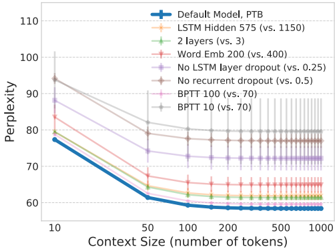
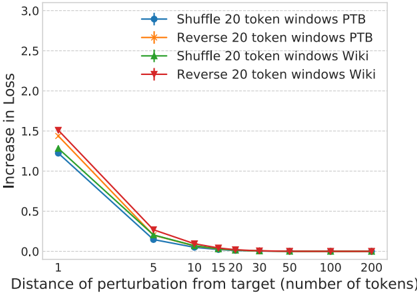
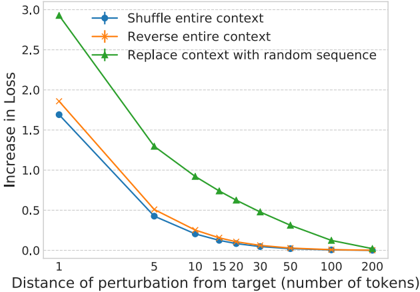
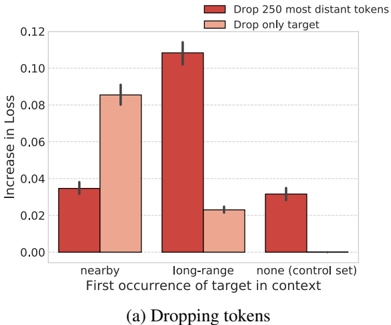
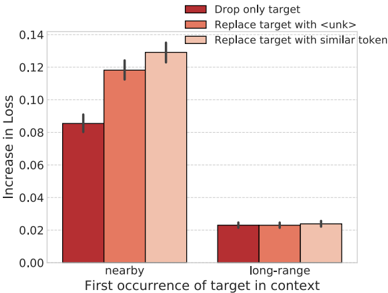
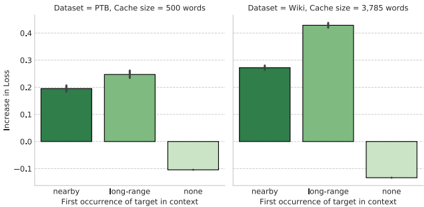
We know very little about how neural language models (LM) use prior linguistic context.In this paper, we investigate the role of context in an LSTM LM, through ablation studies.Specifically, we analyze the increase in perplexity when prior context words are shuffled, replaced, or dropped.On two standard datasets, Penn Treebank and WikiText-2, we find that the model is capable of using about 200 tokens of context on average, but sharply distinguishes nearby context (recent 50 tokens) from the distant history.The model is highly sensitive to the order of words within the most recent sentence, but ignores word order in the long-range context (beyond 50 tokens), suggesting the distant past is modeled only as a rough semantic field or topic.We further find that the neural caching model (Grave et al., 2017b) especially helps the LSTM to copy words from within this distant context.Overall, our analysis not only provides a better understanding of how neural LMs use their context, but also sheds light on recent success from cache-based models.
Overview
The claims and statistics of this paper haven’t been checked yet.
Free: it reads the open-access text and checks the first 5 claims that cite a source we can check. Create a free account to check every claim.
Integrity signals
Registry
Cites
Statistics
Figures
Verification
Claims the paper makes
The claims and statistics of this paper haven’t been checked yet.
Free: it reads the open-access text and checks the first 5 claims that cite a source we can check. Create a free account to check every claim.
Claims other papers make about this one
Each is checked against this paper’s own text: does it say what the citing paper says it does?
The source backs part of the claim, not all of it — or backs it for a different population, condition or comparison.
In the citing paper
“These observations complement prior work, which found that non-instruction fine-tuned language models are biased towards recent tokens (i.e., the end of the input context; Khandelwal et al., 2018;Press et al., 2021).”
From Lost in the Middle: How Language Models Use Long Contexts (2024) · cites this paper as Khandelwal et al., 2018
Experimental — accuracy not yet measuredThe source backs part of the claim, not all of it — or backs it for a different population, condition or comparison.
In the citing paper
“Transformers process natural language as a sequence on finite context windows; however, global relationships among words beyond these windows cannot be completely modeled via sequence processing only.”
From Emotion Classification With Visibility Graphs (2025) · cites this paper as [13]
Experimental — accuracy not yet measured
Self-check
Percentages, sums and reported differences re-computed from the paper’s own numbers.
The self-check needs the paper’s full text.
Citations
Cites
Hochreiter, S., & Schmidhuber, J. (1997) · Neural Computation · doi:10.1162/neco.1997.9.8.1735 · Cited by 102,318 · cited 1×
“LSTMs are designed to capture long-range dependencies in sequences (Hochreiter and Schmidhuber, 1997).”
BackgroundNeural Machine Translation by Jointly Learning to Align and Translate
Bahdanau, D., Cho, K., & Bengio, Y. (2014) · arXiv · doi:10.48550/arxiv.1409.0473 · Cited by 16,213 · cited 1×
“However, the success of copy mechanisms such as attention and caching (Bahdanau et al., 2015; Hill et al., 2016; Merity et al., 2017; Grave et al., 2017a,b) suggests that information in the distant context is very useful.”
BackgroundBuilding a Large Annotated Corpus of English: The Penn Treebank
Marcus, M. (1993) · doi:10.21236/ada273556 · Cited by 7,405
The Stanford CoreNLP Natural Language Processing Toolkit
Manning, C., Surdeanu, M., Bauer, J., Finkel, J., Bethard, S., & McClosky, D. (2014) · Proceedings of 52nd Annual Meeting of the Association for Computational Linguistics: System Demonstrations · doi:10.3115/v1/p14-5010 · Cited by 7,037 · cited 1×
“We obtain part-of-speech tags using Stanford CoreNLP (Manning et al., 2014).”
MethodRecurrent neural network based language model
Mikolov, T., Karafiát, M., Burget, L., Černocký, J., & Khudanpur, S. (2010) · Interspeech 2010 · doi:10.21437/interspeech.2010-343 · Cited by 5,390 · cited 1×
“We analyze two datasets commonly used for language modeling, Penn Treebank (PTB) (Marcus et al., 1993; Mikolov et al., 2010) and Wikitext-2 (Wiki) (Merity et al., 2017).”
MethodGenerating Sequences With Recurrent Neural Networks
Graves, A. (2013) · arXiv · doi:10.48550/arxiv.1308.0850 · Cited by 2,894 · cited 1×
“For several years now, neural language models (NLMs) (Graves, 2013; Jozefowicz et al., 2016; Grave et al., 2017a; Dauphin et al., 2017; Melis et al., 2018; Yang et al., 2018) have consistently outperformed classical n -gram models, an improvement often attributed to their ability to model…”
Background(2013) · Cited by 2,056
A theoretically grounded application of dropout in recurrent neural networks
Gal, Y., & Ghahramani, Z. (2016) · Cambridge University Engineering Department Publications Database · Cited by 1,600
Language Modeling with Gated Convolutional Networks
Dauphin, Y., Fan, A., Auli, M., & Grangier, D. (2016) · arXiv (Cornell University) · doi:10.48550/arxiv.1612.08083 · Cited by 1,080 · cited 2×
“For several years now, neural language models (NLMs) (Graves, 2013; Jozefowicz et al., 2016; Grave et al., 2017a; Dauphin et al., 2017; Melis et al., 2018; Yang et al., 2018) have consistently outperformed classical n-gram models, an improvement often attributed to their ability to model long-range dependencies in far…”
BackgroundExploring the Limits of Language Modeling
Józefowicz, R., Vinyals, O., Schuster, M., Shazeer, N., & Wu, Y. (2016) · arXiv (Cornell University) · doi:10.48550/arxiv.1602.02410 · Cited by 823 · cited 2×
“For several years now, neural language models (NLMs) (Graves, 2013; Jozefowicz et al., 2016; Grave et al., 2017a; Dauphin et al., 2017; Melis et al., 2018; Yang et al., 2018) have consistently outperformed classical n-gram models, an improvement often attributed to their ability to model long-range dependencies in far…”
Background
Cited by
Items 101–200 of 339
Understanding Learning Dynamics Of Language Models with SVCCA
Saphra, N., & Lopez, A. (2019) · Proceedings of the 2019 Conference of the North American Chapter of the Association for Computational Linguistics: Human Language Technologies, Volume 1 (Long and Short Papers) · doi:10.18653/v1/n19-1329 · Cited by 31
Coherence boosting: When your pretrained language model is not paying enough attention
Malkin, N., Wang, Z., & Jojić, N. (2022) · Proceedings of the conference - Association for Computational Linguistics. Meeting · doi:10.18653/v1/2022.acl-long.565 · Cited by 57
“…sequences (Beltagy et al., 2020; Zaheer et al., 2020; Roy et al., 2021; Press et al., 2022), but they remain undersensi-tive to distant content or syntax (Khandelwal et al., 2018; Sun et al., 2021) and are easily fooled by re-cency bias in few-shot prompts (Zhao et al., 2021) or multi-turn…”
RankGen: Improving Text Generation with Large Ranking Models
Krishna, K., Chang, Y., Wieting, J., & Iyyer, M. (2022) · Proceedings of the 2022 Conference on Empirical Methods in Natural Language Processing · doi:10.18653/v1/2022.emnlp-main.15 · Cited by 30
Dynamic Evaluation of Transformer Language Models
Krause, B., Kahembwe, E., Murray, I., & Renals, S. (2019) · arXiv · doi:10.48550/arxiv.1904.08378 · Cited by 30
“LSTMs (Hochreiter and Schmidhuber, 1997) conventionally used for language modeling have been shown to use relatively shorter contexts to make predictions (Khandelwal et al., 2018).”
MethodA surprisal–duration trade-off across and within the world’s languages
Pimentel, T., Meister, C., Salesky, E., Teufel, S., Blasí, D. E., & Cotterell, R. (2021) · Conference on Empirical Methods in Natural Language Processing (EMNLP) · doi:10.18653/v1/2021.emnlp-main.73 · Cited by 46
“In this work, we make use of LSTMs (as described in §3), which can model long context dependencies (Khandelwal et al., 2018).”
MethodPreCLN: Pretrained-based contrastive learning network for vehicle trajectory prediction
Yan, B., Zhao, G., Song, L., Yu, Y., & Dong, J. (2022) · World Wide Web · doi:10.1007/s11280-022-01121-3 · Cited by 39
“, LSTM) can hardly capture long-term dependencies in trajectory data [28], and can not run in parallel.”
BackgroundThe Importance of Generation Order in Language Modeling
Ford, N., Duckworth, D., Norouzi, M., & Dahl, G. E. (2018) · Conference on Empirical Methods in Natural Language Processing (EMNLP) · doi:10.18653/v1/d18-1324 · Cited by 40
“Experimentally, Khandelwal et al. (2018) show that recurrent neural networks have a memory that degrades with time.”
BackgroundZhang, F., Yu, X., Keung, J., Li, F., Xie, Z., Yang, Z., Ma, C., & Zhang, Z. (2022) · Information and Software Technology · doi:10.1016/j.infsof.2022.106922 · Cited by 33
A unified multi-task learning model for AST-level and token-level code completion
Liu, F., Li, G., Wei, B., Xia, X., Fu, Z., & Jin, Z. G. (2022) · Empirical Software Engineering · doi:10.1007/s10664-022-10140-7 · Cited by 37
“Existing research shows that LSTM-based language models use 200 context words on average (Khandelwal et al. 2018), which is not sufficient to model the long-term dependency in programs. c) The relationship between the type and value of the token/node is ignored.”
BackgroundPretraining with Artificial Language: Studying Transferable Knowledge in Language Models
Ri, R., & Tsuruoka, Y. (2022) · Proceedings of the conference - Association for Computational Linguistics. Meeting · doi:10.18653/v1/2022.acl-long.504 · Cited by 49
H-Transformer-1D: Fast One-Dimensional Hierarchical Attention for Sequences
Zhu, Z., & Soricut, R. (2021) · doi:10.18653/v1/2021.acl-long.294 · Cited by 35
“It is also well known in the NLP literature that long-range contextual information is necessary for many NLP tasks (Khandelwal et al., 2018; Liu and Lapata, 2019).”
BackgroundShipborne Multi-Function Radar Working Mode Recognition Based on DP-ATCN
Tian, T., Zhang, Q., Zhang, Z., Niu, F., Guo, X., & Zhou, F. (2023) · Remote Sensing · doi:10.3390/rs15133415 · Cited by 27
Mutual Information Scaling and Expressive Power of Sequence ModelsPreprint
Shen, H. (2019) · arXiv (Cornell University) · doi:10.48550/arxiv.1905.04271 · Cited by 30
“[25, 26, 27], where different approaches or metrics are adopted to empirically study the ability of RNNs as language models to capture long-range temporal dependence.”
BackgroundRukhsar, S., & Tiwari, A. K. (2024) · Neurocomputing · doi:10.1016/j.neucom.2024.129203 · Cited by 25
Measuring context dependency in birdsong using artificial neural networks
Morita, T., Koda, H., Okanoya, K., & Tachibana, R. O. (2021) · PLoS Computational Biology · doi:10.1371/journal.pcbi.1009707 · Cited by 27
Modeling Vocabulary for Big Code Machine LearningPreprint
Babii, H., Janes, A., & Robbes, R. (2019) · arXiv (Cornell University) · doi:10.48550/arxiv.1904.01873 · Cited by 24
“In addition, some neural architectures such as Recurrent Neural Networks (RNN) [46], Long Short-Term Memory (LSTM) [34, 65], or Transformer [71] are able to model much longer range dependencies: a study of LSTM language models showed that they use context as far as 250 words [41].”
MethodCASMS: Combining clustering with attention semantic model for identifying security bug reports
Ma, X., Keung, J., Yang, Z., Yu, X., Li, Y., & Zhang, H. (2022) · Information and Software Technology · doi:10.1016/j.infsof.2022.106906 · Cited by 28
Sarkar, M. R., Anavatti, S. G., Dam, T., Pratama, M., & Kindhi, B. A. (2023) · International Joint Conference on Neural Networks (IJCNN) · doi:10.1109/ijcnn54540.2023.10191444 · Cited by 26
“In addition, it shows poorer performance for non-stationary time series datasets and training needs an input of a fixed size [22] [23].”
BackgroundRavfogel, S., Goldberg, Y., & Goldberger, J. (2023) · Findings of the Association for Computational Linguistics: ACL (Findings of ACL) · doi:10.18653/v1/2023.findings-acl.3 · Cited by 56
Stealing the Decoding Algorithms of Language Models
Naseh, A., Krishna, K., Iyyer, M., & Houmansadr, A. (2023) · ACM SIGSAC Conference on Computer and Communications Security (CCS) · doi:10.1145/3576915.3616652 · Cited by 40
Controllable Neural Story Generation via Reinforcement Learning.Preprint
Tambwekar, P., Dhuliawala, M., Mehta, A., Martin, L. J., Harrison, B. E., & Riedl, M. O. (2018) · arXiv (Cornell University) · Cited by 24
Quantifying Exposure Bias for Neural Language GenerationPreprint
He, T., Zhang, J., Zhou, Z., & Glass, J. R. (2019) · arXiv (Cornell University) · Cited by 26
Temporal Action Localization Using Long Short-Term Dependency
Zhou, Y., Wang, R., Li, H., & Kung, S. (2020) · IEEE Transactions on Multimedia · doi:10.1109/tmm.2020.3042077 · Cited by 23
Multi-scale Transformer Language ModelsPreprint
Subramanian, S., Collobert, R., Ranzato, M., & Boureau, Y.-L. (2020) · arXiv (Cornell University) · doi:10.48550/arxiv.2005.00581 · Cited by 24
“We design three such architectures and present empirical evidence of their advantages, as well as analyses to better understand how transformer language models (LMs) use available context, following work by Khandelwal et al. (2018); Sankar et al. (2019).”
BackgroundInfluentialConstructing the ChatGPT for PDF Files with Langchain – AI
Jacob, T. P., Bizotto, B. L. S., & Sathiyanarayanan, M. (2024) · International Conference on Inventive Computation Technologies (ICICT) · doi:10.1109/icict60155.2024.10544643 · Cited by 27
“The world has been shocked by this advanced AI system, which is driven by deep learning technology, because of its remarkable capacity to produce writing that appears human and hold conversations with people[24].”
BackgroundOn Training Recurrent Networks with Truncated Backpropagation Through time in Speech Recognition
Tang, H., & Glass, J. R. (2018) · IEEE Spoken Language Technology Workshop (SLT) · doi:10.1109/slt.2018.8639517 · Cited by 27
Co-Channel Multiuser Modulation Classification Using Data-Driven Blind Signal Separation
Wen, D., Wang, X., & Huang, Z. (2023) · IEEE Internet of Things Journal · doi:10.1109/jiot.2023.3345023 · Cited by 20
“This makes an RNN more sensitive to contexts nearer the current time node than to distant contexts [34].”
BackgroundTowards Full-line Code Completion with Neural Language ModelsPreprint
Wang, W., Shen, S., Li, G., & Jin, Z. G. (2020) · arXiv (Cornell University) · doi:10.48550/arxiv.2009.08603 · Cited by 24
“However, RNNs share a common weakness: they cannot efficiently capture the long-term dependencies in sequential data (Khandelwal et al. 2018).”
Early Formalization of AI-tools Usage in Software Engineering in Europe: Study of 2023
Software engineering domain, A., & Pashchenko, D. S. (2023) · International Journal of Information Technology and Computer Science · doi:10.5815/ijitcs.2023.06.03 · Cited by 21
“These LLMs undergo training using self-supervised and semi-supervised learning techniques and typically comprise tens of millions to billions of weights [4].”
MethodDissecting Span Identification Tasks with Performance Prediction
Papay, S., Klinger, R., & Padó, S. (2020) · Conference on Empirical Methods in Natural Language Processing (EMNLP) · doi:10.18653/v1/2020.emnlp-main.396 · Cited by 28
Toward a Theory of Causation for Interpreting Neural Code Models
Nader Palacio, D., Velasco, A., Cooper, N., Rodriguez, A., Moran, K., & Poshyvanyk, D. (2024) · IEEE Transactions on Software Engineering · doi:10.1109/tse.2024.3379943 · Cited by 18
“…groups: (i) intrinsic techniques such as probing for specific linguistic characteristics [56] and examining neuron activations [57]; and (ii) post hoc techniques such as benchmarks [15], [34], [58], [59], [60], attention-based analysis [61], [62], and intervention analyses [17], [63], [64], [65].”
MethodNoji, H., & Takamura, H. (2020) · Proceedings of the conference - Association for Computational Linguistics. Meeting · doi:10.18653/v1/2020.acl-main.309 · Cited by 20
A System-call Behavior Language System for Malware Detection Using A Sensitivity-based LSTM Model
Xie, W., Xu, S., Zou, S., & Xi, J. (2020) · doi:10.1145/3403746.3403914 · Cited by 18
“And in the 200 length, only the last 50 length words can learn the order relationship effectively, the length more than 50 words can only learn rough semantic information [13].”
BackgroundCalibration, Entropy Rates, and Memory in Language Models
Braverman, M., Chen, X., Kakade, S. M., Narasimhan, K., Zhang, C., & Zhang, Y. (2019) · arXiv · doi:10.48550/arxiv.1906.05664 · Cited by 17
“Khandelwal et al. [2018] analyze LSTM-based language models and empirically show that such models make use of a finite context for prediction. Lin and Tegmark [2017] measure mutual information between any two symbols in human languages, and show that it decays with distance, roughly following a power law distribution.…”
BackgroundInfluentialModern Applications With a Focus on Training ChatGPT and GPT Models: Exploring Generative AI and NLP
Kondurkar, I., Raj, A., & Lakshmi, D. (2023) · Advances in computational intelligence and robotics book series · doi:10.4018/979-8-3693-0502-7.ch010 · Cited by 32
Forecast of global ionospheric TEC using an improved transformer model
Wu, X., Fan, C., Tang, J., & Cheng, Y. (2024) · Advances in Space Research · doi:10.1016/j.asr.2024.02.003 · Cited by 18
Incorporating emotion for response generation in multi-turn dialogues
Mao, Y., Cai, F., Guo, Y., & Chen, H. (2021) · Applied Intelligence · doi:10.1007/s10489-021-02819-z · Cited by 18
“However, conversation processes are usually continuous and dynamic, and the current dialogue context, that is, historical dialogue information, needs to be referred when generating a reply [9, 30, 32].”
BackgroundGrid Load Forecasting Based on Dual Attention BiGRU and DILATE Loss Function
Wang, X., Wu, Z., Ge, J., Zhang, Z., Han, L., Wang, S., & Zhang, X. (2022) · IEEE Access · doi:10.1109/access.2022.3182334 · Cited by 17
“In [19], we find that the effective con-text size of language models using LSTM is around 200 units on average, but only the closer 50 tokens can be clearly distinguished, suggesting that even This article has been accepted for publication in IEEE Access.”
BackgroundA quantum search decoder for natural language processing
Bausch, J., Subramanian, S., & Piddock, S. (2021) · Quantum Machine Intelligence · doi:10.1007/s42484-021-00041-1 · Cited by 21
“Furthermore, such models appear to be very sensitive to word order within the most recent context, but ignore word order in the long-range context (more than 50 tokens away) (Zhu et al. 2015; Dabrowska 2008; Khandelwal et al. 2018).”
BackgroundDeepClone: Modeling Clones to Generate Code Predictions
Hammad, M., Babur, Ö., Basit, H. A., & van den Brand, M. (2020) · Lecture notes in computer science · doi:10.1007/978-3-030-64694-3_9 · Cited by 18
Multi-timescale Representation Learning in LSTM Language Models
Mahto, S., Vo, V. A., Turek, J. S., & Huth, A. G. (2020) · arXiv (Cornell University) · doi:10.26153/tsw/43665 · Cited by 21
Fiacco, J., Adamson, D., & Rosé, C. P. (2023) · Workshop on Innovative Use of NLP for Building Educational Applications · doi:10.18653/v1/2023.bea-1.20 · Cited by 25
“…work to this is that of neural model probes (Shi et al., 2016; Adi et al., 2016; Conneau et al., 2018; Zhu et al., 2018; Kuncoro et al., 2018; Khandelwal et al., 2018) which have frequently being used to test whether a model has learned a set of properties (Ryskina and Knight, 2021;…”
BackgroundWhat Is Waiting for Us at the End? Inherent Biases of Game Story Endings in Large Language Models
Taveekitworachai, P., Abdullah, F., Gursesli, M. C., Dewantoro, M. F., Chen, S., Lanatà, A., Guazzini, A., & Thawonmas, R. (2023) · Lecture notes in computer science · doi:10.1007/978-3-031-47658-7_26 · Cited by 22
Novel spatio-temporal attention causal convolutional neural network for multi-site PM2.5 prediction
Wang, Y., Tian, S., & Zhang, P. (2024) · Frontiers in Environmental Science · doi:10.3389/fenvs.2024.1408370 · Cited by 20
Relevance-Promoting Language Model for Short-Text Conversation
Li, X., Li, P., Bi, W., Liu, X., & Lam, W. P. (2020) · Proceedings of the AAAI Conference on Artificial Intelligence · doi:10.1609/aaai.v34i05.6340 · Cited by 17
Context Dependent Semantic Parsing: A Survey
Li, Z., Qu, L., & Haffari, G. (2020) · International Conference on Computational Linguistics · doi:10.18653/v1/2020.coling-main.226 · Cited by 23
Shenoy, A., Bodapati, S., & Kirchhoff, K. (2021) · Workshop on e-Commerce and NLP (ECNLP) · doi:10.18653/v1/2021.ecnlp-1.3 · Cited by 18
“The first pass LM we used was a domain-general Kneser-Ney (KN) (Kneser and Ney, 1995) smoothed 4-gram model estimated on a weighted mix of datasets spanning multiple domains.”
MethodCan LSTM Learn to Capture Agreement? The Case of BasquePreprint
Ravfogel, S., Tyers, F. M., & Goldberg, Y. (2018) · arXiv (Cornell University) · doi:10.48550/arxiv.1809.04022 · Cited by 16
“RNNs were shown to be able to capture longterm dependencies and statistical regularities in input sequences (Karpathy et al., 2015; Linzen et al., 2016; Shi et al., 2016; Jurafsky et al., 2018; Gulordava et al., 2018).”
BackgroundEnformer: Encoder-Based Sparse Periodic Self-Attention Time-Series Forecasting
Wang, N., & Zhao, X. (2023) · IEEE Access · doi:10.1109/access.2023.3322957 · Cited by 19
“The classical LSTM [10] model still has problems in capturing the timing dependence of long series because it focuses more on the output of the last hidden layer [11].”
BackgroundPost-Processing of Word Representations via Variance Normalization and Dynamic Embedding
Wang, B., Chen, F., Wang, A., & Kuo, C. ‐. J. (2019) · IEEE International Conference on Multimedia and Expo (ICME) · doi:10.1109/icme.2019.00129 · Cited by 17
Attention-Based Neural Network: A Novel Approach for Predicting the Popularity of Online Content
Nguyen, M., Le, D. H., Nakajima, T., Yoshimi, M., & Thoai, N. (2019) · IEEE International Conference on High Performance Computing and Communications; IEEE International Conference on Smart City; IEEE International Conference on Data Science and Systems (HPCC/SmartCity/DSS) · doi:10.1109/hpcc/smartcity/dss.2019.00058 · Cited by 17
“However, a recent study [22] empirically shows that LSTM cannot handle very long dependencies in language models since it is only capable of using about 200 tokens of context on average.”
BackgroundH-Transformer-1D: Fast One-Dimensional Hierarchical Attention for SequencesPreprint
Zhu, Z., & Soricut, R. (2021) · arXiv (Cornell University) · doi:10.48550/arxiv.2107.11906 · Cited by 24
“It is also well known in the NLP literature that long-range contextual information is necessary for many NLP tasks (Khandelwal et al., 2018; Liu and Lapata, 2019).”
BackgroundData augmentation via diffusion model to enhance AI fairness
Blow, C. H., Qian, L., Gibson, C. A., Obiomon, P., & Dong, X. (2025) · Frontiers in Artificial Intelligence · doi:10.3389/frai.2025.1530397 · Cited by 19
Data Augmentation for Neural Online Chats Response Selection
Du, W., & Black, A. W. (2018) · doi:10.18653/v1/w18-5708 · Cited by 13
“Recent studies (Adi et al., 2016; Khandelwal et al., 2018) have shown that recurrent neural networks (RNN), especially long-short term memory networks (LSTM), are sensitive to word order when encoding contextual information.”
BackgroundAdapting Long Context NLM for ASR Rescoring in Conversational Agents
Shenoy, A., Bodapati, S., Sunkara, M., Ronanki, S., & Kirchhoff, K. (2021) · Interspeech (USB) · doi:10.21437/interspeech.2021-1849 · Cited by 19
“It is known that LSTM-based NLMs with context carry over (CCO) suffer from sharp nearby, fuzzy far away issues [22] and therefore we propose to investigate input feature augmentation using various context embeddings.”
BackgroundA novel selective learning based transformer encoder architecture with enhanced word representation
Ansar, W., Goswami, S., Chakrabarti, A., & Chakraborty, B. (2022) · Applied Intelligence · doi:10.1007/s10489-022-03865-x · Cited by 16
“However, it has been observed that the average retention power of LSTM can be approximately 200 context-words [36].”
BackgroundKristensson, P. O., Mjelde, M., & Vertanen, K. D. (2023) · ACM International Conference on Intelligent User Interfaces (IUI) · doi:10.1145/3581641.3584093 · Cited by 16
An Augmented Transformer Architecture for Natural Language Generation Tasks
Li, H., Adele, Y. C. W., Liu, Y., Tang, D., Lei, Z., & Li, W. (2019) · IEEE ... International Conference on Data Mining workshops · doi:10.1109/icdmw48858.2019.9024754 · Cited by 20
Gendered Ambiguous Pronouns Shared Task: Boosting Model Confidence by Evidence Pooling
Attree, S. (2019) · Workshop on Gender Bias in Natural Language Processing (GeBNLP) · doi:10.18653/v1/w19-3820 · Cited by 21
“Transformer networks have been found to have limited capability in modeling long-range dependency (Dai et al., 2018; Khandelwal et al., 2018 knowledge (Lee et al., 2018).”
BackgroundHard but Robust, Easy but Sensitive: How Encoder and Decoder Perform in Neural Machine TranslationPreprint
He, T., Tan, X., & Qin, T. (2019) · arXiv (Cornell University) · doi:10.48550/arxiv.1908.06259 · Cited by 13
“Why Decoder is Easier and More Sensitive The decoder in NMT model typically acts as a conditional language model, which generates tokens highly depending on the previous tokens, like the standard language model (Khandelwal et al., 2018).”
BackgroundBidirectional Scene Text Recognition with a Single Decoder
Bleeker, M., & de Rijke, M. (2019) · UvA-DARE (University of Amsterdam) · doi:10.48550/arxiv.1912.03656 · Cited by 15
“length 17) is not as long as for other language tasks [19], we are interested in whether or not our transformer-based method is better in predicting longer output character sequence than an RNN-based method.”
MethodLDformer: a parallel neural network model for long-term power forecasting
Tian, R., Li, X., Ma, Z., Liu, Y., Wang, J., & Wang, C. (2023) · Frontiers of Information Technology & Electronic Engineering · doi:10.1631/fitee.2200540 · Cited by 15
“However, we can learn from Khandelwal et al. (2018) that the adequate context size of the language model using LSTM is approximately 200 tokens on average.”
Diverse title generation for Stack Overflow posts with multiple-sampling-enhanced transformer
Zhang, F., Liu, J., Wan, Y., Yu, X., Liu, X., & Keung, J. (2023) · Journal of Systems and Software · doi:10.1016/j.jss.2023.111672 · Cited by 14
“First, they train an LSTM (Long Short Term ORCID (s): Memory) [18] model on a large-scale dataset collected from Stack Overflow, which contains pairs of code snippets and post titles.”
MethodInfluentialWang, L., Long, J., Li, X., Peng, H., & Ye, Z. (2023) · Chemical Engineering Research and Design · doi:10.1016/j.cherd.2023.10.052 · Cited by 12
On the Inability of Markov Models to Capture Criticality in Human Mobility
Kulkarni, V., Mahalunkar, A., Garbinato, B., & Kelleher, J. D. (2019) · Lecture notes in computer science · doi:10.1007/978-3-030-30508-6_39 · Cited by 18
Deep Neural Model Inspection and Comparison via Functional Neuron Pathways
Fiacco, J., Choudhary, S., & Rosé, C. P. (2019) · Proceedings of the conference - Association for Computational Linguistics. Meeting · doi:10.18653/v1/p19-1575 · Cited by 14
Revisiting Simple Neural Probabilistic Language Models
Sun, S., & Iyyer, M. (2021) · Conference of the North American Chapter of the Association for Computational Linguistics: Human Language Technologies (NAACL-HLT) · doi:10.18653/v1/2021.naacl-main.407 · Cited by 22
Attention-Based Transformer-BiGRU for Question Classification
Han, D., Tohti, T., & Hamdulla, A. (2022) · Information · doi:10.3390/info13050214 · Cited by 13
Feature Interaction Dual Self-attention network for sequential recommendation
Zhu, Y., Yao, S., & Sun, X. (2024) · Frontiers in Neurorobotics · doi:10.3389/fnbot.2024.1456192 · Cited by 12
Context Analysis for Pre-trained Masked Language Models
Lai, Y.-A., Lalwani, G., & Zhang, Y. (2020) · Findings of the Association for Computational Linguistics: EMNLP (Findings of EMNLP) · doi:10.18653/v1/2020.findings-emnlp.338 · Cited by 14
“The findings also show that MLMs handle content and function words in a similar manner as regular language models do, which are previously analyzed by Wang and Cho (2016); Khandelwal et al. (2018).”
MethodTransformer-XL With Graph Neural Network for Source Code Summarization
Zhang, X., Yang, S., Duan, L., Lang, Z., Shi, Z., & Sun, L. (2021) · Conference proceedings/Conference proceedings - IEEE International Conference on Systems, Man, and Cybernetics · doi:10.1109/smc52423.2021.9658619 · Cited by 14
“The Long Short Term Memory model, a variant of the RNN-based model, only increases the ability of RNN to capture contextual information to about 200 words on average [9].”
Generative AI for NFTs using GANs
Tiwari, H., Raj, A., Singh, U. K., & Fatima, H. (2024) · International Conference on Computing for Sustainable Global Development · doi:10.23919/indiacom61295.2024.10498251 · Cited by 14
“Later on, Long Short-Term Memory (LSTM) was designed with gating mechanisms [23]. designs that use Gated Recurrent Units (GRU) [24] to improve memory control during learning.”
MethodThe Influence of Generative AI Technologies On Academic Writing in EFL Education
Tian, C. (2024) · Journal of Education Humanities and Social Sciences · doi:10.54097/xv0rbq11 · Cited by 12
“This innovation allowed an extension of context length to approximately 200 tokens, where a token can be a word or a subword unit, representing the smallest units of text that the model processes [6].”
BackgroundXu, D., Laparra, E., & Bethard, S. J. (2019) · Joint Conference on Lexical and Computational Semantics · doi:10.18653/v1/s19-1008 · Cited by 14
“Inspired by Khandelwal et al. (2018)’s analysis of the effective context size of a word-based language model, we present an ablation study to measure performance when contextual information is removed.”
MethodSimple Local Attentions Remain Competitive for Long-Context Tasks
Xiong, W., Oğuz, B., Gupta, A., Chen, X., Liskovich, D., Levy, O., Yih, S., & Mehdad, Y. (2022) · Conference of the North American Chapter of the Association for Computational Linguistics: Human Language Technologies (NAACL-HLT) · doi:10.18653/v1/2022.naacl-main.144 · Cited by 20
On-the-Fly Attention Modulation for Neural Generation
Dong, Y., Bhagavatula, C., Lu, X., Hwang, J. D., Bosselut, A., Cheung, J. C. K., & Choi, Y. (2021) · Findings of the Association for Computational Linguistics: ACL-IJCNLP 2021 · doi:10.18653/v1/2021.findings-acl.107 · Cited by 10
“Sentence-level attention entropy Khandelwal et al. (2018) observed that LSTM represent distant context as topics; only a few token in the distant context are used to compute the context representation.”
MethodPersonalized Dynamic Music Emotion Recognition with Dual-Scale Attention-Based Meta-Learning
Zhang, D., You, W., Liu, Z., Sun, L., & Chen, P. (2025) · Proceedings of the AAAI Conference on Artificial Intelligence · doi:10.1609/aaai.v39i2.32155 · Cited by 17
Toward Automatic Discourse Parsing of Student Writing Motivated by Neural Interpretation
Fiacco, J., Jiang, S., Adamson, D., & Rosé, C. P. (2022) · Workshop on Innovative Use of NLP for Building Educational Applications · doi:10.18653/v1/2022.bea-1.25 · Cited by 13
“While they use recurrent models to construct their stacks and buffers, in practice, recurrent models have been shown to primarily to use very near context (Khandelwal et al., 2018).”
BackgroundQuotation Detection and Classification with a Corpus-Agnostic Model
Papay, S., & Padó, S. (2019) · International conference Recent advances in natural language processing · doi:10.26615/978-954-452-056-4_103 · Cited by 18
“As all datasets involve long quotation spans with long-distance dependencies, an LSTM-based approach was natural, given such models’ ability to capture very long-distance dependencies of up to 200 tokens (Khandelwal et al., 2018).”
BackgroundCapturing Multi-Resolution Context by Dilated Self-Attention
Moritz, N., Hori, T., & Roux, J. L. (2021) · IEEE International Conference on Acoustics Speech and Signal Processing · doi:10.1109/icassp39728.2021.9415001 · Cited by 12
“, to machine translation or language modeling, where close-by words are more likely to have a dependent relationship, while only a few distant words or word groups are relevant to trace the semantic context and syntax of a sentence [15].”
BackgroundHistory Reuse and Bag-of-Words Loss for Long Summary Generation
Liu, Q., Chen, L., Yuan, Y., & Wu, H. (2021) · IEEE/ACM Transactions on Audio Speech and Language Processing · doi:10.1109/taslp.2021.3100281 · Cited by 10
Evaluating Approaches to Personalizing Language Models
King, M., & Cook, P. F. (2020) · Language Resources and Evaluation · Cited by 37
State gradients for analyzing memory in LSTM language models
Verwimp, L., hamme, H. V., & Wambacq, P. (2019) · Computer Speech & Language · doi:10.1016/j.csl.2019.101034 · Cited by 11
Why and when should you pool? Analyzing Pooling in Recurrent Architectures
Maini, P., Kolluru, K., Pruthi, D., & Mausam (2020) · Findings of the Association for Computational Linguistics: EMNLP (Findings of EMNLP) · doi:10.18653/v1/2020.findings-emnlp.410 · Cited by 9
Liu, Y., Yang, Z., You, Y., Shan, W., & Ban, W. (2022) · Physiological Measurement · doi:10.1088/1361-6579/ac7b67 · Cited by 10
AA-forecast: anomaly-aware forecast for extreme events
Farhangi, A., Bian, J., Huang, A., Xiong, H., Wang, J., & Guo, Z. (2023) · Data Mining and Knowledge Discovery · doi:10.1007/s10618-023-00919-7 · Cited by 10
“However, Khandelwal et al. (2018) show that even LSTMs have a limited ability to capture long-term dependencies, and their awareness of context degrades as the length of the input sequence increases.”
BackgroundInfluentialCross Entropy of Neural Language Models at Infinity—A New Bound of the Entropy Rate
Takahashi, S., & Tanaka‐Ishii, K. (2018) · Entropy · doi:10.3390/e20110839 · Cited by 15
Meaning to Form: Measuring Systematicity as InformationPreprint
Pimentel, T., McCarthy, A. D., Blasí, D. E., Roark, B., & Cotterell, R. (2019) · arXiv (Cornell University) · doi:10.48550/arxiv.1906.05906 · Cited by 12
“Recurrent neural networks are great representation extractors, being able to model long dependencies—up to a few hundred tokens (Khandelwal et al., 2018)—and complex distributions Pr(wi | w<i) (Mikolov et al.”
BackgroundLong-span language modeling for speech recognitionPreprint
Parthasarathy, S., Gale, W. A., Chen, X., Polovets, G., & Chang, S. (2019) · arXiv (Cornell University) · doi:10.48550/arxiv.1911.04571 · Cited by 11
“There has been significant work on long-span neural LMs in the larger NLP community beyond speech recognition [21, 25].”
BackgroundMasked Diffusion for Generative RecommendationPreprint
Shah, K., Kumar, B., Shah, N., & Collins, L. (2025) · arXiv (Cornell University) · doi:10.48550/arxiv.2511.23021 · Cited by 11
“This is consistent with prior results suggesting that AR modeling over-indexes on local relationships among tokens [KHQJ18, HKK + 20, BDDR23], as well as our intuition that masked diffusion, by training a more diverse set of targets, is better able to model global relationships.”
Shaking Syntactic Trees on the Sesame Street: Multilingual Probing with Controllable Perturbations
Taktasheva, E., Mikhailov, V., & Artemova, E. (2021) · Workshop on Multilingual Representation Learning (MRL) · doi:10.18653/v1/2021.mrl-1.17 · Cited by 17
“Starting from studies on randomized word order in LSTMs (Hill et al., 2016; Khandelwal et al., 2018; Sankar et al., 2019; Nie et al., 2019), text perturbations have emerged as an audacious experimental direction under the “pre-train & fine-tune” paradigm along with the interpreta-”
MethodHow LSTM Encodes Syntax: Exploring Context Vectors and Semi-Quantization on Natural Text
Shibata, C., Uchiumi, K., & Mochihashi, D. (2020) · International Conference on Computational Linguistics · doi:10.18653/v1/2020.coling-main.356 · Cited by 10
Cross-sentence Neural Language Models for Conversational Speech Recognition
Chiu, S.-H., Lo, T.-H., & Chen, B. (2021) · International Joint Conference on Neural Networks (IJCNN) · doi:10.1109/ijcnn52387.2021.9533796 · Cited by 9
Lee, I., Jiang, N., & Berg-Kirkpatrick, T. (2024) · International Conference on Learning Representations · doi:10.48550/arxiv.2310.08049 · Cited by 11
“Given that the RNNs fail at this task on average , we credit this finding to luck with our hyperparameter sweep.”
BackgroundInfluentialStudying word order through iterative shuffling
Malkin, N., Lanka, S., Goel, P., & Jojić, N. (2021) · Conference on Empirical Methods in Natural Language Processing (EMNLP) · doi:10.18653/v1/2021.emnlp-main.809 · Cited by 16
“In the domain of text generation, Khandelwal et al. (2018) found that the order of distant context words has little effect on prediction of the next word in a text.”
De-identification techniques to preserve privacy in medical records
Catelli, R., & Esposito, M. (2023) · Elsevier eBooks · doi:10.1016/b978-0-323-90531-2.00007-2 · Cited by 9
2kenize: Tying Subword Sequences for Chinese Script Conversion
Pranav, A., & Augenstein, I. (2020) · Proceedings of the conference - Association for Computational Linguistics. Meeting · doi:10.18653/v1/2020.acl-main.648 · Cited by 8
On-The-Fly Information Retrieval Augmentation for Language Models
Wang, H., & McAllester, D. (2020) · doi:10.18653/v1/2020.nuse-1.14 · Cited by 7
Path context augmented statement and network for learning programs
Xiao, D., Hang, D., Ai, L., Li, S., & Liang, H. (2022) · Empirical Software Engineering · doi:10.1007/s10664-021-10098-y · Cited by 8
“Although ASTNN uses LSTM to handle the sequence of statement subtrees, Khandelwal et al. (2018) show that LSTM is insensitive to word order in long-range contexts.”
MethodChiu, S.-H., Lo, T.-H., Chao, F.-A., & Chen, B. (2021) · arXiv (Cornell University) · doi:10.48550/arxiv.2106.06922 · Cited by 7
“This may because that RNN and LSTM inherently suffer from the sharp nearby, fuzzy far away issues [22] and may fail to capture complex global structural dependencies among these utterances.”
Background
Metadata
- Authors
- Khandelwal, U., He, H., Qi, P., & Jurafsky, D.
- Affiliations
- Stanford University (US)
- Venue
- Proceedings of the 56th Annual Meeting of the Association for Computational Linguistics (Volume 1: Long Papers)
- Published
- 2018
- Pages
- 284-294
- ISSN
- 0736-587X (ISSN-L)
- OpenAlex
- W2963951265
- Cited by
- 303
- References
- 34
- Citations by year
- 2026: 9 · 2025: 9 · 2024: 24 · 2023: 42 · 2022: 43 · 2021: 56 · 2020: 48 · 2019: 57 · 2018: 15
- FWCI
- 17.96
- Type
- conference paper
- Language
- en
- Open access
- hybrid
- doi.org
- Licence
- cc-by
- Locations
- Proceedings of the conference - Association for Computational Linguistics. Meeting (publishedVersion, cc-by)
- arXiv (Cornell University) (submittedVersion)
- arXiv (Cornell University)
- Funders
- National Science Foundation (1514268)
- Defense Advanced Research Projects Agency
- Army Research Office
- Topics
- Physical Sciences › Computer Science › Artificial Intelligence › Topic Modeling
- Physical Sciences › Computer Science › Artificial Intelligence › Natural Language Processing Techniques
- Physical Sciences › Computer Science › Artificial Intelligence › Speech Recognition and Synthesis
- Keywords
- neural language models, long-range context, LSTM, context length, perplexity, semantic field, topic modeling, ablation study, Penn Treebank, WikiText-2
About these checks
Registry, retraction, Cites and statistics results are computed, not judged, with one exception: a printed reference that no index lists is read once by a model before it counts as a citation error. Claims are extracted by a model and kept only when their quote appears verbatim in the text; each cited source is then checked, with a model’s help, for whether it says what the claim relies on. Those verdicts can be wrong — read the claim’s quote and the cited source before relying on one.
Statistics and arithmetic are recomputed, not judged.
Confidence bands are shown only for fields calibrated on our annotated test set. None is calibrated yet, so no band is shown.
What counts as a claim ›How we measure confidence ›How we check this ›
Are you an author, or do you see a problem with this page? Request a review
Data sources
Bibliographic data: Semantic Scholar, OpenAlex, Crossref.
Contains information from the Semantic Scholar Academic Graph Datasets, made available under the ODC Attribution License (ODC-BY 1.0).
Semantic Scholar’s data is described in: Kinney, R., et al. (2023). The Semantic Scholar Open Data Platform. arXiv:2301.10140.
