

Sharp Nearby, Fuzzy Far Away: How Neural Language Models Use Context
Open accessThe DOI matches its Crossref record; 30 of the 34 references it cites were found in a registry or an index.
Abstract
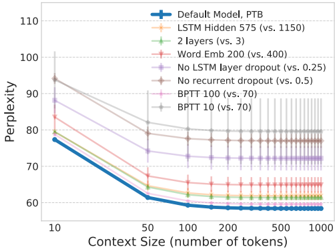
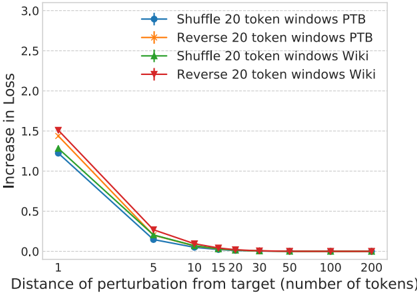
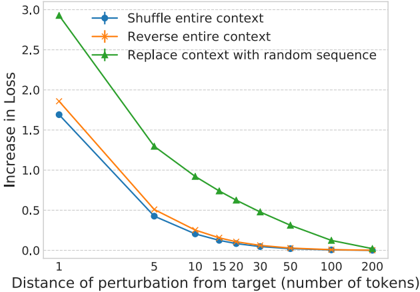
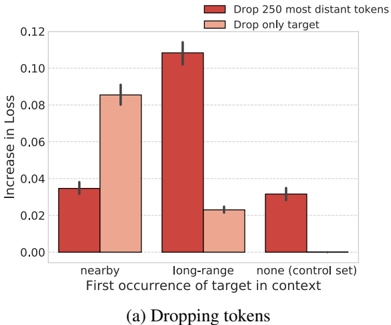
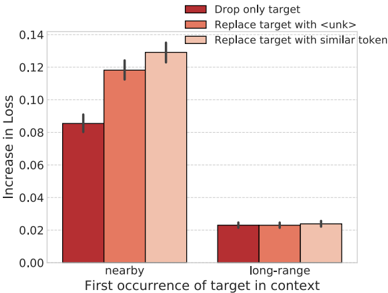
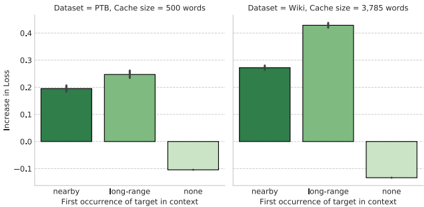
We know very little about how neural language models (LM) use prior linguistic context.In this paper, we investigate the role of context in an LSTM LM, through ablation studies.Specifically, we analyze the increase in perplexity when prior context words are shuffled, replaced, or dropped.On two standard datasets, Penn Treebank and WikiText-2, we find that the model is capable of using about 200 tokens of context on average, but sharply distinguishes nearby context (recent 50 tokens) from the distant history.The model is highly sensitive to the order of words within the most recent sentence, but ignores word order in the long-range context (beyond 50 tokens), suggesting the distant past is modeled only as a rough semantic field or topic.We further find that the neural caching model (Grave et al., 2017b) especially helps the LSTM to copy words from within this distant context.Overall, our analysis not only provides a better understanding of how neural LMs use their context, but also sheds light on recent success from cache-based models.
Overview
The claims and statistics of this paper haven’t been checked yet.
Free: it reads the open-access text and checks the first 5 claims that cite a source we can check. Create a free account to check every claim.
Integrity signals
Registry
Cites
Statistics
Figures
Verification
Claims the paper makes
The claims and statistics of this paper haven’t been checked yet.
Free: it reads the open-access text and checks the first 5 claims that cite a source we can check. Create a free account to check every claim.
Claims other papers make about this one
Each is checked against this paper’s own text: does it say what the citing paper says it does?
The source backs part of the claim, not all of it — or backs it for a different population, condition or comparison.
In the citing paper
“These observations complement prior work, which found that non-instruction fine-tuned language models are biased towards recent tokens (i.e., the end of the input context; Khandelwal et al., 2018;Press et al., 2021).”
From Lost in the Middle: How Language Models Use Long Contexts (2024) · cites this paper as Khandelwal et al., 2018
Experimental — accuracy not yet measuredThe source backs part of the claim, not all of it — or backs it for a different population, condition or comparison.
In the citing paper
“Transformers process natural language as a sequence on finite context windows; however, global relationships among words beyond these windows cannot be completely modeled via sequence processing only.”
From Emotion Classification With Visibility Graphs (2025) · cites this paper as [13]
Experimental — accuracy not yet measured
Self-check
Percentages, sums and reported differences re-computed from the paper’s own numbers.
The self-check needs the paper’s full text.
Citations
Cites
Hochreiter, S., & Schmidhuber, J. (1997) · Neural Computation · doi:10.1162/neco.1997.9.8.1735 · Cited by 102,318 · cited 1×
“LSTMs are designed to capture long-range dependencies in sequences (Hochreiter and Schmidhuber, 1997).”
BackgroundNeural Machine Translation by Jointly Learning to Align and Translate
Bahdanau, D., Cho, K., & Bengio, Y. (2014) · arXiv · doi:10.48550/arxiv.1409.0473 · Cited by 16,213 · cited 1×
“However, the success of copy mechanisms such as attention and caching (Bahdanau et al., 2015; Hill et al., 2016; Merity et al., 2017; Grave et al., 2017a,b) suggests that information in the distant context is very useful.”
BackgroundBuilding a Large Annotated Corpus of English: The Penn Treebank
Marcus, M. (1993) · doi:10.21236/ada273556 · Cited by 7,405
The Stanford CoreNLP Natural Language Processing Toolkit
Manning, C., Surdeanu, M., Bauer, J., Finkel, J., Bethard, S., & McClosky, D. (2014) · Proceedings of 52nd Annual Meeting of the Association for Computational Linguistics: System Demonstrations · doi:10.3115/v1/p14-5010 · Cited by 7,037 · cited 1×
“We obtain part-of-speech tags using Stanford CoreNLP (Manning et al., 2014).”
MethodRecurrent neural network based language model
Mikolov, T., Karafiát, M., Burget, L., Černocký, J., & Khudanpur, S. (2010) · Interspeech 2010 · doi:10.21437/interspeech.2010-343 · Cited by 5,390 · cited 1×
“We analyze two datasets commonly used for language modeling, Penn Treebank (PTB) (Marcus et al., 1993; Mikolov et al., 2010) and Wikitext-2 (Wiki) (Merity et al., 2017).”
MethodGenerating Sequences With Recurrent Neural Networks
Graves, A. (2013) · arXiv · doi:10.48550/arxiv.1308.0850 · Cited by 2,894 · cited 1×
“For several years now, neural language models (NLMs) (Graves, 2013; Jozefowicz et al., 2016; Grave et al., 2017a; Dauphin et al., 2017; Melis et al., 2018; Yang et al., 2018) have consistently outperformed classical n -gram models, an improvement often attributed to their ability to model…”
Background(2013) · Cited by 2,056
A theoretically grounded application of dropout in recurrent neural networks
Gal, Y., & Ghahramani, Z. (2016) · Cambridge University Engineering Department Publications Database · Cited by 1,600
Language Modeling with Gated Convolutional Networks
Dauphin, Y., Fan, A., Auli, M., & Grangier, D. (2016) · arXiv (Cornell University) · doi:10.48550/arxiv.1612.08083 · Cited by 1,080 · cited 2×
“For several years now, neural language models (NLMs) (Graves, 2013; Jozefowicz et al., 2016; Grave et al., 2017a; Dauphin et al., 2017; Melis et al., 2018; Yang et al., 2018) have consistently outperformed classical n-gram models, an improvement often attributed to their ability to model long-range dependencies in far…”
BackgroundExploring the Limits of Language Modeling
Józefowicz, R., Vinyals, O., Schuster, M., Shazeer, N., & Wu, Y. (2016) · arXiv (Cornell University) · doi:10.48550/arxiv.1602.02410 · Cited by 823 · cited 2×
“For several years now, neural language models (NLMs) (Graves, 2013; Jozefowicz et al., 2016; Grave et al., 2017a; Dauphin et al., 2017; Melis et al., 2018; Yang et al., 2018) have consistently outperformed classical n-gram models, an improvement often attributed to their ability to model long-range dependencies in far…”
Background
Cited by
Items 201–300 of 339
Transformers Simulate MLE for Sequence Generation in Bayesian NetworksPreprint
Cao, Y., He, Y., Wu, D., Chen, H., Fan, J., & Liu, H. (2025) · arXiv (Cornell University) · doi:10.48550/arxiv.2501.02547 · Cited by 8
Shen, X., Lam, W. P., Ma, S., & Wang, H. (2023) · Natural Language Engineering · doi:10.1017/s1351324923000177 · Cited by 7
“Previous studies show that vanilla LSTM (Hochreiter and Schmidhuber, 1997) and vanilla Transformer (Vaswani et al ., 2017) can effectively handle sequences of several hundred words at most (Khandelwal et al ., 2018; Dai et al ., 2019).”
BackgroundDotless Arabic Text for Natural Language Processing
Al-shaibani, M. S., & Ahmad, I. (2025) · Computational Linguistics · doi:10.1162/coli_a_00535 · Cited by 8
“Additionally, this issue becomes serious with fine-grained tokenization as learning in RNNs is less efficient for longer sequences (Khandelwal et al. 2018; Rumelhart, Hinton, and Williams 1985; Werbos 1990).”
CATREEN: Context-Aware Code Timing Estimation with Stacked Recurrent Networks
Amalou, A. N., Fromont, É., & Puaut, I. (2022) · IEEE International Conference on Tools with Artificial Intelligence (ICTAI) · doi:10.1109/ictai56018.2022.00090 · Cited by 10
“[30] has observed that LSTM models can use a maximum of 200 context tokens which prevent them from learning longer-term information (i.e., they can remember sequences of hundreds but not thousands of items).”
Lemke, R., Schäfer, L., & Reich, I. (2021) · PLoS ONE · doi:10.1371/journal.pone.0246255 · Cited by 10
Wang, J., Lam, M. W. Y., Su, D., & Yu, D. (2021) · Proceedings of the AAAI Conference on Artificial Intelligence · doi:10.1609/aaai.v35i16.17644 · Cited by 8
Conditional set generation using Seq2seq models
Madaan, A., Rajagopal, D., Tandon, N., Yang, Y., & Bosselut, A. (2022) · Conference on Empirical Methods in Natural Language Processing (EMNLP) · doi:10.18653/v1/2022.emnlp-main.324 · Cited by 14
Zhang, M., He, T., Wang, T., Mi, L., Mireshghallah, F., Chen, B., Wang, H., & Tsvetkov, Y. (2023) · arXiv (Cornell University) · doi:10.48550/arxiv.2309.17157 · Cited by 6
“While the history is blurred, the local sharpness (Khandelwal et al., 2018) is preserved by LatticeGen: From Equation 2, the exact last token wt−1 is provided to the model.”
BackgroundCausal Dynamic Variational Autoencoder for Counterfactual Regression in Longitudinal Data
Bouchattaoui, M. E., Tami, M., Lepetit, B., & Cournède, P.-H. (2025) · Transactions on machine learning research · doi:10.48550/arxiv.2310.10559 · Cited by 8
Evaluating Long Range Dependency Handling in Code Generation LLMs
Assogba, Y., & Ren, D. (2025) · Transactions on machine learning research · doi:10.48550/arxiv.2407.21049 · Cited by 7
“Khandelwal et al. [16] showed that early LSTM-based language models only roughly modelled information from more distant tokens.”
Fast and Accurate Context-Aware Basic Block Timing Prediction using Transformers
Amalou, A. N., Fromont, É., & Puaut, I. (2024) · ACM SIGPLAN International Conference on Compiler Construction (CC) · doi:10.1145/3640537.3641572 · Cited by 9
Explaining Dialogue Evaluation Metrics using Adversarial Behavioral Analysis
Khalid, B., & Lee, S. (2022) · Conference of the North American Chapter of the Association for Computational Linguistics: Human Language Technologies (NAACL-HLT) · doi:10.18653/v1/2022.naacl-main.430 · Cited by 13
“…specially those based on neural architectures, show poor performance in generating consistent responses by keeping track of information in a dialogue context and are prone to generating repetitive, unnatural and bland responses (Yang et al., 2021; Khandelwal et al., 2018; Gao et al., 2018).”
BackgroundDavíðsson, H. B., Rees, T., Ólafsdóttir, M. R., & Einarsson, H. (2023) · Animals · doi:10.3390/ani13010183 · Cited by 7
FluPMT: Prediction of Predominant Strains of Influenza A Viruses via Multi-Task Learning
Cai, C., Li, J., Xia, Y.-L., & Li, W. (2024) · IEEE Transactions on Computational Biology and Bioinformatics · doi:10.1109/tcbb.2024.3378468 · Cited by 6
“While Long Short-Term Memory (LSTM) networks [27] have alleviated these issues to a great extent, they still struggle to capture long-term dependencies in lengthy sequences [28].”
BackgroundGuiding Extractive Summarization with Question-Answering RewardsPreprint
Arumae, K., & Liu, F. (2019) · arXiv (Cornell University) · doi:10.48550/arxiv.1904.02321 · Cited by 6
“A recent study by Khandelwal et al. (2018) reported that the recurrent networks are capable of memorizing a recent context of about 20 tokens and the model is highly sensitive to word order, whereas this is less the case for CNN whose max-pooling operation makes it agnostic to word order.”
BackgroundA unifying computational account of temporal context effects in language across the human cortexPreprint
Vo, V. A., Jain, S., Beckage, N., Chien, H.-Y. S., Obinwa, C., & Huth, A. G. (2023) · bioRxiv (Cold Spring Harbor Laboratory) · doi:10.1101/2023.08.03.551886 · Cited by 6
Characterizing verbatim short-term memory in neural language models
Armeni, K., Honey, C., & Linzen, T. (2022) · Proceedings of the 26th Conference on Computational Natural Language Learning (CoNLL) · doi:10.18653/v1/2022.conll-1.28 · Cited by 4
Scale-Dependent Relationships in Natural Language
Sarkar, A., & Howard, M. W. (2021) · Computational Brain & Behavior · doi:10.1007/s42113-020-00094-8 · Cited by 4
“LSTMs have also been shown to empirically use 200 context words on average regardless of the hyperparameters chosen, and start to disregard word order significantly after the first 50 tokens (Khandelwal et al. 2018).”
MethodPredictable Words Are More Likely to Be Omitted in Fragments–Evidence From Production Data
Lemke, R., Reich, I., Schäfer, L., & Drenhaus, H. (2021) · Frontiers in Psychology · doi:10.3389/fpsyg.2021.662125 · Cited by 8
Time-Series Prediction Based on Double Pyramid Bidirectional Feature Fusion Mechanism
Na, W. A. N. G., & Xianglian, Z. H. A. O. (2022) · IEICE Transactions on Fundamentals of Electronics Communications and Computer Sciences · doi:10.1587/transfun.2022eap1081 · Cited by 4
The Locality and Symmetry of Positional Encodings
Chen, L., Varoquaux, G. P., & Suchanek, F. M. (2023) · Findings of the Association for Computational Linguistics: EMNLP (Findings of EMNLP) · doi:10.18653/v1/2023.findings-emnlp.955 · Cited by 7
Noisy Neural Language Modeling for Typing Prediction in BCI Communication
Dong, R., Smith, D. A., Dudy, S., & Bedrick, S. D. (2019) · Workshop on Speech and Language Processing for Assistive Technologies · doi:10.18653/v1/w19-1707 · Cited by 8
“Recurrent language models, however, could effectively utilize contexts of 200 tokens on average (Khandelwal et al., 2018).”
BackgroundMethodLi, Y., Yao, K., Qin, L., Peng, S., Liu, Y., & Li, X. (2020) · Proceedings of the AAAI Conference on Artificial Intelligence · doi:10.1609/aaai.v34i05.6343 · Cited by 4
“Most natural language sentences are grammatically simple and most words can be predicted from their local context (Khandelwal et al. 2018; Marvin and Linzen 2018), a phenomenon we name it as simple sentence dominance problem.”
BackgroundLanguage Model Using Differentiable Neural Computer Based on Forget Gate-Based Memory Deallocation
Lee, D., Park, H.-S., Seo, S., Kim, C., Son, H., Kim, G., & Kim, J. (2021) · Computers, materials & continua/Computers, materials & continua (Print) · doi:10.32604/cmc.2021.015430 · Cited by 4
“In particular, recent studies have shown that an LSTM RNN-based LM cannot be trained with more than 200 words or character sequences as its input [16].”
BackgroundAn Efficient Minimal Text Segmentation Method for URL Domain Names
Li, Y., Du, T., Zhu, L., & Qu, S. (2021) · Scientific Programming · doi:10.1155/2021/9946729 · Cited by 5
“In addition, when the text has no language dependency in any direction [29], the model cannot determine appropriate word segmentation rules through context semantics.”
BackgroundRevisiting Entropy Rate Constancy in Text
Verma, V. K., Tomlin, N., & Klein, D. (2023) · Findings of the Association for Computational Linguistics: EMNLP (Findings of EMNLP) · doi:10.18653/v1/2023.findings-emnlp.1039 · Cited by 14
sadeghi, H., Motameni, H., Ebrahimnejad, A., & Vahidi, J. (2019) · Journal of Intelligent & Fuzzy Systems · doi:10.3233/jifs-181330 · Cited by 4
LaMemo: Language Modeling with Look-Ahead Memory
Ji, H., Zhang, R., Yang, Z., Hu, Z., & Huang, M. (2022) · Conference of the North American Chapter of the Association for Computational Linguistics: Human Language Technologies (NAACL-HLT) · doi:10.18653/v1/2022.naacl-main.422 · Cited by 5
Neural Academic Paper GenerationPreprint
Demir, S., Mutlu, U., & Özdemir, Ö. (2019) · arXiv (Cornell University) · doi:10.48550/arxiv.1912.01982 · Cited by 5
Lan, T., Mao, X.-L., Wei, W., & Huang, H. (2020) · arXiv (Cornell University) · doi:10.48550/arxiv.2008.02964 · Cited by 4
“This phenomenon is already reported by the recent works [9, 14].”
BackgroundResultChoir Transformer: Generating Polyphonic Music with Relative Attention on TransformerPreprint
Zhou, J., Zhu, H. C., & Wang, X. (2023) · arXiv (Cornell University) · doi:10.48550/arxiv.2308.02531 · Cited by 6
“In contrast, the distant past is modeled only as a rough semantic field or topic[11].”
BackgroundEvaluating the Evaluations: A Perspective on Benchmarks
Alonso, O., & Church, K. (2024) · ACM SIGIR Forum · doi:10.1145/3722449.3722467 · Cited by 7
“Here are some highly cited papers that use the PTB in these two ways: Parsing: [Collins, 1997, 2003; Charniak, 2000] Perplexity: [Zhao et al., 2023; Zhuang et al., 2020; Dong and Yang, 2019; Khandelwal et al., 2018] Figure 1a uses citing sentences to show how the community views the PTB.”
Time Will Tell: Criss-Cross Transformer for Encrypted Traffic Analysis
Ding, H., Chen, L., Zhang, B., Li, S., Peng, H., Qu, Z., & Bai, Y. (2026) · IEEE Transactions on Services Computing · doi:10.1109/tsc.2026.3664705 · Cited by 3
Limitations of Open-Domain Question Answering Benchmarks for Document-level Reasoning
Kamalloo, E., Clarke, C. L. A., & Rafiei, D. (2023) · International ACM SIGIR Conference on Research and Development in Information Retrieval (SIGIR) · doi:10.1145/3539618.3592011 · Cited by 7
“The ubiquity of passage retrieval is rooted in the struggles of QA models, even large language models [7], in capturing long-range dependencies within documents [28].”
BackgroundAdvancing Natural Language Processing: Beyond Embeddings
Iskandarova, S., Kuziyev, U., Ashurov, D. A., & Rakhmatullayeva, D. (2024) · International Conference on IoT, Communication and Automation Technology (ICICAT) · doi:10.1109/icicat62666.2024.10923033 · Cited by 4
Identification and cause analysis on unplanned reoperations by text classification approach
Liang, Z., Huang, W., Xu, H., He, Z., Yuan, C., Liang, Y., Guo, Q., Liu, T., & Jia, P. (2025) · Scientific Reports · doi:10.1038/s41598-025-22791-9 · Cited by 3
“Although Long Short-Term Memory (LSTM) uses gating and gradient clipping 54 , its ability to capture long-range dependencies is limited, typically to about 200 tokens 55 .”
Information-Weighted Neural Cache Language Models for ASR
Verwimp, L., Pelemans, J., hamme, H. V., & Wambacq, P. (2018) · IEEE Spoken Language Technology Workshop (SLT) · doi:10.1109/slt.2018.8639543 · Cited by 4
Bidirectional Scene Text Recognition with a Single Decoder
Bleeker, M., & de Rijke, M. (2020) · Frontiers in artificial intelligence and applications · doi:10.3233/faia200404 · Cited by 4
Neural Language Modeling with Implicit Cache Pointers
Li, K., Povey, D., & Khudanpur, S. P. (2020) · Interspeech (USB) · doi:10.21437/interspeech.2020-3020 · Cited by 7
Detecting Compiler Bugs Via a Deep Learning-Based Framework
Tang, Y., Ren, Z., Jiang, H., Qiao, L., Liu, D., Zhou, Z., & Kong, W. (2022) · International Journal of Software Engineering and Knowledge Engineering · doi:10.1142/s0218194022500206 · Cited by 3
Improved Divide-and-Conquer Approach to Abstractive Summarization of Scientific Papers
Shen, X., & Lam, W. (2022) · 2022 4th International Conference on Natural Language Processing (ICNLP) · doi:10.1109/icnlp55136.2022.00073 · Cited by 6
“However, this practice is not suitable for the long documents such as scientific papers, because the underlying neural architectures of NATS can only effectively handle sequences of several hundred words at most [3, 4].”
BackgroundAdjustable Context-Aware Transformer
Koohfar, S., & Dietz, L. (2023) · Lecture notes in computer science · doi:10.1007/978-3-031-24378-3_1 · Cited by 4
“Previous studies have demonstrated that RNNs including Long Short Term Memory networks (LSTMs) [12] might also fail to capture long-term patterns of dependency when information from the past is gradually overwritten by information from recent observations [15].”
BackgroundPosition Matters! Empirical Study of Order Effect in Knowledge-grounded Dialogue
Su, H., Kumar, S. H., Mazumder, S., Chen, W., Manuvinakurike, R., Okur, E., Sahay, S., Nachman, L., Chen, S.-T., & Lee, H.-Y. (2023) · DialDoc Workshop on Document-grounded Dialogue and Conversational Question Answering (DialDoc) · doi:10.18653/v1/2023.dialdoc-1.4 · Cited by 3
A Response Generation Framework Based on Empathy Factors, Common Sense, and Persona
Li, W., Yang, Y., Tuerxun, P., Fan, X., & Diao, Y. (2024) · IEEE Access · doi:10.1109/access.2024.3365533 · Cited by 3
“This has been observed in research works such as [25], [26], and [27].”
MethodRelating RNN Layers with the Spectral WFA Ranks in Sequence Modelling
Liza, F. F., & Grześ, M. (2019) · doi:10.18653/v1/w19-3903 · Cited by 4
Learning Multimodal Word Representations by Explicitly Embedding Syntactic and Phonetic Information
Zhu, W., Liu, S., Liu, C., Yin, X., & Xv, X. (2020) · IEEE Access · doi:10.1109/access.2020.3042183 · Cited by 5
Lee, D., Park, H.-S., Seo, S., Son, H., Kim, G., & Kim, J. (2021) · KSII Transactions on Internet and Information Systems · doi:10.3837/tiis.2021.03.002 · Cited by 3
“The LSTM achieved a higher performance than the RNN in LM tasks, but previous works showed that the LSTM are still suffered from unstable gradients on long-range sequences consist of more than 200 words or characters [13].”
BackgroundYou May Not Need Order in Time Series ForecastingPreprint
Zhang, Y., Jiang, Q., Li, S., Jin, X., Ma, X., & Yan, X. (2019) · arXiv (Cornell University) · doi:10.48550/arxiv.1910.09620 · Cited by 3
Knowledge Efficient Deep Learning for Natural Language ProcessingPreprint
Wang, H. (2020) · arXiv (Cornell University) · doi:10.48550/arxiv.2008.12878 · Cited by 3
“[205].”
BackgroundContextual Biasing of Language Models for Speech Recognition in Goal-Oriented Conversational AgentsPreprint
Shenoy, A., Bodapati, S., & Kirchhoff, K. (2021) · arXiv (Cornell University) · doi:10.48550/arxiv.2103.10325 · Cited by 4
“One of the drawbacks of the context carry over approach in a recurrent NLM, is that the context vector tends to capture more recent information better than more distant words (Khandelwal et al., 2018).”
BackgroundHiPerformer: Hierarchically Permutation-Equivariant Transformer for Time Series ForecastingPreprint
Umagami, R., Ono, Y., Mukuta, Y., & Harada, T. (2023) · arXiv (Cornell University) · doi:10.48550/arxiv.2305.08073 · Cited by 4
“Long short-term memory (LSTM) and gated recurrent units (GRUs) alleviate these problems but still cannot retrieve information in the distant past [Khandelwal et al., 2018].”
Emotion Classification With Visibility Graphs
Şimşek, E., Topcu, A., Koç, E., Saritas, E. U., & Koç, A. (2025) · IEEE Signal Processing Letters · doi:10.1109/lsp.2025.3567033 · Cited by 2
“More specifically, sequential models process text as token sequences within fixed context windows, limiting their ability to capture word-level dependencies that span beyond those boundaries [12], [13].”
MAGMA: A Multi-Graph based Agentic Memory Architecture for AI Agents
Jiang, D., Li, Y., Li, G., & Li, B. (2026) · Proceedings of the 64th Annual Meeting of the Association for Computational Linguistics (Volume 1: Long Papers) · doi:10.18653/v1/2026.acl-long.1709 · Cited by 2
Tang, J., Fan, C., Wu, X., Ding, M., Hu, M., & Xu, C. (2025) · IEEE Transactions on Geoscience and Remote Sensing · doi:10.1109/tgrs.2025.3593488 · Cited by 3
“However, due to the structural characteristics of RNN-type models, the gradient explosion and gradient disappearance problems are more likely to occur during the training process of these models [21], [22], which makes the model training more di ffi cult.”
Authorship Verification with Personalized Language Models
King, M., & Cook, P. (2020) · Lecture notes in computer science · doi:10.1007/978-3-030-58323-1_27 · Cited by 2
Language Model Using Neural Turing Machine Based on Localized Content-Based Addressing
Lee, D., Park, J., Koo, M., & Kim, J. (2020) · Applied Sciences · doi:10.3390/app10207181 · Cited by 2
“However, LSTM language models can effectively use only 200 words or character sequences on average [5].”
BackgroundMethodInfluentialMedical assistant diagnosis method based on graph neural network and attention mechanism
Yang, W., Zhang, S., & Zhang, B. (2021) · World Symposium on Software Engineering (WSSE) · doi:10.1145/3488838.3488871 · Cited by 2
“Khandelwal et al. [11] confirmed that LSTM has a good ability to recognize sequences of about 50 words.”
BackgroundEffective Cross-Utterance Language Modeling for Conversational Speech Recognition
Yan, B.-C., Wang, H.-W., Chiu, S.-H., Chiu, H.-S., & Chen, B. (2022) · International Joint Conference on Neural Networks (IJCNN) · doi:10.1109/ijcnn55064.2022.9892941 · Cited by 2
“In addition, RNN and LSTM inherently suffer from the sharp nearby, fuzzy far away issues [12] and might fail to capture complex global structural dependencies among these utterances.”
BackgroundCrowdFlowTransformer: Capturing Spatio-Temporal Dependence for Forecasting Human Mobility
Choya, T., Tamura, N., Katayama, S., Urano, K., Yonezawa, T., & Kawaguchi, N. (2023) · IEEE International Conference on Pervasive Computing and Communications Workshops (PerCom Workshops) · doi:10.1109/percomworkshops56833.2023.10150301 · Cited by 3
“Another drawback is that it is difficult to parallelize the processing, which makes learning and prediction inefficient, and longterm memory difficult[6].”
BackgroundSeo, S., & Kim, J. (2023) · Computers, materials & continua/Computers, materials & continua (Print) · doi:10.32604/cmc.2023.042816 · Cited by 2
de Souza, P. A., Filho, V. G. E., & Santos, F. D. S. (2023) · Suprema - Revista de Estudos Constitucionais · doi:10.53798/suprema.2023.v3.n2.a225 · Cited by 2
Inducing Grammar from Long Short-Term Memory Networks by Shapley Decomposition
Zhang, Y., & Nie, A. (2020) · Annual Meeting of the Association for Computational Linguistics: Student Research Workshop (ACL SRW) · doi:10.18653/v1/2020.acl-srw.40 · Cited by 3
“…(Kuncoro et al., 2018), whether a neuron learns to recognize a group of words with special properties (such as date) (Dalvi et al., 2019), or by dropping the word in the context far away vs nearby and trace perplexity to see how neural networks leverage context (Khandelwal et al., 2018).”
BackgroundTransformer Decoder Based Reinforcement Learning Approach for Conversational Response Generation
Faal, F., Yu, J. Y., & Schmitt, K. (2020) · International Joint Conference on Neural Networks (IJCNN) · doi:10.1109/ijcnn48605.2020.9207289 · Cited by 2
“The LSTM/GRU models have been shown effective in encoding the textual data; however, they have the limitation for dealing with long context (usually more than 500 words [27]).”
MethodMapping the Timescale Organization of Neural Language ModelsPreprint
Chien, H.-Y. S., Zhang, J., & Honey, C. J. (2020) · arXiv (Cornell University) · doi:10.48550/arxiv.2012.06717 · Cited by 2
“Inspired by the findings of Khandelwal et al. (2018) and Lakretz et al. (2019), in the present study we set out to map the context-dependence across all of the individual units in the LSTM model.”
BackgroundMethodResultInfluentialQuantifying Exposure Bias for Open-ended Language GenerationPreprint
He, T., Zhang, J., Zhou, Z., & Glass, J. R. (2021) · arXiv (Cornell University) · Cited by 5
Fine-grained Forecasting Models Via Gaussian Process Blurring EffectPreprint
Koohfar, S., & Dietz, L. (2023) · arXiv (Cornell University) · doi:10.48550/arxiv.2312.14280 · Cited by 2
“However, prior works including Koohfar & Dietz (2022); Khandelwal et al. (2018) show that LSTMs do not perform competitively compared to transformer-based forecasting methods.”
BackgroundDixit, T., Singh, N., Srivastava, G., & Srivastava, M. (2022) · Communications in computer and information science · doi:10.1007/978-3-030-95711-7_47 · Cited by 1
Wang, H., Li, H., Fu, L., Liu, X., & Xu, J. (2024) · doi:10.1109/icsip61881.2024.10671517 · Cited by 2
Topological constraints on self-organization in locally interacting systems
Sacco, F. M., Sakthivadivel, D. A. R., & Levin, M. (2026) · Philosophical Transactions of the Royal Society A Mathematical Physical and Engineering Sciences · doi:10.1098/rsta.2025.0011 · Cited by 1
“Whilst some systems—like those prevalent in biology—demonstrate remarkable abilities to organ-ise at large-scales, other systems that also exhibit some degree of collective intelligence—such as nat-ural language models—have much more limited capabilities [27–31].”
Liu, Z., Zhang, G., & Shen, Y. (2025) · Scientific Reports · doi:10.1038/s41598-025-90939-8 · Cited by 2
Beyond the Utterance: An Empirical Study of Very Long Context Speech Recognition
Flynn, R., & Ragni, A. (2026) · IEEE Transactions on Audio Speech and Language Processing · doi:10.1109/taslpro.2026.3658246 · Cited by 3
“ForLong Short-TermMemory[20]basedlanguagemodels(LMs)[21] findsthatonaveragethemodelisabletobenefitfrom200 previoustokens.”
Multi-Relational Hierarchical Attention for Top-k Recommendation
Yang, S., Zhu, J., & Xi, H. (2022) · Lecture notes in computer science · doi:10.1007/978-3-030-95388-1_20 · Cited by 1
Morita, T., Toyoda, A., Aisu, S., Kaneko, A., Suda‐Hashimoto, N., Adachi, I., Matsuda, I., & Koda, H. (2021) · Ecological Informatics · doi:10.1016/j.ecoinf.2021.101435 · Cited by 1
Bhattacharya, S., Kumar, R., & Bojar, O. (2022) · Workshop on Cognitive Modeling and Computational Linguistics (CMCL) · doi:10.18653/v1/2022.cmcl-1.15 · Cited by 3
Sequence Attention for Multivariate Time Series Forecasting
Wu, W., Tao, T., Shang, J., Xiao, D., Shi, C., & Jiang, Y. (2021) · IEEE International Conference on Data Science in Cyberspace · doi:10.1109/dsc53577.2021.00019 · Cited by 1
Video Captioning Using Deep Learning Approach-A Comprehensive Survey
Jacob, J., & Devassia, V. P. (2023) · Proceedings in adaptation, learning and optimization · doi:10.1007/978-3-031-31164-2_7 · Cited by 1
Learning Compact Neural Network for Long-Term Time Series Forecasting
Qin, N., & Zhou, Y. (2023) · International Annual Conference on Complex Systems and Intelligent Science (CSIS-IAC) · doi:10.1109/csis-iac60628.2023.10364022 · Cited by 1
Zhang, M., He, T., Wang, T., Mi, L., Mireshghallah, N., Chen, B., Wang, H., & Tsvetkov, Y. (2024) · Findings of the Association for Computational Linguistics: NAACL · doi:10.18653/v1/2024.findings-naacl.171 · Cited by 5
“While the history is blurred, the local sharpness (Khandelwal et al., 2018) is preserved by LatticeGen: From Equation 2, the exact last G tokens is provided to the model.”
BackgroundZhang, M., Ma, H., Yang, Y., Gao, Y., & Zhang, Q. (2025) · The Journal of Supercomputing · doi:10.1007/s11227-025-07269-9 · Cited by 1
“However, as highlighted by Khandelwal [20], LSTMs have also grappled with capturing long-term dependencies, with an effective context size limited to approximately 200 tokens.”
Knowledge-driven Answer Generation for Conversational SearchPreprint
Leite, M., Ferreira, R., Semedo, D., & Magalhães, J. (2021) · arXiv (Cornell University) · doi:10.48550/arxiv.2104.06892 · Cited by 1
Boosting coherence of language models.Preprint
Malkin, N., Wang, Z., & Jojić, N. (2021) · arXiv (Cornell University) · Cited by 1
IDEA: Interpretable Dynamic Ensemble Architecture for Time Series PredictionPreprint
Zha, M., Chen, K., & Zhang, T. (2022) · arXiv (Cornell University) · doi:10.48550/arxiv.2201.05336 · Cited by 1
“According to [9], long-term dependencies contribute greatly to a promising model in time series prediction.”
BackgroundFusing Sentence Embeddings Into LSTM-based Autoregressive Language ModelsPreprint
Zouhar, V., Mosbach, M., & Klakow, D. (2022) · arXiv (Cornell University) · doi:10.48550/arxiv.2208.02402 · Cited by 1
Neural Models for Source Code Synthesis and CompletionPreprint
Niyogi, M. (2024) · arXiv (Cornell University) · doi:10.48550/arxiv.2402.06690 · Cited by 2
Short-Context Dominance: How Much Local Context Natural Language Actually Needs?Preprint
Vakilian, V., Wang, Z., Rawat, A. S., & Thrampoulidis, C. (2025) · arXiv (Cornell University) · doi:10.48550/arxiv.2512.08082 · Cited by 1
“Khandelwal et al. (2018) characterize predictions as “sharp nearby, fuzzy far away,” with sensitivity concentrated in the most recent span, while Sun et al. (2021) demonstrate that only a small fraction of tokens benefit from context beyond the first few thousand tokens.”
Temporal Guidance for Large Language ModelsPreprint
Zheng, H.-K., & Li, P. (2026) · arXiv (Cornell University) · doi:10.48550/arxiv.2601.21744 · Cited by 1
“Given the strong locality bias of LLMs (Liu et al., 2024; Khandelwal et al., 2018; Xiao et al., 2023; Press et al., 2021), the standard prediction P ( x t | x <t ) acts as a highly capable Expert , leveraging the full immediate context to resolve local nuances.”
Context Shapes LLMs Retrieval-Augmented Fact-Checking EffectivenessPreprint
Bernardelle, P., Civelli, S., Roitero, K., & Demartini, G. (2026) · arXiv (Cornell University) · doi:10.48550/arxiv.2602.14044 · Cited by 2
Beyond Subtokens: A Rich Character Embedding for Low-resource and Morphologically Complex Languages
Schneider, F., Gogolev, M., Sickert, S., & Denzler, J. (2026) · Transactions on machine learning research · doi:10.48550/arxiv.2602.21377 · Cited by 1
“Earlier LSTM-based approaches have a smaller context window and, thus, more quickly forget previously provided information (Khandelwal et al., 2018).”
Document Understanding with Deep Learning Techniques
Nguyen, K.-A. L. (2024) · theses.fr (ABES) · doi:10.70675/b83ce709z5fc9z4a33za0bezd7aaad779ef1 · Cited by 4
Right Reset: Chunking by Prefix RemovalPreprint
Vegeto, M. (2026) · arXiv (Cornell University) · doi:10.48550/arxiv.2608.04330 · Cited by 1
Serial Recall Effects in Neural Language Modeling
Hajipoor, H., Amiri, H., Rahgozar, M., & Oroumchian, F. (2019) · Conference of the North American Chapter of the Association for Computational Linguistics: Human Language Technologies (NAACL-HLT) · doi:10.18653/v1/n19-1073
“Second, the accuracy of network in predicting POS classes which has been shown in Figure 5 and also reported in (Khandelwal et al., 2018).”
MethodMachine Learning Techniques for Detecting Identifying Linguistic Patterns in News MediaPreprint
Pottinger, A. S. (2019) · Preprints.org · doi:10.20944/preprints201906.0051.v1
“FF prevails in this task possibly because, given recent research in useable context, the number of tokens per instance may simply be too short to take full advantage of LSTM’s properties (Khandelwal et al., 2018).”
BackgroundSparsity Emerges Naturally in Neural Language ModelsPreprint
Saphra, N., & Lopez, A. (2019) · arXiv (Cornell University) · doi:10.48550/arxiv.1908.01817
“(Khandelwal et al., 2018), the gradient associated with a common word would be focused on interactions with the most recent words.”
BackgroundResultLi, Y., Cheng, Q., Che, H., Wang, R., Wang, Z., & Zhang, J. (2019) · Lecture notes in computer science · doi:10.1007/978-3-030-32381-3_37
Gemini Network for Temporal Action Localization
Li, H., Wang, Y., & Zhou, Y. (2019) · Lecture notes in computer science · doi:10.1007/978-3-030-31723-2_39
Metadata
- Authors
- Khandelwal, U., He, H., Qi, P., & Jurafsky, D.
- Affiliations
- Stanford University (US)
- Venue
- Proceedings of the 56th Annual Meeting of the Association for Computational Linguistics (Volume 1: Long Papers)
- Published
- 2018
- Pages
- 284-294
- ISSN
- 0736-587X (ISSN-L)
- OpenAlex
- W2963951265
- Cited by
- 303
- References
- 34
- Citations by year
- 2026: 9 · 2025: 9 · 2024: 24 · 2023: 42 · 2022: 43 · 2021: 56 · 2020: 48 · 2019: 57 · 2018: 15
- FWCI
- 17.96
- Type
- conference paper
- Language
- en
- Open access
- hybrid
- doi.org
- Licence
- cc-by
- Locations
- Proceedings of the conference - Association for Computational Linguistics. Meeting (publishedVersion, cc-by)
- arXiv (Cornell University) (submittedVersion)
- arXiv (Cornell University)
- Funders
- National Science Foundation (1514268)
- Defense Advanced Research Projects Agency
- Army Research Office
- Topics
- Physical Sciences › Computer Science › Artificial Intelligence › Topic Modeling
- Physical Sciences › Computer Science › Artificial Intelligence › Natural Language Processing Techniques
- Physical Sciences › Computer Science › Artificial Intelligence › Speech Recognition and Synthesis
- Keywords
- neural language models, long-range context, LSTM, context length, perplexity, semantic field, topic modeling, ablation study, Penn Treebank, WikiText-2
About these checks
Registry, retraction, Cites and statistics results are computed, not judged, with one exception: a printed reference that no index lists is read once by a model before it counts as a citation error. Claims are extracted by a model and kept only when their quote appears verbatim in the text; each cited source is then checked, with a model’s help, for whether it says what the claim relies on. Those verdicts can be wrong — read the claim’s quote and the cited source before relying on one.
Statistics and arithmetic are recomputed, not judged.
Confidence bands are shown only for fields calibrated on our annotated test set. None is calibrated yet, so no band is shown.
What counts as a claim ›How we measure confidence ›How we check this ›
Are you an author, or do you see a problem with this page? Request a review
Data sources
Bibliographic data: Semantic Scholar, OpenAlex, Crossref.
Contains information from the Semantic Scholar Academic Graph Datasets, made available under the ODC Attribution License (ODC-BY 1.0).
Semantic Scholar’s data is described in: Kinney, R., et al. (2023). The Semantic Scholar Open Data Platform. arXiv:2301.10140.
