

Transformation Networks for Target-Oriented Sentiment Classification
Open accessThe DOI matches its Crossref record; 44 of the 44 references it cites were found in a registry or an index.
Abstract
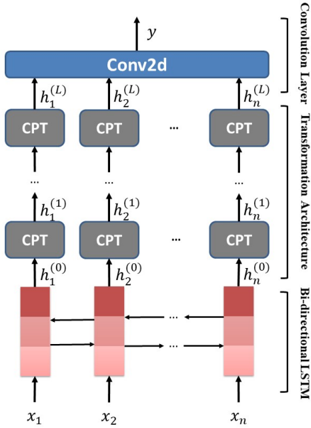
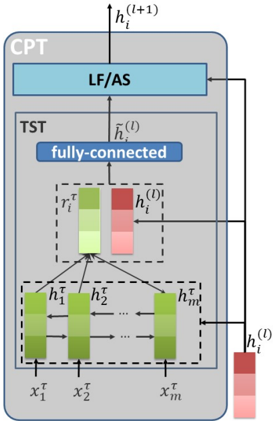
Target-oriented sentiment classification aims at classifying sentiment polarities over individual opinion targets in a sentence.RNN with attention seems a good fit for the characteristics of this task, and indeed it achieves the state-of-the-art performance.After re-examining the drawbacks of attention mechanism and the obstacles that block CNN to perform well in this classification task, we propose a new model to overcome these issues.Instead of attention, our model employs a CNN layer to extract salient features from the transformed word representations originated from a bi-directional RNN layer.Between the two layers, we propose a component to generate target-specific representations of words in the sentence, meanwhile incorporate a mechanism for preserving the original contextual information from the RNN layer.Experiments show that our model achieves a new state-of-the-art performance on a few benchmarks. 1
Overview
The claims and statistics of this paper haven’t been checked yet.
Free: it reads the open-access text and checks the first 5 claims that cite a source we can check. Create a free account to check every claim.
Integrity signals
Registry
Cites
Statistics
Figures
Verification
Claims the paper makes
The claims and statistics of this paper haven’t been checked yet.
Free: it reads the open-access text and checks the first 5 claims that cite a source we can check. Create a free account to check every claim.
Self-check
Percentages, sums and reported differences re-computed from the paper’s own numbers.
The self-check needs the paper’s full text.
Citations
Cites
Deep Residual Learning for Image Recognition
He, K., Zhang, X., Ren, S., & Sun, J. (2016) · 2016 IEEE Conference on Computer Vision and Pattern Recognition (CVPR) · doi:10.1109/cvpr.2016.90 · Cited by 235,474
Adam: A Method for Stochastic Optimization
Kingma, D. P., & Ba, J. (2014) · arXiv · doi:10.48550/arxiv.1412.6980 · Cited by 98,946
LeCun, Y., Bengio, Y., & Hinton, G. (2015) · Nature · doi:10.1038/nature14539 · Cited by 84,126
Glove: Global Vectors for Word Representation
Pennington, J., Socher, R., & Manning, C. (2014) · Proceedings of the 2014 Conference on Empirical Methods in Natural Language Processing (EMNLP) · doi:10.3115/v1/d14-1162 · Cited by 34,071
Neural Machine Translation by Jointly Learning to Align and Translate
Bahdanau, D., Cho, K., & Bengio, Y. (2014) · arXiv · doi:10.48550/arxiv.1409.0473 · Cited by 16,213
Convolutional Neural Networks for Sentence Classification
Kim, Y. (2014) · Proceedings of the 2014 Conference on Empirical Methods in Natural Language Processing (EMNLP) · doi:10.3115/v1/d14-1181 · Cited by 14,831
Representation Learning: A Review and New Perspectives
Bengio, Y., Courville, A., & Vincent, P. (2013) · IEEE Transactions on Pattern Analysis and Machine Intelligence · doi:10.1109/tpami.2013.50 · Cited by 13,001
Identity mappings in deep residual networks
He, K., Zhang, X., Ren, S., & Sun, J. (2016) · Lecture Notes in Computer Science · doi:10.1007/978-3-319-46493-0_38 · Cited by 10,741
Identity Mappings in Deep Residual Networks
He, K., Zhang, X., Ren, S., & Sun, J. (2016) · arXiv · doi:10.48550/arxiv.1603.05027 · Cited by 10,665 · cited 1×
“CPT also contains a context-preserving mechanism, resembling identity mapping (He et al., 2016a,b) and highway connection (Srivastava et al., 2015a,b), allows preserving the context information and learning more abstract word-level features using a deep network.”
BackgroundEffective Approaches to Attention-based Neural Machine Translation
Luong, T., Pham, H., & Manning, C. D. (2015) · Proceedings of the 2015 Conference on Empirical Methods in Natural Language Processing · doi:10.18653/v1/d15-1166 · Cited by 8,382
Cited by
A survey of the recent architectures of deep convolutional neural networks
Khan, A., Sohail, A., Zahoora, U., & Qureshi, A. S. (2020) · Artificial Intelligence Review · doi:10.1007/s10462-020-09825-6 · Cited by 3,137
“In one of the previous studies, Transformation network (Jaderberg et al. 2015; Li et al. 2018) also exploited the idea of attention in a simple way by incorporating it with convolution block, but the main problem was that attention modules in Transformation network are fixed and cannot adapt to changing circumstances.”
BackgroundAspect-based Sentiment Classification with Aspect-specific Graph Convolutional Networks
Zhang, C., Li, Q., & Song, D. (2019) · Proceedings of the 2019 Conference on Empirical Methods in Natural Language Processing and the 9th International Joint Conference on Natural Language Processing (EMNLP-IJCNLP) · doi:10.18653/v1/d19-1464 · Cited by 712
Relational Graph Attention Network for Aspect-based Sentiment Analysis
Wang, K., Shen, W., Yang, Y., Quan, X., & Wang, R. (2020) · Proceedings of the 58th Annual Meeting of the Association for Computational Linguistics · doi:10.18653/v1/2020.acl-main.295 · Cited by 665
A systematic review on affective computing: emotion models, databases, and recent advances
Wang, Y., Song, W., Tao, W., Liotta, A., Yang, D., Li, X., Gao, S., Sun, Y., Ge, W., Zhang, W., et al. (2022) · Information Fusion · doi:10.1016/j.inffus.2022.03.009 · Cited by 615
Self-citationA Survey on Aspect-Based Sentiment Analysis: Tasks, Methods, and Challenges
Zhang, W., Li, X., Deng, Y., Bing, L., & Lam, W. (2023) · IEEE Transactions on Knowledge and Data Engineering · doi:10.1109/tkde.2022.3230975 · Cited by 567
Self-citation
Metadata
- Authors
- Li, X., Bing, L., Lam, W., & Shi, B.
- Affiliations
- Chinese University of Hong Kong (HK)
- Tencent (China) (CN)
- Venue
- Proceedings of the 56th Annual Meeting of the Association for Computational Linguistics (Volume 1: Long Papers)
- Published
- 2018
- Pages
- 946-956
- ISSN
- 0736-587X (ISSN-L)
- OpenAlex
- W2963240575
- Cited by
- 603
- References
- 43
- Citations by year
- 2026: 28 · 2025: 52 · 2024: 74 · 2023: 75 · 2022: 102 · 2021: 104 · 2020: 88 · 2019: 75 · 2018: 5
- FWCI
- 21.59
- Type
- conference paper
- Language
- en
- Open access
- hybrid
- doi.org
- Licence
- cc-by
- Locations
- Proceedings of the conference - Association for Computational Linguistics. Meeting (publishedVersion, cc-by)
- arXiv (Cornell University) (submittedVersion)
- arXiv (Cornell University)
- Funders
- Tencent
- Topics
- Physical Sciences › Computer Science › Artificial Intelligence › Sentiment Analysis and Opinion Mining
- Physical Sciences › Computer Science › Artificial Intelligence › Topic Modeling
- Physical Sciences › Computer Science › Artificial Intelligence › Hate Speech and Cyberbullying Detection
- Keywords
- sentiment polarity, transformation networks, bidirectional RNN, attention mechanism, CNN feature extraction
About these checks
Registry, retraction, Cites and statistics results are computed, not judged, with one exception: a printed reference that no index lists is read once by a model before it counts as a citation error. Claims are extracted by a model and kept only when their quote appears verbatim in the text; each cited source is then checked, with a model’s help, for whether it says what the claim relies on. Those verdicts can be wrong — read the claim’s quote and the cited source before relying on one.
Statistics and arithmetic are recomputed, not judged.
Confidence bands are shown only for fields calibrated on our annotated test set. None is calibrated yet, so no band is shown.
What counts as a claim ›How we measure confidence ›How we check this ›
Are you an author, or do you see a problem with this page? Request a review
Data sources
Bibliographic data: Semantic Scholar, OpenAlex, Crossref.
Contains information from the Semantic Scholar Academic Graph Datasets, made available under the ODC Attribution License (ODC-BY 1.0).
Semantic Scholar’s data is described in: Kinney, R., et al. (2023). The Semantic Scholar Open Data Platform. arXiv:2301.10140.
