

An End-to-end Approach for Handling Unknown Slot Values in Dialogue State Tracking
The DOI matches its Crossref record; 26 of the 26 references it cites were found in a registry or an index.
Abstract
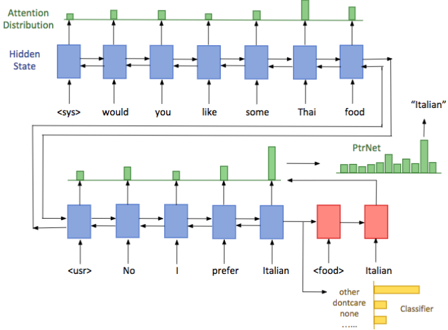
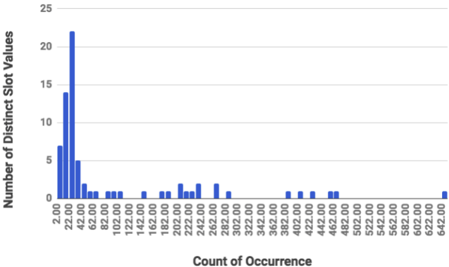
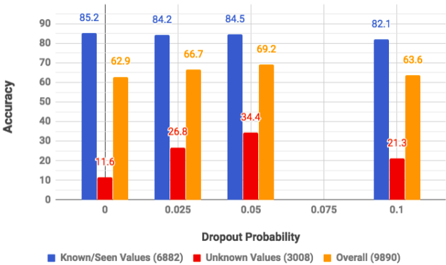
We highlight a practical yet rarely discussed problem in dialogue state tracking (DST), namely handling unknown slot values.Previous approaches generally assume predefined candidate lists and thus are not designed to output unknown values, especially when the spoken language understanding (SLU) module is absent as in many end-to-end (E2E) systems.We describe in this paper an E2E architecture based on the pointer network (PtrNet) that can effectively extract unknown slot values while still obtains state-of-the-art accuracy on the standard DSTC2 benchmark.We also provide extensive empirical evidence to show that tracking unknown values can be challenging and our approach can bring significant improvement with the help of an effective feature dropout technique.
Overview
The claims and statistics of this paper haven’t been checked yet.
Free: it reads the open-access text and checks the first 5 claims that cite a source we can check. Create a free account to check every claim.
Integrity signals
Registry
Cites
Statistics
Figures
Verification
Claims the paper makes
The claims and statistics of this paper haven’t been checked yet.
Free: it reads the open-access text and checks the first 5 claims that cite a source we can check. Create a free account to check every claim.
Claims other papers make about this one
Each is checked against this paper’s own text: does it say what the citing paper says it does?
The cited source says what the claim attributes to it.
In the citing paper
“In more recent end-to-end approaches for dialogue modeling, speech, and feedback recognition can be seen as a classification task from user behavior to the state of the system (Qian et al., 2017; Shi et al., 2017), or to the value of specific slots in a slot-filling dialogue state (Xu and Hu, 2018; Ma et al., 2020; Ouyang et al., 2020; Zhang et al., 2020).”
From Modeling Feedback in Interaction With Conversational Agents—A Review (2022) · cites this paper as Xu and Hu, 2018
Self-check
Percentages, sums and reported differences re-computed from the paper’s own numbers.
The self-check needs the paper’s full text.
Citations
Cites
Adam: A Method for Stochastic Optimization
Kingma, D. P., & Ba, J. (2014) · arXiv · doi:10.48550/arxiv.1412.6980 · Cited by 98,946
Improving neural networks by preventing co-adaptation of feature detectors
Hinton, G. E., Srivastava, N., Krizhevsky, A., Sutskever, I., & Salakhutdinov, R. R. (2012) · arXiv · doi:10.48550/arxiv.1207.0580 · Cited by 6,382 · cited 1×
“Feature dropout is an effective technique to prevent feature co-adaption and improve model generalization (Hinton et al., 2012).”
MethodGet To The Point: Summarization with Pointer-Generator Networks
See, A., Liu, P. J., & Manning, C. D. (2017) · Proceedings of the 55th Annual Meeting of the Association for Computational Linguistics (Volume 1: Long Papers) · doi:10.18653/v1/p17-1099 · Cited by 3,775 · cited 1×
“The proposed combined architecture, taking the best of both worlds, is similar to the pointer-generator model introduced in (See et al., 2017) for abstractive text summarization.”
MethodVinyals, O., Fortunato, M., & Jaitly, N. (2015) · neural information processing systems · Cited by 3,005
Incorporating Copying Mechanism in Sequence-to-Sequence Learning
Gu, J., Lu, Z., Li, H., & Li, V. O. K. (2016) · Proceedings of the 54th Annual Meeting of the Association for Computational Linguistics (Volume 1: Long Papers) · doi:10.18653/v1/p16-1154 · Cited by 1,446
A Network-based End-to-End Trainable Task-oriented Dialogue System
Wen, T.-H., Vandyke, D., Mrkšić, N., Gasic, M., Rojas Barahona, L. M., Su, P.-H., Ultes, S., & Young, S. (2017) · Proceedings of the 15th Conference of the European Chapter of the Association for Computational Linguistics: Volume 1, Long Papers · doi:10.18653/v1/e17-1042 · Cited by 778
The Second Dialog State Tracking Challenge
Henderson, M., Thomson, B., & Williams, J. D. (2014) · Proceedings of the 15th Annual Meeting of the Special Interest Group on Discourse and Dialogue (SIGDIAL) · doi:10.18653/v1/w14-4337 · Cited by 538
Spoken Language Understanding: Systems for Extracting Semantic Information from Speech
Tür, G., & Mori, R. D. (2011) · Cited by 510
Gulcehre, C., Ahn, S., Nallapati, R., Zhou, B., & Bengio, Y. (2016) · Proceedings of the 54th Annual Meeting of the Association for Computational Linguistics (Volume 1: Long Papers) · doi:10.18653/v1/p16-1014 · Cited by 478
Neural Belief Tracker: Data-Driven Dialogue State Tracking
Mrkšić, N., Ó Séaghdha, D., Wen, T.-H., Thomson, B., & Young, S. (2017) · Proceedings of the 55th Annual Meeting of the Association for Computational Linguistics (Volume 1: Long Papers) · doi:10.18653/v1/p17-1163 · Cited by 459
Machine Comprehension Using Match-LSTM and Answer Pointer
Wang, S., & Jiang, J. (2016) · arXiv (Cornell University) · doi:10.48550/arxiv.1608.07905 · Cited by 408
The Dialog State Tracking Challenge
Williams, J. D., Raux, A., Ramachandran, D., & Black, A. W. (2013) · Cited by 407
Word-Based Dialog State Tracking with Recurrent Neural Networks
Henderson, M., Thomson, B., & Young, S. (2014) · Proceedings of the 15th Annual Meeting of the Special Interest Group on Discourse and Dialogue (SIGDIAL) · doi:10.18653/v1/w14-4340 · Cited by 337
End-to-End Task-Completion Neural Dialogue SystemsPreprint
Li, X., Chen, Y.-N., Li, L. C., Gao, J., & Çelikyılmaz, A. (2017) · arXiv (Cornell University) · doi:10.48550/arxiv.1703.01008 · Cited by 327
Towards End-to-End Reinforcement Learning of Dialogue Agents for Information Access
Dhingra, B., Li, L., Li, X., Gao, J., Chen, Y.-N., Ahmed, F., & Deng, L. (2017) · Proceedings of the 55th Annual Meeting of the Association for Computational Linguistics (Volume 1: Long Papers) · doi:10.18653/v1/p17-1045 · Cited by 272
Zhao, T., & Eskenazi, M. (2016) · Proceedings of the 17th Annual Meeting of the Special Interest Group on Discourse and Dialogue · doi:10.18653/v1/w16-3601 · Cited by 255
Multi-domain dialog state tracking using recurrent neural networks
Séaghdha, D. Ó., Thomson, B., Su, P.-H., Vandyke, D., Wen, T.-H., & Young, S. J. (n.d.) · Cited by 172
A Copy-Augmented Sequence-to-Sequence Architecture Gives Good Performance on Task-Oriented Dialogue
Eric, M., & Manning, C. (2017) · Proceedings of the 15th Conference of the European Chapter of the Association for Computational Linguistics: Volume 2, Short Papers · doi:10.18653/v1/e17-2075 · Cited by 134
Scalable multi-domain dialogue state tracking
Rastogi, A., Hakkani-Tur, D., & Heck, L. (2017) · 2017 IEEE Automatic Speech Recognition and Understanding Workshop (ASRU) · doi:10.1109/asru.2017.8268986 · Cited by 110
End-to-end LSTM-based dialog control optimized with supervised and reinforcement learning
Williams, J. D., & Zweig, G. (2016) · arXiv (Cornell University) · doi:10.48550/arxiv.1606.01269 · Cited by 108
Incremental LSTM-based dialog state tracker
Žilka, L., & Jurčíček, F. (2015) · IEEE Workshop on Automatic Speech Recognition and Understanding (ASRU) · doi:10.1109/asru.2015.7404864 · Cited by 91
Dialog state tracking, a machine reading approach using Memory Network
Pérez, J., & Liu, F. (2017) · Conference of the European Chapter of the Association for Computational Linguistics · doi:10.18653/v1/e17-1029 · Cited by 71
Multi-domain Dialog State Tracking using Recurrent Neural Networks
Mrkšić, N., Ó Séaghdha, D., Thomson, B., Gasic, M., Su, P.-H., Vandyke, D., Wen, T.-H., & Young, S. (2015) · Proceedings of the 53rd Annual Meeting of the Association for Computational Linguistics and the 7th International Joint Conference on Natural Language Processing (Volume 2: Short Papers) · doi:10.3115/v1/p15-2130 · Cited by 50
End-to-End Optimization of Task-Oriented Dialogue Model with Deep Reinforcement Learning
Liu, B., Tür, G., Hakkani-Tür, D. Z., Shah, P., & Heck, L. P. (2017) · arXiv (Cornell University) · doi:10.48550/arxiv.1711.10712 · Cited by 50
Discriminative state tracking for spoken dialog systems
Metallinou, A., Bohus, D., & Williams, J. D. (2013) · Cited by 32
Targeted feature dropout for robust slot filling in natural language understanding
Xu, P., & Sarikaya, R. (2014) · Interspeech (USB) · doi:10.21437/interspeech.2014-64 · Cited by 24
Self-citation
Research works printed but not linked: 4
- Antoine Bordes and Jason Weston. 2016. Learning end-to-end goal-oriented dialog. In CoRR.
- Mihail Eric and Christopher Manning. 2017b. Key- value retrieval networks for task-oriented dialogue. In arXiv preprint arXiv:1705.05414v2 [cs.CL]. · arXiv
- Matthew Henderson, Blaise Thomson, and Steve Young. 2014b. Robust dialosg state tracking using delexicalised recurrent neural networks and unsu- pervised adaptation. In Proceedings of IEEE Spoken Language Technology..
- Jason Weston, Sumit Chopra, and Antoine Bordes. 2014. Memory networks. In CoRR.
Cited by
Transferable Multi-Domain State Generator for Task-Oriented Dialogue Systems
Wu, C.-S., Madotto, A., Hosseini-Asl, E., Xiong, C., Socher, R., & Fung, P. (2019) · Proceedings of the 57th Annual Meeting of the Association for Computational Linguistics · doi:10.18653/v1/p19-1078 · Cited by 415
TripPy: A Triple Copy Strategy for Value Independent Neural Dialog State Tracking
Heck, M., van Niekerk, C., Lubis, N., Geishauser, C., Lin, H.-C., Moresi, M., & Gasic, M. (2020) · Proceedings of the 21th Annual Meeting of the Special Interest Group on Discourse and Dialogue · doi:10.18653/v1/2020.sigdial-1.4 · Cited by 181
Dialog State Tracking: A Neural Reading Comprehension Approach
Gao, S., Sethi, A., Agarwal, S., Chung, T., & Hakkani-Tur, D. (2019) · Proceedings of the 20th Annual SIGdial Meeting on Discourse and Dialogue · doi:10.18653/v1/w19-5932 · Cited by 164
“Perhaps, the most similar technique to our work is the pointer networks proposed by Xu and Hu (2018) wherein an attention-based mechanism is employed to point the start and end token of a slot value.”
MethodModeling Feedback in Interaction With Conversational Agents—A Review
Axelsson, A., Buschmeier, H., & Skantze, G. (2022) · Frontiers in Computer Science · doi:10.3389/fcomp.2022.744574 · Cited by 45
Metadata
- Authors
- Xu, P., & Hu, Q.
- Venue
- Proceedings of the 56th Annual Meeting of the Association for Computational Linguistics (Volume 1: Long Papers)
- Published
- 2018
- Pages
- 1448-1457
- Cited by
- 38
- References
- 26
About these checks
Registry, retraction, Cites and statistics results are computed, not judged, with one exception: a printed reference that no index lists is read once by a model before it counts as a citation error. Claims are extracted by a model and kept only when their quote appears verbatim in the text; each cited source is then checked, with a model’s help, for whether it says what the claim relies on. Those verdicts can be wrong — read the claim’s quote and the cited source before relying on one.
Statistics and arithmetic are recomputed, not judged.
Confidence bands are shown only for fields calibrated on our annotated test set. None is calibrated yet, so no band is shown.
What counts as a claim ›How we measure confidence ›How we check this ›
Are you an author, or do you see a problem with this page? Request a review
Data sources
Bibliographic data: Semantic Scholar, OpenAlex, Crossref.
Contains information from the Semantic Scholar Academic Graph Datasets, made available under the ODC Attribution License (ODC-BY 1.0).
Semantic Scholar’s data is described in: Kinney, R., et al. (2023). The Semantic Scholar Open Data Platform. arXiv:2301.10140.
