

The DOI matches its Crossref record; 31 of the 33 references it cites were found in a registry or an index.
Multimodal and Multi-view Models for Emotion Recognition
Open accessAbstract
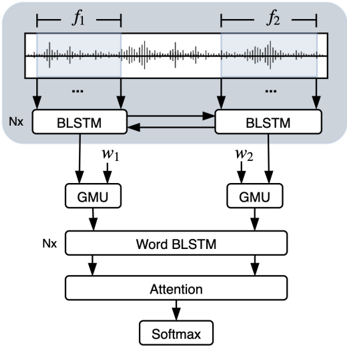
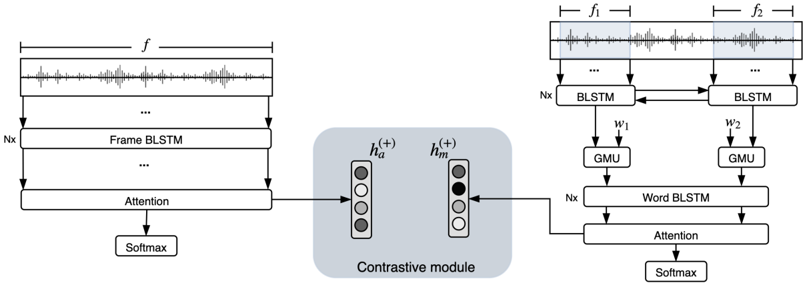
Studies on emotion recognition (ER) show that combining lexical and acoustic information results in more robust and accurate models.The majority of the studies focus on settings where both modalities are available in training and evaluation.However, in practice, this is not always the case; getting ASR output may represent a bottleneck in a deployment pipeline due to computational complexity or privacyrelated constraints.To address this challenge, we study the problem of efficiently combining acoustic and lexical modalities during training while still providing a deployable acoustic model that does not require lexical inputs.We first experiment with multimodal models and two attention mechanisms to assess the extent of the benefits that lexical information can provide.Then, we frame the task as a multi-view learning problem to induce semantic information from a multimodal model into our acoustic-only network using a contrastive loss function.Our multimodal model outperforms the previous state of the art on the USC-IEMOCAP dataset reported on lexical and acoustic information.Additionally, our multi-view-trained acoustic network significantly surpasses models that have been exclusively trained with acoustic features.
Overview
The claims and statistics of this paper haven’t been checked yet.
Run the check — free, no account needed. It reads the open-access text and checks the sources it cites.
Integrity signals
Registry
Cites
Statistics
Figures
Verification
Claims the paper makes
The claims and statistics of this paper haven’t been checked yet.
Run the check — free, no account needed. It reads the open-access text and checks the sources it cites.
Claims other papers make about this one
Each is checked against this paper’s own text: does it say what the citing paper says it does?
The source backs part of the claim, not all of it — or backs it for a different population, condition or comparison.
In the citing paper
“Existing multimodal fusion models trained on full-modality samples usually fail when partial modalities are missing (Aguilar et al., 2019; Pham et al., 2019; Cai et al., 2018; Parthasarathy and Sundaram, 2020).”
From Missing Modality Imagination Network for Emotion Recognition with Uncertain Missing Modalities (2021) · cites this paper as Aguilar et al., 2019
Experimental — accuracy not yet measuredThe source backs part of the claim, not all of it — or backs it for a different population, condition or comparison.
In the citing paper
“Current multimodal models trained on complete data usually fail when tested on incomplete data (Aguilar et al., 2019; Pham et al., 2019).”
From Multimodal Prompt Learning with Missing Modalities for Sentiment Analysis and Emotion Recognition (2024) · cites this paper as Aguilar et al., 2019
Experimental — accuracy not yet measured
Self-check
Percentages, sums and reported differences re-computed from the paper’s own numbers.
The self-check needs the paper’s full text.
Citations
Cites
Adam: A Method for Stochastic Optimization
Kingma, D. P., & Ba, J. (2014) · arXiv · doi:10.48550/arxiv.1412.6980 · Cited by 98,946
(2014) · Cited by 33,419
Batch Normalization: Accelerating Deep Network Training by Reducing Internal Covariate Shift
Ioffe, S., & Szegedy, C. (2015) · arXiv · doi:10.48550/arxiv.1502.03167 · Cited by 27,818
Neural Machine Translation by Jointly Learning to Align and Translate
Bahdanau, D., Cho, K., & Bengio, Y. (2014) · arXiv · doi:10.48550/arxiv.1409.0473 · Cited by 16,213
Batch Normalization: Accelerating Deep Network Training by Reducing Internal Covariate ShiftPreprint
Ioffe, S. (2024) · arXiv (Cornell University) · doi:10.57702/o9raffed · Cited by 15,273
Deep Contextualized Word Representations
Peters, M., Neumann, M., Iyyer, M., Gardner, M., Clark, C., Lee, K., & Zettlemoyer, L. (2018) · Proceedings of the 2018 Conference of the North American Chapter of the Association for Computational Linguistics: Human Language Technologies, Volume 1 (Long Papers) · doi:10.18653/v1/n18-1202 · Cited by 11,983
(2016) · Cited by 11,679
Combining labeled and unlabeled data with co-training
Blum, A. L., & Mitchell, T. M. (1998) · Conference on Learning Theory · doi:10.1145/279943.279962 · Cited by 5,597
IEMOCAP: Interactive emotional dyadic motion capture database
Busso, C., Bulut, M., Lee, C.-C., Kazemzadeh, A., Mower, E., Kim, S., Chang, J. N., Lee, S., & Narayanan, S. S. (2008) · Language Resources and Evaluation · doi:10.1007/s10579-008-9076-6 · Cited by 3,869
Tensor Fusion Network for Multimodal Sentiment Analysis
Zadeh, A., Chen, M., Poria, S., Cambria, E., & Morency, L.-P. (2017) · Proceedings of the 2017 Conference on Empirical Methods in Natural Language Processing · doi:10.18653/v1/d17-1115 · Cited by 2,102
Deep Canonical Correlation Analysis
Andrew, G., Arora, R., Bilmes, J., & Livescu, K. (2013) · Cited by 1,603
Recent developments in openSMILE, the munich open-source multimedia feature extractor
Eyben, F., Weninger, F. J., Gross, F., & Schuller, B. W. (2013) · ACM International Conference on Multimedia (ACM MM) · doi:10.1145/2502081.2502224 · Cited by 1,265
A Survey on Multi-view LearningPreprint
Xu, C., Tao, D., & Xu, C. (2013) · arXiv (Cornell University) · doi:10.48550/arxiv.1304.5634 · Cited by 1,252
On Deep Multi-View Representation Learning
Wang, W., Livescu, K., & Bilmes, J. (2015) · Cited by 752
Self-citationSchuller, B. W., Steidl, S., Batliner, A. M., Vinciarelli, A., Scherer, K. R., Ringeval, F., Chétouani, M., Weninger, F. J., Eyben, F., Marchi, E., et al. (2013) · Interspeech (USB) · doi:10.21437/interspeech.2013-56 · Cited by 732
Gated Multimodal Units for Information FusionPreprint
Arévalo, J., Solorio, T., Montes-y-Gómez, M., & Gonzalez, F. A. (2017) · arXiv (Cornell University) · doi:10.48550/arxiv.1702.01992 · Cited by 610
Conversational Memory Network for Emotion Recognition in Dyadic Dialogue Videos
Hazarika, D., Poria, S., Zadeh, A., Cambria, E., Morency, L., & Zimmermann, R. (2018) · Conference of the North American Chapter of the Association for Computational Linguistics: Human Language Technologies (NAACL-HLT) · doi:10.18653/v1/n18-1193 · Cited by 506
Understanding the exploding gradient problemPreprint
Pascanu, R., Mikolov, T., & Bengio, Y. (2012) · arXiv (Cornell University) · Cited by 413
Multimodal sentiment analysis using hierarchical fusion with context modeling
Majumder, N., Hazarika, D., Gelbukh, A. F., Cambria, E., & Poria, S. (2018) · Knowledge-Based Systems · doi:10.1016/j.knosys.2018.07.041 · Cited by 392
Multimodal Sentiment Analysis: Addressing Key Issues and Setting Up the Baselines
Poria, S., Majumder, N., Hazarika, D., Cambria, E., Gelbukh, A. F., & Hussain, A. (2018) · IEEE Intelligent Systems · doi:10.1109/mis.2018.2882362 · Cited by 264
Learning small-size DNN with output-distribution-based criteria
Li, J., Zhao, R., Huang, J.-T., & Gong, Y. (2014) · Interspeech (USB) · doi:10.21437/interspeech.2014-432 · Cited by 252
(2013) · Cited by 236
Speech emotion recognition with acoustic and lexical features
Jin, Q., Li, C., Chen, S., & Wu, H. (2015) · IEEE International Conference on Acoustics Speech and Signal Processing · doi:10.1109/icassp.2015.7178872 · Cited by 175
Interpreting ambiguous emotional expressions
Mower, E., Metallinou, A., Lee, C.-C., Kazemzadeh, A., Busso, C., Lee, S., & Narayanan, S. S. (2009) · International Conference on Affective Computing and Intelligent Interaction and workshops · doi:10.1109/acii.2009.5349500 · Cited by 127
Ensemble of SVM trees for multimodal emotion recognition
Rozgić, V., Ananthakrishnan, S., Saleem, S., Kumar, R., & Prasad, R. (2012) · Asia-Pacific Signal and Information Processing Association Annual Summit and Conference (APSIPA ASC) · Cited by 111
Adversarial Teacher-Student Learning for Unsupervised Domain Adaptation
Meng, Z., Li, J., Gong, Y., & Juang, B.-H. F. (2018) · IEEE International Conference on Acoustics Speech and Signal Processing · doi:10.1109/icassp.2018.8461682 · Cited by 85
Multi-view Recurrent Neural Acoustic Word EmbeddingsPreprint
He, W., Wang, W., & Livescu, K. (2016) · arXiv (Cornell University) · doi:10.48550/arxiv.1611.04496 · Cited by 81
Self-citationSpeech Emotion Recognition via Contrastive Loss under Siamese Networks
Lian, Z., Li, Y., Tao, J., & Huang, J. (2018) · doi:10.1145/3267935.3267946 · Cited by 58
Perceiving emotion: towards a realistic understanding of the task
Cowie, R. (2009) · Philosophical Transactions of the Royal Society B Biological Sciences · doi:10.1098/rstb.2009.0139 · Cited by 53
Pooling acoustic and lexical features for the prediction of valence
Aldeneh, Z., Khorram, S., Dimitriadis, D., & Provost, E. M. (2017) · INTERNATIONAL CONFERENCE ON MULTIMODAL INTERACTION · doi:10.1145/3136755.3136760 · Cited by 40
Which prosodic features contribute to the recognition of dramatic attitudes?
Barbulescu, A., Ronfard, R. P., & Bailly, G. (2017) · Speech Communication · doi:10.1016/j.specom.2017.07.003 · Cited by 7
Research works printed but not linked: 2
- Matthew Peters, Mark Neumann, Mohit Iyyer, Matt Gardner, Christopher Clark, Kenton Lee, and Luke Zettlemoyer. 2018. Deep contextualized word rep- resentations. In Proceedings of the 2018 Confer- ence of the North American Chapter of the Associ- ation for Computational Linguistics: Human Lan- guage Technologies, Volume 1 (Long Papers), pages 2227-2237, New Orleans, Louisiana. Association for Computational Linguistics.
- Amir Zadeh, Minghai Chen, Soujanya Poria, Erik Cambria, and Louis-Philippe Morency. 2017. Ten- sor fusion network for multimodal sentiment analy- sis. CoRR, abs/1707.07250. · arXiv
Cited by
Sorted by citations
CTNet: Conversational Transformer Network for Emotion Recognition
Lian, Z., Liu, B., & Tao, J. (2021) · IEEE/ACM Transactions on Audio Speech and Language Processing · doi:10.1109/taslp.2021.3049898 · Cited by 309
Missing Modality Imagination Network for Emotion Recognition with Uncertain Missing Modalities
Zhao, J., Li, R., & Jin, Q. (2021) · Proceedings of the 59th Annual Meeting of the Association for Computational Linguistics and the 11th International Joint Conference on Natural Language Processing (Volume 1: Long Papers) · doi:10.18653/v1/2021.acl-long.203 · Cited by 275
“Existing multimodal fusion models trained on full-modality samples usually fail when partial modalities are missing (Aguilar et al., 2019; Pham et al., 2019; Cai et al., 2018; Parthasarathy and Sundaram, 2020).”
BackgroundInfluentialA survey of speech emotion recognition in natural environment
Fahad, M. S., Ranjan, A., Yadav, J., & Deepak, A. (2020) · Digital Signal Processing · doi:10.1016/j.dsp.2020.102951 · Cited by 167
C-GCN: Correlation Based Graph Convolutional Network for Audio-Video Emotion Recognition
Nie, W., Ren, M., Nie, J., & Zhao, S. (2020) · IEEE Transactions on Multimedia · doi:10.1109/tmm.2020.3032037 · Cited by 92
Learning Audio-Video Modalities from Image Captions
Nagrani, A., Seo, P. H., Seybold, B., Hauth, A., Manén, S., Sun, C., & Schmid, C. (2022) · Lecture notes in computer science · doi:10.1007/978-3-031-19781-9_24 · Cited by 82
Metadata
- Authors
- Aguilar, G., Rozgic, V., Wang, W., & Wang, C.
- Affiliations
- University of Houston (US)
- Venue
- Proceedings of the 57th Annual Meeting of the Association for Computational Linguistics
- Published
- 2019
- Pages
- 991-1002
- ISSN
- 0736-587X (ISSN-L)
- OpenAlex
- W2952307697
- Cited by
- 45
- References
- 33
- Citations by year
- 2026: 5 · 2025: 3 · 2024: 6 · 2023: 4 · 2022: 10 · 2021: 7 · 2020: 9 · 2019: 1
- FWCI
- 8.51
- Type
- conference paper
- Language
- en
- Open access
- hybrid
- doi.org
- Licence
- cc-by
- Locations
- Proceedings of the conference - Association for Computational Linguistics. Meeting (publishedVersion, cc-by)
- arXiv (Cornell University) (submittedVersion)
- arXiv (Cornell University)
- Topics
- Physical Sciences › Computer Science › Artificial Intelligence › Emotion and Mood Recognition
- Physical Sciences › Computer Science › Artificial Intelligence › Sentiment Analysis and Opinion Mining
- Physical Sciences › Computer Science › Artificial Intelligence › Speech Recognition and Synthesis
- Keywords
- emotion recognition, multimodal fusion, lexical data, acoustic features, multi-view learning, contrastive loss, attention mechanism
About these checks
Registry, retraction, Cites and statistics results are computed, not judged, with one exception: a printed reference that no index lists is read once by a model before it counts as a citation error. Claims are extracted by a model and kept only when their quote appears verbatim in the text; each cited source is then checked, with a model’s help, for whether it says what the claim relies on. Those verdicts can be wrong — read the claim’s quote and the cited source before relying on one.
Statistics and arithmetic are recomputed, not judged.
Confidence bands are shown only for fields calibrated on our annotated test set. None is calibrated yet, so no band is shown.
What counts as a claim ›How we measure confidence ›How we check this ›
Are you an author, or do you see a problem with this page? Request a review
