

Is Attention Interpretable?
Open accessThe DOI matches its Crossref record; 43 of the 43 references it cites were found in a registry or an index.
Abstract
Attention mechanisms have recently boosted performance on a range of NLP tasks.Because attention layers explicitly weight input components' representations, it is also often assumed that attention can be used to identify information that models found important (e.g., specific contextualized word tokens).We test whether that assumption holds by manipulating attention weights in already-trained text classification models and analyzing the resulting differences in their predictions.While we observe some ways in which higher attention weights correlate with greater impact on model predictions, we also find many ways in which this does not hold, i.e., where gradient-based rankings of attention weights better predict their effects than their magnitudes.We conclude that while attention noisily predicts input components' overall importance to a model, it is by no means a fail-safe indicator.1
Overview
The claims and statistics of this paper haven’t been checked yet.
Free: it reads the open-access text and checks the first 5 claims that cite a source we can check. Create a free account to check every claim.
Integrity signals
Registry
Cites
Statistics
Figures


Verification
Claims the paper makes
The claims and statistics of this paper haven’t been checked yet.
Free: it reads the open-access text and checks the first 5 claims that cite a source we can check. Create a free account to check every claim.
Claims other papers make about this one
Each is checked against this paper’s own text: does it say what the citing paper says it does?
The source backs part of the claim, not all of it — or backs it for a different population, condition or comparison.
In the citing paper
“Besides using Incremental Deletion/Addition to evaluate correctness and output-completeness, compactness can be evaluated by counting how many features of the explanation need to be removed, perturbed or added to change the decision of the predictive model [7,34,70,123,165,221].”
From From Anecdotal Evidence to Quantitative Evaluation Methods: A Systematic Review on Evaluating Explainable AI (2023) · cites this paper as [221]
Experimental — accuracy not yet measuredIn the citing paper
“In [85], the attention mechanism weights were seen as at best noisy predictors of the relative importance of specific regions of the input sequence, and they should not be treated as justifications for the model’s decisions.”
From Survey of Explainable AI Techniques in Healthcare (2023) · cites this paper as [85]
In the citing paper
“Although this is typically the case for softmax scores [221], there might be cases where this assumption is invalid.”
From From Anecdotal Evidence to Quantitative Evaluation Methods: A Systematic Review on Evaluating Explainable AI (2023) · cites this paper as [221]
Self-check
Percentages, sums and reported differences re-computed from the paper’s own numbers.
The self-check needs the paper’s full text.
Citations
Cites
Vaswani, A., Shazeer, N., Parmar, N., Uszkoreit, J., Jones, L., Gomez, A. N., Kaiser, L., & Polosukhin, I. (2017) · arXiv · doi:10.48550/arxiv.1706.03762 · Cited by 120,404
Adam: A Method for Stochastic Optimization
Kingma, D. P., & Ba, J. (2014) · arXiv · doi:10.48550/arxiv.1412.6980 · Cited by 98,946 · cited 1×
“Unless otherwise noted, to train each model, we used Adam (Kingma and Ba, 2014) with gradient clipping of 10.0 and a patience value of 5, so we would stop training a model if five epochs elapsed without any improvement in validation set accuracy.”
MethodInfluential"Why Should I Trust You?": Explaining the Predictions of Any Classifier
Ribeiro, M. T., Singh, S., & Guestrin, C. (2016) · Proceedings of the 22nd ACM SIGKDD International Conference on Knowledge Discovery and Data Mining · doi:10.1145/2939672.2939778 · Cited by 17,555 · cited 4×
“Note, however, that we still do not take either as a gold-standard indicator of importance to the model, as with the gradient in Ross et al. (2017) and Melis and Jaakkola (2018), but merely as an alternative ordering method.”
BackgroundMethodInfluentialNeural Machine Translation by Jointly Learning to Align and Translate
Bahdanau, D., Cho, K., & Bengio, Y. (2014) · arXiv · doi:10.48550/arxiv.1409.0473 · Cited by 16,213 · cited 2×
“Specifically, we use the additive formulation originally defined in Bahdanau et al. (2015).”
BackgroundMethodConvolutional Neural Networks for Sentence Classification
Kim, Y. (2014) · Proceedings of the 2014 Conference on Empirical Methods in Natural Language Processing (EMNLP) · doi:10.3115/v1/d14-1181 · Cited by 14,831 · cited 2×
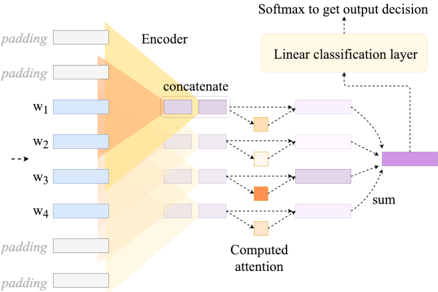
“Aside from biRNNs, we also experiment with models that instead contextualize word vectors by convolutions on only a token’s close neighbors, inspired by Kim (2014). See Figure 2 for a diagram of the FLAN architecture using a convolutional encoder.”
MethodEffective Approaches to Attention-based Neural Machine Translation
Luong, T., Pham, H., & Manning, C. D. (2015) · Proceedings of the 2015 Conference on Empirical Methods in Natural Language Processing · doi:10.18653/v1/d15-1166 · Cited by 8,382 · cited 1×
“For many different problems — to name a few, machine translation (Luong et al., 2015), syntactic parsing (Vinyals et al., 2015), reading comprehension (Hermann et al., 2015), and language modeling (Liu and Lapata, 2018) — incorporating attention mechanisms into models has proven beneficial for…”
BackgroundLipton, Z. C. (2018) · Queue · doi:10.1145/3236386.3241340 · Cited by 5,427 · cited 1×
“Lipton (2016) describes a model as “transparent” if “a person can contemplate the entire model at once.””
BackgroundHierarchical Attention Networks for Document Classification
Yang, Z., Yang, D., Dyer, C., He, X., Smola, A., & Hovy, E. (2016) · Proceedings of the 2016 Conference of the North American Chapter of the Association for Computational Linguistics: Human Language Technologies · doi:10.18653/v1/n16-1174 · Cited by 4,712 · cited 6×
“Our model architectures are inspired by the hierarchical attention network (HAN; Yang et al., 2016), a text classification model with two layers of attention, first to the word tokens in each sentence and then to the resulting sentence representations.”
BackgroundMethodResultInfluentialCharacter-level Convolutional Networks for Text Classification
Zhang, X., Zhao, J., & LeCun, Y. (2015) · arXiv (Cornell University) · doi:10.48550/arxiv.1509.01626 · Cited by 3,205 · cited 3×
“We investigate four model architectures on a topic classification dataset (Yahoo Answers; Zhang et al., 2015) and on three review ratings datasets: IMDB (Diao et al.”
MethodTeaching Machines to Read and Comprehend
Hermann, K. M., Kočiský, T., Grefenstette, E., Espeholt, L., Kay, W., Suleyman, M., & Blunsom, P. (2015) · arXiv (Cornell University) · doi:10.48550/arxiv.1506.03340 · Cited by 2,521 · cited 1×
“For many different problems—to name a few, machine translation (Luong et al., 2015), syntactic parsing (Vinyals et al., 2015), reading comprehension (Hermann et al., 2015), and language modeling (Liu and Lapata, 2018)—incorporating attention mechanisms into models has proven benefi-cial for…”
BackgroundAttention-based LSTM for Aspect-level Sentiment Classification
Wang, Y., Huang, M., zhu, X., & Zhao, L. (2016) · Proceedings of the 2016 Conference on Empirical Methods in Natural Language Processing · doi:10.18653/v1/d16-1058 · Cited by 2,450 · cited 1×
“Since attention calculates a distribution over inputs, prior work has used attention as a tool for interpretation of model decisions (Wang et al., 2016; Lee et al., 2017; Lin et al., 2017; Ghaeini et al., 2018).”
MethodJain, S., & Wallace, B. (2019) · Conference of the North American Chapter of the Association for Computational Linguistics: Human Language Technologies (NAACL-HLT) · doi:10.18653/v1/n19-1357 · Cited by 1,987 · cited 3×
“So far, other work looking at attention has examined whether attention suffices as a holistic explanation for a model’s decision (Jain and Wallace, 2019), which is a higher bar.”
BackgroundResultInfluentialA Structured Self-attentive Sentence Embedding
Lin, Z., Feng, M., Santos, C. N. D., Yu, M., Xiang, B., Zhou, B., & Bengio, Y. (2017) · arXiv · doi:10.48550/arxiv.1703.03130 · Cited by 1,743 · cited 1×
“Since attention calculates a distribution over inputs, prior work has used attention as a tool for interpretation of model decisions (Wang et al., 2016; Lee et al., 2017; Lin et al., 2017; Ghaeini et al., 2018).”
MethodUnderstanding Black-box Predictions via Influence Functions
Koh, P. W., & Liang, P. (2017) · arXiv · doi:10.48550/arxiv.1703.04730 · Cited by 1,514 · cited 2×
“For example, recent work has focused on which training instances (Koh and Liang, 2017) or which human-interpretable features were most relevant for a particular decision (Ribeiro et al., 2016; Arras et al., 2016).”
BackgroundSanity Checks for Saliency Maps
Adebayo, J., Gilmer, J., Muelly, M., Goodfellow, I., Hardt, M., & Kim, B. (2018) · arXiv · doi:10.48550/arxiv.1810.03292 · Cited by 1,294 · cited 1×
“Others have explored alternative ways of comparing the behavior of proposed explanation methods (Adebayo et al., 2018).”
BackgroundLong Short-Term Memory-Networks for Machine Reading
Cheng, J., Dong, L., & Lapata, M. (2016) · arXiv · doi:10.48550/arxiv.1601.06733 · Cited by 1,198 · cited 2×
“, 2017), as well as cases where a single attention layer is responsible for producing more than one attended representation, such as in self-attention (Cheng et al., 2016).”
BackgroundLong Short-Term Memory-Networks for Machine Reading
Cheng, J., Dong, L., & Lapata, M. (2016) · Proceedings of the 2016 Conference on Empirical Methods in Natural Language Processing · doi:10.18653/v1/d16-1053 · Cited by 1,172 · cited 2×
“, 2017), as well as cases where a single attention layer is responsible for producing more than one attended representation, such as in self-attention (Cheng et al., 2016).”
BackgroundInterpretation of Neural Networks is FragilePreprint
Ghorbani, A., Abid, A., & Zou, J. Y. (2017) · AAAI Conference on Artificial Intelligence · doi:10.48550/arxiv.1710.10547 · Cited by 1,153 · cited 1×
“In this work, we focus on whether the attention weights’ suggested importance ranking of I faithfully describes why the model produced its output, echoing existing work on explanation brittleness for other model components (Ghorbani et al., 2017).”
BackgroundA Class of Submodular Functions for Document Summarization
Lin, H. Z., & Bilmes, J. (2011) · Cited by 960
Rationalizing Neural Predictions
Lei, T., Barzilay, R., & Jaakkola, T. (2016) · Proceedings of the 2016 Conference on Empirical Methods in Natural Language Processing · doi:10.18653/v1/d16-1011 · Cited by 777 · cited 2×
“…inputs necessary to uphold a decision is not new; Li et al. (2016) use reinforcement learning to attempt to construct such a minimal set of words, Lei et al. (2016) train an encoder to constrain the input prior to clas-sification, and much of the work that has been done on extractive…”
BackgroundInterpretation of Neural Networks Is Fragile
Ghorbani, A., Abid, A., & Zou, J. (2019) · Proceedings of the AAAI Conference on Artificial Intelligence · doi:10.1609/aaai.v33i01.33013681 · Cited by 765
Effective Approaches to Attention-based Neural Machine Translation
Luong, M.-T., Pham, H., & Manning, C. D. (2015) · arXiv (Cornell University) · doi:10.48550/arxiv.1508.04025 · Cited by 655 · cited 1×
“For many different problems — to name a few, machine translation (Luong et al., 2015), syntactic parsing (Vinyals et al., 2015), reading comprehension (Hermann et al., 2015), and language modeling (Liu and Lapata, 2018) — incorporating attention mechanisms into models has proven beneficial for…”
BackgroundVisualizing and Understanding Neural Models in NLP
Li, J., Chen, X., Hovy, E., & Jurafsky, D. (2016) · Proceedings of the 2016 Conference of the North American Chapter of the Association for Computational Linguistics: Human Language Technologies · doi:10.18653/v1/n16-1082 · Cited by 625 · cited 1×
“The second ranking scheme, inspired by Li et al. (2015) and Feng et al. (2018), is to order the attention weights by the gradient of the decision function with respect to each calculated attention weight, in descending order.”
BackgroundRight for the Right Reasons: Training Differentiable Models by Constraining their Explanations
Ross, A. S., Hughes, M. C., & Doshi-Velez, F. (2017) · Proceedings of the Twenty-Sixth International Joint Conference on Artificial Intelligence · doi:10.24963/ijcai.2017/371 · Cited by 515 · cited 1×
“Note, however, that we still do not take either as a gold-standard indicator of importance to the model, as with the gradient in Ross et al. (2017) and Melis and Jaakkola (2018), but merely as an alternative ordering method.”
MethodJointly modeling aspects, ratings and sentiments for movie recommendation (JMARS)
Diao, Q., Qiu, M., Wu, C.-Y., Smola, A. J., Jiang, J., & Wang, C. (2014) · Proceedings of the 20th ACM SIGKDD international conference on Knowledge discovery and data mining · doi:10.1145/2623330.2623758 · Cited by 447 · cited 3×
“We note that our IMDB data and Yelp data are different sets of reviews from those used by Yang et al. (2016), so our reported performances are not directly comparable to theirs.”
BackgroundMethodFrom Softmax to Sparsemax: A Sparse Model of Attention and Multi-Label Classification
Martins, A. F. T., & Astudillo, R. F. (2016) · arXiv (Cornell University) · doi:10.48550/arxiv.1602.02068 · Cited by 431 · cited 3×
“Given attention layer ℓ ’s learned parameters, element 𝑖 of a sequence, and its encoded representation 𝐡 𝑖 , the attention weight 𝛼 𝑖 is computed using ℓ ’ s learned context vector 𝐜 ℓ as follows: 𝑗 4 Alternatives such as sparse attention (Martins and Astudillo, 2016) and unnormalized attention (Ji and Smith, 2017) ha…”
BackgroundMethodUnderstanding Neural Networks through Representation Erasure
Li, J., Monroe, W., & Jurafsky, D. (2016) · arXiv (Cornell University) · doi:10.48550/arxiv.1612.08220 · Cited by 412 · cited 2×
“The idea of a minimal set of inputs necessary to uphold a decision is not new; Li et al. (2016) use reinforcement learning to attempt to construct such a minimal set of words, Lei et al. (2016) train an encoder to constrain the input prior to clas-sification, and much of the work that has been done…”
BackgroundMethodTowards Robust Interpretability with Self-Explaining Neural Networks
Alvarez-Melis, D., & Jaakkola, T. (2018) · arXiv (Cornell University) · doi:10.48550/arxiv.1806.07538 · Cited by 397 · cited 1×
“(2017) and Melis and Jaakkola (2018), but merely as an alternative ordering method.”
BackgroundPathologies of Neural Models Make Interpretations Difficult
Feng, S., Wallace, E., Grissom II, A., Iyyer, M., Rodriguez, P., & Boyd-Graber, J. (2018) · Proceedings of the 2018 Conference on Empirical Methods in Natural Language Processing · doi:10.18653/v1/d18-1407 · Cited by 245 · cited 6×
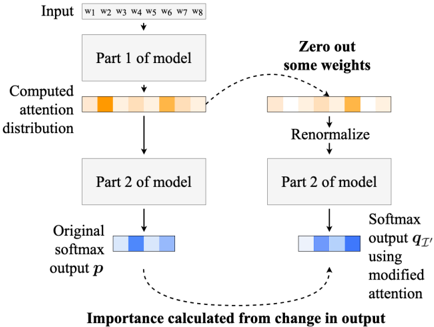
“To examine the importance of ℐ′ , we run the classification layer of the model twice (Figure 1): once without any modification, and once after renormalizing the attention distribution with ℐ′ ’s attention weights zeroed out, similar to other erasure-based work (Li et al., 2016; Feng et al., 2018).”
BackgroundMethodInfluentialComparing Automatic and Human Evaluation of Local Explanations for Text Classification
Nguyen, D. (2018) · Proceedings of the 2018 Conference of the North American Chapter of the Association for Computational Linguistics: Human Language Technologies, Volume 1 (Long Papers) · doi:10.18653/v1/n18-1097 · Cited by 173 · cited 1×
“Nguyen (2018) leveraged the idea of minimal sets in a much more similar way to our work, comparing different input importance orderings.”
ResultVisualizing and Understanding Neural Machine Translation
Ding, Y., Liu, Y., Luan, H., & Sun, M. (2017) · Proceedings of the 55th Annual Meeting of the Association for Computational Linguistics (Volume 1: Long Papers) · doi:10.18653/v1/p17-1106 · Cited by 168 · cited 1×
“The existence of so much work on visualizing attention weights is a testament to attention’s popularity in this regard; to name just a few examples of these weights being examined to understand a model, recent work has focused on goals from explaining and debugging the current system’s decision (Lee et al., 2017; Ding…”
BackgroundVisualizing and Understanding Neural Models in NLPPreprint
Li, J., Chen, X., Hovy, E. H., et al. (2015) · arXiv (Cornell University) · doi:10.48550/arxiv.1506.01066 · Cited by 165 · cited 1×
“The second ranking scheme, inspired by Li et al. (2015) and Feng et al. (2018), is to order the attention weights by the gradient of the decision function with respect to each calculated attention weight, in descending order.”
BackgroundNeural Discourse Structure for Text Categorization
Ji, Y., & Smith, N. A. (2017) · Proceedings of the conference - Association for Computational Linguistics. Meeting · doi:10.18653/v1/p17-1092 · Cited by 157
Self-citationLearning Structured Text Representations
Liu, Y., & Lapata, M. (2018) · Transactions of the Association for Computational Linguistics · doi:10.1162/tacl_a_00005 · Cited by 145 · cited 1×
“…many different problems—to name a few, machine translation (Luong et al., 2015), syntactic parsing (Vinyals et al., 2015), reading comprehension (Hermann et al., 2015), and language modeling (Liu and Lapata, 2018)—incorporating attention mechanisms into models has proven benefi-cial for performance.”
BackgroundBefore Name-Calling: Dynamics and Triggers of Ad Hominem Fallacies in Web Argumentation
Habernal, I., Wachsmuth, H., Gurevych, I., & Stein, B. (2018) · Conference of the North American Chapter of the Association for Computational Linguistics: Human Language Technologies (NAACL-HLT) · doi:10.18653/v1/n18-1036 · Cited by 128 · cited 2×
“, 2017) to distilling important traits of a dataset (Yang et al., 2017; Habernal et al., 2018).”
BackgroundSPINE: SParse Interpretable Neural Embeddings
Subramanian, A., Pruthi, D., Jhamtani, H., Berg-Kirkpatrick, T., & Hovy, E. H. (2018) · AAAI Publications (The Association for the Advancement of Artificial Intelligence (AAAI)) · doi:10.1609/aaai.v32i1.11935 · Cited by 107
Explaining Predictions of Non-Linear Classifiers in NLP
Arras, L., Horn, F., Montavon, G., Müller, K.-R., & Samek, W. (2016) · Proceedings of the 1st Workshop on Representation Learning for NLP · doi:10.18653/v1/w16-1601 · Cited by 91 · cited 1×
“For example, recent work has focused on which training instances (Koh and Liang, 2017) or which human-interpretable features were most relevant for a particular decision (Ribeiro et al., 2016; Arras et al., 2016).”
BackgroundInterpreting Recurrent and Attention-Based Neural Models: a Case Study on Natural Language Inference
Ghaeini, R., Fern, X., & Tadepalli, P. (2018) · Proceedings of the 2018 Conference on Empirical Methods in Natural Language Processing · doi:10.18653/v1/d18-1537 · Cited by 91 · cited 1×
“Since attention calculates a distribution over inputs, prior work has used attention as a tool for interpretation of model decisions (Wang et al., 2016; Lee et al., 2017; Lin et al., 2017; Ghaeini et al., 2018).”
MethodSatirical News Detection and Analysis using Attention Mechanism and Linguistic Features
Yang, F., Mukherjee, A., & Dragut, E. C. (2017) · Conference on Empirical Methods in Natural Language Processing (EMNLP) · doi:10.18653/v1/d17-1211 · Cited by 83 · cited 2×
“…name just a few examples of these weights being examined to understand a model, recent work has focused on goals from explaining and debugging the current system’s decision (Lee et al., 2017; Ding et al., 2017) to distilling important traits of a dataset (Yang et al., 2017; Habernal et al., 2018).”
BackgroundInteractive Visualization and Manipulation of Attention-based Neural Machine Translation
Lee, J., Shin, J.-H., & Kim, J.-S. (2017) · Proceedings of the 2017 Conference on Empirical Methods in Natural Language Processing: System Demonstrations · doi:10.18653/v1/d17-2021 · Cited by 67 · cited 3×
“The existence of so much work on visualizing attention weights is a testament to attention’s popularity in this regard; to name just a few examples of these weights being examined to understand a model, recent work has focused on goals from explaining and debugging the current system’s decision (Lee et al., 2017; Ding…”
BackgroundMethodA Compositional and Interpretable Semantic Space
Fyshe, A., Wehbe, L., Talukdar, P. P., Murphy, B., & Mitchell, T. M. (2015) · Conference of the North American Chapter of the Association for Computational Linguistics: Human Language Technologies (NAACL-HLT) · doi:10.3115/v1/n15-1004 · Cited by 63 · cited 1×
“Yet another line of work focuses on aligning models with human feedback for what is interpretable (Fyshe et al., 2015; Subramanian et al., 2017), which could refine our idea of what defines a high-quality explanation derived from attention.”
BackgroundInterpreting Recurrent and Attention-Based Neural Models: a Case Study on Natural Language InferencePreprint
Ghaeini, R., Fern, X. Z., & Tadepalli, P. V. (2018) · arXiv (Cornell University) · doi:10.48550/arxiv.1808.03894 · Cited by 10 · cited 1×
“Since attention calculates a distribution over inputs, prior work has used attention as a tool for interpretation of model decisions (Wang et al., 2016; Lee et al., 2017; Lin et al., 2017; Ghaeini et al., 2018).”
MethodSatirical News Detection and Analysis using Attention Mechanism and Linguistic FeaturesPreprint
Yang, F., Mukherjee, A., & Dragut, E. (2017) · arXiv (Cornell University) · doi:10.48550/arxiv.1709.01189 · Cited by 5 · cited 2×
“…name just a few examples of these weights being examined to understand a model, recent work has focused on goals from explaining and debugging the current system’s decision (Lee et al., 2017; Ding et al., 2017) to distilling important traits of a dataset (Yang et al., 2017; Habernal et al., 2018).”
Background
Research works printed but not linked: 4
- Philipp Koehn and Rebecca Knowles. 2017. Six chal- lenges for neural machine translation. In Pro- ceedings of the First Workshop on Neural Machine Translation.
- Zachary C Lipton. 2016. The mythos of model inter- pretability. arXiv preprint arXiv:1606.03490. · arXiv
- Yang Liu and Mirella Lapata. 2018. Learning struc- tured text representations. Transactions of the Asso- ciation of Computational Linguistics, 6:63-75.
- Oriol Vinyals, Łukasz Kaiser, Terry Koo, Slav Petrov, Ilya Sutskever, and Geoffrey Hinton. 2015. Gram- mar as a foreign language. In Advances in Neural Information Processing Systems.
Cited by
Han (2023) · doi:10.1109/tpami.2022.3152247 · Cited by 4,682
“Transformer is originally applied on natural language processing (NLP) tasks and brings in significant improvement [123, 29, 10].”
BackgroundInfluentialA review on the attention mechanism of deep learning
Niu, Z., Zhong, G., & Yu, H. (2021) · Neurocomputing · doi:10.1016/j.neucom.2021.03.091 · Cited by 3,379
Pre-trained models for natural language processing: A survey
Qiu, X., Sun, T., Xu, Y., Shao, Y., Dai, N., & Huang, X. (2020) · Science China Technological Sciences · doi:10.1007/s11431-020-1647-3 · Cited by 1,591
“However, much work on model analysis depends on the attention mechanism, and the effectiveness of attention for interpretability is still controversial [71, 155].”
BackgroundA primer in BERTology: What we know about how BERT works
Rogers, A., Kovaleva, O., & Rumshisky, A. (2020) · Transactions of the Association for Computational Linguistics · doi:10.1162/tacl_a_00349 · Cited by 1,552
“However, there is ongoing debate on the merits of attention as a tool for interpreting deep learning models (Jain and Wallace, 2019; Serrano and Smith, 2019; Wiegreffe and Pinter, 2019; Brunner et al., 2020).”
MethodAn Attentive Survey of Attention Models
Chaudhari, S., Mithal, V., Polatkan, G., & Ramanath, R. (2021) · ACM Transactions on Intelligent Systems and Technology · doi:10.1145/3465055 · Cited by 689
Metadata
- Authors
- Serrano, S., & Smith, N. A.
- Affiliations
- University of Washington (US)
- Venue
- Proceedings of the 57th Annual Meeting of the Association for Computational Linguistics
- Published
- 2019
- Pages
- 2931-2951
- ISSN
- 0736-587X (ISSN-L)
- OpenAlex
- W2948140294
- Cited by
- 690
- References
- 39
- Citations by year
- 2026: 63 · 2025: 85 · 2024: 82 · 2023: 102 · 2022: 119 · 2021: 143 · 2020: 80 · 2019: 15
- FWCI
- 34.15
- Type
- conference paper
- Language
- en
- Open access
- hybrid
- doi.org
- Licence
- cc-by
- Locations
- Proceedings of the conference - Association for Computational Linguistics. Meeting (publishedVersion, cc-by)
- arXiv (Cornell University) (submittedVersion)
- arXiv (Cornell University)
- Topics
- Physical Sciences › Computer Science › Artificial Intelligence › Explainable Artificial Intelligence (XAI)
- Physical Sciences › Computer Science › Artificial Intelligence › Topic Modeling
- Physical Sciences › Computer Science › Artificial Intelligence › Natural Language Processing Techniques
- Keywords
- attention mechanism, interpretability, text classification, model interpretability, feature importance, explainable AI
About these checks
Registry, retraction, Cites and statistics results are computed, not judged, with one exception: a printed reference that no index lists is read once by a model before it counts as a citation error. Claims are extracted by a model and kept only when their quote appears verbatim in the text; each cited source is then checked, with a model’s help, for whether it says what the claim relies on. Those verdicts can be wrong — read the claim’s quote and the cited source before relying on one.
Statistics and arithmetic are recomputed, not judged.
Confidence bands are shown only for fields calibrated on our annotated test set. None is calibrated yet, so no band is shown.
What counts as a claim ›How we measure confidence ›How we check this ›
Are you an author, or do you see a problem with this page? Request a review
Data sources
Bibliographic data: Semantic Scholar, OpenAlex, Crossref.
Contains information from the Semantic Scholar Academic Graph Datasets, made available under the ODC Attribution License (ODC-BY 1.0).
Semantic Scholar’s data is described in: Kinney, R., et al. (2023). The Semantic Scholar Open Data Platform. arXiv:2301.10140.
