

Learning from Dialogue after Deployment: Feed Yourself, Chatbot!
Open accessThe DOI matches its Crossref record; 55 of the 55 references it cites were found in a registry or an index.
Abstract
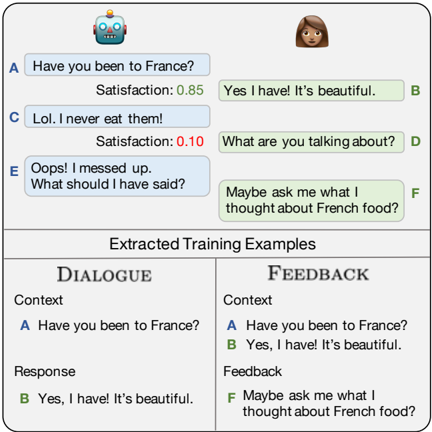
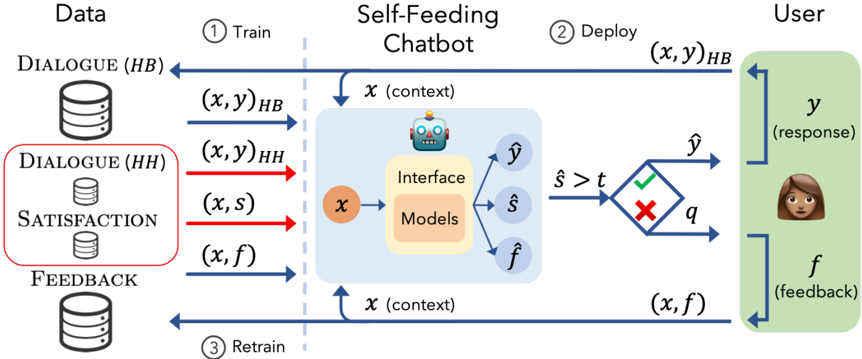
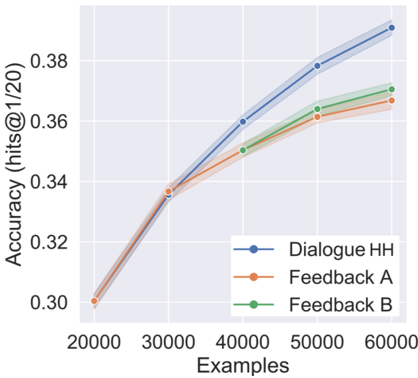
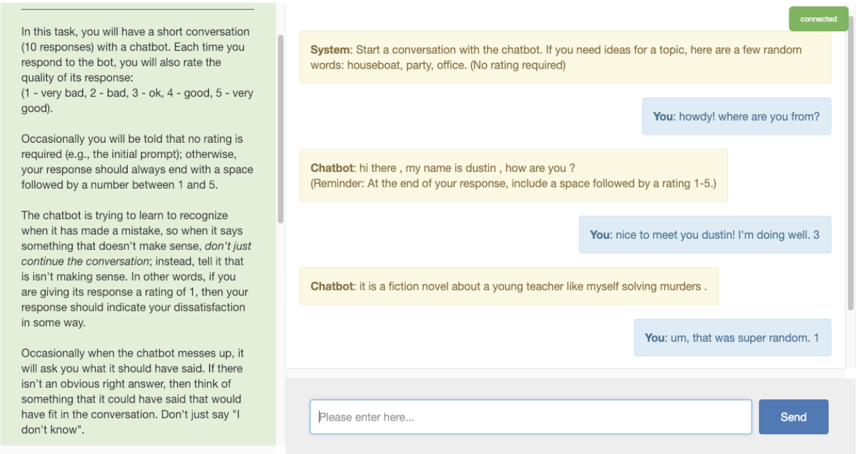
The majority of conversations a dialogue agent sees over its lifetime occur after it has already been trained and deployed, leaving a vast store of potential training signal untapped.In this work, we propose the self-feeding chatbot, a dialogue agent with the ability to extract new training examples from the conversations it participates in.As our agent engages in conversation, it also estimates user satisfaction in its responses.When the conversation appears to be going well, the user's responses become new training examples to imitate.When the agent believes it has made a mistake, it asks for feedback; learning to predict the feedback that will be given improves the chatbot's dialogue abilities further.On the PERSONACHAT chitchat dataset with over 131k training examples, we find that learning from dialogue with a selffeeding chatbot significantly improves performance, regardless of the amount of traditional supervision.
Overview
The claims and statistics of this paper haven’t been checked yet.
Free: it reads the open-access text and checks the first 5 claims that cite a source we can check. Create a free account to check every claim.
Integrity signals
Registry
Cites
Statistics
Figures
Verification
Claims the paper makes
The claims and statistics of this paper haven’t been checked yet.
Free: it reads the open-access text and checks the first 5 claims that cite a source we can check. Create a free account to check every claim.
Claims other papers make about this one
Each is checked against this paper’s own text: does it say what the citing paper says it does?
The check wasn’t confident either way, so it gives no verdict — never disputed.
In the citing paper
“Most of these approaches are limited in their task application domain.”
From User Feedback in Human-LLM Dialogues: A Lens to Understand Users But Noisy as a Learning Signal (2025) · cites this paper as Hancock et al., 2019
Experimental — accuracy not yet measured
Self-check
Percentages, sums and reported differences re-computed from the paper’s own numbers.
The self-check needs the paper’s full text.
Citations
Cites
Vaswani, A., Shazeer, N., Parmar, N., Uszkoreit, J., Jones, L., Gomez, A. N., Kaiser, L., & Polosukhin, I. (2017) · arXiv · doi:10.48550/arxiv.1706.03762 · Cited by 120,404
Adam: A Method for Stochastic Optimization
Kingma, D. P., & Ba, J. (2014) · arXiv · doi:10.48550/arxiv.1412.6980 · Cited by 98,946
BERT: Pre-training of Deep Bidirectional Transformers for Language Understanding
Devlin, J., Chang, M.-W., Lee, K., & Toutanova, K. (2018) · arXiv · doi:10.48550/arxiv.1810.04805 · Cited by 73,173
BERT: Pre-training of Deep Bidirectional Transformers for Language Understanding
Devlin, J., Chang, M.-W., Lee, K., & Toutanova, K. (2019) · Proceedings of the 2019 Conference of the North American Chapter of the Association for Computational Linguistics: Human Language Technologies, Volume 1 (Long and Short Papers) · doi:10.18653/v1/n19-1423 · Cited by 54,325
(2017) · Cited by 11,625
Enriching Word Vectors with Subword Information
Bojanowski, P., Grave, E., Joulin, A., & Mikolov, T. (2017) · Transactions of the Association for Computational Linguistics · doi:10.1162/tacl_a_00051 · Cited by 9,645 · cited 1×
“Tokens are embedded with fastText (Bojanowski et al., 2017) 300-dimensional embeddings.”
BackgroundKruger, J., & Dunning, D. (1999) · Journal of Personality and Social Psychology · doi:10.1037/0022-3514.77.6.1121 · Cited by 7,731
An Overview of Multi-Task Learning in Deep Neural Networks
Ruder, S. (2017) · arXiv (Cornell University) · doi:10.48550/arxiv.1706.05098 · Cited by 2,265
Toward an architecture for never-ending language learning
Carlson, A., Betteridge, J., Kisiel, B., Settles, B., Hruschka, E., & Mitchell, T. (2010) · Proceedings of the AAAI Conference on Artificial Intelligence · doi:10.1609/aaai.v24i1.7519 · Cited by 2,000 · cited 2×
“, 2013) and never-ending (language) learning (Carlson et al., 2010) are related to the topics dis-”
BackgroundPersonalizing Dialogue Agents: I have a dog, do you have pets too?
Zhang, S., Dinan, E., Urbanek, J., Szlam, A., Kiela, D., & Weston, J. (2018) · Proceedings of the 56th Annual Meeting of the Association for Computational Linguistics (Volume 1: Long Papers) · doi:10.18653/v1/p18-1205 · Cited by 1,177 · cited 11×
“Our experiments use the PERSONACHAT distribution that was released as a part of the ConvAI2 (Burtsev et al., 2018) challenge.”
BackgroundMethodInfluentialSelf-citation
Research works printed but not linked: 3
- T. Hong, O. Kwon, and Y. Kim. 2019. An end-to- end trainable task-oriented dialog system with hu- man feedback. In Association for the Advancement of Artificial Intelligence (AAAI).
- J. Li, A. H. Miller, S. Chopra, M. Ranzato, and J. We- ston. 2017a. Dialogue learning with human-in-the- loop. In International Conference on Learning Rep- resentations (ICLR).
- S. Tong and D. Koller. 2001. Support vector ma- chine active learning with applications to text clas- sification. Journal of machine learning research, 2(0):45-66.
Cited by
Items 101–171 of 171
The future of open human feedback
Don-Yehiya, S., Burtenshaw, B., Astudillo, R. F., Osborne, C., Jaiswal, M., Kuo, T.-S., Zhao, W., Shenfeld, I., Peng, A., Yurochkin, M., et al. (2025) · Nature Machine Intelligence · doi:10.1038/s42256-025-01038-2 · Cited by 23
“Where possible, prompted feedback, such as users’ rating or ranking of LLM responses, should be supplemented with feedback from the naturally occurring cues in the chat 91 , such as when the user verbally thanks the model or edits their original prompt 92 .”
Adapting language generation to dialogue environments and users for task-oriented dialogue systems
Ohashi, A., & Higashinaka, R. (2025) · Natural Language Processing Journal · doi:10.1016/j.nlp.2025.100153 · Cited by 15
Automatically Selecting Follow-up Questions for Deficient Bug Reports
Imran, M. M., Ciborowska, A., & Damevski, K. (2021) · International Conference on Mining Software Repositories (MSR) · doi:10.1109/msr52588.2021.00029 · Cited by 22
БІБЛІОМЕТРИЧНИЙ АНАЛІЗ ДОСЛІДЖЕНЬ З НАВЧАННЯ ЧАТ-БОТІВ: КЛЮЧОВІ ПОНЯТТЯ ТА ТЕНДЕНЦІЇ
Liashenko, R. O., & Semerikov, S. O. (2024) · Information Technologies and Learning Tools · doi:10.33407/itlt.v101i3.5622 · Cited by 13
Multi-modal Emotion Recognition for User Adaptation in Social Robots
Schiffmann, M., Thoma, A., & Richert, A. (2021) · Lecture notes in networks and systems · doi:10.1007/978-3-030-79997-7_16 · Cited by 5
Personalizing Retrieval-Based Dialogue Agents
Posokhov, P., Matveeva, A., Makhnytkina, O. V., Matveev, A., & Matveev, Y. N. (2022) · Lecture notes in computer science · doi:10.1007/978-3-031-20980-2_47 · Cited by 6
Learning Improvised Chatbots from Adversarial Modifications of Natural Language Feedback
Sreedhar, M. N., Ni, K., & Reddy, S. (2020) · Findings of the Association for Computational Linguistics: EMNLP (Findings of EMNLP) · doi:10.18653/v1/2020.findings-emnlp.221 · Cited by 9
Eskénazi, M., & Zhao, T. (2020) · arXiv (Cornell University) · doi:10.48550/arxiv.2006.06026 · Cited by 8
Learning from Human Feedback: Challenges for Real-World Reinforcement Learning in NLP.Preprint
Kreutzer, J., Riezler, S., & Lawrence, C. (2020) · arXiv (Cornell University) · Cited by 7
Liu, J., Liu, J., Wang, Q., Wang, J., Cai, X., Zhao, D., Wang, R., & Yan, R. (2023) · Findings of the Association for Computational Linguistics: EMNLP (Findings of EMNLP) · doi:10.18653/v1/2023.findings-emnlp.578 · Cited by 9
Toward Self-Learning End-to-End Task-oriented Dialog Systems
Zhang, X., Peng, B., Gao, J., & Meng, H. M. L. (2022) · Annual Meeting of the Special Interest Group on Discourse and Dialogue · doi:10.18653/v1/2022.sigdial-1.49 · Cited by 8
“517 mulated after deployment are cheap, dynamic and contain useful information (Hancock et al., 2019),”
BackgroundDialogue in the Wild: Learning from a Deployed Role-Playing Game with Humans and Bots
Shuster, K., Urbanek, J., Dinan, E., Szlam, A. D., & Weston, J. (2021) · Findings of the Association for Computational Linguistics: ACL (Findings of ACL) · doi:10.18653/v1/2021.findings-acl.54 · Cited by 18
“Closer to our work, is the self-feeding chatbot (Hancock et al., 2019), where dialogue models were used to collect data to improve themselves via crowdsourcing utilizing the PersonaChat task.”
MethodSelf-citationUser Satisfaction Modeling with Domain Adaptation in Task-oriented Dialogue Systems
Pan, Y., Ma, M., Pflugfelder, B., & Groh, G. (2022) · Annual Meeting of the Special Interest Group on Discourse and Dialogue · doi:10.18653/v1/2022.sigdial-1.59 · Cited by 5
“When USE detects good user feedback in the deployment environment, chatbots can utilize this information to learn and improve continuously (Hancock et al., 2019).”
MethodUser Feedback in Human-LLM Dialogues: A Lens to Understand Users But Noisy as a Learning Signal
Liu, Y., Zhang, M. J. Q., & Choi, E. (2025) · arXiv · doi:10.48550/arxiv.2507.23158 · Cited by 29
“Hancock et al. (2019) uses feedback responses associated with the conversation partner’s attitude in chatbot applications.”
Fine-Tuning an LLM Using QLORA and PEFT with RLHF Dataset
Shalini, T. G., Geetha, P., Yugabharathi, R., & Arsath, R. (2025) · International Conference on Visual Analytics and Data Visualization (ICVADV) · doi:10.1109/icvadv63329.2025.10961936 · Cited by 5
Predict-Then-Decide: A Predictive Approach for Wait or Answer Task in Dialogue Systems
Lin, Z., Cui, S., Li, G., Kang, X., Ji, F. Q., Li, F.-L., Zhao, Z., Chen, H., & Zhang, Y. (2021) · IEEE/ACM Transactions on Audio Speech and Language Processing · doi:10.1109/taslp.2021.3110145 · Cited by 3
“Task-oriented dialogue systems [13], [14], [15] aim at solving tasks in specific domains with grounding knowledge while chit-chat bots [16], [17], [18] mainly concentrate on interacting with a human to provide reasonable responses and entertainment [19].”
BackgroundResearch on Automatic Generation of Social Short Text Based on Backtracking Pattern
Ma, R., Gao, Y., Li, X., & Yang, L. (2023) · Asia-Pacific Conference on Image Processing, Electronics and Computers (IPEC) · doi:10.1109/ipec57296.2023.00066 · Cited by 4
“Hancock [20] et al. designed a self-feedback chat robot based on the Transformer model, when the dialogue goes well, the user's answer is imitated as a new example of training, when the dialogue is not smooth, it will feed back and correct and establish a new paradigm to improve the fluency and…”
MethodA Weak Supervision-Based Approach to Improve Chatbots for Code Repositories
Farhour, F., Abdellatif, A., Mansour, E., & Shihab, E. (2024) · Proceedings of the ACM on software engineering. · doi:10.1145/3660812 · Cited by 4
“For example, Hancock et al. [24] developed a self-feeding approach to train a chit-chat chatbot on the posed query if the user’s satisfaction with the chatbot response is above a certain threshold.”
InfluentialLearning Personalized End-to-End Task-Oriented Dialogue for Fast and Reliable Adaptation
Qiu, S., & Zhang, K. (2021) · International Conference on Digital Society and Intelligent Systems (DSInS) · doi:10.1109/dsins54396.2021.9670559 · Cited by 4
Framing Lifelong Learning as Autonomous Deployment: Tune Once Live Forever
Agirre, E., Jönsson, A., & Larcher, A. (2021) · Lecture notes in electrical engineering · doi:10.1007/978-981-15-9323-9_29 · Cited by 3
“Please see [5] for a recent successful example, where simple patterns are used to get feedback in the framework of simple chatbots.”
BackgroundI Know You Better: User Profile Aware Personalized Dialogue Generation
Dong, W., Feng, S., Wang, D., & Zhang, Y. (2022) · Lecture notes in computer science · doi:10.1007/978-3-030-95408-6_15 · Cited by 5
Study of a lifelong learning scenario for question answering
Echegoyen, G., Rodrigo, Á., & Peñas, A. (2022) · Expert Systems with Applications · doi:10.1016/j.eswa.2022.118271 · Cited by 5
HM-MDS: A Human-machine Collaboration based Online Medical Diagnosis System
Chen, Y., Liu, J., Yu, Z., Wang, H., Wang, L., & Guo, B. (2022) · Conference proceedings/Conference proceedings - IEEE International Conference on Systems, Man, and Cybernetics · doi:10.1109/smc53654.2022.9945298 · Cited by 2
“Hancock et al. [9] proposed a self-feeding chatbot, the conversational agent can extract new training examples from the conversations it participates.”
BackgroundA Unified Metric for Simultaneous Evaluation of Error Rate and Annotation Cost
Lindsey, M., Kubala, F., & Stern, R. M. (2025) · IEEE International Conference on Acoustics Speech and Signal Processing · doi:10.1109/icassp49660.2025.10889646 · Cited by 2
“These algorithms have been applied to a number of Natural Language Processing systems [4] including dialogue learning [5]–[7] and topic modeling [8], [9], spam filtering [10], network protocol identification [11], object classification [12], and various detection and monitoring applications…”
What Did You Refer to? Evaluating Co-References in Dialogue
Zhang, W., Zhang, Y., Tang, H., Zhao, Z., Zhu, C., & Liu, T. (2021) · Findings of the Association for Computational Linguistics: ACL (Findings of ACL) · doi:10.18653/v1/2021.findings-acl.450 · Cited by 3
“Driven by the growth of interest in social chat-bot, online customer service and virtual mobile assistant, social dialogue systems have received increasing research attention (Cui et al., 2017; Zhou et al., 2018; Hancock et al., 2019).”
BackgroundNoé-Bienvenu, G. L., Nouvel, D., & Mostefa, D. (2020) · Annals of Computer Science and Information Systems · doi:10.15439/2020f63 · Cited by 2
Deng, Y., & Murari, S. (2021) · Companion Publication of the International Conference on Multimodal Interaction (ICMI Companion) · doi:10.1145/3461615.3485403 · Cited by 3
“Previous studies have shown that using implicit [12], [13] and explicit customer feedback [14] as training data improves model performance of dialog agents.”
BackgroundUsing clarification questions to improve software developers’ Web search
Imran, M. M., & Damevski, K. (2022) · Information and Software Technology · doi:10.1016/j.infsof.2022.107021 · Cited by 3
“The research on asking clarification questions has been applied within a few different domains and applications such as chatbots [59], open-domain question answering systems [60, 61], domain-specific question answering systems [15, 62, 63], search engines [14], search queries [28], image content [64], and e-commerce […”
BackgroundEcosystem for Construction of Hybrid Conversational Systems (BRasa)
Mir, Y. O. V., Pupo, I. P., Pérez, P. Y. P., Acuña, L. A., & Bello, R. (2024) · Studies in computational intelligence · doi:10.1007/978-3-031-50495-2_8 · Cited by 2
User Feedback and Ranking in-a-Loop: Towards Self-Adaptive Dialogue Systems
Chen, S., Hu, Y., Zhang, Z., Shao, L., & Jiang, F. (2021) · International ACM SIGIR Conference on Research and Development in Information Retrieval (SIGIR) · doi:10.1145/3404835.3463079 · Cited by 2
“2) Relies on explicit "satisfied questions" [7, 13], which would damage user experiences to a certain degree.”
BackgroundPatgar, T., Patel, R., & Girija, S. (2021) · Communications in computer and information science · doi:10.1007/978-3-030-91244-4_21 · Cited by 2
Lifelong Learning Dialogue Systems: Chatbots that Self-Learn On the JobPreprint
Liu, B., & Mazumder, S. (2020) · arXiv (Cornell University) · doi:10.48550/arxiv.2009.10750 · Cited by 2
“Hancock et al. (2019) proposed a self-feeding chatbot, with the ability to extract new training examples from the conversations.”
Evaluate On-the-job Learning Dialogue Systems and a Case Study for Natural Language UnderstandingPreprint
Veron, M., Rosset, S., Galibert, O., & Bernard, G. (2021) · arXiv (Cornell University) · doi:10.48550/arxiv.2102.13589 · Cited by 3
“This step is performed by detecting a posteriori that an NLU error occurred (Hancock et al., 2019): first the user addresses the system which answers him/her and tells him/her the concepts it detected (NLU output); if the user continues the conversation, the NLU output is supposed to be correct -…”
Wójcik, M., Kościukiewicz, W., Baran, M., Kajdanowicz, T. J., & Gonczarek, A. (2023) · Proceedings of the conference - Association for Computational Linguistics. Meeting · doi:10.18653/v1/2023.acl-industry.51 · Cited by 3
MERCY: Multiple Response Ranking Concurrently in Realistic Open-Domain Conversational Systems
Ghazarian, S., Hedayatnia, B., Jin, D., Liu, S., Peng, N., Liu, Y., & Hakkani-Tür, D. Z. (2023) · Annual Meeting of the Special Interest Group on Discourse and Dialogue · doi:10.18653/v1/2023.sigdial-1.58 · Cited by 2
“Shi et al. (2022); Hancock et al. (2019); Scheurer et al. (2022) focused on improving response generation models using three types of human feedback: binary, modular and natural language.”
BackgroundLearning From Free-Text Human Feedback – Collect New Datasets Or Extend Existing Ones?
Petrak, D., Moosavi, N. S., Tian, Y., Rozanov, N., & Gurevych, I. (2023) · Conference on Empirical Methods in Natural Language Processing (EMNLP) · doi:10.18653/v1/2023.emnlp-main.1011 · Cited by 10
Chatbots – Nächstes User-Experience-Level im Support von Bildungsangeboten?
Todorovic, D., & Steinert, F. (2020) · Springer eBooks · doi:10.1007/978-3-658-30525-3_24 · Cited by 1
Getting Your Conversation on Track: Estimation of Residual Life for Conversations
Lu, Z., Li, J., Zhang, Y., & Zhang, H. (2021) · IEEE Spoken Language Technology Workshop (SLT) · doi:10.1109/slt48900.2021.9383544 · Cited by 1
“Without adopting such strategy, it is likely that a chatbot yield generic and boring responses, such as “ I don’t know” and “Me too” [10, 11, 12, 13], and thus turn human participants away.”
BackgroundAssessing the Quality of Human-Generated Summaries with Weakly Supervised Learning.
Olsen, J., Næss, A. B., & Lison, P. (2021) · DSpace repository (University of Tartu) · Cited by 1
LightBlue: Nurture Your Personal Chatbot
Zhang, X., Liu, Y., Chen, G., & Zhong, S.-H. (2022) · doi:10.5121/csit.2022.120401 · Cited by 1
“In addition to passively observing others' conversations, we also actively adjust and correct our speech in response to feedback woven throughout our own conversations [18,19].”
BackgroundTopic-time Heatmaps for Human-in-the-loop Topic Detection and TrackingPreprint
Beeferman, D., & Jiang, H. (2021) · arXiv (Cornell University) · doi:10.48550/arxiv.2110.07337 · Cited by 3
“Recent advances in human-in-the-loop (HITL) [25] have demonstrated the effectiveness of human intervention for NLP model training [12] and deployment [6].”
BackgroundNaturally Occurring Feedback is Common, Extractable and Useful
Don-Yehiya, S., Choshen, L., & Abend, O. (2024) · arXiv · doi:10.48550/arxiv.2407.10944 · Cited by 1
“Out of the six datasets that were annotated by Petrak et al. (2023), only the Self-Feeding Chatbot dataset (Hancock et al., 2019) is both human-model and open domain, and thus comparable.”
Leveraging Implicit Feedback from Deployment Data in Dialogue
Pang, R. Y., Roller, S., Cho, K., He, H., & Weston, J. (2023) · arXiv · doi:10.48550/arxiv.2307.14117 · Cited by 1
Self-citationCritique-GRPO: Advancing LLM Reasoning with Natural Language and Numerical Feedback
Zhang, X., Zhang, Y., Sun, H., Feng, K., Lu, C., Yang, C., & Meng, H. (2025) · arXiv · doi:10.48550/arxiv.2506.03106 · Cited by 92
“For each such pair, we prompt GPT-4o [40] to generate a CoT critique and then construct the two corresponding heuristic-based critiques.”
Pseudo Labeling and Negative Feedback Learning for Large-scale Multi-label Domain ClassificationPreprint
Kim, J.-K., & Kim, Y. (2020) · arXiv (Cornell University) · doi:10.48550/arxiv.2003.03728
“5 6 Previous work [22, 23] excludes such negative utterances from the training set.”
BackgroundLin, Z., Cui, S., Kang, X., Li, G., Ji, F., Chen, H., & Zhang, Y. (2020) · arXiv (Cornell University)
CS2S-NCG: Cycle-Seq2Seq Model for Open Domain Neural Conversation Generation
Wu, J., Jiang, C., Yu, J., & Zhang, C. (2021) · International Conference on Control, Automation and Robotics (ICCAR) · doi:10.1109/iccar52225.2021.9463496
“Sequence-to-2equence model (Seq2Seq), as a core structured prediction framework, has obtained great success in many sequence-generate based works so far, especially in Neural Conversation Generation (NCG) field [7][8][9].”
BackgroundSchaub, L.-P., Hudeček, V., Stancl, D., Dušek, O., & Paroubek, P. (2021)
Riou, M., Jabaian, B., Huet, S., & Lefèvre, F. (2021) · arXiv (Cornell University) · doi:10.48550/arxiv.2110.13213
“Other approaches see on-line learning only as a complementary step on top of traditional training (Shah et al. 2018; Hancock et al. 2019) and are more oriented toward user or task adaptation.”
Emotional Dialogue Generation with Emotion Embedding
Miao, Y., & Zhang, L. (2022) · International Conference on Advanced Electronic Materials, Computers and Software Engineering (AEMCSE) · doi:10.1109/aemcse55572.2022.00048 · Cited by 1
Yamada, K. D. (2023) · bioRxiv (Cold Spring Harbor Laboratory) · doi:10.1101/2023.05.25.542376
“The development of an AI, which continues to learn even after deployment, is a challenging problem in the field of AI research [1].”
BackgroundStadler, P., & Bawa, V. (2023) · Mensch und Computer (MuC) · doi:10.1145/3603555.3608549 · Cited by 1
College Management Chatbot System
Khatri, A. A., Shelavale, V., Khan, K., & Bano, S. (2023) · International Journal of Advanced Research in Science Communication and Technology · doi:10.48175/ijarsct-14369
Mazumder, S., & Liu, B. (2024) · Synthesis lectures on human language technologies · doi:10.1007/978-3-031-48189-5_1
Continual Learning in Chit-Chat Systems
Mazumder, S., & Liu, B. (2024) · Synthesis lectures on human language technologies · doi:10.1007/978-3-031-48189-5_5
Use of Chatbots at the Intersection of Technology and Education: A Comprehensive Review
Ojha, N. K., & Vaish, A. (2024) · Advances in higher education and professional development book series · doi:10.4018/979-8-3693-0343-6.ch007
PICK: Polished & Informed Candidate Scoring for Knowledge-Grounded Dialogue Systems
Wilie, B., Xu, Y., Chung, W., Cahyawijaya, S., Lovenia, H., & Fung, P. (2023) · International Joint Conference on Natural Language Processing and Conference of the Asia-Pacific Chapter of the Association for Computational Linguistics (IJCNLP-AACL) · doi:10.18653/v1/2023.ijcnlp-main.63 · Cited by 3
Reddy, A. R., Bhavya, K. R., Srilekha, M., Mulugu, N., Sandhya, K., & Rao, B. N. K. (2025) · Lecture notes in networks and systems · doi:10.1007/978-3-031-81086-2_47
KUBOTA, A., Kodate, S., Yinxing, L. I., Lin, F., Hiroyuki, F., Baladram, M. S., & Yamada, K. D. (2025) · Interdisciplinary Information Sciences · doi:10.4036/iis.2025.a.01
Kulshrestha, P., Aslam, A., & Ansari, M. S. (2025) · IEEE Symposium on Computers and Communications (ISCC) · doi:10.1109/iscc65549.2025.11325935
“Hancock et al. (2019) introduced the concept of self-feeding dialogue agents, capable of improving chatbot performance by actively learning from user interactions post-deployment [5].”
InfluentialDhakal, A., Neupane, S. S., Dhakal, A., & Paudel, M. (2026) · International Journal of Scientific Research in Science Engineering and Technology · doi:10.32628/ijsrset261313
Enhancing Textual Understanding in ChatGPT
Samita, S., Rawat, S., Singh, M., Vyas, A., & Upadhyay, P. (2026) · Lecture notes in electrical engineering · doi:10.1007/978-981-95-6063-9_29
Enhancing LLM Dialogue with Graph-Based Context, Style, and Sentiment Integration
Gotmare, M. P., & Vatsavai, R. R. (2025) · IEEE ... International Conference on Data Mining workshops · doi:10.1109/icdmw69685.2025.00299
“In parallel, the integration of style features (such as vocabulary richness, punctuation usage, and sentence structure) and sentiment information has shown promise in making AI systems more engaging and emotionally intelligent [7].”
Privacy-Preserving Self-Learning Chatbot with Federated Intelligence
Kulshrestha, P., Aslam, A., & Ansari, M. S. (2026) · Lecture notes in electrical engineering · doi:10.1007/978-981-95-0429-9_39
Department Visitor Assistance System with Augmented Reality Navigation
Viswanath, K., Siju, S., Philip, L., Maria, J., Anly Antony, M., & Satheesh Kumar, R. (2026) · International Conference on Pervasive Computing and Social Networking (ICPCSN) · doi:10.1109/icpcsn68523.2026.11543530
“Additionally, self-feeding mechanisms in chatbot systems allow for continuous learning from post-deployment user interactions, enabling the system to improve its recommendations over time while maintaining human oversight to prevent erroneous knowledge accumulation [15].”
Ansari, M. S., Kulsheshtra, P., Kanwal, N., & Aslam, A. (2026) · Procedia Computer Science · doi:10.1016/j.procs.2026.06.175
Zhang, H., Wu, R., Hou, W., Lan, P., & Hu, S. (2026) · Data Science and Management · doi:10.1016/j.dsm.2026.100205
Let Me Teach You: Pedagogical Foundations of Feedback for Language Models
Borges, B., Tandon, N., Käser, T., & Bosselut, A. (2023) · arXiv · doi:10.48550/arxiv.2307.00279
“Other approaches, such as imitation learning (Li et al., 2016; Kreutzer et al., 2018; Hancock et al., 2019; Scheurer et al., 2022), and feedback modelling (Weston, 2016; Li et al., 2017; Hancock et al., 2019; Xu et al., 2022; Liu et al., 2023) have had similar success.”
BackgroundRetrospective Learning from Interactions
Chen, Z., Gul, M. O., Chen, Y., Geng, G., Wu, A., & Artzi, Y. (2024) · arXiv · doi:10.48550/arxiv.2410.13852
Metadata
- Authors
- Hancock, B., Bordes, A., Mazare, P.-E., & Weston, J.
- Affiliations
- Stanford University (US)
- Meta (United Kingdom) (GB)
- ORCID
- Hancock, Braden
- Venue
- Proceedings of the 57th Annual Meeting of the Association for Computational Linguistics
- Published
- 2019
- Pages
- 3667-3684
- ISSN
- 0736-587X (ISSN-L)
- OpenAlex
- W2910458567
- Cited by
- 161
- References
- 53
- Citations by year
- 2026: 6 · 2025: 14 · 2024: 13 · 2023: 21 · 2022: 23 · 2021: 41 · 2020: 33 · 2019: 10
- FWCI
- 10.24
- Type
- conference paper
- Language
- en
- Open access
- hybrid
- doi.org
- Licence
- cc-by
- Locations
- Proceedings of the conference - Association for Computational Linguistics. Meeting (publishedVersion, cc-by)
- arXiv (Cornell University) (submittedVersion)
- arXiv (Cornell University)
- Topics
- Physical Sciences › Computer Science › Artificial Intelligence › Speech and dialogue systems
- Physical Sciences › Computer Science › Artificial Intelligence › Intelligent Tutoring Systems and Adaptive Learning
- Social Sciences › Business, Management and Accounting › Marketing › AI in Service Interactions
- Keywords
- imitation learning
About these checks
Registry, retraction, Cites and statistics results are computed, not judged, with one exception: a printed reference that no index lists is read once by a model before it counts as a citation error. Claims are extracted by a model and kept only when their quote appears verbatim in the text; each cited source is then checked, with a model’s help, for whether it says what the claim relies on. Those verdicts can be wrong — read the claim’s quote and the cited source before relying on one.
Statistics and arithmetic are recomputed, not judged.
Confidence bands are shown only for fields calibrated on our annotated test set. None is calibrated yet, so no band is shown.
What counts as a claim ›How we measure confidence ›How we check this ›
Are you an author, or do you see a problem with this page? Request a review
Data sources
Bibliographic data: Semantic Scholar, OpenAlex, Crossref.
Contains information from the Semantic Scholar Academic Graph Datasets, made available under the ODC Attribution License (ODC-BY 1.0).
Semantic Scholar’s data is described in: Kinney, R., et al. (2023). The Semantic Scholar Open Data Platform. arXiv:2301.10140.
