

Learning from Dialogue after Deployment: Feed Yourself, Chatbot!
Open accessThe DOI matches its Crossref record; 55 of the 55 references it cites were found in a registry or an index.
Abstract
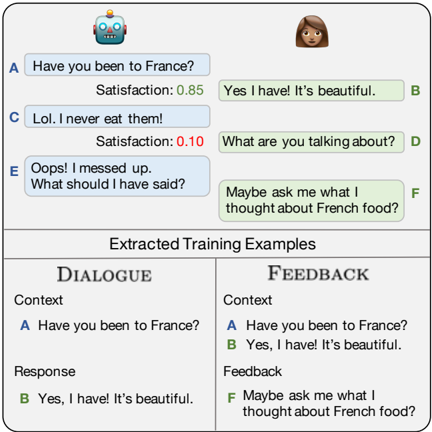
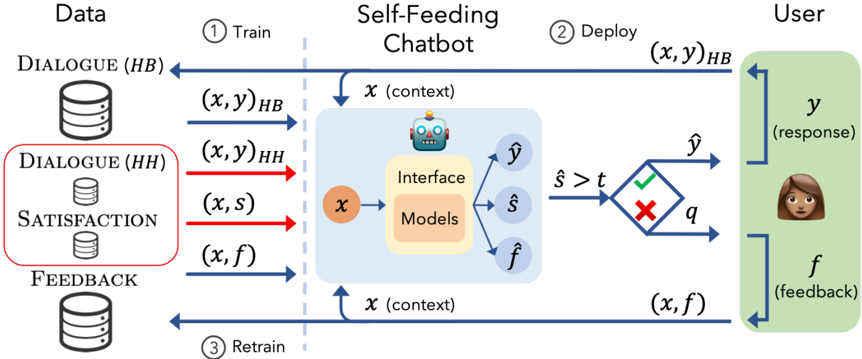
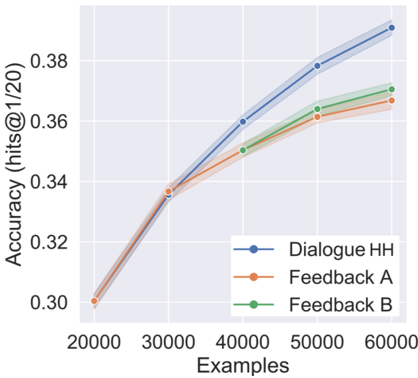
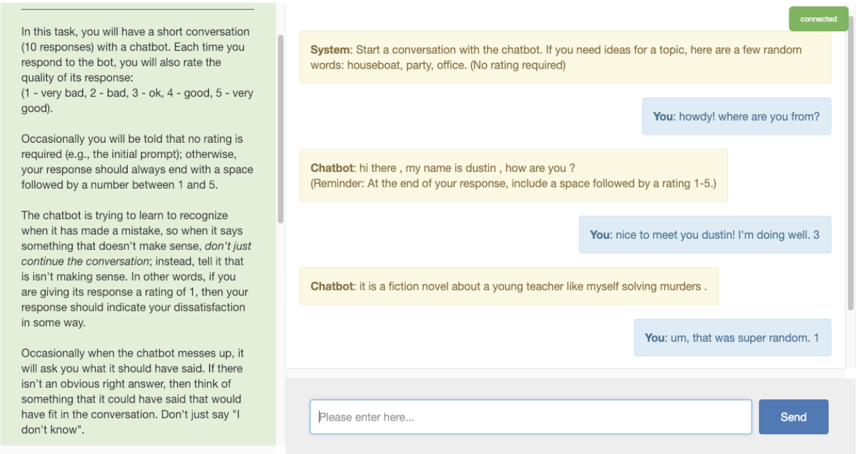
The majority of conversations a dialogue agent sees over its lifetime occur after it has already been trained and deployed, leaving a vast store of potential training signal untapped.In this work, we propose the self-feeding chatbot, a dialogue agent with the ability to extract new training examples from the conversations it participates in.As our agent engages in conversation, it also estimates user satisfaction in its responses.When the conversation appears to be going well, the user's responses become new training examples to imitate.When the agent believes it has made a mistake, it asks for feedback; learning to predict the feedback that will be given improves the chatbot's dialogue abilities further.On the PERSONACHAT chitchat dataset with over 131k training examples, we find that learning from dialogue with a selffeeding chatbot significantly improves performance, regardless of the amount of traditional supervision.
Overview
The claims and statistics of this paper haven’t been checked yet.
Free: it reads the open-access text and checks the first 5 claims that cite a source we can check. Create a free account to check every claim.
Integrity signals
Registry
Cites
Statistics
Figures
Verification
Claims the paper makes
The claims and statistics of this paper haven’t been checked yet.
Free: it reads the open-access text and checks the first 5 claims that cite a source we can check. Create a free account to check every claim.
Claims other papers make about this one
Each is checked against this paper’s own text: does it say what the citing paper says it does?
The check wasn’t confident either way, so it gives no verdict — never disputed.
In the citing paper
“Most of these approaches are limited in their task application domain.”
From User Feedback in Human-LLM Dialogues: A Lens to Understand Users But Noisy as a Learning Signal (2025) · cites this paper as Hancock et al., 2019
Experimental — accuracy not yet measured
Self-check
Percentages, sums and reported differences re-computed from the paper’s own numbers.
The self-check needs the paper’s full text.
Citations
Cites
Vaswani, A., Shazeer, N., Parmar, N., Uszkoreit, J., Jones, L., Gomez, A. N., Kaiser, L., & Polosukhin, I. (2017) · arXiv · doi:10.48550/arxiv.1706.03762 · Cited by 120,404
Adam: A Method for Stochastic Optimization
Kingma, D. P., & Ba, J. (2014) · arXiv · doi:10.48550/arxiv.1412.6980 · Cited by 98,946
BERT: Pre-training of Deep Bidirectional Transformers for Language Understanding
Devlin, J., Chang, M.-W., Lee, K., & Toutanova, K. (2018) · arXiv · doi:10.48550/arxiv.1810.04805 · Cited by 73,173
BERT: Pre-training of Deep Bidirectional Transformers for Language Understanding
Devlin, J., Chang, M.-W., Lee, K., & Toutanova, K. (2019) · Proceedings of the 2019 Conference of the North American Chapter of the Association for Computational Linguistics: Human Language Technologies, Volume 1 (Long and Short Papers) · doi:10.18653/v1/n19-1423 · Cited by 54,325
(2017) · Cited by 11,625
Enriching Word Vectors with Subword Information
Bojanowski, P., Grave, E., Joulin, A., & Mikolov, T. (2017) · Transactions of the Association for Computational Linguistics · doi:10.1162/tacl_a_00051 · Cited by 9,645 · cited 1×
“Tokens are embedded with fastText (Bojanowski et al., 2017) 300-dimensional embeddings.”
BackgroundKruger, J., & Dunning, D. (1999) · Journal of Personality and Social Psychology · doi:10.1037/0022-3514.77.6.1121 · Cited by 7,731
An Overview of Multi-Task Learning in Deep Neural Networks
Ruder, S. (2017) · arXiv (Cornell University) · doi:10.48550/arxiv.1706.05098 · Cited by 2,265
Toward an architecture for never-ending language learning
Carlson, A., Betteridge, J., Kisiel, B., Settles, B., Hruschka, E., & Mitchell, T. (2010) · Proceedings of the AAAI Conference on Artificial Intelligence · doi:10.1609/aaai.v24i1.7519 · Cited by 2,000 · cited 2×
“, 2013) and never-ending (language) learning (Carlson et al., 2010) are related to the topics dis-”
BackgroundPersonalizing Dialogue Agents: I have a dog, do you have pets too?
Zhang, S., Dinan, E., Urbanek, J., Szlam, A., Kiela, D., & Weston, J. (2018) · Proceedings of the 56th Annual Meeting of the Association for Computational Linguistics (Volume 1: Long Papers) · doi:10.18653/v1/p18-1205 · Cited by 1,177 · cited 11×
“Our experiments use the PERSONACHAT distribution that was released as a part of the ConvAI2 (Burtsev et al., 2018) challenge.”
BackgroundMethodInfluentialSelf-citation
Research works printed but not linked: 3
- T. Hong, O. Kwon, and Y. Kim. 2019. An end-to- end trainable task-oriented dialog system with hu- man feedback. In Association for the Advancement of Artificial Intelligence (AAAI).
- J. Li, A. H. Miller, S. Chopra, M. Ranzato, and J. We- ston. 2017a. Dialogue learning with human-in-the- loop. In International Conference on Learning Rep- resentations (ICLR).
- S. Tong and D. Koller. 2001. Support vector ma- chine active learning with applications to text clas- sification. Journal of machine learning research, 2(0):45-66.
Cited by
Learning Transferable Visual Models From Natural Language Supervision
Radford, A., Kim, J. W., Hallacy, C., Ramesh, A., Goh, G., Agarwal, S., Sastry, G., Askell, A., Mishkin, P., Clark, J., et al. (2021) · arXiv · doi:10.48550/arxiv.2103.00020 · Cited by 15,293
“Dialog based learning (Weston, 2016; Li et al., 2016; Hancock et al., 2019) develops techniques to learn from interactive natural language feedback in dialog.”
BackgroundSurvey of Hallucination in Natural Language Generation
Ji, Z., Lee, N., Frieske, R., Yu, T., Su, D., Xu, Y., Ishii, E., Bang, Y. J., Madotto, A., & Fung, P. (2023) · ACM Computing Surveys · doi:10.1145/3571730 · Cited by 5,025
“The PersonaChat datasets [31, 228] have accelerated research into persona consistency [68, 91, 126, 208, 219, 224, 232].”
BackgroundChatbots: History, technology, and applications
Adamopoulou, E., & Moussiades, L. (2020) · Machine Learning with Applications · doi:10.1016/j.mlwa.2020.100006 · Cited by 1,090
A survey of human-in-the-loop for machine learning
Wu, X., Xiao, L., Sun, Y., Zhang, J., Ma, T., & He, L. (2022) · Future Generation Computer Systems · doi:10.1016/j.future.2022.05.014 · Cited by 800
Recipes for Building an Open-Domain Chatbot
Roller, S., Dinan, E., Goyal, N., Ju, D., Williamson, M., Liu, Y., Xu, J., Ott, M., Smith, E. M., Boureau, Y.-L., et al. (2021) · Proceedings of the 16th Conference of the European Chapter of the Association for Computational Linguistics: Main Volume · doi:10.18653/v1/2021.eacl-main.24 · Cited by 784
Self-citationRecipes for building an open-domain chatbot
Roller, S., Dinan, E., Goyal, N., Ju, D., Williamson, M., Liu, Y., Xu, J., Ott, M., Shuster, K., Smith, E. M., et al. (2020) · arXiv · doi:10.48550/arxiv.2004.13637 · Cited by 784
“We note that these models cannot be taught a concept through further conversation, so as-is they will always be stunted, see (Weston, 2016; Hancock et al., 2019) for early work in this direction.”
BackgroundSelf-citationLearning to summarize from human feedback
Stiennon, N., Ouyang, L., Wu, J., Ziegler, D. M., Lowe, R., Voss, C., Radford, A., Amodei, D., & Christiano, P. (2020) · arXiv · doi:10.48550/arxiv.2009.01325 · Cited by 550
“We treat the logit output of the reward model as a reward that we optimize using reinforcement learning, specifically with the PPO algorithm [58].”
MethodFine-Tuning Language Models from Human Preferences
Ziegler, D. M., Stiennon, N., Wu, J., Brown, T. B., Radford, A., Amodei, D., Christiano, P., & Irving, G. (2019) · arXiv · doi:10.48550/arxiv.1909.08593 · Cited by 413
“RL is not the only way to incorporate ongoing human feedback: Hancock et al. (2019) ask humans what a dialogue system should have said instead, then continue supervised training.”
BackgroundSurvey on evaluation methods for dialogue systems
Deriu, J., Rodrigo, A., Otegi, A., Echegoyen, G., Rosset, S., Agirre, E., & Cieliebak, M. (2021) · Artificial Intelligence Review · doi:10.1007/s10462-020-09866-x · Cited by 215
“One step in this direction is done by [Hancock et al., 2019], who present a solution that relies on a satisfaction module that is able of to classify the current dialogue state as either satisfactory or not.”
BackgroundHsieh, C.-Y., Li, C.-L., Yeh, C.-K., Nakhost, H., Fujii, Y., Ratner, A., Krishna, R., Lee, C.-Y., & Pfister, T. (2023) · Findings of the Association for Computational Linguistics: ACL 2023 · doi:10.18653/v1/2023.findings-acl.507 · Cited by 316
Recent advances in deep learning based dialogue systems: a systematic survey
Ni, J., Young, T., Pandelea, V., Xue, F., & Cambria, E. (2023) · Artificial Intelligence Review · doi:10.1007/s10462-022-10248-8 · Cited by 264
“Hancock et al. (2019) argued that most conversation samples an agent saw happened after it was pretrained and deployed.”
BackgroundDynabench: Rethinking Benchmarking in NLP
Kiela, D., Bartolo, M., Nie, Y., Kaushik, D., Geiger, A., Wu, Z., Vidgen, B., Prasad, G., Singh, A., Ringshia, P., et al. (2021) · Proceedings of the 2021 Conference of the North American Chapter of the Association for Computational Linguistics: Human Language Technologies · doi:10.18653/v1/2021.naacl-main.324 · Cited by 254
MoEL: Mixture of Empathetic Listeners
Lin, Z., Madotto, A., Shin, J., Xu, P., & Fung, P. (2019) · Proceedings of the 2019 Conference on Empirical Methods in Natural Language Processing and the 9th International Joint Conference on Natural Language Processing (EMNLP-IJCNLP) · doi:10.18653/v1/d19-1012 · Cited by 213
“Based on such, several follow-up work has been presented (Mazare et al., 2018b; Hancock et al., 2019; Joshi et al., 2017; Kulikov et al., 2018; Yavuz et al., 2018; Zemlyan-skiy and Sha, 2018; Madotto et al., 2019).”
BackgroundSivarajkumar, S., Kelley, M., Samolyk-Mazzanti, A., Visweswaran, S., & Wang, Y. (2024) · JMIR Medical Informatics · doi:10.2196/55318 · Cited by 213
“By systematically evaluating different types of prompts proposed in recent literature, including prefix [13], cloze [14], chain of thought [15], and anticipatory prompts [16], we gain insights into their performance and suitability for each task.”
BackgroundPersonalizing Dialogue Agents via Meta-Learning
Madotto, A., Lin, Z., Wu, C.-S., & Fung, P. (2019) · Proceedings of the 57th Annual Meeting of the Association for Computational Linguistics · doi:10.18653/v1/p19-1542 · Cited by 183
“Several works improved on the initial baselines with various methodologies (Kulikov et al., 2018; Yavuz et al.; Hancock et al., 2019; Lucas et al., 2009; Joshi et al., 2017; Zemlyanskiy and Sha, 2018; Gao et al., 2018).”
BackgroundApplications, Challenges, and Future Directions of Human-in-the-Loop Learning
Kumar, S., Datta, S., Singh, V., Datta, D., Kumar Singh, S., & Sharma, R. (2024) · IEEE Access · doi:10.1109/access.2024.3401547 · Cited by 168
“In the context of the online feedback loop, as exemplified by Hancock et al. [130], human feedback is persistently harnessed to iteratively refine the model through reinforcement learning.”
BackgroundMethodEmpDG: Multi-resolution Interactive Empathetic Dialogue Generation
Li, Q., Chen, H., Ren, Z., Ren, P., Tu, Z., & Chen, Z. (2020) · International Conference on Computational Linguistics · doi:10.18653/v1/2020.coling-main.394 · Cited by 206
“Our research also aligns with recent advances in open-domain dialogue generation models (Vinyals and Le, 2015; Li et al., 2016b; Zhang et al., 2018b; Hancock et al., 2019; Li et al., 2020; Song et al., 2020).”
ResultWay Off-Policy Batch Deep Reinforcement Learning of Implicit Human Preferences in Dialog
Jaques, N., Ghandeharioun, A., Shen, J. H., Ferguson, C., Lapedriza, A., Jones, N., Gu, S., & Picard, R. (2019) · arXiv · doi:10.48550/arxiv.1907.00456 · Cited by 126
Choosing a Chatbot Development Tool
Pérez-Soler, S., Juárez-Puerta, S., Guerra, E., & Lara, J. D. (2021) · IEEE Software · doi:10.1109/ms.2020.3030198 · Cited by 94
RLHF Deciphered: A Critical Analysis of Reinforcement Learning from Human Feedback for LLMs
Chaudhari, S., Aggarwal, P., Murahari, V., Rajpurohit, T., Kalyan, A., Narasimhan, K., Deshpande, A., & Castro da Silva, B. (2026) · ACM Computing Surveys · doi:10.1145/3743127 · Cited by 92
“Future research should explore the integration of these techniques to address the unique challenges in training LLMs with RLHF, potentially improving generalization and robustness.”
Recursively Summarizing Books with Human Feedback
Wu, J., Ouyang, L., Ziegler, D. M., Stiennon, N., Lowe, R., Leike, J., & Christiano, P. (2021) · arXiv · doi:10.48550/arxiv.2109.10862 · Cited by 76
“, 2020), dialogue (Jaques et al., 2019; Yi et al., 2019; Hancock et al., 2019), translation (Kreutzer et al.”
BackgroundIrfan, B., Kuoppamäki, S., Hosseini, A., & Skantze, G. (2025) · Autonomous Robots · doi:10.1007/s10514-025-10190-y · Cited by 108
“In comparison to ‘(reinforcement) learning from human feedback’ approaches for LLMs (Ziegler et al., 2020; Hancock et al., 2019; Xu et al., 2022; Wang et al., 2023; Casper et al., 2023), lifelong learning does not require explicit feedback, which can be used to acquire new knowledge from…”
The Dialogue Dodecathlon: Open-Domain Knowledge and Image Grounded Conversational Agents
Shuster, K., JU, D., Roller, S., Dinan, E., Boureau, Y.-L., & Weston, J. (2020) · Proceedings of the 58th Annual Meeting of the Association for Computational Linguistics · doi:10.18653/v1/2020.acl-main.222 · Cited by 71
Self-citationBuilding and Evaluating Open-Domain Dialogue Corpora with Clarifying Questions
Aliannejadi, M., Kiseleva, J., Chuklin, A., Dalton, J., & Burtsev, M. (2021) · Conference on Empirical Methods in Natural Language Processing (EMNLP) · doi:10.18653/v1/2021.emnlp-main.367 · Cited by 159
“There are separate attempts to explore the following related tasks: (1) identifying a moment when the question should be asked in the course of conversation (Hancock et al., 2019); and (2) retrieving a clarification question (Rao and III, 2018; Wang et al., 2018).”
BackgroundInfluentialSoftware-Based Dialogue Systems: Survey, Taxonomy, and Challenges
Motger, Q., Franch, X., & Marco, J. (2023) · ACM Computing Surveys · doi:10.1145/3527450 · Cited by 68
Ng, M., Coopamootoo, K. P. L., Toreini, E., Aitken, M., Elliot, K., & van Moorsel, A. (2020) · 2020 IEEE European Symposium on Security and Privacy Workshops (EuroS&PW) · doi:10.1109/eurospw51379.2020.00034 · Cited by 68
A Conversation-Driven Approach for Chatbot Management
Santos, G. A., de Andrade, G. G., Silva, G. R. S., Duarte, F. C. M., da Costa, J. P. C. L., & de Sousa, R. T. (2022) · IEEE Access · doi:10.1109/access.2022.3143323 · Cited by 98
A survey on chatbots and large language models: Testing and evaluation techniques
Singh, S. U., & Namin, A. S. (2025) · Natural Language Processing Journal · doi:10.1016/j.nlp.2025.100128 · Cited by 107
Speak to your Parser: Interactive Text-to-SQL with Natural Language Feedback
Elgohary, A., Hosseini, S., & Awadallah, A. H. (2020) · Proceedings of the conference - Association for Computational Linguistics. Meeting · doi:10.18653/v1/2020.acl-main.187 · Cited by 95
Putting Humans in the Natural Language Processing Loop: A SurveyPreprint
Wang, Z. J., Choi, D., Xu, S., & Yang, D. (2021) · arXiv (Cornell University) · doi:10.48550/arxiv.2103.04044 · Cited by 98
“For example, human feedback can come from end users (Li et al., 2017) or crowd workers (Wallace et al., 2019), and human can intervene models during training (Stiennon et al., 2020) or deployment (Hancock et al., 2019).”
BackgroundInfluentialXPersona: Evaluating Multilingual Personalized Chatbot
Lin, Z., Liu, Z., Winata, G. I., Cahyawijaya, S., Madotto, A., Bang, Y., Ishii, E., & Fung, P. (2021) · Workshop on NLP for Conversational AI (NLP4ConvAI) · doi:10.18653/v1/2021.nlp4convai-1.10 · Cited by 90
Blockchain‐based asset storage and service mechanism to metaverse universe: Metarepo
Ersoy, M., & Gürfidan, R. (2022) · Transactions on Emerging Telecommunications Technologies · doi:10.1002/ett.4658 · Cited by 66
“28 Although blockchain technology has recently attracted much attention in the national and international media, various international organizations, the private sector, and public institutions, some researchers say that it is a technology that can be stronger than the internet.”
BackgroundThe Challenges in Designing a Prevention Chatbot for Eating Disorders: Observational Study
Chan, W. W., Fitzsimmons-Craft, E. E., Smith, A. C., Firebaugh, M.-L., Fowler, L. A., DePietro, B., Topooco, N., Wilfley, D. E., Taylor, C. B., & Jacobson, N. C. (2022) · JMIR Formative Research · doi:10.2196/28003 · Cited by 50
Understanding and predicting user dissatisfaction in a neural generative chatbot
See, A., & Manning, C. D. (2021) · Annual Meeting of the Special Interest Group on Discourse and Dialogue · doi:10.18653/v1/2021.sigdial-1.1 · Cited by 67
Bridging the Gap: A Survey on Integrating (Human) Feedback for Natural Language Generation
Fernandes, P., Madaan, A., Liu, E., Farinhas, A., Martins, P. H., Bertsch, A., de Souza, J. G. C., Zhou, S., Wu, T., Neubig, G., et al. (2023) · Transactions of the Association for Computational Linguistics · doi:10.1162/tacl_a_00626 · Cited by 44
“A slightly different approach was proposed by Hancock et al. (2019): Deploying a chit-chat dialogue model and using the human utterances as targets to fine-tune the model.”
Trends & Methods in Chatbot Evaluation
Casas, J., Tricot, M.-O., Khaled, O. A., Mugellini, E., & Cudré-Mauroux, P. (2020) · Companion Publication of the International Conference on Multimodal Interaction (ICMI Companion) · doi:10.1145/3395035.3425319 · Cited by 79
Anticipating Safety Issues in E2E Conversational AI: Framework and Tooling
Dinan, E., Abercrombie, G., Bergman, A. S., Spruit, S., Hovy, D., Boureau, Y.-L., & Rieser, V. (2021) · arXiv · doi:10.48550/arxiv.2107.03451 · Cited by 44
Bridging the Gap: A Survey on Integrating (Human) Feedback for Natural Language Generation
Fernandes, P., Madaan, A., Liu, E., Farinhas, A., Martins, P. H., Bertsch, A., de Souza, J. G. C., Zhou, S., Wu, T., Neubig, G., et al. (2023) · arXiv · doi:10.48550/arxiv.2305.00955 · Cited by 44
Chatbot Security and Privacy in the Age of Personal Assistants
Ye, W., & Li, Q. (2020) · IEEE/ACM Symposium on Edge Computing (SEC) · doi:10.1109/sec50012.2020.00057 · Cited by 59
“For example, instead of directly retraining on the messages themselves, the developers can separate the response generation module and the training examples located in the database module with a layer of abstraction [19].”
BackgroundHuman-centric dialog training via offline reinforcement learning
Jaques, N., Shen, J. H., Ghandeharioun, A., Ferguson, C., Lapedriza, À., Jones, N. C., Gu, S., & Picard, R. W. (2020) · Conference on Empirical Methods in Natural Language Processing (EMNLP) · doi:10.18653/v1/2020.emnlp-main.327 · Cited by 125
Open-Domain Conversational Agents: Current Progress, Open Problems, and Future Directions
Roller, S., Boureau, Y.-L., Weston, J., Bordes, A., Dinan, E., Fan, A., Gunning, D., Ju, D., Li, M., Poff, S., et al. (2020) · arXiv · doi:10.48550/arxiv.2006.12442 · Cited by 38
“This has been explored in Hancock et al. (2019), where a “selffeeding chatbot” learns to estimate its partner’s satisfaction and can also ask for feedback when it believes it has made a mistake, see Figure 1.”
BackgroundSelf-citationEmotionally-Aware Chatbots: A Survey
Pamungkas, E. W. (2019) · Artificial Intelligence Systems and Its Applications · doi:10.48550/arxiv.1906.09774 · Cited by 69
“Conversational agents or dialogue systems development are gaining more attention from both industry and academia [15, 17] in the”
BackgroundMarketing Innovations in Industry 4.0 and Their Impacts on Current Enterprises
Ungerman, O., & Dědková, J. (2019) · Applied Sciences · doi:10.3390/app9183685 · Cited by 53
“Chatbots find out everything a customer wants and prepare specific communication for them [35].”
BackgroundLifelong and Continual Learning Dialogue Systems: Learning during Conversation
Liu, B., & Mazumder, S. (2021) · Proceedings of the AAAI Conference on Artificial Intelligence · doi:10.1609/aaai.v35i17.17768 · Cited by 34
“Some initial attempts have been made in (Mazumder et al. 2020a,b, 2019; Hancock et al. 2019; Luo et al. 2019).”
BackgroundChandu, K. R., Bisk, Y., & Black, A. W. (2021) · Findings of the Association for Computational Linguistics: ACL (Findings of ACL) · doi:10.18653/v1/2021.findings-acl.375 · Cited by 84
Knoedler, L., Knoedler, S. A., Hoch, C. C., Prantl, L., Frank, K., Soiderer, L., Cotofana, S. C., Dorafshar, A. H., Schenck, T. L., Vollbach, F. H., et al. (2024) · Scientific Reports · doi:10.1038/s41598-024-63997-7 · Cited by 34
Privacy Preserving Chatbot Conversations
Biswas, D. (2020) · IEEE International Conference on Artificial Intelligence and Knowledge Engineering (AIKE) · doi:10.1109/aike48582.2020.00035 · Cited by 30
“Chatbot research has mostly focused on improving the underlying Natural Language Processing (NLP) precision [2], [3], such that chatbots are more proficient”
BackgroundExploring the Feasibility and Efficacy of ChatGPT3 for Personalized Feedback in Teaching
Naz, I., & Robertson, R. (2024) · The Electronic Journal of e-Learning · doi:10.34190/ejel.22.2.3345 · Cited by 66
“Research has provided evidence that when learners interact with AI chatbots and observe how feedback is generated and incorporated into their learning process, they essentially learn from the feedback generation process itself (Vijayakumar, Höhn, and Schommer, 2019b; Hancock et al., 2019).”
BackgroundAsistente virtual académico utilizando tecnologías cognitivas de procesamiento de lenguaje natural
Manjarres-Betancur, R., & Echeverri-Torres, M. M. (2020) · Revista Politécnica · doi:10.33571/rpolitec.v16n31a7 · Cited by 24
Building an Arabic Flight Booking Dialogue System Using a Hybrid Rule-Based and Data Driven Approach
Al-Ajmi, A.-H., & Al-Twairesh, N. (2021) · IEEE Access · doi:10.1109/access.2021.3049732 · Cited by 25
“[33] proposed a newmeans by which to extract training examples from a chatbot after deployment through its interaction with regular users.”
BackgroundAttention over Parameters for Dialogue SystemsPreprint
Madotto, A., Lin, Z., Wu, C.-S., Shin, J., & Fung, P. (2020) · arXiv (Cornell University) · doi:10.48550/arxiv.2001.01871 · Cited by 33
Tian, Y., Han, Y., Chen, X., Wang, W. W., & Chawla, N. V. (2025) · ACM International Conference on Web Search and Data Mining (WSDM) · doi:10.1145/3701551.3703577 · Cited by 97
SaFeRDialogues: Taking Feedback Gracefully after Conversational Safety Failures
Ung, M., Xu, J., & Boureau, Y.-L. (2022) · Proceedings of the conference - Association for Computational Linguistics. Meeting · doi:10.18653/v1/2022.acl-long.447 · Cited by 56
Survey on dialogue systems including slavic languages
Wołk, K., Wołk, A., Wnuk, D. C., Grześ, T., & Skubis, I. (2021) · Neurocomputing · doi:10.1016/j.neucom.2021.11.076 · Cited by 27
A Multi-Task Based Neural Model to Simulate Users in Goal Oriented Dialogue Systems
Kim, T. E., & Lipani, A. (2022) · International ACM SIGIR Conference on Research and Development in Information Retrieval (SIGIR) · doi:10.1145/3477495.3531814 · Cited by 33
Ng, M., Coopamootoo, K., Toreini, E., Aitken, M., Elliot, K., & van Moorsel, A. (2020) · arXiv (Cornell University) · Cited by 19
An Imitation Game for Learning Semantic Parsers from User Interaction
Yao, Z., Tang, Y., Yih, W.-T., Sun, H., & Su, Y. (2020) · Conference on Empirical Methods in Natural Language Processing (EMNLP) · doi:10.18653/v1/2020.emnlp-main.559 · Cited by 38
Qiu, L., Shiu, Y., Lin, P., Song, R., Liu, Y., Zhao, D., & Yan, R. (2020) · International ACM SIGIR Conference on Research and Development in Information Retrieval (SIGIR) · doi:10.1145/3397271.3401108 · Cited by 25
“On the basis of sequence-to-sequence architecture [31], many systems have been proposed to improve response generation in various aspects, such as promoting response diversity [15, 26], persona modelling [5, 41], and pursuing better optimization strategies [8].”
BackgroundXu, J., Ung, M., Komeili, M., Arora, K., Boureau, Y.-L., & Weston, J. (2023) · Proceedings of the conference - Association for Computational Linguistics. Meeting · doi:10.18653/v1/2023.acl-long.758 · Cited by 53
Self-citationDeploying Lifelong Open-Domain Dialogue LearningPreprint
Shuster, K., Urbanek, J., Dinan, E., Szlam, A. D., & Weston, J. (2020) · arXiv (Cornell University) · doi:10.48550/arxiv.2008.08076 · Cited by 29
“Closer to our work, is the self-feeding chatbot (Hancock et al., 2019), whereby it is shown that models can be used to collect data to improve themselves via crowdsourcing utilizing the PersonaChat task.”
BackgroundMethodSelf-citationLi, Z., Sharma, P., Lù, X. H., Cheung, J. C. K., & Reddy, S. (2022) · Findings of the Association for Computational Linguistics: ACL (Findings of ACL) · doi:10.18653/v1/2022.findings-acl.75 · Cited by 39
“Hancock et al. (2019) collect suggested responses from users to improve a chatbot, while we investigate the effect of natural feedback for RQA models.”
BackgroundJASMINE: Arabic GPT Models for Few-Shot Learning
Nagoudi, E. M. B., Abdul-Mageed, M., Elmadany, A., Inciarte, A. A., & Khondaker, M. T. I. (2023) · Conference on Empirical Methods in Natural Language Processing (EMNLP) · doi:10.18653/v1/2023.emnlp-main.1040 · Cited by 40
Falke, T., Boese, M., Sorokin, D., Tırkaz, Ç., & Lehnen, P. (2020) · International Conference on Computational Linguistics · doi:10.18653/v1/2020.coling-industry.3 · Cited by 19
“Hancock et al. (2019) propose a dialog agent that incorporates feedback via supervised multi-task learning and gathers the feedback by learning to explicitly ask a user for it.”
BackgroundKirk, H. R., Bean, A., Vidgen, B., Röttger, P., & Hale, S. A. (2023) · Conference on Empirical Methods in Natural Language Processing (EMNLP) · doi:10.18653/v1/2023.emnlp-main.148 · Cited by 91
Asking Multimodal Clarifying Questions in Mixed-Initiative Conversational Search
Yuan, Y., Siro, C., Aliannejadi, M., de Rijke, M., & Lam, W. P. (2024) · International World Wide Web Conference (WWW) · doi:10.1145/3589334.3645483 · Cited by 30
“It enables systems to interact with users to clarify their information needs before presenting search results [26, 52].”
BackgroundStudying Catastrophic Forgetting in Neural Ranking Models
Lovón-Melgarejo, J., Soulier, L., Pinel-Sauvagnat, K., & Tamine, L. (2021) · Lecture notes in computer science · doi:10.1007/978-3-030-72113-8_25 · Cited by 31
Hierarchical Reinforcement Learning for Open-Domain Dialog
Saleh, A., Jaques, N., Ghandeharioun, A., Shen, J. H., & Picard, R. W. (2020) · AAAI Publications (The Association for the Advancement of Artificial Intelligence (AAAI)) · doi:10.1609/aaai.v34i05.6400 · Cited by 39
Irfan, B., Hellou, M., & Belpaeme, T. (2021) · Frontiers in Robotics and AI · doi:10.3389/frobt.2021.676814 · Cited by 14
“Another line of attack could be to learn from users during deployment (similar to Zhao and Eskenazi, 2016; Hancock et al., 2019; Sreedhar et al., 2020; Liu, 2020; Irfan et al., 2020b), where the feedback could be the user response or emotions of the user to evaluate the user satisfaction with the agent’s responses.”
BackgroundAn affective chatbot with controlled specific emotion expression
Jiang, C., Zhang, C., Ji, Y., Hu, Z., Zhan, Z., & Yang, G. (2022) · Science China Information Sciences · doi:10.1007/s11432-020-3356-4 · Cited by 12
The Gutenberg Dialogue Dataset
Csáky, R., & Recski, G. (2021) · Conference of the European Chapter of the Association for Computational Linguistics · doi:10.18653/v1/2021.eacl-main.11 · Cited by 24
Deciding Whether to Ask Clarifying Questions in Large-Scale Spoken Language Understanding
Kim, J.-K., Wang, G., Lee, S., & Kim, Y. (2021) · IEEE Workshop on Automatic Speech Recognition and Understanding (ASRU) · doi:10.1109/asru51503.2021.9688265 · Cited by 11
A First Look at Toxicity Injection Attacks on Open-domain Chatbots
Weeks, C., Cheruvu, A., Abdullah, S. M., Kanchi, S., Yao, D. D., & Viswanath, B. (2023) · Annual Computer Security Applications Conference · doi:10.1145/3627106.3627122 · Cited by 16
“In DBL, a chatbot is periodically trained after deployment on data obtained from recent conversations with its users, facilitating low-cost, efficient, and high-performing continual updates [24].”
BackgroundMethodInfluentialOffline Reinforcement Learning from Human Feedback in Real-World Sequence-to-Sequence Tasks
Kreutzer, J., Riezler, S., & Lawrence, C. (2021) · Workshop on Structured Prediction for NLP (SPNLP) · doi:10.18653/v1/2021.spnlp-1.4 · Cited by 29
Continual Learning Dialogue Systems - Learning during Conversation
Mazumder, S., & Liu, B. (2022) · International ACM SIGIR Conference on Research and Development in Information Retrieval (SIGIR) · doi:10.1145/3477495.3532677 · Cited by 11
Why Build an Assistant in Minecraft?Preprint
Szlam, A. D., Gray, J., Srinet, K., Jernite, Y., Joulin, A., Synnaeve, G., Kiela, D., Yu, H., Chen, Z., Goyal, S., et al. (2019) · arXiv (Cornell University) · doi:10.48550/arxiv.1907.09273 · Cited by 29
Self-citationSun, L., Liu, Y., Joseph, G., Yu, Z., Zhu, H., & Dow, S. P. (2022) · Proceedings of the AAAI Conference on Human Computation and Crowdsourcing · doi:10.1609/hcomp.v10i1.21999 · Cited by 16
“Existing research has explored the complementary value of experts and crowd workers for a single data work to improve chatbot (i.e. rewrite responses) (Hancock et al. 2019).”
BackgroundConversational Agents and Language Models that Learn from Human Dialogues to Support Design Thinking
Demetriadis, S., & Dimitriadis, Y. A. (2023) · Lecture notes in computer science · doi:10.1007/978-3-031-32883-1_60 · Cited by 16
Pseudo Labeling and Negative Feedback Learning for Large-Scale Multi-Label Domain Classification
Kim, J.-K., & Kim, Y. (2020) · IEEE International Conference on Acoustics Speech and Signal Processing · doi:10.1109/icassp40776.2020.9053728 · Cited by 12
“5 6 Previous work [22, 23] excludes such negative utterances from the training set.”
BackgroundBeyond Turing: Intelligent Agents Centered on the UserPreprint
Eskénazi, M., Mehri, S., Razumovskaia, E., & Zhao, T. (2019) · arXiv (Cornell University) · doi:10.48550/arxiv.1901.06613 · Cited by 15
“Hancock et al (2019) used a configuration that enabled the user of a deployed agent to give it immediate feedback when it made an error.”
MethodA Survey on the Recent Advancements in Human-Centered Dialog Systems
Oruche, R., Goruganthu, S. K., Akula, R., Cheng, X., Goni, M. A., Shibo, B. W., Kee, K. F., Zampieri, M., & Calyam, P. P. (2025) · ACM Computing Surveys · doi:10.1145/3729220 · Cited by 18
“Concepts such as active learning and reinforcement learning are employed in making efective text summarization models, with active learning helping dialog systems by selecting diverse examples for human annotation, and reinforcement learning enhancing models by training them to generate optimal…”
InfluentialThe CRINGE Loss: Learning what language not to model
Adolphs, L., Gao, T., Xu, J., Shuster, K., Sukhbaatar, S., & Weston, J. (2023) · Proceedings of the conference - Association for Computational Linguistics. Meeting · doi:10.18653/v1/2023.acl-long.493 · Cited by 47
Self-citationOggyBug: A Test Automation Tool in Chatbots
dos Santos, M. B., Furtado, A. P., Nogueira, S., & Moreira, D. D. (2020) · Brazilian Symposium on Systematic and Automated Software Testing (SAST) · doi:10.1145/3425174.3425230 · Cited by 8
“Alguns chatbot capturam informações durante o diálogo com o usuário e podem determinar ações específicas, alguns exemplos são: identificação de cyberbullying [29], rompimento de negócios [1], e engajamento do usuário [12, 19].”
Would You Like to Hear the News?
Sahijwani, H., Choi, J. I., & Agichtein, E. (2020) · Conference on Human Information Interaction and Retrieval · doi:10.1145/3343413.3378013 · Cited by 8
Academic Customer Service Chatbot Development using TelegramBot API
Sebastián, D., & Nugraha, K. A. (2021) · International Conference on Innovative and Creative Information Technology (ICITech) · doi:10.1109/icitech50181.2021.9590140 · Cited by 9
Towards Boosting the Open-Domain Chatbot with Human Feedback
Lu, H. C., Bao, S., He, H., Wang, F., Wu, H., & Wang, H. (2023) · Proceedings of the conference - Association for Computational Linguistics. Meeting · doi:10.18653/v1/2023.acl-long.224 · Cited by 25
Campos, J. A., Cho, K., Otegi, A., Soroa, A., Agirre, E., & Azkune, G. (2020) · International Conference on Computational Linguistics · doi:10.18653/v1/2020.coling-main.230 · Cited by 10
A Survey of Dialogue System Evaluation
Fan, Y., & Luo, X. (2020) · IEEE International Conference on Tools with Artificial Intelligence (ICTAI) · doi:10.1109/ictai50040.2020.00182 · Cited by 8
“Hancock et al. [13] propose a user satisfaction model, which can divide the current dialogue state into satisfaction and dissatisfaction.”
BackgroundGamification on Chatbot-Based Learning Media: a Review and Challenges
Hidayatulloh, I., Pambudi, S., Surjono, H. D., & Sukardiyono, T. (2021) · Elinvo (Electronics Informatics and Vocational Education) · doi:10.21831/elinvo.v6i1.43705 · Cited by 18
“Ye and Li already proposed several ways to prevent the response generated attack, such as: creating an algorithm to detect the malicious trigger, separate the response learning and training model server with layer abstraction[56].”
BackgroundLeveraging speaker-aware structure and factual knowledge for faithful dialogue summarization
Zhao, L., Xu, W., Zhang, C., & Guo, J. (2022) · Knowledge-Based Systems · doi:10.1016/j.knosys.2022.108550 · Cited by 7
Towards a Metric for Automated Conversational Dialogue System Evaluation and Improvement
Deriu, J., & Cieliebak, M. (2019) · International Conference on Natural Language Generation · doi:10.18653/v1/w19-8654 · Cited by 8
“More precisely we attempt to apply the metric in two different ways: (i) response ranking similar to (Shalyminov et al., 2018; Hancock et al., 2019), and (ii) reward for reinforcement learning.”
MoEL: Mixture of Empathetic ListenersPreprint
Lin, Z., Madotto, A., Shin, J., Xu, P., & Fung, P. (2019) · arXiv (Cornell University) · doi:10.48550/arxiv.1908.07687 · Cited by 7
“Based on such, several follow-up work has been presented (Mazare et al., 2018b; Hancock et al., 2019; Joshi et al., 2017; Kulikov et al., 2018; Yavuz et al., 2018; Zemlyan-skiy and Sha, 2018; Madotto et al., 2019).”
BackgroundEmpBot: A T5-based Empathetic Chatbot focusing on SentimentsPreprint
Zaranis, E., Paraskevopoulos, G., Katsamanis, A., & Potamianos, A. (2021) · arXiv (Cornell University) · doi:10.48550/arxiv.2111.00310 · Cited by 20
Agent-in-the-loop to distill expert knowledge into artificial intelligence models: a survey
Gao, J., Zhang, Y., Chen, Y., Dong, Y., Chen, Y., Song, S., Tang, B., & Gu, Y. (2025) · Artificial Intelligence Review · doi:10.1007/s10462-025-11255-1 · Cited by 10
The Future of Chatbots: Survey on Generative Pretrained Models, Ernie, and Gemini
Raut, A., & Katti, J. (2024) · International Conference on Innovations and Challenges in Emerging Technologies (ICICET) · doi:10.1109/icicet59348.2024.10616356 · Cited by 8
“Chatbot By Hugging Face and Facebook 2019 [11] Proposes a self-supervised learning framework for chatbots that allows them to improve their language understanding and generation abilities through continual interaction with users.”
BackgroundModeling User Satisfaction Dynamics in Dialogue via Hawkes Process
Ye, F., Hu, Z., & Yılmaz, E. (2023) · Proceedings of the conference - Association for Computational Linguistics. Meeting · doi:10.18653/v1/2023.acl-long.494 · Cited by 13
Learning to Simulate Natural Language Feedback for Interactive Semantic Parsing
Yan, H., Srivastava, S., Tai, Y., Wang, S. I., Yih, W.-T., & Yao, Z. (2023) · Proceedings of the conference - Association for Computational Linguistics. Meeting · doi:10.18653/v1/2023.acl-long.177 · Cited by 23
How rationals boost textual entailment modeling: Insights from large language models
Pham, D.-H., Le, T., & Nguyen, H. T. (2024) · Computers & Electrical Engineering · doi:10.1016/j.compeleceng.2024.109517 · Cited by 7
Human-in-the-loop Abstractive Dialogue Summarization
Chen, J., Dodda, M., & Yang, D. (2023) · Findings of the Association for Computational Linguistics: ACL (Findings of ACL) · doi:10.18653/v1/2023.findings-acl.584 · Cited by 23
Sezgın, E., Jackson, D., Kaufman, K. M., Skeens, M. A., Gerhardt, C. A., & Moscato, E. L. (2025) · Digital Health · doi:10.1177/20552076251326160 · Cited by 11
“74 This technology also introduces risks to information delivery, including misinformation, misguidance, and hallucinations, which can reduce the accuracy and perceived trust to the technology (please see Appendix C for post-study VA response analysis).”
The future of open human feedback
Don-Yehiya, S., Burtenshaw, B., Astudillo, R. F., Osborne, C., Jaiswal, M., Kuo, T.-S., Zhao, W., Shenfeld, I., Peng, A., Yurochkin, M., et al. (2025) · Nature Machine Intelligence · doi:10.1038/s42256-025-01038-2 · Cited by 23
“Where possible, prompted feedback, such as users’ rating or ranking of LLM responses, should be supplemented with feedback from the naturally occurring cues in the chat 91 , such as when the user verbally thanks the model or edits their original prompt 92 .”
Metadata
- Authors
- Hancock, B., Bordes, A., Mazare, P.-E., & Weston, J.
- Affiliations
- Stanford University (US)
- Meta (United Kingdom) (GB)
- ORCID
- Hancock, Braden
- Venue
- Proceedings of the 57th Annual Meeting of the Association for Computational Linguistics
- Published
- 2019
- Pages
- 3667-3684
- ISSN
- 0736-587X (ISSN-L)
- OpenAlex
- W2910458567
- Cited by
- 161
- References
- 53
- Citations by year
- 2026: 6 · 2025: 14 · 2024: 13 · 2023: 21 · 2022: 23 · 2021: 41 · 2020: 33 · 2019: 10
- FWCI
- 10.24
- Type
- conference paper
- Language
- en
- Open access
- hybrid
- doi.org
- Licence
- cc-by
- Locations
- Proceedings of the conference - Association for Computational Linguistics. Meeting (publishedVersion, cc-by)
- arXiv (Cornell University) (submittedVersion)
- arXiv (Cornell University)
- Topics
- Physical Sciences › Computer Science › Artificial Intelligence › Speech and dialogue systems
- Physical Sciences › Computer Science › Artificial Intelligence › Intelligent Tutoring Systems and Adaptive Learning
- Social Sciences › Business, Management and Accounting › Marketing › AI in Service Interactions
- Keywords
- imitation learning
About these checks
Registry, retraction, Cites and statistics results are computed, not judged, with one exception: a printed reference that no index lists is read once by a model before it counts as a citation error. Claims are extracted by a model and kept only when their quote appears verbatim in the text; each cited source is then checked, with a model’s help, for whether it says what the claim relies on. Those verdicts can be wrong — read the claim’s quote and the cited source before relying on one.
Statistics and arithmetic are recomputed, not judged.
Confidence bands are shown only for fields calibrated on our annotated test set. None is calibrated yet, so no band is shown.
What counts as a claim ›How we measure confidence ›How we check this ›
Are you an author, or do you see a problem with this page? Request a review
Data sources
Bibliographic data: Semantic Scholar, OpenAlex, Crossref.
Contains information from the Semantic Scholar Academic Graph Datasets, made available under the ODC Attribution License (ODC-BY 1.0).
Semantic Scholar’s data is described in: Kinney, R., et al. (2023). The Semantic Scholar Open Data Platform. arXiv:2301.10140.
