

Latent Retrieval for Weakly Supervised Open Domain Question Answering
Open accessThe DOI matches its Crossref record; 34 of the 34 references it cites were found in a registry or an index.
Abstract
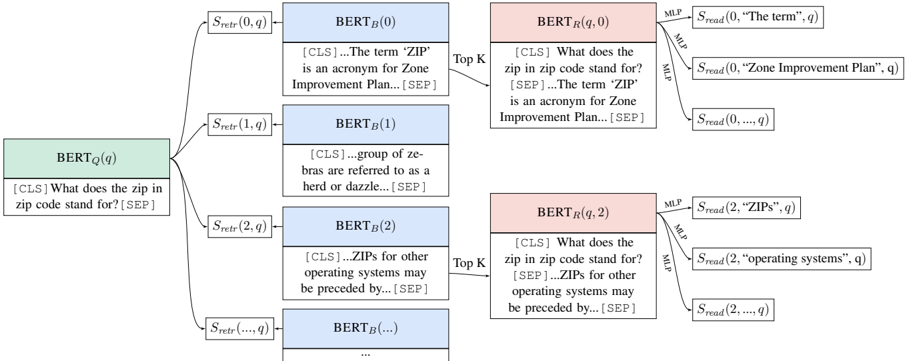
Recent work on open domain question answering (QA) assumes strong supervision of the supporting evidence and/or assumes a blackbox information retrieval (IR) system to retrieve evidence candidates.We argue that both are suboptimal, since gold evidence is not always available, and QA is fundamentally different from IR.We show for the first time that it is possible to jointly learn the retriever and reader from question-answer string pairs and without any IR system.In this setting, evidence retrieval from all of Wikipedia is treated as a latent variable.Since this is impractical to learn from scratch, we pre-train the retriever with an Inverse Cloze Task.We evaluate on open versions of five QA datasets.On datasets where the questioner already knows the answer, a traditional IR system such as BM25 is sufficient.On datasets where a user is genuinely seeking an answer, we show that learned retrieval is crucial, outperforming BM25 by up to 19 points in exact match.
Overview
The claims and statistics of this paper haven’t been checked yet.
Free: it reads the open-access text and checks the first 5 claims that cite a source we can check. Create a free account to check every claim.
Integrity signals
Registry
Cites
Statistics
Figures
Verification
Claims the paper makes
The claims and statistics of this paper haven’t been checked yet.
Free: it reads the open-access text and checks the first 5 claims that cite a source we can check. Create a free account to check every claim.
Claims other papers make about this one
Each is checked against this paper’s own text: does it say what the citing paper says it does?
The source backs part of the claim, not all of it — or backs it for a different population, condition or comparison.
In the citing paper
“Pretrained models with a differentiable access mechanism to explicit non-parametric memory have so far been only investigated for extractive downstream tasks.”
From Retrieval-Augmented Generation for Knowledge-Intensive NLP Tasks (2020) · cites this paper as [31]
Experimental — accuracy not yet measuredThe source backs part of the claim, not all of it — or backs it for a different population, condition or comparison.
In the citing paper
“The standard solution to these issues is to rely on Retrieval Augmented Generation (RAG) (Lee et al., 2019;Lewis et al., 2020;Guu et al., 2020).”
From RAGAs: Automated Evaluation of Retrieval Augmented Generation (2024) · cites this paper as Lee et al., 2019
Experimental — accuracy not yet measuredThe source backs part of the claim, not all of it — or backs it for a different population, condition or comparison.
In the citing paper
“Dense retrieval methods have thus never be shown to outperform TF-IDF/BM25 for opendomain QA before ORQA (Lee et al., 2019)”
From Dense passage retrieval for open-domain question answering (2020) · cites this paper as Lee et al., 2019
Experimental — accuracy not yet measuredThe cited source says what the claim attributes to it.
In the citing paper
“We instantiate this task with data from NaturalQuestions-Open (Lee et al., 2019;Kwiatkowski et al., 2019), which contains historical queries issued to the Google search engine, coupled with human-annotated answers extracted from Wikipedia.”
From Lost in the Middle: How Language Models Use Long Contexts (2024) · cites this paper as Lee et al., 2019
The cited source says what the claim attributes to it.
In the citing paper
“REALM [20] and ORQA [31], two recently introduced models that combine masked language models [8] with a differentiable retriever, have shown promising results, but have only explored open-domain extractive question answering.”
From Retrieval-Augmented Generation for Knowledge-Intensive NLP Tasks (2020) · cites this paper as [31]
8 more claims about this paper
Create a free account to see every claim other papers make about this one.
Self-check
Percentages, sums and reported differences re-computed from the paper’s own numbers.
The self-check needs the paper’s full text.
Citations
Cites
BERT: Pre-training of Deep Bidirectional Transformers for Language Understanding
Devlin, J., Chang, M.-W., Lee, K., & Toutanova, K. (2018) · arXiv · doi:10.48550/arxiv.1810.04805 · Cited by 73,173 · cited 3×
“Following recent advances in transfer learning, all scoring components are derived from BERT (Devlin et al., 2018), a bidirectional transformer that has been pre-trained on unsupervised language-modeling data.”
BackgroundMethodSelf-citationBERT: Pre-training of Deep Bidirectional Transformers for Language Understanding
Devlin, J., Chang, M.-W., Lee, K., & Toutanova, K. (2019) · Proceedings of the 2019 Conference of the North American Chapter of the Association for Computational Linguistics: Human Language Technologies, Volume 1 (Long and Short Papers) · doi:10.18653/v1/n19-1423 · Cited by 54,325 · cited 3×
“Following recent advances in transfer learning, all scoring components are derived from BERT (Devlin et al., 2018), a bidirectional transformer that has been pre-trained on unsupervised language-modeling data.”
BackgroundMethodSelf-citationEfficient Estimation of Word Representations in Vector Space
Mikolov, T., Chen, K., Corrado, G., & Dean, J. (2013) · arXiv · doi:10.48550/arxiv.1301.3781 · Cited by 26,568 · cited 1×
“ICT can be considered a generalization of the skip-gram objective (Mikolov et al., 2013), with a coarser granularity, deep architecture, and in-batch negative sampling from Logeswaran and Lee (2018).”
BackgroundDeep Contextualized Word Representations
Peters, M., Neumann, M., Iyyer, M., Gardner, M., Clark, C., Lee, K., & Zettlemoyer, L. (2018) · Proceedings of the 2018 Conference of the North American Chapter of the Association for Computational Linguistics: Human Language Technologies, Volume 1 (Long Papers) · doi:10.18653/v1/n18-1202 · Cited by 11,983 · cited 2×
“, 2003),4 and (2) ELMO (small), a context-dependent bidirectional LSTM (Peters et al., 2018).”
BackgroundMethodSelf-citationSQuAD: 100,000+ Questions for Machine Comprehension of Text
Rajpurkar, P., Zhang, J., Lopyrev, K., & Liang, P. (2016) · Proceedings of the 2016 Conference on Empirical Methods in Natural Language Processing · doi:10.18653/v1/d16-1264 · Cited by 6,208 · cited 8×
“In the strongly supervised setting popularized by DrQA (Chen et al., 2017), they also assume a reading comprehension model trained on question-answer-evidence triples, such as SQuAD (Rajpurkar et al., 2016).”
BackgroundMethodResultInfluentialThe probabilistic relevance framework: BM25 and beyond
Robertson, S., & Zaragoza, H. (2009) · Foundations and Trends® in Information Retrieval · doi:10.1561/1500000019 · Cited by 3,374
“Cloze Procedure”: A New Tool for Measuring Readability
Taylor, W. L. (1953) · Journalism Quarterly · doi:10.1177/107769905303000401 · Cited by 2,332 · cited 1×
“In the standard Cloze task (Taylor, 1953), the goal is to predict masked-out text based on its context.”
BackgroundNatural Questions: A benchmark for question answering research
Kwiatkowski, T., Palomaki, J., Redfield, O., Collins, M., Parikh, A., Alberti, C., Epstein, D., Polosukhin, I., Devlin, J., Lee, K., et al. (2019) · Transactions of the Association for Computational Linguistics · doi:10.1162/tacl_a_00276 · Cited by 2,069 · cited 3×
“Natural Questions contains question from aggregated queries to Google Search (Kwiatkowski et al., 2019).”
BackgroundSelf-citationTriviaQA: A Large Scale Distantly Supervised Challenge Dataset for Reading Comprehension
Joshi, M., Choi, E., Weld, D., & Zettlemoyer, L. (2017) · Proceedings of the 55th Annual Meeting of the Association for Computational Linguistics (Volume 1: Long Papers) · doi:10.18653/v1/p17-1147 · Cited by 1,690 · cited 8×
“TriviaQA is a collection of trivia questionanswer pairs that were scraped from the web (Joshi et al., 2017).”
BackgroundMethodInfluentialTriviaQA: A Large Scale Distantly Supervised Challenge Dataset for Reading Comprehension
Joshi, M., Choi, E., Weld, D. S., & Zettlemoyer, L. (2017) · arXiv · doi:10.48550/arxiv.1705.03551 · Cited by 1,650 · cited 8×
“TriviaQA is a collection of trivia questionanswer pairs that were scraped from the web (Joshi et al., 2017).”
BackgroundMethodInfluential
Research works printed but not linked: 5
- Yoshua Bengio, Réjean Ducharme, Pascal Vincent, and Christian Jauvin. 2003. A neural probabilistic lan- guage model. Journal of machine learning research, 3(Feb):1137-1155.
- Danqi Chen, Adam Fisch, Jason Weston, and Antoine Bordes. 2017. Reading wikipedia to answer open- domain questions. In Proceedings of the 55th An- nual Meeting of the Association for Computational Linguistics (Volume 1: Long Papers), volume 1, pages 1870-1879.
- Rajarshi Das, Shehzaad Dhuliawala, Manzil Zaheer, and Andrew McCallum. 2019. Multi-step retriever- reader interaction for scalable open-domain question answering. In International Conference on Learn- ing Representations.
- Matthew E. Peters, Mark Neumann, Mohit Iyyer, Matt Gardner, Christopher Clark, Kenton Lee, and Luke Zettlemoyer. 2018. Deep contextualized word rep- resentations. In Proc. of NAACL.
- Shuohang Wang, Mo Yu, Xiaoxiao Guo, Zhiguo Wang, Tim Klinger, Wei Zhang, Shiyu Chang, Gerry Tesauro, Bowen Zhou, and Jing Jiang. 2018. R 3: Reinforced ranker-reader for open-domain question answering. In Thirty-Second AAAI Conference on Artificial Intelligence.
Cited by
Dense Passage Retrieval for Open-Domain Question Answering
Karpukhin, V., Oğuz, B., Min, S., Lewis, P., Wu, L., Edunov, S., Chen, D., & Yih, W.-T. (2020) · arXiv · doi:10.48550/arxiv.2004.04906 · Cited by 5,311
Dense passage retrieval for open-domain question answering
Karpukhin, V., Oguz, B., Min, S., Lewis, P., Wu, L., Edunov, S., Chen, D., & Yih, W.-T. (2020) · Proceedings of the 2020 Conference on Empirical Methods in Natural Language Processing (EMNLP) · doi:10.18653/v1/2020.emnlp-main.550 · Cited by 3,575
Retrieval-Augmented Generation for Knowledge-Intensive NLP Tasks
Lewis, P., Perez, E., Piktus, A., Petroni, F., Karpukhin, V., Goyal, N., Küttler, H., Lewis, M., Yih, W.-T., Rocktäschel, T., et al. (2020) · arXiv · doi:10.48550/arxiv.2005.11401 · Cited by 3,101
“Following Lee et al. [27] and Karpukhin et al. [22], we use the December 2018 dump.”
MethodResultInfluentialLost in the Middle: How Language Models Use Long Contexts
Liu, N. F., Lin, K., Hewitt, J., Paranjape, A., Bevilacqua, M., Petroni, F., & Liang, P. (2024) · Transactions of the Association for Computational Linguistics · doi:10.1162/tacl_a_00638 · Cited by 1,612
“When retrieving from Wikipedia to answer queries from NaturalQuestions-Open, we find that model performance saturates long before retriever re-call saturates, indicating that current models fail to effectively use additional retrieved doc-uments—using 50 documents instead of 20 retrieved documents only marginally impr…”
MethodInfluentialLost in the Middle: How Language Models Use Long Contexts
Liu, N. F., Lin, K., Hewitt, J., Paranjape, A., Bevilacqua, M., Petroni, F., & Liang, P. (2023) · arXiv · doi:10.48550/arxiv.2307.03172 · Cited by 1,599
“When retrieving from Wikipedia to answer queries from NaturalQuestions-Open, we find that model performance saturates long before retriever re-call saturates, indicating that current models fail to effectively use additional retrieved doc-uments—using 50 documents instead of 20 retrieved documents only marginally impr…”
MethodInfluentialBig Bird: Transformers for Longer Sequences
Zaheer, M., Guruganesh, G., Dubey, A., Ainslie, J., Alberti, C., Ontanon, S., Pham, P., Ravula, A., Wang, Q., Yang, L., et al. (2020) · arXiv · doi:10.48550/arxiv.2007.14062 · Cited by 1,349
“Most prominently, SpanBERT [42], ORQA [54], REALM [34], RAG [57] have achieved strong performance for different tasks.”
MethodLeveraging Passage Retrieval with Generative Models for Open Domain Question Answering
Izacard, G., & Grave, E. (2021) · Proceedings of the 16th Conference of the European Chapter of the Association for Computational Linguistics: Main Volume · doi:10.18653/v1/2021.eacl-main.74 · Cited by 1,109
Finetuned Language Models Are Zero-Shot Learners
Wei, J., Bosma, M., Zhao, V. Y., Guu, K., Yu, A. W., Lester, B., Du, N., Dai, A. M., & Le, Q. V. (2021) · arXiv · doi:10.48550/arxiv.2109.01652 · Cited by 1,101
“For Natural Questions (NQ; Lee et al., 2019; Kwiatkowski et al., 2019) and TQA (Joshi et al.”
BackgroundMethodInfluentialDetecting hallucinations in large language models using semantic entropy
Farquhar, S., Kossen, J., Kuhn, L., & Gal, Y. (2024) · Nature · doi:10.1038/s41586-024-07421-0 · Cited by 934
“33), life sciences (BioASQ 34 ) and open-domain natural questions (NQ-Open 35 ) derived from actual queries to Google Search 36 .”
InfluentialRAGAs: Automated Evaluation of Retrieval Augmented Generation
Es, S., James, J., Espinosa Anke, L., & Schockaert, S. (2024) · Proceedings of the 18th Conference of the European Chapter of the Association for Computational Linguistics: System Demonstrations · doi:10.18653/v1/2024.eacl-demo.16 · Cited by 651
How Much Knowledge Can You Pack into the Parameters of a Language Model?
Roberts, A., Raffel, C., & Shazeer, N. (2020) · Proceedings of the 2020 Conference on Empirical Methods in Natural Language Processing (EMNLP) · doi:10.18653/v1/2020.emnlp-main.437 · Cited by 638
REALM: Retrieval-Augmented Language Model Pre-Training
Guu, K., Lee, K., Tung, Z., Pasupat, P., & Chang, M.-W. (2020) · arXiv · doi:10.48550/arxiv.2002.08909 · Cited by 574
“A deeper justification is given in Lee et al. (2019).”
BackgroundMethodInfluentialSelf-citationQu, Y., Ding, Y., Liu, J., Liu, K., Ren, R., Zhao, W. X., Dong, D., Wu, H., & Wang, H. (2021) · Proceedings of the 2021 Conference of the North American Chapter of the Association for Computational Linguistics: Human Language Technologies · doi:10.18653/v1/2021.naacl-main.466 · Cited by 356
Clark, J. H., Choi, E., Collins, M., Garrette, D., Kwiatkowski, T., Nikolaev, V., & Palomaki, J. (2020) · Transactions of the Association for Computational Linguistics · doi:10.1162/tacl_a_00317 · Cited by 342
“) and CoQA (Reddy et al., 2019); datasets whose question writers did not see the answer text remain largely unsolved—for example, the Natural Questions (Kwiatkowski et al., 2019) and QuAC. Similarly, Lee et al. (2019) found that question answering datasets in which questions were written while annotators saw the answe…”
BackgroundApproximate Nearest Neighbor Negative Contrastive Learning for Dense Text Retrieval
Xiong, L., Xiong, C., Li, Y., Tang, K., Liu, J., Bennett, P. N., Ahmed, J., & Overwikj, A. (2021) · International Conference on Learning Representations · Cited by 1,139
Learning To Retrieve Prompts for In-Context Learning
Rubin, O., Herzig, J., & Berant, J. (2022) · Proceedings of the 2022 Conference of the North American Chapter of the Association for Computational Linguistics: Human Language Technologies · doi:10.18653/v1/2022.naacl-main.191 · Cited by 374
Sparse, Dense, and Attentional Representations for Text Retrieval
Luan, Y., Eisenstein, J., Toutanova, K., & Collins, M. (2021) · Transactions of the Association for Computational Linguistics · doi:10.1162/tacl_a_00369 · Cited by 363
“This approach is widely used for retrieval (Lee et al., 2019; Reimers and Gurevych, 2019; Humeau et al., 2020; Wu et al., 2019).”
MethodSelf-citationPrecise Zero-Shot Dense Retrieval without Relevance Labels
Gao, L., Ma, X., Lin, J., & Callan, J. (2023) · Proceedings of the 61st Annual Meeting of the Association for Computational Linguistics (Volume 1: Long Papers) · doi:10.18653/v1/2023.acl-long.99 · Cited by 362
“Dense Retrieval (Lee et al., 2019; Karpukhin et al., 2020) has been extensively studied after the emergence of pre-trained Transformer language models (Devlin et al., 2019).”
InfluentialPrecise Zero-Shot Dense Retrieval without Relevance Labels
Gao, L., Ma, X., Lin, J., & Callan, J. (2022) · arXiv · doi:10.48550/arxiv.2212.10496 · Cited by 362
“Dense Retrieval (Lee et al., 2019; Karpukhin et al., 2020) has been extensively studied after the emergence of pre-trained Transformer language models (Devlin et al., 2019).”
InfluentialKILT: a Benchmark for Knowledge Intensive Language Tasks
Petroni, F., Piktus, A., Fan, A., Lewis, P., Yazdani, M., De Cao, N., Thorne, J., Jernite, Y., Karpukhin, V., Maillard, J., et al. (2021) · Proceedings of the 2021 Conference of the North American Chapter of the Association for Computational Linguistics: Human Language Technologies · doi:10.18653/v1/2021.naacl-main.200 · Cited by 357
ColBERTv2: Effective and Efficient Retrieval via Lightweight Late Interaction
Santhanam, K., Khattab, O., Saad-Falcon, J., Potts, C., & Zaharia, M. (2022) · Proceedings of the 2022 Conference of the North American Chapter of the Association for Computational Linguistics: Human Language Technologies · doi:10.18653/v1/2022.naacl-main.272 · Cited by 353
Siriwardhana, S., Weerasekera, R., Wen, E., Kaluarachchi, T., Rana, R., & Nanayakkara, S. (2023) · Transactions of the Association for Computational Linguistics · doi:10.1162/tacl_a_00530 · Cited by 337
“Open Domain Question Answering (ODQA) (Lee et al., 2019; Lewis et al., 2020c) is an important task in natural language understanding.”
BackgroundInfluentialPretrained Transformers for Text Ranking: BERT and Beyond
Lin, J., Nogueira, R. F., & Yates, A. (2021) · Synthesis lectures on human language technologies · doi:10.2200/s01123ed1v01y202108hlt053 · Cited by 452
Unsupervised Corpus Aware Language Model Pre-training for Dense Passage Retrieval
Gao, L., & Callan, J. (2022) · Proceedings of the 60th Annual Meeting of the Association for Computational Linguistics (Volume 1: Long Papers) · doi:10.18653/v1/2022.acl-long.203 · Cited by 193
Long Range Arena: A Benchmark for Efficient Transformers
Tay, Y., Dehghani, M., Abnar, S., Shen, Y., Bahri, D., Pham, P., Rao, J., Yang, L., Ruder, S., & Metzler, D. (2020) · arXiv · doi:10.48550/arxiv.2011.04006 · Cited by 241
“Successful approaches are often highly engineered, computationally expensive systems that require pre-training and a separate retrieval model (Lee et al., 2019; Guu et al., 2020).”
BackgroundTaming Pretrained Transformers for Extreme Multi-label Text Classification
Chang, W.-C., Yu, H.-F., Zhong, K., Yang, Y., & Dhillon, I. S. (2020) · Proceedings of the 26th ACM SIGKDD International Conference on Knowledge Discovery & Data Mining · doi:10.1145/3394486.3403368 · Cited by 217
“In open-domain question answering, x represents a question and y represents an evidence passage containing the answer [4, 11].”
BackgroundRetrieving and Reading: A Comprehensive Survey on Open-domain Question Answering
Zhu, F., Lei, W., Wang, C., Zheng, J., Poria, S., & Chua, T. (2021) · arXiv (Cornell University) · doi:10.48550/arxiv.2101.00774 · Cited by 143
“In recent years, various OpenQA systems [15], [29], [36] have been developed, in which Retriever and Reader can be trained in an end-to-end manner.”
BackgroundMethodInfluentialThe power of noise: Redefining retrieval for rag systems
Cuconasu, F., Trappolini, G., Siciliano, F., Filice, S., Campagnano, C., Maarek, Y., Tonellotto, N., & Silvestri, F. (2024) · Proceedings of the 47th International ACM SIGIR Conference on Research and Development in Information Retrieval · doi:10.1145/3626772.3657834 · Cited by 236
“To enhance the efficiency of similarity searches within our corpus, comprising about 21 million documents, we also employ the FAISS IndexFlatIP indexing system.”
Enabling Large Language Models to Generate Text with Citations
Gao, T., Yen, H., Yu, J., & Chen, D. (2023) · arXiv · doi:10.48550/arxiv.2305.14627 · Cited by 223
AmbigQA: Answering Ambiguous Open-domain Questions
Min, S., Michael, J., Hajishirzi, H., & Zettlemoyer, L. (2020) · Proceedings of the 2020 Conference on Empirical Methods in Natural Language Processing (EMNLP) · doi:10.18653/v1/2020.emnlp-main.466 · Cited by 87
Enabling Large Language Models to Generate Text with Citations
Gao, T., Yen, H., Yu, J., & Chen, D. (2023) · Proceedings of the 2023 Conference on Empirical Methods in Natural Language Processing · doi:10.18653/v1/2023.emnlp-main.398 · Cited by 216
Approximate Nearest Neighbor Negative Contrastive Learning for Dense Text Retrieval
Xiong, L., Xiong, C., Li, Y., Tang, K.-F., Liu, J., Bennett, P., Ahmed, J., & Overwijk, A. (2020) · arXiv · doi:10.48550/arxiv.2007.00808 · Cited by 204
“Dense Retrieval (DR) using learned distributed representations is a promising direction to overcome this sparse retrieval bottleneck [9, 10, 11, 12, 13, 14, 15]: The representation space is fully learnable and can leverage the strength of pretraining, while the retrieval operation is sufficiently…”
BackgroundMethodInfluentialPre-training Tasks for Embedding-based Large-scale RetrievalPreprint
Chang, W.-C., Yu, F. X., Chang, Y.-W., Yang, Y., & Kumar, S. (2020) · arXiv (Cornell University) · doi:10.48550/arxiv.2002.03932 · Cited by 351
Condenser: a Pre-training Architecture for Dense Retrieval
Gao, L., & Callan, J. (2021) · Proceedings of the 2021 Conference on Empirical Methods in Natural Language Processing · doi:10.18653/v1/2021.emnlp-main.75 · Cited by 161
“A.3 ICT Model Our ICT model comes from Lee et al. (2019).”
BackgroundMethodResultInfluentialPretrained Transformers for Text Ranking: BERT and Beyond
Yates, A., Nogueira, R., & Lin, J. (2021) · Proceedings of the 14th ACM International Conference on Web Search and Data Mining · doi:10.1145/3437963.3441667 · Cited by 170
Blockwise Self-Attention for Long Document Understanding
Qiu, J., Ma, H., Levy, O., Yih, W.-T., Wang, S., & Tang, J. (2020) · Findings of the Association for Computational Linguistics: EMNLP 2020 · doi:10.18653/v1/2020.findings-emnlp.232 · Cited by 161
Pretrained Encyclopedia: Weakly Supervised Knowledge-Pretrained Language Model
Xiong, W., Du, J., Wang, W. Y., & Stoyanov, V. (2019) · arXiv (Cornell University) · doi:10.48550/arxiv.1912.09637 · Cited by 23
Information Retrieval: Recent Advances and Beyond
Hambarde, K., & Proença, H. P. M. C. (2023) · IEEE Access · doi:10.1109/access.2023.3295776 · Cited by 291
“For example, in [145], the authors propose a method called ORQA, which uses latent retrieval for weakly supervised open domain question answering.”
MethodInjecting Numerical Reasoning Skills into Language Models
Geva, M., Gupta, A., & Berant, J. (2020) · Proceedings of the 58th Annual Meeting of the Association for Computational Linguistics · doi:10.18653/v1/2020.acl-main.89 · Cited by 162
The NLP Cookbook: Modern Recipes for Transformer Based Deep Learning Architectures
Singh, S., & Mahmood, A. (2021) · IEEE Access · doi:10.1109/access.2021.3077350 · Cited by 158
“Current Knowledge Retrieval models like ORQA [30], REALM [31], RAG [32], DPR [33] attempt to alleviate implicit storage concerns of language models by providing external access to interpretable modular knowledge.”
MethodRocketQAv2: A Joint Training Method for Dense Passage Retrieval and Passage Re-ranking
Ren, R., Qu, Y., Liu, J., Zhao, W. X., She, Q., Wu, H., Wang, H., & Wen, J.-R. (2021) · Proceedings of the 2021 Conference on Empirical Methods in Natural Language Processing · doi:10.18653/v1/2021.emnlp-main.224 · Cited by 149
“Existing approaches of learning dense passage retriever can be divided into two categories: (1) self-supervised pretraining for retrieval (Chang et al., 2020; Lee et al., 2019; Guu et al., 2020) and (2) fine-tuning pre-trained language models (PLMs) on labeled data (Lu et al.”
BackgroundOpen-Retrieval Conversational Question Answering
Qu, C., Yang, L., Chen, C., Qiu, M., Croft, W. B., & Iyyer, M. (2020) · Proceedings of the 43rd International ACM SIGIR Conference on Research and Development in Information Retrieval · doi:10.1145/3397271.3401110 · Cited by 84
“Open-Retrieval QA [11, 26] ✓ ✗ - -”
BackgroundMethodResultInfluentialHow Context Affects Language Models' Factual Predictions
Petroni, F., Lewis, P., Piktus, A., Rocktäschel, T., Wu, Y., Miller, A. H., & Riedel, S. (2020) · arXiv · doi:10.48550/arxiv.2005.04611 · Cited by 154
“Finally, while we have chosen DrQA as our baseline to compare to recent work, there exist several more sophisticated supervised open-domain QA models that outperform it on a variety of open-domain QA tasks [Lee et al., 2019, Yang et al., 2019a, Guu et al., 2020].”
BackgroundMethodPAQ: 65 Million Probably-Asked Questions and What You Can Do With Them
Lewis, P., Wu, Y., Liu, L., Minervini, P., Küttler, H., Piktus, A., Stenetorp, P., & Riedel, S. (2021) · Transactions of the Association for Computational Linguistics · doi:10.1162/tacl_a_00415 · Cited by 146
Learning to Retrieve Reasoning Paths over Wikipedia Graph for Question Answering
Asai, A., Hashimoto, K., Hajishirzi, H., Socher, R., & Xiong, C. (2019) · arXiv · doi:10.48550/arxiv.1911.10470 · Cited by 152
“Recently, Lee et al. (2019) and Seo et al. (2019) introduce fully trainable models that retrieve a few candidates directly from large-scale Wikipedia collections.”
BackgroundMethodInfluentialGeneration-Augmented Retrieval for Open-Domain Question Answering
Mao, Y., He, P., Liu, X., Shen, Y., Gao, J., Han, J., & Chen, W. (2021) · Proceedings of the 59th Annual Meeting of the Association for Computational Linguistics and the 11th International Joint Conference on Natural Language Processing (Volume 1: Long Papers) · doi:10.18653/v1/2021.acl-long.316 · Cited by 146
“For passage reading, we compare with both extractive (Min et al., 2019a; Asai et al., 2019; Lee et al., 2019; Min et al., 2019b; Guu et al., 2020; Karpukhin et al., 2020) and generative (Brown et al., 2020; Roberts et al., 2020; Min et al., 2020; Lewis et al., 2020a; Izacard and Grave, 2020)…”
MethodInfluentialQuestion and Answer Test-Train Overlap in Open-Domain Question Answering Datasets
Lewis, P., Stenetorp, P., & Riedel, S. (2021) · Proceedings of the 16th Conference of the European Chapter of the Association for Computational Linguistics: Main Volume · doi:10.18653/v1/2021.eacl-main.86 · Cited by 145
Evaluating Open-Domain Question Answering in the Era of Large Language Models
Kamalloo, E., Dziri, N., Clarke, C., & Rafiei, D. (2023) · Proceedings of the 61st Annual Meeting of the Association for Computational Linguistics (Volume 1: Long Papers) · doi:10.18653/v1/2023.acl-long.307 · Cited by 116
RARR: Researching and revising what language models say, using language models
Gao, L., Dai, Z., Pasupat, P., Chen, A., Chaganty, A. T., Fan, Y., Zhao, V., Lao, N., Lee, H., Juan, D.-C., et al. (2023) · Proceedings of the 61st Annual Meeting of the Association for Computational Linguistics (Volume 1: Long Papers) · doi:10.18653/v1/2023.acl-long.910 · Cited by 141
“Retrieval-augmented models RAMs have proven to be effective for a wide range of tasks such as question answering (Chen et al., 2017; Lee et al., 2019; Nakano et al., 2021), machine translation (Zhang et al., 2018), code generation (Hayati et al., 2018), language modeling (Khandelwal et al., 2020),…”
BackgroundEntities as Experts: Sparse Memory Access with Entity Supervision
Févry, T., Baldini Soares, L., FitzGerald, N., Choi, E., & Kwiatkowski, T. (2020) · Proceedings of the 2020 Conference on Empirical Methods in Natural Language Processing (EMNLP) · doi:10.18653/v1/2020.emnlp-main.400 · Cited by 130
A Discrete Hard EM Approach for Weakly Supervised Question Answering
Min, S., Chen, D., Hajishirzi, H., & Zettlemoyer, L. (2019) · Proceedings of the 2019 Conference on Empirical Methods in Natural Language Processing and the 9th International Joint Conference on Natural Language Processing (EMNLP-IJCNLP) · doi:10.18653/v1/d19-1284 · Cited by 141
“Some models are trained with maximum marginal likelihood (MML) (Kadlec et al., 2016; Swayamdipta et al., 2018; Clark and Gardner, 2018; Lee et al., 2019), but it is unclear if it gives a meaningful improvement over the heuristics.”
BackgroundMethodA Survey on Recent Advances in LLM-Based Multi-turn Dialogue Systems
Yi, Z., Ouyang, J., Xu, Z., Liu, Y., Liao, T., Luo, H., & Shen, Y. (2025) · ACM Computing Surveys · doi:10.1145/3771090 · Cited by 311
“…and decoding fusion K2R [133] Knowledge-first approach for factual accuracy EMDR 2 [134] T5 integration with Top-k MIPS retrieval Latent Retrieval [135] MIPS for efficient evidence retrieval IAG [136] Real-time Internet search integration LeanDojo [130] Retrieval-augmented theorem proving with…”
KAT: A Knowledge Augmented Transformer for Vision-and-Language
Gui, L., Wang, B., Huang, Q., Hauptmann, A., Bisk, Y., & Gao, J. (2022) · Proceedings of the 2022 Conference of the North American Chapter of the Association for Computational Linguistics: Human Language Technologies · doi:10.18653/v1/2022.naacl-main.70 · Cited by 130
Open-Domain Question Answering Goes Conversational via Question Rewriting
Anantha, R., Vakulenko, S., Tu, Z., Longpre, S., Pulman, S., & Chappidi, S. (2021) · Proceedings of the 2021 Conference of the North American Chapter of the Association for Computational Linguistics: Human Language Technologies · doi:10.18653/v1/2021.naacl-main.44 · Cited by 130
Semantic Models for the First-Stage Retrieval: A Comprehensive Review
Guo, J., Cai, Y., Fan, Y., Sun, F., Zhang, R., & Cheng, X. (2022) · ACM Transactions on Information Systems · doi:10.1145/3486250 · Cited by 113
“85 [97] Kenton Lee, Ming-Wei Chang, and Kristina Toutanova.”
BackgroundMethodInfluentialIn-Batch Negatives for Knowledge Distillation with Tightly-Coupled Teachers for Dense Retrieval
Lin, S.-C., Yang, J.-H., & Lin, J. (2021) · Proceedings of the 6th Workshop on Representation Learning for NLP (RepL4NLP-2021) · doi:10.18653/v1/2021.repl4nlp-1.17 · Cited by 122
“The bi-encoder design has been widely adopted for dense retrieval (Lee et al., 2019; Chang et al., 2020; Guu et al., 2020; Karpukhin et al., 2020; Luan et al., 2021; Qu et al., 2020; Xiong et al., 2021), where queries and passages are encoded in a low-dimensional space.”
MethodThe Expando-Mono-Duo Design Pattern for Text Ranking with Pretrained Sequence-to-Sequence ModelsPreprint
Pradeep, R., Nogueira, R. F., & Lin, J. (2021) · arXiv (Cornell University) · doi:10.48550/arxiv.2101.05667 · Cited by 244
“, ranking with BM25 [47], or more recently, via approximate nearest-neighbor search on learned dense representations [13, 18, 19, 21, 27, 57].”
BackgroundMethodNotin, P., Dias, M., Frazer, J., Marchena-Hurtado, J., Gomez, A., Marks, D. S., & Gal, Y. (2022) · arXiv · doi:10.48550/arxiv.2205.13760 · Cited by 118
“Grave et al. (2017) and Khandelwal et al. (2020) both extended language models with a k-NN retrieval over pretrained embeddings at test time for question answering, while ORQA (Lee et al., 2019) and REALM (Guu et al., 2020) architectures jointly trained both the ‘retriever’ and ‘reader’ models end-to-end.”
Method(2021) · doi:10.18653/v1/2021.naacl-main.46 · Cited by 115
Self-citationHurdles to Progress in Long-form Question Answering
Krishna, K., Roy, A., & Iyyer, M. (2021) · Proceedings of the 2021 Conference of the North American Chapter of the Association for Computational Linguistics: Human Language Technologies · doi:10.18653/v1/2021.naacl-main.393 · Cited by 114
Rethinking search: making domain experts out of dilettantes
Metzler, D., Tay, Y., Bahri, D., & Najork, M. (2021) · ACM SIGIR Forum · doi:10.1145/3476415.3476428 · Cited by 112
“…learning resulted in a shift away from traditional inverted indexes towards dense vector-based indexes (or hybrid inverted + vector-based indexes) [Gao et al., 2021; Karpukhin et al., 2020; Khattab and Zaharia, 2020; Kuzi et al., 2020; Lee et al., 2019; Lin et al., 2020; Xiong et al., 2021].”
BackgroundMethodAnswering Complex Open-Domain Questions with Multi-Hop Dense Retrieval
Xiong, W., Li, X. L., Iyer, S., Du, J., Lewis, P., Wang, W. Y., Mehdad, Y., Yih, W.-T., Riedel, S., Kiela, D., et al. (2020) · arXiv · doi:10.48550/arxiv.2009.12756 · Cited by 112
“pretrained encoders to cast the question and documents into dense representations in a vector space and relies on fast maximum inner-product search (MIPS) to complete the retrieval. These approaches (Lee et al., 2019; Guu et al., 2020; Karpukhin et al., 2020) have demonstrated significant retrieval improvements over tr…”
BackgroundMethodResultInfluentialXu, P., Patwary, M., Shoeybi, M., Puri, R., Fung, P., Anandkumar, A., & Catanzaro, B. (2020) · Proceedings of the 2020 Conference on Empirical Methods in Natural Language Processing (EMNLP) · doi:10.18653/v1/2020.emnlp-main.226 · Cited by 100
Open-book Video Captioning with Retrieve-Copy-Generate Network
Zhang, Z., Qi, Z., Yuan, C., Shan, Y., Li, B., Deng, Y., & Hu, W. (2021) · IEEE Computer Society Conference on Computer Vision and Pattern Recognition/Proceedings - IEEE Computer Society Conference on Computer Vision and Pattern Recognition/Proceedings · doi:10.1109/cvpr46437.2021.00971 · Cited by 150
“REALM [10] and ORQA [17] show promising results on the Open-QA task by combining masked language models with a differentiable retriever.”
MethodLearning to Retrieve Reasoning Paths over Wikipedia Graph for Question Answering
Asai, A. (2025) · TIB Data Manager · doi:10.57702/2jfyctjr · Cited by 114
Open Question Answering over Tables and Text
Chen, W., Chang, M.-W., Schlinger, E., Wang, W. Y., & Cohen, W. W. (2020) · arXiv (Cornell University) · doi:10.48550/arxiv.2010.10439 · Cited by 75
“To enhance the neural retrieval system to retrieve fused blocks, we also apply the Inverse Cloze Task (ICT) (Lee et al., 2019) pretraining task on the corpus of fused blocks.”
BackgroundMethodInfluentialSelf-citationTransform-Retrieve-Generate: Natural Language-Centric Outside-Knowledge Visual Question Answering
Gao, F., Ping, Q., Thattai, G., Reganti, A., Wu, Y. N., & Natarajan, P. (2022) · 2022 IEEE/CVF Conference on Computer Vision and Pattern Recognition (CVPR) · doi:10.1109/cvpr52688.2022.00501 · Cited by 92
“Second, although most previous language QA models follow a span-based answer prediction paradigm [29, 44, 60, 62], it is impractical in our opendomain setting since there is no ground-truth supporting fact in our task, let alone the ground-truth answer span for prediction.”
BackgroundMethodInfluentialZero-shot Neural Passage Retrieval via Domain-targeted Synthetic Question Generation
Ma, J., Korotkov, I., Yang, Y., Hall, K., & McDonald, R. (2021) · Proceedings of the 16th Conference of the European Chapter of the Association for Computational Linguistics: Main Volume · doi:10.18653/v1/2021.eacl-main.92 · Cited by 80
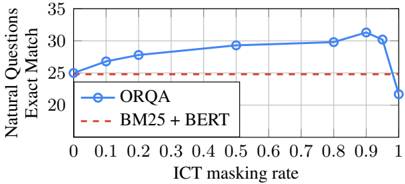
“Lee et al. (2019b) showed that masking a sentence with a certain probability, p , can both mimic the performance of lexical matching ( p = 0 ) or semantic matching ( p > 0 ).”
BackgroundMethodResultInfluentialASQA: Factoid Questions Meet Long-Form Answers
Stelmakh, I., Luan, Y., Dhingra, B., & Chang, M.-W. (2022) · Proceedings of the 2022 Conference on Empirical Methods in Natural Language Processing · doi:10.18653/v1/2022.emnlp-main.566 · Cited by 63
Self-citationDistilling Knowledge from Reader to Retriever for Question Answering
Izacard, G., & Grave, E. (2020) · arXiv · doi:10.48550/arxiv.2012.04584 · Cited by 102
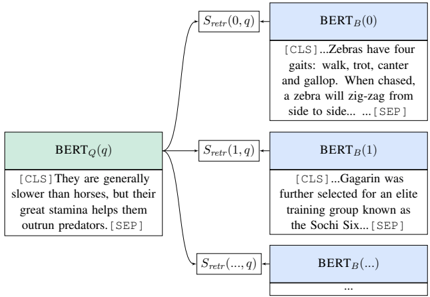
“Lee et al. (2019) introduced the inverse cloze task for pre-training retrievers, which can then be fine-tuned end-to-end on question-answering tasks.”
BackgroundFew-Shot Conversational Dense Retrieval
Yu, S., Liu, Z., Xiong, C., Feng, T., & Liu, Z. (2021) · International ACM SIGIR Conference on Research and Development in Information Retrieval (SIGIR) · doi:10.1145/3404835.3462856 · Cited by 180
“We use the common BERT-Siamese/Dual-Encoder architecture in dense retrieval [24] to encode the conversational turns and documents:”
BackgroundMethodCogLTX: Applying BERT to Long Texts
Ding, M., Zhou, C., Yang, H., & Tang, J. (2020) · neural information processing systems · Cited by 189
SparTerm: Learning Term-based Sparse Representation for Fast Text RetrievalPreprint
Bai, Y., Li, X., Wang, G., Zhang, C., Shang, L., Xu, J., Wang, Z., Wang, F., & Liu, Q. (2020) · arXiv (Cornell University) · doi:10.48550/arxiv.2010.00768 · Cited by 172
“Based on dense representations, Lee [8] proposed ORQA with bi-encoder architecture to retrieve candidate passages for question answering using FAISS [5].”
MethodSimple Entity-Centric Questions Challenge Dense Retrievers
Sciavolino, C., Zhong, Z., Lee, J., & Chen, D. (2021) · Proceedings of the 2021 Conference on Empirical Methods in Natural Language Processing · doi:10.18653/v1/2021.emnlp-main.496 · Cited by 98
“Compared to DPR, REALM adopts a pre-training task called salient span masking (SSM), along with an inverse cloze task from Lee et al. (2019).”
MethodReducing hallucination in structured outputs via Retrieval-Augmented Generation
Ayala, O., & Bechard, P. (2024) · Proceedings of the 2024 Conference of the North American Chapter of the Association for Computational Linguistics: Human Language Technologies (Volume 6: Industry Track) · doi:10.18653/v1/2024.naacl-industry.19 · Cited by 97
“These retrievers are often used in open-domain question answering systems (Guu et al., 2020; Lee et al., 2019), where both queries and documents are unstructured data and thus share the same semantic space.”
BackgroundOpen Domain Question Answering over Tables via Dense Retrieval
Herzig, J., Müller, T., Krichene, S., & Eisenschlos, J. (2021) · Proceedings of the 2021 Conference of the North American Chapter of the Association for Computational Linguistics: Human Language Technologies · doi:10.18653/v1/2021.naacl-main.43 · Cited by 78
Distilling Dense Representations for Ranking using Tightly-Coupled Teachers
Lin, S.-C., Yang, J.-H., & Lin, J. (2020) · arXiv (Cornell University) · doi:10.48550/arxiv.2010.11386 · Cited by 50
“…based on pretrained trans-formers (Devlin et al., 2018) have been widely adopted to map queries and passages into low dimensional vectors independently (Lee et al., 2019; Chang et al., 2020; Khattab and Zaharia, 2020; Guu et al., 2020; Karpukhin et al., 2020; Luan et al., 2020; Xiong et al., 2020).”
BackgroundUnderstanding tables with intermediate pre-training
Eisenschlos, J., Krichene, S., & Müller, T. (2020) · Findings of the Association for Computational Linguistics: EMNLP 2020 · doi:10.18653/v1/2020.findings-emnlp.27 · Cited by 86
Complement Lexical Retrieval Model with Semantic Residual Embeddings
Gao, L., Dai, Z., Chen, T., Fan, Z., Durme, B. V., & Callan, J. (2021) · Lecture notes in computer science · doi:10.1007/978-3-030-72113-8_10 · Cited by 162
“Recent research investigated using modern deep learning techniques to build vector representations: [21] and [13] used BERT-based retrieval to find passages for QA; [4] proposes a set of pre-training tasks for sentence retrieval.”
BackgroundMethodImproving Passage Retrieval with Zero-Shot Question Generation
Sachan, D., Lewis, M., Joshi, M., Aghajanyan, A., Yih, W.-T., Pineau, J., & Zettlemoyer, L. (2022) · Proceedings of the 2022 Conference on Empirical Methods in Natural Language Processing · doi:10.18653/v1/2022.emnlp-main.249 · Cited by 90
A Survey of Knowledge Enhanced Pre-trained Language Models
Yang, J., Hu, X., Xiao, G., & Shen, Y. (2024) · ACM Transactions on Asian and Low-Resource Language Information Processing · doi:10.1145/3631392 · Cited by 47
Retrieval Augmented Classification for Long-Tail Visual Recognition
Long, A., Yin, W., Ajanthan, T., Nguyen, V., Purkait, P., Garg, R., Blair, A., Shen, C., & van den Hengel, A. (2022) · 2022 IEEE/CVF Conference on Computer Vision and Pattern Recognition (CVPR) · doi:10.1109/cvpr52688.2022.00683 · Cited by 80
“Latent retrieval has been applied to textual open-domain QA [25, 29].”
MethodRetrieval Augmented Visual Question Answering with Outside Knowledge
Lin, W., & Byrne, B. (2022) · Proceedings of the 2022 Conference on Empirical Methods in Natural Language Processing · doi:10.18653/v1/2022.emnlp-main.772 · Cited by 61
GPL: Generative Pseudo Labeling for Unsupervised Domain Adaptation of Dense Retrieval
Wang, K., Thakur, N., Reimers, N., & Gurevych, I. (2022) · Proceedings of the 2022 Conference of the North American Chapter of the Association for Computational Linguistics: Human Language Technologies · doi:10.18653/v1/2022.naacl-main.168 · Cited by 76
TopiOCQA: Open-domain Conversational Question Answering with Topic Switching
Adlakha, V., Dhuliawala, S., Suleman, K., de Vries, H., & Reddy, S. (2022) · Transactions of the Association for Computational Linguistics · doi:10.1162/tacl_a_00471 · Cited by 74
“, 2019), more recent deep learning approaches learn dense representations of the questions and document through a dual-encoder framework (Lee et al., 2019; Karpukhin et al., 2020).”
BackgroundHow to Train Your Dragon: Diverse Augmentation Towards Generalizable Dense Retrieval
Lin, S.-C., Asai, A., Li, M., Oğuz, B., Lin, J., Mehdad, Y., Yih, W.-T., & Chen, X. (2023) · Findings of the Association for Computational Linguistics: EMNLP (Findings of EMNLP) · doi:10.18653/v1/2023.findings-emnlp.423 · Cited by 210
Learning Dense Representations of Phrases at Scale
Lee, J., Sung, M., Kang, J., & Chen, D. (2021) · Proceedings of the 59th Annual Meeting of the Association for Computational Linguistics and the 11th International Joint Conference on Natural Language Processing (Volume 1: Long Papers) · doi:10.18653/v1/2021.acl-long.518 · Cited by 68
“While a dominating approach is a two-stage retriever-reader approach (Chen et al., 2017; Lee et al., 2019; Guu et al., 2020; Karpukhin et al., 2020), we focus on a recent new paradigm solely based on phrase retrieval (Seo et al., 2019; Lee et al., 2020).”
BackgroundMethodInfluentialKnowledge Guided Text Retrieval and Reading for Open Domain Question Answering
Min, S., Chen, D., Zettlemoyer, L., & Hajishirzi, H. (2019) · arXiv (Cornell University) · doi:10.48550/arxiv.1911.03868 · Cited by 75
“Other lines of research in open-domain QA include joint learning of retrieval and reader components (Lee et al., 2019) or direct phrase retrieval in a large collection of documents (Seo et al., 2019).”
Neural machine translation with monolingual translation memory
Cai, D., Wang, Y., Li, H., Lam, W., & Liu, L. (2021) · Proceedings of the 59th Annual Meeting of the Association for Computational Linguistics and the 11th International Joint Conference on Natural Language Processing (Volume 1: Long Papers) · doi:10.18653/v1/2021.acl-long.567 · Cited by 45
“One typical use is to retrieve supporting evidence for open-domain question answering (e.g., Chen et al., 2017; Lee et al., 2019; Karpukhin et al., 2020).”
BackgroundOguz, B., Chen, X., Karpukhin, V., Peshterliev, S., Okhonko, D., Schlichtkrull, M., Gupta, S., Mehdad, Y., & Yih, S. (2022) · Findings of the Association for Computational Linguistics: NAACL 2022 · doi:10.18653/v1/2022.findings-naacl.115 · Cited by 41
Scaling Deep Contrastive Learning Batch Size under Memory Limited Setup
Gao, L., Zhang, Y., Han, J., & Callan, J. (2021) · Workshop on Representation Learning for NLP (RepL4NLP) · doi:10.18653/v1/2021.repl4nlp-1.31 · Cited by 233
“Recent works in NLP adopt deep neural nets as encoders and use unsupervised contrastive learning on sentence representation (Giorgi et al., 2020), text retrieval (Lee et al., 2019), and language model pre-training tasks (Wu et al., 2020).”
BackgroundMethodTowards General Text Embeddings with Multi-stage Contrastive Learning
Li, Z., Zhang, X., Zhang, Y., Long, D., Xie, P., & Zhang, M. (2023) · arXiv · doi:10.48550/arxiv.2308.03281 · Cited by 79
“Lee et al. (2019) propose the Inverse Close Task (ICT) as a self-supervised pre-training approach for generating a dense retriever.”
MethodPROP: Pre-training with Representative Words Prediction for Ad-hoc Retrieval
Ma, X., Guo, J., Zhang, R., Fan, Y., Ji, X., & Cheng, X. (2021) · ACM International Conference on Web Search and Data Mining (WSDM) · doi:10.1145/3437963.3441777 · Cited by 122
“As observed in Chang et.al [6], ICT outperforms BFS and WLP task.”
BackgroundMethodInfluentialShuster, K., Komeili, M., Adolphs, L., Roller, S., Szlam, A., & Weston, J. (2022) · Findings of the Association for Computational Linguistics: EMNLP 2022 · doi:10.18653/v1/2022.findings-emnlp.27 · Cited by 72
Can Pre-trained Vision and Language Models Answer Visual Information-Seeking Questions?
Chen, Y., Hu, H., Luan, Y., Sun, H., Changpinyo, S., Ritter, A., & Chang, M.-W. (2023) · Conference on Empirical Methods in Natural Language Processing (EMNLP) · doi:10.18653/v1/2023.emnlp-main.925 · Cited by 299
Self-citationAlawwad, H. A., Alhothali, A., Naseem, U., Alkhathlan, A., & Jamal, A. T. (2025) · Pattern Recognition · doi:10.1016/j.patcog.2024.111332 · Cited by 109
“Retrievers can be sparse, relying on classical information retrieval (IR) methods like TF-IDF [19], dense, incorporating DL retrieval methods as in REALM [20] and ORQA [21], or iterative, as in MUPPET [22].”
Evaluating Correctness and Faithfulness of Instruction-Following Models for Question Answering
Adlakha, V., BehnamGhader, P., Lu, X. H., Meade, N., & Reddy, S. (2024) · Transactions of the Association for Computational Linguistics · doi:10.1162/tacl_a_00667 · Cited by 74
“We use the open version (Lee et al., 2019) of Natural Questions (NQ; Kwiatkowski et al. 2019), that contains queries from Google search engine.”
MethodEnd-to-End Training of Neural Retrievers for Open-Domain Question Answering
Sachan, D., Patwary, M., Shoeybi, M., Kant, N., Ping, W., Hamilton, W. L., & Catanzaro, B. (2021) · Proceedings of the 59th Annual Meeting of the Association for Computational Linguistics and the 11th International Joint Conference on Natural Language Processing (Volume 1: Long Papers) · doi:10.18653/v1/2021.acl-long.519 · Cited by 62
“In particular, (Lee et al., 2019) first pre-train the retriever in an unsupervised manner using ICT and then jointly train the retriever and reader for OpenQA.”
BackgroundMethodInfluentialEvaluating Correctness and Faithfulness of Instruction-Following Models for Question Answering
Adlakha, V., BehnamGhader, P., Lu, X. H., Meade, N., & Reddy, S. (2023) · arXiv · doi:10.48550/arxiv.2307.16877 · Cited by 74
Discriminative Nearest Neighbor Few-Shot Intent Detection by Transferring Natural Language Inference
Zhang, J., Hashimoto, K., Liu, W., Wu, C.-S., Wan, Y., Yu, P. S., Socher, R., & Xiong, C. (2020) · Conference on Empirical Methods in Natural Language Processing (EMNLP) · doi:10.18653/v1/2020.emnlp-main.411 · Cited by 112
Metadata
- Authors
- Lee, K., Chang, M.-W., & Toutanova, K.
- Affiliations
- Google (United States) (US)
- Venue
- Proceedings of the 57th Annual Meeting of the Association for Computational Linguistics
- Published
- 2019
- Pages
- 6086-6096
- ISSN
- 0736-587X (ISSN-L)
- OpenAlex
- W2947497897
- Cited by
- 771
- References
- 30
- Citations by year
- 2026: 36 · 2025: 67 · 2024: 70 · 2023: 159 · 2022: 134 · 2021: 194 · 2020: 101 · 2019: 10
- FWCI
- 41.99
- Type
- conference paper
- Language
- en
- Open access
- hybrid
- doi.org
- Licence
- cc-by
- Locations
- Proceedings of the conference - Association for Computational Linguistics. Meeting (publishedVersion, cc-by)
- arXiv (Cornell University) (submittedVersion)
- arXiv (Cornell University)
- Topics
- Physical Sciences › Computer Science › Artificial Intelligence › Topic Modeling
- Physical Sciences › Computer Science › Information Systems › Information Retrieval and Search Behavior
- Physical Sciences › Computer Science › Computer Vision and Pattern Recognition › Multimodal Machine Learning Applications
- Keywords
- open-domain question answering, weakly supervised learning, evidence retrieval
About these checks
Registry, retraction, Cites and statistics results are computed, not judged, with one exception: a printed reference that no index lists is read once by a model before it counts as a citation error. Claims are extracted by a model and kept only when their quote appears verbatim in the text; each cited source is then checked, with a model’s help, for whether it says what the claim relies on. Those verdicts can be wrong — read the claim’s quote and the cited source before relying on one.
Statistics and arithmetic are recomputed, not judged.
Confidence bands are shown only for fields calibrated on our annotated test set. None is calibrated yet, so no band is shown.
What counts as a claim ›How we measure confidence ›How we check this ›
Are you an author, or do you see a problem with this page? Request a review
Data sources
Bibliographic data: Semantic Scholar, OpenAlex, Crossref.
Contains information from the Semantic Scholar Academic Graph Datasets, made available under the ODC Attribution License (ODC-BY 1.0).
Semantic Scholar’s data is described in: Kinney, R., et al. (2023). The Semantic Scholar Open Data Platform. arXiv:2301.10140.
