

Celiac disease and bone
Open accessThe DOI matches its Crossref record; 78 of the 78 references it cites were found in a registry or an index.
Abstract
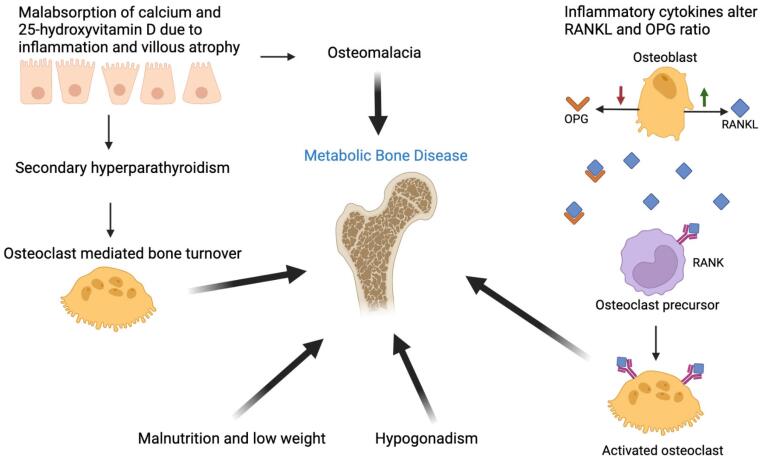
Celiac disease (CD) is an autoimmune disorder characterized by small intestinal inflammation triggered by gluten ingestion in genetically-predisposed individuals. A frequent extra-intestinal manifestation of CD is metabolic bone disease which contributes to an increased risk of fracture. The mechanisms underlying bone disease in CD remain incompletely understood, but multiple processes have been proposed including (1) malabsorption of calcium and vitamin D leading to secondary hyperparathyroidism and increased skeletal resorption, (2) pro-inflammatory cytokines altering the osteoprotegerin and receptor activator of nuclear kappa-B ligand ratio favoring osteoclastogenesis, (3) hypogonadism, and (4) low weight and malnutrition. Most studies show reduced bone mineral density in patients with CD. Bone microarchitecture is also deteriorated leading to reduced whole bone stiffness. Many, but not all investigations, have shown an increased risk of fracture associated with CD. The main stay of therapy for CD is maintaining a gluten-free diet. Improvement in bone mineral density with adherence to a gluten-free diet has been well-established. Bone mineral density remains lower, however, compared to controls and increased fracture risk can persist. There is no consensus on the timing of dual-energy x-ray absorptiometry for bone mineral density assessment in patients with CD. Routine screening for CD in patients with osteoporosis is not recommended. Little data are available on the use or efficacy of prescription osteoporosis therapeutics in patients with CD. Studies are needed to develop standardized guidelines for screening and treatment of metabolic bone disease in patients with CD to identify those who may need early intervention with prescription osteoporosis therapy.
Overview
The claims and statistics of this paper haven’t been checked yet.
Free: it reads the open-access text and checks the first 5 claims that cite a source we can check. Create a free account to check every claim.
Integrity signals
Registry
Cites
Statistics
Figures
Verification
Claims the paper makes
The claims and statistics of this paper haven’t been checked yet.
Free: it reads the open-access text and checks the first 5 claims that cite a source we can check. Create a free account to check every claim.
Self-check
Percentages, sums and reported differences re-computed from the paper’s own numbers.
The self-check needs the paper’s full text.
Citations
Cites
Global Prevalence of Celiac Disease: Systematic Review and Meta-analysis
Singh, P., Arora, A., Strand, T. A., Leffler, D. A., Catassi, C., Green, P. H., Kelly, C. P., Ahuja, V., & Makharia, G. K. (2018) · Clinical Gastroenterology and Hepatology · doi:10.1016/j.cgh.2017.06.037 · Cited by 1,743
The Oslo definitions for coeliac disease and related terms
Ludvigsson, J. F., Leffler, D. A., Bai, J. C., Biagi, F., Fasano, A., Green, P. H. R., Hadjivassiliou, M., Kaukinen, K., Kelly, C. P., Leonard, J. N., et al. (2013) · Gut · doi:10.1136/gutjnl-2011-301346 · Cited by 1,721 · cited 2×
“CD is estimated to affect 1%-2% of the population worldwide with increasing incidence and prevalence over the last few decades (7-9).”
BackgroundSelf-citationFasano, A., Berti, I., Gerarduzzi, T., Not, T., Colletti, R. B., Drago, S., Elitsur, Y., Green, P. H. R., Guandalini, S., Hill, I. D., et al. (2003) · Archives of Internal Medicine · doi:10.1001/archinte.163.3.286 · Cited by 1,698 · cited 2×
“The mechanisms underlying bone disease in CD remain incompletely understood, but multiple processes have been proposed including (1) malabsorption of calcium and vitamin D leading to secondary hyperparathyroidism and increased skeletal resorption, (2) pro-inflammatory cytokines altering the osteoprotegerin and recepto…”
BackgroundACG Clinical Guidelines: Diagnosis and Management of Celiac Disease
Rubio-Tapia, A., Hill, I. D., Kelly, C. P., Calderwood, A. H., & Murray, J. A. (2013) · American Journal of Gastroenterology · doi:10.1038/ajg.2013.79 · Cited by 1,681
Minireview: The OPG/RANKL/RANK System
Khosla, S. (2001) · Endocrinology · doi:10.1210/endo.142.12.8536 · Cited by 1,515 · cited 1×
“Inflammatory cytokines lower the ratio favoring osteoclastogenesis (36,37).”
BackgroundLudvigsson, J. F., Bai, J. C., Biagi, F., Card, T. R., Ciacci, C., Ciclitira, P. J., Green, P. H. R., Hadjivassiliou, M., Holdoway, A., van Heel, D. A., et al. (2014) · Gut · doi:10.1136/gutjnl-2013-306578 · Cited by 1,116 · cited 1×
“Similarly, the American Gastroenterological Association (AGA) recommends BMD assessment one year after GFD initiation in newly diagnosed CD patients (64), while the British Society of Gastroenterology (BSG) recommends BMD testing after one year of a GFD in patients above age 55 or those who have additional risk factor…”
BackgroundCeliac disease: a comprehensive current review
Caio, G., Volta, U., Sapone, A., Leffler, D. A., De Giorgio, R., Catassi, C., & Fasano, A. (2019) · BMC Medicine · doi:10.1186/s12916-019-1380-z · Cited by 1,105 · cited 3×
“Ingestion of gluten and its immunogenic fragment, gliadin, leads to an inflammatory cascade that may result in changes in gut permeability, production of pro-inflammatory cytokines, lymphocytic infiltration of the intestinal epithelium and ultimately villous atrophy (2,3).”
BackgroundLebwohl, B., Sanders, D. S., & Green, P. H. R. (2018) · The Lancet · doi:10.1016/s0140-6736(17)31796-8 · Cited by 1,065 · cited 2×
“Ingestion of gluten and its immunogenic fragment, gliadin, leads to an inflammatory cascade that may result in changes in gut permeability, production of pro-inflammatory cytokines, lymphocytic infiltration of the intestinal epithelium and ultimately villous atrophy (2,3).”
BackgroundAl-Toma, A., Volta, U., Auricchio, R., Castillejo, G., Sanders, D. S., Cellier, C., Mulder, C. J., & Lundin, K. E. A. (2019) · United European Gastroenterology Journal · doi:10.1177/2050640619844125 · Cited by 1,012 · cited 1×
“In contrast, the European Society for Study of Celiac Disease recommends BMD testing at time of diagnosis in all adult CD patients (62).”
BackgroundFasano, A., & Catassi, C. (2012) · New England Journal of Medicine · doi:10.1056/nejmcp1113994 · Cited by 687 · cited 2×
“The mechanisms underlying bone disease in CD remain incompletely understood, but multiple processes have been proposed including (1) malabsorption of calcium and vitamin D leading to secondary hyperparathyroidism and increased skeletal resorption, (2) pro-inflammatory cytokines altering the osteoprotegerin and recepto…”
Background
Cited by
Clinical practice guidelines for the care of girls and women with Turner syndrome.
Gravholt, C. H., Andersen, N. H., Christin-Maitre, S., Davis, S. M., Duijnhouwer, A., Gawlik, A., Maciel-Guerra, A. T., Gutmark-Little, I., Fleischer, K., Hong, D., et al. (2024) · European Journal of Endocrinology · doi:10.1093/ejendo/lvae050 · Cited by 224
Celiac Disease: Beyond Diet and Food Awareness
Herrera‐Quintana, L., Navajas-Porras, B., Vázquez‐Lorente, H., Hinojosa-Nogueira, D., Corrales-Borrego, F. J., López-Garzón, M., & Plaza‐Díaz, J. (2025) · Foods · doi:10.3390/foods14030377 · Cited by 29
Santonicola, A., Wieser, H., Gizzi, C., Soldaini, C., & Ciacci, C. (2024) · Nutrients · doi:10.3390/nu16121814 · Cited by 33
“The underlying mechanisms remain incompletely understood, although several mechanisms, such as the malabsorption of calcium and vitamin D and the secretion of pro-inflammatory cytokines, have been suggested [41].”
BackgroundExtraintestinal complications of celiac disease: treatment considerations
Lazzano, P., Fracas, E., Nandi, N., Scaramella, L., & Elli, L. (2024) · Expert Review of Gastroenterology & Hepatology · doi:10.1080/17474124.2024.2443053 · Cited by 12
“The International Society for Clinical Densitometry suggests carrying out more investigations only in subjects with signs of malabsorption [62].”
Celiac Disease: A Transitional Point of View
Aitella, E., Cozzolino, D., Ginaldi, L., & Romano, C. P. (2025) · Nutrients · doi:10.3390/nu17020234 · Cited by 13
“…exogenous gluten dependence of the disease is lost to become a “fully” dysimmune gluten-independent condition; type 2, on the other hand, seems to be more frequently associated with homozygosity of HLA-DQ2 and can be considered as an in situ T cell lymphoma at high risk of EATL progression [62,63].”
Metadata
- Authors
- Kondapalli, A. V., & Walker, M. D.
- Affiliations
- Columbia University Irving Medical Center (US)
- Corresponding author
- Walker, Marcella Donovan
- Venue
- Archives of Endocrinology and Metabolism
- Published
- 2022
- Volume
- 66
- Issue
- 5
- Pages
- 756-764
- ISSN
- 2359-3997 (ISSN-L)
- 2359-4292
- PMC
- PMC10118825
- OpenAlex
- W4309364606
- Cited by
- 25
- References
- 78
- Citations by year
- 2026: 7 · 2025: 8 · 2024: 7 · 2023: 3
- FWCI
- 0.93
- Type
- journal article
- Language
- en
- Open access
- diamond
- doi.org
- Licence
- cc-by
- Locations
- Archives of Endocrinology and Metabolism (publishedVersion, cc-by)
- PubMed Central (publishedVersion, cc-by)
- PubMed (publishedVersion)
- LA Referencia (Red Federada de Repositorios Institucionales de Publicaciones Científicas) (publishedVersion, other-oa)
- DOAJ (DOAJ: Directory of Open Access Journals) (submittedVersion, cc-by-sa)
- Topics
- Health Sciences › Medicine › Gastroenterology › Celiac Disease Research and Management
- Health Sciences › Medicine › Orthopedics and Sports Medicine › Bone health and osteoporosis research
- Life Sciences › Biochemistry, Genetics and Molecular Biology › Molecular Biology › Bone Metabolism and Diseases
- Keywords
- celiac disease, metabolic bone disease, bone mineral density, fracture risk, osteoporosis, gluten-free diet, secondary hyperparathyroidism, osteoclastogenesis, RANK/RANKL, osteoprotegerin, hypogonadism, bone microarchitecture, osteoporosis screening, osteoporosis treatment
- MeSH terms
- Bone and Bones, Bone Diseases, Metabolic, Celiac Disease, Humans, Osteoporosis, Bone Density, Fractures, Bone, Diet, Gluten-Free
About these checks
Registry, retraction, Cites and statistics results are computed, not judged, with one exception: a printed reference that no index lists is read once by a model before it counts as a citation error. Claims are extracted by a model and kept only when their quote appears verbatim in the text; each cited source is then checked, with a model’s help, for whether it says what the claim relies on. Those verdicts can be wrong — read the claim’s quote and the cited source before relying on one.
Statistics and arithmetic are recomputed, not judged.
Confidence bands are shown only for fields calibrated on our annotated test set. None is calibrated yet, so no band is shown.
What counts as a claim ›How we measure confidence ›How we check this ›
Are you an author, or do you see a problem with this page? Request a review
How to cite
Cite CoChat for the checks on this page, and the paper for its own findings.
- This page
- CoChat. (2026). Citation check: Celiac disease and bone. https://app.cochat.ai/papers/10.20945/2359-3997000000561
- The paper
- Kondapalli, A. V., & Walker, M. D. (2022). Celiac disease and bone. Archives of Endocrinology and Metabolism. https://doi.org/10.20945/2359-3997000000561
Data sources
Bibliographic data: Semantic Scholar, OpenAlex, Crossref.
Contains information from the Semantic Scholar Academic Graph Datasets, made available under the ODC Attribution License (ODC-BY 1.0).
Semantic Scholar’s data is described in: Kinney, R., et al. (2023). The Semantic Scholar Open Data Platform. arXiv:2301.10140.
