

MiRNA-494 specifically inhibits SIRT3-mediated microglia activation in sepsis-associated encephalopathy
Open accessThe DOI matches its Crossref record; 44 of the 44 references it cites were found in a registry or an index.
Abstract
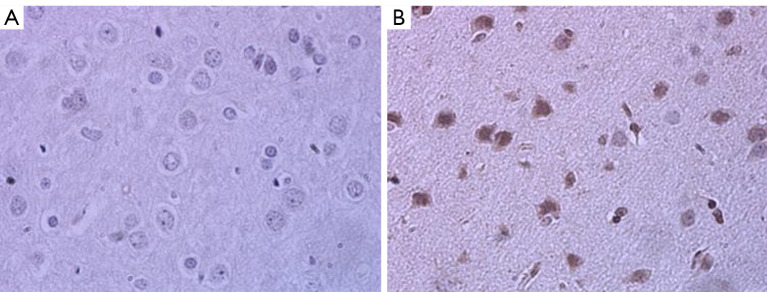
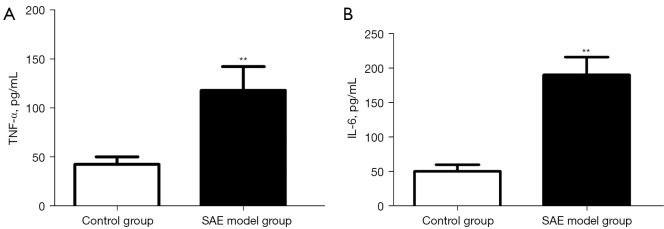
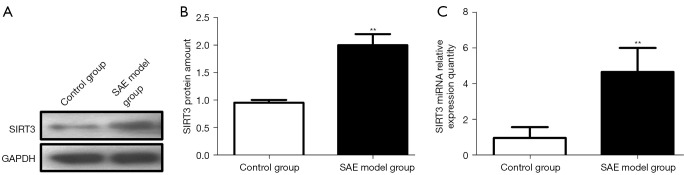
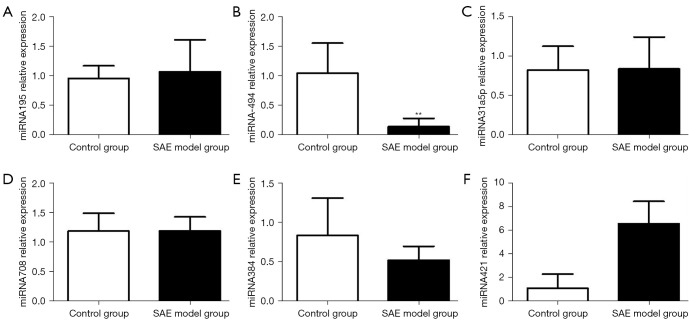
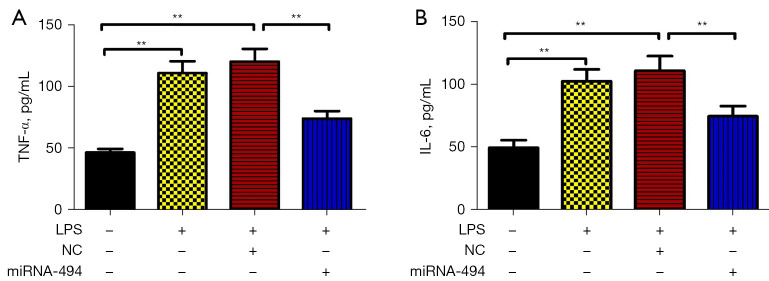
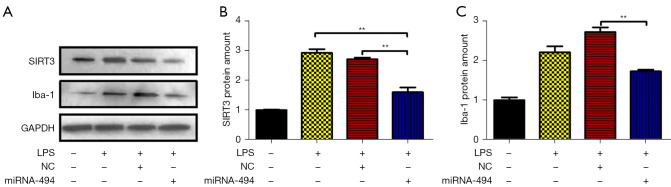
Background: Sepsis-associated encephalopathy (SAE) is characterized by the activation of inflammatory cascades, in which microglia play a key role. The activation of Recombinant Sirtuin 3 (SIRT3) was shown to significantly reduce the susceptibility of microglia to inflammatory stress. The purpose of this study is to determine whether miRNA-494 can regulate the activation and oxidative stress of SAE microglia through SIRT3. Methods: An SAE rat model was established, and the expression of Ionized calcium bindingadaptor molecule-1 (Iba-1) in rat brain tissue was detected by immunohistochemistry. Enzyme-linked immuno sorbent assay was performed to detect the expression of tumor necrosis factor alpha (TNF-α) and interleukin-6 (IL-6) in brain tissue. Real time quantitative PCR was performed to detect the relative expression of SIRT3 and related miRNAs, while Western blot was used to detect the protein expression of SIRT3. Rat microglia cells were cultured in vitro . After miRNA-494 was transfected, the expression of TNF-α and IL-6 was detected. Western blot was used to detect the protein expression of SIRT3 and Iba-1 in microglia. Results: The results showed that the expression of Iba-1 in the brain tissue of the SAE model group increased, and the expression of inflammatory factors TNF-α and IL-6 increased significantly (P<0.01). The expression of SIRT3 protein and mRNA in the brain tissue of the SAE model group also significantly increased (P<0.05). The relative expression of miRNA-494 in the SAE model group was significantly lower than that in the control group (P<0.01). After miRNA-494 was transfected into microglia, cells were treated with lipopolysaccharide. In the miRNA transfection group, the expression levels of TNF-α and IL-6 were significantly lower than those in the negative control (NC) group (P<0.01), and the protein expression levels of Iba-1 and SIRT3 were also significantly lower than those in the NC (P<0.01). Conclusions: MiRNA-494 may further regulate the activation of microglia in SAE by regulating mitochondrial function, providing basic research data for the development of new SAE treatment methods.
Overview
The claims and statistics of this paper haven’t been checked yet.
Free: it reads the open-access text and checks the first 5 claims that cite a source we can check. Create a free account to check every claim.
Integrity signals
Registry
Cites
Statistics
Figures
Verification
Claims the paper makes
The claims and statistics of this paper haven’t been checked yet.
Free: it reads the open-access text and checks the first 5 claims that cite a source we can check. Create a free account to check every claim.
Claims other papers make about this one
Each is checked against this paper’s own text: does it say what the citing paper says it does?
The source backs part of the claim, not all of it — or backs it for a different population, condition or comparison.
In the citing paper
“miR-494 maintains mitochondrial metabolic homeostasis [24].”
From Research Advances in the Pathogenesis of Sepsis-Associated Encephalopathy (2026) · cites this paper as [24]
Experimental — accuracy not yet measured
Self-check
Percentages, sums and reported differences re-computed from the paper’s own numbers.
The self-check needs the paper’s full text.
Citations
Cites
The third international consensus definitions for sepsis and septic shock (Sepsis-3).
Singer, M., Deutschman, C. S., Seymour, C. W., Shankar-Hari, M., Annane, D., Bauer, M., Bellomo, R., Bernard, G. R., Chiche, J.-D., Coopersmith, C. M., et al. (2016) · JAMA · doi:10.1001/jama.2016.0287 · Cited by 28,250
Microglia-mediated neurotoxicity: uncovering the molecular mechanisms
Block, M. L., Zecca, L., & Hong, J.-S. (2007) · Nature Reviews Neuroscience · doi:10.1038/nrn2038 · Cited by 4,110 · cited 1×
“…accompanied by excessive activation of microglia and the release of a large number of inflammatory factors and NO, and the massive release of these factors will cause the body to produce excessive inflammatory responses and oxidative stress, thus further exacerbating the progression of SAE (29,30).”
MicroRNA as Biomarkers and Diagnostics
Wang, J., Chen, J., & Sen, S. (2016) · Journal of Cellular Physiology · doi:10.1002/jcp.25056 · Cited by 793 · cited 1×
“It is important that miRNAs are highly conserved in mammals and are key players in cellular processes such as cell differentiation, growth, proliferation, apoptosis, metabolism, and cell homeostasis (35,37,38).”
The Third International Consensus Definitions for Sepsis and Septic Shock (Sepsis-3)
Rather, A. R., & Kasana, B. (2015) · JMS SKIMS · doi:10.33883/jms.v18i2.269 · Cited by 780
Tumor necrosis factor alpha: A link between neuroinflammation and excitotoxicity
Olmos, G., & Lladó, J. (2014) · Mediators of Inflammation · doi:10.1155/2014/861231 · Cited by 730 · cited 1×
“…accompanied by excessive activation of microglia and the release of a large number of inflammatory factors and NO, and the massive release of these factors will cause the body to produce excessive inflammatory responses and oxidative stress, thus further exacerbating the progression of SAE (29,30).”
Systemic infection and delirium: when cytokines and acetylcholine collide
van Gool, W. A., van de Beek, D., & Eikelenboom, P. (2010) · The Lancet · doi:10.1016/s0140-6736(09)61158-2 · Cited by 561 · cited 1×
“However, cytokine dysregulation can cause neurotoxicity (9).”
MicroRNA history: Discovery, recent applications, and next frontiers
Almeida, M. I., Reis, R. M., & Calin, G. A. (2011) · Mutation Research - Fundamental and Molecular Mechanisms of Mutagenesis · doi:10.1016/j.mrfmmm.2011.03.009 · Cited by 466 · cited 2×
“MiRNAs are small non-coding RNAs which regulate post-transcriptional gene expression levels by inducing mRNA translational repression or degradation (35).”
Immune cell regulation of glia during CNS injury and disease
Greenhalgh, A. D., David, S., & Bennett, F. C. (2020) · Nature Reviews Neuroscience · doi:10.1038/s41583-020-0263-9 · Cited by 396 · cited 1×
“Microglia are the most common central nervous system resident immune cells that can regulate a variety of brain functions through cytokines and their interactions with neuronal and non-neuronal cells (8).”
Long-term cerebral consequences of sepsis
Widmann, C. N., & Heneka, M. T. (2014) · The Lancet Neurology · doi:10.1016/s1474-4422(14)70017-1 · Cited by 361 · cited 1×
“Patients who recover from SAE demonstrate various degrees of cognitive dysfunction persisting for months to years after discharge, which requires long-term medical intervention to restore function (4).”
Understanding brain dysfunction in sepsis
Sonneville, R., Verdonk, F., Rauturier, C., Klein, I. F., Wolff, M., Annane, D., Chretien, F., & Sharshar, T. (2013) · Annals of Intensive Care · doi:10.1186/2110-5820-3-15 · Cited by 352
Cited by
The role of SIRT3 in homeostasis and cellular health
Trinh, D., Halabi, L. A., Brar, H., Kametani, M., & Nash, J. E. (2024) · Frontiers in Cellular Neuroscience · doi:10.3389/fncel.2024.1434459 · Cited by 64
“Conversely, inflammatory stress can activate SIRT3 which reduces the effects of inflammation on microglia, inhibited by the presence of miRNA-494 in the brain (He et al., 2022).”
BackgroundResearch progress in the pathogenesis of sepsis-associated encephalopathy
Zhou, Y., Bai, L., Tang, W., Yang, W., & Sun, L. (2024) · Heliyon · doi:10.1016/j.heliyon.2024.e33458 · Cited by 20
“MiRNA-494 may further regulate the activation of microglia in SAE by regulating mitochondrial function, providing basic research data for the development of new SAE therapeutics [74].”
BackgroundTian, M., Zhan, Y., Cao, J., Gao, J., Sun, J., & Zhang, L. (2024) · Brain Research Bulletin · doi:10.1016/j.brainresbull.2024.110922 · Cited by 12
Sepsis‐associated encephalopathy: Autophagy and miRNAs regulate microglial activation
Qin, N., Miao, Y., Xie, L., Ma, X., & Xie, P. (2024) · Physiological Reports · doi:10.14814/phy2.15964 · Cited by 10
“…TREM-2 expression to promote microglial M2 polarization and alleviate neuroinflammation and behavioral deficits in SAE by inhibiting microRNA- 130a-3p (Peng et al., 2022). microRNA-494 can further regulate the activation of microglia in SAE by modulating mitochondrial function (He et al., 2022).”
BackgroundYu, D., Ji, Y., Zhang, J., & Huang, X. (2024) · Cellular and Molecular Biology · doi:10.14715/cmb/2024.70.3.15 · Cited by 4
Research Advances in the Pathogenesis of Sepsis-Associated Encephalopathy
Tan, H., Su, W., & Niu, Z. (2026) · International Journal of Molecular Sciences · doi:10.3390/ijms27125390 · Cited by 1
“…stage: 1 ⃝ Preclinical research: CD137L neutralizing antibody TKS-1 inhibits M1 polarization [21]; α 7nAChR agonist remimazolam activates the Nrf2/HO-1 pathway [22]; miR-25-3p inhibits IL-1 β signaling via the TLR4/NLRP3 axis [23]; miR-494 maintains mitochondrial metabolic homeostasis [24].”
Chen, Y., Tang, F., & Li, X. (2026) · Stem Cell Research & Therapy · doi:10.1186/s13287-026-05198-9
“Consequently, this inhibition facilitates a phenotypic shift from the M1 state to the anti-inflammatory M2 state, ultimately mitigating SAE-associated neuronal injury [175].”
Metadata
- Authors
- He, C., Aziguli, A., Zhen, J., Jiao, A., Liao, H., Du, C., Liu, W., Aihemaitijiang, K., & Xu, A.
- Corresponding author
- Xu, Aimin
- Venue
- Translational Cancer Research
- Publisher
- AME Publishing Company
- Published
- 2022-07
- Volume
- 11
- Issue
- 7
- Pages
- 2299-2309
- ISSN
- 2218-676X (ISSN-L)
- 2219-6803
- PMC
- PMC9372247
- OpenAlex
- W4288518869
- Cited by
- 7
- References
- 44
- Citations by year
- 2026: 1 · 2024: 5 · 2022: 1
- FWCI
- 0.53
- Type
- journal article
- Language
- en
- Open access
- diamond
- doi.org
- Licence
- cc-by-nc-nd
- Locations
- Translational Cancer Research (publishedVersion, cc-by-nc-nd)
- PubMed Central (publishedVersion, cc-by-nc-nd)
- PubMed (publishedVersion)
- Funders
- Natural Science Foundation of Xinjiang
- Topics
- Life Sciences › Neuroscience › Neurology › Neuroinflammation and Neurodegeneration Mechanisms
- Life Sciences › Biochemistry, Genetics and Molecular Biology › Cancer Research › MicroRNA in disease regulation
- Health Sciences › Medicine › Geriatrics and Gerontology › Sirtuins and Resveratrol in Medicine
- Keywords
- SIRT3, sepsis-associated encephalopathy, microglial activation, neuroinflammation, oxidative stress, TNF-α, interleukin-6, Iba1, lipopolysaccharide, mitochondrial function, brain injury, rat model, therapeutic target, neuroprotection, sepsis
About these checks
Registry, retraction, Cites and statistics results are computed, not judged, with one exception: a printed reference that no index lists is read once by a model before it counts as a citation error. Claims are extracted by a model and kept only when their quote appears verbatim in the text; each cited source is then checked, with a model’s help, for whether it says what the claim relies on. Those verdicts can be wrong — read the claim’s quote and the cited source before relying on one.
Statistics and arithmetic are recomputed, not judged.
Confidence bands are shown only for fields calibrated on our annotated test set. None is calibrated yet, so no band is shown.
What counts as a claim ›How we measure confidence ›How we check this ›
Are you an author, or do you see a problem with this page? Request a review
Data sources
Bibliographic data: Semantic Scholar, OpenAlex, Crossref.
Contains information from the Semantic Scholar Academic Graph Datasets, made available under the ODC Attribution License (ODC-BY 1.0).
Semantic Scholar’s data is described in: Kinney, R., et al. (2023). The Semantic Scholar Open Data Platform. arXiv:2301.10140.
