

High-Fidelity Control of Spin Ensemble Dynamics via Artificial Intelligence: From Quantum Computing to Imaging
Open accessThe DOI matches its Crossref record; 87 of the 89 references it cites were found in a registry or an index, and 1 are not checked yet; 1 of the 52 sources its claims cite were checked for support.
Abstract
High-fidelity control of spin ensemble dynamics is essential to many fields, spanning from quantum computing to optical, coherent, and nuclear magnetic resonance (NMR) spectroscopy and imaging (MRI). However, attaining robust and high-fidelity quantum spin operations remains an unmet challenge. Using a combination of an evolutionary algorithm and artificial intelligence, we designed time-optimal, radio frequency (RF) pulses with tunable spatial or temporal field inhomogeneity compensation and fidelity for unitary operations up to 0.9999. As a benchmark, we constructed a spin entanglement operator and a programmable quantum state creator for a weakly-coupled two-spin-1/2 system. We achieved high-fidelity transformations under multiple inhomogeneity sources. The newly designed RF pulses are more robust and less prone to imperfection than the commonly used shapes for basic liquid-state NMR experiments and reduce RF artifacts in MRI. This new strategy will enable the design of efficient quantum computing opera-tors as well as new spectroscopic and imaging techniques.
Verified 2026-11-22 · 1 reference not checked yet
Overview
CoChat Summary
TL;DR
The authors introduce GENETICS-AI, an evolutionary-algorithm/AI framework that designs constant-amplitude RF pulses with customizable bandwidth, inhomogeneity compensation, and fidelity for spin-ensemble control. The generated pulses outperform standard rectangular/composite pulses in simulations and in NMR, MRI phantom, and ¹³CHCl₃ entanglement experiments, with reported fidelities up to 0.99999.
Key findings
- GENETICS-AI generated RF pulses with constant amplitude and customizable bandwidth, RF inhomogeneity compensation, and operational fidelity; the OPS library contained ∼2,00,000 RF shapes, and several spin operations reached fidelity up to 0.99999.
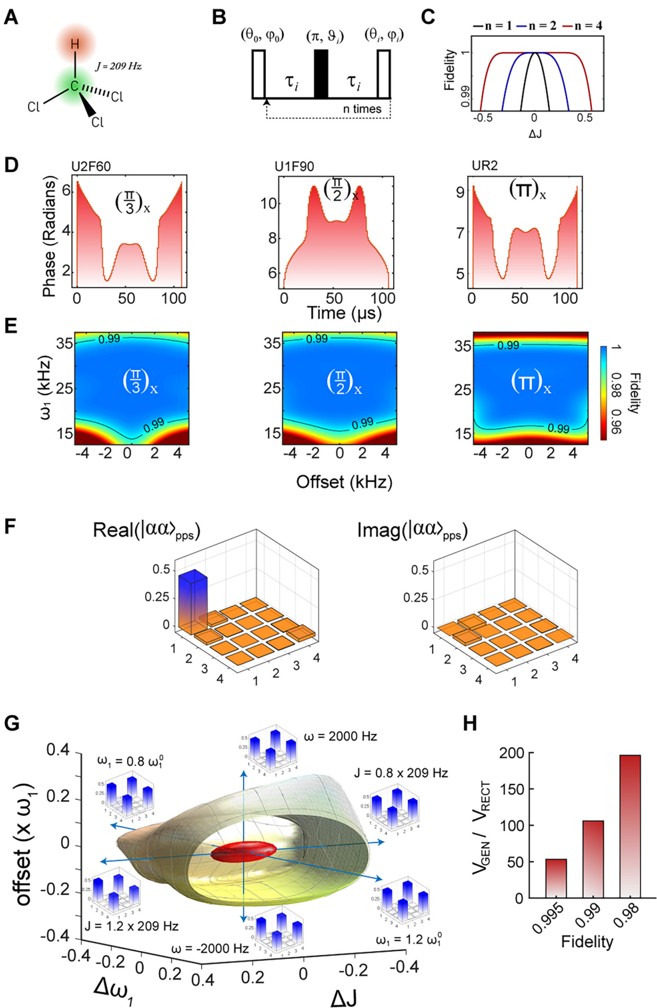
- For the weakly coupled two-spin-1/2 system of ¹³CHCl₃, the GEN-Entangler gave J-coupling compensation of ±10% for n = 1, ±30% for n = 2, and ±50% for n = 4; with n = 2 and compensation of ±20% for ω₁ and ±2 kHz for BW, the fidelity volume was approximately 100 times larger than a rectangular-pulse C-NOT entangler at maximum inhomogeneity, rising to 200 times at 0.98 fidelity, and the sequence was ∼62% shorter than the J-compensated C-NOT gate sequence.
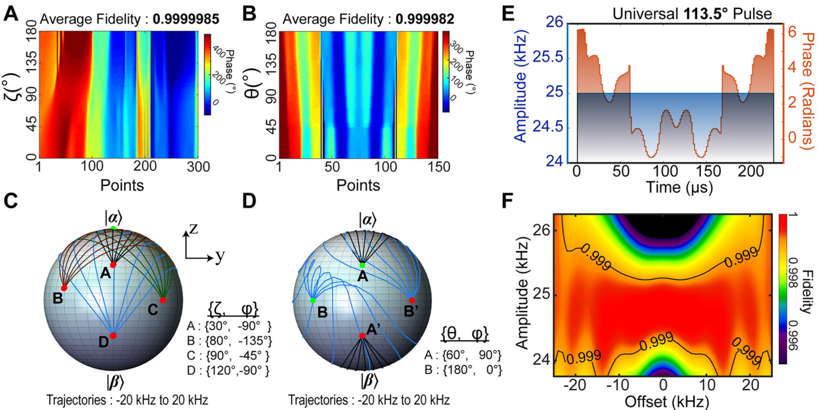
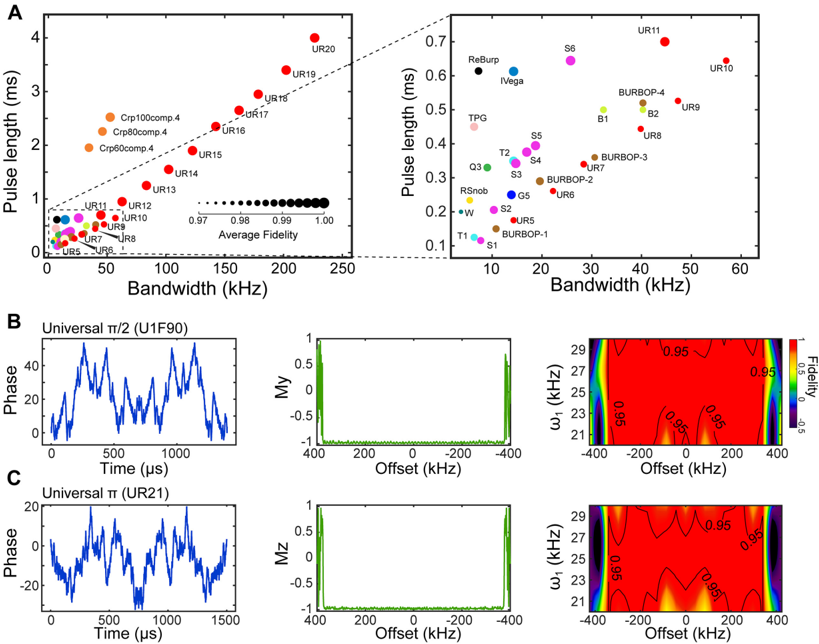
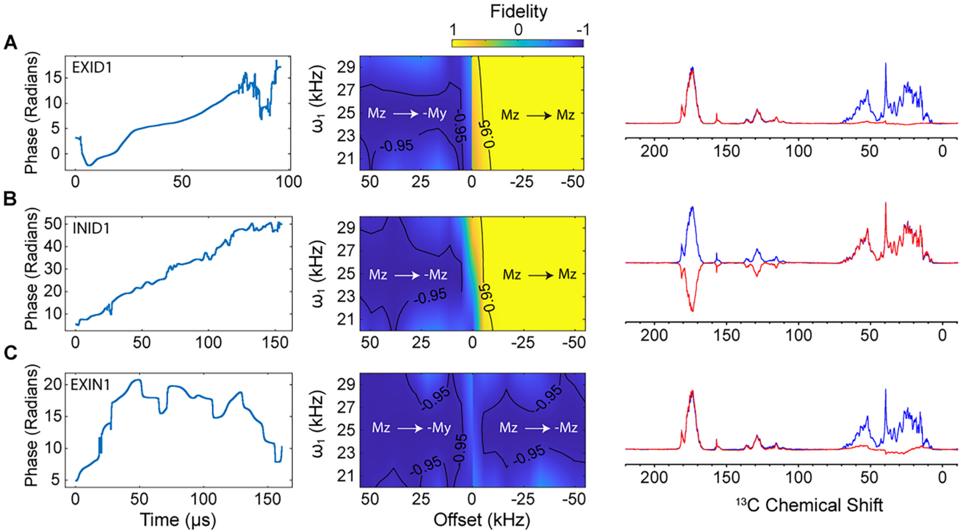
- Broadband pulses: universal π/2 and π pulses covered 40 kHz BW with lengths <300 μs, constant ω₁ = 25 kHz, and average fidelity 0.9999; ultra-broadband universal π/2 and π pulses reached 750 kHz BW (30 × ω₁) with ∼1.5 ms length; a broadband inversion pulse achieved fidelity 0.99999 with 274 μs duration, 100 kHz BW, and 25 kHz RF amplitude; adding 5 kHz (20%) numerical noise dropped fidelity by only 0.014 (0.999 to 0.985).
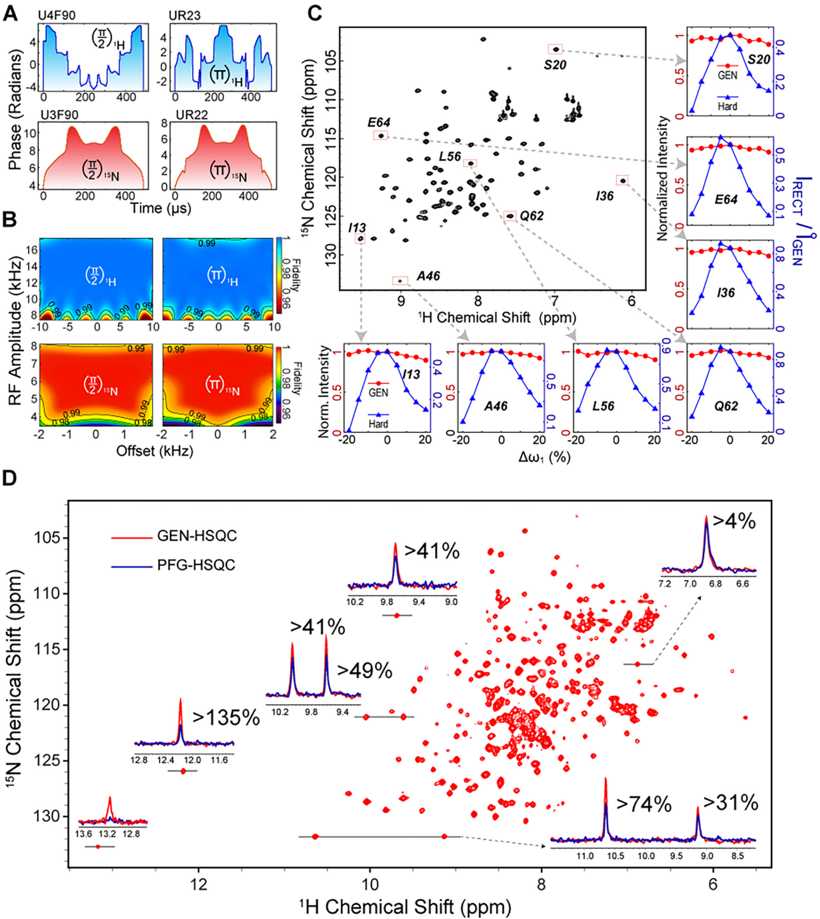
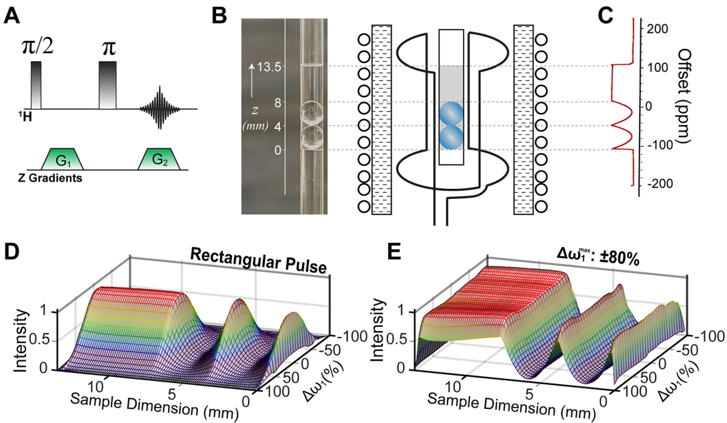
- NMR/MRI applications: in GEN-HSQC, PFG-HSQC intensities were ∼0.8 near the ¹H carrier and dropped to ∼0.5 off-resonance relative to GEN-HSQC; at ±20% amplitude attenuation, PFG-HSQC amide resonances were barely observable while GEN-HSQC showed constant response; for 42 kDa PKA-C, GEN-HSQC detected additional amide peaks; band-selective pulses were less than 1/4 the duration of traditional band-selective pulses; GEN-SE phantom images remained high quality with fewer artifacts even at ±80% ω₁ inhomogeneity, and an ultra-broadband pulse required 6.57 mW versus 7.3 W for a corresponding rectangular pulse.
Methods
- Design: GENETICS-AI combines iterative forward search (IFSA) and iterative self-correcting algorithms (ISCA) to search RF phase space and generate an Optimal Phase Surface (OPS) library; a neural network (PhaseNET) trained on this library predicts new RF shapes. The software was written in MATLAB R2018a and run on an Intel Core i7-7700K processor; fitness was defined as average operational fidelity over offset and ω₁ ranges.
- Samples and experiments: ¹³CHCl₃ in CDCl₃; U-¹⁵N ubiquitin K48C mutant at 500 μM; 42 kDa PKA-C; U-¹³C-labeled maltose-binding protein; MRI phantom of two 4 mm glass beads in a 5 mm Shigemi tube. Spectrometers included Bruker 600 MHz for entanglement experiments, 850 MHz for protein NMR, and 900 MHz for MRI.
- Analysis: simulated fidelity/offset/ω₁ profiles, quantum state tomography, 2D HSQC spectra, and 1D MRI images; GENETICS-AI pulses were compared with standard rectangular pulses, PFG-HSQC, and C-NOT entanglers using metrics including fidelity, bandwidth, pulse length, S/N, and intensity.
Limitations
- Paper states: at the time, GENETICS-AI could design only pulses with constant amplitude or preselected amplitude shapes; future developments were planned to include RF pulse amplitude in the search space.
- Paper states: the ultra-broadband pulse showed signal intensity loss due to relaxation during pulse execution; the 5 GHz biomolecular NMR pulses are hypothetical because commercially available ultra-high magnetic fields are limited to 1.2 GHz.
- Evident from the text: computational cost is high (a 100-point OPS takes ∼12 hours; a 500-point shape grows to approximately a week; up to 2,000-point shapes were implemented), and MRI validation was performed on a phantom rather than in vivo, with NMR tests limited to selected proteins.
Model-written summary. Check it against the paper before relying on it.
Integrity signals
Registry
Cites
Statistics
Figures
Verification
Claims the paper makes
1 Valid · 1 Not valid · 22 Not checked · 85 Own results and interpretations
Every source the paper cites for this claim was checked and supports it.
In the paper
“In fact, the GEN-HSQC experiment has a significantly higher RF inhomogeneity compensation relative to our previous implementation of HSQC using the universal broadband pulse G5 (11).”
§ High-fidelity control of spin ensemble dynamics via artificial intelligence: from quantum computing to NMR spectroscopy and imaging > Results and discussion > GENETICS-AI pulses for NMR spectroscopy at high and ultra-high magnetic fields
What the sources say
- Supportedcites [11] matched to “Enhancing the sensitivity of multidimensional NMR experiments by using triply-compensated π pulses” (2017) source
The citation (11) is attached to the identifying phrase 'our previous implementation of HSQC using the universal broadband pulse G5', and our copy of Xia et al. 2017 is exactly that work: the Introduction and Results and Discussion (2D 1H-15N HSQC; 2D 1H-13C HSQC) describe replacing the 1H/15N hard π pulses and the 13C shaped pulses of standard Bruker HSQC sequences with the G5 pulse, which is described as a GA-designed broadband pulse with built-in simultaneous compensation for RF inhomogeneity/miscalibration, offset and J-coupling (RF tolerance ±10%, wider 1H/13C/15N bandwidths). Our copy contains no 'GEN-HSQC' and makes no comparison to such an experiment; the 'significantly higher RF inhomogeneity compensation' comparison is the citing authors' own conclusion about their new experiment, not a point attributed to this source, so it is not judged here. (LLM, conf=0.85)
plainstates a cause- Asserted: passes — The authors put it forward as true.
- Checkable: passes — It can be checked against evidence.
- Load-bearing: passes — The paper’s conclusions depend on it.
- Based: passes — The paper gives a reason why it holds.
- Supported
A result the paper states — it cites no source for it, so there is none to check. The quote shows it is in the paper.
In the paper
“Using an evolutionary algorithm and artificial intelligence (AI), we designed new RF pulses with customizable spatial or temporal field inhomogeneity compensation.”
§ High-fidelity control of spin ensemble dynamics via artificial intelligence: from quantum computing to NMR spectroscopy and imaging > Abstract
plainstates a cause- Asserted: passes — The authors put it forward as true.
- Checkable: passes — It can be checked against evidence.
- Load-bearing: passes — The paper’s conclusions depend on it.
- Based: passes — The paper gives a reason why it holds.
- Rests on 2 assumptions not shown here.
A result the paper reports from its own data — it cites no other source for it, so there is none to check. The quote shows it is in the paper.
In the paper
“As a benchmark, we constructed a spin entanglement operator for the weakly coupled two-spin-1/2 system of 13CHCl3, achieving high-fidelity transformations under multiple inhomogeneity sources.”
§ High-fidelity control of spin ensemble dynamics via artificial intelligence: from quantum computing to NMR spectroscopy and imaging > Abstract
plainstates a cause- Asserted: passes — The authors put it forward as true.
- Checkable: passes — It can be checked against evidence.
- Load-bearing: unclear — It is unclear whether the paper’s conclusions depend on it.
- Based: passes — The paper gives a reason why it holds.
A result the paper reports from its own data — it cites no other source for it, so there is none to check. The quote shows it is in the paper.
In the paper
“Compared with the standard RF shapes, the new AI-generated pulses show superior performance for bandwidth, robustness, and tolerance to field imperfections.”
§ High-fidelity control of spin ensemble dynamics via artificial intelligence: from quantum computing to NMR spectroscopy and imaging > Abstract
plainstates a cause- Asserted: passes — The authors put it forward as true.
- Checkable: passes — It can be checked against evidence.
- Load-bearing: passes — The paper’s conclusions depend on it.
- Based: passes — The paper gives a reason why it holds.
A result the paper reports from its own data — it cites no other source for it, so there is none to check. The quote shows it is in the paper.
In the paper
“When implemented in multipulse NMR experiments, the AI-generated pulses significantly increased the sensitivity of medium-size and large protein spectra relative to standard pulse sequences.”
§ High-fidelity control of spin ensemble dynamics via artificial intelligence: from quantum computing to NMR spectroscopy and imaging > Abstract
plainstates a cause- Asserted: passes — The authors put it forward as true.
- Checkable: passes — It can be checked against evidence.
- Load-bearing: passes — The paper’s conclusions depend on it.
- Based: passes — The paper gives a reason why it holds.
63 more claims
Create a free account to see all 109 claims and to verify the 46 references still open.
- It may state two separate claims as one. 28
- Probably not a substantial claim. 15
Claims other papers make about this one
Each is checked against this paper’s own text: does it say what the citing paper says it does?
The cited source says what the claim attributes to it.
In the citing paper
“GENETICS-AI combines an evolutionary algorithm and artificial intelligence (AI) to generate inhomogeneity-compensated high-fidelity RF pulses22.”
From AI-designed NMR spectroscopy RF pulses for fast acquisition at high and ultra-high magnetic fields (2023) · cites this paper as [22]
The cited source says what the claim attributes to it.
In the citing paper
“GENETICS-AI couples an evolutionary search with a neural-network predictor (PhaseNET) to generate RF pulse shapes with user-defined bandwidth, B1 tolerance, and fidelity. [16]”
From Artificial Intelligence-Designed Ultra-Low-Power Broadband Universal and Pulses for NMR Spectroscopy: Application to 19F NMR (2026) · cites this paper as [16]
In the citing paper
“The UR33 is part of a broader family of pulses we previously designed for universal 180o flipping operation.6”
From Detection of 15 N-labeled metabolites in microbial extracts using AI-designed broadband pulses for 1 H, 15 N heteronuclear NMR spectroscopy (2025) · cites this paper as [6]
In the citing paper
“The GENETICS-AI pulses are highly compensated for field inhomogeneity and possess high-fidelity operation across the irradiated bandwidth.6”
From Detection of 15 N-labeled metabolites in microbial extracts using AI-designed broadband pulses for 1 H, 15 N heteronuclear NMR spectroscopy (2025) · cites this paper as [6]
In the citing paper
“GENETICS-AI utilizes an evolutionary algorithm to generate a library of optimal phase shapes (OPS) to train an artificial intelligence (AI) module of MatLab® and create optimal solutions to a specific problem30.”
From Water Irradiation Devoid Pulses Enhance the Sensitivity of 1H, 1H Nuclear Overhauser Effects (2022) · cites this paper as [30]
6 more claims about this paper
Create a free account to see every claim other papers make about this one.
Self-check
Percentages, sums and reported differences re-computed from the paper’s own numbers.
Each contradiction between two passages listed here was confirmed by an independent check.
Rated minor: it would not touch a result — a value no result rests on, a p-value that stays on the same side of the significance level, or a conflict that is clerical, resolved elsewhere in the paper, or outside its own findings.
In the paper
§ High-fidelity control of spin ensemble dynamics via artificial intelligence: from quantum computing to NMR spectroscopy and imaging > Prototypical pulses for MRI
“a solution of 10% H 2 O and 90% 2 H 2 O”
§ High-fidelity control of spin ensemble dynamics via artificial intelligence: from quantum computing to NMR spectroscopy and imaging > NMR sample preparations
“filled with 10% D 2 O and 90% H 2 O.”
Rated minor: it would not touch a result — a value no result rests on, a p-value that stays on the same side of the significance level, or a conflict that is clerical, resolved elsewhere in the paper, or outside its own findings.
In the paper
§ High-fidelity control of spin ensemble dynamics via artificial intelligence: from quantum computing to NMR spectroscopy and imaging > GENETICS-AI pulses for NMR spectroscopy at high and ultra-high magnetic fields
“All experiments were performed on a Bruker 600 MHz spectrometer at 300 K.”
§ High-fidelity control of spin ensemble dynamics via artificial intelligence: from quantum computing to NMR spectroscopy and imaging > NMR sample preparations
“All experiments were recorded on a Bruker 600 MHz spectrometer at 290 K.”
Citations
Cites
Holland, J. H. (1992) · The MIT Press eBooks · doi:10.7551/mitpress/1090.001.0001 · Cited by 47,002
Algorithms for quantum computation: discrete logarithms and factoring
Shor, P. W. (2002) · Proceedings 35th Annual Symposium on Foundations of Computer Science · doi:10.1109/sfcs.1994.365700 · Cited by 8,713 · cited 1×
“The creation and preservation of high-fidelity spin entanglement are central to several quantum computing applications (30, 31) and are ideal for testing the performance of GENETICS-AI (32– 35).”
BackgroundQuantum Computation and Quantum Information: 10th Anniversary Edition
Nielsen, M. A., & Chuang, I. L. (2012) · doi:10.1017/cbo9780511976667 · Cited by 8,436
Principles of Nuclear Magnetic Resonance in One and Two Dimensions
Ernst, R. R., Bodenhausen, G., Wokaun, A., & Redfield, A. G. (1989) · Physics Today · doi:10.1063/1.2811094 · Cited by 4,201
A new approach to variable metric algorithms
Fletcher, R. (1970) · The Computer Journal · doi:10.1093/comjnl/13.3.317 · Cited by 4,068
Quantum information and computation
Bennett, C. H., & DiVincenzo, D. P. (2000) · Nature · doi:10.1038/35005001 · Cited by 3,263 · cited 1×
“The creation and preservation of high-fidelity spin entanglement are central to several quantum computing applications (30, 31) and are ideal for testing the performance of GENETICS-AI (32– 35).”
BackgroundMagnetic Resonance Imaging: Physical Principles and Sequence Design
Brown, R. W., Cheng, Y. N., Haacke, E. M., Thompson, M. R., & Venkatesan, R. (2014) · doi:10.1002/9781118633953 · Cited by 2,688
Kay, L., Keifer, P., & Saarinen, T. (1992) · Journal of the American Chemical Society · doi:10.1021/ja00052a088 · Cited by 2,247
Iterative Methods for Optimization
Kelley, C. T. (1999) · Society for Industrial and Applied Mathematics eBooks · doi:10.1137/1.9781611970920 · Cited by 2,052
Khaneja, N., Reiss, T., Kehlet, C., Schulte-Herbrüggen, T., & Glaser, S. J. (2005) · Journal of Magnetic Resonance · doi:10.1016/j.jmr.2004.11.004 · Cited by 1,854
Principles of nuclear magnetic resonance in one and two dimensions
Redpath, T. W. (1988) · Magnetic Resonance Imaging · doi:10.1016/0730-725x(88)90413-4 · Cited by 1,207
Coherent Control of Quantum Dynamics: The Dream Is Alive
Warren, W. S., Rabitz, H., & Dahleh, M. (1993) · Science · doi:10.1126/science.259.5101.1581 · Cited by 1,058
Ensemble quantum computing by NMR spectroscopy
Cory, D. G., Fahmy, A. F., & Havel, T. F. (1997) · Proceedings of the National Academy of Sciences · doi:10.1073/pnas.94.5.1634 · Cited by 964
The Return of the Frequency Sweep: Designing Adiabatic Pulses for Contemporary NMR
Garwood, M., & DelaBarre, L. (2001) · Journal of Magnetic Resonance · doi:10.1006/jmre.2001.2340 · Cited by 952
Self-citationPalmer, A. G., Cavanagh, J., Wright, P. E., & Rance, M. (1991) · Journal of Magnetic Resonance (1969) · doi:10.1016/0022-2364(91)90036-s · Cited by 948
Principles of nuclear magnetic resonance in one and two dimensions
V.S.D. (1988) · Journal of Molecular Structure · doi:10.1016/0022-2860(88)80261-8 · Cited by 946
Gradient-Enhanced Triple-Resonance Three-Dimensional NMR Experiments with Improved Sensitivity
Muhandiram, D. R., & Kay, L. E. (1994) · Journal of Magnetic Resonance, Series B · doi:10.1006/jmrb.1994.1032 · Cited by 892
Wittekind, M., & Mueller, L. (1993) · Journal of Magnetic Resonance, Series B · doi:10.1006/jmrb.1993.1033 · Cited by 859
Band-selective radiofrequency pulses
Geen, H., & Freeman, R. (1991) · Journal of Magnetic Resonance (1969) · doi:10.1016/0022-2364(91)90034-q · Cited by 828
A general enhancement scheme in heteronuclear multidimensional NMR employing pulsed field gradients
Schleucher, J., Schwendinger, M., Sattler, M., Schmidt, P., Schedletzky, O., Glaser, S. J., S�rensen, O. W., & Griesinger, C. (1994) · Journal of Biomolecular NMR · doi:10.1007/bf00175254 · Cited by 806
Pauly, J., Le Roux, P., Nishimura, D., & Macovski, A. (1991) · IEEE Transactions on Medical Imaging · doi:10.1109/42.75611 · Cited by 800
Levitt, M. H. (1986) · Progress in Nuclear Magnetic Resonance Spectroscopy · doi:10.1016/0079-6565(86)80005-x · Cited by 776
Pros and cons of ultra-high-field MRI/MRS for human application
Ladd, M. E., Bachert, P., Meyerspeer, M., Moser, E., Nagel, A. M., Norris, D. G., Schmitter, S., Speck, O., Straub, S., & Zaiss, M. (2018) · Progress in Nuclear Magnetic Resonance Spectroscopy · doi:10.1016/j.pnmrs.2018.06.001 · Cited by 544
On the Local and Superlinear Convergence of Quasi-Newton Methods
BROYDEN, C. G., DENNIS, J. E., & MORÉ, J. J. (1973) · IMA Journal of Applied Mathematics · doi:10.1093/imamat/12.3.223 · Cited by 502
Grzesiek, S., & Bax, A. (1992) · Journal of Magnetic Resonance (1969) · doi:10.1016/0022-2364(92)90169-8 · Cited by 391
Coherent Optical Spectroscopy of a Strongly Driven Quantum Dot
Xu, X., Sun, B., Berman, P. R., Steel, D. G., Bracker, A. S., Gammon, D., & Sham, L. J. (2007) · Science · doi:10.1126/science.1142979 · Cited by 368
Zheng, A., Liu, S.-B., & Deng, F. (2017) · Chemical Reviews · doi:10.1021/acs.chemrev.7b00289 · Cited by 365
Facing and Overcoming Sensitivity Challenges in Biomolecular NMR Spectroscopy
Ardenkjaer‐Larsen, J., Boebinger, G. S., Comment, A., Duckett, S., Edison, A. S., Engelke, F., Griesinger, C., Griffin, R. G., Hilty, C., Maeda, H., et al. (2015) · Angewandte Chemie International Edition · doi:10.1002/anie.201410653 · Cited by 351
Emsley, L., & Bodenhausen, G. (1990) · Chemical Physics Letters · doi:10.1016/0009-2614(90)87025-m · Cited by 345
Deterministic quantum state transfer and remote entanglement using microwave photons
Kurpiers, P., Magnard, P., Walter, T., Royer, B., Pechal, M., Heinsoo, J., Salathé, Y., Akin, A., Storz, S., Besse, J.-C., et al. (2018) · Nature · doi:10.1038/s41586-018-0195-y · Cited by 338
High-fidelity spin entanglement using optimal control
Dolde, F., Bergholm, V., Wang, Y., Jakobi, I., Naydenov, B., Pezzagna, S., Meijer, J., Jelezko, F., Neumann, P., Schulte-Herbrüggen, T., et al. (2014) · Nature Communications · doi:10.1038/ncomms4371 · Cited by 325 · cited 1×
“In the experimental implementation of quantum computing, inhomogeneities affect the experimental fidelity of quantum gates, on-demand entangled state generation, and coherent control (1, 7, 8).”
BackgroundEmsley, L., & Bodenhausen, G. (1992) · Journal of Magnetic Resonance (1969) · doi:10.1016/0022-2364(92)90242-y · Cited by 294
Optimized recording of heteronuclear multidimensional NMR spectra using pulsed field gradients
Bax, A., & Pochapsky, S. S. (1992) · Journal of Magnetic Resonance (1969) · doi:10.1016/0022-2364(92)90221-r · Cited by 291
Optimal Control Solutions to the Magnetic Resonance Selective Excitation Problem
Conolly, S., Nishimura, D., & Macovski, A. (1986) · IEEE Transactions on Medical Imaging · doi:10.1109/tmi.1986.4307754 · Cited by 278
Short selective pulses for biochemical applications
Kupce, E., Boyd, J., & Campbell, I. D. (1995) · Journal of Magnetic Resonance, Series B · doi:10.1006/jmrb.1995.1049 · Cited by 258
The Usefulness of NMR Quantum Computing
Warren, W. S. (1997) · Science · doi:10.1126/science.277.5332.1688 · Cited by 253
Fortunato, E. M., Pravia, M. A., Boulant, N., Teklemariam, G., Havel, T. F., & Cory, D. G. (2002) · The Journal of Chemical Physics · doi:10.1063/1.1465412 · Cited by 243
Fixed point theory of iterative excitation schemes in NMR
Tycko, R., Pines, A., & Guckenheimer, J. (1985) · The Journal of Chemical Physics · doi:10.1063/1.449228 · Cited by 196
Allosteric cooperativity in protein kinase A
Masterson, L. R., Mascioni, A., Traaseth, N. J., Taylor, S. S., & Veglia, G. (2008) · Proceedings of the National Academy of Sciences · doi:10.1073/pnas.0709214104 · Cited by 189
Self-citationShaped radiofrequency pulses in high resolution NMR
Freeman, R. (1998) · Progress in Nuclear Magnetic Resonance Spectroscopy · doi:10.1016/s0079-6565(97)00024-1 · Cited by 174
Selective shaped pulse decoupling in NMR: homonuclear [carbon-13]carbonyl decoupling
McCoy, M. A., & Mueller, L. (1992) · Journal of the American Chemical Society · doi:10.1021/ja00032a026 · Cited by 173
Composite pulses without phase distortion
Tycko, R., Cho, H. M., Schneider, E., & Pines, A. (1985) · Journal of Magnetic Resonance (1969) · doi:10.1016/0022-2364(85)90270-7 · Cited by 168
Bray, J. M., Doswell, C. L., Pavlovskaya, G. E., Chen, L., Kishore, B., Au, H., Alptekin, H., Kendrick, E., Titirici, M., Meersmann, T., et al. (2020) · Nature Communications · doi:10.1038/s41467-020-15938-x · Cited by 167
[Proceedings 1988] 29th Annual Symposium on Foundations of Computer Science
(1988) · doi:10.1109/sfcs.1988 · Cited by 167
Optimal pulse design in quantum control: A unified computational method
Li, J.-S., Ruths, J., Yu, T., Arthanari, H., & Wagner, G. (2011) · Proceedings of the National Academy of Sciences · doi:10.1073/pnas.1009797108 · Cited by 152
Real-time 3D imaging of microstructure growth in battery cells using indirect MRI
Ilott, A. J., Mohammadi, M., Chang, H. J., Grey, C. P., & Jerschow, A. (2016) · Proceedings of the National Academy of Sciences · doi:10.1073/pnas.1607903113 · Cited by 151
Broadband adiabatic inversion pulses for cross polarization in wideline solid-state NMR spectroscopy
Harris, K. J., Lupulescu, A., Lucier, B. E. G., Frydman, L., & Schurko, R. W. (2012) · Journal of Magnetic Resonance · doi:10.1016/j.jmr.2012.08.015 · Cited by 144
Exploring the limits of broadband 90° and 180° universal rotation pulses
Kobzar, K., Ehni, S., Skinner, T. E., Glaser, S. J., & Luy, B. (2012) · Journal of Magnetic Resonance · doi:10.1016/j.jmr.2012.09.013 · Cited by 137
Systematic Procedure for Constructing Broadband decoupling Sequences
Waugh, J. S. (1982) · Journal of Magnetic Resonance (1969) · doi:10.1016/0022-2364(82)90263-3 · Cited by 134
Symmetric phase-alternating composite pulses
Shaka, A. J., & Pines, A. (1987) · Journal of Magnetic Resonance (1969) · doi:10.1016/0022-2364(87)90249-6 · Cited by 132
Boeszoermenyi, A., Chhabra, S., Dubey, A., Radeva, D. L., Burdzhiev, N. T., Chanev, C. D., Petrov, O. I., Gelev, V. M., Zhang, M., Anklin, C., et al. (2019) · Nature Methods · doi:10.1038/s41592-019-0334-x · Cited by 129
Xu, D., King, K. F., Zhu, Y., McKinnon, G. C., & Liang, Z. (2008) · Magnetic Resonance in Medicine · doi:10.1002/mrm.21485 · Cited by 116
Application of optimal control to CPMG refocusing pulse design
Borneman, T. W., Hürlimann, M. D., & Cory, D. G. (2010) · Journal of Magnetic Resonance · doi:10.1016/j.jmr.2010.09.003 · Cited by 93
Noncovalent Dimerization of Ubiquitin
Liu, Z., Zhang, W., Xing, Q., Ren, X., Liu, M., & Tang, C. (2011) · Angewandte Chemie International Edition · doi:10.1002/anie.201106190 · Cited by 93
Broadband Adiabatic Refocusing without Phase Distortion
Hwang, T.-L., van Zijl, P. C. M., & Garwood, M. (1997) · Journal of Magnetic Resonance · doi:10.1006/jmre.1996.1049 · Cited by 92
Self-citationTheis, T., Feng, Y., Wu, T.-L., & Warren, W. S. (2014) · The Journal of Chemical Physics · doi:10.1063/1.4851337 · Cited by 87
Robust Ising gates for practical quantum computation
Jones, J. A. (2003) · Physical Review A · doi:10.1103/physreva.67.012317 · Cited by 77
Vinding, M. S., Maximov, I. I., Tošner, Z., & Nielsen, N. C. (2012) · The Journal of Chemical Physics · doi:10.1063/1.4739755 · Cited by 71
Magnetic resonance imaging of granular materials
Stannarius, R. (2017) · Review of Scientific Instruments · doi:10.1063/1.4983135 · Cited by 71
Spins as qubits: quantum information processing by nuclear magnetic resonance
Suter, D., & Mahesh, T. S. (2008) · The Journal of Chemical Physics · doi:10.1063/1.2838166 · Cited by 66
Vega, A. J. (2004) · Journal of Magnetic Resonance · doi:10.1016/j.jmr.2004.05.017 · Cited by 57
Derivation of broadband and narrowband excitation pulses using the Floquet formalism
Abramovich, D., & Vega, S. (1993) · Journal of Magnetic Resonance, Series A · doi:10.1006/jmra.1993.1245 · Cited by 46
Dogra, S., Dorai, K., & Arvind (2015) · Physical Review A · doi:10.1103/physreva.91.022312 · Cited by 45
Truong, T.-K., Chakeres, D. W., Beversdorf, D. Q., Scharre, D. W., & Schmalbrock, P. (2006) · Magnetic Resonance Imaging · doi:10.1016/j.mri.2005.09.013 · Cited by 42
NMR Quantum Information Processing
Ramanathan, C., Boulant, N., Chen, Z., Cory, D. G., Chuang, I. L., & Steffen, M. (2006) · ChemInform · doi:10.1002/chin.200612279 · Cited by 38
Mitra, A., Ghosh, A., Das, R., Patel, A. D., & Kumar, A. (2005) · Journal of Magnetic Resonance · doi:10.1016/j.jmr.2005.08.004 · Cited by 36
Magnetic Resonance RF Pulse Design by Optimal Control With Physical Constraints
Rund, A., Aigner, C. S., Kunisch, K. K., & Stollberger, R. (2017) · IEEE Transactions on Medical Imaging · doi:10.1109/tmi.2017.2758391 · Cited by 36
Experimental generation of pseudo-bound-entanglement
Kampermann, H., Bruß, D., Peng, X., & Suter, D. (2010) · Physical Review A · doi:10.1103/physreva.81.040304 · Cited by 35
Deep reinforcement learning-designed radiofrequency waveform in MRI
Shin, D., Kim, Y., Oh, C., An, H., Park, J., Kim, J., & Lee, J. (2021) · Nature Machine Intelligence · doi:10.1038/s42256-021-00411-1 · Cited by 35
Composite RF pulses for -insensitive volume excitation at 7Tesla
Moore, J. E., Jankiewicz, M., Zeng, H., Anderson, A. W., & Gore, J. C. (2010) · Journal of Magnetic Resonance · doi:10.1016/j.jmr.2010.04.002 · Cited by 27
Genetic algorithm optimized triply compensated pulses in NMR spectroscopy
Manu, V. S., & Veglia, G. (2015) · Journal of Magnetic Resonance · doi:10.1016/j.jmr.2015.09.010 · Cited by 26
Self-citationEvaluation of non-selective refocusing pulses for 7T MRI
Moore, J. E., Jankiewicz, M., Anderson, A. W., & Gore, J. C. (2011) · Journal of Magnetic Resonance · doi:10.1016/j.jmr.2011.11.010 · Cited by 26
CAVANAGH, J., FAIRBROTHER, W. J., PALMER, A. G., RANCE, M., & SKELTON, N. J. (2007) · Protein NMR Spectroscopy · doi:10.1016/b978-012164491-8/50003-8 · Cited by 26
Ultrafast (milliseconds), multidimensional RF pulse design with deep learning
Vinding, M. S., Skyum, B., Sangill, R., & Lund, T. E. (2019) · Magnetic Resonance in Medicine · doi:10.1002/mrm.27740 · Cited by 25
Exact broadband excitation of two-level systems by mapping spins to springs
Li, J.-S., Ruths, J., & Glaser, S. J. (2017) · Nature Communications · doi:10.1038/s41467-017-00441-7 · Cited by 24
Singlet-state creation and universal quantum computation in NMR using a genetic algorithm
Manu, V. S., & Kumar, A. (2012) · Physical Review A · doi:10.1103/physreva.86.022324 · Cited by 21
Enhancing the sensitivity of multidimensional NMR experiments by using triply-compensated π pulses
Xia, Y., Rossi, P., Subrahmanian, M. V., Huang, C., Saleh, T., Olivieri, C., Kalodimos, C. G., & Veglia, G. (2017) · Journal of Biomolecular NMR · doi:10.1007/s10858-017-0153-2 · Cited by 20
Self-citationRapid convergence of optimal control in NMR using numerically-constructed toggling frames
Coote, P., Anklin, C., Massefski, W., Wagner, G., & Arthanari, H. (2017) · Journal of Magnetic Resonance · doi:10.1016/j.jmr.2017.05.011 · Cited by 16
Multiband RF pulses with improved performance via convex optimization
Shang, H., Larson, P. E. Z., Kerr, A. B., Reed, G. D., Sukumar, S., Elkhaled, A., Gordon, J. W., Ohliger, M. A., Pauly, J. M., Lustig, M. S., et al. (2015) · Journal of Magnetic Resonance · doi:10.1016/j.jmr.2015.11.010 · Cited by 14
Generation of arbitrary qubit states by adiabatic evolution split by a phase jump
Zlatanov, K. N., & Vitanov, N. V. (2020) · Physical Review A · doi:10.1103/physreva.101.013426 · Cited by 14
Artifacts can emerge in spectra recorded with even the simplest of pulse schemes: an HMQC case study
Kay, L. E. (2019) · Journal of Biomolecular NMR · doi:10.1007/s10858-019-00227-7 · Cited by 12
Quantum simulation using fidelity-profile optimization
Manu, V. S., & Kumar, A. (2014) · Physical Review A · doi:10.1103/physreva.89.052331 · Cited by 11
Use of neural networks to design shaped radiofrequency pulses
Gezelter, J. D., & Freeman, R. (1990) · Journal of Magnetic Resonance (1969) · doi:10.1016/0022-2364(90)90149-4 · Cited by 11
Olivieri, C., Subrahmanian, M. V., Xia, Y., Kim, J., Porcelli, F., & Veglia, G. (2018) · Journal of Biomolecular NMR · doi:10.1007/s10858-018-0165-6 · Cited by 10
Self-citationDeep Reinforcement Learning Designed Shinnar-Le Roux RF Pulse Using Root-Flipping: DeepRFSLR
Shin, D., Ji, S., Lee, D., Lee, J., Oh, S.-H., & Lee, J. (2020) · IEEE Transactions on Medical Imaging · doi:10.1109/tmi.2020.3018508 · Cited by 9
Somai, V., Wright, A. J., Fala, M., Hesse, F., & Brindle, K. M. (2020) · Magnetic Resonance in Medicine · doi:10.1002/mrm.28248 · Cited by 4
Entanglement in Liquid-State NMR
Oliveira, I. S., Bonagamba, T. J., Sarthour, R. S., Freitas, J. C. C., & deAzevedo, E. R. (2007) · NMR Quantum Information Processing · doi:10.1016/b978-044452782-0/50008-7 · Cited by 1
The Physical Implementation of Quantum Computation
DiVincenzo, D. P. (2000) · Fortschritte der Physik · doi:10.1002/1521-3978(200009)48:9/11<771::aid-prop771>3.0.co;2-e
Research works printed but not linked: 2
- Cavanagh J, Fairbrother WJ, Palmer AG, Rance M, Skelton NJ. 2007. Protein NMR spectroscopy: principles and practice, 2nd ed. Cambridge, MA: Academic Press. p. 1-888.
- Zheng A, Liu S-B, Deng F. 2017. 31P NMR chemical shifts of phos- phorus probes as reliable and practical acidity scales for solid and liquid catalysts. Chem Rev. 117(19):12475-12531.
Cited by
Pineda, V. G., Valencia-Arías, A., Giraldo, F. E. L., & Ochoa, E. A. Z. (2025) · International Journal of Cognitive Computing in Engineering · doi:10.1016/j.ijcce.2025.08.002 · Cited by 54
AI-designed NMR spectroscopy RF pulses for fast acquisition at high and ultra-high magnetic fields
Manu, V. S., Olivieri, C., & Veglia, G. (2023) · Nature Communications · doi:10.1038/s41467-023-39581-4 · Cited by 35
Self-citationZhan, H., Huang, Y., & Chen, Z. (2026) · Applied Physics Reviews · doi:10.1063/5.0277355 · Cited by 22
Matarèse, B. F. E., & Purushotham, A. D. (2025) · Quantum Reports · doi:10.3390/quantum7010009 · Cited by 21
Seedless: on-the-fly pulse calculation for NMR experiments
Buchanan, C. J., Bhole, G., Karunanithy, G., Casablancas-Antràs, V., Poh, A. W. J., Davis, B. G., Jones, J. A., & Baldwin, A. J. (2025) · Nature Communications · doi:10.1038/s41467-025-61663-8 · Cited by 13
Metadata
- Authors
- Manu, V. S., Pavuluri, K., Mullen, M., Garwood, M., & Veglia, G.
- Affiliations
- University of Minnesota
- Mayo Clinic (US)
- University of Minnesota (US)
- Corresponding author
- Garwood, Michael
- Venue
- PNAS Nexus
- Publisher
- Research Square Platform LLC
- Published
- 2021-04-20
- Volume
- 1
- Issue
- 4
- Pages
- pgac133-pgac133
- ISSN
- 2752-6542 (ISSN-L)
- PMC
- PMC9463062
- OpenAlex
- W4289885698
- Semantic Scholar
- 8aea7312f856b71ddc270acdd30a08e70cda921d
- Cited by
- 24
- References
- 89
- Citations by year
- 2026: 9 · 2025: 7 · 2024: 4 · 2023: 3 · 2022: 1
- FWCI
- 1.30
- Type
- journal article
- Language
- en
- Open access
- gold
- doi.org
- Licence
- Locations
- PNAS Nexus (publishedVersion, cc-by-nc-nd)
- Research Square (submittedVersion, cc-by)
- PubMed Central (publishedVersion, cc-by-nc-nd)
- PubMed (publishedVersion)
- Archivio Istituzionale della Ricerca (Universita Degli Studi Di Milano) (submittedVersion, other-oa)
- Funders
- National Institutes of Health
- National Heart, Lung, and Blood Institute (R01HL144130)
- National Institute of General Medical Sciences (R01GM064742, R01GM100310)
- Topics
- Physical Sciences › Chemistry › Spectroscopy › Advanced NMR Techniques and Applications
- Physical Sciences › Computer Science › Artificial Intelligence › Quantum Computing Algorithms and Architecture
- Health Sciences › Medicine › Radiology, Nuclear Medicine and Imaging › Advanced MRI Techniques and Applications
- Keywords
- spin entanglement, magnetic resonance imaging, quantum computing
About these checks
Registry, retraction, Cites and statistics results are computed, not judged, with one exception: a printed reference that no index lists is read once by a model before it counts as a citation error. Claims are extracted by a model and kept only when their quote appears verbatim in the text; each cited source is then checked, with a model’s help, for whether it says what the claim relies on. Those verdicts can be wrong — read the claim’s quote and the cited source before relying on one.
A language model drew the claims from the paper on 2026-11-18, under version 3 of the claim definition (model deepseek-v4.1-flash, prompt extract-v3).
A second model labelled each claim on 2026-11-18 (model jev-1.13-20260917, definition revision gold-guideline-v0.2).
Cited sources are checked with a language model’s help (qwen3.8-omni-flash).
Statistics and arithmetic are recomputed, not judged.
Confidence bands are shown only for fields calibrated on our annotated test set. None is calibrated yet, so no band is shown.
What counts as a claim ›How we measure confidence ›How we check this ›
Are you an author, or do you see a problem with this page? Request a review
Data sources
Bibliographic data: Semantic Scholar, OpenAlex, Crossref.
Contains information from the Semantic Scholar Academic Graph Datasets, made available under the ODC Attribution License (ODC-BY 1.0).
Semantic Scholar’s data is described in: Kinney, R., et al. (2023). The Semantic Scholar Open Data Platform. arXiv:2301.10140.
