

Helios: A 98-qubit trapped-ion quantum computer
Open accessPreprint — published as 10.1038/s41586-026-10676-4 · Paper page
The DOI matches its Crossref record; 78 of the 87 references it cites were found in a registry or an index, and 9 are not checked yet.
Abstract
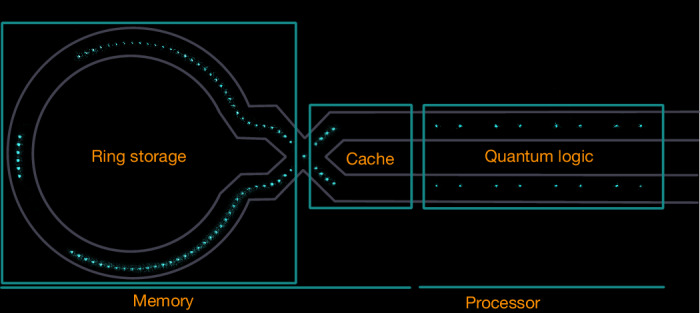
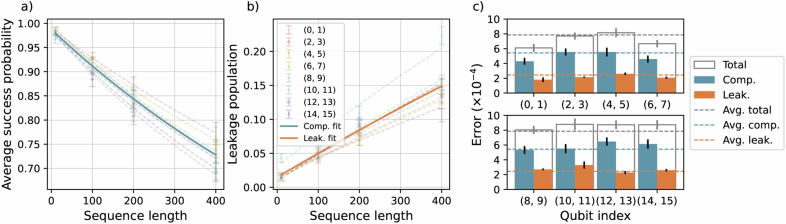
We report on Quantinuum Helios, a 98-qubit trapped-ion quantum processor based on the quan- tum charge-coupled device (QCCD) architecture. Helios features 137Ba+ hyperfine qubits, all-to-all connectivity enabled by a rotatable ion storage ring connecting two quantum operation regions by a junction, speed improvements from parallelized operations, and a new software stack with real-time compilation of dynamic programs. Averaged over all operational zones in the system, we achieve average infidelities of 2.5(1) × 10−5 for single-qubit gates, 7.9(2) × 10−4 for two-qubit gates, and 4.8(6) × 10−4 for state preparation and measurement, none of which are fundamentally limited and likely able to be improved. These component infidelities are predictive of system-level performance in both random Clifford circuits and random circuit sampling, the latter demonstrating that Helios operates well beyond the reach of classical simulation and establishes a new frontier of fidelity and complexity for quantum computers.
Overview
The claims and statistics of this paper haven’t been checked yet.
Free: it reads the open-access text and checks the first 5 claims that cite a source we can check. Create a free account to check every claim.
Integrity signals
Registry
Cites
Statistics
Figures





Verification
Claims the paper makes
The claims and statistics of this paper haven’t been checked yet.
Free: it reads the open-access text and checks the first 5 claims that cite a source we can check. Create a free account to check every claim.
Self-check
Percentages, sums and reported differences re-computed from the paper’s own numbers.
The self-check needs the paper’s full text.
Citations
Cites
An Introduction to the Bootstrap
Efron, B., & Tibshirani, R. J. (1993) · doi:10.1007/978-1-4899-4541-9 · Cited by 21,230
Quantum supremacy using a programmable superconducting processor
Arute, F., Arya, K., Babbush, R., Bacon, D., Bardin, J. C., Barends, R., Biswas, R., Boixo, S., Brandao, F. G. S. L., Buell, D. A., et al. (2019) · Nature · doi:10.1038/s41586-019-1666-5 · Cited by 7,720
Architecture for a large-scale ion-trap quantum computer
Kielpinski, D., Monroe, C., & Wineland, D. J. (2002) · Nature · doi:10.1038/nature00784 · Cited by 1,589
Experimental issues in coherent quantum-state manipulation of trapped atomic ions
Wineland, D. J., Monroe, C., Itano, W. M., Leibfried, D., King, B. E., & Meekhof, D. M. (1998) · Journal of Research of the National Institute of Standards and Technology · doi:10.6028/jres.103.019 · Cited by 1,497
Monte Carlo wave-function method in quantum optics
Mølmer, K., Castin, Y., & Dalibard, J. (1993) · Journal of the Optical Society of America B · doi:10.1364/josab.10.000524 · Cited by 1,233
Characterizing quantum supremacy in near-term devices
Boixo, S., Isakov, S. V., Smelyanskiy, V. N., Babbush, R., Ding, N., Jiang, Z., Bremner, M. J., Martinis, J. M., & Neven, H. (2018) · Nature Physics · doi:10.1038/s41567-018-0124-x · Cited by 1,175
Strong Quantum Computational Advantage Using a Superconducting Quantum Processor
Wu, Y., Bao, W.-S., Cao, S., Chen, F., Chen, M.-C., Chen, X., Chung, T.-H., Deng, H., Du, Y., Fan, D., et al. (2021) · Physical Review Letters · doi:10.1103/physrevlett.127.180501 · Cited by 1,059
Evidence for the utility of quantum computing before fault tolerance
Kim, Y., Eddins, A., Anand, S., Wei, K. X., van den Berg, E., Rosenblatt, S., Nayfeh, H., Wu, Y., Zaletel, M., Temme, K., et al. (2023) · Nature · doi:10.1038/s41586-023-06096-3 · Cited by 1,050
Entanglement and quantum computation with ions in thermal motion
Sørensen, A., & Mølmer, K. (2000) · Physical Review A · doi:10.1103/physreva.62.022311 · Cited by 783
Quantum error correction below the surface code threshold
Collaborators, G. Q. A. A., Acharya, R., Abanin, D. A., Aghababaie-Beni, L., Aleiner, I., Andersen, T. I., Ansmann, M., Arute, F., Arya, K., Asfaw, A., et al. (2025) · Nature · doi:10.1038/s41586-024-08449-y · Cited by 778
Research works printed but not linked: 14
- B. W. Reichardt, A. Paetznick, D. Aasen, I. Basov, J. M. Bello-Rivas, P. Bonderson, R. Chao, W. van Dam, M. B. Hastings, R. V. Mishmash, et al., Fault-tolerant quan- tum computation with a neutral atom processor (2025), arXiv:2411.11822 [quant-ph]. · arXiv
- M. F. Brandl, A quantum von neumann architecture for large-scale quantum computing (2017), arXiv:1702.02583 [quant-ph]. · arXiv
- J. Gaebler, A. Ransford, L. Sletten, F. An, J. Hostetter, A. Schaffer, and G. Vittorini, Detecting leakage errors in hyperfine qubits, U.S. patent 20,240,211,792 (2024), filed November 20, 2023.
- A. S. Sotirova, J. D. Leppard, A. Vazquez-Brennan, S. M. Decoppet, F. Pokorny, M. Malinowski, and C. J. Bal- lance, High-fidelity heralded quantum state preparation and measurement (2024), arXiv:2409.05805 [quant-ph]. · arXiv
- N. C. Brown, J. P. C. III, C. Granade, B. Heim, S. Wernli, C. Ryan-Anderson, D. Lucchetti, A. Paetznick, M. Roet- teler, K. Svore, et al., Advances in compilation for quantum hardware -a demonstration of magic state distillation and repeat-until-success protocols, (2023), arXiv:2310.12106 [quant-ph]. · arXiv
- M. Koch, A. Lawrence, K. Singhal, S. Sivarajah, and R. Duncan, Guppy: Pythonic quantum-classical pro- gramming (2024), arXiv:2510.12582. · arXiv
- A. W. Cross, L. S. Bishop, J. A. Smolin, and J. M. Gambetta, Open quantum assembly language (2017), arXiv:1707.03429 [quant-ph]. · arXiv
- M. Liu, P. Niroula, M. DeCross, C. Foreman, W. Y. Kon, I. W. Primaatmaja, M. S. Allman, J. P. Campora III, A. Isanaka, K. Singhal, et al., Certified randomness am- plification by dynamically probing remote random quan- tum states, arxiv:2511.03686 (2025). · arXiv
- A. Wack, H. Paik, A. Javadi-Abhari, P. Jurcevic, I. Faro, J. M. Gambetta, and B. R. Johnson, Quality, speed, and scale: three key attributes to measure the performance of near-term quantum computers (2021), arXiv:2110.14108 [quant-ph]. · arXiv
- K. Mayer, A. Hall, T. Gatterman, S. K. Halit, K. Lee, J. Bohnet, D. Gresh, A. Hankin, K. Gilmore, J. Gerber, et al., Theory of mirror benchmarking and demonstration on a quantum computer (2023), arXiv:2108.10431 [quant- ph]. · arXiv
- T. Proctor, S. Seritan, E. Nielsen, K. Rudinger, K. Young, R. Blume-Kohout, and M. Sarovar, Es- tablishing trust in quantum computations (2022), arXiv:2204.07568 [quant-ph]. · arXiv
- E. Granet, S.-H. Lin, K. Hémery, R. Haghshenas, P. Andres-Martinez, D. T. Stephen, A. Ransford, J. Arkinstall, M. Allman, P. Campora, et al., Supercon- ducting pairing correlations on a trapped-ion quantum computer, arXiv:2511.02125 (2025). · arXiv
- C. Ryan-Anderson, N. C. Brown, M. S. Allman, B. Arkin, G. Asa-Attuah, C. Baldwin, J. Berg, J. G. Bohnet, S. Braxton, N. Burdick, et al., Implementing fault- tolerant entangling gates on the five-qubit code and the color code (2022), arXiv:2208.01863 [quant-ph]. · arXiv
- S. Dasu, S. Burton, K. Mayer, D. Amaro, J. A. Gerber, K. Gilmore, D. Gresh, D. DelVento, A. C. Potter, and D. Hayes, Breaking even with magic: demonstration of a high-fidelity logical non-clifford gate, arxiv:2506.14688 (2025). · arXiv
Cited by
Computing efficiently in QLDPC codes
Malcolm, A. J., Glaudell, A. N., Fuentes, P., Chandra, D., Schotte, A., DeLisle, C., Haenel, R., Ebrahimi, A. M., Roffe, J., Quintavalle, A. O., et al. (2026) · Nature Communications · doi:10.1038/s41467-026-73061-9 · Cited by 57
High-rate qLDPC processorsPreprint
Bhardwaj, A., Ma, M., Meister, N., King, R., Bluvstein, D., Preskill, J., Cain, M., Xu, Q., & Huang, H.-Y. (2026) · arXiv (Cornell University) · doi:10.48550/arxiv.2607.28795 · Cited by 48
Computing with many encoded logical qubits beyond break-evenPreprint
Dasu, S., DeCross, M. P., Guo, A. Y., Lavasani, A., Behrends, J., Benhemou, A., Chen, Y.-H., Mayer, K., Self, C. N., Simsek, S., et al. (2026) · arXiv (Cornell University) · doi:10.48550/arxiv.2602.22211 · Cited by 44
Self-citationFault-Tolerant Quantum Computing with Trapped Ions: The Walking Cat ArchitecturePreprint
Tripier, F., Chung, W. C., Young, J., Alam, S., Bjork, B., Brodutch, A., Buessen, F. L., Coble, N. J., Dellaert, T., Maslov, D., et al. (2026) · arXiv (Cornell University) · doi:10.48550/arxiv.2604.19481 · Cited by 38
Fault-tolerant execution of error-corrected quantum algorithms
Perlin, M. A., He, Z., Armenakas, A. A., Andres-Martinez, P., Hao, T., Herman, D., Jin, Y., Mayer, K., Self, C. N., Amaro, D., et al. (2026) · Physical Review X · doi:10.1103/gnq3-c2df · Cited by 20
Metadata
- Authors
- Ransford, A., & Bohnet, J.
- Affiliations
- Quantinuum (United States) (US)
- Corresponding author
- Ransford, Anthony
- Venue
- Nature
- Published
- 2025-11-19
- Volume
- 655
- Issue
- 8121
- Pages
- 81-86
- ISSN
- 0028-0836 (ISSN-L)
- PMC
- PMC13322971
- OpenAlex
- W7165026787
- Cited by
- 16
- References
- 78
- Citations by year
- 2026: 16
- FWCI
- 54.32
- Type
- journal article
- Language
- en
- Open access
- hybrid
- doi.org
- Licence
- Locations
- Nature (publishedVersion, cc-by-nc-nd)
- Research Square (acceptedVersion, cc-by)
- PubMed Central (publishedVersion, cc-by-nc-nd)
- PubMed (publishedVersion)
- Funders
- U.S. Department of Energy (DENA0003525, 0003525)
- Office of Science (DE-NA0003525)
- National Nuclear Security Administration (DENA-0003525)
- Advanced Scientific Computing Research (DE-NA-0003525)
- Sandia National Laboratories (DE‐NA,0003525)
- Topics
- Physical Sciences › Computer Science › Artificial Intelligence › Quantum Computing Algorithms and Architecture
- Physical Sciences › Physics and Astronomy › Atomic and Molecular Physics, and Optics › Quantum Information and Cryptography
- Physical Sciences › Physics and Astronomy › Atomic and Molecular Physics, and Optics › Cold Atom Physics and Bose-Einstein Condensates
- Keywords
- trapped-ion quantum computer, quantum charge-coupled device, all-to-all connectivity, gate fidelity, random circuit sampling, quantum advantage, quantum processor scaling
About these checks
Registry, retraction, Cites and statistics results are computed, not judged, with one exception: a printed reference that no index lists is read once by a model before it counts as a citation error. Claims are extracted by a model and kept only when their quote appears verbatim in the text; each cited source is then checked, with a model’s help, for whether it says what the claim relies on. Those verdicts can be wrong — read the claim’s quote and the cited source before relying on one.
Statistics and arithmetic are recomputed, not judged.
Confidence bands are shown only for fields calibrated on our annotated test set. None is calibrated yet, so no band is shown.
What counts as a claim ›How we measure confidence ›How we check this ›
Are you an author, or do you see a problem with this page? Request a review
How to cite
Cite CoChat for the checks on this page, and the paper for its own findings.
- This page
- CoChat. (2026). Citation check: Helios: A 98-qubit trapped-ion quantum computer. https://app.cochat.ai/papers/10.21203/rs.3.rs-8130124/v1
- The paper
- Ransford, A., & Bohnet, J. (2025). Helios: A 98-qubit trapped-ion quantum computer. Nature. https://doi.org/10.21203/rs.3.rs-8130124/v1
Data sources
Bibliographic data: Semantic Scholar, OpenAlex, Crossref.
Contains information from the Semantic Scholar Academic Graph Datasets, made available under the ODC Attribution License (ODC-BY 1.0).
Semantic Scholar’s data is described in: Kinney, R., et al. (2023). The Semantic Scholar Open Data Platform. arXiv:2301.10140.
