

Evidence for the utility of quantum computing before fault tolerance
Open accessThe DOI matches its Crossref record; 43 of the 43 references it cites were found in a registry or an index.
Abstract
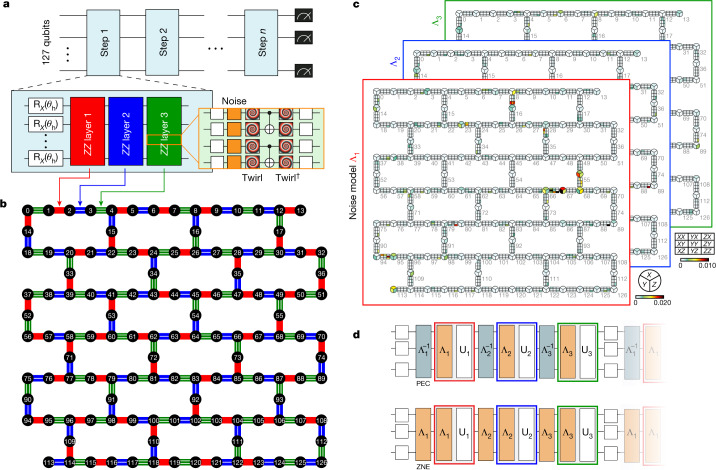
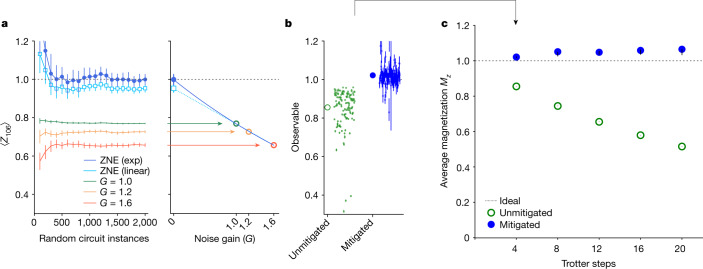
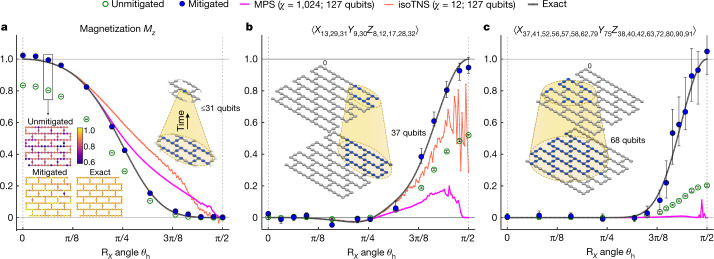
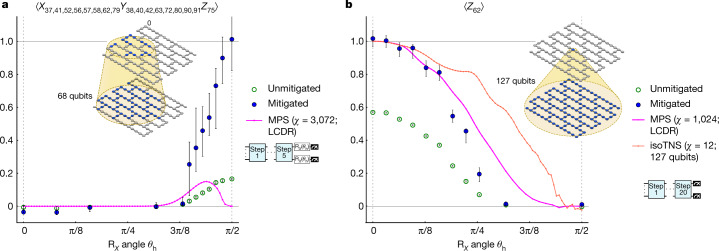
Quantum computing promises to offer substantial speed-ups over its classical counterpart for certain problems. However, the greatest impediment to realizing its full potential is noise that is inherent to these systems. The widely accepted solution to this challenge is the implementation of fault-tolerant quantum circuits, which is out of reach for current processors. Here we report experiments on a noisy 127-qubit processor and demonstrate the measurement of accurate expectation values for circuit volumes at a scale beyond brute-force classical computation. We argue that this represents evidence for the utility of quantum computing in a pre-fault-tolerant era. These experimental results are enabled by advances in the coherence and calibration of a superconducting processor at this scale and the ability to characterize 1 and controllably manipulate noise across such a large device. We establish the accuracy of the measured expectation values by comparing them with the output of exactly verifiable circuits. In the regime of strong entanglement, the quantum computer provides correct results for which leading classical approximations such as pure-state-based 1D (matrix product states, MPS) and 2D (isometric tensor network states, isoTNS) tensor network methods 2,3 break down. These experiments demonstrate a foundational tool for the realization of near-term quantum applications 4,5 .
Overview
The claims and statistics of this paper haven’t been checked yet.
Free: it reads the open-access text and checks the first 5 claims that cite a source we can check. Create a free account to check every claim.
Integrity signals
Registry
Cites
Statistics
Figures
Verification
Claims the paper makes
The claims and statistics of this paper haven’t been checked yet.
Free: it reads the open-access text and checks the first 5 claims that cite a source we can check. Create a free account to check every claim.
Claims other papers make about this one
Each is checked against this paper’s own text: does it say what the citing paper says it does?
The cited source says what the claim attributes to it.
In the citing paper
“However, mobile qubit architectures, such as QCCD and optical tweezers24,25, can distribute resources more efficiently than stationary qubit architectures26–28, because qubits flow through the QPU like bits in a classical processor, with separated memory structures, data buses and logic units, each optimized for their purpose12.”
From A 98-qubit trapped-ion quantum computer with all-to-all connectivity (2026) · cites this paper as [26]
Self-check
Percentages, sums and reported differences re-computed from the paper’s own numbers.
The self-check needs the paper’s full text.
Citations
Cites
Quantum Computing in the NISQ era and beyond
Preskill, J. (2018) · Quantum · doi:10.22331/q-2018-08-06-79 · Cited by 8,830
Quantum supremacy using a programmable superconducting processor
Arute, F., Arya, K., Babbush, R., Bacon, D., Bardin, J. C., Barends, R., Biswas, R., Boixo, S., Brandao, F. G. S. L., Buell, D. A., et al. (2019) · Nature · doi:10.1038/s41586-019-1666-5 · Cited by 7,720
The density-matrix renormalization group in the age of matrix product states
Schollwöck, U. (2011) · Annals of Physics · doi:10.1016/j.aop.2010.09.012 · Cited by 4,818 · cited 2×
“Tensor networks have been widely used to approximate and compress quantum state vectors that arise in the study of the low-energy eigenstates of and time evolution by local Hamiltonians 2,32,33 and, more recently, have been successfully used to simulate low-depth noisy quantum circuits 34–36 .”
MethodCharge-insensitive qubit design derived from the Cooper pair box
Koch, J., Yu, T. M., Gambetta, J., Houck, A. A., Schuster, D. I., Majer, J., Blais, A., Devoret, M. H., Girvin, S. M., & Schoelkopf, R. J. (2007) · Physical Review A · doi:10.1103/physreva.76.042319 · Cited by 3,351 · cited 1×
“For the experimental implementation, we primarily used the IBM Eagle processor ibm_kyiv, composed of 127 fixed-frequency transmon qubits 15 with heavy-hex connectivity and median T 1 and T 2 times of 288 μs and 127 μs, respectively.”
MethodPurification of Noisy Entanglement and Faithful Teleportation via Noisy Channels
Bennett, C. H., Brassard, G., Popescu, S., Schumacher, B., Smolin, J. A., & Wootters, W. K. (1996) · Physical Review Letters · doi:10.1103/physrevlett.76.722 · Cited by 2,961 · cited 1×
“…restricting to jump operators acting on local pairs of qubits yields a sparse noise model that can be efficiently learned for many qubits and that accurately captures the noise associated with layers of two-qubit Clifford gates, including crosstalk, when combined with random Pauli twirls 23,24 .”
BackgroundNoisy intermediate-scale quantum algorithms
Bharti, K., Cervera-Lierta, A., Kyaw, T. H., Haug, T., Alperin-Lea, S., Anand, A., Degroote, M., Heimonen, H., Kottmann, J. S., Menke, T., et al. (2022) · Reviews of Modern Physics · doi:10.1103/revmodphys.94.015004 · Cited by 2,231
Improved simulation of stabilizer circuits
Aaronson, S., & Gottesman, D. (2004) · Physical Review A · doi:10.1103/physreva.70.052328 · Cited by 1,515 · cited 1×
“Clifford circuits serve as useful benchmarks of estimates produced by error mitigation, as they can be efficiently simulated classically 29 .”
BackgroundError Mitigation for Short-Depth Quantum Circuits
Temme, K., Bravyi, S., & Gambetta, J. M. (2017) · Physical Review Letters · doi:10.1103/physrevlett.119.180509 · Cited by 1,379 · cited 2×
“based on pulse stretching 9,17,18 or subcircuit repetition 20–22 have circum-vented the need for precise noise learning, while relying on simplistic assumptions about the device noise.”
BackgroundSelf-citationEvolution of entanglement entropy in one-dimensional systems
Calabrese, P., & Cardy, J. (2005) · Journal of Statistical Mechanics: Theory and Experiment · doi:10.1088/1742-5468/2005/04/p04010 · Cited by 1,295 · cited 1×
“As entanglement (bond dimension) of a generic state grows linearly (exponentially) with time evolution until it saturates the volume law, deep quantum circuits are inherently difficult for tensor networks 37 .”
BackgroundError mitigation extends the computational reach of a noisy quantum processor
Kandala, A., Temme, K., Córcoles, A. D., Mezzacapo, A., Chow, J. M., & Gambetta, J. M. (2019) · Nature · doi:10.1038/s41586-019-1040-7 · Cited by 871 · cited 2×
“based on pulse stretching 9,17,18 or subcircuit repetition 20–22 have circum-vented the need for precise noise learning, while relying on simplistic assumptions about the device noise.”
BackgroundSelf-citation
Research works printed but not linked: 5
- Shor, P. W. in Proc. 35th Annual Symposium on Foundations of Computer Science 124–134 (IEEE, 1994).
- Kitaev, A. Y. Quantum measurements and the Abelian Stabilizer Problem. Preprint at https://arxiv.org/abs/quant-ph/9511026 (1995). · arXiv
- Li Y Benjamin SC Efficient variational quantum simulator incorporating active error minimization Phys. Rev. X 2017 7 021050
- Endo S Benjamin SC Li Y Practical quantum error mitigation for near-future applications Phys. Rev. X 2018 8 031027
- Zhou Y Stoudenmire EM Waintal X What limits the simulation of quantum computers? Phys. Rev. X 2020 10 041038
Cited by
Logical quantum processor based on reconfigurable atom arrays
Bluvstein, D., Evered, S. J., Geim, A. A., Li, S. H., Zhou, H., Manovitz, T., Ebadi, S., Cain, M., Kalinowski, M., Hangleiter, D., et al. (2024) · Nature · doi:10.1038/s41586-023-06927-3 · Cited by 1,119
“Because in the two-copy measurements for each error-detection threshold we also measure the overall system purity, we can extrapolate our expectation values to the case of unit purity (zero noise) 54 .”
BackgroundCai, Z., Babbush, R., Benjamin, S. C., Endo, S., Huggins, W. J., Li, Y., McClean, J. R., & O’Brien, T. E. (2023) · Reviews of Modern Physics · doi:10.1103/revmodphys.95.045005 · Cited by 591
“However, while this will work well with depolarising gate noise, it may change the gate error model for more general gate noise such that the factor of increase in the error strength is no longer well-defined (Kim et al. , 2023b).”
BackgroundMethodInfluentialA tweezer array with 6,100 highly coherent atomic qubits
Manetsch, H. J., Nomura, G., Bataille, E., Lv, X., Leung, K. H., & Endres, M. (2025) · Nature · doi:10.1038/s41586-025-09641-4 · Cited by 491
“Our results, along with recent developments 8,22–24 , indicate that universal quantum computing and QEC with thousands to tens of thousands of physical qubits could be a near-term prospect.”
Does provable absence of barren plateaus imply classical simulability?
Cerezo, M., Larocca, M., García-Martín, D., Diaz, N. L., Braccia, P., Fontana, E., Rudolph, M. S., Bermejo, P., Ijaz, A., Thanasilp, S., et al. (2025) · Nature Communications · doi:10.1038/s41467-025-63099-6 · Cited by 110
“Forinstance,therecentworkof 171 studiedwhy certain quantum experiments 172 could be ef fi ciently simulated via tensor networks?.”
Chemistry beyond the scale of exact diagonalization on a quantum-centric supercomputer
Moreno, J. R., Motta, M., Haas, H., Javadi-Abhari, A., Jurcevic, P., Kirby, W., Martiel, S., Sharma, K., Sharma, S., Shirakawa, T., et al. (2025) · Science Advances · doi:10.1126/sciadv.adu9991 · Cited by 442
Metadata
- Authors
- Kim, Y., Eddins, A., Anand, S., Wei, K. X., van den Berg, E., Rosenblatt, S., Nayfeh, H., Wu, Y., Zaletel, M., Temme, K., & Kandala, A.
- Affiliations
- IBM Research - Cambridge (United States) (US)
- University of California, Berkeley (US)
- IBM (United States) (US)
- RIKEN (JP)
- Lawrence Berkeley National Laboratory (US)
- Corresponding author
- Eddins, Andrew
- Kandala, Abhinav
- ORCID
- Venue
- Nature
- Published
- 2023-06-14
- Volume
- 618
- Issue
- 7965
- Pages
- 500-505
- ISSN
- 0028-0836 (ISSN-L)
- 1476-4687
- PMC
- PMC10266970
- OpenAlex
- W4380627387
- Cited by
- 1,050
- References
- 41
- Citations by year
- 2026: 226 · 2025: 399 · 2024: 358 · 2023: 67
- FWCI
- 98.85
- Type
- journal article
- Language
- en
- Open access
- hybrid
- doi.org
- Licence
- cc-by
- creativecommons.org/licenses/by/4.0 (tdm)
- creativecommons.org/licenses/by/4.0 (vor)
- Locations
- Nature (publishedVersion, cc-by)
- PubMed Central (publishedVersion, cc-by)
- PubMed (publishedVersion)
- eScholarship (California Digital Library) (submittedVersion, cc-by)
- OSTI OAI (U.S. Department of Energy Office of Scientific and Technical Information) (submittedVersion)
- RePEc: Research Papers in Economics (submittedVersion)
- Funders
- National Science Foundation (DEAC02-05CH11231, 2137603, 2138259, 2138296, 2138307, 2138286)
- U.S. Department of Energy (-AC02-05CH11231, 05CH11231, DE AC02 05CH11231, DESC0022716, DE-AC02-)
- National Energy Research Scientific Computing Center (DE–AC02–05CH11231, 05CH11231, AC02-05CH11231)
- Office of Science (DEAC02–05CH11231, AC02-05CH11231, DE-AC02)
- Office of Advanced Cyberinfrastructure (#2138286, #2138296, 2138259, #2138307, 2137603)
- Basic Energy Sciences (DE-AC02, DE-AC02-05CH11231., AC02–05CH11231)
- Lawrence Berkeley National Laboratory (AC02‐05CH11231, DE-AC02-05CH11231, 05CH11231)
- Topics
- Physical Sciences › Computer Science › Artificial Intelligence › Quantum Computing Algorithms and Architecture
- Physical Sciences › Physics and Astronomy › Atomic and Molecular Physics, and Optics › Quantum Information and Cryptography
- Physical Sciences › Physics and Astronomy › Atomic and Molecular Physics, and Optics › Quantum many-body systems
- Keywords
- quantum computing, NISQ devices, superconducting qubits, noise characterization, tensor network states, matrix product states, entanglement, quantum advantage
About these checks
Registry, retraction, Cites and statistics results are computed, not judged, with one exception: a printed reference that no index lists is read once by a model before it counts as a citation error. Claims are extracted by a model and kept only when their quote appears verbatim in the text; each cited source is then checked, with a model’s help, for whether it says what the claim relies on. Those verdicts can be wrong — read the claim’s quote and the cited source before relying on one.
Statistics and arithmetic are recomputed, not judged.
Confidence bands are shown only for fields calibrated on our annotated test set. None is calibrated yet, so no band is shown.
What counts as a claim ›How we measure confidence ›How we check this ›
Are you an author, or do you see a problem with this page? Request a review
How to cite
Cite CoChat for the checks on this page, and the paper for its own findings.
- This page
- CoChat. (2026). Citation check: Evidence for the utility of quantum computing before fault tolerance. https://app.cochat.ai/papers/10.1038/s41586-023-06096-3
- The paper
- Kim, Y., Eddins, A., Anand, S., Wei, K. X., van den Berg, E., Rosenblatt, S., Nayfeh, H., Wu, Y., Zaletel, M., Temme, K., & Kandala, A. (2023). Evidence for the utility of quantum computing before fault tolerance. Nature. https://doi.org/10.1038/s41586-023-06096-3
Data sources
Bibliographic data: Semantic Scholar, OpenAlex, Crossref.
Contains information from the Semantic Scholar Academic Graph Datasets, made available under the ODC Attribution License (ODC-BY 1.0).
Semantic Scholar’s data is described in: Kinney, R., et al. (2023). The Semantic Scholar Open Data Platform. arXiv:2301.10140.
