

Parenting or partnership? Corpus-assisted analysis of institution-people dynamics in university sustainability reporting
Open accessThe DOI matches its Crossref record; 39 of the 39 references it cites were found in a registry or an index.
Abstract
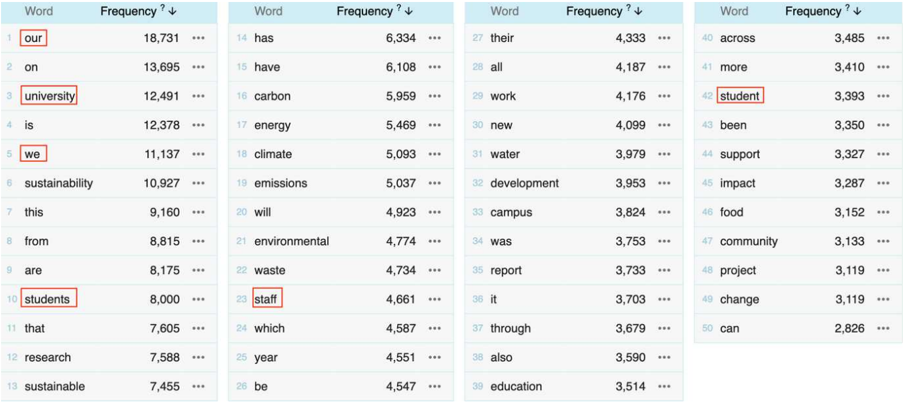
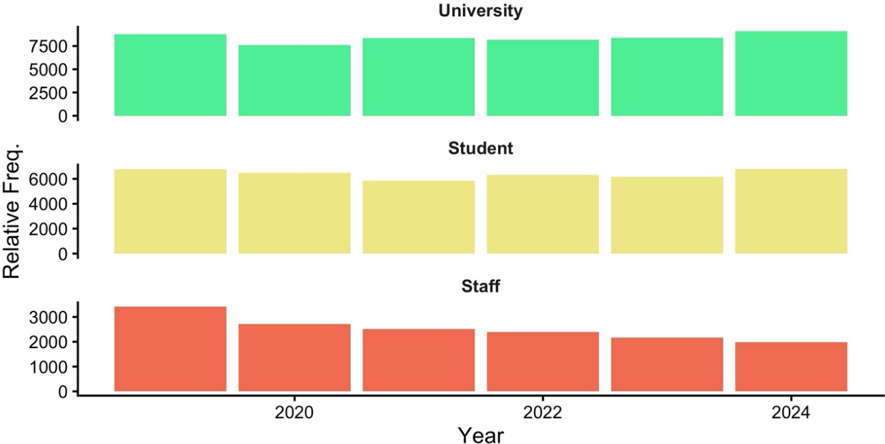
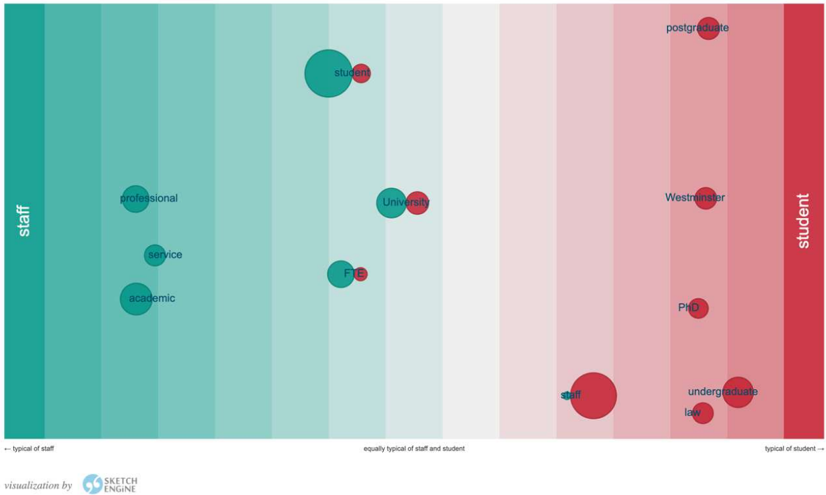
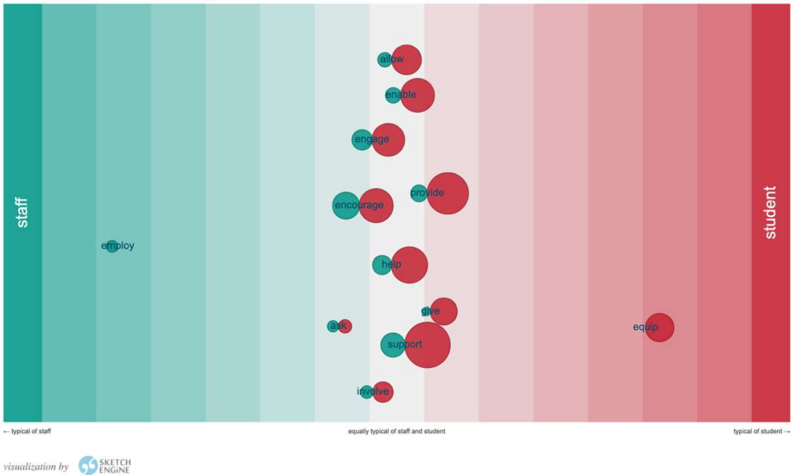
Higher education institutions are increasingly required to produce formal reports on their sustainability practices. How these reports are written can tell us much about the way higher education leadership prioritises the contributions of different parts of the institution to sustainability goals. In this paper we investigate how key actors — institutions, staff, and students — are represented within these formal documents. We employ corpus-assisted discourse analysis, combining concordance and collocation analysis, to examine sustainability reports produced by UK universities included in the 2024 QS Sustainability Ranking. Findings show that universities, staff and students are the most frequently mentioned actors, but there are clear asymmetries in how they are represented. Universities are consistently portrayed as ethically, socially, and environmentally responsible leaders who provide facilities, inclusion programmes, services, and sustainability initiatives. In contrast, staff and students are more often positioned as passive recipients and beneficiaries of university affordances, often referenced in role-based terms or as components of carbon reporting rather than as agents in their own right. The findings point to a hierarchical “parenting” representational pattern that diminishes collective agency and undermines more participatory understandings of sustainability governance. Such representations are consequential because the discursive marginalisation of staff and student agency raises questions about the extent to which university sustainability governance is genuinely participatory or democratic. This study makes an original contribution to scholarship on sustainability discourse, governance and legitimacy in higher education, and demonstrates the value of corpus-assisted discourse analysis for identifying ideological patterns in institutional reporting.
Overview
The claims and statistics of this paper haven’t been checked yet.
Free: it reads the open-access text and checks the first 5 claims that cite a source we can check. Create a free account to check every claim.
Integrity signals
Registry
Cites
Statistics
Figures
Verification
Claims the paper makes
The claims and statistics of this paper haven’t been checked yet.
Free: it reads the open-access text and checks the first 5 claims that cite a source we can check. Create a free account to check every claim.
Claims other papers make about this one
Each is checked against this paper’s own text: does it say what the citing paper says it does?
The cited source says what the claim attributes to it.
In the citing paper
“it leads to performance-based model, in which universities highlight their own comprehensive endeavours while backgrounding the roles of staff and students (Tao et al., 2026).”
From Assessment-focused governance mode? Mapping Generative AI policies across 76 UK higher education institutions: Policy framework and recommendations (2026) · cites this paper as Tao et al., 2026
Self-check
Percentages, sums and reported differences re-computed from the paper’s own numbers.
The self-check needs the paper’s full text.
Citations
Cites
Maximizing business returns to corporate social responsibility (CSR): The role of CSR communication
Du, S., Bhattacharya, C. B., & Sen, S. (2010) · International Journal of Management Reviews · doi:10.1111/j.1468-2370.2009.00276.x · Cited by 2,633
Kilgarriff, A., Baisa, V., Bušta, J., Jakubíček, M., Kovář, V., Michelfeit, J., Rychlý, P., & Suchomel, V. (2014) · Lexicography · doi:10.1007/s40607-014-0009-9 · Cited by 2,105
Lozano, R., Ceulemans, K., Alonso-Almeida, M., Huisingh, D., Lozano, F. J., Waas, T., Lambrechts, W., Lukman, R., & Hugé, J. (2015) · Journal of Cleaner Production · doi:10.1016/j.jclepro.2014.09.048 · Cited by 1,157
Organized hypocrisy, organizational façades, and sustainability reporting
Cho, C. H., Laine, M., Roberts, R. W., & Rodrigue, M. (2015) · Accounting, Organizations and Society · doi:10.1016/j.aos.2014.12.003 · Cited by 1,066
Incorporation and institutionalization of SD into universities: breaking through barriers to change
Lozano, R. (2006) · Journal of Cleaner Production · doi:10.1016/j.jclepro.2005.12.010 · Cited by 851
Rankings and the Reshaping of Higher Education
Hazelkorn, E. (2015) · Palgrave Macmillan UK eBooks · doi:10.1057/9781137446671 · Cited by 670
Textual Agency: How Texts Do Things in Organizational Settings
Cooren, F. (2004) · Organization · doi:10.1177/1350508404041998 · Cited by 637
The state of sustainability reporting in universities
Lozano, R. (2011) · International Journal of Sustainability in Higher Education · doi:10.1108/14676371111098311 · Cited by 494
Gablasova, D., Brezina, V., & McEnery, T. (2017) · Language Learning · doi:10.1111/lang.12225 · Cited by 482
Ceulemans, K., Molderez, I., & Van Liedekerke, L. (2015) · Journal of Cleaner Production · doi:10.1016/j.jclepro.2014.09.052 · Cited by 372
Language and Organization: The Doing of Discourse
Bøje, D. M., Oswick, C., & Ford, J. D. (2004) · Academy of Management Review · doi:10.5465/amr.2004.14497609 · Cited by 229
Ferrero‐Ferrero, I., Izquierdo, M. Á. F., Torres, M. J. M., & Bellés-Colomer, L. (2017) · International Journal of Sustainability in Higher Education · doi:10.1108/ijshe-06-2016-0116 · Cited by 188
Improving how sustainability reports drive change: A critical discourse analysis
Higgins, C., & Coffey, B. (2016) · Journal of Cleaner Production · doi:10.1016/j.jclepro.2016.01.101 · Cited by 155
Smeuninx, N., Clerck, B. D., & Aerts, W. (2016) · International Journal of Business Communication · doi:10.1177/2329488416675456 · Cited by 152
Jorge, M. L., Peña, F. J. A., & Madueño, J. H. (2018) · Journal of Environmental Planning and Management · doi:10.1080/09640568.2018.1457952 · Cited by 151
Narayanan, V., & Adams, C. A. (2016) · Accounting and Business Research · doi:10.1080/00014788.2016.1257930 · Cited by 100
Sustainability reporting: meeting stakeholder demands
Amran, A., & Ooi, S. K. (2014) · Strategic Direction · doi:10.1108/sd-03-2014-0035 · Cited by 85
Kang, H., & Kim, J. (2022) · Applied Sciences · doi:10.3390/app12115614 · Cited by 79
Reframing the climate debate: The origins and diffusion of net zero pledges
Coppenolle, H. V., Blondeel, M., & de Graaf, T. V. (2022) · Global Policy · doi:10.1111/1758-5899.13161 · Cited by 78
Climate change engagement of scientists
Dablander, F., Sachisthal, M. S. M., Cologna, V., Strahm, N., Bosshard, A., Grüning, N., Green, A. J. K., Brick, C., Aron, A. R., & Haslbeck, J. M. B. (2024) · Nature Climate Change · doi:10.1038/s41558-024-02091-2 · Cited by 77
Characteristics of UK higher education institutions that disclose sustainability reports
Sassen, R., Dienes, D., & Wedemeier, J. (2018) · International Journal of Sustainability in Higher Education · doi:10.1108/ijshe-03-2018-0042 · Cited by 69
O’Neill, K. J., & Sinden, C. K. (2021) · Politics and Governance · doi:10.17645/pag.v9i2.3872 · Cited by 52
Fuoli, M., & Beelitz, A. (2023) · International Journal of Corpus Linguistics · doi:10.1075/ijcl.22123.fuo · Cited by 45
A data analytics approach for university competitiveness: the QS world university rankings
Estrada-Real, A. C., & Cantú-Ortiz, F. J. (2022) · International Journal on Interactive Design and Manufacturing (IJIDeM) · doi:10.1007/s12008-022-00966-2 · Cited by 41
Latter, B., Demski, C., & Capstick, S. (2024) · PLOS Climate · doi:10.1371/journal.pclm.0000322 · Cited by 39
Green or green‐washed? Examining sustainability reporting in higher education
Lakhno, M. (2024) · Higher Education Quarterly · doi:10.1111/hequ.12513 · Cited by 35
Durán, M. V. C., Sánchez, T. B., & García, M. G. (2023) · Higher Education Quarterly · doi:10.1111/hequ.12470 · Cited by 33
Scientists’ identities shape engagement with environmental activism
Finnerty, S., Piazza, J. R., & Levine, M. (2024) · Communications Earth & Environment · doi:10.1038/s43247-024-01412-9 · Cited by 33
Self-citationBetween two worlds: the scientist’s dilemma in climate activism
Finnerty, S., Piazza, J. R., & Levine, M. (2024) · npj Climate Action · doi:10.1038/s44168-024-00161-x · Cited by 26
Self-citationBohunovsky, L., Radinger-Peer, V., Zint, M. T., & Penker, M. (2023) · International Journal of Sustainability in Higher Education · doi:10.1108/ijshe-12-2022-0393 · Cited by 20
How UK universities approach sustainability: A timely review
Zhou, R. (2024) · Journal of Adult and Continuing Education · doi:10.1177/14779714241240985 · Cited by 18
Irungu, R. W., & Liu, Z. (2024) · PLoS ONE · doi:10.1371/journal.pone.0306286 · Cited by 17
Fuoli, M., & Beelitz, A. (2025) · Applied Corpus Linguistics · doi:10.1016/j.acorp.2025.100142 · Cited by 17
Tao, Y., & Ryan, M. (2025) · International Journal of Business Communication · doi:10.1177/23294884251336358 · Cited by 10
Self-citationThe wins of the grassroots climate movement in the University of California
Aron, A. R., Nelson, M., Gere, C., Cooper, A., & Thackray, V. (2025) · Frontiers in Education · doi:10.3389/feduc.2025.1491439 · Cited by 9
Sustainability Curriculum in UK University Sustainability Reports
Kosta, K. (2017) · World sustainability series · doi:10.1007/978-3-319-70281-0_6 · Cited by 8
Finnerty, S. (2026) · PLOS Climate · doi:10.1371/journal.pclm.0000828 · Cited by 6
Self-citationStudent Agency for Sustainable Access and Quality in Higher Education
Rutar, S., & Krmac, N. (2025) · Rethinking higher education · doi:10.1007/978-981-96-3329-6_11 · Cited by 2
Finnerty, S. (2025) · doi:10.31234/osf.io/uxdmb_v1 · Cited by 1
Self-citation
Research works printed but not linked: 5
- 6. Brookes, G., & Collins, L. C. (2024). Corpus Linguistics for Health Communication: A Guide for Research. Routledge. Cancer Research UK. (2025, April 25). Environmental sustainability in research. https://www.cancerresearchuk.org/for-researchers/apply-for- and-manage-your-funding/research-policies-and- guidance/environmental-sustainability-in- research?utm_source=chatgpt.com
- 25. Hazelkorn, E. (2015b). The effect of rankings on student choice and institutional selection. In Access and expansion post-massification (pp. 107-128). Routledge.
- 34. Latter, B., & Capstick, S. (2021). Climate Emergency: UK Universities' Declarations and Their Role in Responding to Climate Change. Frontiers in Sustainability, 2, 660596. https://doi.org/10.3389/FRSUS.2021.660596/ · doi:10.3389/frsus.2021.660596/
- 44. Planet-Based Universities. (2026). Students everywhere are transforming university catering -will yours be next? Planet-Based Universities. https://plantbaseduniversities.org/
- 51. Tao, Y., & Ryan, M. (2025a). Greenlash in the Media. Humanities and Social Sciences Communications. https://www.nature.com/articles/s41599- 025-05324-7
Cited by
Tao, Y., Ryan, M., Bialy, F., & Zhang, X. (2026) · Research Square (preprint) · doi:10.21203/rs.3.rs-10029667/v1
Self-citation
Metadata
- Authors
- Tao, Y., Finnerty, S., Robinson, S., Philpot, R., Shaw, H., & Levine, M.
- Affiliations
- Lancaster University (GB)
- Venue
- Research Square
- Published
- 2026-04-27
- OpenAlex
- W6922504155
- Cited by
- 1
- References
- 39
- Citations by year
- 2026: 1
- Type
- posted content
- Language
- en
- Open access
- green
- doi.org
- Locations
- Research Square (acceptedVersion, cc-by)
- Lancaster EPrints (Lancaster University) (acceptedVersion)
- Lancaster EPrints (Lancaster University) (submittedVersion)
- Funders
- Wellcome Trust (228123/Z/23/Z)
- Topics
- Social Sciences › Education › Sustainability in Higher Education
- Social Sciences › Business, Management and Accounting › Strategy and Management › Corporate Social Responsibility Reporting
- Social Sciences › Linguistics and Language › Discourse Analysis in Language Studies
- Keywords
- parental discourse, higher education sustainability, institutional discourse
About these checks
Registry, retraction, Cites and statistics results are computed, not judged, with one exception: a printed reference that no index lists is read once by a model before it counts as a citation error. Claims are extracted by a model and kept only when their quote appears verbatim in the text; each cited source is then checked, with a model’s help, for whether it says what the claim relies on. Those verdicts can be wrong — read the claim’s quote and the cited source before relying on one.
Statistics and arithmetic are recomputed, not judged.
Confidence bands are shown only for fields calibrated on our annotated test set. None is calibrated yet, so no band is shown.
What counts as a claim ›How we measure confidence ›How we check this ›
Are you an author, or do you see a problem with this page? Request a review
Data sources
Bibliographic data: Semantic Scholar, OpenAlex, Crossref.
Contains information from the Semantic Scholar Academic Graph Datasets, made available under the ODC Attribution License (ODC-BY 1.0).
Semantic Scholar’s data is described in: Kinney, R., et al. (2023). The Semantic Scholar Open Data Platform. arXiv:2301.10140.
