

Evaluating AI Text Detection Accuracy: A Structured Review of False Positives, False Negatives, and Implications for Academic Integrity Policy in Gulf Region Universities
Open accessThe DOI matches its Crossref record; 19 of the 19 references it cites were found in a registry or an index; 1 of the 90 sources its claims cite were checked for support.
Abstract
Universities across the Gulf Cooperation Council (GCC) have rapidly adopted AI text detection tools for academic integrity enforcement, yet no review of published empirical evidence exists for this regional context. This paper presents a structured narrative review of published independent evidence on the accuracy, bias, and policy implications of five widely deployed AI detection platforms GPTZero, Turnitin AI Detection, Originality.AI, Copyleaks, and ZeroGPT with sustained attention to non-native English speaker (NNS) populations and the Arabic-English bilingual writers who make up most of the GCC student body. Drawing on peer-reviewed studies, preprints, and institutional statements, the review finds that: (1) in the largest independent multi-tool evaluation, no detection tool reached 80% accuracy [1]; (2) in the most widely cited bias study, detectors flagged an average of 61.2% of authentic essays by non-native English writers as AI-generated [2], although subsequent evidence from another language found no such bias [3]; (3) no validation study exists for Arabic-English bilingual writers, the most critical unaddressed gap in the regional literature; and (4) simple modification of AI-generated text sharply reduces detection, with accuracy on machine-paraphrased text falling to 26% [1]. Five contributions are made: a structured synthesis of AI detection evidence for the GCC context; formal identification of the Arabic-English bilingual research gap; a four-tier evidence-based policy framework; a structured regional research agenda; and implementation guidance for institutional decision-makers. The evidence indicates that using AI detection scores for disciplinary purposes in Gulf universities carries unacceptable false positive risk, particularly for NNS students, and warrants immediate policy reform.
Overview
CoChat Summary
TL;DR
This PRISMA-based systematic review synthesises 27 independent studies (2022–2025) on five widely deployed AI text detectors and finds that none exceeds 80% real-world accuracy, with non-native English speakers facing false positive rates of 26–61%. It argues that GCC universities, whose students are predominantly Arabic-English bilingual and for whom no validation data exists, should not use detection scores as primary evidence in misconduct proceedings.
Key findings
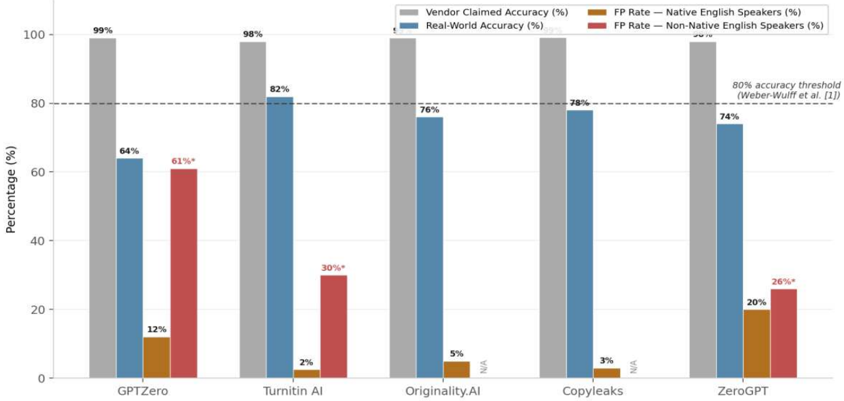
- All independently tested tools scored below 80% real-world accuracy, with only five of 14 exceeding 70% in Weber-Wulff et al.; vendor claims of 98–99% exceed measured performance by 14 points (Turnitin AI: claimed 98%, measured 80–84%) to more than 24 points (GPTZero: claimed 99%, measured 52–76%).
- Liang et al. found detectors flagged 61.3% of authentic human-written TOEFL essays as AI-generated versus near-zero for native-speaker essays; 19.8% were flagged unanimously by all seven detectors and 97.8% received at least one flag. Synthesised NNS false positive rates range 26–61% across tools, versus 1–20% for native speakers.
- Simple adversarial modification collapses detection: recursive paraphrasing reduced detection from over 70% to under 5% (Sadasivan et al.), and Perkins et al. reported accuracy falling from 39.5% to 17.4% across six detectors.
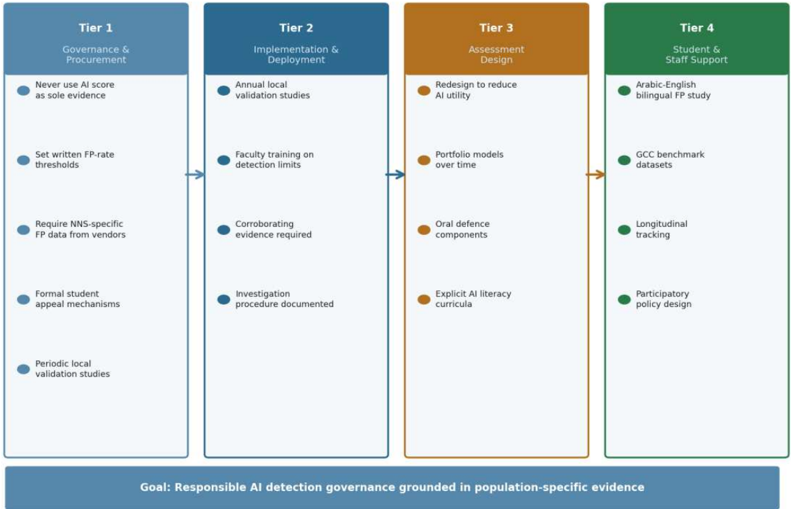
- No published study has validated any AI detection tool against Arabic-English bilingual writing corpora; the review identifies this as the most critical regional gap and proposes a four-tier policy framework plus a six-priority research agenda.
Methods
- Systematic literature review following the PRISMA framework, searching Google Scholar, Semantic Scholar, arXiv, PubMed, and the ACM Digital Library in March 2025 with primary, tool-specific, and population-specific search strings plus forward and backward citation chaining.
- From 847 initial records, 213 duplicates removed, 634 screened by title/abstract, 89 full-text reviewed, yielding 27 included studies (inclusion required empirical accuracy/FP/FN measurement, ≥20 text samples, and publication Nov 2022–Mar 2025).
- Narrative synthesis (Popay et al. framework) rather than meta-analysis due to methodological heterogeneity; study quality assessed with an adapted QUADAS-2 checklist, with findings graded High/Moderate/Low confidence.
Limitations
- Paper-stated: as a review rather than primary study, its GCC policy implications rely on extrapolation from other NNS populations since Arabic-English bilingual data do not exist; the rapidly evolving detection landscape means 2022–2023 accuracy figures may not reflect current performance; and the focus on five tools limits generalisability to other platforms.
- Paper-stated: the absence of Arabic-English bilingual validation is identified as a limitation of the existing literature rather than of the review itself.
- Evident from the text: several key figures rest on non-peer-reviewed or vendor-adjacent sources (DecEptioner benchmark, UndetectedGPT blog, GPTZero's own technical report), and Table 1 marks NNS false positive rates with an asterisk as estimated from Liang et al.'s 61.3% average rather than tool-specific measurements, with "N/A" for Originality.AI and Copyleaks.
Model-written summary. Check it against the paper before relying on it.
Integrity signals
Registry
Cites
Statistics
Figures
Verification
Claims the paper makes
1 Valid · 14 Not valid · 89 Not checked · 97 Own results and interpretations
The cited sources support only part of this claim — read each source’s verdict below.
In the paper
“The tools showed systematic bias toward classifying texts as human-authored rather than AI-generated, a pattern consistent with conservative calibration designed to minimise false accusation rates at the cost of higher false negative rates.”
§ Evaluating AI Text Detection Accuracy: A Systematic Review of False Positives, False Negatives, and Implications for Academic Integrity Policy in Gulf Region Universities > B. Empirical Evidence on Detection Accuracy 1) Comprehensive Multi-Tool Evaluations
What the sources say
- Partly supportedcites [1] D. Weber-Wulff et al., "Testing of detection tools for AI-generated text," Int. J. Educ. Integr., vol. 19, no. 1, p. 26, 2023. sourceExperimental — accuracy not yet measured
The bias half of the claim is squarely supported: the Abstract (p. 1) and Discussion (p. 25) state the tools 'have a main bias towards classifying the output as human-written rather than detecting AI-generated text' (~20% of AI-generated texts misattributed to humans), and Consistency in tool results (p. 17) reports all tested tools except GPT Zero were more accurate on human-written text. However, the citing sentence converts the source's hedge into a stated design intent: p. 17 says the classification is '(probably deliberately) biased towards humans' and merely that this bias 'is preferable in academic contexts', while the Error analysis sections (pp. 19-22) treat the resulting false-negative cost as the greater harm (risk of unfair advantage significantly greater than false accusation) rather than describing a calibration aimed at minimising false accusations. The part not supported is the assertion of deliberate conservative calibration 'designed to minimise false accusation rates', and the unqualified 'the tools showed' glosses over the GPT Zero exception. (LLM, conf=0.75)
plainstates an association- Asserted: passes — The authors put it forward as true.
- Checkable: passes — It can be checked against evidence.
- Load-bearing: passes — The paper’s conclusions depend on it.
- Based: passes — The paper gives a reason why it holds.
- Partly supported
In the paper
“Walters [21] evaluated 16 AI detection tools using 42 essays produced by both AI and human authors, finding substantial and systematic inconsistency across tools.”
§ Evaluating AI Text Detection Accuracy: A Systematic Review of False Positives, False Negatives, and Implications for Academic Integrity Policy in Gulf Region Universities > B. Empirical Evidence on Detection Accuracy 1) Comprehensive Multi-Tool Evaluations
What the sources say
- Not checked yetcites [21] W. R. Walters, "Some evidence on the accuracy and utility of detection tools for AI-generated text," J. Acad. Librarianship, vol. 49, no. 5, p. 102726, 2023.
plain- Asserted: passes — The authors put it forward as true.
- Checkable: passes — It can be checked against evidence.
- Load-bearing: passes — The paper’s conclusions depend on it.
- Based: passes — The paper gives a reason why it holds.
In the paper
“testing 14 commercial AI detection tools across a standardised corpus and finding that all scored below 80% accuracy and only five exceeded 70%”
- Also stated in: § B. Empirical Evidence on Detection Accuracy 1) Comprehensive Multi-Tool Evaluations · plain
“All tested tools scored below 80% overall accuracy, with only five exceeding 70%.”
§ Evaluating AI Text Detection Accuracy: A Systematic Review of False Positives, False Negatives, and Implications for Academic Integrity Policy in Gulf Region Universities > I. INTRODUCTION
What the sources say
- Not checked yetcites [1] D. Weber-Wulff et al., "Testing of detection tools for AI-generated text," Int. J. Educ. Integr., vol. 19, no. 1, p. 26, 2023. source
plain- Asserted: passes — The authors put it forward as true.
- Checkable: passes — It can be checked against evidence.
- Load-bearing: passes — The paper’s conclusions depend on it.
- Based: passes — The paper gives a reason why it holds.
- Also stated in: § B. Empirical Evidence on Detection Accuracy 1) Comprehensive Multi-Tool Evaluations · plain
In the paper
“Alshahrani [11] surveyed faculty at Saudi Arabian universities and found that 78% had adopted some form of AI detection practice by 2023, yet only 23% had received formal guidance on interpreting detection outputs.”
§ Evaluating AI Text Detection Accuracy: A Systematic Review of False Positives, False Negatives, and Implications for Academic Integrity Policy in Gulf Region Universities > A. Higher Education in the Gulf Cooperation Council
What the sources say
- Not checked yetcites [11] H. Alshahrani, "The use of AI detection tools in Saudi Arabian universities: Faculty perceptions and practices," J. Educ. Technol. Soc., vol. 27, no. 1, pp. 44-58, 2024.
plain- Asserted: passes — The authors put it forward as true.
- Checkable: passes — It can be checked against evidence.
- Load-bearing: passes — The paper’s conclusions depend on it.
- Based: passes — The paper gives a reason why it holds.
In the paper
“No single tool performed consistently well across all text types, disciplines, and modification conditions.”
§ Evaluating AI Text Detection Accuracy: A Systematic Review of False Positives, False Negatives, and Implications for Academic Integrity Policy in Gulf Region Universities > B. Empirical Evidence on Detection Accuracy 1) Comprehensive Multi-Tool Evaluations
What the sources say
- Not checked yetcites [1] D. Weber-Wulff et al., "Testing of detection tools for AI-generated text," Int. J. Educ. Integr., vol. 19, no. 1, p. 26, 2023. source
plain- Asserted: passes — The authors put it forward as true.
- Checkable: passes — It can be checked against evidence.
- Load-bearing: passes — The paper’s conclusions depend on it.
- Based: passes — The paper gives a reason why it holds.
102 more claims
Create a free account to see all 201 claims and to verify the 89 references still open.
- Probably not a substantial claim. 31
- It may state two separate claims as one. 67
- The quote only partly states this claim. 2
Self-check
Percentages, sums and reported differences re-computed from the paper’s own numbers.
Each contradiction between two passages listed here was confirmed by an independent check.
Rated major: it would touch a result — a value a result rests on, reported and recomputed p-values on opposite sides of the significance level, two passages that conflict with no sign which is right, or a cited work retracted before this paper was published.
In the paper
§ Evaluating AI Text Detection Accuracy: A Systematic Review of False Positives, False Negatives, and Implications for Academic Integrity Policy in Gulf Region Universities > E. RQ5: Summary of Evidence for Policy
“Finding 1 (Confidence: High): All independently tested AI detection tools score below 80% real-world accuracy”
§ Evaluating AI Text Detection Accuracy: A Systematic Review of False Positives, False Negatives, and Implications for Academic Integrity Policy in Gulf Region Universities > IX. CONCLUSION
“| Turnitin AI | 98% | 80-84% | 1-4% | ~30%* | ~15% | High | [1],[5],[8],[23] |”
Rated minor: it would not touch a result — a value no result rests on, a p-value that stays on the same side of the significance level, or a conflict that is clerical, resolved elsewhere in the paper, or outside its own findings.
In the paper
§ Evaluating AI Text Detection Accuracy: A Systematic Review of False Positives, False Negatives, and Implications for Academic Integrity Policy in Gulf Region Universities > B. Empirical Evidence on Detection Accuracy 1) Comprehensive Multi-Tool Evaluations
“false negative rates climbed to approximately 40-50%”
§ Evaluating AI Text Detection Accuracy: A Systematic Review of False Positives, False Negatives, and Implications for Academic Integrity Policy in Gulf Region Universities > B. Empirical Evidence on Detection Accuracy 1) Comprehensive Multi-Tool Evaluations
“meaning that the majority of even lightly modified AI content evaded detection entirely.”
Rated minor: it would not touch a result — a value no result rests on, a p-value that stays on the same side of the significance level, or a conflict that is clerical, resolved elsewhere in the paper, or outside its own findings.
In the paper
§ Evaluating AI Text Detection Accuracy: A Systematic Review of False Positives, False Negatives, and Implications for Academic Integrity Policy in Gulf Region Universities > B. The Equity Crisis and Vendor Transparency Problem
“real-world accuracy ranging from 52% to 84%”
§ Evaluating AI Text Detection Accuracy: A Systematic Review of False Positives, False Negatives, and Implications for Academic Integrity Policy in Gulf Region Universities > IX. CONCLUSION
“| Copyleaks | 99.1% | 65-91% | 1-5% | N/A | ~35% | Moderate | [8],[21],[22] |”
Citations
Cites
The PRISMA 2020 statement: An updated guideline for reporting systematic reviews
Page, M. J., McKenzie, J. E., Bossuyt, P. M., Boutron, I., Hoffmann, T. C., Mulrow, C. D., Shamseer, L., Tetzlaff, J. M., Akl, E. A., Brennan, S. E., et al. (2021) · BMJ · doi:10.1136/bmj.n71 · Cited by 108,283
QUADAS-2: a revised tool for the quality assessment of diagnostic accuracy studies
Whiting, P. F., Rutjes, A. W. S., Westwood, M. E., Mallett, S., Deeks, J. J., Reitsma, J. B., Leeflang, M. M. G., Sterne, J. A. C., Bossuyt, P. M. M., & the QUADAS-2 Group* (2011) · Annals of Internal Medicine · doi:10.7326/0003-4819-155-8-201110180-00009 · Cited by 14,199
Chatting and cheating: Ensuring academic integrity in the era of ChatGPT
Cotton, D. R. E., Cotton, P. A., & Shipway, J. R. (2024) · Innovations in Education and Teaching International · doi:10.1080/14703297.2023.2190148 · Cited by 3,087
Popay, J., Roberts, H., Sowden, A., Petticrew, M., Arai, L., Rodgers, M., Britten, N., Roen, K., & Duffy, S. (2006) · Lancaster University · doi:10.13140/2.1.1018.4643 · Cited by 2,070
CULTURAL THOUGHT PATTERNS IN INTER‐CULTURAL EDUCATION
Kaplan, R. B. (1966) · Language Learning · doi:10.1111/j.1467-1770.1966.tb00804.x · Cited by 2,069
Synthesizing Research: A Guide for Literature Reviews
Cooper, H. (1998) · Cited by 1,704
ChatGPT User Experience: Implications for Education
Zhai, X. (2023) · doi:10.2139/ssrn.4312418 · Cited by 935
Can AI-Generated Text be Reliably Detected?
Sadasivan, V. S., Kumar, A., Balasubramanian, S., Wang, W., & Feizi, S. (2023) · arXiv · doi:10.48550/arxiv.2303.11156 · Cited by 810
GPT detectors are biased against non-native English writers
Liang, W., Yuksekgonul, M., Mao, Y., Wu, E., & Zou, J. (2023) · Patterns · doi:10.1016/j.patter.2023.100779 · Cited by 673
Testing of detection tools for AI-generated text
Weber-Wulff, D., Anohina-Naumeca, A., Bjelobaba, S., Foltýnek, T., Guerrero-Dib, J., Popoola, O., Šigut, P., & Waddington, L. (2023) · International Journal for Educational Integrity · doi:10.1007/s40979-023-00146-z · Cited by 582
Research works printed but not linked: 11
- G. A. Fowler, "We tested a new ChatGPT-detector for teachers. It flagged an innocent student," The Washington Post, Apr. 3, 2023.
- UNESCO, "Higher education in the Arab states," UNESCO Regional Bureau for Education in the Arab States, Beirut, 2022.
- H. Alshahrani, "The use of AI detection tools in Saudi Arabian universities: Faculty perceptions and practices," J. Educ. Technol. Soc., vol. 27, no. 1, pp. 44-58, 2024.
- L. Welding, "Half of college students say using AI on schoolwork is cheating or plagiarism," BestColleges, Jan. 2023.
- D. R. E. Cotton, P. A. Cotton, and J. R. Shipway, "Chatting and cheating: Ensuring academic integrity in the era of ChatGPT," Innov. Educ. Teach. Int., vol. 60, no. 6, pp. 1-12, 2023.
- E. Mitchell, Y. Lee, A. Khazatsky, C. D. Manning, and C. Finn, "DetectGPT: Zero-shot machine-generated text detection using probability curvature," in Proc. 40th ICML, 2023.
- W. R. Walters, "Some evidence on the accuracy and utility of detection tools for AI-generated text," J. Acad. Librarianship, vol. 49, no. 5, p. 102726, 2023.
- R. Nagata, "Turnitin AI detection performance across academic disciplines: An empirical evaluation," J. Writ. Assess., vol. 16, no. 2, 2024.
- B. D. Denning and G. M. Sherrat, "Due process in academic misconduct proceedings: A comparative analysis," J. High. Educ. Policy Manag., vol. 45, no. 1, pp. 12-28, 2023.
- International Center for Academic Integrity, "Fundamental values of academic integrity," 3rd ed. Clemson, SC: ICAI, 2021.
- M. Bearman, P. Dawson, R. Ajjawi, J. Tai, and D. Boud, Re-imagining University Assessment in a Time of Generative AI. London: Routledge, 2023.
Cited by
AI content detection in student text assignments, false positive rates, and academic integrity
Maghami, M. R., Ho, C. K., & Patrick, C. (2026) · Discover Education · doi:10.1007/s44217-026-02307-x · Cited by 1
Costa, K., Thusi, T. T., Mfolo, L. N., & Thusi, N. (2026) · Research Square · doi:10.21203/rs.3.rs-11731937/v1
Metadata
- Authors
- Shamlooh, H. A. M.
- Affiliations
- University of Bahrain (BH)
- Corresponding author
- Shamlooh, Husain Ali Merza
- Venue
- Research Square
- Published
- 2026-10-02
- OpenAlex
- W7164025994
- Cited by
- 1
- References
- 15
- Citations by year
- 2026: 1
- Type
- posted content
- Language
- en
- Open access
- green
- doi.org
- Locations
- Research Square (submittedVersion, cc-by)
- Topics
- Social Sciences › Education › Academic integrity and plagiarism
- Social Sciences › Education › Artificial Intelligence in Education
- Physical Sciences › Computer Science › Artificial Intelligence › Authorship Attribution and Profiling
- Keywords
- AI-generated text detection, academic integrity policy, false positive rate, non-native English speakers, adversarial testing, GPTZero, Gulf Cooperation Council universities, academic dishonesty
About these checks
Registry, retraction, Cites and statistics results are computed, not judged, with one exception: a printed reference that no index lists is read once by a model before it counts as a citation error. Claims are extracted by a model and kept only when their quote appears verbatim in the text; each cited source is then checked, with a model’s help, for whether it says what the claim relies on. Those verdicts can be wrong — read the claim’s quote and the cited source before relying on one.
The claim verdicts this report counts are experimental: their accuracy is not yet measured.
A language model drew the claims from the paper on 2026-11-24, under version 3 of the claim definition (model deepseek-v4.1-flash, prompt extract-v3).
A second model labelled each claim on 2026-11-24 (model jev-1.13-20260917, definition revision gold-guideline-v0.2).
Cited sources are checked with a language model’s help (qwen3.8-omni-flash).
Statistics and arithmetic are recomputed, not judged.
Confidence bands are shown only for fields calibrated on our annotated test set. None is calibrated yet, so no band is shown.
What counts as a claim ›How we measure confidence ›How we check this ›
Are you an author, or do you see a problem with this page? Request a review
How to cite
Cite CoChat for the checks on this page, and the paper for its own findings.
- This page
- CoChat. (2026). Citation check: Evaluating AI Text Detection Accuracy: A Structured Review of False Positives, False Negatives, and Implications for Academic Integrity Policy in Gulf Region Universities. https://app.cochat.ai/papers/10.21203/rs.3.rs-9581862/v2
- The paper
- Shamlooh, H. A. M. (2026). Evaluating AI Text Detection Accuracy: A Structured Review of False Positives, False Negatives, and Implications for Academic Integrity Policy in Gulf Region Universities. Research Square. https://doi.org/10.21203/rs.3.rs-9581862/v2
Data sources
Bibliographic data: Semantic Scholar, OpenAlex, Crossref.
Contains information from the Semantic Scholar Academic Graph Datasets, made available under the ODC Attribution License (ODC-BY 1.0).
Semantic Scholar’s data is described in: Kinney, R., et al. (2023). The Semantic Scholar Open Data Platform. arXiv:2301.10140.
