

The DOI matches its Crossref record; 59 of the 63 references it cites were found in a registry or an index.
Fooled Twice – People Cannot Detect Deepfakes But Think They Can
Open accessAbstract
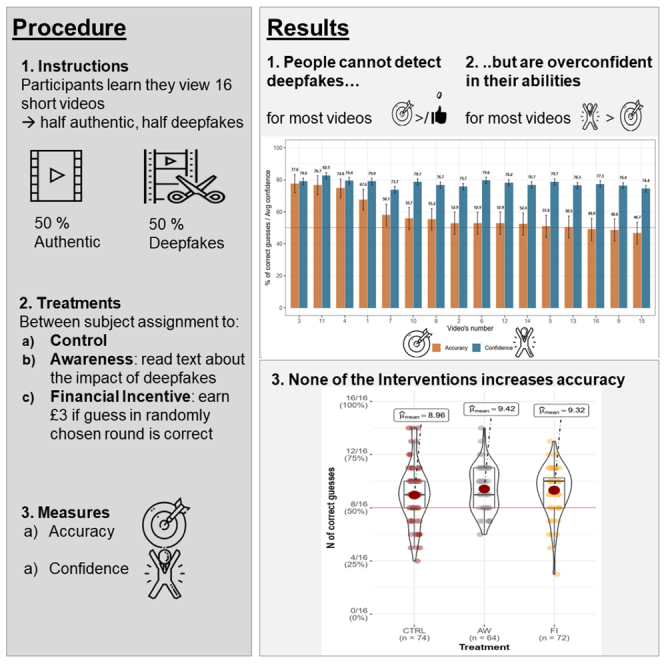
Hyper-realistic manipulation of audio-visual content, i.e., deepfakes, presents a new challenge for establishing veracity of online content. Research on the human impact of deepfakes, addressing both behaviors in response to and cognitive processing of deepfakes, remains sparse. In a pre-registered behavioral experiment ( N = 210), we show that (a) people cannot reliably detect deepfakes, and (b) neither raising awareness nor introducing financial incentives improves their detection accuracy. Zeroing in on the underlying cognitive processes, we find that (c) people are biased towards mistaking deepfakes as authentic videos (rather than vice versa) and (d) overestimate their own detection abilities. Together, these results suggest that people adopt a ``seeing-is-believing'' heuristic for deepfake detection while being overconfident in their (low) detection abilities. The combination renders people particularly susceptible to be influenced by inauthentic deepfake content.
Overview
Integrity signals
Registry
Cites
Statistics
Figures


Verification
Claims the paper makes
Claims other papers make about this one
Each is checked against this paper’s own text: does it say what the citing paper says it does?
In the citing paper
“and are hard for people to distinguish, as shown in studies in the USA, UK, and Netherlands (Dobber et al., 2020; Vaccari and Chadwick, 2020; Köbis et al., 2021; Nightingale and Farid, 2022).”
From On manipulation by emotional AI: UK adults’ views and governance implications (2024) · cites this paper as Köbis et al., 2021
In the citing paper
“studies that show that people are poor at recognizing deepfakes and false content online (Dobber et al., 2020; Vaccari and Chadwick, 2020; Köbis et al., 2021; Nightingale and Farid, 2022; Vaccari et al., 2022)”
From On manipulation by emotional AI: UK adults’ views and governance implications (2024) · cites this paper as Köbis et al., 2021
Citations
Cites
Generative adversarial networks
Goodfellow, I., Pouget-Abadie, J., Mirza, M., Xu, B., Warde-Farley, D., Ozair, S., Courville, A., & Bengio, Y. (2020) · Communications of the ACM · doi:10.1145/3422622 · Cited by 18,384
(2011) · Cited by 14,317
The spread of true and false news online
Vosoughi, S., Roy, D., & Aral, S. (2018) · Science · doi:10.1126/science.aap9559 · Cited by 8,847
Illusion and well‐being: A social psychological perspective on mental health
Taylor, S. E., & Brown, J. D. (1988) · Psychological Bulletin · doi:10.1037/0033-2909.103.2.193 · Cited by 7,814
Kruger, J., & Dunning, D. (1999) · Journal of Personality and Social Psychology · doi:10.1037/0022-3514.77.6.1121 · Cited by 7,731
(2018) · Cited by 3,510
FaceForensics++: Learning to Detect Manipulated Facial Images
Rossler, A., Cozzolino, D., Verdoliva, L., Riess, C., Thies, J., & Niessner, M. (2019) · 2019 IEEE/CVF International Conference on Computer Vision (ICCV) · doi:10.1109/iccv.2019.00009 · Cited by 3,314
Beyond the Turk: Alternative platforms for crowdsourcing behavioral research
Peer, E., Brandimarte, L., Samat, S., & Acquisti, A. (2017) · Journal of Experimental Social Psychology · doi:10.1016/j.jesp.2017.01.006 · Cited by 2,957
The trouble with overconfidence.
Moore, D. A., & Healy, P. J. (2008) · Psychological Review · doi:10.1037/0033-295x.115.2.502 · Cited by 2,358
MesoNet: a Compact Facial Video Forgery Detection Network
Afchar, D., Nozick, V., Yamagishi, J., & Echizen, I. (2018) · 2018 IEEE International Workshop on Information Forensics and Security (WIFS) · doi:10.1109/wifs.2018.8630761 · Cited by 1,872
Cited by
Items 101–192 of 192
Tulga, A. Y. (2025) · EDPACS · doi:10.1080/07366981.2025.2564783 · Cited by 3
Oesterreich, K. C. N., Fysh, M. C., & Bindemann, M. (2025) · Perception · doi:10.1177/03010066251379016 · Cited by 2
Detection of GenAI-Generated Faces Using a Customized Residual Network Model
Rout, J., Sathua, M., Soni, A., & Nanda, S. K. (2025) · IEEE Silchar Subsection Conference (SILCON) · doi:10.1109/silcon67893.2025.11327204 · Cited by 2
Wolf, E., Samaradivakara, Y., Gokhale, O., Ahmed, S., Wang, Y., Pataranutaporn, P., & Maes, P. (2026) · CHI Conference Extended Abstracts on Human Factors in Computing Systems (CHI EA) · doi:10.1145/3772363.3798358 · Cited by 2
Jin, X., Wang, G., Zhang, Z., Zhou, W., Yu, N., Gao, B., & Gao, S. (2025) · Information Communication & Society · doi:10.1080/1369118x.2025.2496902 · Cited by 11
Generative Artificial Intelligence as Creative Artificial Intelligence
Appel, M., Messingschlager, T. V., Raffloer, G., & Reed, P. A. (2025) · Oxford University Press eBooks · doi:10.1093/oxfordhb/9780197689875.013.0016 · Cited by 2
Seeing is Believing: The Continued Influence of a Known AI-Generated 'Deepfake' VideoPreprint
Clark, S. P., & Lewandowsky, S. (2024) · doi:10.31234/osf.io/t7jfk · Cited by 2
Tokens of Reality: On the Prospective Nature of Virtual Consciousness
Hancock, P. A. (2024) · PRESENCE Virtual and Augmented Reality · doi:10.1162/pres_a_00436 · Cited by 1
Zegarow, P., & Bartuzi-Trokielewicz, E. (2024) · Applied Cybersecurity & Internet Governance · doi:10.60097/acig/201147 · Cited by 5
Chen, C., & Goh, D. H. (2025) · Communications in computer and information science · doi:10.1007/978-3-031-94153-5_16 · Cited by 4
Deepfakes y violencia de género digital. Una respuesta penal incierta
Pena, A. M. N. (2025) · Estudios Penales y Criminológicos · doi:10.15304/epc.46.10259 · Cited by 5
How hedonic and utilitarian generative AI shape ethical decision-making: neural insights
Li, M., Wan, Y., Zhou, L.-F., & Rao, H. (2025) · Behaviour and Information Technology · doi:10.1080/0144929x.2025.2573430 · Cited by 4
The Role of Self‐Efficacy, Critical Thinking, and Media Literacy in Human Deepfake Video Detection
Chen, C., & Goh, D. H. (2025) · Proceedings of the Association for Information Science and Technology · doi:10.1002/pra2.1310 · Cited by 5
Levesque, J. (2025) · Journal of Human Trafficking · doi:10.1080/23322705.2025.2572911 · Cited by 3
Fullwood, B., & Monrose, F. (2025) · ACM Workshop on Artificial Intelligence and Security (AISec) · doi:10.1145/3733799.3762979 · Cited by 2
An Analysis of Deep Fake Technology, Including Pros, Cons, and Use Cases
Devi, K. Y., Anusha, P., Chary, P. D., Kumar, Y. R., Jyothsna, K., & Srivani, N. (2025) · IEEE International Conference on Advanced Computing Technologies (ICACT) · doi:10.1109/icact67549.2025.11351382 · Cited by 1
Deepfakes: Threats and Media Impact
Seibert, D., Godulla, A., & Hoffmann, C. P. (2026) · Future of business and finance · doi:10.1007/978-3-032-07605-2_18 · Cited by 1
Davydov, S. G., Matveeva, N. N., & Saponova, A. V. (2025) · Moscow University Journalism Bulletin · doi:10.55959/msu.vestnik.journ.5.2025.5478 · Cited by 3
Aghbari, A. A., Aman, W., Tarhini, A., & Iqbal, W. (2026) · Social Sciences & Humanities Open · doi:10.1016/j.ssaho.2026.102772 · Cited by 3
Seeing, Hearing, and Knowing Together: Multimodal Strategies in Deepfake Videos Detection
Chen, C., & Goh, D. H. (2026) · CHI Conference on Human Factors in Computing Systems · doi:10.1145/3772318.3790480 · Cited by 2
Imagining the city: Evaluating visual realism and identity in AI-generated cityscapes using DALL·E 2
Kim, J., Jain, N., Jang, K. M., & Ye, X. (2026) · Technology in Society · doi:10.1016/j.techsoc.2026.103360 · Cited by 1
Through the eyes of seniors: Uncovering strategies for identifying deepfakes
Huang, S., Chun, R. W., Goh, D. H., & Lee, C. S. (2026) · Journal of Information Science · doi:10.1177/01655515261458163 · Cited by 1
Critical and systems thinking to address climate change: validation of the CSTS scale
Rodríguez, U. P., Rial, M. A. L., Vega-Marcote, P., & Varela-Losada, M. (2026) · International Journal of Sustainability in Higher Education · doi:10.1108/ijshe-03-2026-0498 · Cited by 1
Securing Digital Media in the Age of AI and Deepfakes: A Hardware-Based Solution
Sisson, E. S., & Puckett, S. C. (2025) · IEEE SoutheastCon · doi:10.1109/southeastcon56624.2025.10971593 · Cited by 1
Agnellini, F. (2025) · The Conversation · doi:10.64628/aai.hq7x5xseg · Cited by 1
Sytsma, T., Marrone, J., Shenk, A., Leonard, G., Grek, L., & Steier, J. (2024) · RAND Corporation eBooks · doi:10.7249/rra2533-1
Steffes, B., & Zichler, A. (2024) · Datenschutz und Datensicherheit - DuD · doi:10.1007/s11623-023-1899-1 · Cited by 2
Deepfakes in InterrogationsPreprint
Logan, W. A. (2024) · SSRN Electronic Journal · doi:10.2139/ssrn.4969898
Güncel Deepfake Video Algılama Yöntemleri Üzerine Bir Literatür İncelemesi
Aydın, S., & Özen, Z. (2024) · Bilgisayar bilimleri ve mühendisliği dergisi. · doi:10.54525/bbmd.1460699
Assessing the Believability of Deepfake Ads in the Indian Market
Menon, V. A., & Gupta, A. (2024) · Advances in business information systems and analytics book series · doi:10.4018/979-8-3693-6890-9.ch003
أثر برامج التربية الإعلامية الرقمية في تعزيز وعي المراهقين بالتزييف المرئي العميق
عبدالحليم, م. م. م. (2025) · Al-Maǧallah Al-Miṣriyyaẗ Li-Buḥūṯ Al-Rāʼī Al-ʿām · doi:10.21608/joa.2025.403543
Hoffmann, C. P., Bitton, D. B., & Godulla, A. (2025) · Social Science Computer Review · doi:10.1177/08944393251354977 · Cited by 5
Generative AI and Deepfakes: Challenges to Epistemic Justice and Comprehensive Regulations
Deng, Y. (2025) · AMINTAPHIL · doi:10.1007/978-3-031-93783-5_11
From Common Sense to Sensing: The Trickster in the Digital Era
Erdős, M. B. (2025) · Springer eBooks · doi:10.1007/978-3-031-96007-9_4
EMERGING AI TECHNIQUES AND DISSEMINATION OF MISINFORMATION: A QUALITATIVE APPROACH
Gautam, R. (2024) · International Journal of Global Research Innovations & Technology (IJGRIT). · doi:10.62823/ijgrit/02.01.6270
Lee, S. S., Jang, T.-Y., & Kwon, Y.-S. (2025) · SSRN Electronic Journal · doi:10.2139/ssrn.5572706
Abrahams, T., & Snyman, D. P. (2025) · IFIP advances in information and communication technology · doi:10.1007/978-3-032-02504-3_4
Deepfakes, investor vulnerability and trust erosion: evidence from the Czech Republic
Moravec, V., Gavurová, B., & Rigelský, M. (2025) · The Journal of Risk Finance · doi:10.1108/jrf-07-2025-0337 · Cited by 1
Karalność tworzenia i rozpowszechniania fałszywych treści pornograficznych deepfake
Głuchowski, M. (2023) · Czasopismo Prawa Karnego i Nauk Penalnych · doi:10.60677/cpkinp2023.4.1 · Cited by 2
Dupuis, M., Sung, H., & Long, S. (2025) · IEEE Annual Ubiquitous Computing, Electronics & Mobile Communication Conference (UEMCON) · doi:10.1109/uemcon67449.2025.11267666 · Cited by 1
The Impact of Deepfake Technology on Elections and Democratic Trust
Raj, P. (2025) · Indian Journal of Law. · doi:10.36676/ijl.v3.i6.137 · Cited by 3
Teaching People to Spot Deepfakes: Investigating User Acceptance of LLM-Powered Chatbots
Chen, C., Goh, D. H., & Tang, Z. (2026) · International Journal of Human-Computer Interaction · doi:10.1080/10447318.2026.2622583 · Cited by 2
The Psychology of Deception: Why We Believe Deepfakes
Plohl, N., Smrke, U., Aquilino, L., & Mlakar, I. (2026) · doi:10.18690/um.feri.2.2026.4 · Cited by 1
García-Marín, D., Sánchez, A. N., & Martinrey, G. S. (2026) · VISUAL REVIEW International Visual Culture Review / Revista Internacional de Cultura Visual · doi:10.62161/revvisual.v18.6137
Deepfakes como actos comunicativos: desafíos éticos sobre consentimiento y privacidad
Balmaceda, T., Belli, L. F., & Pérez, D. I. (2026) · trilogía Ciencia Tecnología Sociedad · doi:10.22430/21457778.3684 · Cited by 1
An Analysis of the Human Ability to Detect Deepfakes With Geopolitical Content
Brienza, M., Golotta, M., Romano, M., Nardi, D., & Bloisi, D. D. (2026) · IEEE Transactions on Computational Social Systems · doi:10.1109/tcss.2026.3667623
A Systematic Literature Review on How Cybercriminals Are Utilizing Deepfakes to Conduct Cyberattacks
James, E. C., Bongiovanni, I., Glencross, M., & Brace, L. (2026) · Digital Threats Research and Practice · doi:10.1145/3801545 · Cited by 4
Talukder, M. U. (2026) · Child & Youth Services · doi:10.1080/0145935x.2026.2653659
Timing Matters: Designing Effective Corrections for Short-Form Video Misinformation
Gunasekara, S., Sew, C., Pareek, S., Kelly, R., Kostakos, V., & Gonçalves, J. (2026) · CHI Conference on Human Factors in Computing Systems · doi:10.1145/3772318.3790560 · Cited by 1
Fatima, K., Wu, Y. K., & Uzun, E. (2026) · CHI Conference on Human Factors in Computing Systems · doi:10.1145/3772318.3791799 · Cited by 2
Illusions of Understanding from Outsourcing Thinking to LLMs
Cruz, N. (2026) · Computational Brain & Behavior · doi:10.1007/s42113-026-00288-6 · Cited by 2
Swapped faces, swayed beliefs: How deepfakes affect trust in data videos with human narrators
Lan, X., Wang, X., & Tian, X. (2026) · Visual Informatics · doi:10.1016/j.visinf.2026.100326
“@?”: Authorship and Newsroom Image Crediting Practices on Instagram
Scott, A., & Lough, K. (2026) · Journalism Practice · doi:10.1080/17512786.2026.2674682 · Cited by 1
Tang, W. K.-W., Lau, C., & Zhang, A. (2026) · Journalism and Media · doi:10.3390/journalmedia7020109
Forming the Ability of Recognition of Faces in AI-Generated Photos
Vasileva, I. V., Asafova, A. N., & Grischenko, D. S. (2026) · Psychological Sciences · doi:10.18384/3033-6414-2026-2-92-104
We Are Equally Vulnerable? An Examination of the Third-Person Effect in AI-Generated Misinformation
Fu, B., & Li, X. (2026) · Social Media + Society · doi:10.1177/20563051261452019
Almazroa, A., Alnoamani, W., Almuflih, M., Almanea, N., Alturki, J., Aljobailah, N., & Kurdi, H. A. (2026) · Procedia Computer Science · doi:10.1016/j.procs.2026.04.184
The Impact of User Awareness of AI-Generated Content on Perceived Credibility of Online Media
Jimenez, S. F. C. L. J. F. S., & Fernandez, J. R. E. (2026) · International Journal of Advanced Research in Science Communication and Technology · doi:10.48175/ijarsct-36213
Almaimani, M., Li, X., Kider, J. T., Volonte, M., & Patterson, E. K. (2026) · Computer Animation and Virtual Worlds · doi:10.1002/cav.70150
Deceptive intentions: AI-propaganda use and reach in the 2024 U.S. Presidential Election
Tiberghien, A., Dalton, J., McLean, W., Joshi, D., & Navarro, J. N. (2026) · International Journal of Police Science & Management · doi:10.1177/14613557261447753
Bradley, A. F., & Marín, M. D. M. P. (2026) · AI-Linguistica Linguistic Studies on AI-Generated Texts and Discourses · doi:10.62408/ai-ling.v4i1.39
Remembering the Disease behind the Symptoms – the Oligarchical Causes of Democratic Backsliding
Heidemann, K. (2026) · International Journal of Politics Culture and Society · doi:10.1007/s10767-026-09585-1 · Cited by 1
Case Study: Quantum-Cognitive Neural Networks for Next-Generation Defence
Maksymov, I. S. (2026) · Springer eBooks · doi:10.1007/978-3-032-25965-3_8
AI literacy research topic mining and evolution analysis using the BERTopic model
Xu, H., Cheng, Y., Feng, Y., Lin, C., & Teng, G. (2026) · Journal of Information Science · doi:10.1177/01655515261459058
Gasparello, G. G., Tirkkonen, O., Campos, L. A., & Tanaka, O. M. (2026) · Clinical Oral Investigations · doi:10.1007/s00784-026-07020-5
Nicholson, J. (2026) · Springer eBooks · doi:10.1007/978-3-031-52643-5_176-1
Villacura-Herrera, C., Zaal, F. T. J. M., & Cox, R. F. A. (2026) · Computers in Human Behavior Reports · doi:10.1016/j.chbr.2026.101221
Shepherd, L., Sopina, D., Dawson, J., Brown, G., & Paterson, J. (2026) · Sex Roles · doi:10.1007/s11199-026-01677-8 · Cited by 2
Gomez, H. (2026) · VISUAL REVIEW International Visual Culture Review / Revista Internacional de Cultura Visual · doi:10.62161/revvisual.v18.6396
Facial Region Analysis and Interpretability in Deepfake Detection: Advances and Open Challenges
Saraogi, A., & Chandra (2026) · IEEE Global Symposium on Emerging and Communication Technologies (GSEACT) · doi:10.1109/gseact68539.2026.11620416
When Human Judgment Meets Artificial Intelligence: Redefining Financial Fraud and Personal Defence
Qian, J. (2026) · Sustainable finance · doi:10.1007/978-3-032-29188-2_6
Journalism in the Shadows: AI Deepfakes, Credibility, and the Fragility of Media Trust
Okocha, M. U. (2026) · Journalism Practice · doi:10.1080/17512786.2026.2719552 · Cited by 1
Kalivoshka, N. (2026) · Universal Library of business and economics. · doi:10.70315/uloap.ulbec.2026.0301018
Aragón, M. D. M. M. (2026) · Oñati Socio-legal Series · doi:10.35295/osls.iisl.2793
Managing threats from emerging technologies in emergency contexts
Neylan, J., Patel, D. S. S., Lenk, T., & Erickson, T. B. (2026) · Journal of Emergency Management · doi:10.5055/jem.1020
Manhede, T., Fartachuk, Y., Martinez, S. A., Langer, A., & Chein, J. M. (2026) · AI & Society · doi:10.1007/s00146-026-03373-3
Is It Real or AI? How Digital Natives Identify AI-Generated Images
Brysch, A. A., Chvirova, D., Keller, R., Rebholz, D., & Rudman, J. (2026) · Springer proceedings in business and economics · doi:10.1007/978-3-032-23925-9_9
Presumption of generation: neural network paranoia and the crisis of trust in political content
Сергеевич, С. Н. (2026) · THE KAZAN SOCIALLY-HUMANITARIAN BULLETIN · doi:10.26907/2079-5912.2026.3.111-121
Impact of AI Deepfake Awareness on Trust and Perceived Reputational Risk in Multinational Banks
Sandy, C. A. N., Laurdian, M. C., & Mulyadin, T. (2026) · International Conference on ICT for Smart Society (ICISS) · doi:10.1109/iciss71466.2026.11715166
Lee, J., Kim, S., Lee, H., & Hwang, J. (2026) · International Journal of Human-Computer Interaction · doi:10.1080/10447318.2026.2740422
Seeing Is Believing? Most People Struggle to Detect AI-Generated Images
Hove, M. F., Hjorth, F., Golovchenko, Y., Adler‐Nissen, R., Bechmann, A., van Dalen, A., HOBOLT, S. B., & de Vreese, C. H. (2026) · Social Media + Society · doi:10.1177/20563051261483376
Meykola1, K. G., Taheri, R., Ellingsen, A., Dadgostari, F., Clark, J., & Nazemi, N. (2026) · Research Square · doi:10.21203/rs.3.rs-11013514/v1
“He Put Too Much Pressure on Me”: Pressure and Urgency in Synthetic Voice Deception
Amirkhani, S., Agyemang, A. N., Larty, D. A., Boateng, D. T., Alizadeh, F., Boden, A., & Stevens, G. (2026) · International Conference on Human-Computer Interaction with Mobile Devices and Services (MobileHCI) · doi:10.1145/3821581.3833108
Moore, R. C., & Hancock, J. T. (2026) · Perspectives on Psychological Science · doi:10.1177/17456916261475589
Why No One Has Implemented the Turing Test: Identifying Turing’s Design and Putting it into Practice
Proudfoot, D., Temtsin, S., & Bartneck, C. (2026) · Philosophy of Science · doi:10.1017/psa.2026.10282
Kumar, R. (2026) · Journal of Information Technology & Politics · doi:10.1080/19331681.2026.2747165
Revathi, P., & Sivajothi, E. (2026) · International Conference on Networks, Computers and Communications (ICNCCom) · doi:10.1109/icnccom69117.2026.11736304
Museum of Fake: An AR Escape Room Improves Adolescents' Recognition of Visual Manipulation
Paraschivoiu, I., Layer-Wagner, T., Arzt, B., & Hoffmann, T. (2026) · Annual Symposium on Computer-Human Interaction in Play · doi:10.1145/3800965.3834300
Djanggih, H. (2026) · Research Square · doi:10.21203/rs.3.rs-11460998/v1
Santoso, A., & Nogami, Y. (2026) · Electronics · doi:10.3390/electronics15214903
Deepfake or Real? How Political Alignment and Believability Influence Reporting on Social Media
冯敏绮, Lioliou, E., Dickert, S., & Panzarasa, P. (2026) · Information Systems Frontiers · doi:10.1007/s10796-026-10833-0
Metadata
- Authors
- Köbis, N., Doležalová, B., & Soraperra, I.
- Affiliations
- Max Planck Institute for Human Development (DE)
- University of Amsterdam (NL)
- Corresponding author
- Köbis, Nils
- Venue
- iScience
- Publisher
- Elsevier BV
- Published
- 2021
- Volume
- 24
- Issue
- 11
- Pages
- 103364-103364
- ISSN
- 2589-0042 (ISSN-L)
- PMC
- PMC8602050
- OpenAlex
- W3208526032
- Cited by
- 194
- References
- 63
- Citations by year
- 2026: 64 · 2025: 48 · 2024: 48 · 2023: 23 · 2022: 11
- FWCI
- 28.45
- Type
- journal article
- Language
- en
- Open access
- gold
- doi.org
- Licence
- cc-by-nc-nd
- Locations
- iScience (publishedVersion, cc-by-nc-nd)
- SSRN Electronic Journal (acceptedVersion)
- PubMed Central (publishedVersion, cc-by-nc-nd)
- PubMed (publishedVersion)
- UvA-DARE (University of Amsterdam) (publishedVersion, cc-by-nc-nd)
- Data Archiving and Networked Services (DANS) (submittedVersion, other-oa)
- DOAJ (DOAJ: Directory of Open Access Journals) (submittedVersion, cc-by-sa)
- Funders
- Universiteit van Amsterdam (202006110906)
- Max-Planck-Institut für Bildungsforschung
- Toulouse School of Economics
- Topics
- Social Sciences › Sociology and Political Science › Misinformation and Its Impacts
- Physical Sciences › Computer Science › Computer Vision and Pattern Recognition › Digital Media Forensic Detection
- Social Sciences › Psychology › Social Psychology › Deception detection and forensic psychology
- Keywords
- deepfakes, deepfake detection, misinformation, overconfidence, belief bias, awareness intervention, financial incentives
About these checks
Registry, retraction, Cites and statistics results are computed, not judged, with one exception: a printed reference that no index lists is read once by a model before it counts as a citation error. Claims are extracted by a model and kept only when their quote appears verbatim in the text; each cited source is then checked, with a model’s help, for whether it says what the claim relies on. Those verdicts can be wrong — read the claim’s quote and the cited source before relying on one.
Statistics and arithmetic are recomputed, not judged.
Confidence bands are shown only for fields calibrated on our annotated test set. None is calibrated yet, so no band is shown.
What counts as a claim ›How we measure confidence ›How we check this ›
Are you an author, or do you see a problem with this page? Request a review
Data sources
Bibliographic data: Semantic Scholar, OpenAlex, Crossref.
Contains information from the Semantic Scholar Academic Graph Datasets, made available under the ODC Attribution License (ODC-BY 1.0).
Semantic Scholar’s data is described in: Kinney, R., et al. (2023). The Semantic Scholar Open Data Platform. arXiv:2301.10140.
