

The DOI matches its Crossref record; 59 of the 63 references it cites were found in a registry or an index.
Fooled Twice – People Cannot Detect Deepfakes But Think They Can
Open accessAbstract
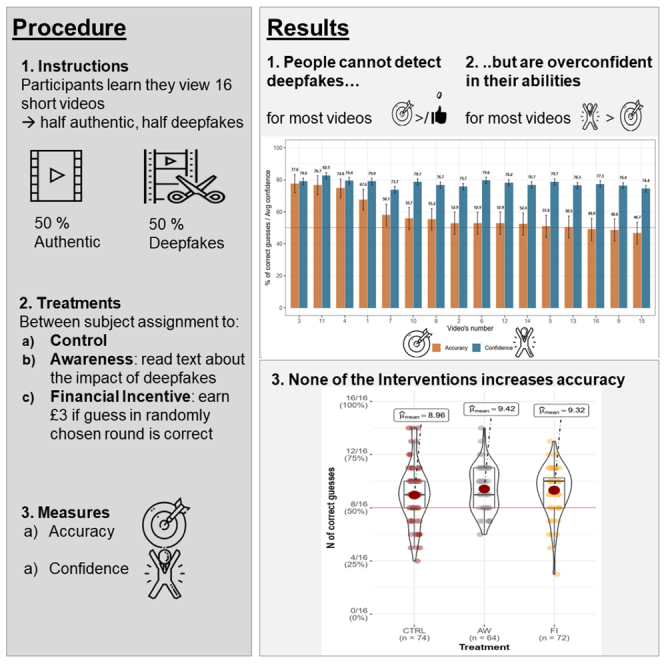
Hyper-realistic manipulation of audio-visual content, i.e., deepfakes, presents a new challenge for establishing veracity of online content. Research on the human impact of deepfakes, addressing both behaviors in response to and cognitive processing of deepfakes, remains sparse. In a pre-registered behavioral experiment ( N = 210), we show that (a) people cannot reliably detect deepfakes, and (b) neither raising awareness nor introducing financial incentives improves their detection accuracy. Zeroing in on the underlying cognitive processes, we find that (c) people are biased towards mistaking deepfakes as authentic videos (rather than vice versa) and (d) overestimate their own detection abilities. Together, these results suggest that people adopt a ``seeing-is-believing'' heuristic for deepfake detection while being overconfident in their (low) detection abilities. The combination renders people particularly susceptible to be influenced by inauthentic deepfake content.
Overview
Integrity signals
Registry
Cites
Statistics
Figures


Verification
Claims the paper makes
Claims other papers make about this one
Each is checked against this paper’s own text: does it say what the citing paper says it does?
In the citing paper
“and are hard for people to distinguish, as shown in studies in the USA, UK, and Netherlands (Dobber et al., 2020; Vaccari and Chadwick, 2020; Köbis et al., 2021; Nightingale and Farid, 2022).”
From On manipulation by emotional AI: UK adults’ views and governance implications (2024) · cites this paper as Köbis et al., 2021
In the citing paper
“studies that show that people are poor at recognizing deepfakes and false content online (Dobber et al., 2020; Vaccari and Chadwick, 2020; Köbis et al., 2021; Nightingale and Farid, 2022; Vaccari et al., 2022)”
From On manipulation by emotional AI: UK adults’ views and governance implications (2024) · cites this paper as Köbis et al., 2021
Citations
Cites
Generative adversarial networks
Goodfellow, I., Pouget-Abadie, J., Mirza, M., Xu, B., Warde-Farley, D., Ozair, S., Courville, A., & Bengio, Y. (2020) · Communications of the ACM · doi:10.1145/3422622 · Cited by 18,384
(2011) · Cited by 14,317
The spread of true and false news online
Vosoughi, S., Roy, D., & Aral, S. (2018) · Science · doi:10.1126/science.aap9559 · Cited by 8,847
Illusion and well‐being: A social psychological perspective on mental health
Taylor, S. E., & Brown, J. D. (1988) · Psychological Bulletin · doi:10.1037/0033-2909.103.2.193 · Cited by 7,814
Kruger, J., & Dunning, D. (1999) · Journal of Personality and Social Psychology · doi:10.1037/0022-3514.77.6.1121 · Cited by 7,731
(2018) · Cited by 3,510
FaceForensics++: Learning to Detect Manipulated Facial Images
Rossler, A., Cozzolino, D., Verdoliva, L., Riess, C., Thies, J., & Niessner, M. (2019) · 2019 IEEE/CVF International Conference on Computer Vision (ICCV) · doi:10.1109/iccv.2019.00009 · Cited by 3,314
Beyond the Turk: Alternative platforms for crowdsourcing behavioral research
Peer, E., Brandimarte, L., Samat, S., & Acquisti, A. (2017) · Journal of Experimental Social Psychology · doi:10.1016/j.jesp.2017.01.006 · Cited by 2,957
The trouble with overconfidence.
Moore, D. A., & Healy, P. J. (2008) · Psychological Review · doi:10.1037/0033-295x.115.2.502 · Cited by 2,358
MesoNet: a Compact Facial Video Forgery Detection Network
Afchar, D., Nozick, V., Yamagishi, J., & Echizen, I. (2018) · 2018 IEEE International Workshop on Information Forensics and Security (WIFS) · doi:10.1109/wifs.2018.8630761 · Cited by 1,872
Cited by
A systematic review of AI literacy scales
Lintner, T. (2024) · npj Science of Learning · doi:10.1038/s41539-024-00264-4 · Cited by 292
Evaluating Large Language Models in Generating Synthetic HCI Research Data: a Case Study
Hämäläinen, P., Tavast, M., & Kunnari, A. (2023) · Proceedings of the 2023 CHI Conference on Human Factors in Computing Systems · doi:10.1145/3544548.3580688 · Cited by 248
Consumer Responses to AI-Generated Charitable Giving Ads
Arango, L., Singaraju, S. P., & Niininen, O. (2023) · Journal of Advertising · doi:10.1080/00913367.2023.2183285 · Cited by 243
Deepfakes: Deceptions, mitigations, and opportunities
Mustak, M., Salminen, J., Mäntymäki, M., Rahman, A., & Dwivedi, Y. K. (2023) · Journal of Business Research · doi:10.1016/j.jbusres.2022.113368 · Cited by 209
Abbas, F., & Taeihagh, A. (2024) · Expert Systems with Applications · doi:10.1016/j.eswa.2024.124260 · Cited by 184
Testing human ability to detect ‘deepfake’ images of human faces
Bray, S. D., Johnson, S. D., & Kleinberg, B. (2023) · Journal of Cybersecurity · doi:10.1093/cybsec/tyad011 · Cited by 96
The detection of political deepfakes
Appel, M., & Prietzel, F. (2022) · Journal of Computer-Mediated Communication · doi:10.1093/jcmc/zmac008 · Cited by 95
Narrative transportation: How stories shape how we see ourselves and the world
Green, M. C., & Appel, M. (2024) · Advances in experimental social psychology · doi:10.1016/bs.aesp.2024.03.002 · Cited by 190
Warning: Humans cannot reliably detect speech deepfakes
Mai, K. T., Bray, S., Davies, T., & Griffin, L. D. (2023) · PLOS ONE · doi:10.1371/journal.pone.0285333 · Cited by 98
Human detection of political speech deepfakes across transcripts, audio, and video
Groh, M., Sankaranarayanan, A., Singh, N., Kim, D. Y., Lippman, A., & Picard, R. (2024) · Nature Communications · doi:10.1038/s41467-024-51998-z · Cited by 89
Non-Consensual Synthetic Intimate Imagery: Prevalence, Attitudes, and Knowledge in 10 Countries
Umbach, R., Henry, N., Beard, G. F., & Berryessa, C. M. (2024) · Proceedings of the CHI Conference on Human Factors in Computing Systems · doi:10.1145/3613904.3642382 · Cited by 73
Human performance in detecting deepfakes: A systematic review and meta-analysis of 56 papers
Diel, A., Lalgi, T., Schröter, I. C., MacDorman, K. F., Teufel, M., & Bäuerle, A. (2024) · Computers in Human Behavior Reports · doi:10.1016/j.chbr.2024.100538 · Cited by 64
People are poorly equipped to detect AI-powered voice clones
Barrington, S., Cooper, E. A., & Farid, H. (2025) · Scientific Reports · doi:10.1038/s41598-025-94170-3 · Cited by 131
Nguyen, L.-T., Dang, T.-Q., & Đức, Đ. T. V. (2024) · Social Science Computer Review · doi:10.1177/08944393241258760 · Cited by 67
Li, M., & Wan, Y. (2023) · Internet Research · doi:10.1108/intr-07-2022-0561 · Cited by 65
Can you spot the bot? Identifying AI-generated writing in college essays
Waltzer, T., Pilegard, C., & Heyman, G. D. (2024) · International Journal for Educational Integrity · doi:10.1007/s40979-024-00158-3 · Cited by 49
Using deepfakes for experiments in the social sciences - A pilot study
Eberl, A., Kühn, J., & Wolbring, T. (2022) · Frontiers in Sociology · doi:10.3389/fsoc.2022.907199 · Cited by 48
Providing detection strategies to improve human detection of deepfakes: An experimental study
Somoray, K., & Miller, D. J. (2023) · Computers in Human Behavior · doi:10.1016/j.chb.2023.107917 · Cited by 47
Lu, H., & Chu, H. (2023) · Computers in Human Behavior · doi:10.1016/j.chb.2023.107761 · Cited by 52
Labeling AI-generated media online
Wittenberg, C., Epstein, Z., Péloquin-Skulski, G., Berinsky, A. J., & Rand, D. G. (2025) · PNAS Nexus · doi:10.1093/pnasnexus/pgaf170 · Cited by 85
Vasist, P. N., & Krishnan, S. (2022) · Internet Research · doi:10.1108/intr-06-2022-0465 · Cited by 49
Users’ emotional and behavioral responses to deepfake videos of K-pop idols
Wang, S., & Kim, S. (2022) · Computers in Human Behavior · doi:10.1016/j.chb.2022.107305 · Cited by 52
Labeling AI-Generated Content: Promises, Perils, and Future Directions
Wittenberg, C., Epstein, Z., Berinsky, A. J., & Rand, D. G. (2024) · An MIT Exploration of Generative AI · doi:10.21428/e4baedd9.0319e3a6 · Cited by 73
Chein, J. M., Martinez, S. A., & Barone, A. R. (2024) · Scientific Reports · doi:10.1038/s41598-024-76218-y · Cited by 38
On manipulation by emotional AI: UK adults’ views and governance implications
Bakir, V., Laffer, A., McStay, A., Miranda, D., & Urquhart, L. (2024) · Frontiers in Sociology · doi:10.3389/fsoc.2024.1339834 · Cited by 34
Misinformed by images: How images influence perceptions of truth and what can be done about it
Newman, E. J., & Schwarz, N. (2023) · Current Opinion in Psychology · doi:10.1016/j.copsyc.2023.101778 · Cited by 71
Multimodal Forgery Detection Using Ensemble Learning
Hashmi, A., Shahzad, S. A., Ahmad, W., Lin, C. W., Tsao, Y., & Wang, H.-M. (2022) · 2022 Asia-Pacific Signal and Information Processing Association Annual Summit and Conference (APSIPA ASC) · doi:10.23919/apsipaasc55919.2022.9980255 · Cited by 32
As Good as a Coin Toss: Human Detection of AI-Generated Content
Cooke, D., Edwards, A., Barkoff, S., & Kelly, K. (2025) · Communications of the ACM · doi:10.1145/3729417 · Cited by 106
Perception and deception: Exploring individual responses to deepfakes across different modalities
Ahmed, S., & Chua, H. W. (2023) · Heliyon · doi:10.1016/j.heliyon.2023.e20383 · Cited by 29
Mumuni, F., & Mumuni, A. (2023) · Cognitive Systems Research · doi:10.1016/j.cogsys.2023.101188 · Cited by 40
Powers, G., Johnson, J. P., & Killian, G. (2023) · Journal of Interactive Advertising · doi:10.1080/15252019.2023.2260399 · Cited by 41
Possible Health Benefits and Risks of DeepFake Videos: A Qualitative Study in Nursing Students
Martínez, O. N., Fernández, D., Monteagudo, N. C., & Rincón, O. F. (2024) · Nursing Reports · doi:10.3390/nursrep14040203 · Cited by 33
Beyond A Reasonable Doubt? Audiovisual Evidence, AI Manipulation, Deepfakes, and the Law
Apolo, Y. M., & Michael, K. (2024) · IEEE Transactions on Technology and Society · doi:10.1109/tts.2024.3427816 · Cited by 47
Kaate, I., Salminen, J. O., Jung, S., Almerekhi, H., & Jansen, B. J. J. (2023) · Biannual Conference of the Italian SIGCHI Chapter (CHItaly) · doi:10.1145/3605390.3605397 · Cited by 44
The New Paradigm of Deepfake Detection at the Text Level
Roșca, C.-M., Stancu, A., & Iovanovici, E. M. (2025) · Applied Sciences · doi:10.3390/app15052560 · Cited by 34
Purcell, Z. A., Dong, M., Nußberger, A.-M., Köbis, N., & Jakesch, M. (2024) · British Journal of Psychology · doi:10.1111/bjop.12727 · Cited by 47
Self-citationDelfino, R. (2022) · SSRN Electronic Journal · doi:10.2139/ssrn.4032094 · Cited by 21
The continued influence of AI-generated deepfake videos despite transparency warnings
Clark, S. P., & Lewandowsky, S. (2026) · Communications Psychology · doi:10.1038/s44271-025-00381-9 · Cited by 40
Ng, Y.-L. (2023) · Current Psychology · doi:10.1007/s12144-022-03621-x · Cited by 19
Kaate, I., Salminen, J. O., Santos, J. M., Jung, S., Almerekhi, H., & Jansen, B. J. J. (2023) · Computers in Human Behavior Artificial Humans · doi:10.1016/j.chbah.2023.100031 · Cited by 31
Human Performance in Deepfake Detection: A Systematic Review
Somoray, K., Miller, D. J., & Holmes, M. (2025) · Human Behavior and Emerging Technologies · doi:10.1155/hbe2/1833228 · Cited by 19
Confidence as a metacognitive contributor to and consequence of misinformation experiences
Rapp, D. N., & Withall, M. M. (2024) · Current Opinion in Psychology · doi:10.1016/j.copsyc.2023.101735 · Cited by 17
What You See Is Not What You Know: Studying Deception in Deepfake Video Manipulation
Allen, C., Payne, B. R., Abegaz, T. T., & Robertson, C. L. (2023) · Journal of Cybersecurity Education Research and Practice · doi:10.32727/8.2023.25 · Cited by 18
Preu, E., Jackson, M., & Choudhury, N. (2022) · IEEE Annual Ubiquitous Computing, Electronics & Mobile Communication Conference (UEMCON) · doi:10.1109/uemcon54665.2022.9965697 · Cited by 28
Deepfakes: Vehicles for Radicalization, Not Persuasion
Nieweglowska, M., Stellato, C., & Sloman, S. A. (2023) · Current Directions in Psychological Science · doi:10.1177/09637214231161321 · Cited by 16
Adjusting news accuracy perceptions after deepfakes exposure: Evidence from a non-Western context
Ahmed, S., Wang, Y., & Bee, A. W. T. (2023) · Telematics and Informatics · doi:10.1016/j.tele.2023.102047 · Cited by 20
Ahmed, S., Bee, A. W. T., Masood, M., & Wei, T. H. (2024) · Telematics and Informatics · doi:10.1016/j.tele.2024.102123 · Cited by 19
Lie detection algorithms disrupt the social dynamics of accusation behavior
von Schenk, A., Klockmann, V., Bonnefon, J.-F., Rahwan, I., & Köbis, N. (2024) · iScience · doi:10.1016/j.isci.2024.110201 · Cited by 19
Self-citationNeyazi, T. A., Nadaf, A. H., Tan, K. E., & Schroeder, R. (2024) · Government Information Quarterly · doi:10.1016/j.giq.2024.101980 · Cited by 26
Deepfakes and Society: What Lies Ahead?
Gamage, D., Chen, J., Ghasiya, P., & Sasahara, K. (2022) · Studies in Autonomic, Data-driven and Industrial Computing · doi:10.1007/978-981-19-1524-6_1 · Cited by 14
Deepfake Detection in Video and Audio Clips: A Comprehensive Survey and Analysis
Jbara, W. A., Hussein, N. A.-H. K., & Soud, J. H. (2024) · Mesopotamian Journal of CyberSecurity · doi:10.58496/mjcs/2024/025 · Cited by 21
Partial Fake Speech Attacks in the Real World Using Deepfake Audio
AlAli, A., & Theodorakopoulos, G. (2025) · Journal of Cybersecurity and Privacy · doi:10.3390/jcp5010006 · Cited by 38
False failures, real distrust: the impact of an infrastructure failure deepfake on government trust
Ahmed, S., Masood, M., Bee, A. W. T., & Ichikawa, K. (2025) · Frontiers in Psychology · doi:10.3389/fpsyg.2025.1574840 · Cited by 25
Artificial Intelligence Physician Avatars for Patient Education: A Pilot Study
Haider, S. A., Prabha, S., Gomez-Cabello, C. A., Genovese, A., Collaço, B. G., Wood, N. G., Lifson, M. A., Bagaria, S. P., Tao, C., & Forte, A. J. (2025) · Journal of Clinical Medicine · doi:10.3390/jcm14238595 · Cited by 18
A comprehensive study on multimedia DeepFakes
Boutadjine, A., Harrag, F., Shaalan, K. F., & Karboua, S. (2023) · International Conference on Advances in Electronics, Control and Communication Systems (ICAECCS) · doi:10.1109/icaeccs56710.2023.10104814 · Cited by 17
Can deepfakes be used to study emotion perception? A comparison of dynamic face stimuli
Becker, C., Conduit, R., Chouinard, P. A., & Laycock, R. (2024) · Behavior Research Methods · doi:10.3758/s13428-024-02443-y · Cited by 20
Manipulating faces for identity theft via morphing and deepfake: Digital privacy
Agarwal, A., & Ratha, N. (2023) · Handbook of statistics · doi:10.1016/bs.host.2022.12.003 · Cited by 18
Marten, P. L., & Stadtler, M. (2024) · Computers in Human Behavior · doi:10.1016/j.chb.2024.108548 · Cited by 21
Can deepfakes manipulate us? Assessing the evidence via a critical scoping review
Ching, D., Twomey, J., Aylett, M. P., Quayle, M., Linehan, C., & Murphy, G. (2025) · PLoS ONE · doi:10.1371/journal.pone.0320124 · Cited by 27
Online safety regulation of deepfake abuse: a case study on Australia’s eSafety Commissioner
Martin, N. (2025) · Griffith Law Review · doi:10.1080/10383441.2025.2504791 · Cited by 14
Зарубежный опыт правового регулирования технологии «дипфейк»
Виноградов, В., & Kuznetsova, D. V. (2024) · Law Journal of the Higher School of Economics · doi:10.17323/2072-8166.2024.2.215.240 · Cited by 11
Understanding strategies employed by seniors in identifying deepfakes
Tang, Z., Goh, D. H., Lee, C. S., & Yang, Y. (2024) · Aslib Journal of Information Management · doi:10.1108/ajim-03-2024-0255 · Cited by 13
Pramod, D., Patil, K. P., & Bharathi, S. V. (2025) · Cogent Business & Management · doi:10.1080/23311975.2025.2461239 · Cited by 17
Shahzad, S. A., Hashmi, A., Peng, Y., Tsao, Y., & Wang, H. (2025) · IEEE Transactions on Human-Machine Systems · doi:10.1109/thms.2025.3618409 · Cited by 31
Unmasking Illusions: Understanding Human Perception of Audiovisual DeepfakesPreprint
Hashmi, A., Shahzad, S. A., Lin, C., Tsao, Y., & Wang, H. (2024) · doi:10.36227/techrxiv.171560542.29368554/v1 · Cited by 35
Plohl, N., Mlakar, I., Aquilino, L., Bisconti, P., & Smrke, U. (2025) · International Journal of Human–Computer Interaction · doi:10.1080/10447318.2024.2384821 · Cited by 9
Dark sides of deepfake technology
Veljković, S., Ćurčić, M., & Gavrilović, I. (2024) · Vojnotehnicki glasnik · doi:10.5937/vojtehg72-49630 · Cited by 11
Caci, B., Giordano, G., Alesi, M., Gentile, A., Agnello, C., Presti, L. L., Cascia, M. L., Ingoglia, S., Inguglia, C., Volpes, A., et al. (2024) · PLoS ONE · doi:10.1371/journal.pone.0313605 · Cited by 16
MacKenzie, W. I., Weber, R. P., Barr, H. M., Lanius, C. L., & Tenhundfeld, N. L. (2025) · International Journal of Human-Computer Interaction · doi:10.1080/10447318.2025.2466068 · Cited by 13
Deepfake Technology and Gender-Based Violence: A Scoping Review
Lazard, L., Capdevila, R., Turley, E. L., Gilfoyle, K., & Stavropoulou, N. (2025) · Trauma Violence & Abuse · doi:10.1177/15248380251384271 · Cited by 30
Conclusion: Misinformation and AI—How Algorithms Generate and Manipulate Misinformation
Shin, D. (2024) · Springer eBooks · doi:10.1007/978-3-031-52569-8_10 · Cited by 11
Ruffin, M., Seo, H., Xiong, A., & Wang, G. (2024) · Proceedings of the International AAAI Conference on Web and Social Media · doi:10.1609/icwsm.v18i1.31392 · Cited by 15
Experiences with AI-Generated Pornography: A Quantitative Content Analysis of Reddit Posts
Döring, N., Le, T. D., & Miller, D. J. (2025) · Archives of Sexual Behavior · doi:10.1007/s10508-025-03227-x · Cited by 15
Husnain, G., Ali, A. B. M., Khan, A., Junaid, A., Usman, M., Awwad, E. M., & Telba, A. A. (2025) · IEEE Transactions on Consumer Electronics · doi:10.1109/tce.2025.3643884 · Cited by 10
Effects of Browsing Conditions and Visual Alert Design on Human Susceptibility to Deepfakes
Josephs, E., Fosco, C. L., & Oliva, A. (2024) · Journal of Online Trust and Safety · doi:10.54501/jots.v2i2.144 · Cited by 9
Li, M., Wan, Y., Zhou, L.-F., & Rao, H. (2024) · Information & Management · doi:10.1016/j.im.2024.103982 · Cited by 10
Prediction of self-efficacy in recognizing deepfakes based on personality traits
Abraham, J., Putra, H. A., Prayoga, T., Warnars, H. L. H. S., Manurung, R. H., & Nainggolan, T. (2022) · F1000Research · doi:10.12688/f1000research.128915.1 · Cited by 7
Weigelt-Marom, H., Segev, E., Kurtz, G., Kahana, O., & Raz-Fogel, N. (2025) · Computers & Education · doi:10.1016/j.compedu.2025.105529 · Cited by 12
Exploring Deepfake Detection: Techniques, Datasets and Challenges
Rana, P., & Bansal, S. R. (2024) · International Journal of Computing and Digital Systems · doi:10.12785/ijcds/160156 · Cited by 10
The Impact of Deepfakes on Elections and Methods of Combating Disinformation in the Virtual World
Michałkiewicz-Kądziela, E. (2024) · Teka Komisji Prawniczej PAN Oddział w Lublinie · doi:10.32084/tkp.8615 · Cited by 9
Hu, B., & Huang, G. (2025) · Social Media + Society · doi:10.1177/20563051251401815 · Cited by 9
Of love & lasers: Perceptions of narratives by AI versus human authors
Raffloer, G., & Green, M. C. (2025) · Computers in Human Behavior Artificial Humans · doi:10.1016/j.chbah.2025.100168 · Cited by 11
Can Deepfakes be created on a whim?
Mehta, P., Jagatap, G., Gallagher, K., Timmerman, B., Deb, P., Garg, S., Greenstadt, R., & Dolan-Gavitt, B. (2023) · Companion Proceedings of the ACM Web Conference 2023 · doi:10.1145/3543873.3587581 · Cited by 5
Voices that captivate: The impact of AI-generated voiceover on video Ad engagement
Bai, Y. L., Xue, Z., Zhang, M., Tan, Q., & Li, Y. (2025) · International Journal of Information Management · doi:10.1016/j.ijinfomgt.2025.102962 · Cited by 6
Understanding Deepfake Detection Strategies Among Young Adults and Seniors
Tang, Z., Goh, D. H., Lee, C. S., & Chen, C. (2025) · International Journal of Human-Computer Interaction · doi:10.1080/10447318.2025.2607571 · Cited by 5
Is this real? Susceptibility to deepfakes in machines and humans
Pehlivanoglu, D., Zhu, M., Zhen, J., Gagnon-Roberge, A. A. C. M., Kern, R., Woodard, D., Cahill, B. S., & Ebner, N. C. (2026) · Cognitive Research Principles and Implications · doi:10.1186/s41235-025-00700-y · Cited by 17
Human cognition and AI-generated texts: ethics in educational settings
Doenyas, C. (2024) · Humanities and Social Sciences Communications · doi:10.1057/s41599-024-04002-4 · Cited by 7
When Seeing Isn’t Believing: Navigating Visual Health Misinformation through Library Instruction
Cowles, K., Miller, R. S., & Suppok, R. (2024) · Medical Reference Services Quarterly · doi:10.1080/02763869.2024.2290963 · Cited by 8
Deepfake Sockpuppets: The Toxic “Realities” of a Weaponised Internet
Morris, K. W. (2024) · Palgrave gothic · doi:10.1007/978-3-031-43852-3_5 · Cited by 8
Qian, P., Zhao, S. X., Jiang, W., Wang, W. H., Tang, S., & Xie, X.-Z. (2025) · International Journal of Human-Computer Interaction · doi:10.1080/10447318.2025.2542902 · Cited by 3
Lin, T., & Zhang, Y. (2026) · Journal of Science Communication · doi:10.22323/358020260107085703 · Cited by 9
Harff, D. (2026) · Computers in Human Behavior · doi:10.1016/j.chb.2026.108989 · Cited by 4
AI Literacy and Deepfake Detection Competence in Peruvian Higher Education
Rodriguez-Saavedra, M. O., Galindo, I. C., Ascuña, L. M. C., Gonzales, A. V. M., Cuarite, J. L. C., & Cabe, R. B. A. (2026) · European Journal of Educational Research · doi:10.12973/eu-jer.15.3.1009 · Cited by 5
Pizzoli, S. F. M., Vergani, L., Monzani, D., Scotto, L., Cincidda, C., & Pravettoni, G. (2024) · OMEGA - Journal of Death and Dying · doi:10.1177/00302228231225273 · Cited by 8
Looks real, feels fake: conflict detection in deepfake videos
Janssen, E. M., Mutis, Y. F., & van Gog, T. (2024) · Thinking & Reasoning · doi:10.1080/13546783.2024.2391794 · Cited by 4
Detecting Midjourney-Generated Images: An Eye-Tracking Study
de Winter, J., Pfeifer, J., Dodou, D., & Eisma, Y. B. (2025) · Proceedings of the Human Factors and Ergonomics Society Annual Meeting · doi:10.1177/10711813251363209 · Cited by 5
The Imitation Game: Examining Regulatory Challenges of Political Deepfakes in the European UnionPreprint
Karunian, A. Y. (2024) · SocArXiv (OSF Preprints) · doi:10.31235/osf.io/59qjw · Cited by 5
Prediction of self-efficacy in recognizing deepfakes based on personality traits
Abraham, J., Putra, H. A., Prayoga, T., Warnars, H. L. H. S., Manurung, R. H., & Nainggolan, T. (2023) · F1000Research · doi:10.12688/f1000research.128915.3 · Cited by 3
Sora's Potential Influence on the Marketing Industry
Yonggang, L., Awang, H., Mansor, N. S., & Ibrahim, H. (2024) · Sinergi International Journal of Management and Business · doi:10.61194/ijmb.v2i3.252 · Cited by 2
Can Blockchain-Based Authenticity Disclosures Increase Consumer Trust in Online Advertising?
Antsipava, D., van Reijmersdal, E. A., Strycharz, J., & van Noort, G. (2025) · Journal of Advertising · doi:10.1080/00913367.2025.2510233 · Cited by 6
Metadata
- Authors
- Köbis, N., Doležalová, B., & Soraperra, I.
- Affiliations
- Max Planck Institute for Human Development (DE)
- University of Amsterdam (NL)
- Corresponding author
- Köbis, Nils
- Venue
- iScience
- Publisher
- Elsevier BV
- Published
- 2021
- Volume
- 24
- Issue
- 11
- Pages
- 103364-103364
- ISSN
- 2589-0042 (ISSN-L)
- PMC
- PMC8602050
- OpenAlex
- W3208526032
- Cited by
- 194
- References
- 63
- Citations by year
- 2026: 64 · 2025: 48 · 2024: 48 · 2023: 23 · 2022: 11
- FWCI
- 28.45
- Type
- journal article
- Language
- en
- Open access
- gold
- doi.org
- Licence
- cc-by-nc-nd
- Locations
- iScience (publishedVersion, cc-by-nc-nd)
- SSRN Electronic Journal (acceptedVersion)
- PubMed Central (publishedVersion, cc-by-nc-nd)
- PubMed (publishedVersion)
- UvA-DARE (University of Amsterdam) (publishedVersion, cc-by-nc-nd)
- Data Archiving and Networked Services (DANS) (submittedVersion, other-oa)
- DOAJ (DOAJ: Directory of Open Access Journals) (submittedVersion, cc-by-sa)
- Funders
- Universiteit van Amsterdam (202006110906)
- Max-Planck-Institut für Bildungsforschung
- Toulouse School of Economics
- Topics
- Social Sciences › Sociology and Political Science › Misinformation and Its Impacts
- Physical Sciences › Computer Science › Computer Vision and Pattern Recognition › Digital Media Forensic Detection
- Social Sciences › Psychology › Social Psychology › Deception detection and forensic psychology
- Keywords
- deepfakes, deepfake detection, misinformation, overconfidence, belief bias, awareness intervention, financial incentives
About these checks
Registry, retraction, Cites and statistics results are computed, not judged, with one exception: a printed reference that no index lists is read once by a model before it counts as a citation error. Claims are extracted by a model and kept only when their quote appears verbatim in the text; each cited source is then checked, with a model’s help, for whether it says what the claim relies on. Those verdicts can be wrong — read the claim’s quote and the cited source before relying on one.
Statistics and arithmetic are recomputed, not judged.
Confidence bands are shown only for fields calibrated on our annotated test set. None is calibrated yet, so no band is shown.
What counts as a claim ›How we measure confidence ›How we check this ›
Are you an author, or do you see a problem with this page? Request a review
Data sources
Bibliographic data: Semantic Scholar, OpenAlex, Crossref.
Contains information from the Semantic Scholar Academic Graph Datasets, made available under the ODC Attribution License (ODC-BY 1.0).
Semantic Scholar’s data is described in: Kinney, R., et al. (2023). The Semantic Scholar Open Data Platform. arXiv:2301.10140.
