

The DOI matches its Crossref record; 59 of the 63 references it cites were found in a registry or an index.
Fooled Twice – People Cannot Detect Deepfakes But Think They Can
Open accessAbstract
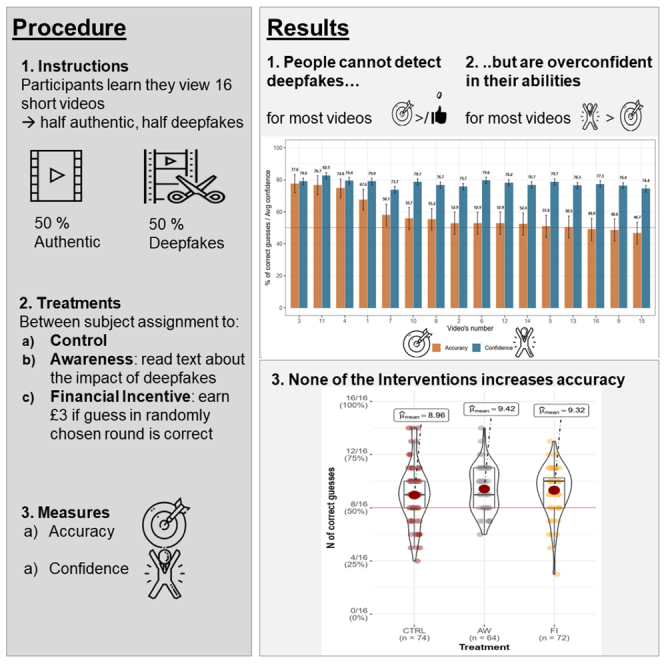
Hyper-realistic manipulation of audio-visual content, i.e., deepfakes, presents a new challenge for establishing veracity of online content. Research on the human impact of deepfakes, addressing both behaviors in response to and cognitive processing of deepfakes, remains sparse. In a pre-registered behavioral experiment ( N = 210), we show that (a) people cannot reliably detect deepfakes, and (b) neither raising awareness nor introducing financial incentives improves their detection accuracy. Zeroing in on the underlying cognitive processes, we find that (c) people are biased towards mistaking deepfakes as authentic videos (rather than vice versa) and (d) overestimate their own detection abilities. Together, these results suggest that people adopt a ``seeing-is-believing'' heuristic for deepfake detection while being overconfident in their (low) detection abilities. The combination renders people particularly susceptible to be influenced by inauthentic deepfake content.
Overview
Integrity signals
Registry
Cites
Statistics
Figures


Verification
Claims the paper makes
Claims other papers make about this one
Each is checked against this paper’s own text: does it say what the citing paper says it does?
In the citing paper
“and are hard for people to distinguish, as shown in studies in the USA, UK, and Netherlands (Dobber et al., 2020; Vaccari and Chadwick, 2020; Köbis et al., 2021; Nightingale and Farid, 2022).”
From On manipulation by emotional AI: UK adults’ views and governance implications (2024) · cites this paper as Köbis et al., 2021
In the citing paper
“studies that show that people are poor at recognizing deepfakes and false content online (Dobber et al., 2020; Vaccari and Chadwick, 2020; Köbis et al., 2021; Nightingale and Farid, 2022; Vaccari et al., 2022)”
From On manipulation by emotional AI: UK adults’ views and governance implications (2024) · cites this paper as Köbis et al., 2021
Citations
Cites
Generative adversarial networks
Goodfellow, I., Pouget-Abadie, J., Mirza, M., Xu, B., Warde-Farley, D., Ozair, S., Courville, A., & Bengio, Y. (2020) · Communications of the ACM · doi:10.1145/3422622 · Cited by 18,384
(2011) · Cited by 14,317
The spread of true and false news online
Vosoughi, S., Roy, D., & Aral, S. (2018) · Science · doi:10.1126/science.aap9559 · Cited by 8,847
Illusion and well‐being: A social psychological perspective on mental health
Taylor, S. E., & Brown, J. D. (1988) · Psychological Bulletin · doi:10.1037/0033-2909.103.2.193 · Cited by 7,814
Kruger, J., & Dunning, D. (1999) · Journal of Personality and Social Psychology · doi:10.1037/0022-3514.77.6.1121 · Cited by 7,731
(2018) · Cited by 3,510
FaceForensics++: Learning to Detect Manipulated Facial Images
Rossler, A., Cozzolino, D., Verdoliva, L., Riess, C., Thies, J., & Niessner, M. (2019) · 2019 IEEE/CVF International Conference on Computer Vision (ICCV) · doi:10.1109/iccv.2019.00009 · Cited by 3,314
Beyond the Turk: Alternative platforms for crowdsourcing behavioral research
Peer, E., Brandimarte, L., Samat, S., & Acquisti, A. (2017) · Journal of Experimental Social Psychology · doi:10.1016/j.jesp.2017.01.006 · Cited by 2,957
The trouble with overconfidence.
Moore, D. A., & Healy, P. J. (2008) · Psychological Review · doi:10.1037/0033-295x.115.2.502 · Cited by 2,358
MesoNet: a Compact Facial Video Forgery Detection Network
Afchar, D., Nozick, V., Yamagishi, J., & Echizen, I. (2018) · 2018 IEEE International Workshop on Information Forensics and Security (WIFS) · doi:10.1109/wifs.2018.8630761 · Cited by 1,872
Celeb-DF: A Large-Scale Challenging Dataset for DeepFake Forensics
Li, Y., Yang, X., Sun, P., Qi, H., & Lyu, S. (2020) · 2020 IEEE/CVF Conference on Computer Vision and Pattern Recognition (CVPR) · doi:10.1109/cvpr42600.2020.00327 · Cited by 1,846
Face2Face: Real-Time Face Capture and Reenactment of RGB Videos
Thies, J., Zollhofer, M., Stamminger, M., Theobalt, C., & Niessner, M. (2016) · 2016 IEEE Conference on Computer Vision and Pattern Recognition (CVPR) · doi:10.1109/cvpr.2016.262 · Cited by 1,747
Rahwan, I., Cebrian, M., Obradovich, N., Bongard, J., Bonnefon, J.-F., Breazeal, C., Crandall, J. W., Christakis, N. A., Couzin, I. D., Jackson, M. O., et al. (2019) · Nature · doi:10.1038/s41586-019-1138-y · Cited by 1,364
Pennycook, G., & Rand, D. G. (2021) · Trends in Cognitive Sciences · doi:10.1016/j.tics.2021.02.007 · Cited by 1,360
Elementary Signal Detection Theory
Wickens, T. D. (2001) · Oxford University Press eBooks · doi:10.1093/acprof:oso/9780195092509.001.0001 · Cited by 1,271
Exposing Deep Fakes Using Inconsistent Head Poses
Yang, X., Li, Y., & Lyu, S. (2019) · ICASSP 2019 - 2019 IEEE International Conference on Acoustics, Speech and Signal Processing (ICASSP) · doi:10.1109/icassp.2019.8683164 · Cited by 1,196
Shifting attention to accuracy can reduce misinformation online
Pennycook, G., Epstein, Z., Mosleh, M., Arechar, A. A., Eckles, D., & Rand, D. G. (2021) · Nature · doi:10.1038/s41586-021-03344-2 · Cited by 1,155
Vaccari, C., & Chadwick, A. (2020) · Social Media + Society · doi:10.1177/2056305120903408 · Cited by 978
Deep Fakes: A Looming Challenge for Privacy, Democracy, and National Security
Chesney, R., & Citron, D. K. (2018) · SSRN Electronic Journal · doi:10.2139/ssrn.3213954 · Cited by 880
Exposing DeepFake Videos By Detecting Face Warping Artifacts
Li, Y., & Lyu, S. (2018) · arXiv · doi:10.48550/arxiv.1811.00656 · Cited by 785
FSGAN: Subject Agnostic Face Swapping and Reenactment
Nirkin, Y., Keller, Y., & Hassner, T. (2019) · 2019 IEEE/CVF International Conference on Computer Vision (ICCV) · doi:10.1109/iccv.2019.00728 · Cited by 706
Video Rewrite: driving visual speech with audio
Bregler, C., Covell, M., & Slaney, M. (1997) · Proceedings of the 24th annual conference on Computer graphics and interactive techniques - SIGGRAPH '97 · doi:10.1145/258734.258880 · Cited by 669
Fake news, fast and slow: Deliberation reduces belief in false (but not true) news headlines.
Bago, B., Rand, D. G., & Pennycook, G. (2020) · Journal of Experimental Psychology: General · doi:10.1037/xge0000729 · Cited by 593
Proceedings of the 24th annual conference on Computer graphics and interactive techniques
Owen, G. S., Whitted, T., & Mones-Hattal, B. (1997) · Cited by 521
DeepFakes: a New Threat to Face Recognition? Assessment and Detection
Korshunov, P., & Marcel, S. (2018) · arXiv · doi:10.48550/arxiv.1812.08685 · Cited by 497
Seeing Is Remembering: How Visuals Contribute to Learning from Television News
Graber, D. A. (1990) · Journal of Communication · doi:10.1111/j.1460-2466.1990.tb02275.x · Cited by 437
Köbis, N., & Mossink, L. D. (2021) · Computers in Human Behavior · doi:10.1016/j.chb.2020.106553 · Cited by 406
Self-citationA Clearer Picture: The Contribution of Visuals and Text to Framing Effects: Visual Framing Effects
Powell, T. E., Boomgaarden, H. G., De Swert, K., & de Vreese, C. H. (2015) · Journal of Communication · doi:10.1111/jcom.12184 · Cited by 393
The psycho Package: an Efficient and Publishing-Oriented Workflow for Psychological Science
Makowski, D. (2018) · The Journal of Open Source Software · doi:10.21105/joss.00470 · Cited by 379
The effects of (incentivized) belief elicitation in public goods experiments
Gächter, S., & Renner, E. (2010) · Experimental Economics · doi:10.1007/s10683-010-9246-4 · Cited by 359
Artificial Intelligence Crime: An Interdisciplinary Analysis of Foreseeable Threats and Solutions
King, T. C., Aggarwal, N., Taddeo, M., & Floridi, L. (2020) · Science and Engineering Ethics · doi:10.1007/s11948-018-00081-0 · Cited by 271
The Epistemic Threat of Deepfakes
Fallis, D. (2021) · Philosophy & Technology · doi:10.1007/s13347-020-00419-2 · Cited by 266
Do (microtargeted) deepfakes have real effects on political attitudes?
Dobber, T., Metoui, N., Trilling, D., Helberger, N., & de Vreese, C. (2021) · The International Journal of Press/Politics · doi:10.1177/1940161220944364 · Cited by 256
Blanz, V., Scherbaum, K., Vetter, T., & Seidel, H. (2004) · Computer Graphics Forum · doi:10.1111/j.1467-8659.2004.00799.x · Cited by 226
A penny for your thoughts: a survey of methods for eliciting beliefs
Schlag, K. H., Tremewan, J., & van der Weele, J. J. (2015) · Experimental Economics · doi:10.1007/s10683-014-9416-x · Cited by 224
The Social Impact of Deepfakes
Hancock, J. T., & Bailenson, J. N. (2021) · Cyberpsychology, Behavior, and Social Networking · doi:10.1089/cyber.2021.29208.jth · Cited by 214
ICASSP - 2008 IEEE International Conference on Acoustics, Speech and Signal Processing
(2007) · IEEE Signal Processing Magazine · doi:10.1109/msp.2007.361617 · Cited by 205
(2020) · arXiv (Cornell University) · Cited by 204
Bad machines corrupt good morals
Köbis, N., Bonnefon, J.-F., & Rahwan, I. (2021) · Nature Human Behaviour · doi:10.1038/s41562-021-01128-2 · Cited by 202
Self-citationAnticipating and addressing the ethical implications of deepfakes in the context of elections
Diakopoulos, N., & Johnson, D. (2021) · New Media & Society · doi:10.1177/1461444820925811 · Cited by 192
A Signal Detection Approach to Understanding the Identification of Fake News
Batailler, C., Brannon, S. M., Teas, P. E., & Gawronski, B. (2022) · Perspectives on Psychological Science · doi:10.1177/1745691620986135 · Cited by 185
Caldwell, M., Andrews, J. T. A., Tanay, T., & Griffin, L. D. (2020) · Crime Science · doi:10.1186/s40163-020-00123-8 · Cited by 180
Why Seeing Is Believing: Merging Auditory and Visual Worlds
Witten, I. B., & Knudsen, E. I. (2005) · Neuron · doi:10.1016/j.neuron.2005.10.020 · Cited by 164
ggstatsplot: 'ggplot2' Based Plots with Statistical Details
Patil, I. (2018) · doi:10.32614/cran.package.ggstatsplot · Cited by 157
Effects of Disinformation Using Deepfake: The Protective Effect of Media Literacy Education
Hwang, Y., Ryu, J. Y., & Jeong, S.-H. (2021) · Cyberpsychology, Behavior, and Social Networking · doi:10.1089/cyber.2020.0174 · Cited by 148
False memories of fabricated political events
Frenda, S. J., Knowles, E. D., Saletan, W., & Loftus, E. F. (2013) · Journal of Experimental Social Psychology · doi:10.1016/j.jesp.2012.10.013 · Cited by 146
Veracity assessment of online data
Lozano, M. G., Brynielsson, J., Franke, U., Rosell, M., Tjörnhammar, E., Varga, S., & Vlassov, V. (2019) · Decision Support Systems · doi:10.1016/j.dss.2019.113132 · Cited by 112
Are the Unskilled Really that Unaware? An Alternative Explanation
Krajč, M., & Ortmann, A. (2007) · Journal of Economic Psychology · doi:10.1016/j.joep.2007.12.006 · Cited by 95
Verschuère, B., Köbis, N., Bereby‐Meyer, Y., Rand, D. G., & Shalvi, S. (2018) · Journal of Applied Research in Memory and Cognition · doi:10.1016/j.jarmac.2018.04.005 · Cited by 89
Self-citationNygren, T., Guath, M., Axelsson, A., & Frau‐Meigs, D. (2021) · Information · doi:10.3390/info12050201 · Cited by 87
Iacobucci, S., Cicco, R. D., Michetti, F., Palumbo, R., & Pagliaro, S. (2021) · Cyberpsychology Behavior and Social Networking · doi:10.1089/cyber.2020.0149 · Cited by 72
Meta-Analysis on Visual Persuasion– Does Adding Images to Texts Influence Persuasion?
Seo, K. (2020) · Athens Journal of Mass Media and Communications · doi:10.30958/ajmmc.6-3-3 · Cited by 58
Creating a Photoreal Digital Actor: The Digital Emily Project
Alexander, O., Mike Rogers, A., Lambeth, W., Chiang, M. J., & Debevec, P. E. (2009) · Conference on Visual Media Production · doi:10.1109/cvmp.2009.29 · Cited by 58
Aral, S. (2021) · Cited by 49
Muthukrishna, M., Henrich, J., Toyokawa, W., Hamamura, T., Kameda, T., & Heine, S. J. (2018) · PLoS ONE · doi:10.1371/journal.pone.0202288 · Cited by 48
Creating a Photoreal Digital Actor: The Digital Emily Project
Alexander, O., Mike Rogers, A., Lambeth, W., Chiang, M. J., & Debevec, P. E. (2009) · Conference on Visual Media Production · doi:10.1109/cvmp.2009.23 · Cited by 39
Do (Microtargeted) Deepfakes Have Real Effects on Political Attitudes?
Dobber, T., Metoui, N., Trilling, D., Helberger, N., & de Vreese, C. (2020) · Sage Journals Data · doi:10.25384/sage.c.5073707 · Cited by 30
Human detection of machine-manipulated media
Groh, M., Epstein, Z., Obradovich, N., Cebrián, M., & Rahwan, I. (2021) · Communications of the ACM · doi:10.1145/3445972 · Cited by 29
Cited by
A systematic review of AI literacy scales
Lintner, T. (2024) · npj Science of Learning · doi:10.1038/s41539-024-00264-4 · Cited by 292
Evaluating Large Language Models in Generating Synthetic HCI Research Data: a Case Study
Hämäläinen, P., Tavast, M., & Kunnari, A. (2023) · Proceedings of the 2023 CHI Conference on Human Factors in Computing Systems · doi:10.1145/3544548.3580688 · Cited by 248
Consumer Responses to AI-Generated Charitable Giving Ads
Arango, L., Singaraju, S. P., & Niininen, O. (2023) · Journal of Advertising · doi:10.1080/00913367.2023.2183285 · Cited by 243
Deepfakes: Deceptions, mitigations, and opportunities
Mustak, M., Salminen, J., Mäntymäki, M., Rahman, A., & Dwivedi, Y. K. (2023) · Journal of Business Research · doi:10.1016/j.jbusres.2022.113368 · Cited by 209
Abbas, F., & Taeihagh, A. (2024) · Expert Systems with Applications · doi:10.1016/j.eswa.2024.124260 · Cited by 184
Metadata
- Authors
- Köbis, N., Doležalová, B., & Soraperra, I.
- Affiliations
- Max Planck Institute for Human Development (DE)
- University of Amsterdam (NL)
- Corresponding author
- Köbis, Nils
- Venue
- iScience
- Publisher
- Elsevier BV
- Published
- 2021
- Volume
- 24
- Issue
- 11
- Pages
- 103364-103364
- ISSN
- 2589-0042 (ISSN-L)
- PMC
- PMC8602050
- OpenAlex
- W3208526032
- Cited by
- 194
- References
- 63
- Citations by year
- 2026: 64 · 2025: 48 · 2024: 48 · 2023: 23 · 2022: 11
- FWCI
- 28.45
- Type
- journal article
- Language
- en
- Open access
- gold
- doi.org
- Licence
- cc-by-nc-nd
- Locations
- iScience (publishedVersion, cc-by-nc-nd)
- SSRN Electronic Journal (acceptedVersion)
- PubMed Central (publishedVersion, cc-by-nc-nd)
- PubMed (publishedVersion)
- UvA-DARE (University of Amsterdam) (publishedVersion, cc-by-nc-nd)
- Data Archiving and Networked Services (DANS) (submittedVersion, other-oa)
- DOAJ (DOAJ: Directory of Open Access Journals) (submittedVersion, cc-by-sa)
- Funders
- Universiteit van Amsterdam (202006110906)
- Max-Planck-Institut für Bildungsforschung
- Toulouse School of Economics
- Topics
- Social Sciences › Sociology and Political Science › Misinformation and Its Impacts
- Physical Sciences › Computer Science › Computer Vision and Pattern Recognition › Digital Media Forensic Detection
- Social Sciences › Psychology › Social Psychology › Deception detection and forensic psychology
- Keywords
- deepfakes, deepfake detection, misinformation, overconfidence, belief bias, awareness intervention, financial incentives
About these checks
Registry, retraction, Cites and statistics results are computed, not judged, with one exception: a printed reference that no index lists is read once by a model before it counts as a citation error. Claims are extracted by a model and kept only when their quote appears verbatim in the text; each cited source is then checked, with a model’s help, for whether it says what the claim relies on. Those verdicts can be wrong — read the claim’s quote and the cited source before relying on one.
Statistics and arithmetic are recomputed, not judged.
Confidence bands are shown only for fields calibrated on our annotated test set. None is calibrated yet, so no band is shown.
What counts as a claim ›How we measure confidence ›How we check this ›
Are you an author, or do you see a problem with this page? Request a review
Data sources
Bibliographic data: Semantic Scholar, OpenAlex, Crossref.
Contains information from the Semantic Scholar Academic Graph Datasets, made available under the ODC Attribution License (ODC-BY 1.0).
Semantic Scholar’s data is described in: Kinney, R., et al. (2023). The Semantic Scholar Open Data Platform. arXiv:2301.10140.
