

The DOI matches its Crossref record; 29 of the 29 references it cites were found in a registry or an index.
Acceptance of an assistive robot in older adults: a mixed-method study of human–robot interaction over a 1-month period in the Living Lab setting
Open accessAbstract
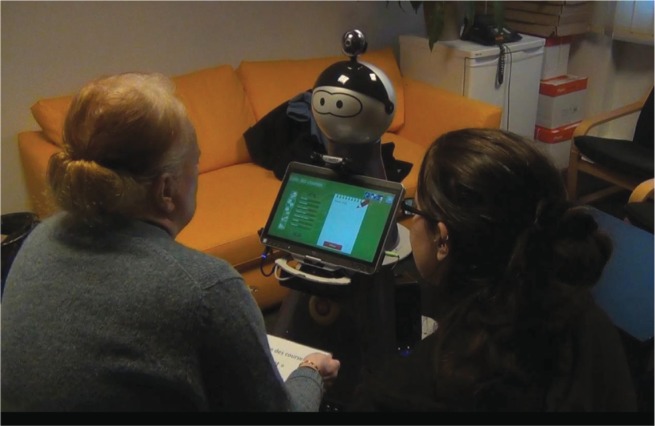
BACKGROUND: There is growing interest in investigating acceptance of robots, which are increasingly being proposed as one form of assistive technology to support older adults, maintain their independence, and enhance their well-being. In the present study, we aimed to observe robot-acceptance in older adults, particularly subsequent to a 1-month direct experience with a robot. SUBJECTS AND METHODS: Six older adults with mild cognitive impairment (MCI) and five cognitively intact healthy (CIH) older adults were recruited. Participants interacted with an assistive robot in the Living Lab once a week for 4 weeks. After being shown how to use the robot, participants performed tasks to simulate robot use in everyday life. Mixed methods, comprising a robot-acceptance questionnaire, semistructured interviews, usability-performance measures, and a focus group, were used. RESULTS: Both CIH and MCI subjects were able to learn how to use the robot. However, MCI subjects needed more time to perform tasks after a 1-week period of not using the robot. Both groups rated similarly on the robot-acceptance questionnaire. They showed low intention to use the robot, as well as negative attitudes toward and negative images of this device. They did not perceive it as useful in their daily life. However, they found it easy to use, amusing, and not threatening. In addition, social influence was perceived as powerful on robot adoption. Direct experience with the robot did not change the way the participants rated robots in their acceptance questionnaire. We identified several barriers to robot-acceptance, including older adults' uneasiness with technology, feeling of stigmatization, and ethical/societal issues associated with robot use. CONCLUSION: It is important to destigmatize images of assistive robots to facilitate their acceptance. Universal design aiming to increase the market for and production of products that are usable by everyone (to the greatest extent possible) might help to destigmatize assistive devices.
Overview
The claims and statistics of this paper haven’t been checked yet.
Run the check — free, no account needed. It reads the open-access text and checks the sources it cites.
Integrity signals
Registry
Cites
Statistics
Figures
Verification
Claims the paper makes
The claims and statistics of this paper haven’t been checked yet.
Run the check — free, no account needed. It reads the open-access text and checks the sources it cites.
Claims other papers make about this one
Each is checked against this paper’s own text: does it say what the citing paper says it does?
In the citing paper
“Seven studies reported that technology was neither accepted nor adhered to [22, 25, 26, 28, 39, 40, 48].”
From Acceptance and use of innovative assistive technologies among people with cognitive impairment and their caregivers: a systematic review (2019) · cites this paper as [48]
In the citing paper
“When it comes to use of robots in health care, our results show that the users had generally low interest to use the robot, as well as negative attitudes toward and negative images for this type of devices [24, 26, 48].”
From Acceptance and use of innovative assistive technologies among people with cognitive impairment and their caregivers: a systematic review (2019) · cites this paper as [48]
Self-check
Percentages, sums and reported differences re-computed from the paper’s own numbers.
The self-check needs the paper’s full text.
Citations
Cites
Using thematic analysis in psychology
Braun, V., & Clarke, V. (2006) · Qualitative Research in Psychology · doi:10.1191/1478088706qp063oa · Cited by 194,414
(2014) · SAGE Publications Ltd eBooks · doi:10.4135/9781446294406.n148 · Cited by 7,272
Neufeld, A., & Ryan, A. G. (1988) · Canadian Journal of Program Evaluation · doi:10.3138/cjpe.3.006 · Cited by 5,906
Current concepts in mild cognitive impairment
Petersen, R. C., Doody, R., Kurz, A., Mohs, R. C., Morris, J. C., Rabins, P. V., Ritchie, K., Rossor, M., Thal, L., & Winblad, B. (2001) · Archives of Neurology · doi:10.1001/archneur.58.12.1985 · Cited by 4,781
Assessing Acceptance of Assistive Social Agent Technology by Older Adults: the Almere Model
Heerink, M., Kröse, B., Evers, V., & Wielinga, B. (2010) · International Journal of Social Robotics · doi:10.1007/s12369-010-0068-5 · Cited by 1,229
Assistive social robots in elderly care: a review
Broekens, J., Heerink, M., & Rosendal, H. (2009) · Gerontechnology · doi:10.4017/gt.2009.08.02.002.00 · Cited by 950
Acceptance of Healthcare Robots for the Older Population: Review and Future Directions
Broadbent, E., Stafford, R., & MacDonald, B. (2009) · International Journal of Social Robotics · doi:10.1007/s12369-009-0030-6 · Cited by 887
Older adults' use of information and communications technology in everyday life
SELWYN, N., GORARD, S., FURLONG, J., & MADDEN, L. (2003) · Ageing and Society · doi:10.1017/s0144686x03001302 · Cited by 617
Older adults: Are they ready to adopt health-related ICT?
Heart, T., & Kalderon, E. (2013) · Int. J. Medical Informatics · doi:10.1016/j.ijmedinf.2011.03.002 · Cited by 599
Universal Design : Barrier Free Environments for Everyone
Mace, R. L. (1985) · Medical Entomology and Zoology · Cited by 275
‘But obviously not for me’: robots, laboratories and the defiant identity of elder test users
Neven, L. (2010) · Sociology of Health & Illness · doi:10.1111/j.1467-9566.2009.01218.x · Cited by 273
Assistive Technology Use and Stigma
Parette, P., & Scherer, M. (2004) · Education and Training in Developmental Disabilities · doi:10.1177/215416470403900304 · Cited by 272
Internet use and non-use: views of older users
Morris, A., Goodman, J., & Brading, H. (2007) · Universal Access in the Information Society · doi:10.1007/s10209-006-0057-5 · Cited by 241
Influence of Direct Computer Experience on Older Adults' Attitudes Toward Computers
Jay, G., & Willis, S. L. (1992) · Journal of Gerontology · doi:10.1093/geronj/47.4.p250 · Cited by 230
Stafford, R. Q., MacDonald, B. A., Jayawardena, C., Wegner, D. M., & Broadbent, E. (2013) · International Journal of Social Robotics · doi:10.1007/s12369-013-0186-y · Cited by 216
Age and gender factors in user acceptance of healthcare robots
Kuo, I. H., Rabindran, J., Broadbent, E., Lee, Y. I., Kerse, N. M., Stafford, R. M. Q., & MacDonald, B. A. (2009) · IEEE RO-MAN · doi:10.1109/roman.2009.5326292 · Cited by 213
Attitudes and Reactions to a Healthcare Robot
Broadbent, E., Kuo, I. H., Lee, Y. I., Rabindran, J., Kerse, N. M., Stafford, R. Q., & MacDonald, B. A. (2010) · Telemedicine Journal and e-Health · doi:10.1089/tmj.2009.0171 · Cited by 129
Older Adults’ Preferences for and Acceptance of Robot Assistance for Everyday Living Tasks
Smarr, C.-A., Prakash, A., Beer, J. M., Mitzner, T. L., Kemp, C. C., & Rogers, W. A. (2012) · Proceedings of the Human Factors and Ergonomics Society Annual Meeting · doi:10.1177/1071181312561009 · Cited by 126
Ethical frontiers of ICT and older users: cultural, pragmatic and ethical issues
McLean, A. (2011) · Ethics and Information Technology · doi:10.1007/s10676-011-9276-4 · Cited by 87
Perceptions and Use of Gerotechnology: Implications for Aging in Place
Mahmood, A. N., Yamamoto, T., Lee, M. F., & Steggell, C. D. (2008) · Journal of Housing for the Elderly · doi:10.1080/02763890802097144 · Cited by 85
Ezer, N., Fisk, A. D., & Rogers, W. A. (2009) · Proceedings of the Human Factors and Ergonomics Society Annual Meeting · doi:10.1177/154193120905300206 · Cited by 72
Seelye, A. M., Wild, K. V., Larimer, N., Maxwell, S. A., Kearns, P., & Kaye, J. A. (2012) · Telemedicine Journal and e-Health · doi:10.1089/tmj.2012.0026 · Cited by 68
Can Late Life Social or Leisure Activities Delay the Onset of Dementia?
Katzman, R. (1995) · Journal of the American Geriatrics Society · doi:10.1111/j.1532-5415.1995.tb06112.x · Cited by 46
Ethical issues in the use of fall detectors
GANYO, M., Dunn, M., & Hope, T. (2011) · Ageing and Society · doi:10.1017/s0144686x10001443 · Cited by 40
Care robots for the supermarket shelf: a product gap in assistive technologies
Blackman, T. (2012) · Ageing and Society · doi:10.1017/s0144686x1200027x · Cited by 24
Older Homebound Women: Negotiating Reliance on a Cane or Walker
Porter, E. J., Benson, J. J., & Matsuda, S. (2010) · Qualitative Health Research · doi:10.1177/1049732310385822 · Cited by 22
Ezer, N., Fisk, A. D., & Rogers, W. A. (2009) · Proceedings of the Human Factors and Ergonomics Society Annual Meeting · doi:10.1518/107118109x12524441079382 · Cited by 11
Challenges for the Current Status of Adult Developmental Theories: A New Century of Progress
Blanchard–Fields, F. (2008) · doi:10.4324/9780203887882-4 · Cited by 10
‘But Obviously not for Me’: Robots, Laboratories and the Defiant Identity of Elder Test Users
Neven, L. (2010) · doi:10.1002/9781444391541.ch12 · Cited by 7
Cited by
Sorted by citations
Wang, Y., & Wang, Y. (2019) · Interactive Learning Environments · doi:10.1080/10494820.2019.1674887 · Cited by 830
Older people, assistive technologies, and the barriers to adoption: A systematic review
Yusif, S., Soar, J., & Hafeez-Baig, A. (2016) · International Journal of Medical Informatics · doi:10.1016/j.ijmedinf.2016.07.004 · Cited by 548
A Systematic Review of Attitudes, Anxiety, Acceptance, and Trust Towards Social Robots
Naneva, S., Gou, M. S., Webb, T. L., & Prescott, T. J. (2020) · International Journal of Social Robotics · doi:10.1007/s12369-020-00659-4 · Cited by 389
Lin, H., Chi, O. H., & Gürsoy, D. (2019) · Journal of Hospitality Marketing & Management · doi:10.1080/19368623.2020.1685053 · Cited by 388
Pino, M., Boulay, M., Jouen, F., & Rigaud, A. (2015) · Frontiers in Aging Neuroscience · doi:10.3389/fnagi.2015.00141 · Cited by 352
Self-citation
Metadata
- Authors
- Wu, Y.-H., Wrobel, J., Cornuet, M., Kerhervé, H., Damnée, S., & Rigaud, A.-S.
- Affiliations
- Assistance Publique – Hôpitaux de Paris (FR)
- Corresponding author
- Wu, Ya-Huei
- Venue
- Clinical Interventions in Aging
- Publisher
- Informa UK Limited
- Published
- 2014-05
- Volume
- 9
- Pages
- 801
- ISSN
- 1176-9092 (ISSN-L)
- 1178-1998
- PMC
- PMC4020879
- OpenAlex
- W2060200729
- Cited by
- 261
- References
- 29
- Citations by year
- 2026: 18 · 2025: 30 · 2024: 24 · 2023: 27 · 2022: 39 · 2021: 36 · 2020: 25 · 2019: 26 · 2018: 14 · 2017: 8 · 2016: 9 · 2015: 5
- FWCI
- 10.88
- Type
- journal article
- Language
- en
- Open access
- gold
- doi.org
- Licence
- Locations
- Clinical Interventions in Aging (publishedVersion, cc-by-nc)
- Europe PMC (PubMed Central) (publishedVersion, cc-by-nc)
- PubMed Central (publishedVersion, cc-by-nc)
- PubMed (publishedVersion)
- Funders
- Agence Nationale de la Recherche (ANR-09-TECS-0012)
- Caisse nationale de solidarité pour l'autonomie
- Direction Générale de l’Armement
- Topics
- Social Sciences › Psychology › Social Psychology › Social Robot Interaction and HRI
- Health Sciences › Medicine › Geriatrics and Gerontology › Technology Use by Older Adults
- Social Sciences › Business, Management and Accounting › Marketing › AI in Service Interactions
- Keywords
- assistive robots, robot acceptance, older adults, mild cognitive impairment, human-robot interaction, living labs, intention to use, social influence, stigmatization, universal design, technology adoption barriers
- MeSH terms
- Activities of Daily Living, Aged, Aged, 80 and over, Attitude to Computers, Female, Humans, Interviews as Topic, Male, Surveys and Questionnaires, Robotics, Self-Help Devices, User-Computer Interface, Focus Groups, Cognitive Dysfunction
About these checks
Registry, retraction, Cites and statistics results are computed, not judged, with one exception: a printed reference that no index lists is read once by a model before it counts as a citation error. Claims are extracted by a model and kept only when their quote appears verbatim in the text; each cited source is then checked, with a model’s help, for whether it says what the claim relies on. Those verdicts can be wrong — read the claim’s quote and the cited source before relying on one.
Statistics and arithmetic are recomputed, not judged.
Confidence bands are shown only for fields calibrated on our annotated test set. None is calibrated yet, so no band is shown.
What counts as a claim ›How we measure confidence ›How we check this ›
Are you an author, or do you see a problem with this page? Request a review
