

The DOI matches its Crossref record; 89 of the 91 references it cites were found in a registry or an index.
Risk factors for fatal and nonfatal repetition of suicide attempts: a literature review
Open accessAbstract
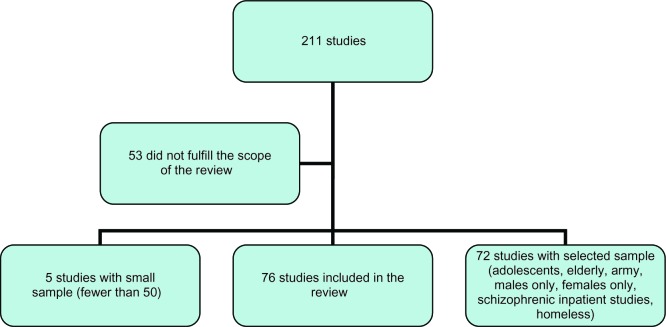
OBJECTIVES: This review aimed to identify the evidence for predictors of repetition of suicide attempts, and more specifically for subsequent completed suicide. METHODS: We conducted a literature search of PubMed and Embase between January 1, 1991 and December 31, 2009, and we excluded studies investigating only special populations (eg, male and female only, children and adolescents, elderly, a specific psychiatric disorder) and studies with sample size fewer than 50 patients. RESULTS: The strongest predictor of a repeated attempt is a previous attempt, followed by being a victim of sexual abuse, poor global functioning, having a psychiatric disorder, being on psychiatric treatment, depression, anxiety, and alcohol abuse or dependence. For other variables examined (Caucasian ethnicity, having a criminal record, having any mood disorders, bad family environment, and impulsivity) there are indications for a putative correlation as well. For completed suicide, the strongest predictors are older age, suicide ideation, and history of suicide attempt. Living alone, male sex, and alcohol abuse are weakly predictive with a positive correlation (but sustained by very scarce data) for poor impulsivity and a somatic diagnosis. CONCLUSION: It is difficult to find predictors for repetition of nonfatal suicide attempts, and even more difficult to identify predictors of completed suicide. Suicide ideation and alcohol or substance abuse/dependence, which are, along with depression, the most consistent predictors for initial nonfatal attempt and suicide, are not consistently reported to be very strong predictors for nonfatal repetition.
Overview
The claims and statistics of this paper haven’t been checked yet.
Run the check — free, no account needed. It reads the open-access text and checks the sources it cites.
Integrity signals
Registry
Cites
Statistics
Figures
Verification
Claims the paper makes
The claims and statistics of this paper haven’t been checked yet.
Run the check — free, no account needed. It reads the open-access text and checks the sources it cites.
Claims other papers make about this one
Each is checked against this paper’s own text: does it say what the citing paper says it does?
The cited source says what the claim attributes to it.
In the citing paper
“Suicidal ideation and behaviour are associated with a host of negative outcomes including risk of future suicide [5].”
Self-check
Percentages, sums and reported differences re-computed from the paper’s own numbers.
The self-check needs the paper’s full text.
Citations
Cites
Fatal and non-fatal repetition of self-harm: Systematic review
Owens, D., Horrocks, J., & House, A. (2002) · British Journal of Psychiatry · doi:10.1192/bjp.181.3.193 · Cited by 1,241
Silverman, M. M., Berman, A. L., Sanddal, N. D., O'Carroll, P. W., & Joiner, T. E. (2007) · Suicide and Life-Threatening Behavior · doi:10.1521/suli.2007.37.3.264 · Cited by 991
Schmidtke, A., Bille‐Brahe, U., DeLeo, D., Kerkhof, A. J. F. M., Bjerke, T., Crepef, P., Häring, C., Hawton, K., Lönnqvist, J. K., Michel, K., et al. (1996) · Acta Psychiatrica Scandinavica · doi:10.1111/j.1600-0447.1996.tb10656.x · Cited by 784
Prediction of Suicide in Psychiatric Patients
Pokorny, A. D. (1983) · Archives of General Psychiatry · doi:10.1001/archpsyc.1983.01790030019002 · Cited by 749
Suicide After Deliberate Self-Harm: A 4-Year Cohort Study
Cooper, J., Kapur, N., Webb, R., Lawlor, M., Guthrie, E., Mackway-Jones, K., & Appleby, L. (2005) · American Journal of Psychiatry · doi:10.1176/appi.ajp.162.2.297 · Cited by 690
Silverman, M. M., Berman, A. L., Sanddal, N. D., O'Carroll, P. W., & Joiner, T. E. (2007) · Suicide and Life-Threatening Behavior · doi:10.1521/suli.2007.37.3.248 · Cited by 593
IDENTIFICATION OF SUICIDE RISK FACTORS USING EPIDEMIOLOGIC STUDIES
Mościcki, E. K. (1997) · Psychiatric Clinics of North America · doi:10.1016/s0193-953x(05)70327-0 · Cited by 507
Zahl, D. L., & Hawton, K. E. (2004) · The British Journal of Psychiatry · doi:10.1192/bjp.185.1.70 · Cited by 475
Platt, S. D., Bille‐Brahe, U., Kerkhof, A. J. F. M., Schmidtke, A., Bjerke, T., Crepet, P., Leo, D. D., Häring, C., Lönnqvist, J. K., Michel, K., et al. (1992) · Acta Psychiatrica Scandinavica · doi:10.1111/j.1600-0447.1992.tb01451.x · Cited by 465
Bertolote, J. M., Fleischmann, A., Leo, D. D., Bolhari, J., Botega, N. J., Silva, D. D., Thanh, H. T. T., PHILLIPS, M., Schlebusch, L., Värnik, A., et al. (2005) · Psychological Medicine · doi:10.1017/s0033291705005404 · Cited by 404
Cited by
Sorted by citations
Items 201–208 of 208
Bliokas, V. V., Whiting, L., Liddle, S. K., Sng, R., & Janackovski, A. (2026) · Suicide and Life-Threatening Behavior · doi:10.1111/sltb.70090
Owasoyo, O. D., Le, J. V., Muzorewa, T., Makhani, R., & Onwuameze, O. E. (2026) · Cureus · doi:10.7759/cureus.111439
Szeifert, N. M., Fábián, B., & Gonda, X. (2026) · European Journal of Psychotraumatology · doi:10.1080/20008066.2026.2697561
Follow-up of recurrent suicide attempts of patients admitted to the emergency department
Sinanoğlu, G. K., & Doğan, V. (2026) · The Annals of Clinical and Analytical Medicine · doi:10.4328/acam.50155
Nadeem, M., Khan, A. A., Mansoor, M. H., & Yousafzai, A. W. (2026) · medRxiv · doi:10.64898/2026.09.03.26362105
Salvat, C. A. (2015) · Universitat de Girona Digital Repository (Universitat de Girona)
Metadata
- Authors
- Cornaggia, C., Beghi, Rosenbaum, & Cerri
- Affiliations
- University of Milano-Bicocca (IT)
- Harvard University (US)
- Venue
- Neuropsychiatric Disease and Treatment
- Publisher
- Informa UK Limited
- Published
- 2013-11
- Volume
- 9
- Pages
- 1725
- ISSN
- 1176-6328 (ISSN-L)
- PMC
- PMC3825699
- OpenAlex
- W2138993798
- Cited by
- 208
- References
- 91
- Citations by year
- 2026: 8 · 2025: 9 · 2024: 15 · 2023: 9 · 2022: 13 · 2021: 11 · 2020: 23 · 2019: 27 · 2018: 26 · 2017: 11 · 2016: 18 · 2015: 23 · 2014: 13 · 2013: 2
- FWCI
- 2.76
- Type
- journal article
- Language
- en
- Open access
- gold
- doi.org
- Licence
- Locations
- Neuropsychiatric Disease and Treatment (publishedVersion, cc-by-nc)
- Europe PMC (PubMed Central) (publishedVersion, cc-by-nc)
- PubMed Central (publishedVersion, cc-by-nc)
- PubMed (publishedVersion)
- Digital Access to Scholarship at Harvard (DASH) (Harvard University) (submittedVersion, cc-by)
- BOA (University of Milano-Bicocca) (submittedVersion, cc-by-nc)
- Dove Medical Press (Taylor and Francis Group) (submittedVersion, cc-by-nc)
- Topics
- Social Sciences › Psychology › Clinical Psychology › Suicide and Self-Harm Studies
- Social Sciences › Sociology and Political Science › Homicide, Infanticide, and Child Abuse
- Health Sciences › Medicine › Public Health, Environmental and Occupational Health › Opioid Use Disorder Treatment
- Keywords
- suicide attempts, repeated suicide attempts, suicide mortality, risk factors, suicidal ideation, alcohol abuse, substance abuse, depression, anxiety, mental illness, sexual abuse, impulsivity, living alone
About these checks
Registry, retraction, Cites and statistics results are computed, not judged, with one exception: a printed reference that no index lists is read once by a model before it counts as a citation error. Claims are extracted by a model and kept only when their quote appears verbatim in the text; each cited source is then checked, with a model’s help, for whether it says what the claim relies on. Those verdicts can be wrong — read the claim’s quote and the cited source before relying on one.
Statistics and arithmetic are recomputed, not judged.
Confidence bands are shown only for fields calibrated on our annotated test set. None is calibrated yet, so no band is shown.
What counts as a claim ›How we measure confidence ›How we check this ›
Are you an author, or do you see a problem with this page? Request a review
