

The DOI matches its Crossref record; 7 of the 7 references it cites were found in a registry or an index.
Total sleep deprivation decreases flow experience and mood status
Overview
The claims and statistics of this paper haven’t been checked yet.
Run the check — free, no account needed. It reads the open-access text and checks the sources it cites.
Integrity signals
Registry
Cites
Statistics
Figures
Verification
Claims the paper makes
The claims and statistics of this paper haven’t been checked yet.
Run the check — free, no account needed. It reads the open-access text and checks the sources it cites.
Claims other papers make about this one
Each is checked against this paper’s own text: does it say what the citing paper says it does?
In the citing paper
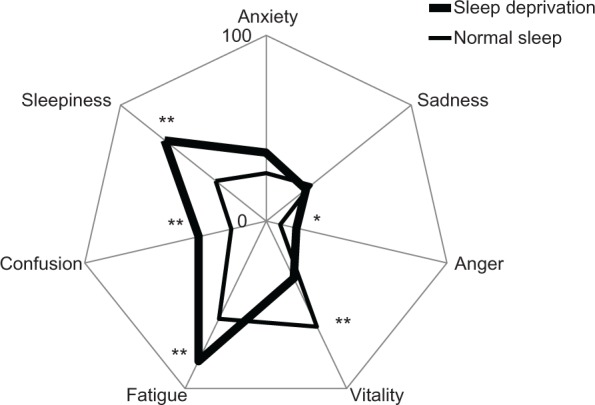
“An earlier SD study by Kaida and Niki (45), showed an increase in negative affect (POMS: the POMS subscale scores of sleepiness, confusion, fatigue, and anger) and a decrease in positive affect (the POMS subscale scores of vigor).”
From Sleep deprivation alters utilization of negative feedback in risky decision-making (2024) · cites this paper as [45]
Self-check
Percentages, sums and reported differences re-computed from the paper’s own numbers.
The self-check needs the paper’s full text.
Citations
Cites
Neurocognitive consequences of sleep deprivation
Goel, N., Rao, H., Durmer, J., & Dinges, D. (2009) · Seminars in Neurology · doi:10.1055/s-0029-1237117 · Cited by 2,154
Sleep and emotions: a focus on insomnia
Baglioni, C., Spiegelhalder, K., Lombardo, C., & Riemann, D. (2010) · Sleep Medicine Reviews · doi:10.1016/j.smrv.2009.10.007 · Cited by 873 · cited 1×
“It has been reported that sleep deprivation not only increases sleepiness but also accelerates deterioration of mood.(16,18,19) Sleep disturbance has been cited as a precursor to a number of psychiatric conditions, including depression,(20) post-traumatic stress disorder,(21) and panic disorder.”
Zohar, D., Tzischinsky, O., Epstein, R., & Lavie, P. (2005) · Sleep · doi:10.1093/sleep/28.1.47 · Cited by 478
Sustained sleep restriction reduces emotional and physical well-being
Haack, M., & Mullington, J. M. (2005) · Pain · doi:10.1016/j.pain.2005.09.011 · Cited by 422 · cited 1×
“34 Importantly, this study found that flow experience and vitality were positively related ( r = 0.45 to 0.57).”
InfluentialPsychological correlates of flow in sport
Jackson, S. A., Ford, S. K., Kimiecik, J. C., & Marsh, H. W. (1998) · Journal of Sport and Exercise Psychology · doi:10.1123/jsep.20.4.358 · Cited by 408 · cited 1×
“Although the flow experience was originally investigated in highly skilled professionals, a short period of flow (or “microflow”) can occur in daily activities, such as during Internet use,(3) driving,(4) musical performance,(5) and sports.(6,7) Importantly, it has been reported that the frequency of flow experiences…”
Sleep and posttraumatic stress disorder: a review
Harvey, A. G., Jones, C., & Schmidt, D. A. (2003) · Clinical Psychology Review · doi:10.1016/s0272-7358(03)00032-1 · Cited by 337
Effects of sleep deprivation on dissociated components of executive functioning
Tucker, A. M., Whitney, P., Belenky, G., Hinson, J. M., & Van Dongen, H. P. (2010) · SLEEP · doi:10.1093/sleep/33.1.47 · Cited by 287
Research works printed but not linked: 24
- [2]Demerouti E Job characteristics, flow, and performance: the moderating role of conscientiousness J Occup Health Psychol 2006 11 266 280 16834474
- [8]Hirao K Kobayashi R The relationship between self-disgust, guilt, and flow experience among Japanese undergraduates Neuropsychiatr Dis Treat 2013 9 985 988 23898226 PMC3718842
- [10]Kaida K Takeda Y Tsuzuki K The relationship between flow, sleepiness and cognitive performance: the effects of short afternoon nap and bright light exposure Ind Health 2012 50 189 196 22453206
- [11]Zohar D Tzischinski O Epstein R Effects of energy availability on immediate and delayed emotional reactions to work events J Appl Psychol 2003 88 1082 1093 14640818
- [13]Heuer H Kleinsorge T Klein W Kohlisch O Total sleep deprivation increases the costs of shifting between simple cognitive tasks Acta Psychol (Amst) 2004 117 29 64 15288228
- [14]Couyoumdjian A Sdoia S Tempesta D The effects of sleep and sleep deprivation on task-switching performance J Sleep Res 2010 19 1 Pt 1 64 70 19878450
- [15]Jewett ME Dijk DJ Kronauer RE Dinges DF Dose-response relationship between sleep duration and human psychomotor vigilance and subjective alertness Sleep 1999 22 171 179 10201061
- [16]Dinges DF Pack F Williams K Cumulative sleepiness, mood disturbance, and psychomotor vigilance performance decrements during a week of sleep restricted to 4–5 hours per night Sleep 1997 20 267 277 9231952
- [17]Drummond SP Bischoff-Grethe A Dinges DF Ayalon L Mednick SC Meloy MJ The neural basis of the psychomotor vigilance task Sleep 2005 28 1059 1068 16268374
- [18]Franzen PL Siegle GJ Buysse DJ Relationships between affect, vigilance, and sleepiness following sleep deprivation J Sleep Res 2008 17 34 41 18275553 PMC3107826
- [20]Vollrath M Wicki W Angst J The Zurich study. VIII. Insomnia: association with depression, anxiety, somatic syndromes, and course of insomnia Eur Arch Psychiatry Neurol Sci 1989 239 113 124 2806334
- [22]Na HR Kang EH Yu BH Relationship between personality and insomnia in panic disorder patients Psychiatry Investig 2011 8 102 106 PMC3149103 21852985
- [24]Van Dongen HP Maislin G Mullington JM Dinges DF The cumulative cost of additional wakefulness: dose-response effects on neurobehavioral functions and sleep physiology from chronic sleep restriction and total sleep deprivation Sleep 2003 26 117 126 12683469
- [25]Horne JA Pettitt AN High incentive effects on vigilance performance during 72 hours of total sleep deprivation Acta Psychol (Amst) 1985 58 123 139 3984776
- [26]Gould KS Hirvonen K Koefoed VF Effects of 60 hours of total sleep deprivation on two methods of high-speed ship navigation Ergonomics 2009 52 1469 1486 19941181
- [28]Ishimura I Psychological Study on Enhancing Factors and Positive Functions of Flow Experiences. Doctoral thesis Tsukuba, Japan School of Comprehensive Human Sciences, Tsukuba University 2008
- [30]Roach GD Dawson D Lamond N Can a shorter psychomotor vigilance task be used as a reasonable substitute for the ten-minute psychomotor vigilance task? Chronobiol Int 2006 23 6 1379 1387 17190720
- [31]Brendel DH Reynolds CF 3rd Jennings JR Sleep stage physiology, mood, and vigilance responses to total sleep deprivation in healthy 80-year-olds and 20-year-olds Psychophysiology 1990 27 677 685 2100353
- [32]Mikulincer M Babkoff H Caspy T Sing H The effects of 72 hours of sleep loss on psychological variables Br J Psychol 1989 80 Pt 2 145 162 2736337
- [33]Pilcher JJ Huffcutt AI Effects of sleep deprivation on performance: a meta-analysis Sleep 1996 19 318 326 8776790
- [35]Horne JA Sleep loss and “divergent” thinking ability Sleep 1988 11 528 536 3238256
- [36]Sagaspe P Sanchez-Ortuno M Charles A Effects of sleep deprivation on Color-Word, Emotional, and Specific Stroop interference and on self-reported anxiety Brain Cogn 2006 60 76 87 16314019
- [37]Kaida K Takeda Y Tsuzuki K Can a short nap and bright light function as implicit learning and visual search enhancers? Ergonomics 2012 55 1340 1349 22928470
- [38]Fulda S Schulz H Cognitive dysfunction in sleep disorders Sleep Med Rev 2001 5 423 445 12531152
Cited by
Sorted by citations
Tomaso, C. C., Johnson, A. B., & Nelson, T. D. (2021) · SLEEP · doi:10.1093/sleep/zsaa289 · Cited by 282
Sleep deprivation alters utilization of negative feedback in risky decision-making
Xu, W., Wang, L., Yang, L., Zhu, Y., & Chen, P. (2024) · Frontiers in Psychiatry · doi:10.3389/fpsyt.2024.1307408 · Cited by 2
Metadata
- Authors
- Kaida, K., & Niki, K.
- Venue
- Neuropsychiatric Disease and Treatment
- Publisher
- Informa UK Limited
- Published
- 2013-12
- Pages
- 19
- ISSN
- 1176-6328
- PMC
- PMC3865143
- Cited by
- 12
- References
- 7
- Language
- en
About these checks
Registry, retraction, Cites and statistics results are computed, not judged, with one exception: a printed reference that no index lists is read once by a model before it counts as a citation error. Claims are extracted by a model and kept only when their quote appears verbatim in the text; each cited source is then checked, with a model’s help, for whether it says what the claim relies on. Those verdicts can be wrong — read the claim’s quote and the cited source before relying on one.
Statistics and arithmetic are recomputed, not judged.
Confidence bands are shown only for fields calibrated on our annotated test set. None is calibrated yet, so no band is shown.
What counts as a claim ›How we measure confidence ›How we check this ›
Are you an author, or do you see a problem with this page? Request a review
How to cite
Cite CoChat for the checks on this page, and the paper for its own findings.
- This page
- CoChat. (2026). Citation check: Total sleep deprivation decreases flow experience and mood status. https://app.cochat.ai/papers/10.2147/ndt.s53633
- The paper
- Kaida, K., & Niki, K. (2013). Total sleep deprivation decreases flow experience and mood status. Neuropsychiatric Disease and Treatment. https://doi.org/10.2147/ndt.s53633
