

A Network Biology Approach for Assessing the Role of Pathologic Adipose Tissues in Insulin Resistance Using Meta-analysis of Microarray Datasets
Open accessThe DOI matches its Crossref record; 34 of the 35 references it cites were found in a registry or an index, and 1 are not checked yet.
Abstract
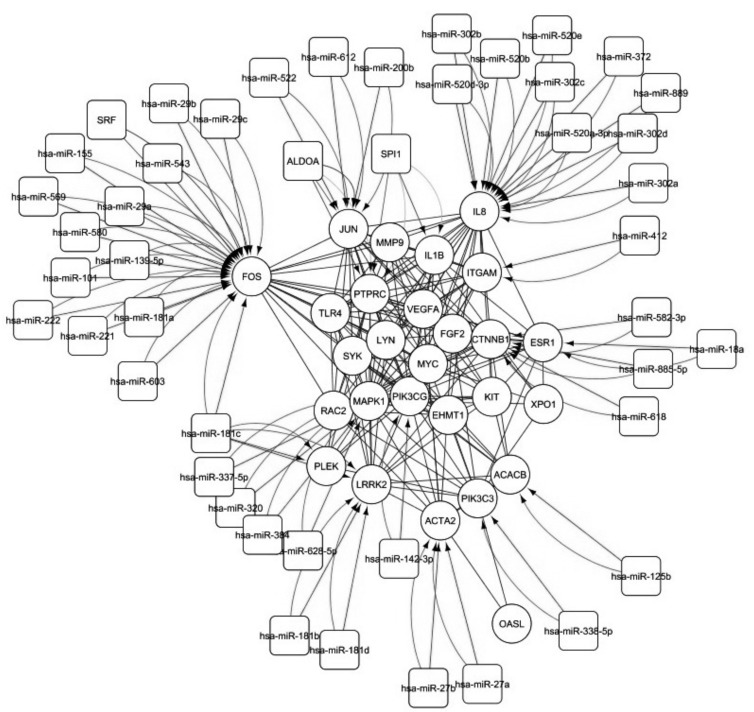
BACKGROUND: The role of adipose tissue in Insulin resistance (IR) and Type 2 Diabetes (T2D) has well been received in the biomedical community; being a precursor of T2D, identification of the molecular basis of IR is therefore, vital to elucidate T2D- pathogenesis and meta-analysis of previously conducted microarray studies provides an inexpensive approach to achieve this end. METHODS: In this study, we have carried out a statistical meta-analysis of 157 microarray datasets from five independent studies and identified a meta-signature of 1,511 genes; their functional meaning was elucidated by integrated pathways-analysis. Further, a protein-protein interaction network was constructed and key genes along with their high confidence transcriptional- and epigenetic-mediators were identified using a network biology approach. RESULTS: Various inflammation- and immune system-related pathways such as TGF-β signaling, IL7 signaling, Neutrophil degranulation, and Chemokine signaling etc. were enriched in sick adipose tissues; identified transcription factors, and microRNAs were also found to regulate processes relevant to IR/T2D pathophysiology. CONCLUSION: This study endorses the development of effective bioinformatics workflow and further grants an indication for the acceptance of adiposopathy as the root mechanistic pathology that poses risk for development of type 2 diabetes; concept of adipospathy in place of metabolic syndrome will open the possibility to design drugs, those will ameliorate adipose functions and hence proved to be more effective against Type 2 Diabetes.
Overview
The claims and statistics of this paper haven’t been checked yet.
Free: it reads the open-access text and checks the first 5 claims that cite a source we can check. Create a free account to check every claim.
Integrity signals
Registry
Cites
Statistics
Figures
Verification
Claims the paper makes
The claims and statistics of this paper haven’t been checked yet.
Free: it reads the open-access text and checks the first 5 claims that cite a source we can check. Create a free account to check every claim.
Claims other papers make about this one
Each is checked against this paper’s own text: does it say what the citing paper says it does?
The cited source says what the claim attributes to it.
In the citing paper
“A meta-analysis of 157 microarray datasets from five independent studies that identified a meta-signature of 1511 genes that endorse the development of effective bioinformatics workflow, and further grants an indication for the acceptance of adiposopathy as the root mechanistic pathology that poses risk for development of type 2 diabetes; the concept of adiposopathy in place of metabolic syndrome”
From Anti-Obesity Medications and Investigational Agents: An Obesity Medicine Association (OMA) Clinical Practice Statement (CPS) 2022 (2022) · cites this paper as [126]
In the citing paper
“the concept of adiposopathy in place of metabolic syndrome will open the possibility to design drugs that will ameliorate adipose tissue dysfunction and prove to be more effective against type 2 diabetes [126].”
From Anti-Obesity Medications and Investigational Agents: An Obesity Medicine Association (OMA) Clinical Practice Statement (CPS) 2022 (2022) · cites this paper as [126]
Self-check
Percentages, sums and reported differences re-computed from the paper’s own numbers.
The self-check needs the paper’s full text.
Citations
Cites
Cytoscape: A software Environment for integrated models of biomolecular interaction networks
Shannon, P., Markiel, A., Ozier, O., Baliga, N. S., Wang, J. T., Ramage, D., Amin, N., Schwikowski, B., & Ideker, T. (2003) · Genome Research · doi:10.1101/gr.1239303 · Cited by 51,888
STRING v10: protein–protein interaction networks, integrated over the tree of life
Szklarczyk, D., Franceschini, A., Wyder, S., Forslund, K., Heller, D., Huerta-Cepas, J., Simonovic, M., Roth, A., Santos, A., Tsafou, K. P., et al. (2015) · Nucleic Acids Research · doi:10.1093/nar/gku1003 · Cited by 10,436 · cited 1×
“To identify most important regulatory mediators of these meta-genes, a functional interaction network for protein products of these genes was created using stringApp that provides access to STRING (Search Tool for the Retrieval of Interacting Genes/Proteins) database [14].”
MethodcytoHubba: identifying hub objects and sub-networks from complex interactome
Chin, C.-H., Chen, S.-H., Wu, H.-H., Ho, C.-W., Ko, M.-T., & Lin, C.-Y. (2014) · BMC Systems Biology · doi:10.1186/1752-0509-8-s4-s11 · Cited by 6,562
Bindea, G., Mlecnik, B., Hackl, H., Charoentong, P., Tosolini, M., Kirilovsky, A., Fridman, W.-H., Pagès, F., Trajanoski, Z., & Galon, J. (2009) · Bioinformatics · doi:10.1093/bioinformatics/btp101 · Cited by 6,280
Mechanisms linking obesity to insulin resistance and type 2 diabetes
Kahn, S. E., Hull, R. L., & Utzschneider, K. M. (2006) · Nature · doi:10.1038/nature05482 · Cited by 5,448 · cited 2×
“However, metabolically healthy obese (MHO) people are clinically characterized in population, delineating the fact that it is indeed incorrect fat distribution rather mere excess fat storage that sets the stage for IR and T2D etiology; recent findings unraveling the role of adipose tissue in energy homeostasis in addi…”
BackgroundMechanisms of fatty acid-induced inhibition of glucose uptake.
Boden, G., Chen, X., Ruiz, J., White, J. V., & Rossetti, L. (1994) · Journal of Clinical Investigation · doi:10.1172/jci117252 · Cited by 3,705
Adipocyte dysfunctions linking obesity to insulin resistance and type 2 diabetes.
Guilherme, A., Virbasius, J. V., Puri, V., & Czech, M. P. (2008) · Nature Reviews Molecular Cell Biology · doi:10.1038/nrm2391 · Cited by 2,292
Yu, H., Kim, P. M., Sprecher, E., Trifonov, V., & Gerstein, M. (2007) · PLoS Computational Biology · doi:10.1371/journal.pcbi.0030059 · Cited by 1,014
NetworkAnalyst for statistical, visual and network-based meta-analysis of gene expression data
Xia, J., Gill, E. E., & Hancock, R. E. W. (2015) · Nature Protocols · doi:10.1038/nprot.2015.052 · Cited by 948
Protection from obesity and diabetes by blockade of TGF-β/smad3 signaling
Yadav, H., Quijano, C., Kamaraju, A. K., Gavrilova, O., Malek, R., Chen, W., Zerfas, P., Zhigang, D., Wright, E. C., Stuelten, C., et al. (2011) · Cell Metabolism · doi:10.1016/j.cmet.2011.04.013 · Cited by 709
Topological analysis and interactive visualization of biological networks and protein structures
Doncheva, N. T., Assenov, Y., Domingues, F. S., & Albrecht, M. (2012) · Nature Protocols · doi:10.1038/nprot.2012.004 · Cited by 503
Chakraborty, C., Doss, C. G. P., Bandyopadhyay, S., & Agoramoorthy, G. (2014) · WIREs RNA · doi:10.1002/wrna.1240 · Cited by 238
Hardy, O. T., Perugini, R. A., Nicoloro, S. M., Gallagher-Dorval, K., Puri, V., Straubhaar, J., & Czech, M. P. (2011) · Surgery for Obesity and Related Diseases · doi:10.1016/j.soard.2010.05.013 · Cited by 223
Xu, L., Kitade, H., Ni, Y., & Ota, T. (2015) · Biomolecules · doi:10.3390/biom5031563 · Cited by 185
Mechanisms of human insulin resistance and thiazolidinedione-mediated insulin sensitization
Sears, D. D., Hsiao, G., Hsiao, A., Yu, J. G., Courtney, C. H., Ofrecio, J. M., Chapman, J., & Subramaniam, S. (2009) · Proceedings of the National Academy of Sciences · doi:10.1073/pnas.0903032106 · Cited by 177
Estep, M., Armistead, D. L., Hossain, N., Elarainy, H. A., Goodman, Z. D., Baranova, A. V., Chandhoke, V., & Younossi, Z. M. (2010) · Alimentary Pharmacology & Therapeutics · doi:10.1111/j.1365-2036.2010.04366.x · Cited by 158
Granjon, A., Gustin, M.-P., Rieusset, J., Lefai, E., Meugnier, E., Güller, I., Cerutti, C., Paultre, C., Disse, E., Rabasa-Lhoret, R., et al. (2009) · Diabetes · doi:10.2337/db09-0165 · Cited by 142
Gene-chip studies of adipogenesis-regulated microRNAs in mouse primary adipocytes and human obesity
Keller, P., Gburcik, V., Petrovic, N., Gallagher, I. J., Nedergaard, J., Cannon, B., & Timmons, J. A. (2011) · BMC Endocrine Disorders · doi:10.1186/1472-6823-11-7 · Cited by 139
Sun, X., Lin, J., Zhang, Y., Kang, S., Belkin, N., Wara, A. K., Icli, B., Hamburg, N. M., Li, D., & Feinberg, M. W. (2016) · Circulation Research · doi:10.1161/circresaha.115.308166 · Cited by 135
CyTargetLinker: A Cytoscape App to Integrate Regulatory Interactions in Network Analysis
Kutmon, M., Kelder, T., Mandaviya, P. R., Evelo, C. T., & Coort, S. L. (2013) · PLoS ONE · doi:10.1371/journal.pone.0082160 · Cited by 129
Jin, W., Goldfine, A. B., Boes, T., Henry, R. R., Ciaraldi, T. P., Kim, E.-Y., Emecan, M., Fitzpatrick, C., Sen, A., Shah, A., et al. (2011) · Journal of Clinical Investigation · doi:10.1172/jci41940 · Cited by 106
Adiposopathy: Sick Fat Causes High Blood Sugar, High Blood Pressure and Dyslipidemia
Bays, H., Abate, N., & Chandalia, M. (2005) · Future Cardiology · doi:10.1517/14796678.1.1.39 · Cited by 105
Chen, M., Wang, M., Xu, S., Guo, X., & Jiang, J. (2015) · Oncotarget · doi:10.18632/oncotarget.6298 · Cited by 100
Soronen, J., Laurila, P.-P., Naukkarinen, J., Surakka, I., Ripatti, S., Jauhiainen, M., Olkkonen, V. M., & Yki-Järvinen, H. (2012) · BMC Medical Genomics · doi:10.1186/1755-8794-5-9 · Cited by 77
Latent Inflammation and Insulin Resistance in Adipose Tissue
Stafeev, I. S., Vorotnikov, A. V., Ratner, E. I., Menshikov, M. Y., & Parfyonova, Y. V. (2017) · International Journal of Endocrinology · doi:10.1155/2017/5076732 · Cited by 57
Lin, L., Pang, W., Chen, K., Wang, F., Gengler, J., Sun, Y., & Tong, Q. (2012) · American Journal of Physiology-Endocrinology and Metabolism · doi:10.1152/ajpendo.00462.2011 · Cited by 54 · cited 1×
“NADPH oxidase activates Reactive Oxygen Species (ROS); ROS cause oxidative stress leading to Insulin resistance and Type 2 diabetes [33].”
BackgroundIL-7 receptor deletion ameliorates diet-induced obesity and insulin resistance in mice
Lee, M., Song, S. J., Choi, M., Yu, R., & Park, T. (2015) · Diabetologia · doi:10.1007/s00125-015-3684-7 · Cited by 44
Jeong, B., Kang, I., & Koh, J. (2014) · FEBS Letters · doi:10.1016/j.febslet.2014.07.035 · Cited by 39
Mathur, S. K., Jain, P., & Mathur, P. (2011) · Journal of Obesity · doi:10.1155/2011/587495 · Cited by 37
Suzuki, T., Dai, P., Hatakeyama, T., Harada, Y., Tanaka, H., Yoshimura, N., & Takamatsu, T. (2013) · ACTA HISTOCHEMICA ET CYTOCHEMICA · doi:10.1267/ahc.12035 · Cited by 34
Lee, C.-C., Chen, P., Ho, K., Shih, C.-M., Cheng, C., Lin, C.-W., Cheng, K.-T., Liu, A.-J., & Chen, K. (2017) · PLoS ONE · doi:10.1371/journal.pone.0173890 · Cited by 18
Erratum to: MicroRNAs involved in the browning process of adipocytes
Arias, N., Aguirre, L., Fernández‐Quintela, A., González, M. A., Lasa, A., Miranda, J., Macarulla, M. T., & Portillo, M. P. (2016) · Journal of Physiology and Biochemistry · doi:10.1007/s13105-016-0475-7 · Cited by 11
System Level Meta-analysis of Microarray Datasets for Elucidation of Diabetes Mellitus Pathobiology
Saxena, A., Sachin, K., & Bhatia, A. K. (2017) · Current Genomics · doi:10.2174/1389202918666170105093339 · Cited by 8
Self-citationNeutrophils Suppress Insulin Signaling
Gough, N. R. (2012) · Science Signaling · doi:10.1126/scisignal.2003633 · Cited by 2
(2014) · Institutional Repository University of Antioquia (University of Antioquia) · doi:10.1371/journal.pone
Research works printed but not linked: 1
- [15]Chin C-H. Chen S-H. Wu H-H. Ho C-W. Ko M-T. Lin C-Y. 2014 https://bmcsystbiol.biomedcentral.com/articles/10
Cited by
Bays, H. E., Fitch, A., Christensen, S., Burridge, K., & Tondt, J. (2022) · Obesity Pillars · doi:10.1016/j.obpill.2022.100018 · Cited by 68
Foiselle, M., Barbosa, S., Godin, O., Wu, C., Boukouaci, W., André, M., Aouizerate, B., Berna, F. S., Barau, C., Capdevielle, D., et al. (2022) · Brain Behavior & Immunity - Health · doi:10.1016/j.bbih.2022.100436 · Cited by 22
Saxena, A., Mathur, N., Pathak, P., Tiwari, P., & Mathur, S. K. (2023) · Biomolecules · doi:10.3390/biom13030432 · Cited by 15
Self-citationSaxena, A. K., Mathur, N., Chaudhary, U., Raj, U., Rai, S., & Mathur, S. K. (2022) · Journal of Applied Biology & Biotechnology · doi:10.7324/jabb.2023.110116 · Cited by 1
Self-citationSzereszewski, K. E. (2019) · Carleton University's Institutional Repository (MacOdrum Library, Carleton University) · doi:10.22215/etd/2019-13837
Metadata
- Authors
- Saxena, A., & Sachin, K.
- Affiliations
- GLA University (IN)
- Department of Biochemistry and Biotechnology, S.B.S. (PG) Institute of Biomedical Sciences & Research, Dehradun (U.K.), India
- Corresponding author
- Saxena, Aditya
- ORCID
- Saxena, Aditya
- Venue
- Current Genomics
- Publisher
- Bentham Science Publishers Ltd.
- Published
- 2018-08-27
- Volume
- 19
- Issue
- 7
- Pages
- 630-636
- ISSN
- 1389-2029 (ISSN-L)
- PMC
- PMC6194434
- OpenAlex
- W2883814301
- Cited by
- 5
- References
- 34
- Citations by year
- 2023: 1 · 2022: 3 · 2019: 1
- FWCI
- 0.04
- Type
- journal article
- Language
- en
- Open access
- bronze
- doi.org
- Locations
- Current Genomics (publishedVersion)
- PubMed Central (publishedVersion, cc-by-nc)
- PubMed (publishedVersion)
- Funders
- GLA University
- Topics
- Health Sciences › Medicine › Endocrinology, Diabetes and Metabolism › Adipokines, Inflammation, and Metabolic Diseases
- Life Sciences › Biochemistry, Genetics and Molecular Biology › Molecular Biology › Bioinformatics and Genomic Networks
- Health Sciences › Medicine › Physiology (medical) › Adipose Tissue and Metabolism
- Keywords
- insulin resistance, type 2 diabetes, adipose tissue, adiposopathy, protein-protein interaction network, TGF-beta signaling, neutrophil degranulation, chemokine signaling, inflammation, microRNA, transcription factors, epigenetic regulators, metabolic syndrome
About these checks
Registry, retraction, Cites and statistics results are computed, not judged, with one exception: a printed reference that no index lists is read once by a model before it counts as a citation error. Claims are extracted by a model and kept only when their quote appears verbatim in the text; each cited source is then checked, with a model’s help, for whether it says what the claim relies on. Those verdicts can be wrong — read the claim’s quote and the cited source before relying on one.
Statistics and arithmetic are recomputed, not judged.
Confidence bands are shown only for fields calibrated on our annotated test set. None is calibrated yet, so no band is shown.
What counts as a claim ›How we measure confidence ›How we check this ›
Are you an author, or do you see a problem with this page? Request a review
Data sources
Bibliographic data: Semantic Scholar, OpenAlex, Crossref.
Contains information from the Semantic Scholar Academic Graph Datasets, made available under the ODC Attribution License (ODC-BY 1.0).
Semantic Scholar’s data is described in: Kinney, R., et al. (2023). The Semantic Scholar Open Data Platform. arXiv:2301.10140.
