

The DOI matches its Crossref record; 48 of the 49 references it cites were found in a registry or an index.
A Speech Recognition-based Solution for the Automatic Detection of Mild Cognitive Impairment from Spontaneous Speech
Open accessAbstract
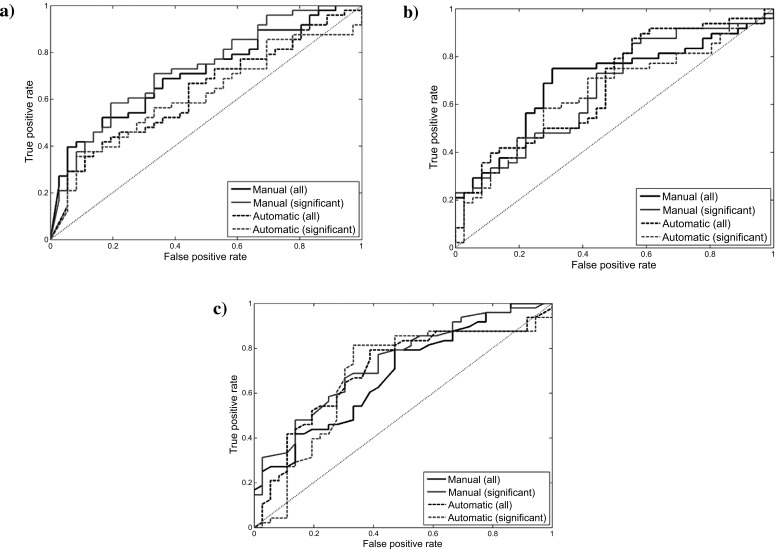
Background: Even today the reliable diagnosis of the prodromal stages of Alzheimer's disease (AD) remains a great challenge. Our research focuses on the earliest detectable indicators of cognitive decline in mild cognitive impairment (MCI). Since the presence of language impairment has been reported even in the mild stage of AD, the aim of this study is to develop a sensitive neuropsychological screening method which is based on the analysis of spontaneous speech production during performing a memory task. In the future, this can form the basis of an Internet-based interactive screening software for the recognition of MCI. Methods: Participants were 38 healthy controls and 48 clinically diagnosed MCI patients. The provoked spontaneous speech by asking the patients to recall the content of 2 short black and white films (one direct, one delayed), and by answering one question. Acoustic parameters (hesitation ratio, speech tempo, length and number of silent and filled pauses, length of utterance) were extracted from the recorded speech signals, first manually (using the Praat software), and then automatically, with an automatic speech recognition (ASR) based tool. First, the extracted parameters were statistically analyzed. Then we applied machine learning algorithms to see whether the MCI and the control group can be discriminated automatically based on the acoustic features. Results: The statistical analysis showed significant differences for most of the acoustic parameters (speech tempo, articulation rate, silent pause, hesitation ratio, length of utterance, pause-per-utterance ratio). The most significant differences between the two groups were found in the speech tempo in the delayed recall task, and in the number of pauses for the question-answering task. The fully automated version of the analysis process – that is, using the ASR-based features in combination with machine learning - was able to separate the two classes with an F1-score of 78.8%. Conclusion: The temporal analysis of spontaneous speech can be exploited in implementing a new, automatic detection-based tool for screening MCI for the community.
Overview
The claims and statistics of this paper haven’t been checked yet.
Run the check — free, no account needed. It reads the open-access text and checks the sources it cites.
Integrity signals
Registry
Cites
Statistics
Figures
Verification
Claims the paper makes
The claims and statistics of this paper haven’t been checked yet.
Run the check — free, no account needed. It reads the open-access text and checks the sources it cites.
Claims other papers make about this one
Each is checked against this paper’s own text: does it say what the citing paper says it does?
In the citing paper
“They were able to achieve over 80% classification accuracy by selecting LIWC categories that best represented the difference in the MCI and healthy control datasets.”
From A Review of Automated Speech and Language Features for Assessment of Cognitive and Thought Disorders (2020) · cites this paper as [7]
In the citing paper
“It is clear from the literature that first-order lexeme-level features, i.e. those related to lexical diversity and density, are useful biomarkers for detecting the presence or predicting the onset of a variety of conditions, such as MCI, AD, CTE, and potentially several others.”
From A Review of Automated Speech and Language Features for Assessment of Cognitive and Thought Disorders (2020) · cites this paper as [7]
Self-check
Percentages, sums and reported differences re-computed from the paper’s own numbers.
The self-check needs the paper’s full text.
Citations
Cites
Folstein, M. F., Folstein, S. E., & McHugh, P. R. (1975) · Journal of Psychiatric Research · doi:10.1016/0022-3956(75)90026-6 · Cited by 88,282
Hirono, N., Mori, E., Ikejiri, Y., Imamura, T., Shimomura, T., Hashimoto, M., Yamashita, H., & Ikeda, M. (1997) · PubMed · Cited by 21,012
Kok, J. S., Berg, I. J., & Scherder, E. J. A. (2013) · Dementia and Geriatric Cognitive Disorders Extra · doi:10.1159/000353441 · Cited by 20,589
Older Adults' Reasons for Using Technology while Aging in Place
Peek, S. T. M., Luijkx, K. G., Rijnaard, M. D., Nieboer, M. E., van der Voort, C. S., Aarts, S., van Hoof, J., Vrijhoef, H. J., & Wouters, E. (2015) · Gerontology · doi:10.1159/000430949 · Cited by 19,852
Sensitivity and False Alarm Rate of a Fall Sensor in Long-Term Fall Detection in the Elderly
Kangas, M., Korpelainen, R., Vikman, I., Nyberg, L., & Jämsä, T. J. (2014) · Gerontology · doi:10.1159/000362720 · Cited by 19,007
The Elements of Statistical Learning: Data Mining, Inference, and Prediction
Lu, Z. Q. J. (2010) · Journal of the Royal Statistical Society Series A (Statistics in Society) · doi:10.1111/j.1467-985x.2010.00646_6.x · Cited by 12,916
Estimating the Support of a High-Dimensional Distribution
Schölkopf, B., Platt, J. C., Shawe-Taylor, J., Smola, A. J., & Williamson, R. C. (2001) · Neural Computation · doi:10.1162/089976601750264965 · Cited by 6,168
Praat, a system for doing phonetics by computer
Boersma, P. (2002) · UvA-DARE (University of Amsterdam) · Cited by 4,417
A new rating scale for Alzheimer's disease
(1984) · American Journal of Psychiatry · doi:10.1176/ajp.141.11.1356 · Cited by 4,175
Naive (Bayes) at forty: The independence assumption in information retrieval
Lewis, D. D. (1998) · Lecture notes in computer science · doi:10.1007/bfb0026666 · Cited by 2,140
Research works printed but not linked: 3
- [36]Hall M. Frank E. Holmes G. Pfahringer B. Reutemann P. Witten I. The WEKA data mining software: an update. ACM SIGKDD Explorations Newsletter 2009 11 1 10 18
- [37]Freedman M.I. Leach L. Kaplan E. Winocur G. Shulman K.J. Delis D.C. Clock drawing. Oxford Oxford University Press 1994
- [44]Szabó L. Tarján B. Mihajlik P. Fegyó T. Speeding up error correction in a Hungarian dictation system (in Hungarian Proceedings of MSZNY 182 91 2015
Cited by
Sorted by citations
Items 101–200 of 289
Balogh, R., Imre, N., Gosztolya, G., Hoffmann, L., Pákáski, M., & Kálmán, J. (2022) · Journal of the International Neuropsychological Society · doi:10.1017/s1355617721001454 · Cited by 15
Self-citationThe current state of artificial intelligence-augmented digitized neurocognitive screening test
Sirilertmekasakul, C., Rattanawong, W., Gongvatana, A., & Srikiatkhachorn, A. (2023) · Frontiers in Human Neuroscience · doi:10.3389/fnhum.2023.1133632 · Cited by 14
Acceptability of collecting speech samples from the elderly via the telephone
Diaz-Asper, C. M., Chandler, C., Turner, R. S., Reynolds, B., & Elvevåg, B. (2021) · Digital Health · doi:10.1177/20552076211002103 · Cited by 15
Wang, R.-M., Chen, K., Guo, C., Chen, Y., Li, C., Matsumura, Y., Ishimaru, M., Pelt, A. J. V., & Chen, F. (2023) · Journal of Alzheimer s Disease · doi:10.3233/jad-230373 · Cited by 13
Dementia Detection from Speech: What If Language Models Are Not the Answer?
Bouazizi, M., Zheng, C., Yang, S., & Ohtsuki, T. O. (2023) · Information · doi:10.3390/info15010002 · Cited by 14
Kim, T. M., Son, J., Chun, J., Lee, Y., Kim, D., Choi, I.-Y., Ko, T., & Choi, S. (2024) · Computers in Biology and Medicine · doi:10.1016/j.compbiomed.2024.108950 · Cited by 13
Open Brain AI and language assessment
Themistocleous, C. K. (2024) · Frontiers in Human Neuroscience · doi:10.3389/fnhum.2024.1421435 · Cited by 18
Hall, A., Shinkawa, K., Kosugi, A., Takase, T., Kobayashi, M., Nishimura, M., Nemoto, M., Watanabe, R., Tsukada, E., Ota, M., et al. (2019) · PubMed Central · Cited by 13
Egas-López, J. V., Balogh, R., Imre, N., Hoffmann, I., Szabó, M. K., Tóth, L., Pákáski, M., Kálmán, J., & Gosztolya, G. (2022) · Computer Speech & Language · doi:10.1016/j.csl.2022.101377 · Cited by 12
Self-citationKálmán, J., Devanand, D. P., Gosztolya, G., Balogh, R., Imre, N., Tóth, L., Hoffmann, I., Kovács, I., Vincze, V., & Pákáski, M. (2022) · Current Alzheimer Research · doi:10.2174/1567205019666220418155130 · Cited by 12
Self-citationDuBord, A. Y., Paolillo, E. W., & Staffaroni, A. M. (2023) · Journal of Diabetes Science and Technology · doi:10.1177/19322968231171399 · Cited by 12
Walker, G., Morris, L., Christensen, H., Mirheidari, B., Reuber, M., & Blackburn, D. J. (2020) · Clinical Linguistics & Phonetics · doi:10.1080/02699206.2020.1777586 · Cited by 12
Hoffmann, I., Balogh, R., Kálmán, J., Pákáski, M., Gosztolya, G., & Imre, N. (2022) · Repository of the Academy's Library (Library of the Hungarian Academy of Sciences) · Cited by 12
Self-citationZolnour, A., Azadmaleki, H., Haghbin, Y., Taherinezhad, F., Nezhad, M. J. M., Rashidi, S., Khani, M., Taleban, A., Sani, S. M., Dadkhah, M., et al. (2025) · Frontiers in Artificial Intelligence · doi:10.3389/frai.2025.1669896 · Cited by 12
Evaluating spoken language as a biomarker for automated screening of cognitive impairment
Lima, M. R. D., Capstick, A., Geranmayeh, F., Nilforooshan, R., Matarić, M. J., Vaidyanathan, R., & Barnaghi, P. M. (2025) · Communications Medicine · doi:10.1038/s43856-025-01263-1 · Cited by 13
Cay, G., Pfeifer, V. A., Lee, M., Rouzi, M. D., Nunes, A. S., El-Refaei, N., Momin, A. S., Atique, M. M. U., Mehl, M. R., Vaziri, A., et al. (2024) · Gerontology · doi:10.1159/000536250 · Cited by 11
Dar, M. A., & Pushparaj, J. (2024) · Applied Acoustics · doi:10.1016/j.apacoust.2024.110505 · Cited by 11
Vincze, V., Szabó, M. K., Hoffmann, I., Tóth, L., Pákáski, M., Kálmán, J., & Gosztolya, G. (2021) · Computational Linguistics · doi:10.1162/coli_a_00428 · Cited by 14
Self-citationA deep learning-based approach to diagnose mild traumatic brain injury using audio classification
Wall, C., Powell, D., Young, F., Zynda, A. J., Stuart, S., Covassin, T., & Godfrey, A. (2022) · PLoS ONE · doi:10.1371/journal.pone.0274395 · Cited by 13
Fu, Z., Haider, F., & Luz, S. F. (2020) · Annual International Conference of the IEEE Engineering in Medicine and Biology Society (EMBC) · doi:10.1109/embc44109.2020.9175379 · Cited by 11
Hybrid architecture CNN-BLSTM for automatic speech recognition
Dar, M. A., & Pushparaj, J. (2024) · International Conference on Artificial Intelligence for Internet of Things (AIIoT) · doi:10.1109/aiiot58432.2024.10574740 · Cited by 10
Predicting Dementia Risk Using Paralinguistic and Memory Test Features with Machine Learning Models
You, Y., Ahmed, B., Barr, P., Ballard, K. J., & Valenzuela, M. (2019) · IEEE Healthcare Innovations and Point of Care Technologies Conference (HI-POCT) · doi:10.1109/hi-poct45284.2019.8962887 · Cited by 10
Imre, N., Balogh, R., Gosztolya, G., Tóth, L., Hoffmann, I., Várkonyi, T., Lengyel, C., Pákáski, M., & Kálmán, J. (2022) · Alzheimer Disease & Associated Disorders · doi:10.1097/wad.0000000000000492 · Cited by 10
Self-citationStatsenko, Y. A., Meribout, S., Habuza, T., Almansoori, T. M., Gorkom, K., Gelovani, J. G., & Ljubisavljević, M. (2023) · Frontiers in Aging Neuroscience · doi:10.3389/fnagi.2022.943566 · Cited by 10
König, A., Köhler, S., Tröger, J., Düzel, E., Glanz, W., Butryn, M., Mallick, E., Priller, J., Altenstein, S., Spottke, A. E., et al. (2024) · Alzheimer s & Dementia Diagnosis Assessment & Disease Monitoring · doi:10.1002/dad2.70011 · Cited by 9
A Comparison of Speech Features between Mild Cognitive Impairment and Healthy Aging Groups
Kim, K. W., Na, S., Chung, Y., & Shin, B. (2021) · Dementia and Neurocognitive Disorders · doi:10.12779/dnd.2021.20.4.52 · Cited by 9
Higa, E., Elbéji, A., Zhang, L., Fischer, A., Aguayo, G., Nazarov, P. V., & Fagherazzi, G. (2022) · JMIR Medical Informatics · doi:10.2196/35622 · Cited by 10
Dörr, F., Schäfer, S., Öhman, F., Linz, N., Bodin, T. H., Skoog, J., Zettergren, A., Kern, S., Skoog, I. G., & Tröger, J. (2023) · Neuropsychologia · doi:10.1016/j.neuropsychologia.2023.108679 · Cited by 9
Consumer‐directed technologies to improve medication management and safety
Andrade, A. Q. D., & Roughead, E. E. (2019) · The Medical Journal of Australia · doi:10.5694/mja2.50029 · Cited by 9
Predicting Prodromal Dementia Using Linguistic Patterns and Deficits
Alkenani, A. H., Li, Y., Xu, Y., & Zhang, Q. (2020) · IEEE Access · doi:10.1109/access.2020.3029907 · Cited by 9
Predicting adult Attention Deficit Hyperactivity Disorder (ADHD) using vocal acoustic featuresPreprint
von Polier, G. G., Ahlers, E., Amunts, J., Langner, J., Patil, K. R., Eickhoff, S. B., Helmhold, F., & Langner, D. (2021) · medRxiv · doi:10.1101/2021.03.18.21253108 · Cited by 10
Kiyoshige, E., Ogata, S., Kwon, N., Nakaoku, Y., Hayashi, C., Blaylock, N., Brueckner, R., Subramanian, V., OConnell, H. J., Yoshikawa, Y., et al. (2025) · The Lancet Regional Health - Western Pacific · doi:10.1016/j.lanwpc.2025.101598 · Cited by 8
Bertsias, A., Symvoulakis, E. K., Tziraki, C., Panagiotakis, S. H., Mathioudakis, L., Zaganas, I. V., Basta, M., Boumpas, D., Simos, P. G., Vgontzas, A. N., et al. (2020) · Frontiers in Medicine · doi:10.3389/fmed.2020.592924 · Cited by 8
Dang, M., Liu, B., Chen, Y., & Zhang, Z. (2026) · Psychoradiology · doi:10.1093/psyrad/kkag007 · Cited by 10
Digital speech biomarkers for assessing cognitive decline across neurodegenerative conditions
Kováč, D., Novakova, L., Mekyska, J., Novotny, K., Brabenec, L., Klobušiaková, P., & Rektorová, I. (2025) · Computers in Biology and Medicine · doi:10.1016/j.compbiomed.2025.111251 · Cited by 11
Learning implicit sentiments in Alzheimer's disease recognition with contextual attention features
Liu, N., Yuan, Z., Chen, Y., Liu, C., & Wang, L. (2023) · Frontiers in Aging Neuroscience · doi:10.3389/fnagi.2023.1122799 · Cited by 9
Friedman, L., Lauber, M. V., Behroozmand, R., Fogerty, D., Kunecki, D., Berry‐Kravis, E., & Klusek, J. (2023) · Experimental Brain Research · doi:10.1007/s00221-023-06653-2 · Cited by 7
Deep Learning-Based Oral Cancer Detection through Speech Analysis
Cherukupalli, M., Ragavan, B., Pooja, S., Jaideep, S., & Supriya, P. (2024) · Control Instrumentation System Conference (CISCON) · doi:10.1109/ciscon62171.2024.10695997 · Cited by 7
Kleiman, M. J., & Galvin, J. E. (2024) · Journal of Alzheimer s Disease · doi:10.1177/13872877241291239 · Cited by 7
A Study for Detecting Mild Cognitive Impairment by Analyzing Conversations with Humanoid Robots
Yoshii, K., Nishimura, M., Kimura, D., Kosugi, A., Shinkawa, K., Takase, T., Kobayashi, M., Yamada, Y., Nemoto, M., Watanabe, R., et al. (2021) · IEEE Global Conference on Life Sciences and Technologies (LifeTech) · doi:10.1109/lifetech52111.2021.9391934 · Cited by 7
Robustness and Sensitivity of BERT Models Predicting Alzheimer’s Disease from Text
Novikova, J. (2021) · Workshop on Noisy User-generated Text (W-NUT) · doi:10.18653/v1/2021.wnut-1.37 · Cited by 11
Discrimination of mild cognitive impairment based on involuntary changes caused in voice elements
Higuchi, M., Nakamura, M., Omiya, Y., & Tokuno, S. (2023) · Frontiers in Neurology · doi:10.3389/fneur.2023.1197840 · Cited by 7
HAMRICK, P. J. J., Sanborn, V. E., Ostrand, R., & Gunstad, J. (2023) · JMIR Aging · doi:10.2196/46483 · Cited by 7
Speech pause distribution as an early marker for Alzheimer’s diseasePreprint
Pastoriza-Domínguez, P., Torre, I. G., Diéguez-Vide, F., Gómez‐Ruiz, I., Geladó, S., López, J. B., Ávila, A., Matías‐Guiu, J. A., Pytel, V., & Hernández-Fernändez, A. (2021) · medRxiv · doi:10.1101/2020.12.28.20248875 · Cited by 7
Objective speech measures capture depressive symptoms and associated cognitive difficulties
Wiseman, M., Yep, R., Alexander, M. W., Pople, C. B., Perri, L., Gopinath, G., Vasileiadi, M., Robin, J., Spilka, M. J., Simpson, W. S., et al. (2025) · Translational Psychiatry · doi:10.1038/s41398-025-03728-2 · Cited by 8
Xu, L., Chen, K., Mueller, K. D., Liss, J., & Berisha, V. (2024) · Journal of Alzheimer s Disease · doi:10.1177/13872877241300149 · Cited by 8
Nylander, A. N., Sisodia, N., Henderson, K., Wijangco, J., Koshal, K., Poole, S. T., Dias, M., Linz, N., Tröger, J., König, A., et al. (2024) · Multiple Sclerosis Journal · doi:10.1177/13524585241303855 · Cited by 6
COVID-19 activity screening by a smart-data-driven multi-band voice analysis
Silva, G., Batista, P., & Rodrigues, P. M. (2022) · Journal of Voice · doi:10.1016/j.jvoice.2022.11.008 · Cited by 6
A Cross-language Dementia Classifier: a Preliminary Study
Bertini, F., Allevi, D., Lutero, G., Calzà, L., & Montesi, D. (2022) · IEEE International Conference on Metrology for eXtended Reality, Artificial Intelligence and Neural Engineering (MetroXRAINE) · doi:10.1109/metroxraine54828.2022.9967558 · Cited by 7
Svindt, V., Gosztolya, G., & Gráczi, T. E. (2023) · Clinical Linguistics & Phonetics · doi:10.1080/02699206.2023.2170830 · Cited by 6
Self-citationPre-training and ensembling based Alzheimer’s disease detection
Xu, F., Zheng, Q., Shi, J., Yan, K., & Wang, M. (2023) · Technology and Health Care · doi:10.3233/thc-230571 · Cited by 6
Discourse and Conversation Impairments in Patients with Dementia
Themistocleous, C. K. (2023) · Springer eBooks · doi:10.1007/978-3-031-45190-4_3 · Cited by 7
Multilingual speech recognition initiative for African languages
Naira, A. M., Allak, A., Gaanoun, K., Benelallam, I., Erraji, Z., & Bahafid, A. (2024) · International Journal of Data Science and Analytics · doi:10.1007/s41060-024-00677-9 · Cited by 10
Kim, M., Kim, H., & Lim, J. S. (2020) · International Conference on Information and Communication Technology Convergence (ICTC) · doi:10.1109/ictc49870.2020.9289477 · Cited by 6
Detection of Alzheimer’s Disease Through Speech Features and Machine Learning Classifiers
Gulapalli, A. S., & Mittal, V. K. (2022) · Lecture notes in networks and systems · doi:10.1007/978-981-16-6309-3_59 · Cited by 5
Speech evaluation of patients with alzheimer’s disease using an automatic interviewer
Alonso Hernández, J. B., Barragán Pulido, M. L., Gil Bordón, J. M., Ferrer Ballester, M. Á., & Travieso González, C. M. (2022) · Expert Systems with Applications · doi:10.1016/j.eswa.2021.116386 · Cited by 5
de la Fuente Garcia, S., Ritchie, C. W., & Luz, S. (2020) · Journal of Alzheimer's Disease · doi:10.3233/jad-200888 · Cited by 5
Analysis of Speech Features in Alzheimer’s Disease with Machine Learning: A Case-Control Study
Noto, S., Sekiyama, Y., Nagata, R., Yamamoto, G., & Tamura, T. (2024) · Healthcare · doi:10.3390/healthcare12212194 · Cited by 9
A Novel Approach to Mimic Linguistic Features of Transcripts of Atypical Speech
Mirbagheri, M., Saghir, H., & Chau, T. (2025) · IEEE Transactions on Audio Speech and Language Processing · doi:10.1109/taslpro.2025.3603921 · Cited by 5
He, D., Xu, L., Betthauser, T. J., Hulle, C. V., Liss, J., Berisha, V., & Mueller, K. D. (2025) · Alzheimer s & Dementia · doi:10.1002/alz.70635 · Cited by 5
Azadmaleki, H., Haghbin, Y., Rashidi, S., Nezhad, M. J. M., Zolnour, A., & Zolnoori, M. (2025) · npj Digital Medicine · doi:10.1038/s41746-025-02026-x · Cited by 5
Taherinezhad, F., Nezhad, M. J. M., Karimi, S., Rashidi, S., Zolnour, A., Dadkhah, M., Haghbin, Y., Azadmaleki, H., & Zolnoori, M. (2026) · JMIR AI · doi:10.2196/82608 · Cited by 8
Speech error rates after a sports-related concussion
Patel, S. A., Grabowski, C., Dayalu, V. N., & Testa, A. J. (2023) · Frontiers in Psychology · doi:10.3389/fpsyg.2023.1135441 · Cited by 6
Prediction of Cognitive Impairment Using Sleep Lifelog Data and LSTM Model
Hong, J., Seol, Y., Lee, S., Yoon, J., Lee, J., Park, K., & Ha, J.-W. (2024) · Mathematics · doi:10.3390/math12203208 · Cited by 6
Transformer-Based Deep Learning Approaches for Speech-Based Dementia Detection: A Systematic Review
Mobtahej, P., Gouron, S., Javaheri, R., Le, D. N., El‐Khoury, A., Naing, T. H., & Sajjadi, S. A. (2025) · IEEE Journal of Biomedical and Health Informatics · doi:10.1109/jbhi.2025.3595781 · Cited by 5
Thaler, F., & Gewald, H. (2021) · Health Informatics - An International Journal · doi:10.5121/hiij.2021.10102 · Cited by 5
Zhang, L., Ngo, A. D., Thomas, J., Burkhardt, H. A., Parsey, C. M., Au, R., & Ghomi, R. H. (2021) · Exploration of Medicine · doi:10.37349/emed.2021.00044 · Cited by 6
Speech Analysis in Preclinical Identification of Alzheimer’s Disease
Ivanova, O., & Meilán, J. J. G. (2022) · Lecture notes in computer science · doi:10.1007/978-3-031-06242-1_36 · Cited by 5
Yawatkar, V., Chow, H. M., & Usler, E. R. (2025) · Behavior Research Methods · doi:10.3758/s13428-025-02733-z · Cited by 5
Tseng, Y.-T., Chang, Y., & Chiu, Y. (2024) · Journal of Alzheimer s Disease · doi:10.3233/jad-230871 · Cited by 4
Voice biomarkers in middle and later adulthood as predictors of cognitive changes
Mahon, E., & Lachman, M. E. (2024) · Frontiers in Psychology · doi:10.3389/fpsyg.2024.1422376 · Cited by 4
Zheng, T., Wang, X., Peng, X., Su, N., Xu, T., Xurong, X. I. E., Huang, J., Xie, L., & Tian, F. (2024) · Virtual Reality & Intelligent Hardware · doi:10.1016/j.vrih.2024.08.001 · Cited by 5
Speech and language outcome measures in clinical trials of Alzheimer’s and Parkinson’s diseases
Berthier, M. L., Welford, A. S., Orozco‐Arroyave, J. R., López-Barroso, D., Torres‐Prioris, M. J., Dávila, G., & García, A. M. (2025) · Expert Review of Neurotherapeutics · doi:10.1080/14737175.2025.2600616 · Cited by 3
Digital Health Technologies Applied in Patients With Early Cognitive Change: Scoping Review
Zhang, Y., Zhu, X., Yang, S., Wong, A. K. C., & Chen, X. (2025) · Journal of Medical Internet Research · doi:10.2196/82881 · Cited by 4
Reeves, S. M., Williams, V. J., Blacker, D., & Woods, R. L. (2022) · Neuropsychology · doi:10.1037/neu0000884 · Cited by 5
Walker, G., Pevy, N., O’Malley, R., Mirheidari, B., Reuber, M., Christensen, H., & Blackburn, D. J. (2023) · Clinical Linguistics & Phonetics · doi:10.1080/02699206.2023.2254458 · Cited by 4
Tripathi, T., & Kumar, R. (2024) · ADCAIJ ADVANCES IN DISTRIBUTED COMPUTING AND ARTIFICIAL INTELLIGENCE JOURNAL · doi:10.14201/adcaij.31625 · Cited by 5
Alonso-Hernández, J. B., Barragán-Pulido, M. L., Gil-Bordón, J. M., Ferrer, M. A., & Travieso, C. M. (2021) · Applied Sciences · doi:10.3390/app11073228 · Cited by 4
Metarugcheep, S., Punyabukkana, P., Wanvarie, D., Hemrungrojn, S., Chunharas, C., & Pratanwanich, P. N. (2022) · Sensors · doi:10.3390/s22155813 · Cited by 4
Virtual Companion for the Elderly: Conceptual FrameworkPreprint
Bassi, A., Chan, J. H., & Mongkolnam, P. (2021) · SSRN Electronic Journal · doi:10.2139/ssrn.3953063 · Cited by 5
Hanford, L. C., Jacoby, J. R., Salat, D. H., Arnold, S. E., & Eshghi, M. (2025) · Human Brain Mapping · doi:10.1002/hbm.70288 · Cited by 3
Heitz, J., Engler, I., & Langer, N. (2026) · npj Digital Medicine · doi:10.1038/s41746-026-02360-8 · Cited by 4
Lyu, Y., Wu, H.-M., Chen, R., Hong, J., Chen, C.-F., Shi, Y., Yi-qin, W. A. N. G., Yan, H., & Xu, J. (2026) · BMC Medical Informatics and Decision Making · doi:10.1186/s12911-026-03518-w · Cited by 3
Meyer, T., Favaro, A., Oh, E. S., Butala, A., Motley, C., Irazoqui, P. P., Dehak, N., & Moro-Velázquez, L. (2024) · Computers in Biology and Medicine · doi:10.1016/j.compbiomed.2024.109398 · Cited by 3
Hamaguchi, R., Hongo, S., Doi, N., Ide, H., Saito, R., Kishimoto, J., Handa, N., & Horie, S. (2025) · Frontiers in Digital Health · doi:10.3389/fdgth.2025.1535900 · Cited by 3
Vocal biomarkers correlate with FEV1 variations during methacholine challenge
Paoletti, G., Costanzo, G., Merigo, M., Puggioni, F., Ferri, S., Messina, M., Cordella, F., Ranieri, G., Arienzo, A., Savevski, V., et al. (2025) · Clinical and Translational Allergy · doi:10.1002/clt2.70055 · Cited by 3
Strip Surface Defect Detection Algorithm Based on Improved YOLO11
Cao, J., & Liu, Z. (2025) · Chinese Control and Decision Conference (CCDC) · doi:10.1109/ccdc65474.2025.11090264 · Cited by 3
Changes in Speech Range Profile Are Associated with Cognitive Impairment
Stefano, A. D., Giovanni, P. D., Kulamarva, G., Fonzo, F. D., Massaro, T., Contini, A., Dispenza, F., & Cazzato, C. (2021) · Dementia and Neurocognitive Disorders · doi:10.12779/dnd.2021.20.4.89 · Cited by 3
Noninvasive Detection of Alzheimer’s Disease from Conversational Speech Using 1D-CNN
Alex, J. S. R., Bhyri, R., Usha, G. P., & Arvind, S. V. (2023) · Lecture notes in electrical engineering · doi:10.1007/978-981-19-8338-2_49 · Cited by 3
Mirheidari, B., Malley, R. O., Blackburn, D. J., & Christensen, H. (2023) · IEEE Workshop on Automatic Speech Recognition and Understanding (ASRU) · doi:10.1109/asru57964.2023.10389623 · Cited by 3
Detection and Classification of Neurodegenerative Diseases by Automatic Speech Analysis
Kehili, A., Bouafif, L., & Chérif, A. (2024) · International Conference on Advanced Technologies for Signal and Image Processing · doi:10.1109/atsip62566.2024.10638844 · Cited by 3
Zhu, Y., Chen, Z., Shi, Z., Chen, J., Zuo, Q., Yang, Z., Zhang, W., Li, W., Lu, S., Peng, S., et al. (2025) · Frontiers in Human Neuroscience · doi:10.3389/fnhum.2025.1623252 · Cited by 3
Holmlund, T. B., Diaz-Asper, C. M., & Elvevåg, B. (2020) · Cortex · doi:10.1016/j.cortex.2020.08.024 · Cited by 4
Gosztolya, G., Bagi, A., Szalóki, S., Szendi, I., & Hoffmann, I. (2020) · Interspeech (USB) · doi:10.21437/interspeech.2020-0049 · Cited by 3
Self-citationA Review of Automated Speech-Based Interaction for Cognitive Screening
Boletsis, C. (2020) · Multimodal Technologies and Interaction · doi:10.3390/mti4040093 · Cited by 3
An Attribute-Aligned Strategy for Learning Speech Representation
Huang, Y.-L., Su, B.-H., Hong, Y.-W. P., & Lee, C.-C. (2021) · Interspeech (USB) · doi:10.21437/interspeech.2021-1341 · Cited by 3
Azadmaleki, H., Zolnour, A., Rashidi, S., Noble, J. M., Hirschberg, J., Esmaeili, E., Morovati, T., & Zolnoori, M. (2025) · International Journal of Medical Informatics · doi:10.1016/j.ijmedinf.2025.106208 · Cited by 2
Choi, Y. H., Kim, H.-J., Hong, S., Baek, C., Wang, B., Shim, Y., Hong, Y. J., Byun, S., Song, I., Na, S., et al. (2025) · Journal of Alzheimer s Disease · doi:10.1177/13872877251401202 · Cited by 2
Zolnoori, M., Zolnour, A., Rashidi, S., Spens, I., Haghbin, Y., Vergez, S., Flaherty, G., Onorato, N., Vasquez, F., Noble, J. M., et al. (2025) · Journal of Gerontological Nursing · doi:10.3928/00989134-20251208-03 · Cited by 2
Paulino, A., Sierra, G., da Cunha, I., & Hernández-Domínguez, L. (2020) · Revista signos · doi:10.4067/s0718-09342020000100242 · Cited by 2
Metadata
- Authors
- Toth, L., Hoffmann, I., Gosztolya, G., Vincze, V., Szatloczki, G., Banreti, Z., Pakaski, M., & Kalman, J.
- Affiliations
- MTA-SZTE Research Group on Artificial Intelligence, Szeged, Hungary
- Linguistics Department, University of Szeged, Szeged, Hungary
- MTA-SZTE Research Group on Artificial Intelligence (HU)
- Department of Psychiatry, University of Szeged, Szeged, Hungary
- Research Institute for Linguistics, Hungarian Academy of Sciences, Budapest, Hungary
- ORCID
- Vincze, Veronika
- Venue
- Current Alzheimer Research
- Publisher
- Bentham Science Publishers Ltd.
- Published
- 2018-01-03
- Volume
- 15
- Issue
- 2
- Pages
- 130-138
- ISSN
- 1567-2050 (ISSN-L)
- PMC
- PMC5815089
- OpenAlex
- W2770604845
- Cited by
- 290
- References
- 49
- Citations by year
- 2026: 39 · 2025: 37 · 2024: 42 · 2023: 46 · 2022: 31 · 2021: 44 · 2020: 26 · 2019: 19 · 2018: 3
- FWCI
- 11.22
- Type
- journal article
- Language
- en
- Open access
- bronze
- doi.org
- Locations
- Current Alzheimer Research (publishedVersion)
- Europe PMC (PubMed Central) (publishedVersion, cc-by-nc)
- PubMed Central (publishedVersion, cc-by-nc)
- PubMed (publishedVersion)
- SZTE Publicatio Repozitórium (University of Szeged) (acceptedVersion, other-oa)
- Repository of the Academy's Library (Library of the Hungarian Academy of Sciences) (acceptedVersion)
- Funders
- Magyar Tudományos Akadémia
- Topics
- Health Sciences › Medicine › Psychiatry and Mental health › Dementia and Cognitive Impairment Research
- Physical Sciences › Computer Science › Artificial Intelligence › Speech Recognition and Synthesis
- Health Sciences › Health Professions › Speech and Hearing › Voice and Speech Disorders
- Keywords
- mild cognitive impairment, Alzheimer's disease, spontaneous speech, speech tempo, acoustic features, speech hesitations, pauses, neuropsychological screening, automated detection, memory retrieval
- MeSH terms
- Machine Learning, Aged, Aged, 80 and over, Diagnosis, Computer-Assisted, Female, Humans, Male, Memory, Middle Aged, Neuropsychological Tests, Pattern Recognition, Automated, ROC Curve, Speech, Speech Production Measurement, Models, Statistical, Internet, Speech Recognition Software, Cognitive Dysfunction
About these checks
Registry, retraction, Cites and statistics results are computed, not judged, with one exception: a printed reference that no index lists is read once by a model before it counts as a citation error. Claims are extracted by a model and kept only when their quote appears verbatim in the text; each cited source is then checked, with a model’s help, for whether it says what the claim relies on. Those verdicts can be wrong — read the claim’s quote and the cited source before relying on one.
Statistics and arithmetic are recomputed, not judged.
Confidence bands are shown only for fields calibrated on our annotated test set. None is calibrated yet, so no band is shown.
What counts as a claim ›How we measure confidence ›How we check this ›
Are you an author, or do you see a problem with this page? Request a review
