

The DOI matches its Crossref record; 48 of the 49 references it cites were found in a registry or an index.
A Speech Recognition-based Solution for the Automatic Detection of Mild Cognitive Impairment from Spontaneous Speech
Open accessAbstract
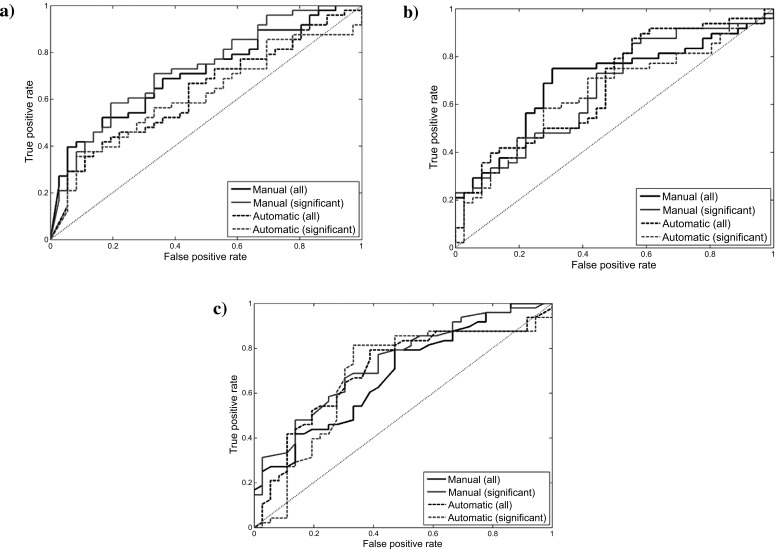
Background: Even today the reliable diagnosis of the prodromal stages of Alzheimer's disease (AD) remains a great challenge. Our research focuses on the earliest detectable indicators of cognitive decline in mild cognitive impairment (MCI). Since the presence of language impairment has been reported even in the mild stage of AD, the aim of this study is to develop a sensitive neuropsychological screening method which is based on the analysis of spontaneous speech production during performing a memory task. In the future, this can form the basis of an Internet-based interactive screening software for the recognition of MCI. Methods: Participants were 38 healthy controls and 48 clinically diagnosed MCI patients. The provoked spontaneous speech by asking the patients to recall the content of 2 short black and white films (one direct, one delayed), and by answering one question. Acoustic parameters (hesitation ratio, speech tempo, length and number of silent and filled pauses, length of utterance) were extracted from the recorded speech signals, first manually (using the Praat software), and then automatically, with an automatic speech recognition (ASR) based tool. First, the extracted parameters were statistically analyzed. Then we applied machine learning algorithms to see whether the MCI and the control group can be discriminated automatically based on the acoustic features. Results: The statistical analysis showed significant differences for most of the acoustic parameters (speech tempo, articulation rate, silent pause, hesitation ratio, length of utterance, pause-per-utterance ratio). The most significant differences between the two groups were found in the speech tempo in the delayed recall task, and in the number of pauses for the question-answering task. The fully automated version of the analysis process – that is, using the ASR-based features in combination with machine learning - was able to separate the two classes with an F1-score of 78.8%. Conclusion: The temporal analysis of spontaneous speech can be exploited in implementing a new, automatic detection-based tool for screening MCI for the community.
Overview
The claims and statistics of this paper haven’t been checked yet.
Run the check — free, no account needed. It reads the open-access text and checks the sources it cites.
Integrity signals
Registry
Cites
Statistics
Figures
Verification
Claims the paper makes
The claims and statistics of this paper haven’t been checked yet.
Run the check — free, no account needed. It reads the open-access text and checks the sources it cites.
Claims other papers make about this one
Each is checked against this paper’s own text: does it say what the citing paper says it does?
In the citing paper
“They were able to achieve over 80% classification accuracy by selecting LIWC categories that best represented the difference in the MCI and healthy control datasets.”
From A Review of Automated Speech and Language Features for Assessment of Cognitive and Thought Disorders (2020) · cites this paper as [7]
In the citing paper
“It is clear from the literature that first-order lexeme-level features, i.e. those related to lexical diversity and density, are useful biomarkers for detecting the presence or predicting the onset of a variety of conditions, such as MCI, AD, CTE, and potentially several others.”
From A Review of Automated Speech and Language Features for Assessment of Cognitive and Thought Disorders (2020) · cites this paper as [7]
Self-check
Percentages, sums and reported differences re-computed from the paper’s own numbers.
The self-check needs the paper’s full text.
Citations
Cites
Folstein, M. F., Folstein, S. E., & McHugh, P. R. (1975) · Journal of Psychiatric Research · doi:10.1016/0022-3956(75)90026-6 · Cited by 88,282
Hirono, N., Mori, E., Ikejiri, Y., Imamura, T., Shimomura, T., Hashimoto, M., Yamashita, H., & Ikeda, M. (1997) · PubMed · Cited by 21,012
Kok, J. S., Berg, I. J., & Scherder, E. J. A. (2013) · Dementia and Geriatric Cognitive Disorders Extra · doi:10.1159/000353441 · Cited by 20,589
Older Adults' Reasons for Using Technology while Aging in Place
Peek, S. T. M., Luijkx, K. G., Rijnaard, M. D., Nieboer, M. E., van der Voort, C. S., Aarts, S., van Hoof, J., Vrijhoef, H. J., & Wouters, E. (2015) · Gerontology · doi:10.1159/000430949 · Cited by 19,852
Sensitivity and False Alarm Rate of a Fall Sensor in Long-Term Fall Detection in the Elderly
Kangas, M., Korpelainen, R., Vikman, I., Nyberg, L., & Jämsä, T. J. (2014) · Gerontology · doi:10.1159/000362720 · Cited by 19,007
The Elements of Statistical Learning: Data Mining, Inference, and Prediction
Lu, Z. Q. J. (2010) · Journal of the Royal Statistical Society Series A (Statistics in Society) · doi:10.1111/j.1467-985x.2010.00646_6.x · Cited by 12,916
Estimating the Support of a High-Dimensional Distribution
Schölkopf, B., Platt, J. C., Shawe-Taylor, J., Smola, A. J., & Williamson, R. C. (2001) · Neural Computation · doi:10.1162/089976601750264965 · Cited by 6,168
Praat, a system for doing phonetics by computer
Boersma, P. (2002) · UvA-DARE (University of Amsterdam) · Cited by 4,417
A new rating scale for Alzheimer's disease
(1984) · American Journal of Psychiatry · doi:10.1176/ajp.141.11.1356 · Cited by 4,175
Naive (Bayes) at forty: The independence assumption in information retrieval
Lewis, D. D. (1998) · Lecture notes in computer science · doi:10.1007/bfb0026666 · Cited by 2,140
Research works printed but not linked: 3
- [36]Hall M. Frank E. Holmes G. Pfahringer B. Reutemann P. Witten I. The WEKA data mining software: an update. ACM SIGKDD Explorations Newsletter 2009 11 1 10 18
- [37]Freedman M.I. Leach L. Kaplan E. Winocur G. Shulman K.J. Delis D.C. Clock drawing. Oxford Oxford University Press 1994
- [44]Szabó L. Tarján B. Mihajlik P. Fegyó T. Speeding up error correction in a Hungarian dictation system (in Hungarian Proceedings of MSZNY 182 91 2015
Cited by
Sorted by citations
Items 201–289 of 289
Fandiño, J. C. R., & Salazar, A. M. (2021) · Revista Ciencias de la Salud · doi:10.12804/revistas.urosario.edu.co/revsalud/a.9877 · Cited by 3
End-to-End recognition approach for Cognitive Impaired speech using Sequential Conv-Nets
Sharma, R., Gupta, S., Gambhir, P., & Bansal, P. (2022) · International Conference on Artificial Intelligence and Speech Technology (AIST) · doi:10.1109/aist55798.2022.10064867 · Cited by 2
Kim, K. H., Lee, B., & Koo, H. (2024) · Korean Journal of Neurotrauma · doi:10.13004/kjnt.2024.20.e30 · Cited by 4
Imre, N., Balogh, R., Gosztolya, G., Tóth, L., Várkonyi, T. T., Lengyel, C., Pákáski, M., & Kálmán, J. (2019) · IEEE International Conference on Cognitive Infocommunications · doi:10.1109/coginfocom47531.2019.9089949 · Cited by 2
Self-citationZhu, Y., & Liang, X. (2020) · arXiv (Cornell University) · doi:10.48550/arxiv.2008.07052 · Cited by 3
Database of Speech and Language Affected by Mild Cognitive Impairment
Rusko, M., Brandoburová, P., Kevická, V., Trnka, M., Sabo, R., Darjaa, S., & Malschitz, R. (2026) · Scientific Data · doi:10.1038/s41597-026-07071-z · Cited by 2
Early Detection of Alzheimer's Disease Using VOT Mean Measure in New Tunisian Arabic Database
Dabbabi, K., Kehili, A., & Cherif, A. (2023) · IEEE International Conference on Advanced Systems and Emergent Technologies (IC_ASET) · doi:10.1109/ic_aset58101.2023.10150580 · Cited by 1
Hegedűs, É., Pákáski, M., Gosztolya, G., Hoffmann, I., Kovács, I., & Kálmán, J. (2024) · PLoS ONE · doi:10.1371/journal.pone.0308409 · Cited by 1
Self-citationConnected speech profiles in mild cognitive impairment reflect global cognition
Pellerin, S., Houzé, B., Bedetti, C., Phillips, N. A., & Brambati, S. M. (2025) · Journal of Alzheimer s Disease · doi:10.1177/13872877251329615 · Cited by 1
Dörr, F., Grandjean, L., Tröger, J., & Peter, J. (2025) · Alzheimer s & Dementia Diagnosis Assessment & Disease Monitoring · doi:10.1002/dad2.70127 · Cited by 1
Comparative Analysis of Machine Learning Models for Speech Disorder Detection
Paduthala, J. M., Joseph, N., Thomas, S., Varghese, N. A., & Mahesh, S. V. (2025) · International Conference on Trends in Engineering Systems and Technologies (ICTEST) · doi:10.1109/ictest64710.2025.11042426 · Cited by 1
Badal, V. D., Tran, C., Brown, H., Glorioso, D., Daly, R., Molina, A. J. A., Moore, A. A., Bilal, E., Lee, E., & Depp, C. A. (2025) · Frontiers in Psychiatry · doi:10.3389/fpsyt.2025.1596132 · Cited by 1
Advances in Facial Expression Recognition in Mild Cognitive Impairment
Wei, Q., Fei, Z., Zhou, W., & Fei, M. (2025) · Communications in computer and information science · doi:10.1007/978-981-96-9952-0_29 · Cited by 1
Integrating Artificial Intelligence with Biomarkers to Meet the Challenges of Dementia
Ginn, C., Walker, R., Cruickshank, G. S., & Patel, B. (2025) · Journal of dementia and Alzheimer's disease · doi:10.3390/jdad2040039 · Cited by 1
How voice biomarkers have been used in heart failure management: a scoping review
Yang, Y., Chen, M., Han, S., Yu, M., Yu, L., Wang, W., Zhang, W., Chen, S., Wang, X., Shan, S., et al. (2025) · Current Medical Research and Opinion · doi:10.1080/03007995.2025.2579378 · Cited by 1
Chen, S., Tan, Y. C., Hu, W., Chen, Y., Chen, L., He, Y., Yu, W., & Lü, Y. (2026) · Bioengineering · doi:10.3390/bioengineering13010073 · Cited by 2
Pérez-Elvira, R., Oltra‐Cucarella, J., Juan, M. A., Polo-Ferrero, L., Díaz, M. Q., Bosch‐Bayard, J., Ruíz, A. S., Rashid, A. N. M. M. O., & Juárez‐Vela, R. (2026) · AI · doi:10.3390/ai7020069 · Cited by 1
Modir, A., Shalchizadeh, F., Ghasimi, A., & Shamekhi, S. (2025) · National and International Iranian Conference on Biomedical Engineering (ICBME) · doi:10.1109/icbme68496.2025.11392474 · Cited by 1
Integrating acoustic, prosodic, and phonological features for automatic Alzheimer’s detection
Kurdi, M. Z. (2026) · Frontiers in Aging Neuroscience · doi:10.3389/fnagi.2026.1786269 · Cited by 1
Jinming, X., Kathiresan, T., Siddiqui, A., & Vogel, A. P. (2026) · Future Neurology · doi:10.1080/14796708.2026.2692075 · Cited by 1
Zolnoori, M., Esmaeili, E., Naserian, M., Zolnour, A., Rashidi, S., Morovati, T., Azadmaleki, H., Zhang, Z., NOBLE, J. M., & McDonald, M. V. (2026) · Health Information Science and Systems · doi:10.1007/s13755-026-00468-5 · Cited by 1
Ahmed, A., Khan, A. A., Shah, I., Tahir, M. A., & Mumtaz, R. (2022) · Advances in logistics, operations, and management science book series · doi:10.4018/978-1-7998-9201-4.ch012 · Cited by 1
Kaur, H. P., & Kaur, R. (2023) · AIP conference proceedings · doi:10.1063/5.0120047 · Cited by 1
Dementia classification using attention mechanism on audio data
Milana, S. (2023) · IEEE World Symposium on Applied Machine Intelligence and Informatics (SAMI) · doi:10.1109/sami58000.2023.10044539 · Cited by 1
Post-processing automatic transcriptions with machine learning for verbal fluency scoring
Bushnell, J., Unverzagt, F. W., Wadley, V. G., Kennedy, R., Gaizo, J. D., & Clark, D. G. (2023) · Speech Communication · doi:10.1016/j.specom.2023.102990 · Cited by 1
Voice Activity Detection Using Convolutional Recurrent Neural Networks
Aguiar-Pontes, J., & Intriago-Pazmiño, M. (2023) · Lecture notes in networks and systems · doi:10.1007/978-3-031-47451-4_17 · Cited by 1
Asano, T., Yasuda, A., Kinoshita, S., Tanaka, T., Sahara, T., Tanaka, T., Homma, A., & Shigeta, M. (2024) · Nippon Ronen Igakkai Zasshi Japanese Journal of Geriatrics · doi:10.3143/geriatrics.61.337 · Cited by 1
Audio-Based Classification of Mild Cognitive Impairment Using XGBoost
Chau, H.-H. H., & Chau, Y. A. (2024) · IEEE Eurasia Conference on Biomedical Engineering, Healthcare and Sustainability (ECBIOS) · doi:10.1109/ecbios61468.2024.10885492 · Cited by 1
Pause Characteristics in Story Recall Tasks of Patients with Normal Pressure Hydrocephalus
Choi, S.-J., Park, K., Yoon, J., & Ha, J.-W. (2025) · Eon'eo cheong'gag jang'ae yeon'gu/Communication sciences & disorders · doi:10.12963/csd.250109 · Cited by 1
Al-Hameed, S. (2019) · White Rose eTheses Online (University of Leeds, The University of Sheffield, University of York) · Cited by 1
Meyer, T., Favaro, A., Cao, T., Butala, A., Oh, E. S., Motley, C., Irazoqui, P. P., Dehak, N., & Moro-Velázquez, L. (2023) · medRxiv · doi:10.1101/2023.05.30.23290742 · Cited by 2
Egas-López, J. V. (2023) · doi:10.14232/phd.11491 · Cited by 1
Speech-Based Cognitive Screening: A Systematic Evaluation of LLM Adaptation Strategies (Preprint)Preprint
Taherinezhad, F., Nezhad, M. J. M., Karimi, S., Rashidi, S., Zolnour, A., Dadkhah, M., Haghbin, Y., Azadmaleki, H., & Zolnoori, M. (2025) · doi:10.2196/preprints.82608 · Cited by 1
Computer Intelligent Recognition Image Speech Signal Application
Ma, X., & Deng, H. (2019)
Gosztolya, G., & Tóth, L. (2020) · arXiv (Cornell University) · doi:10.48550/arxiv.2008.03183
Self-citationAllophone-based acoustic modeling for Persian phoneme recognition
Ahmadi, T., Karshenas, H., BabaAli, B., & Alinejad, B. (2020) · Signal and Data Processing · doi:10.29252/jsdp.17.3.37
Disease Detection from Audio-Visual Signals: Recent Advancements and Challenges
Joseph, A., Chandra, J., Banerjee, B., & Rangaswamy, M. (2021) · SPAST Abstracts
学, 木., & 瑞坤, 徐. (1988) · Institutional Repositories DataBase (IRDB)
Yoshii, K., Kimura, D., Kosugi, A., Shinkawa, K., Takase, T., Kobayashi, M., Yamada, Y., Nemoto, M., Watanabe, R., Ota, M., et al. (2022) · doi:10.2196/preprints.42792
Data Interaction of Scheduling Duty Log Based on B/S Structure and Speech Recognition
Hu, C., Qi, X., Liu, H., Zhao, L., & Liang, L. (2023) · Lecture notes on data engineering and communications technologies · doi:10.1007/978-3-031-31860-3_54
Deep discourse analysis for early prediction of multi-type dementia
Alkenani, A. H. (2023) · Queensland University of Technology · doi:10.5204/thesis.eprints.240368
Zhou, D., Jin, Y., & Chen, Y. (2023) · PubMed Central · doi:10.7507/1001-5515.202208092
Imre, N. (2023) · SZTE Repository of Dissertations (University of Szeged) · doi:10.14232/phd.11496
Chau, H.-H. H., & Chau, Y. A. (2023) · IEEE International Conference on Knowledge Innovation and Invention (ICKII) · doi:10.1109/ickii58656.2023.10332688
Schmitz-Grosz, K., & Lindacher, F. (2023) · Springer eBooks · doi:10.1007/978-3-658-41681-2_8
Kumar, R., Gafoor, R. A., Rajkhowa, P., Shetty, C. C., Sharma, S. K., Dwivedi, S. P., Kumar, A., & Abbas, M. A. E. (2023) · International Journal on Interactive Design and Manufacturing (IJIDeM) · doi:10.1007/s12008-023-01653-6
Artificial intelligence in neurologic disease
McEvoy, D., Zukotynski, K., Black, S. E., Gaudet, V., & Koff, D. (2024) · Elsevier eBooks · doi:10.1016/b978-0-443-13671-9.00016-8
Zhang, L., Binns, M., Chow, R., Rabi, R., Anderson, N. D., Lu, J., Freedman, M., & Alain, C. (2024) · bioRxiv (Cold Spring Harbor Laboratory) · doi:10.1101/2024.08.10.607449
Automatic Assessment of Signs of Alcohol Dependency Syndrome from Spontaneous Speech
Gosztolya, G., Lázár, A. B., Hoffmann, I., Bagi, O., Farkas, F. F., Gajdics, J., Tóth, L., & Kálmán, J. (2024) · Lecture notes in computer science · doi:10.1007/978-3-031-78014-1_2
Self-citationVisualizing Language and Aging From 2013-2022
Li, X., Chen, T., Guo, H., & Wang, H. (2024) · Chinese Journal of Applied Linguistics · doi:10.1515/cjal-2024-0406
Kong, H. H., Shin, K., Yang, D., Kim, A., Joo, H.-S., Oh, M. W., & Lee, J. (2024) · PLoS ONE · doi:10.1371/journal.pone.0315745
Berron, D. (2025) · Elsevier eBooks · doi:10.1016/b978-0-12-822240-9.00009-0
Zhang, L., Binns, M. A., Chow, R., Rabi, R., Anderson, N. D., Lu, J., Freedman, M., & Alain, C. (2025) · GeroScience · doi:10.1007/s11357-025-01799-z
Meng, Y. M., Mihajlik, P., Mengke, D., & Mády, K. (2025) · Lecture notes in computer science · doi:10.1007/978-3-032-02548-7_24
A Systematic Review of the Applications of Speech Processing Technology in Neurological Diseases
Zhang, Y., Xu, X., Ouyang, Y., Feng, L., Han, Z., Li, J., Yin, J., & Yang, J. (2025) · IEEE Annual International Computer Software and Applications Conference (COMPSAC) · doi:10.1109/compsac65507.2025.00294
A Speech-Based Classification Model for Mild Cognitive Impairment Screening
Ahindukha, N. S., & Kasamani, B. S. (2025) · International Conference of Computer and Informatics Engineering (IC2IE) · doi:10.1109/ic2ie67206.2025.11283406
Wang, H.-L., Tang, R., Ren, R.-J., Dammer, E. B., Guo, Q.-H., Peng, G.-P., Cui, H.-L., Zhang, Y.-M., Wang, J.-T., Xie, X.-Y., et al. (2022) · Figshare · doi:10.6084/m9.figshare.21510528
Yeung, A., Iaboni, A., Rochon, E. A., Lavoie, M., Santiago, C., Yancheva, M., Novikova, J., Xu, M., Robin, J., Kaufman, L. D., et al. (2021) · Figshare · doi:10.6084/m9.figshare.14737112
AI-Based Measurement Tools for Intrinsic Capacity in Older Adults: Scoping Review
Yu, C., Lu, P., Zhou, Y., Zhao, J., Yang, X., Tang, D., & Ying, L. (2026) · Journal of Medical Internet Research · doi:10.2196/90411
AI-Enhanced Voice Analysis for Neurological Diseases
Nashaat, N. H. (2026) · Springer eBooks · doi:10.1007/978-3-032-03134-1_3
Farkas, F. F., Hoffmann, I., Bagi, O., Gajdics, J., Andó, B., Gosztolya, G., Kovács, I., Lázár, B. A., & Kálmán, J. (2026) · Journal of Clinical Medicine · doi:10.3390/jcm15031092
Self-citationWedasingha, N., Rajasekaran, A., & Hakmana, N. T. (2026) · SSRN Electronic Journal · doi:10.2139/ssrn.6173274
Liu, N., Sun, Q., Xu, X., Mou, H., Liao, X., Rong, B., & Wang, L. (2026) · Frontiers in Computer Science · doi:10.3389/fcomp.2026.1690044
Varrasi, S., Platania, G. A., Castellano, S., Ferraioli, F., Massimino, S., Vicario, C. M., Nuovo, S. D., & D'Urso, E. D. (2026) · Methods in Psychology · doi:10.1016/j.metip.2026.100244
Verma, A., Buragohain, R., Kumar, A., & Nathwani, K. (2026) · National Conference on Communications · doi:10.1109/ncc68160.2026.11479142
Blázquez-Folch, J., Calm, B., Hinojosa-Calleja, A., García‐Gutiérrez, F., Alegret, M., Muñoz, N., Cano, A. C., Fernández, M. V., Miguel, A., Solivar, A., et al. (2026) · Frontiers in Aging Neuroscience · doi:10.3389/fnagi.2026.1816747 · Cited by 2
Investigating Speech as a Standalone Modality to Detect Dementia Using Deep Learning Techniques
Chakraborty, H., Batra, P., & Pillai, R. (2026) · Lecture notes in networks and systems · doi:10.1007/978-3-032-21013-5_23
Wijesinghe, D., & Lima, I. T. (2026) · Brain Sciences · doi:10.3390/brainsci16060562
The Closer, The Better: How does voice similarity affect our preference for synthetic voices?
Lucas, C. R., & Hines, A. (2026) · Computer Speech & Language · doi:10.1016/j.csl.2026.102014
Shankar, R., Sundar, V., & Chua, K. S. G. (2026) · Campbell Systematic Reviews · doi:10.1177/18911803261460855
Li, R., & Wu, M. (2026) · Bioengineering · doi:10.3390/bioengineering13070748
Mahmoud, M. A., Mahmoud, T. A., & Elhadad, M. K. (2026) · ICEENG International Conference for Innovations in Intelligent Computing and Cybersecurity (IICC) · doi:10.1109/iicc69623.2026.11582631
Makiishi, T., Jozen, T., Nakamura, H., & Niikawa, T. (2026) · Lecture notes in computer science · doi:10.1007/978-3-032-29596-5_10
Wang, Y.-H., Cheng, C. F., Chou, C. J., Liuc, Y. C., & Chang, Y. (2026) · Computer Speech & Language · doi:10.1016/j.csl.2026.102027
Rubaiat, R., & Poellabauer, C. (2026) · Frontiers in Neurology · doi:10.3389/fneur.2026.1830075
Voice, Speech, and Large Language Models in Neurology: From Acoustic Biomarkers to Conversational AI
Shelly, S. (2026) · Computation · doi:10.3390/computation14070160
Applications and Challenges of Speech Emotion Recognition in Geriatric Healthcare: A Scoping Review
Wang, W., Yao, H., Si, X., Qin, X., Li, Z., Han, S., Zhang, M., Wang, Y., & Wang, Z. (2026) · INQUIRY The Journal of Health Care Organization Provision and Financing · doi:10.1177/00469580261476281
Zerrouki, H., & Azzaz-Rahmani, S. (2026) · Research Square · doi:10.21203/rs.3.rs-10462750/v1
From Paper to Speech: ASR-Driven Digitalization of the PICNIR Cognitive Test
Polák, F., Tupý, J., Šmídl, L., & Bartoš, A. (2026) · Lecture notes in computer science · doi:10.1007/978-3-032-37249-9_51
Rubaiat, R., & Poellabauer, C. (2026) · IEEE/ACM Conference on Connected Health: Applications, Systems and Engineering Technologies · doi:10.1109/chase69719.2026.00078
Hu, Y., Shen, C., Bai, Y., & Wu, R.-Y. (2026) · doi:10.2196/preprints.111048
Vocal acoustic biomarkers predict amyloid positivity in non-demented individualsPreprint
Ham, H., Han, A. L., Bae, M., 이하현, Son, J., Yeo, J., Yoon, E. J., Lee, S.-I., Lim, J.-H., Kim, K. Y., et al. (2026) · Research Square · doi:10.21203/rs.3.rs-10848194/v1
Guo, X., Sun, Y., Chen, Y., Liu, H., Liu, X., & Wang, X. (2026) · Biosensors · doi:10.3390/bios16090514
Mairesse, S., Briganti, G., & Lechien, J. R. (2026) · Journal of Voice · doi:10.1016/j.jvoice.2026.08.038
Motor speech markers of Alzheimer’s risk
Giffard, J., Bindoff, A. D., Roccati, E., Li, R., Vogel, A. P., Goldberg, L. R., Bai, Q., King, A. E., Vickers, J. C., & Alty, J. (2026) · GeroScience · doi:10.1007/s11357-026-02560-w
AI-Powered Cognitive Screening & Dementia Risk Analysis Platform
Senaratne, H., Kulasegaram, P., Al-Hazan, N. H., Dissanayake, M., Gamage, M., & Rajapakse, K. (2026) · IEEE Region 10 Symposium (TENSYMP) · doi:10.1109/tensymp68909.2026.11704050
Pellerin, S., Clarke, N., Grunden, N., Bedetti, C., Phillips, N., & Brambati, S. M. (2026) · Brain and Language · doi:10.1016/j.bandl.2026.105862
Metadata
- Authors
- Toth, L., Hoffmann, I., Gosztolya, G., Vincze, V., Szatloczki, G., Banreti, Z., Pakaski, M., & Kalman, J.
- Affiliations
- MTA-SZTE Research Group on Artificial Intelligence, Szeged, Hungary
- Linguistics Department, University of Szeged, Szeged, Hungary
- MTA-SZTE Research Group on Artificial Intelligence (HU)
- Department of Psychiatry, University of Szeged, Szeged, Hungary
- Research Institute for Linguistics, Hungarian Academy of Sciences, Budapest, Hungary
- ORCID
- Vincze, Veronika
- Venue
- Current Alzheimer Research
- Publisher
- Bentham Science Publishers Ltd.
- Published
- 2018-01-03
- Volume
- 15
- Issue
- 2
- Pages
- 130-138
- ISSN
- 1567-2050 (ISSN-L)
- PMC
- PMC5815089
- OpenAlex
- W2770604845
- Cited by
- 290
- References
- 49
- Citations by year
- 2026: 39 · 2025: 37 · 2024: 42 · 2023: 46 · 2022: 31 · 2021: 44 · 2020: 26 · 2019: 19 · 2018: 3
- FWCI
- 11.22
- Type
- journal article
- Language
- en
- Open access
- bronze
- doi.org
- Locations
- Current Alzheimer Research (publishedVersion)
- Europe PMC (PubMed Central) (publishedVersion, cc-by-nc)
- PubMed Central (publishedVersion, cc-by-nc)
- PubMed (publishedVersion)
- SZTE Publicatio Repozitórium (University of Szeged) (acceptedVersion, other-oa)
- Repository of the Academy's Library (Library of the Hungarian Academy of Sciences) (acceptedVersion)
- Funders
- Magyar Tudományos Akadémia
- Topics
- Health Sciences › Medicine › Psychiatry and Mental health › Dementia and Cognitive Impairment Research
- Physical Sciences › Computer Science › Artificial Intelligence › Speech Recognition and Synthesis
- Health Sciences › Health Professions › Speech and Hearing › Voice and Speech Disorders
- Keywords
- mild cognitive impairment, Alzheimer's disease, spontaneous speech, speech tempo, acoustic features, speech hesitations, pauses, neuropsychological screening, automated detection, memory retrieval
- MeSH terms
- Machine Learning, Aged, Aged, 80 and over, Diagnosis, Computer-Assisted, Female, Humans, Male, Memory, Middle Aged, Neuropsychological Tests, Pattern Recognition, Automated, ROC Curve, Speech, Speech Production Measurement, Models, Statistical, Internet, Speech Recognition Software, Cognitive Dysfunction
About these checks
Registry, retraction, Cites and statistics results are computed, not judged, with one exception: a printed reference that no index lists is read once by a model before it counts as a citation error. Claims are extracted by a model and kept only when their quote appears verbatim in the text; each cited source is then checked, with a model’s help, for whether it says what the claim relies on. Those verdicts can be wrong — read the claim’s quote and the cited source before relying on one.
Statistics and arithmetic are recomputed, not judged.
Confidence bands are shown only for fields calibrated on our annotated test set. None is calibrated yet, so no band is shown.
What counts as a claim ›How we measure confidence ›How we check this ›
Are you an author, or do you see a problem with this page? Request a review
