

High Agreement and High Prevalence: The Paradox of Cohen’s Kappa
Open accessThe DOI matches its Crossref record; 30 of the 30 references it cites were found in a registry or an index; none of the 20 sources its claims cite is checked for support yet.
Abstract
Background: Cohen's Kappa is the most used agreement statistic in literature. However, under certain conditions, it is affected by a paradox which returns biased estimates of the statistic itself. Objective: The aim of the study is to provide sufficient information which allows the reader to make an informed choice of the correct agreement measure, by underlining some optimal properties of Gwet’s AC1 in comparison to Cohen’s Kappa, using a real data example. Method: During the process of literature review, we have asked a panel of three evaluators to come up with a judgment on the quality of 57 randomized controlled trials assigning a score to each trial using the Jadad scale. The quality was evaluated according to the following dimensions: adopted design, randomization unit, type of primary endpoint. With respect to each of the above described features, the agreement between the three evaluators has been calculated using Cohen’s Kappa statistic and Gwet’s AC1 statistic and, finally, the values have been compared with the observed agreement. Results: The values of the Cohen’s Kappa statistic would lead to believe that the agreement levels for the variables Unit, Design and Primary Endpoints are totally unsatisfactory. The AC1 statistic, on the contrary, shows plausible values which are in line with the respective values of the observed concordance. Conclusion: We conclude that it would always be appropriate to adopt the AC1 statistic, thus bypassing any risk of incurring the paradox and drawing wrong conclusions about the results of agreement analysis.
Overview
CoChat Summary
TL;DR
Cohen’s Kappa can produce misleadingly low agreement estimates when outcome prevalence is high, even when observed agreement is strong. Using a real reproducibility example, the authors argue Gwet’s AC1 avoids this paradox and should be preferred for agreement analysis.
Key findings
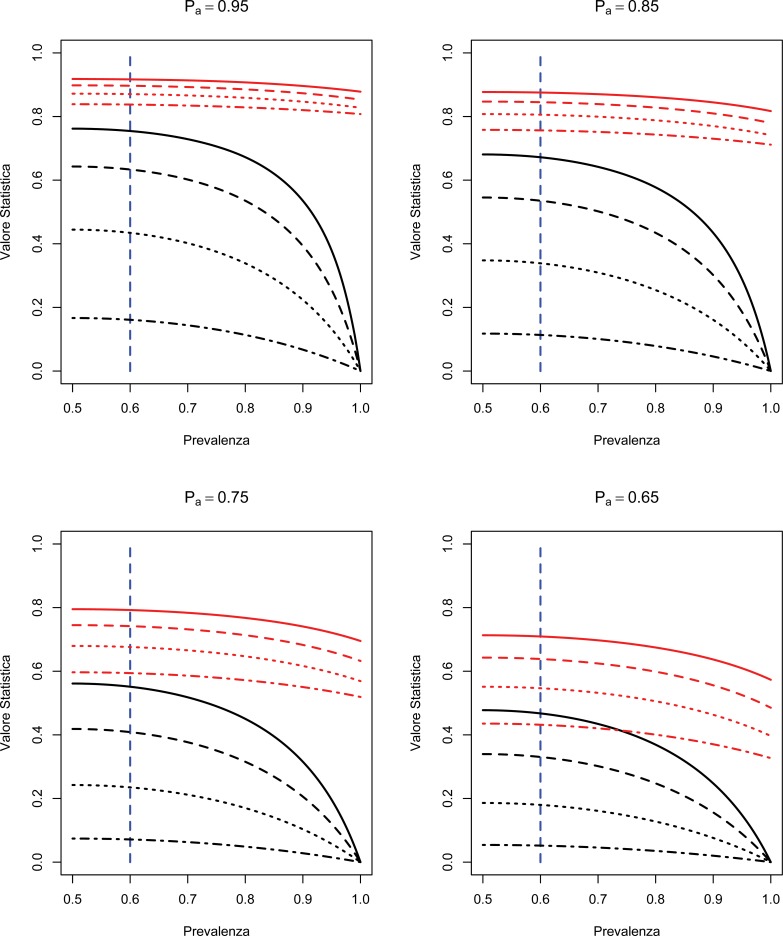
- In sensitivity curves, the Kappa paradox becomes evident when prevalence exceeds 60%, across the scenarios considered; AC1 values remained aligned with observed agreement and were not particularly affected by prevalence level.
- In the case study, Cohen’s Kappa suggested that agreement for the variables Unit, Design, and Primary Endpoints was “totally unsatisfactory,” while AC1 gave plausible values consistent with observed concordance.
- The likely cause of the paradox was high classification probabilities for the levels “Individual,” “Parallel,” and “Continuous” for Unit, Design, and Primary Endpoint, respectively.
- For the Jadad variable, where the authors say the paradox was absent, Kappa and AC1 had quite similar values, both consistent with observed concordance.
Methods
- A panel of three evaluators judged the quality of 57 randomized controlled trials using the Jadad scale, which assigns scores from zero to five; trials were dichotomized as good (>3) or poor (<3) quality.
- Evaluators also classified each trial by randomization unit (individual or community), design (parallel, factorial, or crossover), and primary endpoint (binary, continuous, survival, or other).
- Agreement among the three evaluators was calculated using Cohen’s Kappa and Gwet’s AC1, with 95% confidence intervals, and compared with observed agreement.
Limitations
- The paper does not state a formal limitations section.
- Evident from the text: the empirical demonstration relies on a single case study of 57 RCTs and three evaluators, with no simulation or broader validation reported.
- The authors note that for the Design variable, evaluators may not have had sufficient expertise to distinguish less common designs from “Parallel” type, which may have contributed to high classification probability.
Model-written summary. Check it against the paper before relying on it.
Integrity signals
Registry
Cites
Statistics
Figures
Verification
Claims the paper makes
0 Valid · 0 Not valid · 13 Not checked · 11 Own results and interpretations
A result the paper reports from its own data — it cites no other source for it, so there is none to check. The quote shows it is in the paper.
In the paper
“Even in simple cases with only two evaluators and two outcomes, the paradox tends to occur if, at equal sensitivity and specificity of the evaluators, the prevalence of one of the results is above 60%, as seen in Fig. (1) graphs.”
§ High Agreement and High Prevalence: The Paradox of Cohen’s Kappa > DISCUSSION
hedgedstates a possible cause- Asserted: passes — The authors put it forward as true.
- Checkable: passes — It can be checked against evidence.
- Load-bearing: passes — The paper’s conclusions depend on it.
- Based: passes — The paper gives a reason why it holds.
A result the paper reports from its own data — it cites no other source for it, so there is none to check. The quote shows it is in the paper.
In the paper
“The values of the Cohen’s Kappa statistic would lead to believe that the agreement levels for the variables Unit, Design and Primary Endpoints are totally unsatisfactory.”
- Also stated in: § RESULTS · hedged
“The values of the Cohen’s Kappa statistic would lead to believe that the agreement levels for the variables Unit, Design and Primary Endpoints are totally unsatisfactory.”
§ High Agreement and High Prevalence: The Paradox of Cohen’s Kappa > Abstract > Results:
hedgedstates a cause- Asserted: passes — The authors put it forward as true.
- Checkable: passes — It can be checked against evidence.
- Load-bearing: passes — The paper’s conclusions depend on it.
- Based: passes — The paper gives a reason why it holds.
- Also stated in: § RESULTS · hedged
A result the paper reports from its own data — it cites no other source for it, so there is none to check. The quote shows it is in the paper.
In the paper
“The AC1 statistic, on the contrary, shows plausible values which are in line with the respective values of the observed concordance.”
- Also stated in: § RESULTS · plain
“The AC1 statistic, on the contrary, shows plausible values which are in line with the respective values of the observed concordance.”
§ High Agreement and High Prevalence: The Paradox of Cohen’s Kappa > Abstract > Results:
plainstates an association- Asserted: passes — The authors put it forward as true.
- Checkable: passes — It can be checked against evidence.
- Load-bearing: passes — The paper’s conclusions depend on it.
- Based: passes — The paper gives a reason why it holds.
- Rests on an assumption not shown here.
- Also stated in: § RESULTS · plain
A result the paper reports from its own data — it cites no other source for it, so there is none to check. The quote shows it is in the paper.
In the paper
“As we can see, in all scenarios considered (hence independent on the observed correlation values, sensitivity and specificity) the paradox begins to be evident for values of prevalence higher than 60%.”
§ High Agreement and High Prevalence: The Paradox of Cohen’s Kappa > RESULTS
plainstates an association- Asserted: passes — The authors put it forward as true.
- Checkable: passes — It can be checked against evidence.
- Load-bearing: passes — The paper’s conclusions depend on it.
- Based: passes — The paper gives a reason why it holds.
A conclusion the paper draws from its own results — it cites no other source for it, so there is none to check. The quote shows it is in the paper.
In the paper
“The most likely explanation for the onset of the paradox can be given by high values, shown in Table 2, taken from the levels "Individual", "Parallel" and "Continuous" for variables Unit, Design and Primary Endpoint. These values have led to high probability of classification and hence to paradox affected values of Kappa statistic.”
§ High Agreement and High Prevalence: The Paradox of Cohen’s Kappa > RESULTS
hedgedstates a cause- Asserted: passes — The authors put it forward as true.
- Checkable: passes — It can be checked against evidence.
- Load-bearing: passes — The paper’s conclusions depend on it.
- Based: passes — The paper gives a reason why it holds.
- Rests on an assumption not shown here.
7 more claims
Create a free account to see all 24 claims and every source verdict.
- It may state two separate claims as one. 8
- The quote only partly states this claim. 1
- Probably not a substantial claim. 6
Claims other papers make about this one
Each is checked against this paper’s own text: does it say what the citing paper says it does?
The source backs part of the claim, not all of it — or backs it for a different population, condition or comparison.
In the citing paper
“The 𝜅 statistic is known to severely underestimate the agreement in situations when one of the labels is clearly dominant [59].”
From A Comparative Study of AI-Generated (GPT-4) and Human-crafted MCQs in Programming Education (2024) · cites this paper as [59]
Experimental — accuracy not yet measured
Self-check
Percentages, sums and reported differences re-computed from the paper’s own numbers.
Each contradiction between two passages listed here was confirmed by an independent check.
Rated minor: it would not touch a result — a value no result rests on, a p-value that stays on the same side of the significance level, or a conflict that is clerical, resolved elsewhere in the paper, or outside its own findings.
In the paper
§ High Agreement and High Prevalence: The Paradox of Cohen’s Kappa > METHODS > Case Study: Reproducibility of the Evaluation of Clinical Trial Quality
“An RCT is considered of good quality if it gets a score equal to or greater than 3.”
§ High Agreement and High Prevalence: The Paradox of Cohen’s Kappa > METHODS > Case Study: Reproducibility of the Evaluation of Clinical Trial Quality
“the Jadad score was dichotomized, distinguishing between good (> 3), and poor (<3) quality trial.”
Rated minor: it would not touch a result — a value no result rests on, a p-value that stays on the same side of the significance level, or a conflict that is clerical, resolved elsewhere in the paper, or outside its own findings.
In the paper
§ High Agreement and High Prevalence: The Paradox of Cohen’s Kappa > INTRODUCTION > AC1 Statistic
“The variance of the AC1 statistics, indispensable for the construction of confidence intervals, is calculated through the expression (3), following Gwet [28].”
§ High Agreement and High Prevalence: The Paradox of Cohen’s Kappa > INTRODUCTION > The Cohen’s Kappa Statistic
“while the expected agreement in case of random assignment is given by: (3)Pe|K=∑K=1K∑r=2R(−1)r∑i1,i2,.......ir∏j=1rpkij”
Citations
Cites
A Coefficient of Agreement for Nominal Scales
Cohen, J. (1960) · Educational and Psychological Measurement · doi:10.1177/001316446002000104 · Cited by 42,398 · cited 2×
“The Cohen’s Kappa statistic [16] is the most used agreement measure in literature.”
MethodIntraclass correlations: Uses in assessing rater reliability.
Shrout, P. E., & Fleiss, J. L. (1979) · Psychological Bulletin · doi:10.1037/0033-2909.86.2.420 · Cited by 24,532
Assessing the quality of reports of randomized clinical trials: Is blinding necessary?
Jadad, A. R., Moore, R. A., Carroll, D., Jenkinson, C., Reynolds, D. J. M., Gavaghan, D. J., & McQuay, H. J. (1996) · Controlled Clinical Trials · doi:10.1016/0197-2456(95)00134-4 · Cited by 17,582 · cited 1×
“Case Study: Reproducibility of the Evaluation of Clinical Trial Quality During the process of literature review [29], we have asked a panel of three evaluators to come up with a judgment on the quality of 57 randomized controlled trials (RCTs), assigning a score to each trial using the Jadad scale [9].”
MethodZhang, Q., Wang, C., Zheng, M., Li, Y., Li, J., Zhang, L., Shang, X., & Yan, C. (2015) · Cerebrovascular Diseases · doi:10.1159/000369778 · Cited by 11,533
Measuring nominal scale agreement among many raters.
Fleiss, J. L. (1971) · Psychological Bulletin · doi:10.1037/h0031619 · Cited by 8,733
Moher, D., Cook, D. J., Eastwood, S., Olkin, I., Rennie, D., & Stroup, D. F. (1999) · The Lancet · doi:10.1016/s0140-6736(99)04149-5 · Cited by 4,826
Dong, Y., Hao, L., Shi, Z., Wang, G., Zhang, Z., & Han, C. (2013) · Urologia Internationalis · doi:10.1159/000351405 · Cited by 4,540
Landis, J. R., & Koch, G. G. (1977) · Biometrics · doi:10.2307/2529786 · Cited by 4,332 · cited 1×
“4 or negative are indicators of discordance [27].”
BackgroundAssessing the quality of controlled clinical trials
Jüni, P., Altman, D. G., & Egger, M. (2001) · BMJ · doi:10.1136/bmj.323.7303.42 · Cited by 3,309 · cited 2×
“As for the latter, the literature is unanimous in considering that low-quality trials, conducted using inadequate methodological approach, are often associated with the over-estimated treatment effects [5, 7].”
BackgroundHigh agreement but low Kappa: I. the problems of two paradoxes
Feinstein, A. R., & Cicchetti, D. V. (1990) · Journal of Clinical Epidemiology · doi:10.1016/0895-4356(90)90158-l · Cited by 3,034 · cited 1×
“In fact, this assumption is weakened - sometimes even contradicted - in presence of strong differences in prevalence of possible outcomes [17].”
Background
Cited by
Items 101–171 of 171
Onstad, C. C., & der Flier-Keller, E. V. (2025) · Geoscience Communication · doi:10.5194/gc-8-125-2025 · Cited by 5
Brain Atrophy and White Matter Changes Grading Agreement on NCCT and MRI in Ischemic Stroke
Betzner, W., Singh, N., Alhabli, I., Almekhlafi, M., Bala, F., Benali, F., Lam, K., Doolan, C., Carere, J., Catanese, L., et al. (2026) · Clinical Neuroradiology · doi:10.1007/s00062-026-01636-6 · Cited by 1
“In order to avoid the kappa paradox, a result of conventionally used interrater reliability methods such as Cohen’s kappa [28], we employed a linear-weighted Gwet’s agreement coefficient 1 (AC1) as previously done by our group [23, 29].”
Gardner, A. J., Jones, B., Jhala, P., Smith, O. J., Fortington, L. V., Iverson, G. L., & Fuller, G. W. (2026) · Journal of science and medicine in sport · doi:10.1016/j.jsams.2026.02.013 · Cited by 1
Ragagnin, K., da Silva-Oolup, S., Yu, H., Balaji, S., Côté, P., Hogg‐Johnson, S., Murnaghan, K., & Wong, J. J. (2026) · ACR Open Rheumatology · doi:10.1002/acr2.90007 · Cited by 1
Heerschap, C., & Butt, B. (2026) · Advances in Skin & Wound Care · doi:10.1097/asw.0000000000000465 · Cited by 1
Zak, S., McDonnell, L., & Tour, E. (2026) · CBE—Life Sciences Education · doi:10.1187/cbe.25-04-0065 · Cited by 1
Das, S., Lam, E., Muhn, O., Mahbub, S., Ansari, D., Osman, H., Awad, R., Al-Ghita, M. K., Thornhill, R. E., Walsh, C., et al. (2026) · Journal of Magnetic Resonance Imaging · doi:10.1002/jmri.70467 · Cited by 1
Park, J., McDonald, E. J., Buren, Y., et al. (2023) · PLoS ONE · doi:10.1371/journal.pone.0290679 · Cited by 1
“The AC2 statistic was chosen for its resiliency against the effects of trait prevalence, where high chance agreement can paradoxically result in low chance-corrected agreement despite relatively higher percentage agreement [37, 38].”
MethodContrast‐free visualization of distal trigeminal nerve segments using MR neurography
Sahu, S., Hellwig, D., Morrison, Z., Hughes, J. N., & Sadleir, R. (2024) · Journal of Neuroimaging · doi:10.1111/jon.13230 · Cited by 3
“14 Hence, we also calculated percent-ageagreement(Table2)toprovideamorecomprehensiveindicationof nerve detection performance.”
Variations in media framing of movements in China, France, and the U.S.: An intersectional approach
Li, Y., Cassard, M., Holmes, B., & Wu, H. (2024) · British Journal of Sociology · doi:10.1111/1468-4446.13153 · Cited by 2
Black Belts and High Heels: an Analysis of Gender Representation on Black Belt Magazine Covers
Malmo, J. R., & Rolfe, D. T. (2018) · International Journal of the Sociology of Leisure · doi:10.1007/s41978-018-00031-x · Cited by 1
Finlayson, N., Marsden, E. J., & Hawkes, R. (2024) · doi:10.31219/osf.io/ya9kh · Cited by 1
ALATERAS, O., Chesser, C., Burke, I., Hampstead, B. M., Belleville, S., Simon, S. S., & Bahar‐Fuchs, A. (2025) · Research Square · doi:10.21203/rs.3.rs-5486560/v1 · Cited by 1
Risk Governance for Generative AI Mental Health Support: A Multi-Turn Safety ArchitecturePreprint
Areias, A. C., Botelho, C., Farinhas, A., Vassilopoulos, A., Janela, D., Tong, X., Guerreiro, N. M., D'Eon, M., Costa, F., & Rei, R. (2026) · Research Square · doi:10.21203/rs.3.rs-10279940/v1 · Cited by 3
Pishnamaz, M., Balosu, S., Curfs, I., Uhing, D., Laubach, M., Herren, C., Weber, C. D., Hildebrand, F., Willems, P. C. P. H., & Kobbe, P. (2018) · World Neurosurgery · doi:10.1016/j.wneu.2018.07.130
Documentação do processo de enfermagem na prática clínica: construção de indicadores
de Azevedo, O. A. (2020) · Digital Library of Theses and Dissertations (Universidade de São Paulo) · doi:10.11606/t.7.2020.tde-24022021-112410 · Cited by 1
Dillon, M. P., Puli, L., Ridgewell, E., et al. (2021) · Prosthetics and Orthotics International · doi:10.1097/pxr.0000000000000022
The medical perspective in prescribing: measurements and educational strategies
Lönnbro, J. (2021) · Gothenburg University Publications Electronic Archive (Gothenburg University)
Movin’ on up? A Survey Experiment on Mobility Enhancing Policies
Barton, J. (2020) · AEA Randomized Controlled Trials · doi:10.1257/rct.6135-1.0
Mezquita, C., Legnani, M., Urban, L., et al. (2023) · Revista Médica del Uruguay · doi:10.29193/rmu.39.2.3
Options, Problems and Guidelines for Measuring Interrater Agreement - a Descriptive Approach
Kočišová, L. (2024) · Czech Sociological Review · doi:10.13060/csr.2024.007
“V štúdii, ktorú uskutočnili Zec et al. (2017) sa zistilo, že paradox sa začína objavovať pri prevalencii vyššej ako 60 % (v našom počítanom príklade zošikmenej distribúcie v Tabuľke 5 je index prevalencie = 0,9).”
Gim, H. (2025) · Communication Research Reports · doi:10.1080/08824096.2025.2459114
“Gwet’s AC1 and AC2 were robust to such paradox (Gwet, 2008; Quarfoot & Levine, 2016; Zec et al., 2017); hence, used in this study.”
Analyzing Noise Data From a Noise Audit: A Guide for Industrial-Organizational PractitionersPreprint
Nordmo, M., & Nordmo, M. (2025) · PsyArXiv (OSF Preprints) · doi:10.31234/osf.io/2h8ys_v1
Prust, M. L., Graves, J. C., Jokwiro, J., Giyava, C. R., Apollo, T., Simbi, R., Mupanguri, C., Govha, E., Chipuka, S., Juru, A., et al. (2025) · doi:10.12688/verixiv.942.1
Analyzing Noise Data From a Noise Audit: A Guide for Industrial-Organizational PractitionersPreprint
Nordmo, M., & Nordmo, M. (2025) · PsyArXiv (OSF Preprints) · doi:10.31234/osf.io/2h8ys_v2
Miralles‐Iborra, A., Ríos-Calonge, J. D. L., Coso, J. D., et al. (2025) · Physical Therapy in Sport · doi:10.1016/j.ptsp.2025.09.010
Almehrizi, R. S. (2025) · Educational and Psychological Measurement · doi:10.1177/00131644251380540 · Cited by 3
“Since the development of Cohen’s Kappa and Fleiss’s Kappa as chance-corrected measures of interrater agreement, several interpretive issues and paradoxes have been identified (Brennan & Prediger, 1981; Delgado & Tibau, 2019; Warrens, 2010; Zec et al., 2017).”
Analyzing Noise Data From a Noise Audit: A Guide for Industrial‐Organizational Practitioners
Nordmo, M., & Nordmo, M. (2025) · International Journal of Selection and Assessment · doi:10.1111/ijsa.70034
Banitalebi, H., Espeland, A., Anvar, M., et al. (2022) · Figshare · doi:10.6084/m9.figshare.18482164
Interrater Reliability of a Modified Bronchoscopy Scoring Tool in Children With Cystic Fibrosis
Bosetti, A., Micic, S. J., Hector, A., Bieli, C., Seidl, E., & Moeller, A. (2025) · Pediatric Pulmonology · doi:10.1002/ppul.71452
“Unlike Cohen's Kappa and its generalization to multiple raters, Gwet's method is less affected by the paradoxes that can arise from unequal distributions of scores [9, 10].”
Henry, M. L., O'Connell, N. E., Riley, R. D., Moons, K. G. M., Shea, B., Hooft, L., Wallwork, S. B., Damen, J. A. A. G., Skoetz, N., Appiah, R. P., et al. (2026) · BMJ Open · doi:10.1136/bmjopen-2025-109388 · Cited by 1
Chen, D., Lamiman, K., Jesus, A. D. D., Silver, M., Tsatsas, M., Palileo, A., Hanusek, R., Schachter, A., Gorelick, C., Kanis, M. J., et al. (2026) · Gynecologic Oncology Reports · doi:10.1016/j.gore.2026.102187
ICU dyspnoea assessment tools: Norwegian translation and inter-rater reliability
Martinsen, P. S., Haug, R. A., Bådsvik, S., et al. (2026) · Sykepleien Forskning · doi:10.4220/sykepleienf.2026.105043en
Morell-Hofert, D., Kremser, C., Josip, E., Plaikner, M., Schullian, P., Seeber, B., & Henninger, B. (2026) · Abdominal Radiology · doi:10.1007/s00261-026-05445-w
“Agreement coefficients, including inter-rater agreement, were calcu - lated as percent agreement and, in order to avoid paradoxical results [19], as chance corrected agreement using Gwet’s AC1 coefficient (AC1) [ 20], using the irrCAC-package for R [21].”
Brunton, J., & Lawn, S. (2026) · Safety Science · doi:10.1016/j.ssci.2026.107169 · Cited by 2
Sotelo-Anguiano, D., Lizalde-Hernández, A., Roa, K. J. A., et al. (2026) · SANUS · doi:10.36789/sanus.vi22.571
Identifying Hurdles to Making Sleep Wearables Data Actionable for Users: A Grounded Theory Study
Nolasco, H. R., Vargo, A. W., Blakely, C., Watanabe, K., Armstrong, M., Stricker, M., & Kise, K. (2026) · Electronics · doi:10.3390/electronics15071480
Prust, M. L., Graves, J. C., Jokwiro, J., Giyava, C. R., Apollo, T., Simbi, R., Mupanguri, C., Govha, E., Chipuka, S., Juru, A., et al. (2026) · PLOS Global Public Health · doi:10.1371/journal.pgph.0006180
“However, Cohen’s kappa does not perform well and is subject to Kappa’s paradox where there is high prevalence of the outcome of interest, which we observed in the case of VL suppression [25–27].”
Investigation of modern approaches for automated short answer grading
Hussain, S. A., & Abdullah, N. A. Z. (2026) · AIP conference proceedings · doi:10.1063/5.0328153
Gengchen, Z., Николаевна, Т. Г., Boguslavskaya, V., & Hongbo, Y. (2026) · Communication Strategies in Digital Society Seminar (ComSDS) · doi:10.1109/comsds69583.2026.11493808
“Due to significant Class Imbalance in the dataset, traditional metrics like Cohen's Kappa or Krippendorff's α are susceptible to Paradoxical Underestimation [18].”
Harris, K., Haddock, G., Peters, S., Mulligan, L. D., & Gooding, P. A. (2026) · BMC Psychiatry · doi:10.1186/s12888-026-08092-z
“The inconsistency in inter-rater reliability is known as the ‘kappa paradox’ [85], whereby there is a strong inter-rater percent agreement, but the kappa value is lower.”
Kalmring, M., Chmelar, S., Greimel, P., Kaider, M., Lang, C., & Roszipal, B. (2026) · BMC Medical Education · doi:10.1186/s12909-026-09374-6 · Cited by 2
“This discrepancy can be explained by the so-called Cohen’s kappa paradox, in which high percentage agreement can coincide with only moderate kappa values when most decisions fall into the same category [30].”
Doran, M. (2026) · Healthcare · doi:10.3390/healthcare14111563 · Cited by 2
“This pattern is consistent with the known kappa paradox and suggests that Fleiss’ kappa should not be interpreted in isolation in datasets with highly imbalanced ratings [22].”
Suko, Y., & Korpela, K. M. (2026) · Journal of Environmental Psychology · doi:10.1016/j.jenvp.2026.103091
Güner, E., Çiçek, C., Bakır, A., et al. (2026) · International Journal of Molecular Sciences · doi:10.3390/ijms27125454
Tobback, E., Peeters, A., Basir, N., Haver, E. V., Quayhackx, J., Brumer, M., Woltersdorf, R., Meyer, G. R. Y. D., & Loof, H. D. (2026) · International Journal of Clinical Pharmacy · doi:10.1007/s11096-026-02174-4
“However, ICC values may be artificially low when variance between observations is limited (paradox) [54, 64, 65].”
Çakal, M., Aktaş, E. Ö., Bayraktar, D., et al. (2026) · Journal of Biomechanics · doi:10.1016/j.jbiomech.2026.113432
Pan, Y.-L., Yu, P.-F., Yin, X.-L., Hong-sheng, Y., Long, X., & Tong, Q. (2026) · Educational Technology Research and Development · doi:10.1007/s11423-026-10659-2 · Cited by 2
Making Advanced Temporal Visualizations Accessible to Educators Using Generative AI
Nath, D., Desai, Y., Rajendran, R., & Gašević, D. (2026) · Lecture notes in computer science · doi:10.1007/978-3-032-29760-0_43 · Cited by 1
Laingen, B. E., Iobst, W., Dobbins, J., Johnson, J. W., Cambronero, G. E., Neff, L. P., & Bosley, M. E. (2026) · Research Square · doi:10.21203/rs.3.rs-10028364/v1
Maw, A., Lupi, A. L., Johnson-Koenke, R. A., Coats, H., Zhou, L., Li, B. H., Mitchell, J., Kotz, A., Plasek, J. M., & Goss, F. R. (2026) · JMIR Formative Research · doi:10.2196/89837
“…domains showed high prevalence (ceiling effects), low κ values reflect limited agreement beyond chance rather than a statistical artifact [26,27], and κ is therefore reported alongside percent agreement only as a descriptive indicator of rater divergence, not as evidence of chatbot…”
Patil, P., Nair, S. S., Bhat, S. S., et al. (2026) · Eye · doi:10.1038/s41433-026-04738-0
“AC1 addressed the prevalence paradox, whereby extreme marginal distributions artificially deflate κ [4].”
Socioeconomic status and informal preference signaling among medical school applicants
Benning, T. J., Ashby, G. B., Huston, Z. I., et al. (2026) · Academic Medicine · doi:10.1093/acamed/wvag219
Neural Network Benchmarking on ECG Classification
Collazo, N. D. C., Ortega, A. J. D., & Nocetti, F. G. (2026) · Communications in computer and information science · doi:10.1007/978-3-032-22199-5_5
Stier, H., Borgreen, M. J., Nenninger, H. R., et al. (2026) · Rangelands · doi:10.1016/j.rala.2026.05.001
Will It Be Worth the Effort? The Reality of Brain Drain in Medical Students
Erden, Ş., Keçeci, A., Doğan, C. D., & Gönüllü, İ. (2026) · Bratislavské lekárske listy/Bratislava medical journal · doi:10.1007/s44411-026-00752-6
“Since binary presence/absence coding in sentiment and thematic analyses often leads to skewed category distributions, this statistic was preferred to reduce sensitivity to marginal instability and provide a more stable fit [ 24 , 25 , 26, 27 ].”
ReqCluster4IoT: a clustering method for functional requirements in Internet of Things applications
da Silva, B. C., dos Santos, R. P., & Viana, D. (2026) · Requirements Engineering · doi:10.1007/s00766-026-00467-8
“Given the possibility that all raters assign the same label, we also ana - lyzed observed agreement, a direct descriptive measure of empirical inter-rater concordance [90 ].”
Kumar, V. R., Choi, L. D., Cardy, J. O., & Binns, A. V. (2026) · Autism · doi:10.1177/13623613261469913
“This phenomenon, often referred to as the Kappa Paradox , occurs when high agreement coincides with a lower kappa statistic due to imbalanced category distribution (Bexkens et al., 2018; Zec et al., 2017).”
Steijger, D. J. M., Thissen, S., Aarts, S., Verbeek, H., de Vugt, M. E., & Christie, H. L. (2026) · JMIR Formative Research · doi:10.2196/84989
“This is expected in title and abstract screening, where relevant titles and abstracts are typically a small proportion of the data-set, but the low kappa values should not be interpreted as acceptable agreement [39,43,44].”
Öz, D. S., Sevim, M. E., Tanışman, Ö., Öz, Ö. F., & Urger, S. E. (2026) · Journal of Imaging Informatics in Medicine · doi:10.1007/s10278-026-02213-6
Cohen, J. G., Stadelmann, J. V., Leite-Arada, D., & Poletti, P. (2026) · Journal of Clinical Imaging Science · doi:10.25259/jcis_99_2026
“[18] Differences between TC and VCE scores were tested using the Wilcoxon signed-rank test.”
Zhang, Y., Lv, S., Gong, Z., Russell, B. S., Unvala, D., & Bellizzi, K. M. (2026) · Cognitive Therapy and Research · doi:10.1007/s10608-026-10784-5
Oborevwori, E., Ásbjörnsdóttir, K., Galagan, S. R., et al. (2026) · PLoS neglected tropical diseases · doi:10.1371/journal.pntd.0014740
“Additionally, kappa statistics should be interpreted with caution in this high-prevalence setting, as kappa values are sensitive to the marginal distribution of the outcome and may underestimate true agreement when prevalence is very high [14].”
Sagkal, H. U. (2026) · Journal of Contingencies and Crisis Management · doi:10.1111/1468-5973.70240
10-year analysis of selective dissemination in glaucoma research from major conferences to journals
Ghirardi, A., Camisa, L., Cillà, S. D., & Rabiolo, A. (2026) · British Journal of Ophthalmology · doi:10.1136/bjo-2026-329990
What about Alzheimer 's disease online information?: YouTube video content analysis
Moon, S., & Yang, J. E. (2026) · Heliyon · doi:10.1016/j.heliyon.2026.e45544
Verdillo, J. P. T., Ermina, N., Capilla, T. M., Balane, R. J., Apura, E. P., Apla-on, D. R., & Salvador, R. L. (2026) · Philippine Journal of Physical Therapy · doi:10.46409/002.isud9189
Assi, F. I., Neda, F. S., & Mustafa, A. A. (2026) · Al-Rafidain Journal of Medical Sciences · doi:10.54133/ajms.v11i2.3156
Testing the Evaluation of the Testimony of the Global Evaluation System in Bullying Cases
Montes, Á., Cea, B., & Arce, R. (2026) · Psychosocial Intervention · doi:10.5093/pi2026a12
APS-RAG-Benchmark: Um Recurso Inicial para Avaliação de RAG na Atenção Primária à Saúde
de Andrade, C. M. V., Magalhães, G. R., Asevedo, R., Paes, J., de Oliveira, I. J. R., Pagano, A., Reis, Z., & Gonçalves, M. A. (2026) · Simpósio Brasileiro de Bancos de Dados (SBBD) · doi:10.5753/sbbd.2026.249660
Translation, contextual adaptation, and preliminary evaluation of INCRESE-Norwegian Young
Leiler, A., Børresen, K. Ø., Vogelsang, M., Trovåg, J., Kulstad, I. A., Moe, C. F., Sigurdardottir, H. D.-I., Colado, V. M. P., Nambazira, T., Ng, F., et al. (2026) · Frontiers in Psychiatry · doi:10.3389/fpsyt.2026.1893622
Metadata
- Authors
- Zec, S., Soriani, N., Comoretto, R., & Baldi, I.
- Affiliations
- University of Padua (IT)
- University of Milan (IT)
- Corresponding author
- Baldi, Ileana
- Venue
- The Open Nursing Journal
- Publisher
- Bentham Science Publishers Ltd.
- Published
- 2017-10-31
- Volume
- 11
- Issue
- 1
- Pages
- 211-218
- ISSN
- 1874-4346 (ISSN-L)
- PMC
- PMC5712640
- OpenAlex
- W2767182834
- Cited by
- 169
- References
- 30
- Citations by year
- 2026: 52 · 2025: 28 · 2024: 16 · 2023: 28 · 2022: 14 · 2021: 15 · 2020: 9 · 2019: 3 · 2018: 2
- FWCI
- 3.51
- Type
- journal article
- Language
- en
- Open access
- diamond
- doi.org
- Locations
- The Open Nursing Journal (publishedVersion, cc-by)
- PubMed (publishedVersion)
- Europe PMC (PubMed Central) (submittedVersion, cc-by)
- PubMed Central (submittedVersion, cc-by)
- Institutional Research Information System University of Turin (University of Turin) (submittedVersion, other-oa)
- Padua Research Archive (University of Padova) (submittedVersion, cc-by)
- Topics
- Social Sciences › Decision Sciences › Statistics, Probability and Uncertainty › Reliability and Agreement in Measurement
- Health Sciences › Nursing › Research and Theory › Health Education and Validation
- Health Sciences › Medicine › Surgery › Hemodynamic Monitoring and Therapy
- Keywords
- Cohen's kappa, Gwet's AC1, interobserver agreement, randomized controlled trials, Jadad scale, trial quality assessment
About these checks
Registry, retraction, Cites and statistics results are computed, not judged, with one exception: a printed reference that no index lists is read once by a model before it counts as a citation error. Claims are extracted by a model and kept only when their quote appears verbatim in the text; each cited source is then checked, with a model’s help, for whether it says what the claim relies on. Those verdicts can be wrong — read the claim’s quote and the cited source before relying on one.
A language model drew the claims from the paper on 2026-10-16, under version 3 of the claim definition (model deepseek-v4.1-flash, prompt extract-v3).
A second model labelled each claim on 2026-10-16 (model jev-1.13-20260917, definition revision gold-guideline-v0.2).
Statistics and arithmetic are recomputed, not judged.
Confidence bands are shown only for fields calibrated on our annotated test set. None is calibrated yet, so no band is shown.
What counts as a claim ›How we measure confidence ›How we check this ›
Are you an author, or do you see a problem with this page? Request a review
Data sources
Bibliographic data: Semantic Scholar, OpenAlex, Crossref.
Contains information from the Semantic Scholar Academic Graph Datasets, made available under the ODC Attribution License (ODC-BY 1.0).
Semantic Scholar’s data is described in: Kinney, R., et al. (2023). The Semantic Scholar Open Data Platform. arXiv:2301.10140.
