

Inter-Subject Synchronization of Prefrontal Cortex Hemodynamic Activity During Natural Viewing
Open accessThe DOI matches its Crossref record; 15 of the 16 references it cites were found in a registry or an index.
Abstract
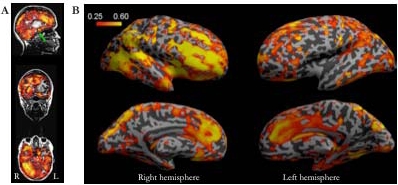
Hemodynamic activity in occipital, temporal, and parietal cortical areas were recently shown to correlate across subjects during viewing of a 30-minute movie clip. However, most of the frontal cortex lacked between-subject correlations. Here we presented 12 healthy naïve volunteers with the first 72 minutes of a movie (“Crash”, 2005, Lions Gate Films) outside of the fMRI scanner to involve the subjects in the plot of the movie, followed by presentation of the last 36 minutes during fMRI scanning. We observed significant between-subjects correlation of fMRI activity in especially right hemisphere frontal cortical areas, in addition to the correlation of activity in temporal, occipital, and parietal areas. It is possible that this resulted from the subjects following the plot of the movie and being emotionally engaged in the movie during fMRI scanning. We further show that probabilistic independent component analysis (ICA) reveals meaningful activations in individual subjects during natural viewing.
Overview
The claims and statistics of this paper haven’t been checked yet.
Free: it reads the open-access text and checks the first 5 claims that cite a source we can check. Create a free account to check every claim.
Integrity signals
Registry
Cites
Statistics
Figures
Verification
Claims the paper makes
The claims and statistics of this paper haven’t been checked yet.
Free: it reads the open-access text and checks the first 5 claims that cite a source we can check. Create a free account to check every claim.
Claims other papers make about this one
Each is checked against this paper’s own text: does it say what the citing paper says it does?
The source backs part of the claim, not all of it — or backs it for a different population, condition or comparison.
In the citing paper
“When viewing complex dynamic scenes, brain activity in sensory and attention-controlling systems becomes synchronized across individuals (12-16)”
From Emotions promote social interaction by synchronizing brain activity across individuals (2012) · cites this paper as [15]
Experimental — accuracy not yet measuredIn the citing paper
“Prior studies have provided contradicting evidence on whether the activity in the frontal regions synchronizes across individuals during prolonged natural stimulation (14,15).”
From Emotions promote social interaction by synchronizing brain activity across individuals (2012) · cites this paper as [15]
In the citing paper
“Previous work has shown that narratives elicit correlated neural responses across subjects in regions of the Default Mode Network (DMN), including temporal parietal junction (TPJ), angular gyrus, temporal poles, posterior medial cortex (PMC), and medial prefrontal cortex (mPFC) (Hasson et al., 2008, 2010; Jaaskelainen et al., 2008; Wilson et al., 2008; Lerner et al., 2011; Ben-Yakov et al., 2012;”
From Shared understanding of narratives is correlated with shared neural responses (2019) · cites this paper as Jaaskelainen et al., 2008
Self-check
Percentages, sums and reported differences re-computed from the paper’s own numbers.
The self-check needs the paper’s full text.
Citations
Cites
Independent component analysis: algorithms and applications
Hyvärinen, A., & Oja, E. (2000) · Neural Networks · doi:10.1016/s0893-6080(00)00026-5 · Cited by 8,705 · cited 1×
“The probabilistic ICA offers easier interpretation of the results obtained, since the analysis determines which independent components (ICs) are statistically significant [6], unlike the more traditional ICA approach where the researcher needs to select the most feasible ICs from amongst all the possible ICs [7].”
Russell, J. A., & Barrett, L. F. (1999) · Journal of Personality and Social Psychology · doi:10.1037//0022-3514.76.5.805 · Cited by 3,102 · cited 1×
“It is a widely held position that positive and negativity affect can be represented on a single bipolar valence scale [13], and the present findings tentatively support a competing view according to which negative and positive affect are generated independently [14, 15].”
BackgroundProbabilistic Independent Component Analysis for Functional Magnetic Resonance Imaging
Beckmann, C. F., & Smith, S. M. (2004) · IEEE Transactions on Medical Imaging · doi:10.1109/tmi.2003.822821 · Cited by 2,715 · cited 3×
“The pICA [6] were conducted on the preprocessed data sets of individual subjects using the Multivariate Exploratory Linear Optimized Decomposition into Independent Components (MELODIC) package of the FSL.”
BackgroundMethodIntersubject synchronization of cortical activity during natural vision
Hasson, U., Nir, Y., Levy, I., Fuhrmann, G., & Malach, R. (2004) · Science · doi:10.1126/science.1089506 · Cited by 1,839 · cited 10×
“In contrast to the other areas, there was an apparent lack of inter-subject synchronization of hemodynamic activity in frontal cortical areas [3].”
BackgroundMethodResultInfluentialThe affect system has parallel and integrative processing components: Form follows function.
Cacioppo, J. T., Gardner, W. L., & Berntson, G. G. (1999) · Journal of Personality and Social Psychology · doi:10.1037/0022-3514.76.5.839 · Cited by 1,217 · cited 1×
“It is a widely held position that positive and negativity affect can be represented on a single bipolar valence scale [13], and the present findings tentatively support a competing view according to which negative and positive affect are generated independently [14, 15].”
BackgroundToward a consensual structure of mood
Watson, D., & Tellegen, A. (1985) · Psychological Bulletin · doi:10.1037//0033-2909.98.2.219 · Cited by 1,170 · cited 1×
“It is a widely held position that positive and negativity affect can be represented on a single bipolar valence scale [13], and the present findings tentatively support a competing view according to which negative and positive affect are generated independently [14, 15].”
BackgroundRight Hemisphere Lateralization for Emotion in the Human Brain: Interactions with Cognition
Schwartz, G. E., Davidson, R. J., & Maer, F. (1975) · Science · doi:10.1126/science.1179210 · Cited by 447 · cited 1×
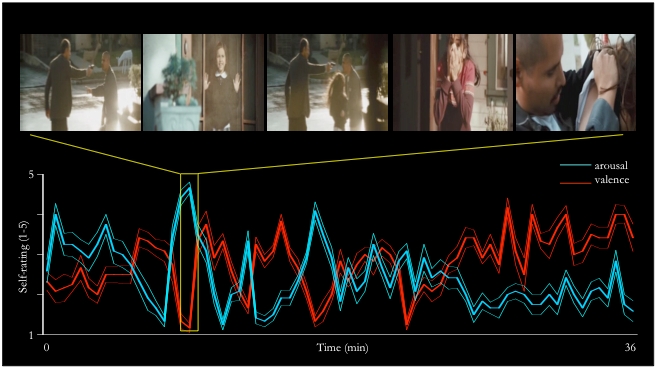
“It is also possible that the right-hemisphere dominance is explained by the right-hemisphere dominance in emotional processing of visual stimuli [10, 11], since the subjects selfreported being emotionally engaged while watching the last 36 minutes of the movie during fMRI scanning (see Fig.”
BackgroundProcessing emotional pictures and words: Effects of valence and arousal
KENSINGER, E. A., & SCHACTER, D. L. (2006) · Cognitive, Affective, & Behavioral Neuroscience · doi:10.3758/cabn.6.2.110 · Cited by 442 · cited 1×
“We could not, however, verify this since the arousal ratings correlated most consistently with cerebellar activity (for corroborating findings, see [12]), and with prefrontal activations only in some subjects, and we failed to see any consistent correlations between the valence ratings and fMRI activity.”
ResultBartels, A., Zeki, S., & Logothetis, N. K. (2008) · Cerebral Cortex · doi:10.1093/cercor/bhm107 · Cited by 150 · cited 3×
“While these studies have significantly advanced our understanding of the neural basis of cognition, rapid developments in non-invasive neuroimaging methodology have made it increasingly possible to record and study brain activity also during more natural viewing conditions [1-5].”
BackgroundMethodResultShort-term plasticity in auditory cognition
Jääskeläinen, I. P., Ahveninen, J., Belliveau, J. W., Raij, T., & Sams, M. E. (2007) · Trends in Neurosciences · doi:10.1016/j.tins.2007.09.003 · Cited by 138 · cited 1×
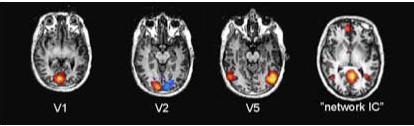
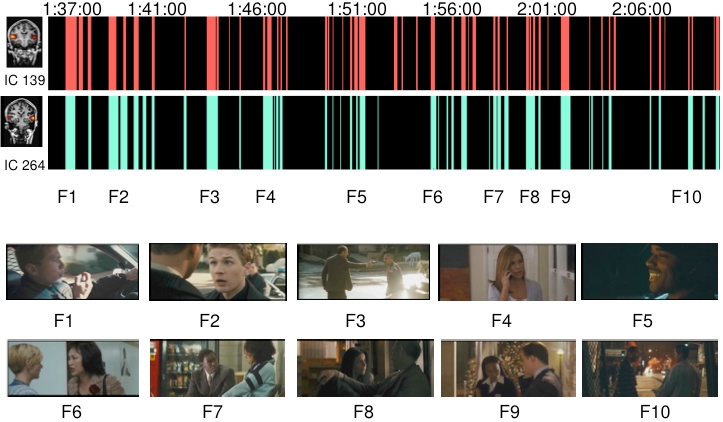
“Using the probabilistic ICA, it was possible to reveal activated areas and networks of areas (which may be even more intriguing [8]) in the individual subjects during the natural viewing conditions (see Figs.”
BackgroundSelf-citationTowards natural stimulation in fMRI—Issues of data analysis
Malinen, S., Hlushchuk, Y., & Hari, R. (2007) · NeuroImage · doi:10.1016/j.neuroimage.2006.11.015 · Cited by 128 · cited 3×
“While these studies have significantly advanced our understanding of the neural basis of cognition, rapid developments in non-invasive neuroimaging methodology have made it increasingly possible to record and study brain activity also during more natural viewing conditions [1-5].”
BackgroundMethodResultThe chronoarchitecture of the cerebral cortex
Bartels, A., & Zeki, S. (2005) · Philosophical Transactions of the Royal Society B: Biological Sciences · doi:10.1098/rstb.2005.1627 · Cited by 107 · cited 3×
“While these studies have significantly advanced our understanding of the neural basis of cognition, rapid developments in non-invasive neuroimaging methodology have made it increasingly possible to record and study brain activity also during more natural viewing conditions [1-5].”
BackgroundMethodResultProcessing of unattended emotional visual scenes.
Calvo, M. G., & Nummenmaa, L. (2007) · Journal of Experimental Psychology: General · doi:10.1037/0096-3445.136.3.347 · Cited by 94 · cited 1×
“It is also possible that the right-hemisphere dominance is explained by the right-hemisphere dominance in emotional processing of visual stimuli [10, 11], since the subjects selfreported being emotionally engaged while watching the last 36 minutes of the movie during fMRI scanning (see Fig.”
BackgroundImaging brain activity during natural vision using CASL perfusion fMRI
Rao, H., Wang, J., Tang, K., Pan, W., & Detre, J. A. (2007) · Human Brain Mapping · doi:10.1002/hbm.20288 · Cited by 39 · cited 2×
“While these studies have significantly advanced our understanding of the neural basis of cognition, rapid developments in non-invasive neuroimaging methodology have made it increasingly possible to record and study brain activity also during more natural viewing conditions [1-5].”
BackgroundResultRight hemisphere dominance in perceiving coherence of visual events
Han, S., Jiang, Y., & Mao, L. (2006) · Neuroscience Letters · doi:10.1016/j.neulet.2005.12.069 · Cited by 8 · cited 1×
“In a previous fMRI study, it was observed that right middle temporal cortex, the right posterior superior temporal cortex, and the right inferior postcentral gyrus exhibited stronger activity than the respective lefthemisphere areas during perception of series of still pictures from a movie when they were presented in…”
Background
Cited by
Brain-to-brain coupling: a mechanism for creating and sharing a social world
Hasson, U., Ghazanfar, A. A., Galantucci, B., Garrod, S., & Keysers, C. (2012) · Trends in Cognitive Sciences · doi:10.1016/j.tics.2011.12.007 · Cited by 1,140
Speaker-listener neural coupling underlies successful communication
Stephens, G. J., Silbert, L. J., & Hasson, U. (2010) · Proceedings of the National Academy of Sciences · doi:10.1073/pnas.1008662107 · Cited by 970
Topographic mapping of a hierarchy of temporal receptive windows using a narrated story
Lerner, Y., Honey, C. J., Silbert, L. J., & Hasson, U. (2011) · The Journal of Neuroscience · doi:10.1523/jneurosci.3684-10.2011 · Cited by 834
“However, other movie stimuli do evoke reliable responses in these areas (Jääskeläinen et al., 2008; Hasson et al., 2010), and additional studies will be needed to better understand information accumulation over long time scales and across modalities in frontal cortices.”
BackgroundShared memories reveal shared structure in neural activity across individuals
Chen, J., Leong, Y. C., Honey, C. J., Yong, C. H., Norman, K. A., & Hasson, U. (2017) · Nature Neuroscience · doi:10.1038/nn.4450 · Cited by 645
Naturalistic Stimuli in Neuroscience: Critically Acclaimed
Sonkusare, S., Breakspear, M., & Guo, C. (2019) · Trends in Cognitive Sciences · doi:10.1016/j.tics.2019.05.004 · Cited by 611
Metadata
- Authors
- Jääskeläinen, I. P., Koskentalo, K., Balk, M. H., Autti, T., Kauramäki, J., Pomren, C., & Sams, M.
- Affiliations
- Helsinki University Hospital (FI)
- Corresponding author
- Jääskeläinen, Iiro P
- Venue
- The Open Neuroimaging Journal
- Publisher
- Bentham Science Publishers Ltd.
- Published
- 2008-04-01
- Volume
- 02
- Issue
- 1
- Pages
- 14-19
- ISSN
- 1874-4400 (ISSN-L)
- PMC
- PMC2577941
- OpenAlex
- W2102717406
- Cited by
- 166
- References
- 16
- Citations by year
- 2026: 4 · 2025: 8 · 2024: 8 · 2023: 12 · 2022: 9 · 2021: 10 · 2020: 12 · 2019: 11 · 2018: 19 · 2017: 8 · 2016: 13 · 2015: 16 · 2014: 11 · 2013: 6 · 2012: 8
- FWCI
- 1.90
- Type
- journal article
- Language
- en
- Open access
- hybrid
- doi.org
- Locations
- The Open Neuroimaging Journal (publishedVersion, cc-by)
- PubMed Central (publishedVersion, cc-by)
- PubMed (publishedVersion)
- Funders
- Academy of Finland
- Topics
- Life Sciences › Neuroscience › Cognitive Neuroscience › Functional Brain Connectivity Studies
- Social Sciences › Psychology › Social Psychology › Action Observation and Synchronization
- Life Sciences › Neuroscience › Cognitive Neuroscience › Neural dynamics and brain function
- Keywords
- prefrontal cortex, hemodynamic activity, naturalistic movie viewing, emotional engagement
About these checks
Registry, retraction, Cites and statistics results are computed, not judged, with one exception: a printed reference that no index lists is read once by a model before it counts as a citation error. Claims are extracted by a model and kept only when their quote appears verbatim in the text; each cited source is then checked, with a model’s help, for whether it says what the claim relies on. Those verdicts can be wrong — read the claim’s quote and the cited source before relying on one.
Statistics and arithmetic are recomputed, not judged.
Confidence bands are shown only for fields calibrated on our annotated test set. None is calibrated yet, so no band is shown.
What counts as a claim ›How we measure confidence ›How we check this ›
Are you an author, or do you see a problem with this page? Request a review
Data sources
Bibliographic data: Semantic Scholar, OpenAlex, Crossref.
Contains information from the Semantic Scholar Academic Graph Datasets, made available under the ODC Attribution License (ODC-BY 1.0).
Semantic Scholar’s data is described in: Kinney, R., et al. (2023). The Semantic Scholar Open Data Platform. arXiv:2301.10140.
