

Systematic review of the prevalence and incidence of Parkinson's disease in Asia
Open accessThe DOI matches its Crossref record; 70 of the 70 references it cites were found in a registry or an index.
Abstract
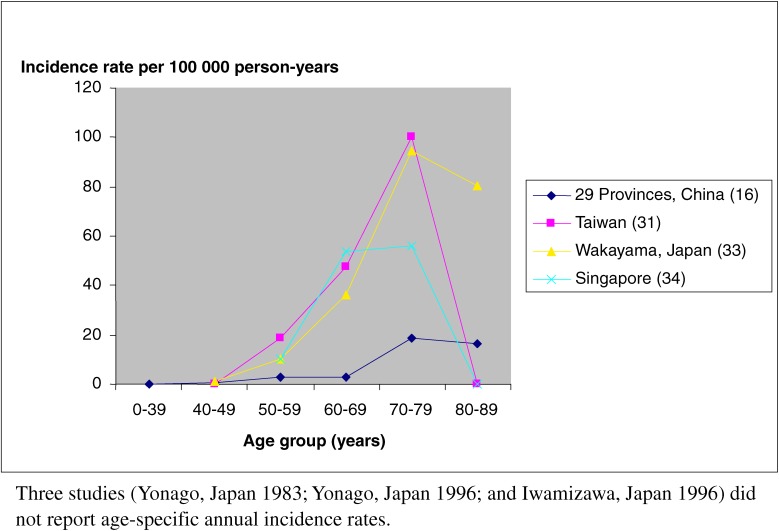
BACKGROUND: Parkinson's disease (PD) is a common neurodegenerative disorder in older people, and half of the world's older population lives in Asia. However, the epidemiology of PD in Asian countries is poorly understood. This review assembles evidence on the prevalence and incidence of PD in Asian countries and identifies gaps in our present knowledge. METHODS: A systematic search of studies published from 1965 to October 2008 was conducted using MEDLINE and EMBASE. The selection criteria were defined a priori. Prevalence and incidence were standardized to the WHO World Standard Population 2000. Twenty-one original studies were selected for the review. Two studies that described the ethnic origin of participants and contained Asian populations were also included in the analysis. RESULTS: Excluding one study with questionably low prevalence and incidence, the remaining studies reported a standardized all-age prevalence of 51.3 to 176.9 per 100,000 in door-to-door surveys; prevalence in record-based studies ranged from 35.8 to 68.3 per 100,000. The standardized incidence rates were 8.7 per 100,000 person-years in door-to-door surveys and 6.7 to 8.3 per 100,000 person-years in record-based surveys. CONCLUSIONS: The prevalence of PD in Asian countries was slightly lower than that in Western countries. However, comparison of incidence was difficult because of the small number of studies. Varying methodologies, diagnostic criteria, and case-finding strategies contributed to the considerable variation in the reported prevalence and incidence of PD.
Overview
The claims and statistics of this paper haven’t been checked yet.
Free: it reads the open-access text and checks the first 5 claims that cite a source we can check. Create a free account to check every claim.
Integrity signals
Registry
Cites
Statistics
Figures
Verification
Claims the paper makes
The claims and statistics of this paper haven’t been checked yet.
Free: it reads the open-access text and checks the first 5 claims that cite a source we can check. Create a free account to check every claim.
Claims other papers make about this one
Each is checked against this paper’s own text: does it say what the citing paper says it does?
In the citing paper
“Our 2015 prevalence estimates are within the ranges reported for Parkinson's disease (51–177 per 100 000 people),40 motor neuron disease (1·9–3·9 per 100 000 people),41, 42 tension-type headache (21–27%),43, 44 medication overuse headache (0·5%–7·2%),45 and migraine (mean estimate 10%, range 1–25),46”
From Global, regional, and national burden of neurological disorders during 1990–2015: a systematic analysis for the Global Burden of Disease Study 2015 (2017) · cites this paper as [40]
Self-check
Percentages, sums and reported differences re-computed from the paper’s own numbers.
The self-check needs the paper’s full text.
Citations
Cites
Incidence of Parkinson's Disease: Variation by Age, Gender, and Race/Ethnicity
Van Den Eeden, S. K. (2003) · American Journal of Epidemiology · doi:10.1093/aje/kwg068 · Cited by 1,747
Core assessment program for surgical interventional therapies in Parkinson's disease (CAPSIT-PD)
Defer, G.-L., Widner, H., Mari�, R.-M., R�my, P., Levivier, M., & Conference Participants: Conference Participants: G. L. Defer, M. (. (1999) · Movement Disorders · doi:10.1002/1531-8257(199907)14:4<572::aid-mds1005>3.0.co;2-c · Cited by 865
MacDonald, B. K. (2000) · Brain · doi:10.1093/brain/123.4.665 · Cited by 858
de Rijk, M. C., Tzourio, C., Breteler, M. M., Dartigues, J. F., Amaducci, L., Lopez-Pousa, S., Manubens-Bertran, J. M., Alperovitch, A., & Rocca, W. A. (1997) · Journal of Neurology, Neurosurgery & Psychiatry · doi:10.1136/jnnp.62.1.10 · Cited by 833
The cognitive ability of an incident cohort of Parkinson’s patients in the UK. The CamPaIGN study
Foltynie, T., Brayne, C. E. G., Robbins, T. W., & Barker, R. A. (2004) · Brain · doi:10.1093/brain/awh067 · Cited by 688
Self-citationSystematic review of incidence studies of Parkinson's disease
Twelves, D., Perkins, K. S. M., & Counsell, C. (2003) · Movement Disorders · doi:10.1002/mds.10305 · Cited by 622 · cited 1×
“The general inclusion criteria were: (1) publication in English, (2) study population larger than 3000 participants for population-based survey studies, unless they were the only study of a country (for registry-based studies, a denominator more than 20 000 participants was required to ensure that the number of cases…”
ResultParkinson’s disease and parkinsonism in a longitudinal study: Two-fold higher incidence in men
Baldereschi, M., Di Carlo, A., Rocca, W. A., Vanni, P., Maggi, S., Perissinotto, E., Grigoletto, F., Amaducci, L., & Inzitari, D. (2000) · Neurology · doi:10.1212/wnl.55.9.1358 · Cited by 526
Incidence and distribution of parkinsonism in Olmsted County, Minnesota, 1976–1990
Bower, J. H., Maraganore, D. M., McDonnell, S. K., & Rocca, W. A. (1999) · Neurology · doi:10.1212/wnl.52.6.1214 · Cited by 511
Prevalence of Parkinson's disease in the elderly: The Rotterdam Study
de Rijk, M. C., Breteler, M. M. B., Graveland, G. A., Ott, A., Grobbee, D. E., van der Meche, F. G. A., & Hofman, A. (1995) · Neurology · doi:10.1212/wnl.45.12.2143 · Cited by 488
Parkinson's disease in China: prevalence in Beijing, Xian, and Shanghai
Zhang, Z., Román, G. C., Hong, Z., Wu, C.-B., Qu, Q.-M., Huang, J.-B., Zhou, B., Geng, Z.-P., Wu, J.-X., Wen, H.-B., et al. (2005) · The Lancet · doi:10.1016/s0140-6736(05)17909-4 · Cited by 398
Cited by
Items 101–184 of 184
Current treatments in Parkinson's including the proposal of an innovative dopamine microimplant
Velázquez-Paniagua, M., Vázquez-Álvarez, A. M., Valverde-Aguilar, G., & Aragón, P. V. (2015) · Revista Médica Del Hospital General De México · doi:10.1016/j.hgmx.2015.10.006 · Cited by 8
Doi, Y., Yokoyama, T., Nakamura, Y., Nagai, M., Fujimoto, K., & Nakano, I. (2011) · Journal of Epidemiology · doi:10.2188/jea.je20100149 · Cited by 7
Movement Disorders and Deep Brain Stimulation in the Middle East
Siddiqui, J., Bhatti, D., Alsubaie, F., & Bajwa, J. A. (2018) · World Neurosurgery · doi:10.1016/j.wneu.2018.02.023 · Cited by 6
Saccadic Eye Movements in Young-Onset Parkinson’s Disease - A BOLD fMRI Study
Srivastava, A., Sharma, R., Goyal, V., Chaudhary, S., Sood, S. K., & Kumaran, S. S. (2019) · Neuro-Ophthalmology · doi:10.1080/01658107.2019.1652656 · Cited by 6
Logroscino, G., Capozzo, R., Tortelli, R., & Marin, B. (2016) · Monographs in clinical neuroscience/Frontiers of neurology and neuroscience/Monographs in neural sciences · doi:10.1159/000445410 · Cited by 5
Does dopamine deficiency affect sex-dependent prognosis in Parkinson's disease?
Jeong, S. H., Lee, H. S., Lee, P. H., Sohn, Y. H., & Chung, S. J. (2022) · Parkinsonism & Related Disorders · doi:10.1016/j.parkreldis.2022.07.012 · Cited by 6
Sharma, K., Shanbhog, M., & Singh, K. (2025) · Asian Journal of Psychiatry · doi:10.1016/j.ajp.2025.104537 · Cited by 5
Gandhi, S. E., Grosset, K. A., Iruthayaraj, P. A., Gravesande, R., Lee, L., Doyle, C., Ben‐Shlomo, Y., & Grosset, D. G. (2025) · Movement Disorders Clinical Practice · doi:10.1002/mdc3.70368 · Cited by 9
“33 Taken together, the observations on PD risk related to ethnicity suggest varying effects in different populations, which requires further research exploring genetics, environmental factors and differential access to healthcare for individuals of non-European origin.”
Mehrotra, B., Rai, N., Rajani, M. R., Budhakar, A., Aggarwal, R., Agarbattiwala, R., Thomas, M., Patole, S., & Doshi, P. K. (2024) · JMIR Research Protocols · doi:10.2196/59018 · Cited by 10
Hong, J. K., Kim, J., Kim, K.-W., Han, J. W., Ahn, S., & Yoon, I. (2022) · SLEEP · doi:10.1093/sleep/zsac071 · Cited by 5
Understanding Parkinson’s Disease (PD) in Ayurvedic Prospective
Menon, N. M., Adiga, M., & Pady, A. E. (2021) · International Journal of Ayurveda and Pharma Research · doi:10.47070/ijapr.v9i6.1944 · Cited by 4
“7 per 100 000 persons per year.[5] The cardinal features of the disease includes rest tremor, rigidity, bradykinesia (slowing), and gait impairment.”
BackgroundRosales, R. L., Rosales, M. C. E., Robles, D. J. S. J., Rodriguez, R. C. N. T., Romana, N. B. S., Rosales, J. M. B., Salazar, G. B., & Santiano, R. A. S. (2022) · Clinical Parkinsonism & Related Disorders · doi:10.1016/j.prdoa.2022.100169 · Cited by 4
“Although half of the world’s aging population is in Asia, the prevalence of PD is still lower compared to Western countries [4,7].”
ResultIntranasal Drug Delivery: A Non-Invasive Method for improving Neurotherapeutic Delivery
Khope, R. G., Gotmare, S. C., Dhoble, N. N., Padole, N. N., Dhapke, P. R., & Baheti, J. (2024) · Asian Journal of Pharmaceutical Research · doi:10.52711/2231-5691.2024.00008 · Cited by 4
Reconstruction of a Caregiver Burden Scale: Identifying Culturally Sensitive Items in Saudi Arabia
Hamad, E. O., AlHadi, A. N., Tremblay, P. F., Savundranayagam, M. Y., Kinsella, E. A., Holmes, J. D., Lee, C., & Johnson, A. M. (2018) · Canadian Journal on Aging / La Revue canadienne du vieillissement · doi:10.1017/s071498081800003x · Cited by 5
Estimation of Parkinson's Disease Prevalence and Its Geographical Variation in Iran
Hosseinzadeh, A., Baneshi, M. R., Sedighi, B., Kermanchi, J., & Haghdoost, A. A. (2021) · DOAJ (DOAJ: Directory of Open Access Journals) · Cited by 4
Salari, M., Mirmosayyeb, O., Etemadifar, M., Shaygannejad, V., Khorvash, F., Najafi, M. R., Ashtari, F., & Chitsaz, A. (2018) · PubMed Central · Cited by 6
Epidemiology of Parkinson's disease
Bartoníková, T., Menšíková, K., Janout, V., & Kaňovský, P. (2020) · Neurologie pro praxi · doi:10.36290/neu.2020.016 · Cited by 4
Paudel, P., & Sah, A. (2025) · Clinical Parkinsonism & Related Disorders · doi:10.1016/j.prdoa.2025.100374 · Cited by 5
“However, little is known about the epidemiology of Parkinson ’ s disease in Asian nations [15].”
Kim, B., Kim, H., Lee, Y., Lee, Y. J., Jung, I. C., Kim, J. Y., & Ha, I. (2025) · Healthcare · doi:10.3390/healthcare13101207 · Cited by 3
“This result is consistent with the findings of a previous study [18], in which the incidence of PD per 100,000 population in Asia was highest among those aged 70–79 years.”
InfluentialShukla, J., Vatsa, R., Mittal, B., Sood, A., Joshi, R. K., Palarwal, K., Bhusari, P., & Modi, M. (2017) · Indian Journal of Nuclear Medicine · doi:10.4103/ijnm.ijnm_111_17 · Cited by 3
“Tc‐99 m TRODAT‐1, ([2‐[[2‐[[[3‐(4‐chlorophenyl)‐8‐methyl‐8‐azabicyclo[3,2,1] oct‐2‐l] methyl](2 mercaptoethyl) amino] ethyl] amino] ethanethiolato (3)‐N2,N2’,S2,S2’]oxo‐[1R‐(exo‐exo)]‐), is the first Tc‐99 m‐labeled tracer of DATs and was developed by Kung et al.”
BackgroundAchbani, A., Wahmane, S. A., Elatiqi, M., Sine, H., Kharbach, A., Belmouden, A., & Nejmeddine, M. (2020) · Archives of Neuroscience · doi:10.5812/ans.106239 · Cited by 3
“Its prevalence is estimated to be about 66-1500 cases per 100 000 population (2), 111 - 329 cases per 100 000 population (3), and 31 470 cases per 100 000 population, respectively (4), respectively; as compared to African, Asian, and Arabic countries, where the prevalence of Parkinson is in the range of 10 - 43 cases…”
BackgroundJung, S., Kim, K., Wang, S., Han, M., & Lee, D. (2024) · Computational and Structural Biotechnology Journal · doi:10.1016/j.csbj.2024.10.035 · Cited by 3
LaDonna, K. A., & Ravenek, M. J. (2014) · The Qualitative Report · doi:10.46743/2160-3715/2014.1241 · Cited by 3
Parkinson's disease in North Karnataka An epidemiological perspective
Kulkarni, S. S., Kulkarni, B. B., Kulkarni, S. S., Nadgir, D., & Gai, P. B. (2012) · Cited by 3
Patofisiologi Penurunan Kognitif pada Penyakit Parkinson
Suharti, S. (2020) · UMI Medical Journal · doi:10.33096/umj.v5i1.76 · Cited by 12
Baik, J. S., Sung, Y. H., Wu, R., Lu, C., & Bhidayasiri, R. (2025) · Therapeutic Advances in Neurological Disorders · doi:10.1177/17562864251329099 · Cited by 2
“80 In addition to being the strongest risk factor of PD, age also impacts disease severity, creating challenges for management.”
The Hidden Burden of Parkinson's Disease in Cambodia: A Call to Action
Sorn, V. (2026) · Public Health Challenges · doi:10.1002/puh2.70343 · Cited by 2
Smoking, Exhaled Carbon Monoxide, and Risk of Parkinson Disease
López, C. B., Iona, A., Turnbull, I. J., Du, H., Chen, Y., Yang, L., Tinworth, A. C., Shen, Z., Kolhe, K., Pei, P., et al. (2026) · JAMA Neurology · doi:10.1001/jamaneurol.2026.3037 · Cited by 2
Biochemical Changes and Cardiovascular Function in Parkinson ’s Disease: Precautionary Notes
Cacabelos, R. (2016) · Clinical & Medical Biochemistry Open Access · doi:10.4172/2471-2663.1000e102 · Cited by 2
“5 per 100,000 to 346 per 100,000 in different countries [1-3], PD represents today a major age-related problem of health [4,5].”
BackgroundChallenges of Parkinson’s Disease Care in Southeast Asia
Bhidayasiri, R., Virameteekul, S., Sukoandari, B., Tran, T. N., & Lim, T. T. (2022) · Springer eBooks · doi:10.1007/978-3-030-62059-2_442 · Cited by 2
Factores asociados a la enfermedad de Parkinson en pacientes de la Comarca Lagunera, México
Ventura-Chávez, R., Reyna-Gil, A. I., & García, S. (2019) · Revista de Fomento Social · doi:10.24875/rmn.m19000067 · Cited by 2
The Parkinson's Disease and Movement Disorders Program at King Fahad Medical City
AlSwaiti, F. Y., Mayo, R., & Bajwa, J. A. (2015) · Perspectives on Global Issues in Communication Sciences and Related Disorders · doi:10.1044/gics5.1.33 · Cited by 2
Security, Privacy, and Applications in Mobile Healthcare
Hsu, C.-L., Inomata, A., Rahman, S. M. M., Xhafa, F., & Yang, L. T. (2015) · International Journal of Distributed Sensor Networks · doi:10.1155/2015/675129 · Cited by 3
Risk factors associated with Parkinson’s disease: An 11-year population-based South Korean studyPreprint
Kim, H. S., Lee, H.-J., Cha, J., Kwon, J., & Lim, H. (2018) · bioRxiv (Cold Spring Harbor Laboratory) · doi:10.1101/253690 · Cited by 2
“4 Parkinsonism is one of the most common neurodegenerative diseases, affecting > 1% of the 60 elderly population.(1) With the marked increase in the mean age of the global population, the 61 prevalence and incidence of Parkinsonism have also increased.”
BackgroundActive and Passive Methods of Detecting Parkinson's Disease
Wen, C., Yen, A. M., Chiu, S. Y., Chen, S. L., Fann, J. C., Hwang, Y., Chen, T., Wen, Y., Liou, H., & Chen, H. (2015) · Journal of the American Geriatrics Society · doi:10.1111/jgs.13464 · Cited by 1
Afaar, F., Youssef, P., Galper, J., Chua, M., Halliday, G. M., Lewis, S. J. G., & Dzamko, N. L. (2025) · Movement Disorders · doi:10.1002/mds.30233 · Cited by 2
“3,4 Tracking the clinical trajectory of PD has remained dif fi cult because of an incomplete understanding of the underlying pathological mechanisms and a lack of objective biomarkers to inform diagnosis and prognosis.”
Nzeako, T. R., Adeniran, O., Kahn, S., & Wimmer, N. J. (2025) · Journal of Cardiovascular Development and Disease · doi:10.3390/jcdd12070252 · Cited by 2
“It is characterized by the loss of dopaminergic neurons in the substantia nigra nuclei in the midbrain, resulting in movement abnormalities and other non-motor dysfunction [3,4].”
Parkinson’s disease care in Pakistan: overcoming challenges in low- and middle-income countries
Hameed, S., & Figari‐Jordan, R. (2026) · BMJ Neurology Open · doi:10.1136/bmjno-2025-001516 · Cited by 1
Complex liaisons moving forward the Parkinson’s disease? An appraisal
Rubino, G. (2015) · Basal Ganglia · doi:10.1016/j.baga.2015.09.001 · Cited by 1
Epidemiology of Parkinson's disease
Tan, L. C. S. (2013) · Cited by 1
Parkinson’s Disease in Kazakhstan: Clinico-Demographic Description of a Large Cohort
Kaiyrzhanov, R. B., Zharkinbekova, N., Shashkin, C., Т.Н., Х., Kaishibayeva, G., Akhmetzhanov, V., Sadykova, D., Seidinova, Z., Taskinbayeva, A., Karimova, A., et al. (2020) · Journal of Parkinson s Disease · doi:10.3233/jpd-191782 · Cited by 1
Chrysostome, V., & Tison, F. (2015) · Elsevier eBooks · doi:10.1016/b978-2-294-74232-3.00001-5 · Cited by 2
Sex Differences in the Allele Distribution of PGLYRP2 Variant rs892145 in Parkinson’s Disease
Ran, C., Wirdefeldt, K., Sydow, O., Svenningsson, P., & Heijtz, R. D. (2023) · Parkinson s Disease · doi:10.1155/2023/6502727 · Cited by 3
“In the Chinese cohort used for our meta-analysis, authors reported a ratio of 1.2 :1; similarly, the sex distribution has been reported to be less pronounced in Asian PD populations as compared to European populations [16, 22].”
InfluentialNapoli, A. D., Scalmana, S., Franco, F., Lallo, D. D., Lacorte, E., & Vanacore, N. (2015) · Journal of Neural Transmission · doi:10.1007/s00702-015-1497-y · Cited by 1
“…disease, with a very low frequency in subjects\50 that increases with age up to 4 % in older subjects (de Lau and Breteler 2006; Pringsheim et al. 2014; Muangpaisan et al. 2009; Wirdefeldt et al. 2011; Morgante et al. 1992; Benito-Leon et al. 2003; de Rijk et al. 1995; Aarsland et al. 2005).”
BackgroundMethodResultInfluentialKlein, A. (2016) · Research Ideas and Outcomes · doi:10.3897/rio.2.e8834 · Cited by 1
Idris, M. I., & Tan, C. T. (2017) · Elsevier eBooks · doi:10.1016/b978-0-12-804607-4.00007-1 · Cited by 1
Chrysostome, V., & Tison, F. (2011) · Elsevier eBooks · doi:10.1016/b978-2-294-71153-4.00001-9 · Cited by 3
Fereshtehnejad, S. (2015) · Figshare · Cited by 1
Lim, E. C. H., Bhidayasiri, R., Rosales, R. L., & Kaji, R. (2011) · Parkinsonism & Related Disorders · doi:10.1016/j.parkreldis.2011.06.012 · Cited by 1
"A GREAT PERTURBATION IN NATURE" : PARKINSON'S DISEASE AND SLEEP DISORDERS
Ylikoski, A. (2016) · Helda - University of Helsinki Institutional Repository · Cited by 2
Message From the Editor-in-Chief
Iso, H. (2013) · Journal of Epidemiology · doi:10.2188/jea.je20120218
Shahidi, G. A., Ghaempanah, Z., Khalili, Y., & Nojomi, M. (2014) · Europe PMC (PubMed Central)
Rodríguez, F. M., Sánchez, R. Y., Carrasco-Vargas, H., Samano-Osuna, A., & Jiménez-Ponce, F. (2014) · Revista Médica Del Hospital General De México · doi:10.1016/j.hgmx.2014.11.001
Priorities in Movement Disorders Research
Macas, M. (2015) · Journal of Neurology Neurological Science and Disorders · doi:10.17352/jnnsd.000001
“Muangpaisan et al. 2009, conducted a systematic search of studies published from 1965 to October 2008.”
BackgroundTeixeira, M. D. A. (2011) · Americanae (AECID Library) · Cited by 1
Liu, Y., Fan, J., Chen, W., Nie, Z., Qiao, Y., & Zhang, L. (2013) · Chinese Medical Journal · doi:10.3760/cma.j.issn.0366-6999.20121771
Paula, A., & Menezes, F. (2012) · Americanae (AECID Library)
Studying the Prevalence and Genetic Contributions to Parkinsonism in Pakistan
Khan, S. (2016) · Griffith Research Online · doi:10.25904/1912/2713
Kim, H. S., Kwon, J.-B., Lim, H., Cha, J., & Kim, H. W. (2018) · bioRxiv (Cold Spring Harbor Laboratory) · doi:10.1101/253682
Zahra, S., & Soetikno, V. (2018) · Journal of Physics Conference Series · doi:10.1088/1742-6596/1073/3/032036
Health Economics for Neuropsychological Diseases in China
Cui, H., & Wang, G. (2019) · Springer eBooks · doi:10.1007/978-3-319-56015-1_17-1
Procedimentos ablativos na doença de Parkinson: uma ferramenta esquecida?
Pessôa, B. L., Leite, M. A. A., Orsini, M. A., Moreno, A. M., & Azizi, M. A. A. (2019) · Revista Neurociências · doi:10.34024/rnc.2019.v27.10178
Interrelationship between Gut microbiota and Parkinson’s disease
Shivananjappa, M. M., Manasa, R., Prakruthi, M., & Shekhara Naik, R. (2020) · IP Journal of Nutrition Metabolism and Health Science · doi:10.18231/j.ijnmhs.2020.015
Electrophysiological Substrates of Cognition in the Basal Ganglia and Basal Forebrain
Al‐Ozzi, T. M. (2020) · TSpace (University of Toronto)
Muangpaisan, W. (2012) · Journal of Neurosciences in Rural Practice · doi:10.1055/s-0039-1696757
Self-citationParkinson’s Disease, Neuroticism, and Extroversion
Dubayová, T. (2022) · Springer eBooks · doi:10.1007/978-3-319-69909-7_3869-2
Health Economics for Neuropsychological Diseases in China
Cui, H., & Wang, G. (2022) · Springer eBooks · doi:10.1007/978-3-030-62059-2_17
Parkinson’s Disease, Neuroticism, and Extroversion
Dubayová, T. (2023) · Springer eBooks · doi:10.1007/978-3-031-17299-1_3869
QR based e-commerce 24*7 delivery using automatic dispenser machine
Saravanan, K., Shankar, S. K., Sangameshwaran, N., & Jayasurya, G. N. (2024) · AIP conference proceedings · doi:10.1063/5.0212965
Self-stabilizing toothbrush for patients with Parkinson’s disease
Palanivel, S., Sudharshan, R., Rajulu, G. P. V., & Aravind, S. (2024) · AIP conference proceedings · doi:10.1063/5.0216499
Mohammad, I., Rashid, S., Sanie, B., Ashraf, S., & Raina, A. (2024) · Annals of Movement Disorders · doi:10.4103/aomd.aomd_27_24
Paudel, P., & Sah, A. (2025) · SSRN Electronic Journal · doi:10.2139/ssrn.5110031
Gandhi, S. E., Grosset, K. A., Iruthayaraj, P. A., Gravesande, R., Lee, L., Doyle, C., Ben‐Shlomo, Y., & Grosset, D. G. (2025) · SSRN Electronic Journal · doi:10.2139/ssrn.5237817
Can simple home-based exercises reduce the fear of falling in Parkinsonian disorders?
Neupane, R., & Kukkle, P. L. (2025) · Annals of Movement Disorders · doi:10.4103/aomd.aomd_122_24
Physical Therapist Management of Parkinson’s Disease
Olaogun, M. O., Balogun, J. A., Akande, M. A., & Ogundele, A. O. (2026) · Springer eBooks · doi:10.1007/978-3-031-86558-9_19
Rôle du noyau sous-thalamique et du noyau pédonculopontin dans la marche et l'équilibre chez l'homme
Demain, A. (2014) · theses.fr (ABES) · doi:10.70675/fab9c70az230dz4ae1za14azae726e0996a1
de Germay, S. (2020) · theses.fr (ABES) · doi:10.70675/3093347az1498z4a7bza97dzdb2c80322cea · Cited by 1
Katsumi, S., Arima, H., Yamada, K., Yagi, M., Mizukoshi, R., Yokosuka, K., Katayanagi, J., Tagami, A., Hori, Y., Matsuyama, Y., et al. (2026) · Spine Surgery and Related Research · doi:10.22603/ssrr.2026-0016
Chen, Y., Chen, C., Juan, C.-H., Cheng, M., Wu, H., Lee, C., Lo, Y., Wang, Y.-R., & Chang, K. (2026) · BMC Neurology · doi:10.1186/s12883-026-05056-4
“Cultural, genetic, or regional factors significantly influence symptom perception and reporting in Asian cohorts [12], highlighting the critical need for region-specific characterization to ensure accurate diagnosis and optimize clinical management.”
Ayurvedic Management of Kampavata with Clinical Correlation to Parkinson’s Disease - A Case Report
Mishra, S., Sapna, & Singh, V. B. (2026) · Journal of Ayurveda and Integrated Medical Sciences · doi:10.21760/jaims.11.5.79
Adak, R., Kumar, P., Yadav, S. S., Chaudhary, S., & Datusalia, A. K. (2026) · Advances in pharmacology · doi:10.1016/bs.apha.2026.07.006
Islam, M. R., Sahabuddin, M., Sheba, N. H., & Hossain, Z. Z. (2026) · Heliyon · doi:10.1016/j.heliyon.2026.e45499
Remote monitoring of symptoms using a smart device in Parkinson's disease: a randomized pilot trial
Oyama, G., Ishida, Y., Tsuboi, Y., Fujioka, S., Tsunemi, T., Hatano, T., Nishikawa, N., Sako, W., Ueno, S., Oji, Y., et al. (2026) · Parkinsonism & Related Disorders · doi:10.1016/j.parkreldis.2026.109028
Metadata
- Authors
- Muangpaisan, W., Hori, H., & Brayne, C.
- Affiliations
- Siriraj Hospital (TH)
- University of Cambridge (GB)
- Venue
- Journal of Epidemiology
- Publisher
- Japan Epidemiological Association
- Published
- 2009
- Volume
- 19
- Issue
- 6
- Pages
- 281-293
- ISSN
- 0917-5040 (ISSN-L)
- 1349-9092
- PMC
- PMC3924097
- OpenAlex
- W2073799274
- Cited by
- 185
- References
- 69
- Citations by year
- 2026: 10 · 2025: 11 · 2024: 10 · 2023: 6 · 2022: 11 · 2021: 14 · 2020: 12 · 2019: 17 · 2018: 10 · 2017: 10 · 2016: 10 · 2015: 20 · 2014: 8 · 2013: 9 · 2012: 9
- FWCI
- 0.97
- Type
- journal article
- Language
- en
- Open access
- gold
- doi.org
- Licence
- cc-by
- Locations
- Journal of Epidemiology (publishedVersion, cc-by)
- Europe PMC (PubMed Central) (publishedVersion, cc-by)
- PubMed Central (publishedVersion, cc-by)
- PubMed (publishedVersion)
- Topics
- Health Sciences › Medicine › Clinical Neurology › Parkinson's Disease Mechanisms and Treatments
- Health Sciences › Medicine › Psychiatry and Mental health › Dementia and Cognitive Impairment Research
- Health Sciences › Medicine › Clinical Neurology › Deep Brain Stimulation and Movement Disorders
- Keywords
- Parkinson's disease, prevalence, incidence, Asia, door-to-door survey, diagnostic criteria
- MeSH terms
- Asia, Health Surveys, Humans, Parkinson Disease, Bias, Incidence, Prevalence, Age Distribution
About these checks
Registry, retraction, Cites and statistics results are computed, not judged, with one exception: a printed reference that no index lists is read once by a model before it counts as a citation error. Claims are extracted by a model and kept only when their quote appears verbatim in the text; each cited source is then checked, with a model’s help, for whether it says what the claim relies on. Those verdicts can be wrong — read the claim’s quote and the cited source before relying on one.
Statistics and arithmetic are recomputed, not judged.
Confidence bands are shown only for fields calibrated on our annotated test set. None is calibrated yet, so no band is shown.
What counts as a claim ›How we measure confidence ›How we check this ›
Are you an author, or do you see a problem with this page? Request a review
Data sources
Bibliographic data: Semantic Scholar, OpenAlex, Crossref.
Contains information from the Semantic Scholar Academic Graph Datasets, made available under the ODC Attribution License (ODC-BY 1.0).
Semantic Scholar’s data is described in: Kinney, R., et al. (2023). The Semantic Scholar Open Data Platform. arXiv:2301.10140.
