

Theories Predicting End-User Acceptance of Telemedicine Use: Systematic Review
Open accessPublished version of a preprint
The DOI matches its Crossref record; 82 of the 82 references it cites were found in a registry or an index.
Abstract
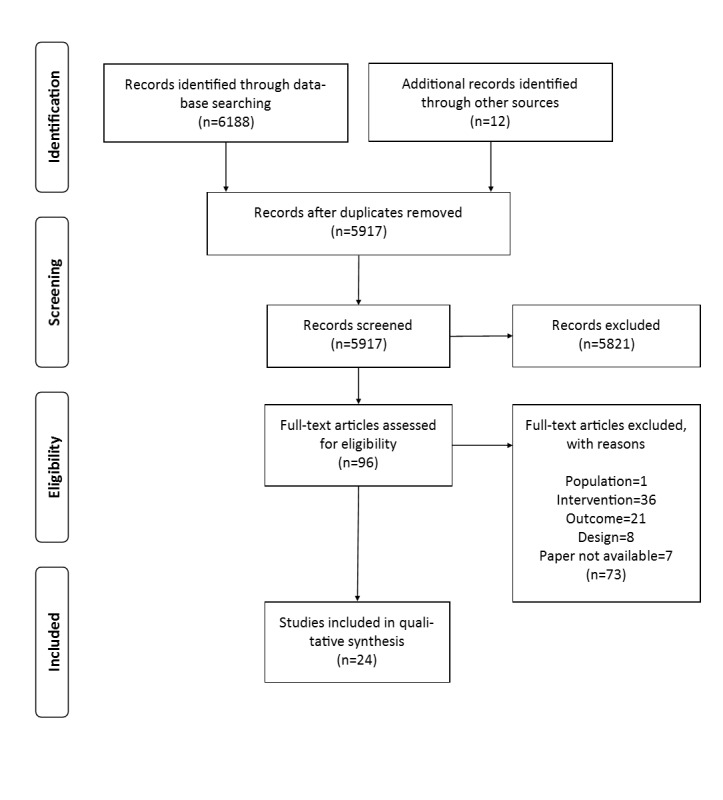
BACKGROUND: Only a few telemedicine applications have made their way into regular care. One reason is the lack of acceptance of telemedicine by potential end users. OBJECTIVE: The aim of this systematic review was to identify theoretical predictors that influence the acceptance of telemedicine. METHODS: An electronic search was conducted in PubMed and PsycINFO in June 2018 and supplemented by a hand search. Articles were identified using predefined inclusion and exclusion criteria. In total, two reviewers independently assessed the title, abstract, and full-text screening and then individually performed a quality assessment of all included studies. RESULTS: Out of 5917 potentially relevant titles (duplicates excluded), 24 studies were included. The Axis Tool for quality assessment of cross-sectional studies revealed a high risk of bias for all studies except for one study. The most commonly used models were the Technology Acceptance Model (n=11) and the Unified Theory of Acceptance and Use of Technology (n=9). The main significant predictors of acceptance were perceived usefulness (n=11), social influences (n=6), and attitude (n=6). The results show a superiority of technology acceptance versus original behavioral models. CONCLUSIONS: The main finding of this review is the applicability of technology acceptance models and theories on telemedicine adoption. Characteristics of the technology, such as its usefulness, as well as attributes of the individual, such as his or her need for social support, inform end-user acceptance. Therefore, in the future, requirements of the target group and the group's social environment should already be taken into account when planning telemedicine applications. The results support the importance of theory-guided user-centered design approaches to telemedicine development.
Overview
The claims and statistics of this paper haven’t been checked yet.
Free: it reads the open-access text and checks the first 5 claims that cite a source we can check. Create a free account to check every claim.
Integrity signals
Registry
Cites
Statistics
Figures
Verification
Claims the paper makes
The claims and statistics of this paper haven’t been checked yet.
Free: it reads the open-access text and checks the first 5 claims that cite a source we can check. Create a free account to check every claim.
Claims other papers make about this one
Each is checked against this paper’s own text: does it say what the citing paper says it does?
The source backs part of the claim, not all of it — or backs it for a different population, condition or comparison.
In the citing paper
“Compared with other traditional behavioral theories (eg, Theory of Planned Behavior, Health Belief Model), the UTAUT seems to have stronger explanatory power for understanding people’s intentions to use telehealth [11].”
From Applying the Unified Theory of Acceptance and Use of Technology to Identify Factors Associated With Intention to Use Teledelivered Supportive Care Among Recently Diagnosed Breast Cancer Survivors During COVID-19 in Hong Kong: Cross-Sectional Survey (2024) · cites this paper as [11]
Experimental — accuracy not yet measuredThe source backs part of the claim, not all of it — or backs it for a different population, condition or comparison.
In the citing paper
“Acceptance, describing attitudes toward and perception of a service or product and their relation to its adaptation (Venkatesh et al., 2003), has been shown to influence actual uptake of new digital interventions, both in industry (Venkatesh et al., 2003) and in (mental) health care (Harst et al., 2019; Philippi et al., 2021; Sora et al., 2021) settings.”
From How to promote usage of telehealth interventions for farmers' mental health? A qualitative study on supporting and hindering aspects for acceptance and satisfaction with a personalized telephone coaching for depression prevention (2023) · cites this paper as Harst et al., 2019
Experimental — accuracy not yet measured
Self-check
Percentages, sums and reported differences re-computed from the paper’s own numbers.
The self-check needs the paper’s full text.
Citations
Cites
Preferred Reporting Items for Systematic Reviews and Meta-Analyses: the PRISMA statement
Moher, D., Liberati, A., Tetzlaff, J., Altman, D. G., & for the PRISMA Group (2009) · BMJ · doi:10.1136/bmj.b2535 · Cited by 83,823
Perceived usefulness, perceived ease of use, and user acceptance of information technology
Davis, F. D. (1989) · MIS Quarterly · doi:10.2307/249008 · Cited by 68,483 · cited 3×
“Although in the TAM, acceptance is defined as “actual system use” [26], in the UTAUT, it is defined as “use behavior” [28].”
BackgroundMethodUser Acceptance of Information Technology: Toward A Unified View1
Venkatesh, V., Morris, M. G., Davis, G. B., & Davis, F. D. (2003) · MIS Quarterly · doi:10.2307/30036540 · Cited by 45,035 · cited 6×
“Although in the TAM, acceptance is defined as “actual system use” [26], in the UTAUT, it is defined as “use behavior” [28].”
BackgroundMethodInfluentialPreferred reporting items for systematic reviews and meta-analyses: the PRISMA Statement.
(2009) · PubMed Central · Cited by 44,859
(1975) · PhilPapers (PhilPapers Foundation) · Cited by 36,737
A Theoretical Extension of the Technology Acceptance Model: Four Longitudinal Field Studies
Venkatesh, V., & Davis, F. D. (2000) · Management Science · doi:10.1287/mnsc.46.2.186.11926 · Cited by 23,066 · cited 5×
“Contradictory to that, the TAM still has the highest amount of variance explained among all the models included in this review: A median R² of 0.68 is achieved by the TAM, compared with an R² of 0.59 for the UTAUT.”
MethodInfluential(1985) · Medical Entomology and Zoology · Cited by 19,180
From Intentions to Actions: A Theory of Planned Behavior
Ajzen, I. (1985) · Action Control · doi:10.1007/978-3-642-69746-3_2 · Cited by 19,057 · cited 8×
“Effect strength and significanceaComponents of the model or theory with significant explanatory power Theoretical model or theoryAuthor (year); Journal Health care provider Original Technology Acceptance Model: PU: ORg 5.28h (95% CI 3.14 to 10.01); PEOU: OR 1.93i (95% CI 1.11 PUe (TAM); PEOUf (TAM); Extended TAM: Comp…”
BackgroundInfluentialHistorical Origins of the Health Belief Model
Rosenstock, I. M. (1974) · Health Education Monographs · doi:10.1177/109019817400200403 · Cited by 6,116 · cited 1×
“The oldest yet still widely used model for health behavior change is the Health Belief Model (HBM) that focuses on the individual assessment of vulnerability, outcomes and costs of behavior change, and external cues toward behavior change [20].”
MethodCochrane Handbook for Systematic Reviews of Interventions
Tarsilla, M. (2010) · Journal of MultiDisciplinary Evaluation · doi:10.56645/jmde.v6i14.284 · Cited by 5,178
Research works printed but not linked: 4
- Atlas of eHealth country profiles. The use of eHealth in support of universal health coverage 2015 Global Observatory for eHealth 2015 Geneva, Switzerland World Health Organisation (WHO)
- Global diffusion of eHealth. Making universal health coverage achievable Global Observatory for eHealth 2015 Geneva, Switzerland World Health Organisation (WHO)
- Hastall M Dockweiler C Mühlhaus J Achieving end user acceptance: Building blocks for an evidence-based user-centered framework for health technology development and assessment 2017 11th International Conference on Universal Access in Human-Computer Interaction UAHCI July 9–14, 2017 Vancouver, BC, Canada Cham, Switzerland Springer 13 25
- Field A Discovering Statistics Using IBM SPSS Statistics: North American Edition 2018 Los Angeles Sage Publications Ltd 1025
Cited by
Chao, C.-M. (2019) · Frontiers in Psychology · doi:10.3389/fpsyg.2019.01652 · Cited by 1,041
Malliaras, P., Merolli, M., Williams, C. M., Caneiro, J. P., Haines, T., & Barton, C. (2021) · Musculoskeletal Science and Practice · doi:10.1016/j.msksp.2021.102340 · Cited by 213
“The online survey was developed by members of the research team (PM, CB, MM, CW, TH), and informed by previous research related to potential barriers and enablers of telehealth adoption (Dorsey and Topol, 2016; Cottrell and Russell, 2020; Harst et al., 2019; Fernandes et al., 2020).”
Rouidi, M., Elouadi, A. E., Hamdoune, A., Choujtani, K., & Chati, A. (2022) · Informatics in Medicine Unlocked · doi:10.1016/j.imu.2022.101008 · Cited by 202
E-health for the future. Managerial perspectives using a multiple case study approach
Biancone, P., Secinaro, S. F., Marseglia, G. R., & Calandra, D. (2021) · Technovation · doi:10.1016/j.technovation.2021.102406 · Cited by 153
Online Communities as a Driver for Patient Empowerment: Systematic Review
Johansson, V., Íslind, A. S., Lindroth, T., Angenete, E., & Gellerstedt, M. (2021) · Journal of Medical Internet Research · doi:10.2196/19910 · Cited by 151
Metadata
- Authors
- Harst, L., Lantzsch, H., & Scheibe, M.
- Affiliations
- University Hospital Carl Gustav Carus (DE)
- Technische Universität Dresden (DE)
- Corresponding author
- Harst, Lorenz
- Venue
- Journal of Medical Internet Research
- Publisher
- JMIR Publications Inc.
- Published
- 2019-05-21
- Volume
- 21
- Issue
- 5
- Pages
- e13117
- ISSN
- 1438-8871 (ISSN-L)
- PMC
- PMC6547771
- OpenAlex
- W2927203543
- Cited by
- 320
- References
- 81
- Citations by year
- 2026: 30 · 2025: 42 · 2024: 40 · 2023: 54 · 2022: 52 · 2021: 58 · 2020: 31 · 2019: 12
- FWCI
- 6.25
- Type
- journal article
- Language
- en
- Open access
- gold
- doi.org
- Licence
- cc-by
- Locations
- Journal of Medical Internet Research (publishedVersion, cc-by)
- PubMed Central (publishedVersion, cc-by)
- PubMed (publishedVersion)
- Funders
- Freistaat Sachsen
- European Social Fund (100310385)
- Topics
- Health Sciences › Medicine › Public Health, Environmental and Occupational Health › Telemedicine and Telehealth Implementation
- Social Sciences › Decision Sciences › Information Systems and Management › Technology Adoption and User Behaviour
- Health Sciences › Medicine › Geriatrics and Gerontology › Technology Use by Older Adults
- Keywords
- telemedicine, end-user acceptance, technology acceptance model, UTAUT, perceived usefulness, social influence, user attitudes, technology adoption, user-centered design, social support
- MeSH terms
- Cross-Sectional Studies, Female, Humans, Male, Patient Compliance, Telemedicine
About these checks
Registry, retraction, Cites and statistics results are computed, not judged, with one exception: a printed reference that no index lists is read once by a model before it counts as a citation error. Claims are extracted by a model and kept only when their quote appears verbatim in the text; each cited source is then checked, with a model’s help, for whether it says what the claim relies on. Those verdicts can be wrong — read the claim’s quote and the cited source before relying on one.
Statistics and arithmetic are recomputed, not judged.
Confidence bands are shown only for fields calibrated on our annotated test set. None is calibrated yet, so no band is shown.
What counts as a claim ›How we measure confidence ›How we check this ›
Are you an author, or do you see a problem with this page? Request a review
How to cite
Cite CoChat for the checks on this page, and the paper for its own findings.
- This page
- CoChat. (2026). Citation check: Theories Predicting End-User Acceptance of Telemedicine Use: Systematic Review. https://app.cochat.ai/papers/10.2196/13117
- The paper
- Harst, L., Lantzsch, H., & Scheibe, M. (2019). Theories Predicting End-User Acceptance of Telemedicine Use: Systematic Review. Journal of Medical Internet Research. https://doi.org/10.2196/13117
Data sources
Bibliographic data: Semantic Scholar, OpenAlex, Crossref.
Contains information from the Semantic Scholar Academic Graph Datasets, made available under the ODC Attribution License (ODC-BY 1.0).
Semantic Scholar’s data is described in: Kinney, R., et al. (2023). The Semantic Scholar Open Data Platform. arXiv:2301.10140.
